×
Request Free Sample ×

Kindly complete the form below to receive a free sample of this Report

* Please use a valid business email

Leading companies partner with us for data-driven Insights

clients tt-cursor
Hero Background

Brazil Hydrogen Fuel Cell Vehicle Market

ID: MRFR/AT/45372-HCR
128 Pages
Sejal Akre
February 2026

Brazil Hydrogen Fuel Cell Vehicle Market Research Report By Type (Proton Exchange Membrane Fuel Cell, Solid Oxide Fuel Cell, Alkaline Fuel Cell) and By End User (Commercial Vehicle, Passenger Cars)- Forecast to 2035

Share:
Download PDF ×

We do not share your information with anyone. However, we may send you emails based on your report interest from time to time. You may contact us at any time to opt-out.

Brazil Hydrogen Fuel Cell Vehicle Market Infographic
Purchase Options

Brazil Hydrogen Fuel Cell Vehicle Market Summary

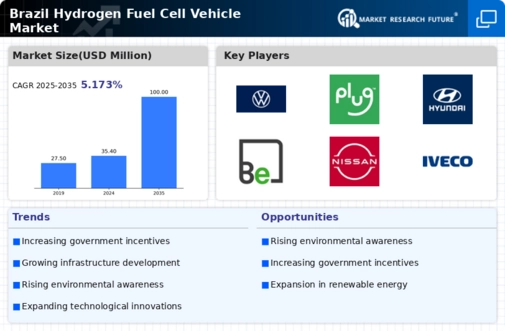
As per analysis, the Brazil Hydrogen Fuel Cell Vehicle Market is projected to grow from USD 61.4 Million in 2025 to USD 307.23 Million by 2035, exhibiting a compound annual growth rate (CAGR) of 17.66% during the forecast period (2025 - 2035).

Key Market Trends & Highlights

The Brazil Hydrogen Fuel Cell Vehicle Market is poised for substantial growth driven by government initiatives and increasing environmental awareness.

  • Public transportation emerges as the largest segment, reflecting a strong commitment to sustainable urban mobility.
  • Logistics and freight represent the fastest-growing segment, indicating a shift towards cleaner supply chain solutions.
  • Government initiatives play a pivotal role in shaping the market landscape, while private sector investments are rapidly gaining momentum.
  • Key market drivers include government support and incentives, alongside rising fuel prices that enhance the appeal of hydrogen solutions.

Market Size & Forecast

2024 Market Size 51.34 (USD Million)
2035 Market Size 307.23 (USD Million)
CAGR (2025 - 2035) 17.66%

Major Players

Toyota (BR), Hyundai (BR), Honda (BR), General Motors (BR), Mercedes-Benz (BR), BMW (BR), Volkswagen (BR), Nissan (BR), Ballard Power Systems (BR)

Our Impact
Enabled $4.3B Revenue Impact for Fortune 500 and Leading Multinationals
Partnering with 2000+ Global Organizations Each Year
30K+ Citations by Top-Tier Firms in the Industry

Brazil Hydrogen Fuel Cell Vehicle Market Trends

The Brazil Hydrogen Fuel Cell Vehicle Market is currently experiencing a notable transformation, driven by a combination of government initiatives and increasing environmental awareness among consumers. The Brazilian government has been actively promoting the adoption of hydrogen fuel cell technology as part of its broader strategy to reduce greenhouse gas emissions and transition towards sustainable energy sources. This shift is further supported by investments in infrastructure, such as hydrogen refueling stations, which are essential for the growth of this market. As a result, manufacturers are beginning to explore opportunities for producing hydrogen fuel cell vehicles tailored to the unique needs of Brazilian consumers, potentially leading to a more diverse range of offerings in the near future. In addition to government support, the Brazil Hydrogen Fuel Cell Vehicle Market is influenced by the growing interest in renewable energy sources. Brazil's abundant natural resources, particularly in hydropower, provide a favorable environment for producing green hydrogen. This renewable hydrogen production could significantly enhance the sustainability of hydrogen fuel cell vehicles, making them an attractive option for environmentally conscious consumers. Furthermore, collaborations between automotive manufacturers and energy companies are likely to foster innovation and accelerate the development of hydrogen technologies, positioning Brazil as a potential leader in this emerging market.

Government Initiatives and Policies

The Brazilian government is implementing various policies to encourage the adoption of hydrogen fuel cell vehicles. These initiatives include financial incentives for manufacturers and consumers, as well as investments in necessary infrastructure. Such measures aim to create a conducive environment for the growth of the market.

Infrastructure Development

The establishment of hydrogen refueling stations is crucial for the expansion of the Brazil Hydrogen Fuel Cell Vehicle Market. Ongoing projects to develop this infrastructure are expected to facilitate the widespread use of hydrogen vehicles, addressing one of the primary barriers to market growth.

Renewable Hydrogen Production

Brazil's potential for producing green hydrogen from renewable sources, particularly hydropower, is a key trend. This capability not only supports the sustainability of hydrogen fuel cell vehicles but also aligns with the country's commitment to reducing carbon emissions.

Brazil Hydrogen Fuel Cell Vehicle Market Drivers

Growing Environmental Awareness

Increasing environmental awareness among Brazilian consumers is driving the Brazil Hydrogen Fuel Cell Vehicle Market. As concerns about air pollution and climate change escalate, there is a growing demand for cleaner transportation alternatives. Hydrogen fuel cell vehicles, which emit only water vapor, present a viable solution to mitigate the environmental impact of traditional fossil fuel-powered vehicles. In 2025, surveys indicated that approximately 70% of Brazilian consumers expressed interest in adopting eco-friendly vehicles, with hydrogen FCVs being a prominent choice. This shift in consumer preferences is likely to encourage automakers to invest in hydrogen technology and expand their offerings in the Brazilian market, thereby accelerating the transition towards sustainable mobility.

Government Support and Incentives

The Brazil Hydrogen Fuel Cell Vehicle Market benefits from robust government support and incentives aimed at promoting clean energy technologies. The Brazilian government has established various policies to encourage the adoption of hydrogen fuel cell vehicles (FCVs), including tax exemptions and subsidies for manufacturers and consumers. In 2025, Brazil's National Hydrogen Program was launched, which outlines a strategic framework for hydrogen production and utilization, including FCVs. This initiative is expected to enhance the market's growth by fostering research and development, as well as facilitating partnerships between public and private sectors. The government's commitment to reducing greenhouse gas emissions aligns with global climate goals, further solidifying the role of hydrogen as a key player in Brazil's transition to sustainable transportation.

Rising Fuel Prices and Energy Security

Rising fuel prices and the quest for energy security are significant drivers for the Brazil Hydrogen Fuel Cell Vehicle Market. As global oil prices fluctuate, Brazilian consumers and businesses are increasingly seeking alternative energy sources to mitigate their dependence on fossil fuels. Hydrogen fuel cell vehicles offer a promising solution, as they can be powered by domestically produced hydrogen, reducing vulnerability to international market volatility. In 2025, the Brazilian government reported a 15% increase in fuel prices, prompting discussions on energy diversification strategies. This scenario is likely to accelerate the adoption of hydrogen FCVs, as consumers and fleet operators look for cost-effective and sustainable transportation options. The emphasis on energy security aligns with Brazil's broader energy transition goals, further supporting the growth of the hydrogen market.

Advancements in Hydrogen Infrastructure

The development of hydrogen infrastructure is crucial for the Brazil Hydrogen Fuel Cell Vehicle Market. In recent years, Brazil has made strides in establishing hydrogen refueling stations, which are essential for the widespread adoption of FCVs. By 2026, it is projected that Brazil will have over 50 operational hydrogen refueling stations, primarily concentrated in major urban areas. This infrastructure expansion is expected to alleviate range anxiety among potential FCV users, making hydrogen vehicles a more attractive option. Furthermore, partnerships between government entities and private companies are facilitating investments in hydrogen production and distribution networks, thereby enhancing the overall viability of hydrogen as a fuel source for transportation in Brazil.

International Collaboration and Investment

International collaboration and investment play a pivotal role in the Brazil Hydrogen Fuel Cell Vehicle Market. Brazil has been actively engaging with countries such as Germany and Japan, which are leaders in hydrogen technology. These partnerships have led to knowledge transfer, joint research initiatives, and investment in hydrogen projects. In 2025, Brazil secured funding from international organizations to support the development of hydrogen production facilities and FCV manufacturing. This influx of foreign investment is expected to bolster local capabilities and accelerate the commercialization of hydrogen technologies. As Brazil positions itself as a key player in the global hydrogen economy, these collaborations are likely to enhance the competitiveness of its hydrogen fuel cell vehicle market.


Market Segment Insights

By Application: Public Transportation (Largest) vs. Logistics and Freight (Fastest-Growing)

In the Brazil Hydrogen Fuel Cell Vehicle Market, the 'Application' segment is characterized by a diverse range of values, notably 'Public Transportation' leading with the largest share. This segment is pivotal due to rising urbanization and demand for cleaner public transport options. Meanwhile, 'Logistics and Freight' is gaining traction as industries focus on reducing carbon footprints, indicating a growing shift toward sustainable practices. As a result, these applications are becoming increasingly prominent in Brazil's transportation landscape. The growth trends within this segment are significantly influenced by government policies aimed at promoting renewable energy sources, including hydrogen. Moreover, advancements in fuel cell technology and infrastructure development are propelling the logistics subsector forward. Concurrently, the push for efficient and eco-friendly public transportation options is reshaping urban mobility, making hydrogen fuel cell vehicles an attractive choice for municipalities in Brazil.

Public Transportation: Dominant vs. Logistics and Freight: Emerging

The 'Public Transportation' segment is currently dominant within Brazil's Hydrogen Fuel Cell Vehicle Market, characterized by established infrastructure and government backing. Major urban centers are increasingly adopting hydrogen fuel cell buses as part of their public transport fleets, reflecting a commitment to sustainable mobility solutions. Conversely, the 'Logistics and Freight' segment is emerging rapidly, driven by the need for cleaner supply chain solutions. As industries seek to enhance their corporate social responsibility profiles, hydrogen solutions are becoming integral to logistics operations. This segment benefits from technological advancements that improve fuel efficiency and reduce operational costs, making it an appealing choice for freight companies aiming to transition to greener alternatives.

By End Use: Government Initiatives (Largest) vs. Private Sector Investments (Fastest-Growing)

In the Brazil Hydrogen Fuel Cell Vehicle Market, the distribution of market share across various end uses reflects the distinct approaches taken by different sectors. Government initiatives currently dominate, as they establish essential policies and frameworks to promote hydrogen fuel cell adoption. Conversely, private sector investments are witnessing rapid growth, as companies increasingly recognize the potential of hydrogen technologies in reducing emissions and enhancing vehicle performance.

Government Initiatives (Dominant) vs. Research and Development (Emerging)

Government initiatives play a crucial role in the hydrogen fuel cell vehicle sector in Brazil, emphasizing policy support, regulation, and funding that facilitate the adoption of green technologies. This dominance stems from the Brazilian government's commitment to reducing greenhouse gas emissions and promoting sustainable transportation solutions. Meanwhile, research and development efforts are emerging as a vital aspect, focusing on innovative fuel cell technologies that enhance efficiency and reduce costs. Collaboration between public and private sectors in R&D is fostering advancements that drive the market forward, positioning Brazil as a competitive player in the global transition to hydrogen fuel solutions.

By Fuel Source: Green Hydrogen (Largest) vs. Blue Hydrogen (Fastest-Growing)

In the Brazil Hydrogen Fuel Cell Vehicle Market, the distribution of fuel sources reflects a progressive shift towards more sustainable solutions. Green hydrogen leads the market, bolstered by Brazil’s abundant renewable resources, while blue hydrogen is on the rise, driven by increasing investments in carbon capture technologies. Gray hydrogen, although significant, is losing ground due to environmental concerns surrounding its production methods. This dynamic illustrates a clear preference for cleaner energy alternatives among consumers and policymakers alike. As Brazil aims to meet its sustainability goals, the growth prospects for green and blue hydrogen are promising. Investments in renewable energy infrastructure, alongside advancements in hydrogen production technologies, are facilitating the faster adoption of blue hydrogen. Additionally, government incentives and evolving regulations are creating favorable conditions for these clean alternatives, further accelerating their market penetration.

Fuel Source: Green Hydrogen (Dominant) vs. Blue Hydrogen (Emerging)

Green hydrogen is currently the dominant fuel source in the Brazil hydrogen fuel cell vehicle market, primarily due to its sustainable production process leveraging the country’s extensive renewable energy capacity, particularly from wind and solar. This segment benefits from positive public sentiment and substantial governmental backing. On the other hand, blue hydrogen represents an emerging fuel source that is gaining traction due to the rising demand for cleaner alternatives and technologies that enable its production with lower carbon emissions. While blue hydrogen carries a forward-looking approach, positioning itself as a transitional fuel to support the move away from gray hydrogen, green hydrogen is firmly establishing itself as the preferred long-term solution, showcasing a promising future.

By Vehicle Type: Light Duty Vehicles (Largest) vs. Heavy Duty Vehicles (Fastest-Growing)

In the Brazil Hydrogen Fuel Cell Vehicle Market, the distribution of market share among the vehicle types reveals a strong presence of Light Duty Vehicles, which currently holds the largest share. They cater to the growing demand for eco-friendly alternatives, particularly in urban settings. In contrast, Heavy Duty Vehicles are emerging as a rapidly growing segment, driven by the need for sustainable solutions in logistics and transportation. Buses are also a key player, particularly with municipal initiatives focused on reducing emissions in public transport.

Light Duty Vehicles (Dominant) vs. Heavy Duty Vehicles (Emerging)

Light Duty Vehicles are dominating the Brazil Hydrogen Fuel Cell Vehicle market due to their versatility and suitability for personal and commercial use. They have established themselves as a preferred choice among consumers looking for environmentally friendly transport options. The growing emphasis on reducing carbon footprints and promoting green technologies has significantly boosted their popularity. On the other hand, Heavy Duty Vehicles are gaining traction as an emerging segment, propelled by regulatory support and the increasing cost-effectiveness of fuel cell technology. Their ability to handle larger payloads while maintaining lower emissions makes them an attractive option for fleet operators looking to transition towards cleaner energy solutions.

Get more detailed insights about Brazil Hydrogen Fuel Cell Vehicle Market

Key Players and Competitive Insights

The Hydrogen Fuel Cell Vehicle Market in Brazil is currently characterized by a dynamic competitive landscape, driven by a confluence of technological advancements, regulatory support, and increasing consumer awareness regarding sustainable transportation. Major players such as Toyota (Japan), Hyundai (South Korea), and Mercedes-Benz (Germany) are actively shaping the market through strategic initiatives focused on innovation and regional expansion. Toyota (Japan), for instance, has positioned itself as a leader in hydrogen technology, emphasizing its commitment to sustainability and long-term investment in fuel cell technology. Meanwhile, Hyundai (South Korea) has been expanding its production capabilities in Brazil, aiming to localize manufacturing and reduce costs, thereby enhancing its competitive edge. These strategies collectively contribute to a moderately fragmented market structure, where the influence of key players is significant yet allows for emerging competitors to carve out niches.

In terms of business tactics, companies are increasingly localizing their manufacturing processes and optimizing supply chains to enhance efficiency and responsiveness to market demands. The competitive structure of the market appears to be moderately fragmented, with several established players and new entrants vying for market share. This fragmentation is indicative of a landscape where innovation and strategic partnerships are paramount, as companies seek to differentiate themselves through unique value propositions rather than solely competing on price.

In November 2025, Toyota (Japan) announced a partnership with a Brazilian energy company to develop hydrogen refueling infrastructure across major urban centers. This strategic move is likely to bolster the adoption of hydrogen fuel cell vehicles by addressing one of the critical barriers to entry—refueling availability. By investing in infrastructure, Toyota (Japan) not only enhances its market presence but also positions itself as a pioneer in promoting hydrogen as a viable alternative to traditional fuels.

In December 2025, Hyundai (South Korea) unveiled its latest hydrogen fuel cell vehicle model tailored specifically for the Brazilian market, showcasing advanced features and improved efficiency. This launch is indicative of Hyundai's commitment to innovation and its strategy to cater to local consumer preferences. By aligning product offerings with market needs, Hyundai (South Korea) is likely to strengthen its foothold in the region and attract environmentally conscious consumers.

In January 2026, Mercedes-Benz (Germany) revealed plans to invest €100 million in expanding its hydrogen fuel cell production facility in Brazil. This investment underscores the company's long-term vision for sustainable mobility and its intent to enhance production capabilities to meet growing demand. Such strategic investments are crucial for maintaining competitive differentiation in a rapidly evolving market.

As of January 2026, the competitive trends within the Hydrogen Fuel Cell Vehicle Market are increasingly defined by digitalization, sustainability, and the integration of advanced technologies such as AI. Strategic alliances are becoming more prevalent, as companies recognize the importance of collaboration in driving innovation and expanding market reach. Looking ahead, it is anticipated that competitive differentiation will evolve, with a pronounced shift from price-based competition to a focus on technological innovation, supply chain reliability, and sustainable practices. This evolution suggests that companies that prioritize these aspects will likely emerge as leaders in the market.

Key Companies in the Brazil Hydrogen Fuel Cell Vehicle Market include

Industry Developments

The Brazil Hydrogen Fuel Cell Vehicle Market has recently seen notable advancements, particularly with Volkswagen, which has been exploring hydrogen fuel cell technology as part of its sustainability initiatives. Meanwhile, Plug Power has expanded its presence in Brazil, signaling a growing interest in hydrogen solutions. Hyundai continues to focus on the development of fuel cell vehicles in the region, contributing to advancements in infrastructure necessary for hydrogen mobility.

In recent months, Bloom Energy has formed partnerships aimed at increasing hydrogen production capabilities in Brazil, further bolstering the market. Current affairs indicate a surge in growth for companies like Mercedes-Benz and Ballard Power Systems, driven by government incentives promoting green technologies. Reports from August 2023 highlighted a strategic merger involving Nikola Corporation and General Motors to enhance hydrogen fuel cell strategies in Brazil, alongside efforts from automotive giants such as Ford and Honda to innovate in the hydrogen sector.

Over the past couple of years, Brazil has been focusing on reducing its carbon emissions through initiatives that include hydrogen investments, proving critical for the future of the hydrogen fuel cell vehicle market.

Future Outlook

Brazil Hydrogen Fuel Cell Vehicle Market Future Outlook

The Brazil Hydrogen Fuel Cell Vehicle Market is poised for growth at 17.66% CAGR from 2025 to 2035, driven by government incentives, technological advancements, and increasing environmental awareness.

New opportunities lie in:

  • Development of hydrogen refueling infrastructure in urban areas.
  • Partnerships with logistics companies for hydrogen-powered fleets.
  • Investment in research for cost-effective hydrogen production methods.

By 2035, the market is expected to be robust, driven by innovation and strategic partnerships.

Market Segmentation

Brazil Hydrogen Fuel Cell Vehicle Market End Use Outlook

  • Government Initiatives
  • Private Sector Investments
  • Research and Development
  • Infrastructure Development

Brazil Hydrogen Fuel Cell Vehicle Market Application Outlook

  • Public Transportation
  • Logistics and Freight
  • Passenger Vehicles
  • Industrial Equipment

Brazil Hydrogen Fuel Cell Vehicle Market Fuel Source Outlook

  • Green Hydrogen
  • Blue Hydrogen
  • Gray Hydrogen

Brazil Hydrogen Fuel Cell Vehicle Market Vehicle Type Outlook

  • Light Duty Vehicles
  • Heavy Duty Vehicles
  • Buses

Report Scope

MARKET SIZE 202451.34(USD Million)
MARKET SIZE 202561.4(USD Million)
MARKET SIZE 2035307.23(USD Million)
COMPOUND ANNUAL GROWTH RATE (CAGR)17.66% (2024 - 2035)
REPORT COVERAGERevenue Forecast, Competitive Landscape, Growth Factors, and Trends
BASE YEAR2024
Market Forecast Period2025 - 2035
Historical Data2019 - 2024
Market Forecast UnitsUSD Million
Key Companies ProfiledToyota (BR), Hyundai (BR), Honda (BR), General Motors (BR), Mercedes-Benz (BR), BMW (BR), Volkswagen (BR), Nissan (BR), Ballard Power Systems (BR)
Segments CoveredApplication, End Use, Fuel Source, Vehicle Type
Key Market OpportunitiesGrowing demand for sustainable transportation solutions drives innovation in the Brazil Hydrogen Fuel Cell Vehicle Market.
Key Market DynamicsBrazil's Hydrogen Fuel Cell Vehicle Market experiences growth driven by regulatory support and increasing consumer interest in sustainable transport.
Countries CoveredBrazil
Leave a Comment

FAQs

What is the current valuation of the Brazil Hydrogen Fuel Cell Vehicle Market?

The market valuation was 51.34 USD Million in 2024.

What is the projected market size for the Brazil Hydrogen Fuel Cell Vehicle Market by 2035?

The projected valuation for 2035 is 307.23 USD Million.

What is the expected CAGR for the Brazil Hydrogen Fuel Cell Vehicle Market during the forecast period?

The expected CAGR from 2025 to 2035 is 17.66%.

Which companies are the key players in the Brazil Hydrogen Fuel Cell Vehicle Market?

Key players include Toyota (BR), Hyundai (BR), Honda (BR), General Motors (BR), and others.

What are the main applications of hydrogen fuel cell vehicles in Brazil?

Main applications include Public Transportation, Logistics and Freight, Passenger Vehicles, and Industrial Equipment.

How much revenue is generated from the Passenger Vehicles segment in the Brazil market?

The Passenger Vehicles segment generated between 20.0 and 120.0 USD Million.

What role do government initiatives play in the Brazil Hydrogen Fuel Cell Vehicle Market?

Government initiatives contributed between 10.27 and 61.45 USD Million to the market.

What is the revenue potential of the Green Hydrogen segment in Brazil?

The Green Hydrogen segment is projected to generate between 20.0 and 120.0 USD Million.

What types of vehicles are included in the Brazil Hydrogen Fuel Cell Vehicle Market?

The market includes Light Duty Vehicles, Heavy Duty Vehicles, and Buses.

What is the revenue range for the Heavy Duty Vehicles segment in Brazil?

The Heavy Duty Vehicles segment is expected to generate between 15.4 and 91.0 USD Million.

Download Free Sample

Kindly complete the form below to receive a free sample of this Report

Compare Licence

×
Features License Type
Single User Multiuser License Enterprise User
Price $4,950 $5,950 $7,250
Maximum User Access Limit 1 User Upto 10 Users Unrestricted Access Throughout the Organization
Free Customization
Direct Access to Analyst
Deliverable Format
Platform Access
Discount on Next Purchase 10% 15% 15%
Printable Versions