×
Request Free Sample ×

Kindly complete the form below to receive a free sample of this Report

* Please use a valid business email

Leading companies partner with us for data-driven Insights

clients tt-cursor
Hero Background

Brazil Gesture Recognition Market

ID: MRFR/ICT/62993-HCR
200 Pages
Aarti Dhapte
February 2026

Brazil Gesture Recognition Market Size, Share and Research Report: By Technology (Sensor, 2D Gesture Technology, 3D Gesture Technology), By Application (Automotive, Healthcare, Consumer Electronics, Transportation, Commercial, IT/Telecom) and By Product (Touchless, Touch-Based)- Industry Forecast to 2035

Share:
Download PDF ×

We do not share your information with anyone. However, we may send you emails based on your report interest from time to time. You may contact us at any time to opt-out.

Brazil Gesture Recognition Market Infographic
Purchase Options

Brazil Gesture Recognition Market Summary

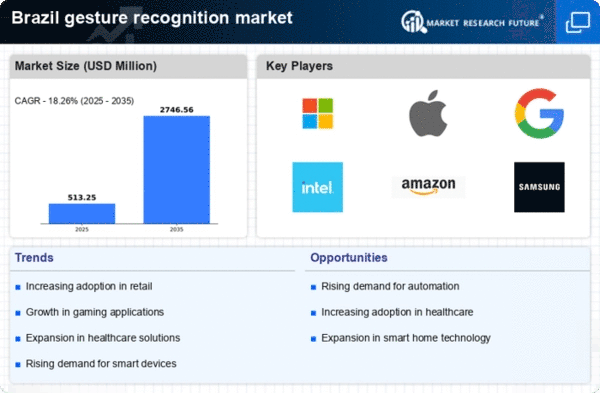
As per Market Research Future analysis, the Brazil gesture recognition market Size was estimated at 434.0 USD Million in 2024. The Brazil gesture recognition market is projected to grow from 513.25 USD Million in 2025 to 2746.56 USD Million by 2035, exhibiting a compound annual growth rate (CAGR) of 18.2% during the forecast period 2025 - 2035

Key Market Trends & Highlights

The Brazil gesture recognition market is experiencing robust growth driven by technological advancements and increasing demand for innovative solutions.

  • The healthcare segment is witnessing rising adoption of gesture recognition technologies to enhance patient care and streamline operations.
  • Integration with smart devices is becoming prevalent, indicating a shift towards more intuitive user interfaces across various applications.
  • Accessibility solutions are gaining traction, reflecting a growing emphasis on inclusivity in technology design.
  • Technological advancements in AI and increasing demand for contactless interfaces are key drivers propelling market expansion.

Market Size & Forecast

2024 Market Size 434.0 (USD Million)
2035 Market Size 2746.56 (USD Million)
CAGR (2025 - 2035) 18.26%

Major Players

Microsoft (US), Apple (US), Google (US), Intel (US), Amazon (US), Samsung (KR), Sony (JP), NVIDIA (US), GestureTek (CA)

Our Impact
Enabled $4.3B Revenue Impact for Fortune 500 and Leading Multinationals
Partnering with 2000+ Global Organizations Each Year
30K+ Citations by Top-Tier Firms in the Industry

Brazil Gesture Recognition Market Trends

The gesture recognition market is experiencing notable growth, driven by advancements in technology and increasing demand for intuitive user interfaces. In Brazil, the integration of gesture recognition systems into various sectors, including healthcare, automotive, and entertainment, appears to be gaining traction. This trend is likely influenced by the rising adoption of smart devices and the need for hands-free control in diverse applications. Furthermore, the Brazilian government has been promoting digital transformation initiatives, which may further enhance the market's development. As industries seek to improve user experience and operational efficiency, the gesture recognition market is poised for expansion. Moreover, the increasing focus on enhancing accessibility for individuals with disabilities suggests a promising avenue for growth. Gesture recognition technology can provide alternative means of interaction, thereby fostering inclusivity. The collaboration between technology firms and local startups in Brazil indicates a vibrant ecosystem that supports innovation in this field. As the market evolves, it is essential to monitor regulatory frameworks and consumer preferences, which could shape the trajectory of the gesture recognition market in the coming years.

Rising Adoption in Healthcare

The gesture recognition market is witnessing increased utilization within the healthcare sector. Medical professionals are exploring touchless interfaces to enhance hygiene and streamline workflows. This trend is likely to improve patient care and operational efficiency.

Integration with Smart Devices

There is a growing trend of integrating gesture recognition technology with smart devices in Brazil. As consumers seek more intuitive interactions, manufacturers are incorporating this technology into smartphones, smart TVs, and home automation systems.

Focus on Accessibility Solutions

The gesture recognition market is increasingly focusing on developing solutions that enhance accessibility for individuals with disabilities. This trend indicates a commitment to inclusivity, as technology becomes more adaptable to diverse user needs.

Brazil Gesture Recognition Market Drivers

Technological Advancements in AI

The gesture recognition market in Brazil is experiencing a surge due to rapid advancements in artificial intelligence (AI) technologies. These innovations enhance the accuracy and efficiency of gesture recognition systems, making them more appealing to various sectors. For instance, the integration of machine learning algorithms allows for improved pattern recognition, which is crucial for applications in gaming, automotive, and smart home devices. As AI continues to evolve, it is expected that the gesture recognition market will expand significantly, with projections indicating a growth rate of approximately 25% annually. This growth is likely to attract investments and drive further research and development, thereby solidifying Brazil's position as a key player in the gesture recognition market.

Expansion of Smart Home Technologies

The expansion of smart home technologies in Brazil is significantly influencing the gesture recognition market. As more households adopt smart devices, the need for intuitive control systems becomes paramount. Gesture recognition offers a seamless way to interact with various devices, from lighting to security systems. This trend is likely to drive the market's growth, with forecasts indicating a compound annual growth rate (CAGR) of around 20% over the next five years. The gesture recognition market is poised to capitalize on this trend, as manufacturers develop more sophisticated systems that integrate with existing smart home ecosystems, enhancing user convenience and satisfaction.

Rising Interest in Gaming and Entertainment

The gaming and entertainment sectors in Brazil are increasingly embracing gesture recognition technologies, which serve as a catalyst for market growth. As gaming becomes more immersive, developers are incorporating gesture-based controls to enhance user engagement. This trend is evident in the rise of virtual reality (VR) and augmented reality (AR) applications, which rely heavily on gesture recognition for interaction. The gesture recognition market is expected to see substantial growth, with estimates suggesting a market size increase of $300 million by 2026. This interest in innovative gaming experiences is likely to drive further investment and development in gesture recognition technologies.

Government Initiatives Supporting Innovation

Government initiatives in Brazil aimed at fostering technological innovation are playing a crucial role in the growth of the gesture recognition market. Various programs and funding opportunities are designed to support research and development in emerging technologies, including gesture recognition. These initiatives not only encourage local startups but also attract international companies looking to establish a presence in Brazil. The gesture recognition market stands to benefit from these supportive measures, with potential funding reaching up to $200 million over the next few years. This environment of innovation is likely to stimulate advancements in gesture recognition technologies, positioning Brazil as a competitive player in the global market.

Increasing Demand for Contactless Interfaces

In Brazil, the growing demand for contactless interfaces is a major driver for the gesture recognition market. As consumers become more health-conscious and seek hygienic solutions, businesses are increasingly adopting gesture-based technologies to minimize physical contact. This trend is particularly evident in retail and hospitality sectors, where touchless interactions enhance customer experiences. The gesture recognition market is projected to benefit from this shift, with estimates suggesting a potential market value increase of $500 million by 2027. Companies are investing in gesture recognition systems to meet consumer expectations, thereby fostering innovation and competition within the market.


Market Segment Insights

By Technology: 3D Gesture Technology (Largest) vs. 2D Gesture Technology (Fastest-Growing)

The Brazil gesture recognition market shows a significant distribution of market share among its key segments. 3D Gesture Technology holds the largest portion, catering to a wide range of applications including gaming, healthcare, and automotive industries. On the other hand, 2D Gesture Technology, while smaller in market share, is rapidly gaining traction due to its integration into smartphones and smart home devices. Growth trends in the Brazil gesture recognition market are spurred by advancements in technology and increasing consumer demand for intuitive user interfaces. The push towards immersive experiences in gaming and virtual reality, alongside the growing adoption of smart devices, is enhancing the deployment of gesture recognition technologies. As such, 2D Gesture Technology is expected to experience explosive growth, while 3D Gesture Technology will continue to dominate overall market share.

3D Gesture Technology (Dominant) vs. 2D Gesture Technology (Emerging)

3D Gesture Technology dominates the Brazil gesture recognition market, offering advanced capabilities for recognizing complex movements and gestures. This technology finds extensive usage across various sectors, including entertainment, healthcare, and security, making it highly versatile. Its ability to provide a more immersive user experience sets it apart from 2D Gesture Technology, which, while emerging and rapidly growing, primarily focuses on simpler gestures. 2D Gesture Technology is increasingly adopted in consumer electronics like smartphones and smart TVs due to its cost-effectiveness and ease of integration. As the market evolves, both technologies will play significant roles, with 3D Gesture Technology leading the market while 2D Gesture Technology will capture a growing share.

By Application: Consumer Electronics (Largest) vs. Automotive (Fastest-Growing)

In the Brazil gesture recognition market, the application segments are witnessing diverse dynamics. Consumer Electronics holds the largest market share, driven by the increasing integration of gesture controls in smartphones, tablets, and smart home devices. Following closely is the Automotive sector, which is expanding as manufacturers incorporate advanced gesture recognition technologies to enhance user experiences within vehicles. The ongoing demand for seamless interactions in consumer devices significantly influences market dynamics, showcasing the pivotal role of Consumer Electronics in overall market growth. Looking ahead, the Automotive segment is projected to be the fastest-growing category, fueled by technological advancements and regulatory pushes towards autonomous driving features. This surge is also attributed to the rising consumer expectation for more intuitive user interfaces. Healthcare and IT/Telecom are emerging segments, slowly gaining traction as the market adapts to innovative solutions, creating opportunities for niche players and established companies alike.

Consumer Electronics: Dominant vs. Automotive: Emerging

Consumer Electronics stands out as a dominant segment in the gesture recognition landscape, characterized by widespread adoption across various devices like smartphones, tablets, and gaming consoles. This segment thrives on user demand for more engaging and interactive interfaces, promoting advancements in touchless technology. In contrast, the Automotive segment, while currently in an emerging phase, is rapidly gaining momentum. It holds promise with innovations aimed at improving driver interaction and safety. Companies in this sector are increasingly exploring gesture-based systems for infotainment controls and driver assistance features. Both segments highlight a shift toward more intuitive interaction methods, indicating a transformative phase in how users engage with technology.

By Product: Touchless (Largest) vs. Touch-Based (Fastest-Growing)

In the Brazil gesture recognition market, the distribution of market share is notably in favor of the Touchless segment, which holds a significant portion due to its advanced technology and user-friendly applications in various industries. On the other hand, the Touch-Based segment, while smaller, is rapidly gaining traction as more manufacturers adopt this technology in consumer devices, aiming to enhance user interaction and experience. The growth trends in this segment show an increasing consumer preference for devices that provide intuitive and seamless interactions. Factors driving this include technological advancements, increased investments in R&D, and rising demand for contactless solutions in various applications across sectors such as retail, gaming, and healthcare, propelling Touchless as a leading choice while also fueling the growth of Touch-Based technologies.

Interaction Modes: Touchless (Dominant) vs. Touch-Based (Emerging)

The Touchless interaction mode is characterized by its ability to recognize gestures without the need for physical contact, making it particularly suitable for environments where hygiene is a concern, such as hospitals and public spaces. This mode utilizes technologies like infrared, cameras, and advanced algorithms, allowing for a smooth user experience. Conversely, the Touch-Based interaction mode, although emerging, is becoming increasingly popular due to its tactile feedback and user familiarity, especially in devices like smartphones and tablets. As products evolve, the integration of Touch-Based features with gesture recognition offers a promising growth avenue, balancing convenience with innovation.

Get more detailed insights about Brazil Gesture Recognition Market

Key Players and Competitive Insights

The gesture recognition market in Brazil is characterized by a dynamic competitive landscape, driven by technological advancements and increasing consumer demand for intuitive user interfaces. Major players such as Microsoft (US), Apple (US), and Google (US) are at the forefront, leveraging their extensive resources to innovate and expand their market presence. Microsoft (US) focuses on integrating gesture recognition into its Azure cloud services, enhancing user experience across various applications. Apple (US) continues to refine its gesture-based controls in devices like the iPhone and iPad, emphasizing seamless interaction. Google (US) is investing in AI-driven gesture recognition technologies, aiming to enhance its smart home devices and mobile applications. Collectively, these strategies foster a competitive environment that prioritizes innovation and user-centric design.Key business tactics employed by these companies include localizing manufacturing and optimizing supply chains to enhance responsiveness to market demands. The market structure appears moderately fragmented, with a mix of established players and emerging startups. This fragmentation allows for diverse offerings, yet the influence of key players remains substantial, as they set industry standards and drive technological advancements.

In October Microsoft (US) announced a partnership with a Brazilian tech firm to develop localized gesture recognition solutions tailored for the Brazilian market. This strategic move is likely to enhance Microsoft's competitive edge by addressing specific regional needs and preferences, thereby increasing user adoption. The collaboration may also facilitate the integration of gesture recognition into local applications, further solidifying Microsoft's position in the market.

In September Apple (US) unveiled a new gesture recognition feature in its latest iOS update, designed to improve accessibility for users with disabilities. This initiative not only demonstrates Apple's commitment to inclusivity but also positions the company as a leader in socially responsible technology. By enhancing user experience through innovative features, Apple (US) is likely to strengthen customer loyalty and attract new users.

In August Google (US) launched a new line of smart home devices equipped with advanced gesture recognition capabilities. This launch signifies Google's intent to dominate the smart home segment, where intuitive user interfaces are increasingly critical. By integrating gesture recognition into everyday devices, Google (US) may enhance user engagement and drive sales, positioning itself favorably against competitors.

As of November current trends in the gesture recognition market include a strong emphasis on digitalization, AI integration, and sustainability. Strategic alliances among key players are shaping the competitive landscape, fostering innovation and collaboration. The shift from price-based competition to a focus on technological advancement and supply chain reliability is evident. Companies that prioritize innovation and user experience are likely to differentiate themselves in this evolving market, suggesting a promising future for those who adapt to these trends.

Key Companies in the Brazil Gesture Recognition Market include

Industry Developments

Recent developments in the Brazil Gesture Recognition Market indicate a growing interest in the integration of advanced technologies across various sectors such as gaming, healthcare, and automotive. Companies like Thalmic Labs, NVIDIA, Google, Apple, and Samsung are at the forefront, investing in Research and Development to enhance gesture recognition capabilities. The market has experienced substantial growth, with a notable increase in investments in artificial intelligence to improve user experiences. Moreover, GestureTek and Intel have begun collaborating with local startups to innovate gesture-based solutions tailored for Brazilian consumers.

Recently, in February 2023, Amazon announced an acquisition of a gesture recognition startup based in Brazil, aimed at advancing its AI-driven product lines. Similar movements were observed in March 2023 when Microsoft expanded its local operations to support gesture technology development. The Brazilian government has also shown support for the sector, launching initiatives to promote technological advances and partnerships with leading global firms. These developments are expected to accelerate the adoption of gesture recognition technologies in Brazil, solidifying its position as a key player in the global market.

Future Outlook

Brazil Gesture Recognition Market Future Outlook

The Gesture Recognition Market in Brazil is poised for growth at 18.26% CAGR from 2025 to 2035, driven by advancements in AI, IoT integration, and consumer demand for touchless interfaces.

New opportunities lie in:

  • Development of gesture-controlled smart home devices
  • Integration of gesture recognition in automotive safety systems
  • Expansion of gesture-based interfaces in retail environments

By 2035, the gesture recognition market is expected to achieve substantial growth and innovation.

Market Segmentation

Brazil Gesture Recognition Market Product Outlook

  • Touchless
  • Touch-Based

Brazil Gesture Recognition Market Technology Outlook

  • Sensor
  • 2D Gesture Technology
  • 3D Gesture Technology

Brazil Gesture Recognition Market Application Outlook

  • Automotive
  • Healthcare
  • Consumer Electronics
  • Transportation
  • Commercial
  • IT/Telecom

Report Scope

MARKET SIZE 2024 434.0(USD Million)
MARKET SIZE 2025 513.25(USD Million)
MARKET SIZE 2035 2746.56(USD Million)
COMPOUND ANNUAL GROWTH RATE (CAGR) 18.26% (2025 - 2035)
REPORT COVERAGE Revenue Forecast, Competitive Landscape, Growth Factors, and Trends
BASE YEAR 2024
Market Forecast Period 2025 - 2035
Historical Data 2019 - 2024
Market Forecast Units USD Million
Key Companies Profiled Microsoft (US), Apple (US), Google (US), Intel (US), Amazon (US), Samsung (KR), Sony (JP), NVIDIA (US), GestureTek (CA)
Segments Covered Technology, Application, Product
Key Market Opportunities Integration of gesture recognition in smart home devices enhances user experience and accessibility.
Key Market Dynamics Rising demand for touchless interfaces drives innovation in gesture recognition technology across various sectors in Brazil.
Countries Covered Brazil
Leave a Comment

FAQs

What is the expected market size of the Brazil Gesture Recognition Market in 2024?

The Brazil Gesture Recognition Market is expected to be valued at 450.0 million USD in 2024.

What is the projected market value for the Brazil Gesture Recognition Market by 2035?

By 2035, the Brazil Gesture Recognition Market is projected to reach a value of 4000.0 million USD.

What is the expected CAGR for the Brazil Gesture Recognition Market from 2025 to 2035?

The expected CAGR for the Brazil Gesture Recognition Market from 2025 to 2035 is 21.972%.

Which technology segment is expected to dominate the market in 2024?

In 2024, the Sensor technology segment is expected to dominate the market with a value of 150.0 million USD.

What is the projected market value for 2D Gesture Technology in 2035?

The 2D Gesture Technology segment is projected to reach a market value of 1600.0 million USD by 2035.

Who are the key competitors in the Brazil Gesture Recognition Market?

Key competitors in the Brazil Gesture Recognition Market include Thalmic Labs, NVIDIA, Google, Apple, and Microsoft.

What is the market value of 3D Gesture Technology in 2024?

The 3D Gesture Technology segment is valued at 100.0 million USD in 2024.

How much is the Sensor technology segment expected to be valued at by 2035?

The Sensor technology segment is expected to be valued at 1200.0 million USD by 2035.

What are some of the key applications driving the growth of the Brazil Gesture Recognition Market?

Key applications driving growth include gaming, healthcare, and smart home devices.

What opportunities exist in the Brazil Gesture Recognition Market for emerging technologies?

Emerging technologies in AI and AR present significant growth opportunities in the Brazil Gesture Recognition Market.

Download Free Sample

Kindly complete the form below to receive a free sample of this Report

Compare Licence

×
Features License Type
Single User Multiuser License Enterprise User
Price $4,950 $5,950 $7,250
Maximum User Access Limit 1 User Upto 10 Users Unrestricted Access Throughout the Organization
Free Customization
Direct Access to Analyst
Deliverable Format
Platform Access
Discount on Next Purchase 10% 15% 15%
Printable Versions