×
Request Free Sample ×

Kindly complete the form below to receive a free sample of this Report

* Please use a valid business email

Leading companies partner with us for data-driven Insights

clients tt-cursor
Hero Background

Brazil Food Processing Market

ID: MRFR/FnB/42797-HCR
128 Pages
Varsha More
February 2026

Brazil Food Processing Market Size, Share, Industry Trend & Analysis Research Report: By Equipment Type Outlook (Cleaning, Sorting,Grading Equipment, Cutting, PeelingGrinding Equipment, MixersBlenders and Homogenizers, ExtrusionThermal Equipment, Others), By Category Outlook (Semi-Automated, Fully Automated) andBy Application Outlook (Bakery, Confectionery and Dairy Products, Meat, Poultry,Seafood Products, FruitVegetable, Beverages, Others)- Forecast to 2035

Share:
Download PDF ×

We do not share your information with anyone. However, we may send you emails based on your report interest from time to time. You may contact us at any time to opt-out.

Brazil Food Processing Market Infographic
Purchase Options

Brazil Food Processing Market Summary

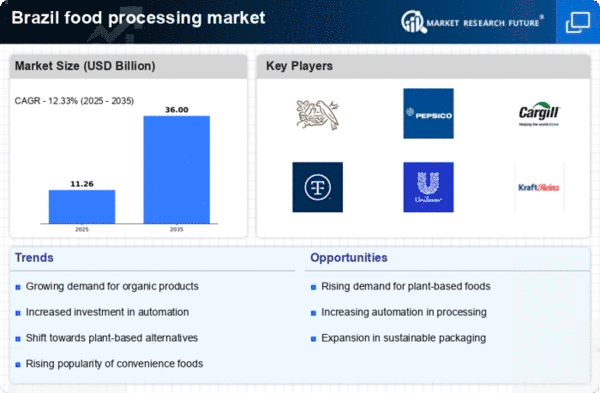
As per Market Research Future analysis, the Brazil food processing market size was estimated at 10.02 USD Billion in 2024. The Brazil food processing market is projected to grow from 11.26 USD Billion in 2025 to 36.0 USD Billion by 2035, exhibiting a compound annual growth rate (CAGR) of 12.3% during the forecast period 2025 - 2035

Key Market Trends & Highlights

The Brazil food processing market is experiencing a dynamic shift towards health-conscious and sustainable practices.

  • Health-conscious products are gaining traction as consumers increasingly prioritize nutrition and wellness.
  • Sustainability initiatives are becoming integral, with companies adopting eco-friendly practices to meet consumer demand.
  • Technological advancements are enhancing production efficiency and product innovation across the sector.
  • Rising urbanization and evolving consumer preferences are key drivers propelling market growth in Brazil.

Market Size & Forecast

2024 Market Size 10.02 (USD Billion)
2035 Market Size 36.0 (USD Billion)
CAGR (2025 - 2035) 12.33%

Major Players

Nestle (CH), PepsiCo (US), Cargill (US), Tyson Foods (US), Unilever (GB), Kraft Heinz (US), General Mills (US), Danone (FR), Mars (US), Mondelez International (US)

Our Impact
Enabled $4.3B Revenue Impact for Fortune 500 and Leading Multinationals
Partnering with 2000+ Global Organizations Each Year
30K+ Citations by Top-Tier Firms in the Industry

Brazil Food Processing Market Trends

The food processing market in Brazil is currently experiencing a dynamic evolution, driven by various factors including consumer preferences, technological advancements, and regulatory changes. The increasing demand for convenience foods, coupled with a growing awareness of health and nutrition, appears to be reshaping product offerings. As consumers become more health-conscious, there is a noticeable shift towards organic and natural ingredients, which influences manufacturers to adapt their processes accordingly. Furthermore, the rise of e-commerce platforms is facilitating greater access to diverse food products, thereby expanding market reach and consumer choice. In addition, sustainability practices are gaining traction within the food processing market. Companies are increasingly focusing on reducing waste and improving energy efficiency in their operations. This trend aligns with broader environmental goals and reflects a commitment to responsible production methods. The integration of innovative technologies, such as automation and artificial intelligence, is also enhancing operational efficiency and product quality. Overall, the food processing market is poised for continued growth, driven by evolving consumer demands and a commitment to sustainability.

Health-Conscious Products

There is a growing trend towards health-oriented food options, as consumers increasingly seek products that align with their nutritional needs. This shift is prompting manufacturers to innovate and reformulate existing products, focusing on natural ingredients and reduced additives.

Sustainability Initiatives

Sustainability is becoming a core focus for many companies within the food processing market. Efforts to minimize environmental impact through waste reduction and energy-efficient practices are gaining importance, reflecting a broader commitment to responsible production.

Technological Advancements

The integration of advanced technologies, such as automation and artificial intelligence, is transforming production processes. These innovations enhance efficiency, improve product quality, and enable companies to respond more effectively to market demands.

Brazil Food Processing Market Drivers

Rising Urbanization

The increasing urbanization in Brazil is a pivotal driver for the food processing market. As more individuals migrate to urban areas, the demand for processed food products rises significantly. Urban consumers often seek convenience, leading to a preference for ready-to-eat meals and packaged foods. This shift is reflected in the market, where the processed food segment is projected to grow at a CAGR of approximately 5.2% from 2025 to 2030. The food processing market is adapting to these changes by innovating product offerings that cater to the fast-paced lifestyle of urban dwellers, thereby enhancing market growth.

Technological Integration

The integration of advanced technologies in the food processing market is transforming production processes and enhancing efficiency. Automation and digitalization are becoming increasingly prevalent, allowing food processors to optimize operations and reduce costs. For example, the adoption of IoT (Internet of Things) technologies enables real-time monitoring of production lines, which can lead to significant improvements in productivity. Market analysis suggests that investments in technology could increase operational efficiency by up to 20% over the next few years. This technological shift is essential for food processors aiming to remain competitive in a rapidly evolving market.

Rising Export Opportunities

Brazil's food processing market is experiencing a surge in export opportunities, driven by the country's rich agricultural resources. The demand for Brazilian processed food products is growing in international markets, particularly in regions such as Asia and Europe. This trend is bolstered by Brazil's reputation for high-quality agricultural products, which enhances the appeal of its processed foods. The food processing market is likely to benefit from this export growth, with projections indicating an increase in export value by approximately 15% over the next five years. This expansion into global markets presents significant opportunities for local food processors to diversify their revenue streams.

Evolving Consumer Preferences

Consumer preferences in Brazil are evolving, with a marked shift towards convenience and quality in food products. The food processing market is responding to this trend by developing products that align with these changing tastes. For instance, there is a growing demand for organic and natural ingredients, which has led to an increase in the production of minimally processed foods. Market data indicates that the organic food segment is expected to witness a growth rate of around 8% annually. This evolution in consumer preferences is driving food processors to innovate and diversify their product lines to meet the expectations of health-conscious consumers.

Government Support and Regulations

Government policies and regulations play a crucial role in shaping the food processing market in Brazil. Initiatives aimed at promoting food safety and quality standards are influencing the operational landscape for food processors. The Brazilian government has implemented various programs to support local food production and processing, which enhances the competitiveness of the food processing market. Additionally, regulatory frameworks that encourage sustainable practices are likely to drive innovation and investment in the sector. As a result, food processors are increasingly focusing on compliance with these regulations, which may lead to improved product quality and safety.


Market Segment Insights

By Type: Mixers, Blenders and Homogenizers (Largest) vs. Cleaning, Sorting, & Grading Equipment (Fastest-Growing)

In the Brazil food processing market, the distribution of market share within the equipment types reveals that Mixers, Blenders and Homogenizers command the largest share, being integral to processing operations across various food sectors. Cleaning, Sorting, & Grading Equipment follows closely, playing a crucial role in maintaining product quality and safety standards. The need for efficient operations drives a significant interest in these segments, shaping competitive dynamics within the market. Growth trends indicate a robust expansion for Cleaning, Sorting, & Grading Equipment, which is driven by increased consumer demand for quality and safety in food products. Technological advancements play a key role as companies seek to enhance productivity and reduce waste in processing. Furthermore, as sustainability becomes more prominent, investments in efficient cleaning and sorting technologies are expected to grow significantly, positioning this segment as a rapidly evolving area within the market.

Mixers, Blenders and Homogenizers (Dominant) vs. Extrusion & Thermal Equipment (Emerging)

Mixers, Blenders and Homogenizers are considered the dominant equipment type in the Brazil food processing market, characterized by their versatility and efficacy in blending various food ingredients to achieve desired textures and tastes. Their widespread application across industries such as dairy, beverage, and baked products enhances their market presence. On the other hand, Extrusion & Thermal Equipment stands as an emerging segment, driven by innovations in processing techniques that cater to evolving consumer preferences for convenience and nutrition. This segment is gaining traction for its ability to produce diverse food products, including snacks and extruded products, showcasing potential for significant market growth. The contrasting positions of these equipment types highlight the diverse needs within the market.

By Category: Semi-Automated (Largest) vs. Fully Automated (Fastest-Growing)

In the Brazil food processing market, the Semi-Automated segment holds the largest share, catering to businesses that require a balance between manual oversight and automation to optimize productivity. Fully Automated systems are rapidly gaining traction due to advances in technology, making them increasingly attractive to new entrants in the market, thus driving competition and market dynamics further. The surge in demand for Fully Automated solutions is driven by the need for greater efficiency and consistency in food production processes. As consumer preferences evolve towards high-quality, safe products, businesses are investing in automation technologies to meet these demands while minimizing labor costs. This results in a shifting landscape where Fully Automated systems are anticipated to capture a larger share as industries adapt to these innovations.

Semi-Automated (Dominant) vs. Fully Automated (Emerging)

The Semi-Automated segment is characterized by a blend of human intervention and machine efficiency, making it an ideal choice for traditional food processing operations that aim to increase productivity without a complete overhaul of existing systems. This segment appeals to established players who prioritize flexibility and lower capital investment. Conversely, the Fully Automated segment represents an emerging force in the Brazil food processing market, characterized by advanced technologies such as AI and robotics that enhance production efficiency and reduce human error. As manufacturers strive for higher output and lower operational costs, the Fully Automated solutions are poised to reshape the industry, attracting investments from tech-savvy companies eager to innovate.

By Application: Bakery, Confectionery and Dairy Products (Largest) vs. Meat, Poultry, & Seafood Products (Fastest-Growing)

In the Brazil food processing market, the application segment showcases a diverse distribution of market shares among its key categories. Bakery, Confectionery and Dairy Products dominate the segment with a significant market presence, largely due to the cultural preference for baked goods and dairy products. In contrast, Meat, Poultry, & Seafood Products have emerged as a compelling segment, capitalizing on the growing demand for protein-rich food sources. Growth trends indicate a rising consumer interest in healthier and sustainably sourced products, making the Meat, Poultry, & Seafood Products segment particularly dynamic. Additionally, increasing urbanization and changing dietary habits are nurturing this growth, allowing it to outperform other segments over the forecast period. The Bakery, Confectionery and Dairy Products segment, while stable, faces challenges from evolving consumer preferences. Monitoring these trends is central to understanding the future landscape of the Brazil food processing market.

Bakery, Confectionery and Dairy Products (Dominant) vs. Meat, Poultry, & Seafood Products (Emerging)

The Bakery, Confectionery and Dairy Products segment stands out as the dominant force in the Brazil food processing market due to its established consumer base and cultural significance. This segment thrives on traditional recipes and innovations in convenience foods, catering to demand for quick and easily accessible products. Conversely, the Meat, Poultry, & Seafood Products segment is emerging rapidly, driven by health-conscious consumers seeking high-quality protein options and sustainable food sources. This shift in consumer behavior reflects broader trends in nutrition and food sourcing, prompting producers in this segment to enhance their offerings through quality improvements and innovative processing techniques. The dynamic nature of these two segments illustrates the evolving preferences of Brazilian consumers.

Get more detailed insights about Brazil Food Processing Market

Key Players and Competitive Insights

The food processing market in Brazil is characterized by a dynamic competitive landscape, driven by factors such as increasing consumer demand for convenience foods, health-conscious products, and sustainable practices. Major players like Nestlé (CH), PepsiCo (US), and Cargill (US) are actively shaping this environment through strategic initiatives. Nestlé (CH) focuses on innovation in health-oriented products, while PepsiCo (US) emphasizes sustainability in its supply chain. Cargill (US) is enhancing its operational efficiency through digital transformation, which collectively influences the competitive dynamics by fostering a culture of continuous improvement and responsiveness to market trends.Key business tactics employed by these companies include localizing manufacturing to reduce costs and optimize supply chains. The market appears moderately fragmented, with a mix of large multinational corporations and smaller local firms. This structure allows for a diverse range of products and services, while the collective influence of key players drives innovation and competitive pricing strategies.

In October Nestlé (CH) announced a partnership with a local agricultural cooperative to source organic ingredients, enhancing its product offerings in the health segment. This strategic move not only strengthens Nestlé's supply chain but also aligns with the growing consumer preference for organic and locally sourced products, potentially increasing market share in Brazil's health-conscious consumer segment.

In September PepsiCo (US) launched a new line of plant-based snacks aimed at the Brazilian market, reflecting a broader trend towards healthier eating. This initiative is significant as it positions PepsiCo to capture the growing demand for plant-based alternatives, thereby enhancing its competitive edge in a market increasingly focused on health and wellness.

In August Cargill (US) invested in advanced processing technology at its Brazilian facilities, aimed at improving efficiency and reducing waste. This investment is crucial as it not only enhances operational capabilities but also aligns with sustainability goals, which are becoming increasingly important to consumers and regulators alike.

As of November current trends in the food processing market include a strong emphasis on digitalization, sustainability, and the integration of artificial intelligence in operations. Strategic alliances are becoming more prevalent, allowing companies to leverage shared resources and expertise. Looking ahead, competitive differentiation is likely to evolve from traditional price-based competition to a focus on innovation, technology adoption, and supply chain reliability, as companies strive to meet the changing demands of consumers.

Key Companies in the Brazil Food Processing Market include

Industry Developments

The Brazil Food Processing Market has seen notable developments recently, particularly with major companies like Cargill Brazil, Marfrig, and Nestlé Brasil. In April 2023, Marfrig announced a strategic partnership with a technology firm to enhance its meat processing efficiency, which is expected to boost productivity. Meanwhile, in August 2023, JBS reported a significant increase in its market valuation, driven by a rise in global demand for beef products. Cargill Brazil has also expanded its operations into plant-based products, responding to shifting consumer preferences towards healthier options.

In terms of mergers and acquisitions, Grupo M. Dias Branco completed its acquisition of a regional competitor in September 2023, consolidating its position in the baked goods segment. Additionally, BRF has focused on sustainability initiatives, launching new products that align with eco-friendly practices. The market is projected to grow as Brazil capitalizes on its agricultural strengths. With investments from major players and an emphasis on technological advancements, the Brazil Food Processing Market is poised for continued growth and innovation, making it a significant sector in the country’s economy.

Future Outlook

Brazil Food Processing Market Future Outlook

The Food Processing Market in Brazil is projected to grow at a 12.33% CAGR from 2025 to 2035, driven by technological advancements, increasing consumer demand, and sustainability initiatives.

New opportunities lie in:

  • Investment in automated processing technologies to enhance efficiency and reduce costs.
  • Development of plant-based food products to cater to health-conscious consumers.
  • Expansion of e-commerce platforms for direct-to-consumer food sales.

By 2035, the food processing market is expected to achieve substantial growth and innovation.

Market Segmentation

Brazil Food Processing Market Type Outlook

  • Cleaning, Sorting, & Grading Equipment
  • Cutting, Peeling & Grinding Equipment
  • Mixers, Blenders and Homogenizers
  • Extrusion & Thermal Equipment
  • Other Equipment

Brazil Food Processing Market Category Outlook

  • Semi-Automated
  • Fully Automated

Brazil Food Processing Market Application Outlook

  • Bakery, Confectionery and Dairy Products
  • Meat, Poultry, & Seafood Products
  • Fruit, Vegetable and Beverages
  • Others

Report Scope

MARKET SIZE 2024 10.02(USD Billion)
MARKET SIZE 2025 11.26(USD Billion)
MARKET SIZE 2035 36.0(USD Billion)
COMPOUND ANNUAL GROWTH RATE (CAGR) 12.33% (2025 - 2035)
REPORT COVERAGE Revenue Forecast, Competitive Landscape, Growth Factors, and Trends
BASE YEAR 2024
Market Forecast Period 2025 - 2035
Historical Data 2019 - 2024
Market Forecast Units USD Billion
Key Companies Profiled Nestle (CH), PepsiCo (US), Cargill (US), Tyson Foods (US), Unilever (GB), Kraft Heinz (US), General Mills (US), Danone (FR), Mars (US), Mondelez International (US)
Segments Covered Type, Category, Application
Key Market Opportunities Adoption of sustainable practices and technologies in food processing enhances efficiency and meets consumer demand.
Key Market Dynamics Rising consumer demand for sustainable products drives innovation in food processing technologies and practices.
Countries Covered Brazil
Leave a Comment

FAQs

What is the expected market value of the Brazil Food Processing Market in 2024?

The Brazil Food Processing Market is expected to be valued at 8.19 USD Billion in 2024.

What is the projected market size for the Brazil Food Processing Market by 2035?

By 2035, the Brazil Food Processing Market is projected to reach a value of 41.05 USD Billion.

What is the compound annual growth rate (CAGR) of the Brazil Food Processing Market from 2025 to 2035?

The market is expected to grow at a CAGR of 15.781% from 2025 to 2035.

Who are the major players in the Brazil Food Processing Market?

Key players in the market include Cargill Brazil, Marfrig, Nestlé Brasil, and Bunge Brasil among others.

What is the market value of Cleaning, Sorting, & Grading Equipment in 2024?

The market value for Cleaning, Sorting, & Grading Equipment is expected to be 1.67 USD Billion in 2024.

How much is the Cutting, Peeling & Grinding Equipment segment valued at in 2035?

The Cutting, Peeling & Grinding Equipment segment is estimated to be valued at 7.65 USD Billion by 2035.

What will be the value of Extrusion & Thermal Equipment by 2035?

By 2035, the Extrusion & Thermal Equipment segment is expected to be valued at 9.07 USD Billion.

What is the expected market size for Mixers & Blenders and Homogenizers in 2024?

In 2024, the Mixers & Blenders and Homogenizers segment is valued at 1.25 USD Billion.

What challenges does the Brazil Food Processing Market face in its growth?

Challenges in the market include fluctuating raw material prices and regulatory compliance.

How will the Brazil Food Processing Market grow in the coming years?

The market is set to experience significant growth driven by increasing demand for processed food and technological advancements.

Download Free Sample

Kindly complete the form below to receive a free sample of this Report

Compare Licence

×
Features License Type
Single User Multiuser License Enterprise User
Price $4,950 $5,950 $7,250
Maximum User Access Limit 1 User Upto 10 Users Unrestricted Access Throughout the Organization
Free Customization
Direct Access to Analyst
Deliverable Format
Platform Access
Discount on Next Purchase 10% 15% 15%
Printable Versions