×
Request Free Sample ×

Kindly complete the form below to receive a free sample of this Report

* Please use a valid business email

Leading companies partner with us for data-driven Insights

clients tt-cursor
Hero Background

Brazil Fixed Mobile Convergence Market

ID: MRFR/ICT/56257-HCR
200 Pages
Aarti Dhapte
February 2026

Brazil Fixed Mobile Convergence Market Size, Share and Trends Analysis Report By Convergence (Network Convergence, Device Convergence, Application Convergence), By Mode (Dual Mode, Single Mode), By Component (Voice, Videotelephony, Social Networking, Broadband Internet, Broadband TV) and By End-User (Home Users, Enterprises, IT & Telecommunication, BFSI, Automotive, Healthcare, Media & Entertainment, Government)- Forecast to 2035

Share:
Download PDF ×

We do not share your information with anyone. However, we may send you emails based on your report interest from time to time. You may contact us at any time to opt-out.

Brazil Fixed Mobile Convergence Market Infographic
Purchase Options

Brazil Fixed Mobile Convergence Market Summary

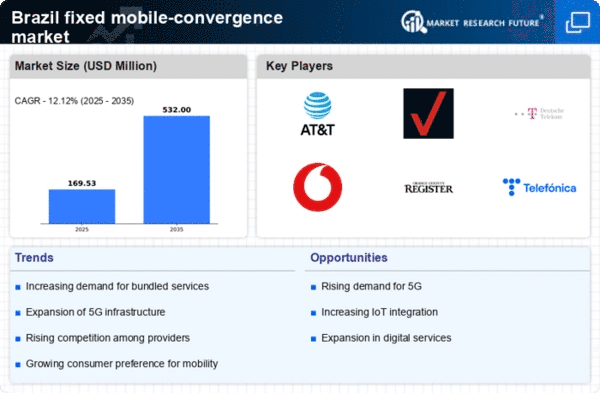
As per Market Research Future analysis, the Brazil fixed mobile-convergence market size was estimated at 151.2 USD Million in 2024. The Brazil fixed mobile-convergence market is projected to grow from 169.53 USD Million in 2025 to 532.0 USD Million by 2035, exhibiting a compound annual growth rate (CAGR) of 12.1% during the forecast period 2025 - 2035

Key Market Trends & Highlights

The Brazil fixed mobile-convergence market is experiencing robust growth. This growth is driven by evolving consumer preferences and technological advancements.

  • The demand for bundled services is increasing as consumers seek more value from their telecommunications providers.
  • Regulatory support for innovation is fostering a competitive landscape, particularly in the largest segment of mobile services.
  • Enhanced customer experience remains a focal point, with providers striving to differentiate themselves in a crowded market.
  • Rising mobile data consumption and technological advancements in network infrastructure are key drivers propelling market growth.

Market Size & Forecast

2024 Market Size 151.2 (USD Million)
2035 Market Size 532.0 (USD Million)
CAGR (2025 - 2035) 12.12%

Major Players

AT&T (US), Verizon (US), Deutsche Telekom (DE), Vodafone (GB), Orange (FR), Telefónica (ES), BT Group (GB), T-Mobile (DE)

Our Impact
Enabled $4.3B Revenue Impact for Fortune 500 and Leading Multinationals
Partnering with 2000+ Global Organizations Each Year
30K+ Citations by Top-Tier Firms in the Industry

Brazil Fixed Mobile Convergence Market Trends

The market is currently experiencing a transformative phase, characterized by the integration of fixed-line and mobile services. This convergence is driven by advancements in technology, which enable seamless communication across various platforms. As consumers increasingly demand flexibility and convenience, service providers are adapting their offerings to meet these expectations. The market appears to be shifting towards bundled services that combine internet, voice, and mobile data, providing users with comprehensive solutions tailored to their needs. This trend suggests a growing recognition of the importance of unified communication solutions in enhancing customer satisfaction. Moreover, regulatory frameworks in Brazil are evolving to support this convergence, fostering competition among service providers. The government is likely to encourage innovation and investment in infrastructure, which could further stimulate growth in the fixed mobile-convergence market. As companies strive to differentiate themselves, there is a potential for new entrants to disrupt traditional business models. This dynamic environment indicates that the market is poised for significant developments in the coming years, as stakeholders navigate the complexities of consumer preferences and technological advancements.

Increased Demand for Bundled Services

There is a noticeable trend towards bundled offerings in the fixed mobile-convergence market. Consumers are increasingly seeking packages that combine internet, voice, and mobile services, which provide convenience and cost savings. This shift reflects a broader desire for integrated solutions that simplify communication and enhance user experience.

Regulatory Support for Innovation

The regulatory landscape is evolving to promote innovation within the fixed mobile-convergence market. Government initiatives are likely aimed at fostering competition and encouraging investment in infrastructure. This supportive environment may lead to enhanced service offerings and improved access for consumers.

Focus on Enhanced Customer Experience

Service providers are placing greater emphasis on improving customer experience in the fixed mobile-convergence market. This focus may involve leveraging technology to offer personalized services and responsive support. As competition intensifies, companies are likely to prioritize customer satisfaction to retain and attract users.

Brazil Fixed Mobile Convergence Market Drivers

Competitive Pricing Strategies

Competitive pricing strategies are emerging as a key driver in the fixed mobile-convergence market in Brazil. With numerous players vying for market share, companies are adopting aggressive pricing models to attract and retain customers. As of 2025, the average cost of bundled services has decreased by approximately 20%, making them more accessible to a broader audience. This trend is encouraging consumers to switch to bundled offerings that combine mobile and fixed-line services, thereby increasing overall market penetration. Additionally, promotional campaigns and loyalty programs are being utilized to enhance customer retention. The focus on competitive pricing is likely to intensify as companies strive to differentiate themselves in a crowded marketplace, ultimately benefiting consumers through improved service offerings.

Rising Mobile Data Consumption

The fixed mobile-convergence market in Brazil is experiencing a notable surge in mobile data consumption. As of 2025, mobile data traffic is projected to increase by approximately 50% compared to previous years. This growth is driven by the proliferation of smartphones and mobile applications, which are becoming integral to daily life. Consumers are increasingly seeking seamless connectivity across devices, prompting service providers to enhance their offerings. The demand for high-speed internet and mobile services is compelling companies to innovate and bundle services, thereby fostering competition in the fixed mobile-convergence market. This trend indicates a shift towards integrated solutions that cater to the evolving needs of consumers, ultimately shaping the landscape of telecommunications in Brazil.

Growing Demand for Smart Home Solutions

The growing demand for smart home solutions is significantly influencing the fixed mobile-convergence market in Brazil. As consumers increasingly adopt smart devices, there is a rising expectation for integrated services that facilitate seamless connectivity. By November 2025, it is estimated that over 30% of households in Brazil will have at least one smart home device, creating a substantial market for service providers. This trend is prompting telecommunications companies to develop bundled packages that include mobile, internet, and smart home services. The integration of these services not only enhances user experience but also positions companies to capitalize on the expanding IoT ecosystem. As a result, the fixed mobile-convergence market is likely to see a shift towards more comprehensive service offerings that cater to the needs of tech-savvy consumers.

Increased Focus on Sustainability Initiatives

An increased focus on sustainability initiatives is emerging as a significant driver in the fixed mobile-convergence market in Brazil. As environmental concerns gain prominence, consumers are becoming more conscious of their carbon footprint and are seeking eco-friendly service options. Telecommunications companies are responding by implementing green practices, such as energy-efficient network operations and sustainable sourcing of materials. By 2025, it is anticipated that a substantial portion of consumers will prefer service providers that demonstrate a commitment to sustainability. This shift is likely to influence purchasing decisions, as companies that prioritize environmental responsibility may gain a competitive edge in the fixed mobile-convergence market. The integration of sustainability into business strategies is expected to reshape the market landscape, encouraging innovation and responsible practices.

Technological Advancements in Network Infrastructure

Technological advancements are playing a crucial role in the evolution of the fixed mobile-convergence market in Brazil. The rollout of 5G technology is expected to revolutionize connectivity, offering significantly higher speeds and lower latency. As of November 2025, major telecommunications companies are investing heavily in upgrading their network infrastructure to support these advancements. This investment is likely to enhance the quality of service and expand coverage, making it easier for consumers to access integrated services. Furthermore, the adoption of cloud-based solutions and Internet of Things (IoT) devices is anticipated to drive demand for converged services, as users seek to connect multiple devices seamlessly. The integration of these technologies is expected to create new opportunities for service providers.


Market Segment Insights

By Convergence: Network Convergence (Largest) vs. Device Convergence (Fastest-Growing)

In the Brazil fixed mobile-convergence market, the segment values show a varied distribution regarding market share. Network Convergence leads with the largest share, driven by its essential role in integrating fixed and mobile networks. Device Convergence, while smaller, is rapidly gaining traction as consumers demand more unified devices that can seamlessly switch between mobile and fixed services, thus enhancing user experience. Growth trends indicate that Network Convergence remains robust, fueled by investments in infrastructure and technological advancements. Device Convergence, on the other hand, is identified as the fastest-growing segment, largely driven by increasing consumer preference for multi-functional devices and the rise of IoT applications. These drivers position the convergence of services and devices at the forefront of market development, reflecting changing consumer habits and expectations.

Network Convergence: Largest vs. Device Convergence: Emerging

Network Convergence is characterized by its comprehensive integration of fixed and mobile network services, allowing for improved communication and efficiency within service delivery. As the dominant force in this segment, it showcases robust infrastructure capabilities and is bolstered by significant investments in technology and service development. Meanwhile, Device Convergence represents the emerging trend of combining functionalities of various devices into one, appealing to tech-savvy consumers looking for versatility and efficiency. This segment is gaining ground due to the growing popularity of smart devices that support multiple connectivity options, which cater to diverse usage scenarios in daily life.

By Mode: Dual Mode (Largest) vs. Single Mode (Fastest-Growing)

In the Brazil fixed mobile-convergence market, the market share is notably skewed towards the Dual Mode segment, which represents the largest proportion of users opting for flexibility and multi-service access. Meanwhile, the Single Mode segment has been gaining traction and is experiencing a surge in adoption as consumers seek simpler and more cost-effective solutions tailored to specific needs. The growth trends within this segment are driven by the increasing demand for seamless connectivity and the rising preference for integrated services among consumers. Innovations in technology and competitive pricing are also propelling the Single Mode segment forward, allowing it to capitalize on niche markets. As the market dynamics evolve, both segments are expected to cater to differing consumer preferences and needs, creating diverse growth opportunities.

Mode: Dual Mode (Dominant) vs. Single Mode (Emerging)

The Dual Mode segment is characterized by its ability to provide users with a comprehensive range of services, allowing both fixed and mobile capabilities in a single solution. This segment has established itself as the dominant force within the Brazil fixed mobile-convergence market, appealing to users who seek versatile communication options. On the other hand, the Single Mode segment is emerging as a significant alternative, catering to customers looking for simplified mobility solutions. This segment typically offers tailored packages that resonate with users preferring specific functionality over versatility. As competition intensifies, both segments are expected to innovate and refine their offerings, ensuring they meet the evolving demands of consumers.

By Component: Broadband Internet (Largest) vs. Voice (Fastest-Growing)

The Brazil fixed mobile-convergence market showcases a varied distribution of market share across its component segments, with Broadband Internet leading as the largest segment. Following closely are Voice and Video Telephony, which continue to hold significant portions of the market share. Social Networking and Broadband TV also contribute to the landscape, albeit at a lesser magnitude, indicating diverse consumer preferences and usage patterns within the market. Growth trends in this segment are driven by increasing demand for high-speed internet and enhanced digital communication. The rapid adoption of mobile technologies and the proliferation of streaming services have positioned Voice as the fastest-growing component. Innovative offerings and improved service quality in these segments, particularly amongst younger demographics, further accelerate market expansion, catering to consumer needs for seamless connectivity and real-time engagement.

Voice (Dominant) vs. Video Telephony (Emerging)

In the Brazil fixed mobile-convergence market, Voice stands as a dominant component, reflecting its extensive utilization in everyday communication. It benefits from established infrastructure and widespread consumer acceptance. Contrastingly, Video Telephony is an emerging value, gaining traction among younger users seeking interactive communication experiences. This segment is characterized by innovative applications and services that emphasize video engagement. While Voice maintains a stronghold, Video Telephony is witnessing robust growth, driven by advancements in mobile technology and user preferences for richer communication forms. This dynamic illustrates the evolving landscape of telecommunications, where traditional and modern communication methods are increasingly integrated.

By End-User: Home Users (Largest) vs. Enterprises (Fastest-Growing)

The market distribution within the Brazil fixed mobile-convergence market reveals that Home Users occupy the largest share due to their increasing demand for integrated communication services. This segment benefits from the trend of remote working and digital entertainment, leading to a surge in fixed and mobile service adoption. In contrast, the Enterprises segment is rapidly catching up as businesses recognize the benefits of convergence in terms of cost efficiency and streamlined operations. Growth trends indicate that the Enterprises segment is the fastest-growing, fueled by the digital transformation initiatives across various industries. As companies shift towards more integrated solutions for their communications, they drive demand for fixed mobile-convergence services. Additionally, sectors like IT & Telecommunication and BFSI are expected to leverage these services significantly, enhancing productivity and customer engagement while reducing operational costs.

Home Users: Dominant vs. Enterprises: Emerging

Home Users represent the dominant force in the Brazil fixed mobile-convergence market, primarily driven by their need for seamless connectivity and entertainment options. This demographic has rapidly adopted mobile and internet services, with a focus on online streaming and social connectivity. On the other hand, Enterprises, although emerging, are witnessing significant growth as they increasingly embrace fixed mobile-convergence solutions. These businesses seek to enhance operational efficiency and reduce costs through unified communication systems that integrate voice, data, and video services. The contrasting dynamics between these segments highlight a robust and evolving landscape where Home Users set the pace, while Enterprises are poised for notable expansion.

Get more detailed insights about Brazil Fixed Mobile Convergence Market

Key Players and Competitive Insights

The fixed mobile-convergence market in Brazil is characterized by a dynamic competitive landscape, driven by technological advancements and evolving consumer preferences. Key players such as Telefónica (ES), AT&T (US), and Deutsche Telekom (DE) are actively shaping the market through strategic initiatives. Telefónica (ES) has focused on enhancing its digital services portfolio, emphasizing integrated solutions that combine fixed and mobile offerings. AT&T (US) appears to be leveraging its extensive network infrastructure to provide seamless connectivity, while Deutsche Telekom (DE) is investing in innovative technologies to improve customer experience and operational efficiency. Collectively, these strategies contribute to a competitive environment that prioritizes service quality and technological integration.
In terms of business tactics, companies are increasingly localizing their operations to better cater to Brazilian consumers. This includes optimizing supply chains and enhancing customer service capabilities. The market structure is moderately fragmented, with several players vying for market share. However, the influence of major companies is significant, as they set benchmarks for service quality and innovation, thereby shaping consumer expectations and competitive dynamics.
In October 2025, Telefónica (ES) announced a partnership with a leading Brazilian fintech to integrate financial services into its mobile offerings. This strategic move is likely to enhance customer engagement and create new revenue streams, reflecting a broader trend towards service diversification in the market. By combining telecommunications with financial solutions, Telefónica (ES) positions itself as a comprehensive service provider, potentially increasing its market share.
In September 2025, AT&T (US) launched a new initiative aimed at expanding its fiber-optic network across urban areas in Brazil. This expansion is crucial as it addresses the growing demand for high-speed internet, particularly in metropolitan regions. The initiative not only strengthens AT&T's competitive position but also aligns with the increasing consumer preference for reliable and fast connectivity, which is essential for both personal and business use.
In August 2025, Deutsche Telekom (DE) unveiled a new AI-driven customer service platform designed to enhance user experience and operational efficiency. This platform aims to streamline customer interactions and reduce response times, which is vital in a market where customer satisfaction is paramount. By investing in AI technologies, Deutsche Telekom (DE) demonstrates its commitment to innovation and its understanding of the importance of customer-centric solutions in maintaining a competitive edge.
As of November 2025, the competitive trends in the fixed mobile-convergence market are increasingly defined by digitalization, sustainability, and the integration of AI technologies. Strategic alliances are becoming more prevalent, as companies recognize the value of collaboration in enhancing service offerings and operational capabilities. Looking ahead, competitive differentiation is likely to evolve from traditional price-based strategies to a focus on innovation, technological advancements, and supply chain reliability. This shift underscores the importance of adapting to consumer needs and leveraging technology to create value in a rapidly changing market.

Key Companies in the Brazil Fixed Mobile Convergence Market include

Industry Developments

Recent developments in the Brazil Fixed Mobile Convergence Market have seen increased competition and strategic partnerships among key players. Embratel has begun to enhance its service offerings by expanding fiber-optic networks across major urban areas, aiming to compete effectively with Vivo and Claro, which are also investing in technology upgrades. 

Telefonica Brasil has reported significant growth in subscriber numbers attributed to their bundled service packages that integrate fixed and mobile offerings. In September 2023, Nextel completed the acquisition of a regional telecom provider, strengthening its market position in the northeastern regions of Brazil. Additionally, TIM Brasil is focusing on innovative solutions to enhance customer experience while aligning with government initiatives to widen broadband access. 

Ongoing regulatory support and favorable market conditions have stimulated investment, contributing to a growth trajectory in the sector. Over the past two years, a notable trend has been the shift towards digitalization, with companies like Algar Telecom and Regional Telecom embracing cloud services as part of their convergence strategies. This continues to reshape consumer expectations and competitiveness in the Brazilian market landscape.


Future Outlook

Brazil Fixed Mobile Convergence Market Future Outlook

The fixed mobile-convergence market in Brazil is projected to grow at a 12.12% CAGR from 2025 to 2035, driven by technological advancements and increasing consumer demand.

New opportunities lie in:

  • Development of integrated billing systems for seamless customer experience.
  • Expansion of 5G infrastructure to enhance mobile connectivity.
  • Partnerships with IoT providers to create smart home solutions.

By 2035, the market is expected to achieve substantial growth and innovation.

Market Segmentation

Brazil Fixed Mobile Convergence Market Mode Outlook

  • Dual Mode
  • Single Mode

Brazil Fixed Mobile Convergence Market End-User Outlook

  • Home Users
  • Enterprises
  • IT & Telecommunication
  • BFSI
  • Automotive
  • Healthcare
  • Media & Entertainment
  • Government

Brazil Fixed Mobile Convergence Market Component Outlook

  • Voice
  • Video Telephony
  • Social Networking
  • Broadband Internet
  • Broadband TV

Brazil Fixed Mobile Convergence Market Convergence Outlook

  • Network Convergence
  • Device Convergence
  • Application Convergence

Report Scope

MARKET SIZE 2024 151.2(USD Million)
MARKET SIZE 2025 169.53(USD Million)
MARKET SIZE 2035 532.0(USD Million)
COMPOUND ANNUAL GROWTH RATE (CAGR) 12.12% (2025 - 2035)
REPORT COVERAGE Revenue Forecast, Competitive Landscape, Growth Factors, and Trends
BASE YEAR 2024
Market Forecast Period 2025 - 2035
Historical Data 2019 - 2024
Market Forecast Units USD Million
Key Companies Profiled AT&T (US), Verizon (US), Deutsche Telekom (DE), Vodafone (GB), Orange (FR), Telefónica (ES), BT Group (GB), T-Mobile (DE)
Segments Covered Convergence, Mode, Component, End-User
Key Market Opportunities Integration of 5G technology enhances service offerings in the fixed mobile-convergence market.
Key Market Dynamics Intensifying competition drives innovation and service bundling in Brazil's fixed mobile-convergence market.
Countries Covered Brazil
Leave a Comment

FAQs

What is the expected market size of the Brazil Fixed Mobile Convergence Market in 2024?

The Brazil Fixed Mobile Convergence Market is expected to be valued at 117.6 million USD in 2024.

What is the projected market size for the Brazil Fixed Mobile Convergence Market in 2035?

By 2035, the Brazil Fixed Mobile Convergence Market is projected to reach 538.8 million USD.

What is the expected compound annual growth rate (CAGR) for the Brazil Fixed Mobile Convergence Market from 2025 to 2035?

The market is expected to grow at a CAGR of 14.84 percent from 2025 to 2035.

Which segment has the highest value in the Brazil Fixed Mobile Convergence Market in 2024?

In 2024, the Network Convergence segment is valued at 42.5 million USD, making it the highest segment.

What will be the market value of Application Convergence in 2035?

The Application Convergence segment is projected to be valued at 188.3 million USD in 2035.

Who are the key players in the Brazil Fixed Mobile Convergence Market?

Major players include Embratel, Telefonica Brasil, Claro, Vivo, TIM Brasil, and Oi.

What is the expected market value for Device Convergence in 2024?

Device Convergence is expected to be valued at 35.5 million USD in the year 2024.

How is the growth rate of the Brazil Fixed Mobile Convergence Market expected to trend over the forecast period?

The market is expected to experience significant growth during the forecast period of 2025 to 2035.

What are the main opportunities driving growth in the Brazil Fixed Mobile Convergence Market?

Increasing demand for integrated communication solutions is a key opportunity driving market growth.

How does the competitive landscape of the Brazil Fixed Mobile Convergence Market appear?

The market features strong competition among various established players, driving innovation and services.

Download Free Sample

Kindly complete the form below to receive a free sample of this Report

Compare Licence

×
Features License Type
Single User Multiuser License Enterprise User
Price $4,950 $5,950 $7,250
Maximum User Access Limit 1 User Upto 10 Users Unrestricted Access Throughout the Organization
Free Customization
Direct Access to Analyst
Deliverable Format
Platform Access
Discount on Next Purchase 10% 15% 15%
Printable Versions