×
Request Free Sample ×

Kindly complete the form below to receive a free sample of this Report

* Please use a valid business email

Leading companies partner with us for data-driven Insights

clients tt-cursor
Hero Background

Brazil Digital Banking Market

ID: MRFR/BS/53423-HCR
200 Pages
Garvit Vyas
February 2026

Brazil Digital Banking Market Size, Share and Research Report: By Service Type (Mobile Banking, Online Banking, Digital Wallets, Payment Processing), By User Type (Retail Customers, Business Customers, Corporate Clients), By Application (Personal Finance Management, Investment Management, Lending Services) andBy Deployment Type (Cloud-Based, On-Premises)- Industry Forecast Till 2035

Share:
Download PDF ×

We do not share your information with anyone. However, we may send you emails based on your report interest from time to time. You may contact us at any time to opt-out.

Brazil Digital Banking Market Infographic
Purchase Options

Brazil Digital Banking Market Summary

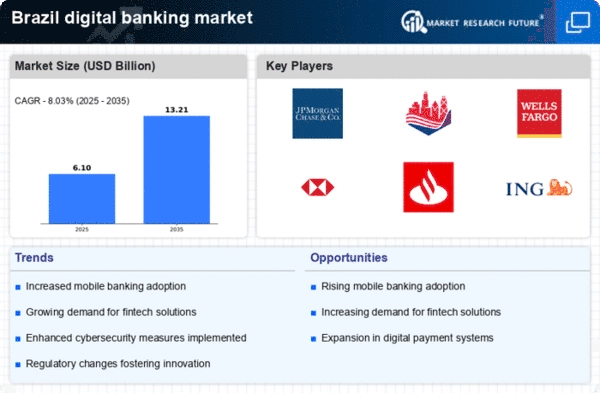
As per Market Research Future analysis, the Brazil digital banking market was estimated at 5.65 USD Billion in 2024. The Brazil digital banking market is projected to grow from 6.1 USD Billion in 2025 to 13.21 USD Billion by 2035, exhibiting a compound annual growth rate (CAGR) of 8.0% during the forecast period 2025 - 2035

Key Market Trends & Highlights

The Brazil digital banking market is experiencing robust growth driven by technological advancements and changing consumer preferences.

  • Mobile banking adoption is surging, with a notable increase in user engagement across various demographics.
  • The integration of advanced technologies, such as AI and blockchain, is transforming service delivery and operational efficiency.
  • The regulatory landscape is evolving, prompting banks to adapt to new compliance requirements and consumer protection standards.
  • Key market drivers include rising smartphone penetration and growing demand for financial inclusion, which are reshaping the banking experience.

Market Size & Forecast

2024 Market Size 5.65 (USD Billion)
2035 Market Size 13.21 (USD Billion)
CAGR (2025 - 2035) 8.03%

Major Players

JPMorgan Chase (US), Bank of America (US), Wells Fargo (US), HSBC (GB), Santander (ES), ING (NL), BNP Paribas (FR), Barclays (GB), Deutsche Bank (DE)

Our Impact
Enabled $4.3B Revenue Impact for Fortune 500 and Leading Multinationals
Partnering with 2000+ Global Organizations Each Year
30K+ Citations by Top-Tier Firms in the Industry

Brazil Digital Banking Market Trends

The digital banking market is experiencing notable evolution, driven by technological advancements and changing consumer preferences. In recent years, there has been a marked increase in the adoption of mobile banking applications, which offer users convenience and accessibility. This shift appears to be influenced by a growing demand for seamless financial services that can be accessed anytime and anywhere. Furthermore, the integration of artificial intelligence and machine learning technologies is enhancing customer experiences, enabling personalized services and improved security measures. As a result, financial institutions are increasingly investing in digital platforms to meet the expectations of tech-savvy consumers. Moreover, regulatory frameworks are adapting to support innovation within the digital banking market. Authorities are implementing policies that encourage competition and protect consumers, which may lead to a more dynamic landscape. The rise of fintech companies is also reshaping traditional banking models, as these entities often provide niche services that cater to specific customer needs. This trend suggests a potential shift in how financial services are delivered, with an emphasis on user-centric solutions. Overall, the digital banking market is poised for continued growth, reflecting broader trends in technology and consumer behavior.

Increased Mobile Banking Adoption

The rise of mobile banking applications is transforming how consumers interact with financial services. Users are increasingly favoring apps that provide easy access to their accounts, enabling transactions and management on-the-go. This trend indicates a shift towards convenience and efficiency in banking.

Integration of Advanced Technologies

The incorporation of artificial intelligence and machine learning is enhancing the digital banking market. These technologies facilitate personalized customer experiences and bolster security measures, suggesting a future where banking is more tailored to individual needs.

Evolving Regulatory Landscape

Regulatory bodies are adapting to the rapid changes in the digital banking market. New policies are being introduced to foster innovation while ensuring consumer protection, which may lead to a more competitive and diverse financial services environment.

Brazil Digital Banking Market Drivers

Emergence of Fintech Startups

The emergence of fintech startups is reshaping the digital banking market in Brazil. These innovative companies are leveraging technology to offer unique financial solutions, often targeting niche markets that traditional banks may overlook. As of 2025, the number of fintech startups in Brazil has surged, with over 600 active companies providing services ranging from peer-to-peer lending to robo-advisory. This proliferation of fintechs is likely to intensify competition within the digital banking market, compelling established banks to adapt and innovate. Collaborations between traditional banks and fintechs are becoming increasingly common, as they seek to combine strengths and enhance service offerings. This trend not only fosters innovation but also accelerates the adoption of digital banking solutions among consumers. As fintechs continue to disrupt the financial landscape, the digital banking market is expected to evolve, driven by the need for agility and customer-centric services.

Rising Smartphone Penetration

The increasing penetration of smartphones in Brazil is a pivotal driver for the digital banking market. As of 2025, approximately 85% of the Brazilian population owns a smartphone, facilitating access to banking services. This trend indicates a shift towards mobile-first banking solutions, as users prefer managing their finances through mobile applications. The digital banking market is likely to benefit from this surge, as financial institutions adapt their services to cater to a tech-savvy demographic. Moreover, the convenience of mobile banking applications enhances user engagement, potentially leading to higher transaction volumes. As more individuals embrace digital solutions, the competitive landscape among banks intensifies, prompting innovation and improved customer experiences. This dynamic environment suggests that the digital banking market will continue to expand, driven by the widespread adoption of smartphones across various socio-economic segments.

Increased Cybersecurity Awareness

As the digital banking market expands in Brazil, the importance of cybersecurity has become increasingly pronounced. With rising incidents of cyber threats, consumers are more aware of the need for secure banking solutions. In 2025, approximately 70% of Brazilians express concerns about online security, prompting banks to invest heavily in advanced cybersecurity measures. This heightened awareness is likely to drive demand for digital banking services that prioritize security, such as multi-factor authentication and encryption technologies. Financial institutions that effectively communicate their commitment to safeguarding customer data may gain a competitive edge in the digital banking market. Furthermore, regulatory bodies are also emphasizing the need for robust cybersecurity frameworks, which could lead to stricter compliance requirements. As a result, banks are compelled to enhance their security protocols, fostering trust and confidence among users, which is essential for sustained growth in the digital banking market.

Shift Towards Contactless Payments

The shift towards contactless payment methods is significantly influencing the digital banking market in Brazil. As of November 2025, contactless transactions account for approximately 40% of all card payments in the country, reflecting a growing consumer preference for convenience and speed. This trend is likely to accelerate as more merchants adopt contactless payment systems, further integrating digital banking solutions into everyday transactions. The digital banking market is poised to benefit from this evolution, as banks enhance their offerings to include seamless payment options. Additionally, the rise of digital wallets and payment apps aligns with consumer expectations for quick and secure transactions. This shift not only improves customer satisfaction but also encourages higher transaction volumes, ultimately driving revenue growth for digital banking institutions. As contactless payments become the norm, the competitive landscape will likely evolve, with banks striving to innovate and differentiate their services.

Growing Demand for Financial Inclusion

Financial inclusion remains a critical driver for the digital banking market in Brazil. With a significant portion of the population previously unbanked, digital banking solutions offer an accessible alternative to traditional banking. As of 2025, around 30% of Brazilians still lack access to formal banking services, highlighting a substantial opportunity for digital banks to bridge this gap. The digital banking market is likely to see growth as institutions develop tailored products for underserved communities, such as microloans and low-fee accounts. Additionally, government initiatives aimed at promoting financial literacy and access to banking services further bolster this trend. By leveraging technology, digital banks can reach remote areas, providing essential financial services to those who have been historically excluded. This focus on inclusion not only enhances the customer base but also contributes to the overall economic development of the country.


Market Segment Insights

By Banking Type: Retail Banking (Largest) vs. Investment Banking (Fastest-Growing)

In the Brazil digital banking market, Retail Banking remains the largest segment, capturing a substantial market share due to its widespread adoption among consumers. This segment caters to individual customers and small businesses, offering essential services such as savings accounts, loans, and payment solutions. Meanwhile, Investment Banking is emerging as the fastest-growing segment, driven by an increasing demand for investment products and advisory services among corporations and affluent clients. The growth trends in this segment are influenced by various factors, including technological advancements and changing consumer preferences. Retail Banking is being transformed by the integration of digital platforms that enhance customer experience and efficiency. Simultaneously, Investment Banking is benefiting from a rise in venture capital investments and a growing interest in capital markets, making it an attractive option for investors looking for growth opportunities.

Retail Banking: Dominant vs. Investment Banking: Emerging

Retail Banking is characterized by its focus on providing essential banking services to individual consumers and small enterprises. It has a broad customer base and is integral to the daily financial activities of individuals, making it the dominant segment in the market. In contrast, Investment Banking, though smaller in market share, represents an emerging opportunity with its focus on providing specialized financial services such as underwriting, mergers and acquisitions, and asset management for corporate clients. This sector is rapidly expanding as corporations seek sophisticated financing solutions and expert advisory services, thus driving adoption and investment in this segment. The contrasting dynamics of these segments highlight the diverse needs of customers in the Brazil digital banking market.

By Solution: Mobile Banking App (Largest) vs. Digital Wallets (Fastest-Growing)

In the Brazil digital banking market, the segment distribution reveals that mobile banking apps dominate the landscape, holding a significant market share due to their widespread adoption among consumers for everyday banking needs. Following closely are digital wallets, which have seen a notable increase in usage, especially among younger demographics looking for convenient and cashless transaction options. Online banking platforms and peer-to-peer payment apps also contribute to the overall market dynamic, yet they remain less prominent compared to the top two solutions. The growth trends in this segment are driven primarily by the increase in smartphone penetration and internet accessibility, which encourage consumers to adopt mobile-centric banking solutions. Furthermore, the ongoing shift towards cashless transactions, heightened by the pandemic, has accelerated the adoption of digital wallets and P2P payment apps. Key players are also continuously enhancing their offerings, leading to increased competition and innovation, which further fosters growth within the segment.

Mobile Banking App (Dominant) vs. Digital Wallets (Emerging)

Mobile banking apps serve as the cornerstone of the digital banking experience in Brazil, offering users a comprehensive suite of banking services right from their smartphones. This segment is characterized by its user-friendly interfaces and strong security features, making banking more accessible and efficient for users. On the other hand, digital wallets are an emerging solution that has gained traction rapidly, especially among tech-savvy individuals who prefer seamless and instant payment options. They provide convenience for both online shopping and in-person transactions, appealing to consumers looking for speed and ease. While mobile banking apps maintain a robust presence, digital wallets are carving out their niche, with increasing adoption rates as businesses and consumers alike embrace cashless payment methods.

By Operating Type: Domestic Banking (Largest) vs. International Banking (Fastest-Growing)

In the operating type segment of the Brazil digital banking market, domestic banking holds a significant share, dominating the landscape. The familiarity and established presence of domestic banking institutions create a robust user base, fostering trust and reliability. Meanwhile, international banking, while currently smaller in market share, is rapidly increasing its footprint as customers hunger for diverse financial solutions and global connectivity, making it a competitive force in the market. Growth trends in this segment are propelled by technological advancements and a growing digital-savvy consumer base. Domestic banking continues to benefit from ongoing innovation in service delivery and customer experience, while international banking rides the wave of globalization, presenting appealing products and services to users seeking overseas financial options. This dynamic interplay positions both segments for robust growth in the upcoming years.

Domestic Banking: Established (Dominant) vs. International Banking (Emerging)

Domestic banking in the Brazil digital banking market represents an established segment, characterized by a strong customer base and a wide range of accessible services. These banks offer tailored solutions that cater to the local consumer needs, making them the preferred option for everyday banking activities. On the other hand, international banking is seen as an emerging player, attracting customers with its innovative offerings and global capabilities, which are appealing to a market increasingly open to international financial options. As competition intensifies, both segments are expected to adapt and evolve, creating a more diverse financial landscape that could lead to enhanced consumer choices.

By Deployment Model: Cloud Based (Largest) vs. On-Premises (Fastest-Growing)

In the Brazil digital banking market, the deployment model segment is predominantly led by cloud-based solutions, which hold the largest market share due to their scalability, flexibility, and cost-effectiveness. Cloud computing has become a preferred choice for many banks and financial institutions, enabling them to innovate rapidly and respond to changing consumer demands more efficiently. On-premises solutions, while still significant, represent a smaller portion of the market as they often entail higher upfront costs and maintenance requirements. Growth trends indicate that on-premises solutions are emerging rapidly, driven by organizations' needs for enhanced security and control over sensitive customer data. The shift towards hybrid models is also promoting their appeal, combining cloud benefits with on-premises capabilities. As regulatory requirements tighten, businesses are likely to invest in secure on-premises solutions, creating new opportunities for development and growth in the sector.

Cloud Based (Dominant) vs. On-Premises (Emerging)

Cloud-based deployment models dominate the landscape, offering scalability and accessibility that align with modern financial services needs. They allow institutions to reduce operational costs and speed up service delivery. Conversely, on-premises models are emerging as they provide enhanced data security and compliance with local regulations, catering to businesses that prioritize control and customization. This duality in deployment preferences represents a significant trend, reflecting varying risk appetites among institutions. As digital transformation accelerates, both models will continue to coexist, each appealing to different segments of the market based on their unique requirements.

By Organization Size: SMEs (Largest) vs. Large Enterprises (Fastest-Growing)

In the Brazil digital banking market, SMEs hold a substantial portion of the market share, driven by their increasing reliance on digital solutions to streamline operations and improve customer service. The adaptability of SMEs to embrace technology positions them favorably, as they navigate through challenges with innovative banking solutions tailored for their needs. Conversely, large enterprises are rapidly adopting digital banking services, contributing to their growing influence in this market segment and reflecting a shift in consumer expectations towards more integrated financial services. As the digital landscape in Brazil continues to evolve, the demand for advanced banking features is driving growth across both segments. SMEs are motivated by improved operational efficiency and cost-effectiveness, while large enterprises focus on enhancing customer experiences through technology. Popular trends, including mobile banking and personalized financial solutions, are facilitating this transformation and creating competitive advantages that enable both SMEs and large enterprises to thrive within the Brazil digital banking market.

SMEs: Dominant vs. Large Enterprises: Emerging

SMEs distinguish themselves as the dominant force in the Brazil digital banking market due to their agility and necessity for personalized services. They typically seek cost-efficient solutions and flexible payment terms to manage their cash flows effectively. In contrast, large enterprises represent an emerging segment that is quickly gaining traction as they integrate sophisticated digital banking technologies into their operations. These entities tend to leverage data analytics and AI to enhance decision-making processes and customer engagement. While SMEs foster a rich ecosystem of innovation and adaptability, large enterprises are setting higher benchmarks for service delivery, pushing the boundaries of what digital banking can offer.

Get more detailed insights about Brazil Digital Banking Market

Key Players and Competitive Insights

The digital banking market in Brazil is characterized by a dynamic competitive landscape, driven by rapid technological advancements and evolving consumer preferences. Major players such as JPMorgan Chase (US), HSBC (GB), and Santander (ES) are actively reshaping their strategies to enhance customer engagement and operational efficiency. For instance, JPMorgan Chase (US) has focused on expanding its digital offerings, leveraging data analytics to personalize services, while HSBC (GB) emphasizes sustainability in its operations, integrating eco-friendly practices into its digital banking solutions. Santander (ES) has adopted a regional expansion strategy, enhancing its digital footprint across Latin America, which collectively intensifies competition and fosters innovation within the market.
The business tactics employed by these key players reflect a blend of localization and technological integration. The market appears moderately fragmented, with a mix of established banks and emerging fintech companies vying for market share. This competitive structure allows for diverse offerings, as companies localize their services to meet the unique needs of Brazilian consumers. The influence of these major players is significant, as they set benchmarks for service quality and technological adoption, thereby shaping the overall market dynamics.
In October 2025, HSBC (GB) announced a partnership with a leading Brazilian fintech to enhance its digital payment solutions. This strategic move is likely to bolster HSBC's position in the market by providing innovative payment options tailored to local consumer preferences. The collaboration may also facilitate the integration of advanced technologies, such as blockchain, into their services, thereby enhancing security and efficiency.
In September 2025, Santander (ES) launched a new mobile banking app specifically designed for the Brazilian market, featuring AI-driven financial advisory services. This initiative underscores Santander's commitment to digital transformation and customer-centricity, potentially attracting a younger demographic that values convenience and personalized financial guidance. The app's success could further solidify Santander's market presence and drive customer loyalty.
In August 2025, JPMorgan Chase (US) expanded its investment in Brazilian startups, focusing on fintech innovations. This strategic investment is indicative of JPMorgan's intent to tap into the burgeoning fintech ecosystem in Brazil, which is characterized by rapid growth and technological disruption. By fostering relationships with local startups, JPMorgan may enhance its service offerings and gain insights into emerging trends, positioning itself as a leader in the digital banking space.
As of November 2025, the competitive trends in the digital banking market are increasingly defined by digitalization, sustainability, and the integration of artificial intelligence. Strategic alliances among key players are shaping the landscape, fostering innovation and enhancing service delivery. The shift from price-based competition to a focus on technological advancement and supply chain reliability is evident, suggesting that future competitive differentiation will hinge on the ability to innovate and adapt to changing consumer demands.

Key Companies in the Brazil Digital Banking Market include

Industry Developments

The Brazil Digital Banking Market has experienced significant developments recently, with various companies gaining traction. In October 2023, Nubank announced a strategic partnership with Banco do Brasil to expand digital credit offers to their customers, enhancing accessibility to financial services. The competitive landscape remains vibrant as C6 Bank and Neon continue to innovate, attracting new users with improved features and services. Mercado Pago has also expanded its footprint in the Brazilian market by enhancing its payment solutions, catering to the growing demand for digital transactions. In September 2023, StoneCo acquired a significant share of PagSeguro, strengthening its market position. 

Banco Inter reported impressive growth in customer acquisition, reflecting a general trend towards digital banking adoption in Brazil. The Brazilian Central Bank's initiatives to boost digital financial inclusion have propelled this growth, leading to a rising market valuation for companies like XP Inc and Santander Brasil. The digital banking sector has become a crucial part of Brazil’s financial ecosystem, driven by increasing smartphone penetration and a shift in consumer preferences towards digital channels. Over the past two to three years, the regulatory landscape has evolved to accommodate new financial technology, advancing Brazil's digital banking capabilities significantly.

Future Outlook

Brazil Digital Banking Market Future Outlook

The digital banking market in Brazil is projected to grow at an 8.03% CAGR from 2025 to 2035, driven by technological advancements, increased smartphone penetration, and evolving consumer preferences.

New opportunities lie in:

  • Development of AI-driven personalized banking solutions
  • Expansion of mobile payment platforms targeting SMEs
  • Integration of blockchain technology for secure transactions

By 2035, the digital banking market is expected to be robust, reflecting substantial growth and innovation.

Market Segmentation

Brazil Digital Banking Market Solution Outlook

  • Online Banking Platforms
  • Mobile Banking App
  • Digital Wallets
  • Peer-to-Peer (P2P) Payment Apps
  • Contactless Payments
  • Others

Brazil Digital Banking Market Banking Type Outlook

  • Retail Banking
  • Corporate Banking
  • Investment Banking
  • Ethical/Socially Responsible Banking

Brazil Digital Banking Market Operating Type Outlook

  • International Banking
  • Domestic Banking

Brazil Digital Banking Market Deployment Model Outlook

  • Cloud Based
  • On-Premises

Brazil Digital Banking Market Organization Size Outlook

  • SMEs
  • Large Enterprises

Report Scope

MARKET SIZE 2024 5.65(USD Billion)
MARKET SIZE 2025 6.1(USD Billion)
MARKET SIZE 2035 13.21(USD Billion)
COMPOUND ANNUAL GROWTH RATE (CAGR) 8.03% (2025 - 2035)
REPORT COVERAGE Revenue Forecast, Competitive Landscape, Growth Factors, and Trends
BASE YEAR 2024
Market Forecast Period 2025 - 2035
Historical Data 2019 - 2024
Market Forecast Units USD Billion
Key Companies Profiled JPMorgan Chase (US), Bank of America (US), Wells Fargo (US), HSBC (GB), Santander (ES), ING (NL), BNP Paribas (FR), Barclays (GB), Deutsche Bank (DE)
Segments Covered Banking Type, Solution, Operating Type, Deployment Model, Organization Size
Key Market Opportunities Adoption of advanced technologies enhances customer experience in the digital banking market.
Key Market Dynamics Rapid technological advancements drive competition and reshape consumer expectations in Brazil's digital banking market.
Countries Covered Brazil
Leave a Comment

FAQs

What is the expected market size of the Brazil Digital Banking Market in 2024?

In 2024, the Brazil Digital Banking Market is expected to be valued at 638.4 million USD.

What will be the projected market size for the Brazil Digital Banking Market by 2035?

By 2035, the Brazil Digital Banking Market is projected to reach a valuation of 1488.0 million USD.

What is the expected compound annual growth rate (CAGR) for the Brazil Digital Banking Market from 2025 to 2035?

The expected CAGR for the Brazil Digital Banking Market from 2025 to 2035 is 7.997%.

Which service type holds the largest market share in the Brazil Digital Banking Market?

Mobile Banking is a significant service type, valued at 180.0 million USD in 2024.

What is the projected growth of the Online Banking segment by 2035?

The Online Banking segment is projected to grow to 480.0 million USD by 2035.

What are the key players in the Brazil Digital Banking Market?

Key players include C6 Bank, Nubank, Mercado Pago, and Bradesco among others.

How large is the Digital Wallets segment expected to be in 2035?

The Digital Wallets segment is expected to reach 280.0 million USD by 2035.

What is the market size for Payment Processing in 2024?

The Payment Processing segment is valued at 158.4 million USD in 2024.

What growth opportunities exist within the Brazil Digital Banking Market?

There are substantial opportunities for growth driven by the increasing adoption of digital payments and banking services.

How does the competitive landscape look in the Brazil Digital Banking Market?

The competitive landscape features a mix of established banks and fintech startups vying for market share.

Download Free Sample

Kindly complete the form below to receive a free sample of this Report

Compare Licence

×
Features License Type
Single User Multiuser License Enterprise User
Price $4,950 $5,950 $7,250
Maximum User Access Limit 1 User Upto 10 Users Unrestricted Access Throughout the Organization
Free Customization
Direct Access to Analyst
Deliverable Format
Platform Access
Discount on Next Purchase 10% 15% 15%
Printable Versions