×
Request Free Sample ×

Kindly complete the form below to receive a free sample of this Report

* Please use a valid business email

Leading companies partner with us for data-driven Insights

clients tt-cursor
Hero Background

Brazil Consumer Packaged Goods Market

ID: MRFR/CG/42686-HCR
128 Pages
Tejas Chaudhary
February 2026

Brazil Consumer Packaged Goods Market Size, Share, Industry Trend & Analysis Research Report: By Product Type (FoodBeverage, CosmeticsPersonal Care, Pharmaceuticals, Nutraceuticals, Others), By End User (Residential/Retail, Commercial, 20Above) andBy Distribution Channel (Offline, Online)- Forecast to 2035

Share:
Download PDF ×

We do not share your information with anyone. However, we may send you emails based on your report interest from time to time. You may contact us at any time to opt-out.

Brazil Consumer Packaged Goods Market Infographic
Purchase Options

Brazil Consumer Packaged Goods Market Summary

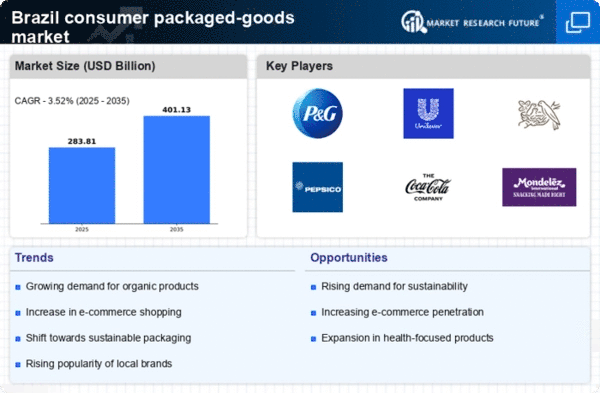
As per Market Research Future analysis, the Brazil Consumer Packaged-Goods Market size was Estimated at 40.12 USD Billion in 2024. The Brazil Consumer Packaged-Goods Market is projected to grow from 41.8 USD Billion in 2025 to 62.7 USD Billion by 2035, exhibiting a compound annual growth rate (CAGR) of 4.14% during the forecast period 2025 - 2035

Key Market Trends & Highlights

The Brazil consumer packaged-goods market is experiencing a dynamic shift towards health-conscious and sustainable products.

  • The health and wellness segment is the largest, driven by increasing consumer awareness and demand for nutritious options.
  • Sustainability and eco-friendly products are gaining traction, reflecting a growing preference for environmentally responsible choices.
  • E-commerce is the fastest-growing channel, as consumers increasingly opt for online shopping for convenience and variety.
  • Key market drivers include the rising middle-class population and health-conscious consumer behavior, which are shaping purchasing decisions.

Market Size & Forecast

2024 Market Size 40.12 (USD Billion)
2035 Market Size 62.7 (USD Billion)
CAGR (2025 - 2035) 4.14%

Major Players

Procter & Gamble (US), Unilever (GB), Nestle (CH), PepsiCo (US), Coca-Cola (US), Mondelez International (US), Johnson & Johnson (US), Colgate-Palmolive (US)

Our Impact
Enabled $4.3B Revenue Impact for Fortune 500 and Leading Multinationals
Partnering with 2000+ Global Organizations Each Year
30K+ Citations by Top-Tier Firms in the Industry

Brazil Consumer Packaged Goods Market Trends

The consumer packaged-goods market in Brazil is currently experiencing a dynamic transformation, driven by evolving consumer preferences and increasing competition among brands. As consumers become more health-conscious, there is a noticeable shift towards products that emphasize natural ingredients and sustainability. This trend is reflected in the growing demand for organic and eco-friendly options, which are perceived as healthier alternatives. Additionally, the rise of e-commerce has significantly altered the purchasing landscape, allowing consumers to access a wider variety of products conveniently. This shift not only enhances consumer choice but also compels traditional retailers to adapt their strategies to remain competitive. Moreover, the economic landscape in Brazil plays a crucial role in shaping the consumer packaged-goods market. With fluctuating economic conditions, consumers are becoming more price-sensitive, leading to an increased interest in value-for-money products. Brands are responding by offering promotions and discounts, as well as developing private label products that cater to budget-conscious shoppers. This environment fosters innovation, as companies strive to balance quality and affordability. Overall, the consumer packaged-goods market in Brazil is poised for continued growth, driven by changing consumer behaviors and strategic adaptations by brands.

Health and Wellness Focus

There is a growing emphasis on health and wellness within the consumer packaged-goods market. Consumers are increasingly seeking products that promote better health, leading to a rise in demand for organic, natural, and functional foods. This trend reflects a broader societal shift towards healthier lifestyles.

Sustainability and Eco-Friendly Products

Sustainability is becoming a key consideration for consumers in their purchasing decisions. The demand for eco-friendly packaging and products that minimize environmental impact is on the rise. Brands are responding by adopting sustainable practices and promoting their commitment to environmental responsibility.

E-Commerce Growth

The expansion of e-commerce is reshaping the consumer packaged-goods market. More consumers are turning to online shopping for convenience and variety. This trend is prompting brands to enhance their digital presence and optimize their supply chains to meet the demands of online consumers.

Brazil Consumer Packaged Goods Market Drivers

Rising Middle-Class Population

The consumer packaged-goods market in Brazil is experiencing a notable shift due to the rising middle-class population. This demographic expansion is characterized by increased disposable income, which enhances purchasing power. As more consumers enter the middle class, they tend to seek higher-quality products, leading to a greater demand for premium goods. Recent data indicates that approximately 30% of Brazilian households now belong to the middle class, a significant increase from previous years. This trend is likely to drive growth in the consumer packaged-goods market, as these consumers prioritize convenience and quality in their purchasing decisions. Furthermore, the middle class's inclination towards brand loyalty may encourage companies to innovate and diversify their product offerings to cater to evolving consumer preferences.

Health-Conscious Consumer Behavior

Health-conscious consumer behavior is significantly influencing the consumer packaged-goods market in Brazil. As awareness of health and wellness increases, consumers are gravitating towards products that offer nutritional benefits. This trend is reflected in the rising demand for organic and natural products, which have seen a growth of approximately 15% in recent years. Consumers are increasingly scrutinizing labels and seeking transparency regarding ingredients, which is prompting manufacturers to reformulate products to meet these expectations. The shift towards healthier options is likely to drive innovation within the consumer packaged-goods market, as companies strive to align their offerings with the evolving preferences of health-conscious consumers.

Technological Advancements in Retail

Technological advancements are reshaping the consumer packaged-goods market in Brazil, particularly in retail. The integration of technology in shopping experiences, such as mobile payment systems and digital marketing, is enhancing consumer engagement. Retailers are increasingly adopting e-commerce platforms, which have seen a growth rate of over 25% in recent years. This shift towards online shopping is likely to continue, as consumers appreciate the convenience and variety offered by digital channels. Moreover, technology enables better inventory management and supply chain efficiency, which can lead to reduced costs and improved product availability. As a result, the consumer packaged-goods market is poised for growth as retailers leverage technology to meet consumer demands.

Urbanization and Changing Lifestyles

Urbanization in Brazil is a critical driver of the consumer packaged-goods market. As more individuals migrate to urban areas, lifestyles are changing, leading to increased demand for convenience-oriented products. Urban consumers often have busier schedules, which results in a preference for ready-to-eat meals and packaged snacks. Data suggests that urban areas account for over 85% of Brazil's GDP, highlighting the economic significance of these regions. This urban-centric lifestyle is likely to propel the growth of the consumer packaged-goods market, as companies adapt their strategies to meet the needs of time-constrained consumers. Additionally, urbanization fosters a culture of brand awareness, further influencing purchasing behaviors and preferences.

Influence of Social Media and Marketing

The influence of social media and marketing strategies is a pivotal driver in the consumer packaged-goods market in Brazil. With the proliferation of social media platforms, brands are able to engage directly with consumers, fostering a sense of community and brand loyalty. Approximately 70% of Brazilian internet users are active on social media, making it a powerful tool for marketing campaigns. This engagement not only enhances brand visibility but also allows for real-time feedback from consumers, which can inform product development. As brands increasingly utilize social media for promotions and consumer interaction, the consumer packaged-goods market is likely to see a shift in purchasing behaviors, with consumers more inclined to buy products endorsed by influencers or trending on social platforms.


Market Segment Insights

By Type: Food and Beverages (Largest) vs. Health Care Products (Fastest-Growing)

In the Brazil consumer packaged-goods market, the Food and Beverages segment takes the lead, showcasing a considerable market share compared to its counterparts. This segment captures the largest portion of consumer spending, driven by the perennial demand for essential food items and beverages. Following closely, Personal Care and Household Care Products maintain noteworthy shares, though they trail behind the dominance of Food and Beverages. This distribution reflects consumers' prioritization of food needs over other personal and household care products. Looking forward, the Health Care Products segment is emerging as the fastest-growing category, energizing market dynamics. Factors such as increasing health awareness, aging population, and rising disposable incomes are key drivers propelling this segment. Consumers are increasingly investing in health-related products, influenced by wellness trends and preventive healthcare measures. This evolving landscape suggests substantial opportunities for growth across the market segments as consumer preferences adjust to both convenience and quality.

Food and Beverages: Dominant vs. Health Care Products: Emerging

The Food and Beverages segment stands out as the dominant player in the Brazil consumer packaged-goods market, characterized by its vast array of essential products that cater to diverse consumer tastes. This sector encompasses a wide range of items, from packaged food and beverages to snacks and dietary supplements, reflecting the enduring demand for nourishment. In contrast, the Health Care Products segment is marked as an emerging force, driven by the changing consumer landscape towards wellness and preventive health. With innovations and a shift in consumer preferences toward health-focused products, this segment is capturing increasing attention among manufacturers and retailers, paving the way for strategic developments and new product introductions.

By Distribution Channel: Supermarkets (Largest) vs. E-commerce (Fastest-Growing)

In the Brazil consumer packaged-goods market, Supermarkets dominate the distribution channel, capturing a significant market share. This channel is preferred by consumers for its wide variety of products, convenience, and strong brand presence. Meanwhile, E-commerce emerges as a rapidly growing segment, appealing to tech-savvy consumers and those seeking convenience without leaving their homes. The shift in consumer behavior towards online shopping has provided E-commerce platforms an opportunity to bolster their market share. The growth trends in this segment are heavily influenced by the increasing internet penetration and rising smartphone usage in Brazil. E-commerce's seamless shopping experience attracts new consumers, particularly the younger demographics. Additionally, Supermarkets are evolving by integrating online shopping options, which may further enhance their market position. This segment is poised for dynamic changes driven by technology and changing consumer preferences.

Supermarkets: Dominant vs. E-commerce: Emerging

Supermarkets in the Brazil consumer packaged-goods market hold a dominant position with extensive physical locations and a broad assortment of products, allowing them to cater to diverse consumer needs. They attract consumers through promotional offers and loyalty programs while ensuring product availability. Conversely, E-commerce is an emerging channel that is redefining shopping experiences. It offers convenience through home delivery services and online discounts. The growth in digital payment methods and logistics solutions further enhances the appeal of E-commerce. As consumers increasingly favor quick and easy transactions, E-commerce's rapid expansion represents a shift in traditional shopping behavior, positioning it as a formidable competitor to Supermarkets.

By Packaging Type: Bottles (Largest) vs. Pouches (Fastest-Growing)

In the Brazil consumer packaged-goods market, the packaging type segment reveals a competitive landscape dominated by bottles, which hold the largest market share, thanks to their widespread use across various beverage and household product categories. Cans and boxes follow, providing consumers with diverse packaging options, while pouches are emerging as a popular choice, particularly in food products, appealing to the preference for convenience and portability. The growth trends in the packaging type segment are influenced by changing consumer preferences toward sustainability and product longevity. Bottles continue to dominate due to their versatility and reusability. In contrast, pouches are rapidly gaining traction, driven by their lightweight nature and space-saving features, catering to the increasing demand for on-the-go solutions in the consumer packaged-goods market.

Bottles: Dominant vs. Pouches: Emerging

Bottles are the dominant packaging type in the Brazil consumer packaged-goods market, primarily due to their acceptance in beverages, personal care, and cleaners, which require robustness and an appealing presentation. Their ability to be recycled and reused enhances their appeal in a market increasingly focused on sustainability. On the other hand, pouches represent an emerging trend characterized by innovation in convenience packaging. With their lightweight design, pouches cater to the busy lifestyles of consumers and are especially popular in snacks and liquid products. This shift towards flexible packaging is reshaping the competitive landscape, as brands aim to attract environmentally conscious consumers by offering eco-friendly pouch options.

By End User: Households (Largest) vs. Businesses (Fastest-Growing)

In the Brazil consumer packaged-goods market, the main end user segment is Households, which dominate the market share due to the consistently high demand for everyday essentials. This segment encompasses a wide range of products, from food and beverages to personal care items, catering to the diverse preferences of Brazilian families. Businesses represent a growing segment, increasingly utilizing consumer packaged goods for operational needs, contributing notably to market dynamics. Growth trends indicate that the Business segment is rapidly emerging as the fastest-growing end user in the Brazil consumer packaged-goods market. Factors driving this growth include the expansion of the retail sector, increased consumption by small to medium-sized enterprises, and a rising number of commercial establishments opting for packaged goods to ensure quality and convenience. These trends not only signify a shift toward packaged goods in business operations but also highlight the evolving consumption patterns in Brazil.

Households: Dominant vs. Businesses: Emerging

Households serve as the dominant end user segment in the Brazil consumer packaged-goods market, characterized by their extensive consumption of essential products. Households prioritize convenience and quality, influencing their purchasing decisions across food, beverages, and personal care categories. In contrast, Businesses represent an emerging segment that is gaining traction due to the need for efficiency and quality assurance in supplies. As various sectors, including hospitality and retail, expand, their reliance on packaged goods continues to surge. This shift reflects a broader transition in consumer behavior, indicating a venue for growth in tailored packaged solutions that meet the needs of both households and businesses, fostering competition and innovation within the market.

Get more detailed insights about Brazil Consumer Packaged Goods Market

Key Players and Competitive Insights

The consumer packaged-goods market in Brazil is characterized by a dynamic competitive landscape, driven by evolving consumer preferences and increasing demand for sustainable products. Major players such as Procter & Gamble (US), Unilever (GB), and Nestlé (CH) are actively shaping the market through strategic initiatives focused on innovation and sustainability. Procter & Gamble (US) emphasizes product innovation and digital transformation, aiming to enhance consumer engagement through personalized marketing strategies. Unilever (GB) continues to prioritize sustainability, with a commitment to reducing plastic waste and promoting eco-friendly products, thereby appealing to environmentally conscious consumers. Nestlé (CH) is leveraging its extensive portfolio to expand its presence in health and wellness segments, indicating a shift towards more health-oriented offerings. Collectively, these strategies contribute to a competitive environment that is increasingly focused on sustainability and consumer-centric innovation.Key business tactics employed by these companies include localizing manufacturing and optimizing supply chains to enhance efficiency and responsiveness to market demands. The market structure appears moderately fragmented, with several key players holding substantial market shares while also facing competition from local brands. This fragmentation allows for diverse product offerings and fosters innovation, as companies strive to differentiate themselves in a crowded marketplace.
In October Procter & Gamble (US) announced a partnership with a local Brazilian startup to develop biodegradable packaging solutions. This strategic move not only aligns with the company's sustainability goals but also enhances its competitive edge by addressing growing consumer concerns regarding plastic waste. The collaboration is expected to bolster Procter & Gamble's market position by appealing to eco-conscious consumers and potentially increasing brand loyalty.
In September Unilever (GB) launched a new line of plant-based personal care products specifically tailored for the Brazilian market. This initiative reflects the company's strategy to tap into the growing demand for natural and organic products. By catering to local preferences, Unilever aims to strengthen its foothold in the region and differentiate itself from competitors, thereby enhancing its market share.
In August Nestlé (CH) expanded its health-focused product range by introducing a new line of fortified snacks aimed at children. This strategic expansion is indicative of Nestlé's commitment to addressing nutritional gaps in the Brazilian market. By focusing on health and wellness, the company not only meets consumer demand but also positions itself as a leader in the health-oriented segment of the consumer packaged-goods market.
As of November current trends in the competitive landscape include a pronounced shift towards digitalization, sustainability, and the integration of artificial intelligence in product development and marketing strategies. Strategic alliances are increasingly shaping the market, enabling companies to leverage shared resources and expertise. Looking ahead, competitive differentiation is likely to evolve from traditional price-based competition to a focus on innovation, technology, and supply chain reliability. This shift underscores the importance of adapting to consumer preferences and market dynamics in a rapidly changing environment.

Key Companies in the Brazil Consumer Packaged Goods Market include

Industry Developments

Recent developments in the Brazil Consumer Packaged Goods Market include a significant increase in demand for health-focused products, driven by changing consumer preferences post-pandemic. Companies such as Nestlé and Danone have been introducing innovative product lines to cater to this trend, particularly in the dairy and snack segments, with enhancements in nutrition and functional benefits. Additionally, PG and Unilever are actively investing in sustainability initiatives to reduce their environmental footprints, aligning with growing consumer awareness and preference for eco-friendly products.

Notably, in September 2023, Coca-Cola announced its expansion of beverage offerings in Brazil, targeting the growing non-alcoholic segment, while Heineken is amplifying its presence in the craft beverage market by acquiring local microbreweries. In recent years, Ambev has expanded its product portfolio to include hard seltzers, reflecting emergent trends in beverage choices. This diversification is critical as the economic landscape in Brazil evolves, with inflation affecting consumer purchasing power. The Brazilian market for packaged goods is expected to grow, driven by shifts toward convenience and premium products, which has compelled companies like Kimberly-Clark and JBS to adapt their strategies accordingly.


Future Outlook

Brazil Consumer Packaged Goods Market Future Outlook

The Consumer Packaged Goods Market in Brazil is projected to grow at a 4.14% CAGR from 2025 to 2035, driven by urbanization, e-commerce expansion, and changing consumer preferences.

New opportunities lie in:

  • Development of eco-friendly packaging solutions to attract sustainability-focused consumers. Investment in AI-driven supply chain optimization for enhanced efficiency and cost reduction. Expansion of private label products to capture price-sensitive market segments.

By 2035, the market is expected to demonstrate robust growth and increased competitiveness.

Market Segmentation

Brazil Consumer Packaged Goods Market Type Outlook

  • Food and Beverages
  • Personal Care Products
  • Household Care Products
  • Health Care Products

Brazil Consumer Packaged Goods Market End User Outlook

  • Households
  • Businesses
  • Institutions

Brazil Consumer Packaged Goods Market Packaging Type Outlook

  • Bottles
  • Cans
  • Boxes
  • Pouches

Brazil Consumer Packaged Goods Market Distribution Channel Outlook

  • Supermarkets
  • Convenience Stores
  • E-commerce
  • Discount Stores

Report Scope

MARKET SIZE 2024 40.12 (USD Billion)
MARKET SIZE 2025 41.8 (USD Billion)
MARKET SIZE 2035 62.7 (USD Billion)
COMPOUND ANNUAL GROWTH RATE (CAGR) 4.14% (2025 - 2035)
REPORT COVERAGE Revenue Forecast, Competitive Landscape, Growth Factors, and Trends
BASE YEAR 2024
Market Forecast Period 2025 - 2035
Historical Data 2019 - 2024
Market Forecast Units USD Billion
Key Companies Profiled Procter & Gamble (US), Unilever (GB), Nestle (CH), PepsiCo (US), Coca-Cola (US), Mondelez International (US), Johnson & Johnson (US), Colgate-Palmolive (US)
Segments Covered Type, Distribution Channel, Packaging Type, End User
Key Market Opportunities Adoption of sustainable packaging solutions driven by consumer demand for eco-friendly products.
Key Market Dynamics Shifting consumer preferences towards sustainability drive innovation in Brazil's consumer packaged-goods market.
Countries Covered Brazil
Leave a Comment

FAQs

What is the projected market size of the Brazil Consumer Packaged Goods Market in 2024?

The Brazil Consumer Packaged Goods Market is expected to be valued at 40.12 USD Billion in 2024.

What is the forecasted market size of the Brazil Consumer Packaged Goods Market by 2035?

By 2035, the Brazil Consumer Packaged Goods Market is projected to reach a valuation of 62.7 USD Billion.

What is the expected CAGR for the Brazil Consumer Packaged Goods Market from 2025 to 2035?

The expected compound annual growth rate (CAGR) for the Brazil Consumer Packaged Goods Market is 4.14% from 2025 to 2035.

Which product type dominates the Brazil Consumer Packaged Goods Market?

The Food Beverage segment dominates the Brazil Consumer Packaged Goods Market, valued at 140.0 USD Billion in 2024.

What is the market value for the Cosmetics Personal Care segment in the Brazil Consumer Packaged Goods Market by 2024?

The Cosmetics Personal Care segment is valued at 70.0 USD Billion in the Brazil Consumer Packaged Goods Market in 2024.

Who are the major players in the Brazil Consumer Packaged Goods Market?

Key players in the market include Procter and Gamble, Danone, Kimberly-Clark, Heineken, and PepsiCo, among others.

What is the forecasted size for Pharmaceuticals in the Brazil Consumer Packaged Goods Market by 2035?

The Pharmaceuticals segment is expected to reach 90.0 USD Billion by 2035.

What growth opportunities exist in Brazil's Nutraceuticals segment for 2025 to 2035?

The Nutraceuticals segment is projected to grow significantly, reaching 65.0 USD Billion by 2035.

How does the Others segment in the Brazil Consumer Packaged Goods Market compare in value from 2024 to 2035?

The Others segment is anticipated to grow from 23.99 USD Billion in 2024 to 50.0 USD Billion by 2035.

What challenges will the Brazil Consumer Packaged Goods Market face in the coming years?

The market may face challenges such as fluctuating consumer preferences and competitive pricing pressures in the upcoming years.

What is the market value for the Cosmetics & Personal Care segment in the Brazil Consumer Packaged Goods Market by 2024?

The Cosmetics & Personal Care segment is valued at 70.0 USD Billion in the Brazil Consumer Packaged Goods Market in 2024.

What growth opportunities exist in the Nutraceuticals segment for 2025 to 2035 in Brazil?

The Nutraceuticals segment is projected to grow significantly, reaching 65.0 USD Billion by 2035.

What challenges does the Brazil Consumer Packaged Goods Market face in the upcoming years?

The market may face challenges such as fluctuating consumer preferences and competitive pricing pressures in the upcoming years.

Download Free Sample

Kindly complete the form below to receive a free sample of this Report

Compare Licence

×
Features License Type
Single User Multiuser License Enterprise User
Price $4,950 $5,950 $7,250
Maximum User Access Limit 1 User Upto 10 Users Unrestricted Access Throughout the Organization
Free Customization
Direct Access to Analyst
Deliverable Format
Platform Access
Discount on Next Purchase 10% 15% 15%
Printable Versions