×
Request Free Sample ×

Kindly complete the form below to receive a free sample of this Report

* Please use a valid business email

Leading companies partner with us for data-driven Insights

clients tt-cursor
Hero Background

Brazil Computing Power Market

ID: MRFR/ICT/57770-HCR
200 Pages
Aarti Dhapte
February 2026

Brazil Computing Power Market Research Report By Component (Servers, Software, Services, Others), By Deployment Mode (On-Premise, Cloud) and By End-Users (BFSI, Gaming, Media & Entertainment, Retail, Transportation, Government & Defense, Education & Research, Manufacturing, Healthcare & Biosciences, Others)- Forecast to 2035

Share:
Download PDF ×

We do not share your information with anyone. However, we may send you emails based on your report interest from time to time. You may contact us at any time to opt-out.

Brazil Computing Power Market Infographic
Purchase Options

Brazil Computing Power Market Summary

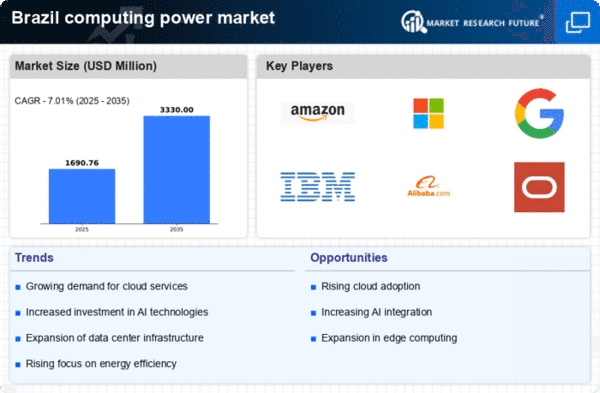
As per Market Research Future analysis, the Brazil Computing Power Market size was estimated at 1580.0 USD Million in 2024. The Computing Power market is projected to grow from 1690.76 USD Million in 2025 to 3330.0 USD Million by 2035, exhibiting a compound annual growth rate (CAGR) of 7.0% during the forecast period 2025 - 2035

Key Market Trends & Highlights

The Brazil computing power market is experiencing robust growth driven by technological advancements and increasing demand.

  • Cloud computing adoption is rapidly increasing, positioning it as the largest segment in the Brazil computing power market.
  • Artificial intelligence integration is emerging as the fastest-growing segment, reflecting a shift towards advanced computational capabilities.
  • Government support and regulation are fostering a conducive environment for technology investments and innovation.
  • Rising demand for data centers and increased investment in technology startups are key drivers propelling market expansion.

Market Size & Forecast

2024 Market Size 1580.0 (USD Million)
2035 Market Size 3330.0 (USD Million)
CAGR (2025 - 2035) 7.01%

Major Players

Amazon (US), Microsoft (US), Google (US), IBM (US), Alibaba (CN), Oracle (US), Tencent (CN), NVIDIA (US), Intel (US)

Our Impact
Enabled $4.3B Revenue Impact for Fortune 500 and Leading Multinationals
Partnering with 2000+ Global Organizations Each Year
30K+ Citations by Top-Tier Firms in the Industry

Brazil Computing Power Market Trends

The Brazil Computing Power Market in Brazil is evolving dynamically, driven by advancements in technology and increasing demand for data processing capabilities. The rise of cloud computing services has significantly influenced the landscape, as businesses and individuals seek efficient solutions for their computational needs. This shift towards cloud infrastructure is not merely a trend but appears to be a fundamental change in how computing resources are accessed and utilized. Furthermore, the growing emphasis on artificial intelligence and machine learning applications is likely to propel the demand for enhanced computing power, as these technologies require substantial processing capabilities to function effectively. In addition to technological advancements, regulatory frameworks and government initiatives are playing a crucial role in shaping the computing power market. Brazil's commitment to fostering innovation and digital transformation is evident through various policies aimed at supporting tech startups and enhancing digital infrastructure. This environment encourages investment in computing resources, which may lead to increased competition among service providers. As the market continues to mature, it seems poised for further growth, with potential opportunities for both local and international players to capitalize on the expanding demand for computing power solutions.

Cloud Computing Adoption

The shift towards cloud computing is reshaping the computing power market. Businesses are increasingly migrating to cloud platforms to leverage scalable resources and reduce operational costs. This trend indicates a preference for flexible computing solutions that can adapt to varying workloads.

Artificial Intelligence Integration

The integration of artificial intelligence technologies is driving demand for advanced computing power. As organizations seek to implement AI-driven applications, the need for robust processing capabilities becomes paramount, suggesting a potential surge in investments in high-performance computing.

Government Support and Regulation

Government initiatives aimed at promoting digital transformation are influencing the computing power market. Policies designed to support innovation and enhance infrastructure may create a favorable environment for growth, encouraging investments in computing resources and technology.

Brazil Computing Power Market Drivers

Growing E-commerce Sector

The e-commerce sector in Brazil is experiencing rapid growth, which is significantly impacting the computing power market. In 2025, e-commerce sales are projected to exceed $50 billion, necessitating robust computing infrastructure to support online transactions, data analytics, and customer engagement. This surge in online retail activities requires enhanced computing power to manage large volumes of transactions and customer data. Consequently, businesses are investing in scalable computing solutions to ensure seamless operations. The growth of e-commerce not only drives demand for computing resources but also encourages advancements in technology, thereby shaping the future of the computing power market in Brazil.

Expansion of 5G Technology

The rollout of 5G technology in Brazil is poised to revolutionize the computing power market by enabling faster data transmission and improved connectivity. As of November 2025, 5G networks are being deployed across major urban areas, facilitating the development of smart cities and IoT applications. This technological advancement is expected to increase the demand for computing power, as devices connected to 5G networks will require enhanced processing capabilities to handle real-time data. The expansion of 5G is likely to create new opportunities for businesses in the computing power market, as they adapt to the growing need for high-speed data processing and low-latency applications.

Rising Demand for Data Centers

The increasing reliance on digital services in Brazil has led to a notable rise in demand for data centers, which are crucial for the computing power market. As businesses and consumers generate vast amounts of data, the need for efficient data storage and processing capabilities becomes paramount. In 2025, the data center market in Brazil is projected to grow by approximately 15%, driven by the expansion of cloud services and the Internet of Things (IoT). This growth indicates a robust investment in infrastructure, which is essential for supporting the computing power market. Furthermore, the establishment of new data centers is likely to create job opportunities and stimulate local economies, thereby enhancing the overall landscape of the computing power market in Brazil.

Focus on Cybersecurity Solutions

With the rise in digital transactions and data storage, the need for robust cybersecurity solutions has become increasingly critical in Brazil. In 2025, the cybersecurity market is projected to grow by 20%, reflecting the heightened awareness of data protection among businesses and consumers. This growth is likely to drive demand for advanced computing power, as sophisticated security measures require substantial processing capabilities. Companies in the computing power market are expected to invest in technologies that enhance security protocols, thereby ensuring the integrity of data and systems. The emphasis on cybersecurity not only protects users but also strengthens the overall trust in digital platforms, which is essential for the continued growth of the computing power market.

Increased Investment in Technology Startups

Brazil has witnessed a surge in investment in technology startups, particularly those focused on innovative computing solutions. In 2025, venture capital funding in the tech sector is expected to reach $2 billion, with a significant portion directed towards companies developing advanced computing technologies. This influx of capital is likely to foster innovation and competition within the computing power market. Startups are increasingly exploring areas such as edge computing and AI-driven applications, which could enhance processing capabilities and efficiency. As these startups grow, they may contribute to the overall expansion of the computing power market, positioning Brazil as a key player in the regional tech ecosystem.


Market Segment Insights

By Component: Servers (Largest) vs. Software (Fastest-Growing)

The component segment reveals a diverse market share distribution in Brazil computing power market. Servers dominate this sector, capturing a significant share due to their critical role in data processing and storage solutions. Software follows, increasingly recognized for its value in optimizing server performance and managing large data sets. Services and other components hold smaller shares, yet they are essential in providing comprehensive solutions to businesses. Growth trends indicate a robust expansion in software solutions, identified as the fastest-growing component, driven by the rising demand for cloud computing and digital transformation initiatives. The increasing reliance on automated technologies and big data analytics fuels the growth of services, while servers remain stable, supported by continuous advancements in hardware technology and increasing enterprise investments.

Servers (Dominant) vs. Software (Emerging)

Servers are the backbone of IT infrastructure, representing the dominant force within the Brazil computing power market. They are essential for handling large-scale data processing and storage needs for businesses across various industries. Features such as scalability and reliability significantly enhance their appeal. On the other hand, software is emerging rapidly as businesses focus on digital innovation. As the fastest-growing segment, software aids organizations in maximizing server capabilities and driving efficiency. This segment is characterized by a shift towards cloud-based solutions and AI-driven applications, making it a vital area for investment and development.

By Deployment Mode: Cloud (Largest) vs. On-premise (Fastest-Growing)

In the Brazil computing power market, the deployment mode segment is prominently dominated by cloud solutions which hold the largest share of the total market. The preference for cloud deployments is driven by their scalability, flexibility, and the ability to serve diverse applications effectively. This widespread adoption is complemented by growing internet penetration and the demand for advanced data processing capabilities. Conversely, on-premise deployments are emerging as the fastest-growing segment in this market. Organizations are increasingly prioritizing data sovereignty and control over their IT infrastructure, leading to a resurgence in on-premise solutions. This trend is fueled by industries that require compliance with stringent regulations and those with specific performance requirements, creating a unique niche that is rapidly expanding.

Cloud (Dominant) vs. On-premise (Emerging)

Cloud deployment solutions are characterized by their ability to deliver computing power on-demand without the need for substantial upfront investment in hardware. This model appeals especially to small and medium enterprises (SMEs) due to its cost-effectiveness and ease of management. On the other hand, the on-premise segment is making a comeback, seen as an emerging alternative for organizations with sensitive data or strict regulatory needs. These setups offer enhanced security and reliability. The combination of these two approaches creates a dynamic ecosystem where enterprises can pick and choose based on their operational requirements, establishing a balanced market landscape.

By End User: BFSI (Largest) vs. Gaming (Fastest-Growing)

In the Brazil computing power market, the distribution of market share among various end-user segments showcases the dominant role of the BFSI sector, which utilizes advanced computing solutions for secure transactions and data management. Gaming has also carved out a significant share, indicative of the growing popularity of online gaming and eSports in the region, appealing to a younger demographic that drives demand for high-performance computing capabilities. Growth trends within the end-user segments reveal a strong upward trajectory for gaming, fueled by an expanding base of gamers and increasing investments in gaming infrastructure. BFSI remains critical, supported by the ongoing digital transformation in financial services. The healthcare sector is also emerging as a key player due to the growing demand for data analytics and processing in biosciences, enhancing decision-making and patient care processes.

BFSI: Dominant vs. Gaming: Emerging

The BFSI sector is characterized by its robust demand for computing power, focusing on data security, transaction speed, and regulatory compliance. This dominance is driven by the need for advanced analytics and real-time processing to enhance customer experience and operational efficiency. Conversely, the gaming segment is rapidly evolving, driven by innovations in graphics and processing technology, making it the fastest-growing sector in the market. The appeal of immersive experiences in gaming, coupled with a burgeoning eSports industry, is pushing the boundaries of hardware requirements, establishing it as an emerging powerhouse in the region.

Get more detailed insights about Brazil Computing Power Market

Key Players and Competitive Insights

The computing power market in Brazil is characterized by a dynamic competitive landscape, driven by rapid technological advancements and increasing demand for cloud services. Major players such as Amazon (US), Microsoft (US), and Google (US) are strategically positioned to leverage their extensive resources and innovative capabilities. Amazon (US) focuses on expanding its AWS services, emphasizing regional data centers to enhance service delivery. Microsoft (US) is heavily investing in AI and machine learning capabilities, aiming to integrate these technologies into its Azure platform. Google (US) continues to enhance its cloud offerings, particularly in data analytics and machine learning, which positions it favorably against competitors. Collectively, these strategies foster a competitive environment that is increasingly centered on technological innovation and customer-centric solutions.
Key business tactics employed by these companies include localizing manufacturing and optimizing supply chains to better serve the Brazilian market. The competitive structure appears moderately fragmented, with several key players vying for market share. However, the influence of major companies is substantial, as they set industry standards and drive technological advancements that smaller firms often follow.
In October 2025, Amazon (US) announced the opening of a new data center in São Paulo, aimed at enhancing its cloud service capabilities in Brazil. This strategic move is likely to bolster its market presence and improve service reliability for local businesses, reflecting a commitment to regional expansion. The establishment of this facility may also serve to attract more clients seeking robust cloud solutions, thereby intensifying competition in the sector.
In September 2025, Microsoft (US) unveiled a partnership with a Brazilian fintech company to develop AI-driven financial solutions. This collaboration underscores Microsoft's focus on integrating AI into its cloud services, potentially revolutionizing the financial sector in Brazil. By aligning with local firms, Microsoft not only enhances its service offerings but also strengthens its foothold in the market, indicating a trend towards localized partnerships that cater to specific industry needs.
In August 2025, Google (US) launched a new initiative aimed at promoting sustainable computing practices among its cloud customers in Brazil. This initiative emphasizes energy efficiency and carbon neutrality, aligning with global sustainability trends. By positioning itself as a leader in sustainable technology, Google (US) may attract environmentally conscious businesses, thereby differentiating itself in a competitive landscape increasingly focused on sustainability.
As of November 2025, current trends in the computing power market are heavily influenced by digitalization, sustainability, and the integration of AI technologies. Strategic alliances are becoming more prevalent, as companies recognize the value of collaboration in enhancing their service offerings. Looking ahead, competitive differentiation is likely to evolve from traditional price-based competition to a focus on innovation, technological advancements, and supply chain reliability. This shift suggests that companies will need to invest significantly in R&D and partnerships to maintain a competitive edge in an increasingly complex market.

Key Companies in the Brazil Computing Power Market include

Industry Developments

Recent developments in the Brazil Computing Power Market reflect a dynamic landscape characterized by technological growth and strategic partnerships.AWS announces an investment of R$10.1 billion (~US$1.8 billion) in the expansion of its Brazilian data center operations through 2034 in September 2024. In September 2024, Microsoft pledged R$14.7 billion (approximately US$2.7 billion) over three years to invest in cloud and AI infrastructure in Brazil.

This trend aligns with the broader expansion strategies of major players like Google and Microsoft, as they continue to invest in developing data centers across the region. Over the past two years, Brazil has seen an upsurge in market valuation, with Alibaba Cloud experiencing substantial growth as local businesses seek scalable solutions. These developments collectively enhance Brazil's position in the global computing power sector, reflecting a robust commitment to digital transformation.

Future Outlook

Brazil Computing Power Market Future Outlook

The computing power market in Brazil is projected to grow at a 7.01% CAGR from 2025 to 2035. This growth is driven by advancements in AI, cloud computing, and data analytics.

New opportunities lie in:

  • Development of AI-optimized cloud services for businesses
  • Expansion of edge computing solutions in urban areas
  • Investment in renewable energy-powered data centers

By 2035, the computing power market is expected to be robust, driven by innovation and strategic investments.

Market Segmentation

Brazil Computing Power Market End User Outlook

  • BFSI
  • Gaming
  • Media & Entertainment
  • Retail
  • Transportation
  • Government & Defense
  • Education & Research
  • Manufacturing
  • Healthcare & Biosciences
  • Others

Brazil Computing Power Market Component Outlook

  • Servers
  • Software
  • Services
  • Others

Brazil Computing Power Market Deployment Mode Outlook

  • On-premise
  • Cloud

Report Scope

MARKET SIZE 2024 1580.0(USD Million)
MARKET SIZE 2025 1690.76(USD Million)
MARKET SIZE 2035 3330.0(USD Million)
COMPOUND ANNUAL GROWTH RATE (CAGR) 7.01% (2025 - 2035)
REPORT COVERAGE Revenue Forecast, Competitive Landscape, Growth Factors, and Trends
BASE YEAR 2024
Market Forecast Period 2025 - 2035
Historical Data 2019 - 2024
Market Forecast Units USD Million
Key Companies Profiled Amazon (US), Microsoft (US), Google (US), IBM (US), Alibaba (CN), Oracle (US), Tencent (CN), NVIDIA (US), Intel (US)
Segments Covered Component, Deployment Mode, End User
Key Market Opportunities Growing demand for cloud computing and artificial intelligence drives expansion in the computing power market.
Key Market Dynamics Rising demand for cloud computing services drives competition and innovation in the computing power market.
Countries Covered Brazil
Leave a Comment

FAQs

What is the expected market size of the Brazil Computing Power Market in 2024?

The Brazil Computing Power Market is expected to be valued at 2.07 billion USD in 2024.

What will be the estimated market size of the Brazil Computing Power Market by 2035?

By 2035, the Brazil Computing Power Market is projected to reach a value of 4.43 billion USD.

What is the compound annual growth rate (CAGR) for the Brazil Computing Power Market from 2025 to 2035?

The market is expected to grow at a CAGR of 7.139% from 2025 to 2035.

Which component of the market is anticipated to have the largest growth by 2035?

The Servers component is projected to be valued at 1.5 billion USD by 2035, making it a significant growth area.

What is the market value of the Software segment in the year 2024?

In 2024, the Software segment of the Brazil Computing Power Market is valued at 0.4 billion USD.

Who are the key players in the Brazil Computing Power Market?

Key players in the market include SAP, Cisco, Nutanix, Huawei, Dell Technologies, Google, and Microsoft among others.

What market value is associated with Services in the Brazil Computing Power Market in 2024?

The Services component is valued at 0.55 billion USD in the year 2024.

What are the anticipated growth drivers for the Brazil Computing Power Market?

The growing demand for data processing and cloud solutions are key drivers for market growth.

What is the expected market value for the Others segment by 2035?

The Others segment is expected to reach 0.93 billion USD by 2035.

How does the current global scenario impact the Brazil Computing Power Market?

The current global scenario increases the demand for robust computing power solutions to support various applications.

Download Free Sample

Kindly complete the form below to receive a free sample of this Report

Compare Licence

×
Features License Type
Single User Multiuser License Enterprise User
Price $4,950 $5,950 $7,250
Maximum User Access Limit 1 User Upto 10 Users Unrestricted Access Throughout the Organization
Free Customization
Direct Access to Analyst
Deliverable Format
Platform Access
Discount on Next Purchase 10% 15% 15%
Printable Versions