×
Request Free Sample ×

Kindly complete the form below to receive a free sample of this Report

* Please use a valid business email

Leading companies partner with us for data-driven Insights

clients tt-cursor
Hero Background

Brazil Cloud Billing Market

ID: MRFR/ICT/61674-HCR
200 Pages
Aarti Dhapte
February 2026

Brazil Cloud Billing Market Research Report By Deployment Model (Public Cloud, Private Cloud, Hybrid Cloud), By Billing Type (Subscription Billing, Usage-Based Billing, Tiered Billing, Flat-Rate Billing), By End User (BFSI, Telecom, IT Software, Healthcare, Retail) and By Payment Method (Credit Card, Direct Debit, Digital Wallets, Bank Transfer) - Forecast to 2035

Share:
Download PDF ×

We do not share your information with anyone. However, we may send you emails based on your report interest from time to time. You may contact us at any time to opt-out.

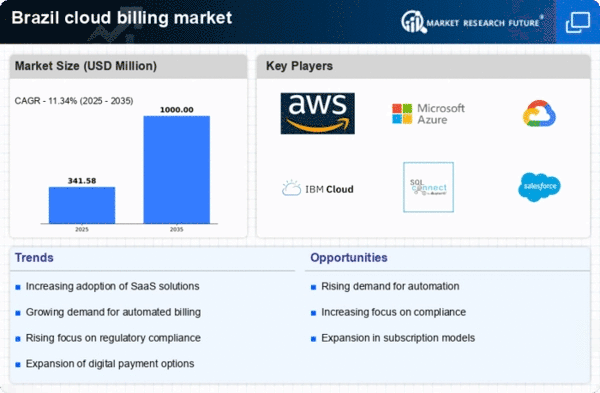
Brazil Cloud Billing Market Infographic
Purchase Options

Brazil Cloud Billing Market Summary

As per Market Research Future analysis, the Brazil cloud billing market size was estimated at 306.79 USD Million in 2024. The Brazil cloud billing market is projected to grow from 341.58 USD Million in 2025 to 1000.0 USD Million by 2035, exhibiting a compound annual growth rate (CAGR) of 11.3% during the forecast period 2025 - 2035

Key Market Trends & Highlights

The Brazil cloud billing market is experiencing robust growth driven by technological advancements and evolving consumer preferences.

  • The market is witnessing increased adoption of subscription models, particularly in the software and e-commerce segments.
  • There is a heightened focus on compliance and security, which is becoming essential for businesses operating in Brazil.
  • Integration of advanced technologies is transforming billing processes, enhancing efficiency and customer experience.
  • Key market drivers include the growing demand for flexible billing solutions and the rise of e-commerce and digital services.

Market Size & Forecast

2024 Market Size 306.79 (USD Million)
2035 Market Size 1000.0 (USD Million)
CAGR (2025 - 2035) 11.34%

Major Players

Amazon Web Services (US), Microsoft Azure (US), Google Cloud (US), IBM Cloud (US), Oracle Cloud (US), Salesforce (US), SAP (DE), Alibaba Cloud (CN), DigitalOcean (US)

Our Impact
Enabled $4.3B Revenue Impact for Fortune 500 and Leading Multinationals
Partnering with 2000+ Global Organizations Each Year
30K+ Citations by Top-Tier Firms in the Industry

Brazil Cloud Billing Market Trends

The cloud billing market is currently experiencing notable growth, driven by the increasing adoption of cloud computing solutions across various sectors. Organizations are increasingly recognizing the benefits of cloud-based billing systems, which offer enhanced flexibility, scalability, and cost-effectiveness. This shift is largely attributed to the need for businesses to streamline their financial operations and improve cash flow management. As companies transition to digital platforms, the demand for efficient billing solutions is expected to rise, leading to a more competitive landscape. Furthermore, the integration of advanced technologies such as artificial intelligence and machine learning into billing systems is likely to enhance operational efficiency and customer satisfaction. In addition, regulatory compliance and data security concerns are becoming paramount in the cloud billing market. Companies are required to adhere to stringent regulations regarding data protection and financial reporting. This has led to an increased focus on developing secure billing solutions that not only meet compliance standards but also protect sensitive customer information. As the market evolves, it appears that service providers will need to prioritize security features and compliance capabilities to remain competitive. Overall, the cloud billing market is poised for continued expansion, driven by technological advancements and the growing need for efficient financial management solutions.

Increased Adoption of Subscription Models

The trend towards subscription-based pricing models is gaining traction within the cloud billing market. Businesses are increasingly favoring these models due to their predictable revenue streams and enhanced customer retention. This shift allows companies to offer flexible payment options, catering to diverse customer needs and preferences.

Focus on Compliance and Security

As regulatory requirements become more stringent, there is a heightened emphasis on compliance and security within the cloud billing market. Organizations are prioritizing solutions that ensure adherence to local regulations while safeguarding sensitive financial data. This focus is likely to drive innovation in security features and compliance capabilities.

Integration of Advanced Technologies

The incorporation of advanced technologies such as artificial intelligence and machine learning is transforming the cloud billing market. These technologies enable automation of billing processes, improving accuracy and efficiency. As businesses seek to enhance operational performance, the demand for intelligent billing solutions is expected to rise.

Brazil Cloud Billing Market Drivers

Increased Focus on Cost Efficiency

Cost efficiency remains a critical driver in the cloud billing market in Brazil. Organizations are increasingly seeking ways to reduce operational costs while maintaining service quality. Cloud billing solutions offer the potential for significant savings by minimizing the need for on-premises infrastructure and reducing administrative overhead. According to industry reports, companies that adopt cloud billing systems can achieve cost reductions of up to 30%. This financial incentive encourages businesses to migrate to cloud-based billing solutions, thereby driving market growth. As competition intensifies, the emphasis on cost-effective solutions is likely to shape the cloud billing market landscape in Brazil.

Rise of E-commerce and Digital Services

The rapid expansion of e-commerce and digital services in Brazil is a key driver for the cloud billing market. As online shopping and digital transactions become more prevalent, businesses require efficient billing systems to manage their operations. The Brazilian e-commerce market is projected to grow by 30% in 2025, further fueling the demand for cloud billing solutions that can handle high transaction volumes and provide real-time analytics. This trend indicates that companies are seeking integrated billing systems that can seamlessly connect with their e-commerce platforms. The cloud billing market is likely to benefit from this growth, as businesses look for solutions that enhance their operational efficiency and customer experience.

Regulatory Compliance and Data Protection

In Brazil, the cloud billing market is significantly influenced by the stringent regulatory landscape surrounding data protection and compliance. The implementation of the General Data Protection Law (LGPD) mandates that companies ensure the security and privacy of customer data. As a result, cloud billing solutions must incorporate robust compliance features to meet these legal requirements. This necessity creates a competitive edge for providers that can offer secure and compliant billing systems. The market for cloud services in Brazil is expected to reach $10 billion by 2026, with a substantial portion attributed to compliance-driven solutions. Consequently, businesses are increasingly prioritizing cloud billing systems that not only streamline operations but also adhere to regulatory standards.

Growing Demand for Flexible Billing Solutions

The cloud billing market in Brazil experiences a notable surge in demand for flexible billing solutions. As businesses increasingly transition to cloud-based services, the need for adaptable billing systems becomes paramount. Companies seek solutions that can accommodate varying pricing models, such as pay-as-you-go and tiered pricing. This flexibility allows organizations to optimize their costs and enhance customer satisfaction. According to recent data, the Brazilian cloud services market is projected to grow at a CAGR of 20% from 2025 to 2030, indicating a robust expansion in the cloud billing market. This growth is likely driven by the increasing number of startups and SMEs adopting cloud technologies, thereby necessitating innovative billing solutions that cater to diverse business needs.

Technological Advancements in Billing Systems

Technological advancements play a pivotal role in shaping the cloud billing market in Brazil. Innovations such as artificial intelligence, machine learning, and automation are transforming traditional billing processes. These technologies enable more accurate billing, improved customer insights, and enhanced operational efficiency. As businesses increasingly adopt these advanced technologies, the demand for sophisticated cloud billing solutions rises. The market is expected to witness a growth rate of 25% in the next five years, driven by the integration of these technologies into billing systems. This trend suggests that companies are prioritizing innovative solutions that not only streamline billing but also provide valuable data analytics to inform business decisions.


Market Segment Insights

By Deployment Model: Public Cloud (Largest) vs. Private Cloud (Fastest-Growing)

In the Brazil cloud billing market, the deployment model segment exhibits a diverse distribution among public, private, and hybrid cloud solutions. Public cloud services dominate the market, capturing a significant share due to their scalability and cost-effectiveness, appealing to businesses of all sizes. In contrast, private cloud solutions are gaining traction, with organizations recognizing the need for enhanced security and compliance, positioning them as a credible alternative for sensitive data handling. Growth trends indicate a robust expansion for both public and private cloud sectors, driven primarily by increasing digital transformation initiatives across industries. While public cloud offerings continue to attract the majority of users, the rise in data privacy concerns is propelling private cloud adoption at an accelerated rate. Hybrid cloud models are also emerging, offering flexibility and optimized resource allocation, appealing to businesses seeking balanced solutions.

Public Cloud (Dominant) vs. Private Cloud (Emerging)

The public cloud segment stands as the dominant force in the Brazil cloud billing market, characterized by its vast range of services and lower entry costs, making it attractive for startups and large enterprises alike. Public cloud providers offer extensive service catalogs, including computing, storage, and analytics, facilitating innovation and rapid deployment. Conversely, the private cloud segment is classified as emerging, with businesses increasingly prioritizing data security and customized solutions. Private clouds cater to organizations with sensitive information, providing enhanced control and compliance compared to public options. This shift reflects a broader trend towards hybrid deployments where businesses aim to combine the best of both worlds, leveraging public cloud scalability alongside the security of private cloud infrastructures.

By Billing Type: Subscription Billing (Largest) vs. Usage-Based Billing (Fastest-Growing)

Among the various billing types in the cloud billing market, Subscription Billing has established itself as the largest segment, dominating the preference of consumers seeking predictable costs. Usage-Based Billing, while smaller, is rapidly gaining traction, appealing to businesses that favor flexibility and scalability in their spending based on actual usage. The growth trends highlight a significant shift in consumer preferences towards more adaptable billing methods. The increasing demand from businesses looking to optimize operational costs is driving the rise of Usage-Based Billing. Furthermore, as cloud services continue to evolve, the need for varying billing structures that can accommodate different usage patterns is fueling the expansion of both Subscription and Usage-Based Billing models.

Subscription Billing (Dominant) vs. Flat-Rate Billing (Emerging)

Subscription Billing remains the dominant force in the landscape, characterized by its ability to offer consistent and predictable billing cycles, which appeal to many businesses in the Brazil cloud billing market. It typically provides users with all-inclusive packages that ease budgeting and resource allocation. Meanwhile, Flat-Rate Billing is emerging as a viable alternative, favored for its simplicity and transparency. Businesses that desire to avoid complexities find Flat-Rate Billing attractive, leading to its gradual recognition in the market. As both billing types cater to distinct consumer needs, their coexistence reflects the diverse preferences within the market landscape.

By End User: BFSI (Largest) vs. Telecom (Fastest-Growing)

The Brazil cloud billing market exhibits a diverse market share distribution among its end user segments, with BFSI commanding the largest share due to its increasing reliance on digital transformation and regulatory compliance. Following closely is the telecom sector, which has expanded its cloud capacity to accommodate generous data demands and customer service delivery. IT software, healthcare, and retail also contribute significantly, albeit at varying scales of market share distribution, indicative of the nuances in their cloud billing requirements. Growth trends for the end user segments in the Brazil cloud billing market are spurred by a combination of digitization efforts and a growing trend towards remote work solutions. BFSI's growth is fueled by evolving customer expectations and stringent compliance standards driving cloud adoption. The telecom sector is witnessing rapid growth, primarily driven by advancements in mobile technologies and the expansion of 5G networks, which require robust cloud billing solutions. Other sectors like healthcare and retail are recognizing the enhanced operational efficiencies provided by cloud billing, thus promoting their growth prospects in this space.

BFSI: Dominant vs. Telecom: Emerging

In the context of the Brazil cloud billing market, BFSI stands out as the dominant segment, leveraging technology to optimize transactions and manage financial operations efficiently. Its established infrastructure and a high degree of compliance make it a reliable player. Conversely, the telecom sector is marked as an emerging segment, presenting substantial growth opportunities as it adopts innovative cloud solutions to enhance its services. Telecom companies are increasingly investing in cloud billing to enhance customer engagement and streamline operations, adapting quickly to the fast-paced digital landscape. While BFSI continues to lead, the telecom sector's evolution signals its potential for significant expansion, driven by technology and responsiveness to consumer needs.

By Payment Method: Credit Card (Largest) vs. Digital Wallets (Fastest-Growing)

In the Brazil cloud billing market, the distribution of market share among payment methods reveals that Credit Cards hold the largest share due to their widespread acceptance and consumer familiarity. Digital Wallets are gaining significant traction, reflecting a changing consumer landscape that embraces technology-driven solutions for transactions. Direct Debit and Bank Transfers are also present, but they represent smaller portions of market share compared to these two dominant methods. Growth trends indicate a shift towards Digital Wallets as they cater to the increasing demand for convenience and quick transactions. This growth is driven by factors such as mobile payment innovations, enhanced security features, and a rising preference for cashless solutions among consumers. As businesses adapt to these trends, Digital Wallets are expected to see the fastest growth trajectory in the coming years.

Credit Card (Dominant) vs. Digital Wallets (Emerging)

Credit Cards remain the dominant payment method in the Brazil cloud billing market due to their extensive acceptance and established user base. They offer convenience and flexibility, appealing to a broad spectrum of users from individual consumers to enterprises. On the other hand, Digital Wallets are regarded as an emerging solution, increasingly popular among younger demographics who prioritize speed and security in transactions. With features such as instant payment capabilities and loyalty rewards, Digital Wallets are rapidly gaining ground. As businesses seek to integrate more payment options, the competition between Credit Cards and Digital Wallets will intensify, catering to varied consumer preferences and enhancing transaction efficiency in the market.

Get more detailed insights about Brazil Cloud Billing Market

Key Players and Competitive Insights

The cloud billing market in Brazil is characterized by a dynamic competitive landscape, driven by rapid digital transformation and increasing demand for scalable billing solutions. Major players such as Amazon Web Services (US), Microsoft Azure (US), and Google Cloud (US) are at the forefront, leveraging their extensive technological capabilities and global reach. These companies focus on innovation and strategic partnerships to enhance their service offerings, thereby shaping a competitive environment that is both aggressive and collaborative. The emphasis on customer-centric solutions and localized services appears to be a common thread among these key players, indicating a shift towards more tailored approaches in the Brazilian market.In terms of business tactics, companies are increasingly localizing their operations to better serve the Brazilian market. This includes optimizing supply chains and establishing regional data centers to enhance service delivery and compliance with local regulations. The market structure is moderately fragmented, with a mix of established giants and emerging players. The collective influence of these key players fosters a competitive atmosphere where innovation and customer engagement are paramount.

In October Amazon Web Services (US) announced the launch of a new billing solution tailored specifically for small and medium-sized enterprises (SMEs) in Brazil. This strategic move is significant as it aims to democratize access to advanced cloud billing technologies, allowing SMEs to leverage sophisticated tools that were previously accessible only to larger corporations. By focusing on this segment, AWS is likely to capture a substantial share of the growing SME market in Brazil, enhancing its competitive positioning.

In September Microsoft Azure (US) expanded its partnership with local telecommunications providers to offer bundled cloud services that include billing solutions. This initiative is crucial as it not only broadens Azure's market reach but also integrates cloud services with telecommunications, providing customers with a seamless experience. Such partnerships may enhance customer loyalty and drive adoption rates, positioning Microsoft Azure as a formidable competitor in the Brazilian cloud billing landscape.

In August Google Cloud (US) unveiled a new AI-driven billing analytics tool designed to optimize cost management for enterprises in Brazil. This tool is particularly relevant in a market where businesses are increasingly focused on cost efficiency. By integrating AI capabilities, Google Cloud is likely to differentiate itself from competitors, offering clients advanced insights that can lead to better financial decision-making. This strategic focus on AI integration reflects a broader trend within the industry towards leveraging technology for enhanced operational efficiency.

As of November the competitive trends in the cloud billing market are heavily influenced by digitalization, sustainability, and the integration of AI technologies. Strategic alliances among key players are reshaping the landscape, fostering innovation and collaboration. The shift from price-based competition to a focus on technological advancement and supply chain reliability is evident. Companies that prioritize innovation and customer-centric solutions are likely to thrive, as the market continues to evolve towards more sophisticated and integrated billing solutions.

Key Companies in the Brazil Cloud Billing Market include

Industry Developments

In recent months, the Brazil Cloud Billing Market has experienced significant activity, particularly concerning major players like Amazon Web Services and Microsoft Azure. Notably, in May 2023, Microsoft Azure announced enhancements to its cloud billing solutions tailored for Brazilian businesses, promoting cost management and transparency. 

Similarly, Amazon Web Services expanded its cloud services within Brazil, focusing on addressing local data sovereignty laws, which continues to boost the cloud industry's potential growth. Emerging trends are also seeing a shift towards service diversification among companies like Salesforce and Oracle as they adapt to the increasing demand for scalable cloud billing solutions. In terms of mergers and acquisitions, in August 2023, Cloudflare made headlines with its acquisition of a local cybersecurity firm, which aims to enhance its offerings in the region, signaling growth and investment focus. 

Furthermore, over the past couple of years, Brazil has seen a rising market valuation in its cloud sectors, driven by increased digitalization efforts from both government and private sectors, spurring innovation and competition among major cloud providers such as IBM, DigitalOcean, and Google Cloud. This growth aligns with Brazil's broader economic objectives to improve technological infrastructure.

Future Outlook

Brazil Cloud Billing Market Future Outlook

The Cloud Billing Market in Brazil is projected to grow at 11.34% CAGR from 2025 to 2035, driven by increasing cloud adoption and demand for automated billing solutions.

New opportunities lie in:

  • Development of AI-driven billing analytics tools for enhanced revenue management.
  • Integration of blockchain technology for secure and transparent transactions.
  • Expansion of subscription-based billing models tailored for SMEs.

By 2035, the cloud billing market is expected to achieve substantial growth, reflecting evolving business needs.

Market Segmentation

Brazil Cloud Billing Market End User Outlook

  • BFSI
  • Telecom
  • IT Software
  • Healthcare
  • Retail

Brazil Cloud Billing Market Billing Type Outlook

  • Subscription Billing
  • Usage-Based Billing
  • Tiered Billing
  • Flat-Rate Billing

Brazil Cloud Billing Market Payment Method Outlook

  • Credit Card
  • Direct Debit
  • Digital Wallets
  • Bank Transfer

Brazil Cloud Billing Market Deployment Model Outlook

  • Public Cloud
  • Private Cloud
  • Hybrid Cloud

Report Scope

MARKET SIZE 2024 306.79(USD Million)
MARKET SIZE 2025 341.58(USD Million)
MARKET SIZE 2035 1000.0(USD Million)
COMPOUND ANNUAL GROWTH RATE (CAGR) 11.34% (2025 - 2035)
REPORT COVERAGE Revenue Forecast, Competitive Landscape, Growth Factors, and Trends
BASE YEAR 2024
Market Forecast Period 2025 - 2035
Historical Data 2019 - 2024
Market Forecast Units USD Million
Key Companies Profiled Amazon Web Services (US), Microsoft Azure (US), Google Cloud (US), IBM Cloud (US), Oracle Cloud (US), Salesforce (US), SAP (DE), Alibaba Cloud (CN), DigitalOcean (US)
Segments Covered Deployment Model, Billing Type, End User, Payment Method
Key Market Opportunities Adoption of advanced analytics and automation in the cloud billing market enhances operational efficiency and customer satisfaction.
Key Market Dynamics Rising demand for flexible billing solutions drives innovation and competition in Brazil's cloud billing market.
Countries Covered Brazil
Leave a Comment

FAQs

What is the expected market size of the Brazil Cloud Billing Market in 2024?

The Brazil Cloud Billing Market is expected to be valued at 420.0 million USD in 2024.

What is the projected market size for the Brazil Cloud Billing Market in 2035?

By 2035, the Brazil Cloud Billing Market is projected to reach a value of 1000.0 million USD.

What is the expected compound annual growth rate (CAGR) for the Brazil Cloud Billing Market from 2025 to 2035?

The expected CAGR for the Brazil Cloud Billing Market from 2025 to 2035 is 8.206%.

Which deployment model holds the largest market share in the Brazil Cloud Billing Market?

The Public Cloud deployment model is expected to dominate the market, valued at 180.0 million USD in 2024.

How much is the Private Cloud segment expected to be worth in 2035?

The Private Cloud segment is projected to be valued at 300.0 million USD in 2035.

What is the estimated market size for the Hybrid Cloud segment in 2024?

The Hybrid Cloud segment is estimated to be valued at 120.0 million USD in 2024.

Who are the key players in the Brazil Cloud Billing Market?

Major players in the Brazil Cloud Billing Market include Microsoft Azure, Amazon Web Services, Google Cloud, and Oracle.

What opportunities exist for growth in the Brazil Cloud Billing Market?

The market is growing rapidly due to increased adoption of cloud services and digital transformation initiatives.

What challenges does the Brazil Cloud Billing Market face?

Challenges in the market include competition among providers and security concerns related to cloud services.

How is the market growth rate projected for specific segments like Public and Private Cloud?

The Public Cloud is expected to grow significantly, reaching 420.0 million USD by 2035, while the Private Cloud is also on track for substantial growth.

Download Free Sample

Kindly complete the form below to receive a free sample of this Report

Compare Licence

×
Features License Type
Single User Multiuser License Enterprise User
Price $4,950 $5,950 $7,250
Maximum User Access Limit 1 User Upto 10 Users Unrestricted Access Throughout the Organization
Free Customization
Direct Access to Analyst
Deliverable Format
Platform Access
Discount on Next Purchase 10% 15% 15%
Printable Versions