×
Request Free Sample ×

Kindly complete the form below to receive a free sample of this Report

* Please use a valid business email

Leading companies partner with us for data-driven Insights

clients tt-cursor
Hero Background

Brazil Building Insulation Material Market

ID: MRFR/CnM/44113-HCR
111 Pages
Chitranshi Jaiswal
February 2026

Brazil Building Insulation Material Market Research Report: By Material (Stone wool, Glass wool, EPS, XPS, Others), By Application (Walls, Roofs, Floors and By End-User (Commercial, Residential) - Forecast to 2035

Share:
Download PDF ×

We do not share your information with anyone. However, we may send you emails based on your report interest from time to time. You may contact us at any time to opt-out.

Brazil Building Insulation Material Market Infographic
Purchase Options

Brazil Building Insulation Material Market Summary

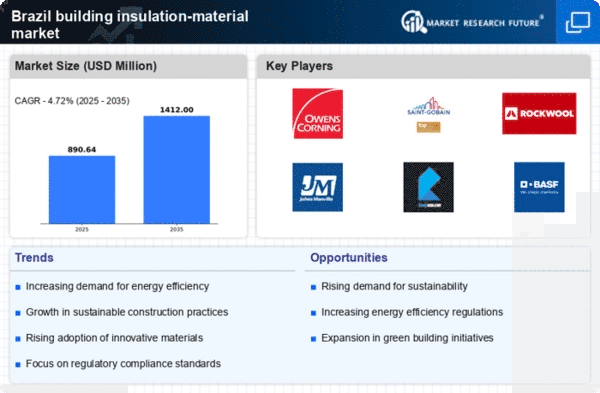
As per Market Research Future analysis, the Brazil building insulation-material market size was estimated at 850.5 USD Million in 2024. The Brazil building insulation-material market is projected to grow from 890.64 USD Million in 2025 to 1412.0 USD Million by 2035, exhibiting a compound annual growth rate (CAGR) of 4.7% during the forecast period 2025 - 2035

Key Market Trends & Highlights

The Brazil building insulation-material market is experiencing a shift towards sustainability and innovation.

  • The market is increasingly driven by a focus on sustainability, with consumers prioritizing eco-friendly insulation solutions.
  • Technological advancements are enhancing the performance and efficiency of insulation materials, making them more appealing to builders.
  • The residential segment remains the largest, while the commercial segment is the fastest-growing in terms of demand for insulation materials.
  • Rising energy costs and government incentives for energy efficiency are key drivers propelling market growth.

Market Size & Forecast

2024 Market Size 850.5 (USD Million)
2035 Market Size 1412.0 (USD Million)
CAGR (2025 - 2035) 4.72%

Major Players

Owens Corning (US), Saint-Gobain (FR), Rockwool International (DK), Johns Manville (US), Knauf Insulation (DE), BASF (DE), Armacell (DE), Kingspan Group (IE)

Our Impact
Enabled $4.3B Revenue Impact for Fortune 500 and Leading Multinationals
Partnering with 2000+ Global Organizations Each Year
30K+ Citations by Top-Tier Firms in the Industry

Brazil Building Insulation Material Market Trends

The building insulation-material market is currently experiencing notable developments. This growth is driven by a combination of regulatory changes and increasing awareness of energy efficiency. In Brazil, the government has implemented various initiatives aimed at promoting sustainable construction practices. These efforts are likely to enhance the demand for advanced insulation materials that contribute to energy savings and improved thermal performance. As a result, manufacturers are focusing on innovation, developing products that not only meet regulatory standards but also cater to the growing consumer preference for eco-friendly solutions. Moreover, the rising cost of energy is prompting both residential and commercial sectors to invest in insulation solutions that can reduce energy consumption. This trend appears to be fostering a competitive landscape where companies are striving to differentiate their offerings through enhanced performance characteristics and sustainability. the building insulation-material market is positioned for growth as stakeholders recognize the long-term benefits of investing in quality insulation solutions. The emphasis on energy efficiency and sustainability is expected to shape the future of this market, leading to increased adoption of innovative materials and technologies.

Sustainability Focus

There is a growing emphasis on sustainable materials within the building insulation-material market. This trend is driven by both consumer demand and regulatory frameworks that encourage the use of eco-friendly products. Manufacturers are increasingly developing insulation solutions that minimize environmental impact while maximizing energy efficiency.

Technological Advancements

Technological innovations are transforming the building insulation-material market. New materials and methods are being introduced, enhancing thermal performance and installation efficiency. These advancements are likely to attract more consumers seeking effective insulation solutions.

Regulatory Support

Government policies are playing a crucial role in shaping the building insulation-material market. Incentives and regulations aimed at improving energy efficiency in buildings are encouraging the adoption of advanced insulation materials. This support is expected to drive market growth and innovation.

Market Segment Insights

By Material Type: Glass Wool (Largest) vs. EPS (Fastest-Growing)

In the Brazil building insulation-material market, the material type segment reveals a diverse distribution with Glass Wool commanding the largest share due to its superior thermal properties and widespread application in residential and commercial buildings. Stone Wool follows closely, benefitting from its fire-resistant attributes, while EPS is gaining ground among builders seeking cost-effective insulation solutions. XPS, although smaller in market presence, retains a dedicated customer base thanks to its high performance in moisture resistance. The growth trends for the material type segment indicate a notable shift towards environmentally friendly insulation materials, with EPS emerging as the fastest-growing segment. Drivers for this growth include increased awareness of energy efficiency, regulations promoting sustainable building practices, and rising demand for lightweight materials that facilitate easier installation. This change is steering investments towards innovative insulation products in the market.

Glass Wool (Dominant) vs. EPS (Emerging)

Glass Wool stands out as the dominant material in the Brazil building insulation-material market, recognized for its excellent insulation capabilities, soundproofing qualities, and affordability. It is widely used across various construction applications, offering a balance of performance and cost-effectiveness. On the other hand, EPS is viewed as an emerging material, rapidly gaining popularity for its lightweight properties and versatility. It is increasingly adopted in modern construction projects, particularly in regions focused on energy efficiency and cost reduction. Both materials are crucial in the evolving landscape of building insulation, catering to differing needs while also aligning with broader sustainability goals.

By Application: Walls (Largest) vs. Floors (Fastest-Growing)

In the Brazil building insulation-material market, the application segment is characterized by diverse uses including walls, roofs, and floors. The walls segment holds the largest market share due to its primary function in energy efficiency and thermal comfort. This segment benefits from regulations promoting insulation in new constructions, ensuring robust performance in the competitive market. The roofs segment, on the other hand, plays a crucial role, but its share is overshadowed by the dominant walls segment. Growth trends indicate that the floors segment is emerging as the fastest-growing application within the market. This surge is driven by a rising demand for improved energy efficiency and comfort in residential and commercial buildings. Innovations in insulation materials are also contributing to this growth, with manufacturers focusing on sustainable and high-performance products that cater to evolving consumer preferences.

Walls (Dominant) vs. Floors (Emerging)

The walls segment is dominant in the Brazil building insulation-material market, often prioritizing energy efficiency, sound insulation, and thermal comfort for residential and commercial spaces. Its widespread adoption is largely influenced by building regulations and the increasing awareness of energy conservation. Conversely, the floors segment is emerging rapidly due to heightened interest in sustainable living and the integration of advanced insulation technologies. This segment is characterized by innovations in material composition and installation techniques, which cater to evolving market demands for both aesthetic appeal and functional performance. With the shift towards environmentally friendly products, the floors segment is expected to see substantial investment and growth in the coming years.

By End-User: Commercial (Largest) vs. Residential (Fastest-Growing)

In the Brazil building insulation-material market, the commercial segment currently holds the largest market share, driven by the substantial investments in infrastructure and commercial projects. Businesses increasingly recognize the value of insulation materials in enhancing energy efficiency and regulatory compliance, bolstering their usage in commercial buildings. In comparison, the residential segment is rapidly gaining traction, capturing the attention of homeowners looking for cost-effective solutions to reduce energy expenses while improving comfort and sustainability in their living spaces. The growth trends in the Brazil building insulation-material market indicate a strong upward trajectory for both segments, although the residential segment is outpacing commercial in terms of growth rate. Factors contributing to this rise include heightened awareness of energy conservation, government incentives promoting sustainable construction practices, and rising demand for eco-friendly materials among consumers. As more residential renovations and new constructions prioritize insulation, this market is poised for expansive growth.

Commercial (Dominant) vs. Residential (Emerging)

The commercial segment of the Brazil building insulation-material market is characterized by its dominance, fueled by large-scale construction activities across various sectors including retail, healthcare, and education. Commercial buildings often require robust insulation solutions to manage operational costs and enhance indoor comfort. Conversely, the residential segment is emerging, appealing to a growing demographic seeking energy-efficient options and sustainable living solutions. This segment's rapid growth is driven by homeowner initiatives aimed at increasing energy efficiency and adopting greener choices. As the market evolves, both segments are likely to witness innovations in insulation technology, catering to the diverse needs of builders and homeowners alike.

Get more detailed insights about Brazil Building Insulation Material Market

Key Players and Competitive Insights

The building insulation-material market in Brazil is characterized by a competitive landscape that is increasingly shaped by innovation, sustainability, and strategic partnerships. Key players such as Owens Corning (US), Saint-Gobain (FR), and Rockwool International (DK) are actively pursuing strategies that emphasize product development and regional expansion. Owens Corning (US), for instance, focuses on enhancing its product portfolio with advanced insulation solutions that cater to the growing demand for energy-efficient buildings. Meanwhile, Saint-Gobain (FR) is leveraging its extensive distribution network to penetrate deeper into the Brazilian market, thereby enhancing its competitive positioning. Rockwool International (DK) appears to be concentrating on sustainability, promoting its stone wool insulation products as environmentally friendly alternatives, which resonates well with the increasing regulatory emphasis on green building practices.In terms of business tactics, companies are localizing manufacturing to reduce costs and improve supply chain efficiency. This approach not only mitigates logistical challenges but also aligns with the growing trend of supporting local economies. The market structure is moderately fragmented, with several players vying for market share, yet the influence of major companies remains substantial. Their collective strategies are likely to shape market dynamics, as they compete not only on price but also on innovation and sustainability.

In October Owens Corning (US) announced a partnership with a local Brazilian firm to develop a new line of eco-friendly insulation products. This strategic move is significant as it not only enhances Owens Corning's product offerings but also aligns with Brazil's increasing focus on sustainable construction practices. The collaboration is expected to leverage local expertise, thereby accelerating product development and market penetration.

In September Saint-Gobain (FR) launched a new initiative aimed at improving energy efficiency in residential buildings through advanced insulation technologies. This initiative is crucial as it positions Saint-Gobain as a leader in the energy efficiency segment, responding to both consumer demand and regulatory pressures for greener building solutions. The initiative is likely to enhance brand loyalty and attract environmentally conscious consumers.

In August Rockwool International (DK) expanded its production capacity in Brazil by investing in a new manufacturing facility. This expansion is indicative of Rockwool's commitment to meeting the rising demand for insulation materials in the region. By increasing local production, Rockwool can better serve its customers while reducing lead times and transportation costs, thus enhancing its competitive edge.

As of November the competitive trends in the building insulation-material market are increasingly defined by digitalization, sustainability, and the integration of advanced technologies such as AI. Strategic alliances are becoming more prevalent, as companies recognize the need to collaborate to enhance innovation and market reach. The competitive landscape is shifting from a focus on price-based competition to one that prioritizes technological advancement, product differentiation, and supply chain reliability. This evolution suggests that companies that can effectively leverage these trends will likely emerge as leaders in the market.


Key Companies in the Brazil Building Insulation Material Market include

Industry Developments

The Brazil Building Insulation Material Market has been witnessing significant developments in recent months. In October 2023, Rockwool, a leading player in the insulation materials sector, announced a strategic investment aimed at expanding its manufacturing capabilities in Brazil to cater to the growing demand for sustainable building solutions. Saint-Gobain has also been active, enhancing its product portfolio by introducing innovative insulation materials suited for the Brazilian climate. In addition, Kingspan's acquisition of a local insulation company in June 2023 has strengthened its presence in the market, contributing to a broader range of energy-efficient solutions.

The market is expected to benefit from government initiatives promoting energy-efficient building practices, with a reported increase in insulation material sales owing to new construction projects. Moreover, Owens Corning's focus on expanding its sustainable product line aligns with Brazil’s increasing commitment to environmental standards, as outlined by the country's recent regulations aimed at reducing energy consumption in buildings. This regulatory framework has further stimulated investment across the insulation sector, highlighting a promising growth trajectory for the Brazil Building Insulation Material Market amid rising demand for eco-friendly construction materials.

Future Outlook

Brazil Building Insulation Material Market Future Outlook

The building insulation-material market in Brazil is projected to grow at a 4.72% CAGR from 2025 to 2035, driven by energy efficiency regulations, rising construction activities, and sustainability trends.

New opportunities lie in:

  • Development of eco-friendly insulation products using recycled materials.
  • Expansion of smart insulation technologies for energy management.
  • Partnerships with construction firms for integrated insulation solutions.

By 2035, the market is expected to achieve robust growth, driven by innovation and sustainability.

Market Segmentation

Brazil Building Insulation Material Market End-User Outlook

  • Commercial
  • Residential

Brazil Building Insulation Material Market Application Outlook

  • Walls
  • Roofs
  • Floors

Brazil Building Insulation Material Market Material Type Outlook

  • Stone wool
  • Glass wool
  • EPS
  • XPS
  • Others

Report Scope

MARKET SIZE 2024 850.5(USD Million)
MARKET SIZE 2025 890.64(USD Million)
MARKET SIZE 2035 1412.0(USD Million)
COMPOUND ANNUAL GROWTH RATE (CAGR) 4.72% (2025 - 2035)
REPORT COVERAGE Revenue Forecast, Competitive Landscape, Growth Factors, and Trends
BASE YEAR 2024
Market Forecast Period 2025 - 2035
Historical Data 2019 - 2024
Market Forecast Units USD Million
Key Companies Profiled Owens Corning (US), Saint-Gobain (FR), Rockwool International (DK), Johns Manville (US), Knauf Insulation (DE), BASF (DE), Armacell (DE), Kingspan Group (IE)
Segments Covered Material Type, Application, End-User
Key Market Opportunities Growing demand for sustainable insulation solutions driven by regulatory changes and consumer preferences in energy efficiency.
Key Market Dynamics Rising demand for sustainable building insulation materials driven by regulatory changes and consumer preferences in Brazil.
Countries Covered Brazil
Leave a Comment

FAQs

What is the expected market size of the Brazil Building Insulation Material Market in 2024?

The Brazil Building Insulation Material Market is expected to be valued at 1.06 USD Billion in 2024.

What will be the market value of the Brazil Building Insulation Material Market by 2035?

By 2035, the market is projected to reach a value of 1.59 USD Billion.

What is the expected CAGR for the Brazil Building Insulation Material Market from 2025 to 2035?

The market is expected to grow at a CAGR of 3.705% from 2025 to 2035.

Which material segment is expected to have the largest market share in 2024?

In 2024, Glass wool is expected to hold a significant market share, valued at 0.28 USD Billion.

What is the projected market size for Stone wool in the Brazil Building Insulation Material Market by 2035?

The market for Stone wool is anticipated to grow to 0.35 USD Billion by 2035.

Who are the key players in the Brazil Building Insulation Material Market?

Major players include Rockwool, SaintGobain, Etex Group, GAF, and Kingspan among others.

What is the estimated size of the EPS material segment in 2024?

The EPS material segment is estimated to be valued at 0.20 USD Billion in 2024.

How is the XPS material segment expected to perform by 2035?

The XPS segment is forecasted to reach 0.26 USD Billion by 2035.

What key trends are influencing the Brazil Building Insulation Material Market?

Emerging trends include sustainability and energy efficiency improvements in building insulation materials.

What challenges does the Brazil Building Insulation Material Market face?

Challenges include fluctuating raw material prices and competition from alternative insulation materials.

Download Free Sample

Kindly complete the form below to receive a free sample of this Report

Compare Licence

×
Features License Type
Single User Multiuser License Enterprise User
Price $4,950 $5,950 $7,250
Maximum User Access Limit 1 User Upto 10 Users Unrestricted Access Throughout the Organization
Free Customization
Direct Access to Analyst
Deliverable Format
Platform Access
Discount on Next Purchase 10% 15% 15%
Printable Versions