×
Request Free Sample ×

Kindly complete the form below to receive a free sample of this Report

* Please use a valid business email

Leading companies partner with us for data-driven Insights

clients tt-cursor
Hero Background
English
Chinese
French
Japanese
Korean
German
Spanish

Brain Computer Interface Market Trends

ID: MRFR/ICT/6940-CR
200 Pages
Aarti Dhapte
July 2025

Brain-Computer Interface Market Size, Share and Trends Analysis Report By Application (Medical, Gaming, Communication, Military, Research), By Technology (Non-Invasive, Invasive, Semi-Invasive), By End Use (Healthcare, Entertainment, Education, Defense, Research Institutions) and By Regional (North America, Europe, South America, Asia Pacific, Middle East and Africa) - Forecast to 2035

Share:
Download PDF ×

We do not share your information with anyone. However, we may send you emails based on your report interest from time to time. You may contact us at any time to opt-out.

Brain Computer Interface Market Infographic
Purchase Options

Market Trends

Key Emerging Trends in the Brain Computer Interface Market

The Brain-Computer Interface (BCI) market is experiencing a tremendous surge in growth and innovation, reflecting the increasing demand for superior technology that bridges the distance between the human brain and PC systems. This burgeoning market is pushed through a myriad of things, with technological advancements at the vanguard. As we delve into cutting-edge market tendencies, it will become glaring that the integration of BCIs into various industries is reshaping the manner in which we engage with technology. One distinguished trend in the BCI market is the rapid evolution of non-invasive interfaces.

Traditional BCIs often require invasive processes for electrode implantation, posing challenges and limitations. However, current advancements have paved the manner for non-invasive BCI solutions, utilizing technology including electroencephalography (EEG). These non-invasive interfaces provide a greater person-pleasant revel, lowering the limitations to adoption and making BCIs handy to a broader audience. Another key trend is the convergence of BCI with synthetic intelligence (AI) and gadget studying (ML). The synergy between BCI and AI technologies has opened new frontiers in interpreting and analyzing brain alerts.

This integration permits BCIs to evolve and research from users' neural patterns, enhancing the overall performance and customization of those systems. As a result, BCIs have become extra intuitive and responsive, catering to personal wishes and alternatives. The healthcare quarter is a pivotal player in using BCI marketplace tendencies, with programs starting from neurorehabilitation to neurological diagnostics. BCIs have shown promise in assisting people with paralysis or neurological disorders, providing them with the potential to govern outside devices through the use of their brain indicators. The ongoing studies and development in this area aim to refine BCI packages for healthcare further, potentially revolutionizing the manner in which we approach neurological conditions.

The gaming and entertainment industry has additionally embraced the BCI generation, ushering in a brand-new technology of immersive stories. BCIs offer an immediate link between the person's thoughts and virtual environments, enhancing the gaming revel by allowing players to govern characters or engage with the virtual global the use of their minds. This trend is anticipated to gain momentum as gaming organizations continue to explore the untapped ability of BCIs to grow more enticing and interactive content material. However, demanding situations such as ethical considerations, privacy worries, and the want for standardization pose hurdles to the considerable adoption of BCIs. As the marketplace keeps amplifying, addressing these challenges may be important in building agreement amongst customers and making sure of the responsible and ethical development of BCI technologies.

Author
Aarti Dhapte
Team Lead - Research

She holds an experience of about 6+ years in Market Research and Business Consulting, working under the spectrum of Information Communication Technology, Telecommunications and Semiconductor domains. Aarti conceptualizes and implements a scalable business strategy and provides strategic leadership to the clients. Her expertise lies in market estimation, competitive intelligence, pipeline analysis, customer assessment, etc.

Leave a Comment

FAQs

What is the current valuation of the US brain-computer interface market?

The US brain-computer interface market was valued at 427.2 USD Million in 2024.

What is the projected market size for the US brain-computer interface market by 2035?

The market is projected to reach 904.8 USD Million by 2035.

What is the expected CAGR for the US brain-computer interface market during the forecast period?

The expected CAGR for the market from 2025 to 2035 is 7.06%.

Which companies are considered key players in the US brain-computer interface market?

Key players include Neuralink, Synchron, Kernel, Paradromics, Blackrock Neurotech, Cerebrum, Emotiv, and BrainCo.

What are the primary applications of brain-computer interfaces in the US market?

The primary applications include Medical, Gaming, Communication, Military, and Research.

How does the market segment by end use in the US brain-computer interface market?

The market segments by end use include Healthcare, Entertainment, Education, Defense, and Industrial.

What technologies are utilized in the US brain-computer interface market?

Technologies include Invasive, Non-Invasive, Partially Invasive, Electroencephalography, and Functional Magnetic Resonance Imaging.

Who are the main user types of brain-computer interfaces in the US market?

Main user types include Patients, Researchers, Gamers, Military Personnel, and Healthcare Professionals.

What product types are available in the US brain-computer interface market?

Product types include Hardware, Software, Accessories, Services, and Platforms.

What was the valuation of the medical application segment in the US brain-computer interface market in 2024?

The medical application segment was valued at 100.0 USD Million in 2024.

Market Summary

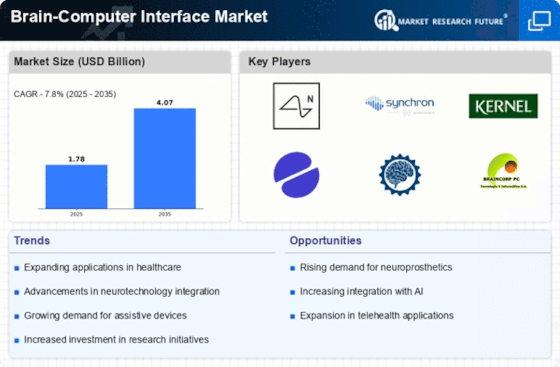
As per MRFR analysis, the Brain Computer Interface Market Size was estimated at 1780.0 USD Million in 2024. The Brain Computer Interface industry is projected to grow from 1918.88 USD Million in 2025 to 4067.39 USD Million by 2035, exhibiting a compound annual growth rate (CAGR) of 7.8 during the forecast period 2025 - 2035.

Key Market Trends & Highlights

The Brain Computer Interface Market is poised for substantial growth driven by technological advancements and increasing applications in healthcare.

  • Technological integration is enhancing the functionality and accessibility of brain-computer interfaces across various applications.
  • Healthcare applications are expanding, particularly in neurorehabilitation and assistive technologies, indicating a shift towards patient-centric solutions.
  • North America remains the largest market, while the Asia-Pacific region is emerging as the fastest-growing area for brain-computer interface technologies.
  • Rising demand for assistive technologies and advancements in neurotechnology are key drivers propelling market growth.

Market Size & Forecast

2024 Market Size 1780.0 (USD Million)
2035 Market Size 4067.39 (USD Million)
CAGR (2025 - 2035) 7.8%
Largest Regional Market Share in 2024 North America

Major Players

<p>Neuralink (US), Synchron (US), Kernel (US), Emotiv (AU), OpenBCI (US), BrainCo (US), Cognixion (US), Blackrock Neurotech (US), Neurable (US)</p>

Market Trends

The Brain Computer Interface Market is currently experiencing a transformative phase, characterized by rapid advancements in technology and increasing interest from various sectors. This market encompasses a range of applications, including healthcare, gaming, and communication, which are driving innovation and investment. As researchers and developers explore new methodologies for interfacing human cognition with machines, the potential for enhancing quality of life and improving productivity becomes increasingly apparent. Moreover, the integration of artificial intelligence and machine learning into Brain Computer Interface systems is likely to further propel growth, as these technologies enable more sophisticated data analysis and user interaction. In addition to technological advancements, the Brain Computer Interface Market is also influenced by ethical considerations and regulatory frameworks. Stakeholders are becoming more aware of the implications of brain-computer interactions, leading to discussions about privacy, security, and the potential for misuse. As a result, there is a growing emphasis on developing standards and guidelines to ensure responsible innovation. This evolving landscape suggests that the Brain Computer Interface Market will continue to expand, driven by both technological progress and a commitment to ethical practices in the field.

Technological Integration

The integration of advanced technologies, such as artificial intelligence and machine learning, is reshaping the Brain Computer Interface Market. These innovations enhance the capabilities of brain-computer systems, allowing for more intuitive user experiences and improved data processing.

Healthcare Applications

The healthcare sector is increasingly adopting Brain Computer Interface technologies for rehabilitation and assistive devices. This trend highlights the potential for these systems to aid individuals with disabilities, thereby expanding their functionality and accessibility.

Ethical Considerations

As the Brain Computer Interface Market evolves, ethical considerations are gaining prominence. Stakeholders are focusing on privacy, security, and the responsible use of technology, which may influence regulatory frameworks and industry standards.

Brain Computer Interface Market Market Drivers

Advancements in Neurotechnology

Recent advancements in neurotechnology are significantly influencing the Brain Computer Interface Market. Innovations in signal processing, machine learning, and miniaturization of devices have improved the accuracy and usability of brain-computer interfaces. For instance, the development of non-invasive techniques, such as EEG-based systems, has made it easier for users to interact with technology without the need for surgical implants. This trend is supported by research indicating that the neurotechnology sector is expected to reach a valuation of several billion dollars by 2027. As these technologies continue to evolve, they are likely to enhance the functionality and accessibility of Brain Computer Interfaces, thereby expanding their applications across various sectors, including healthcare, gaming, and education.

Ethical and Regulatory Developments

Ethical and regulatory considerations are increasingly shaping the landscape of the Brain Computer Interface Market. As the technology advances, concerns regarding privacy, consent, and the potential for misuse are becoming more pronounced. Regulatory bodies are beginning to establish guidelines to ensure the responsible development and deployment of brain-computer interfaces. This regulatory framework is essential for fostering public trust and encouraging adoption. Moreover, ethical discussions surrounding the implications of brain-computer interfaces on identity and autonomy are prompting stakeholders to engage in dialogue about best practices. The Brain Computer Interface Market must navigate these complexities to ensure that innovations align with societal values and ethical standards.

Growing Interest in Neuroergonomics

The concept of neuroergonomics, which focuses on the interaction between the brain and technology, is gaining traction within the Brain Computer Interface Market. As organizations seek to optimize human performance and enhance user experience, the integration of brain-computer interfaces into workplace environments is becoming more prevalent. This trend is supported by studies indicating that brain-computer interfaces can improve productivity and reduce cognitive load. Consequently, companies are exploring the implementation of these technologies to create more efficient workspaces. The Brain Computer Interface Market stands to benefit from this growing interest, as businesses recognize the potential of these interfaces to enhance employee well-being and performance.

Rising Demand for Assistive Technologies

The increasing prevalence of neurological disorders and disabilities has led to a rising demand for assistive technologies, particularly in the Brain Computer Interface Market. As the population ages, the incidence of conditions such as ALS, stroke, and spinal cord injuries is expected to rise, necessitating innovative solutions for communication and mobility. The Brain Computer Interface Market is poised to address these needs by providing devices that enable users to control computers and other devices through brain activity. This demand is reflected in market projections, which indicate a compound annual growth rate of over 15% in the coming years. Such growth underscores the potential for Brain Computer Interfaces to transform the lives of individuals with disabilities, enhancing their independence and quality of life.

Increased Investment in Research and Development

Investment in research and development is a critical driver for the Brain Computer Interface Market. Governments and private entities are increasingly funding projects aimed at exploring the potential of brain-computer interfaces in various applications. This influx of capital is fostering innovation and accelerating the development of new technologies. For example, funding initiatives have led to breakthroughs in brain signal decoding and interface design, which are essential for creating more effective and user-friendly devices. The Brain Computer Interface Market is expected to benefit from this trend, as enhanced R&D efforts could lead to the introduction of novel products and solutions that meet the diverse needs of consumers and industries alike.

Market Segment Insights

By Application: Medical (Largest) vs. Gaming (Fastest-Growing)

<p>In the Brain Computer Interface Market, the application segments reveal a diverse landscape where Medical applications lead significantly, given their established use in neurological rehabilitation and patient monitoring. Following closely is the Gaming segment, which has shown substantial growth potential, attracting investment for innovative gaming experiences driven by brain-computer interactions. Other applications like Communication, Military, and Research remain essential yet smaller in market share, catering to specific niches requiring advanced functionality for unique use cases.</p>

<p>Medical (Dominant) vs. Gaming (Emerging)</p>

<p>The Medical application of Brain Computer Interfaces is characterized by its pivotal role in addressing neurological disorders and facilitating rehabilitation processes. This segment remains dominant due to active collaborations between health tech companies and research institutions focused on enhancing patient care. Conversely, the Gaming segment is rapidly emerging, driven by technological advancements that offer immersive experiences to users. Innovators in this space are experimenting with BCIs to create interactive scenarios that heighten engagement and enjoyment, appealing to both casual and competitive gamers. As these two segments evolve, they exemplify the diverse potential of brain-computer technology across various applications.</p>

By End Use: Healthcare (Largest) vs. Entertainment (Fastest-Growing)

<p>In the Brain Computer Interface Market, the healthcare segment holds the largest share, driven by the rising demand for neurological treatments and assistive technologies. This segment encompasses applications in rehabilitation, brain disorders treatment, and cognitive enhancement, making it crucial in improving the quality of life for patients with disabilities. On the other hand, the entertainment segment is the fastest-growing, gaining traction due to the increasing interest in immersive experiences and interactive gaming solutions that leverage BCI technologies. The convergence of gaming and neuroscience is creating unique opportunities for innovation and expansion in this sector.</p>

<p>Healthcare (Dominant) vs. Entertainment (Emerging)</p>

<p>The healthcare segment of the Brain Computer Interface Market is characterized by its critical role in enhancing patient care and recovery. It focuses on non-invasive interfaces that help users communicate or control devices with their brain signals, particularly benefiting those with mobility impairments. In contrast, the entertainment segment represents an emerging segment, zooming in on the integration of brain-computer interfaces in gaming, virtual reality, and augmented reality experiences. This segment is defined by rapid technological advancements and increasing investments, leading to innovative products that not only entertain but also engage users in unprecedented ways, thereby transforming the landscape of personal and social interaction.</p>

By Technology: Non-Invasive (Largest) vs. Invasive (Fastest-Growing)

<p>The Brain Computer Interface (BCI) market showcases a distinct distribution across technology segments, with non-invasive methods leading the way due to their ease of use and lower risk profiles. These approaches are increasingly popular in both clinical and consumer applications, providing an expansive user base. In contrast, invasive technologies, while currently smaller in market share, are experiencing rapid adoption driven by advancements in neuroprosthetics and therapeutic applications.</p>

<p>Technology: Non-Invasive (Dominant) vs. Invasive (Emerging)</p>

<p>Among the various technologies utilized in the Brain Computer Interface market, non-invasive methods such as Electroencephalography (EEG) have established themselves as the dominant force. This is largely due to their non-intrusive nature, making them suitable for a broader audience, including those hesitant about surgical procedures. On the other hand, invasive technologies, which include devices implanted directly into the brain, represent an emerging segment. These technologies promise high precision and functionality, targeting specific neural pathways for applications in neurorehabilitation and communication aids, thus showing potential for significant growth as safety and efficacy improve.</p>

By Component: Sensors (Largest) vs. Software (Fastest-Growing)

<p>The Brain Computer Interface (BCI) market is witnessing a dynamic shift in component distribution, with Sensors commanding the largest market share. This segment encompasses a variety of technologies essential for the operational functionality of BCIs. Conversely, the Software segment is rapidly gaining ground, characterized by advanced algorithms and machine learning capabilities that enhance BCI performance and user experience. The Hardware, Electrodes, and Transceivers segments are also significant contributors, each playing a crucial role in the overall ecosystem of BCIs.</p>

<p>Electrodes: Dominant vs. Transceivers: Emerging</p>

<p>Electrodes hold a dominant position in the Brain Computer Interface market due to their critical role in signal acquisition from the brain. They are essential for translating neural activity into actionable data. The evolving technologies in electrodes, such as those using flexible materials and wireless capabilities, are enhancing their usability and effectiveness. On the other hand, Transceivers are emerging as a significant player, facilitating the transmission of data between electrodes and external devices. Their growth is driven by advancements in wireless communication technology and miniaturization, making them suitable for a broader range of applications and enhancing the overall functionality of BCI systems.</p>

By User Type: Patients (Largest) vs. Gamers (Fastest-Growing)

<p>The Brain Computer Interface (BCI) market is predominantly influenced by patient users, who represent the largest share of the user demographic. Patients utilize BCIs for various therapeutic applications, including neurological rehabilitation and assistive technologies. In this segment, the demand is driven by advancements in medical technology, growing awareness among healthcare professionals, and a rising patient population with neurological conditions. On the other hand, gamers are rapidly becoming a significant part of the user base, capitalizing on enhanced gaming experiences through brain-controlled interfaces. Their increasing engagement with virtual reality and immersive environments is propelling growth in this segment.</p>

<p>Patients (Dominant) vs. Gamers (Emerging)</p>

<p>Patients, as the dominant user group in the Brain Computer Interface market, leverage these technologies for rehabilitation and improvement of cognitive functions. Their needs drive innovations in medical applications of BCIs, making this segment critical for industry growth. In contrast, gamers represent an emerging demographic that is enthusiastic about integrating BCIs into gaming experiences. This segment is characterized by a demand for more immersive and interactive gameplay, showcasing the potential for innovative BCI applications. The fast-paced advances in gaming technology and a growing community of enthusiasts are pushing the boundaries of brain-computer interactions within this segment.</p>

Get more detailed insights about Brain-Computer Interface Market Research Report - Global Forecast to 2035

Regional Insights

North America : Innovation and Leadership Hub

North America leads the Brain Computer Interface (BCI) market with a substantial share of $890.0M in 2024. The region's growth is driven by advanced technological infrastructure, significant investments in R&D, and a strong focus on healthcare innovations. Regulatory support from agencies like the FDA facilitates the development and commercialization of BCI technologies, enhancing market demand and adoption rates. The competitive landscape is characterized by key players such as Neuralink, Synchron, and Kernel, all based in the US. These companies are at the forefront of BCI advancements, focusing on applications ranging from medical rehabilitation to cognitive enhancement. The presence of a robust startup ecosystem further fuels innovation, making North America a pivotal region for BCI development.

Europe : Emerging Market with Potential

Europe's Brain Computer Interface market is valued at $450.0M, reflecting a growing interest in neurotechnology and its applications. The region benefits from supportive regulatory frameworks, such as the EU's Medical Device Regulation, which encourages innovation while ensuring safety and efficacy. Increased funding for research initiatives and collaborations between academia and industry are also driving market growth. Leading countries like Germany, France, and the UK are spearheading BCI advancements, with numerous startups and established firms working on innovative solutions. Companies such as Emotiv and Kernel are expanding their presence, contributing to a competitive landscape that fosters technological advancements. The European market is poised for significant growth as awareness and acceptance of BCI technologies increase.

Asia-Pacific : Rapidly Growing Technology Sector

The Asia-Pacific region's Brain Computer Interface market is valued at $350.0M, showcasing rapid growth driven by increasing investments in technology and healthcare. Countries like China and Japan are leading the charge, with government initiatives promoting research and development in neurotechnology. The rising prevalence of neurological disorders is also fueling demand for BCI solutions, making this region a key player in the global market. The competitive landscape features a mix of local and international players, with companies like Emotiv and OpenBCI making strides in the market. The presence of a large population and growing awareness of BCI applications in gaming and healthcare further enhances market potential. As technological advancements continue, the Asia-Pacific region is set to become a significant contributor to the BCI market.

Middle East and Africa : Emerging Frontier for Innovation

The Middle East and Africa's Brain Computer Interface market is valued at $90.0M, representing an emerging frontier for neurotechnology. The region is witnessing a gradual increase in awareness and investment in BCI technologies, driven by healthcare needs and technological advancements. Governments are beginning to recognize the potential of BCI in improving quality of life, which is catalyzing market growth. Countries like South Africa and the UAE are at the forefront of BCI initiatives, with a focus on healthcare applications. The competitive landscape is still developing, with a few local startups and international players exploring opportunities. As the region continues to invest in technology and healthcare, the BCI market is expected to expand significantly in the coming years.

Key Players and Competitive Insights

The Brain Computer Interface Market is currently characterized by a dynamic competitive landscape, driven by rapid technological advancements and increasing applications in healthcare, gaming, and communication. Key players such as Neuralink (US), Synchron (US), and Kernel (US) are at the forefront, each adopting distinct strategies to enhance their market positioning. Neuralink (US) focuses on innovation through its cutting-edge neurotechnology aimed at treating neurological disorders, while Synchron (US) emphasizes regulatory compliance and clinical trials to ensure safety and efficacy in its products. Kernel (US) is leveraging partnerships with academic institutions to foster research and development, thereby enhancing its product offerings and market reach. Collectively, these strategies contribute to a competitive environment that is increasingly centered on technological innovation and regulatory navigation.

In terms of business tactics, companies are localizing manufacturing and optimizing supply chains to enhance operational efficiency. The market structure appears moderately fragmented, with several players vying for market share. This fragmentation is indicative of a landscape where innovation and strategic partnerships play a crucial role in shaping competitive dynamics. The influence of key players is significant, as their actions often set the tone for market trends and consumer expectations.

In January 2026, Neuralink (US) announced a groundbreaking partnership with a leading healthcare provider to initiate large-scale clinical trials for its brain implant technology. This strategic move is poised to validate its product efficacy and safety, potentially accelerating market acceptance and paving the way for future commercialization. The collaboration underscores Neuralink's commitment to advancing its technology while adhering to regulatory standards, which may enhance its competitive edge.

In December 2025, Synchron (US) secured a $50M funding round aimed at expanding its research capabilities and accelerating product development. This influx of capital is likely to bolster Synchron's position in the market, enabling it to enhance its product portfolio and invest in innovative solutions. The funding reflects investor confidence in Synchron's approach to developing non-invasive brain-computer interfaces, which could attract a broader customer base.

In November 2025, Kernel (US) launched a new product line focused on cognitive enhancement, targeting both consumers and healthcare professionals. This strategic diversification not only broadens Kernel's market appeal but also positions it as a leader in the cognitive enhancement segment of the Brain Computer Interface Market. The launch is indicative of a trend towards personalized solutions, which may resonate well with consumers seeking tailored experiences.

As of February 2026, current competitive trends are increasingly defined by digitalization, AI integration, and a focus on sustainability. Strategic alliances are becoming more prevalent, as companies recognize the value of collaboration in driving innovation and expanding market reach. Looking ahead, competitive differentiation is likely to evolve from traditional price-based competition to a focus on technological innovation, reliability in supply chains, and the ability to meet regulatory requirements. This shift suggests that companies that prioritize R&D and strategic partnerships will be better positioned to thrive in the rapidly evolving Brain Computer Interface Market.

Key Companies in the Brain Computer Interface Market include

Industry Developments

The Brain-Computer Interface Market has witnessed significant advancements recently. In September 2023, Neuralink received FDA approval to begin human trials for its implantable brain device, aiming to help paralyzed individuals regain movement, marking a crucial milestone for the company and the industry. Concurrently, Synchron announced successful preliminary results for its implant, aiming to assist individuals with severe motor impairments.

In terms of market growth, BrainCo and Emotiv have expanded their product lines, enhancing user engagement through wearable BCI technologies, contributing to an uptick in market valuation.

Notably, in May 2023, Blackrock Neurotech entered a partnership with a leading research institution to enhance neural data analytics, positioning itself strongly in the market. There have also been past events, such as Paradromics securing funding in December 2022, enabling the advancement of high-data-rate brain interfaces.

The continued interest from major investors and partnerships aims to propel the Brain-Computer Interface technology forward on a global scale, addressing diverse applications in healthcare, gaming, and cognitive enhancement. The concerted efforts of these companies reflect a dynamic arena where innovation is reshaping interaction between technology and human cognitive functions.


Future Outlook

Brain Computer Interface Market Future Outlook

The Brain Computer Interface Market is projected to grow at a 7.8% CAGR from 2024 to 2035, driven by advancements in neurotechnology, increasing demand for assistive devices, and rising applications in gaming and healthcare.

New opportunities lie in:

  • Development of advanced neurofeedback training programs for cognitive enhancement.
  • Integration of BCI technology in smart home systems for improved accessibility.
  • Partnerships with gaming companies to create immersive virtual reality experiences.

By 2035, the Brain Computer Interface Market is expected to be a pivotal sector, showcasing robust growth and innovation.

Market Segmentation

Brain Computer Interface Market End Use Outlook

  • Healthcare
  • Entertainment
  • Education
  • Defense
  • Industrial

Brain Computer Interface Market Component Outlook

  • Sensors
  • Software
  • Hardware
  • Electrodes
  • Transceivers

Brain Computer Interface Market User Type Outlook

  • Patients
  • Gamers
  • Researchers
  • Military Personnel
  • General Public

Brain Computer Interface Market Technology Outlook

  • Invasive
  • Non-Invasive
  • Semi-Invasive
  • Electroencephalography
  • Functional Magnetic Resonance Imaging

Brain Computer Interface Market Application Outlook

  • Medical
  • Gaming
  • Communication
  • Military
  • Research

Report Scope

MARKET SIZE 20241780.0(USD Million)
MARKET SIZE 20251918.88(USD Million)
MARKET SIZE 20354067.39(USD Million)
COMPOUND ANNUAL GROWTH RATE (CAGR)7.8% (2024 - 2035)
REPORT COVERAGERevenue Forecast, Competitive Landscape, Growth Factors, and Trends
BASE YEAR2024
Market Forecast Period2025 - 2035
Historical Data2019 - 2024
Market Forecast UnitsUSD Million
Key Companies ProfiledNeuralink (US), Synchron (US), Kernel (US), Emotiv (AU), OpenBCI (US), BrainCo (US), Cognixion (US), Blackrock Neurotech (US), Neurable (US)
Segments CoveredApplication, End Use, Technology, Component, User Type
Key Market OpportunitiesAdvancements in neurotechnology enhance user experience in the Brain Computer Interface Market.
Key Market DynamicsTechnological advancements and regulatory changes drive innovation and competition in the Brain Computer Interface Market.
Countries CoveredNorth America, Europe, APAC, South America, MEA

FAQs

What is the current valuation of the US brain-computer interface market?

The US brain-computer interface market was valued at 427.2 USD Million in 2024.

What is the projected market size for the US brain-computer interface market by 2035?

The market is projected to reach 904.8 USD Million by 2035.

What is the expected CAGR for the US brain-computer interface market during the forecast period?

The expected CAGR for the market from 2025 to 2035 is 7.06%.

Which companies are considered key players in the US brain-computer interface market?

Key players include Neuralink, Synchron, Kernel, Paradromics, Blackrock Neurotech, Cerebrum, Emotiv, and BrainCo.

What are the primary applications of brain-computer interfaces in the US market?

The primary applications include Medical, Gaming, Communication, Military, and Research.

How does the market segment by end use in the US brain-computer interface market?

The market segments by end use include Healthcare, Entertainment, Education, Defense, and Industrial.

What technologies are utilized in the US brain-computer interface market?

Technologies include Invasive, Non-Invasive, Partially Invasive, Electroencephalography, and Functional Magnetic Resonance Imaging.

Who are the main user types of brain-computer interfaces in the US market?

Main user types include Patients, Researchers, Gamers, Military Personnel, and Healthcare Professionals.

What product types are available in the US brain-computer interface market?

Product types include Hardware, Software, Accessories, Services, and Platforms.

What was the valuation of the medical application segment in the US brain-computer interface market in 2024?

The medical application segment was valued at 100.0 USD Million in 2024.

  1. EXECUTIVE SUMMARY
    1. Market Overview
    2. Key Findings
    3. Market Segmentation
    4. Competitive Landscape
    5. Challenges and Opportunities
    6. Future Outlook
  2. MARKET INTRODUCTION
    1. Definition
    2. Scope of the study
      1. Research Objective
      2. Assumption
      3. Limitations
  3. RESEARCH METHODOLOGY
    1. Overview
    2. Data Mining
    3. Secondary Research
    4. Primary Research
      1. Primary Interviews and Information Gathering Process
      2. Breakdown of Primary Respondents
    5. Forecasting Model
    6. Market Size Estimation
      1. Bottom-Up Approach
      2. Top-Down Approach
    7. Data Triangulation
    8. Validation
  4. MARKET DYNAMICS
    1. Overview
    2. Drivers
    3. Restraints
    4. Opportunities
  5. MARKET FACTOR ANALYSIS
    1. Value chain Analysis
    2. Porter''s Five Forces Analysis
      1. Bargaining Power of Suppliers
      2. Bargaining Power of Buyers
      3. Threat of New Entrants
      4. Threat of Substitutes
      5. Intensity of Rivalry
    3. COVID-19 Impact Analysis
      1. Market Impact Analysis
      2. Regional Impact
      3. Opportunity and Threat Analysis
  6. Brain-Computer Interface Market, BY Application (USD Billion)
    1. Medical
    2. Gaming
    3. Communication
    4. Military
    5. Research
  7. Brain-Computer Interface Market, BY Technology (USD Billion)
    1. Non-Invasive
    2. Invasive
    3. Semi-Invasive
  8. Brain-Computer Interface Market, BY End Use (USD Billion)
    1. Healthcare
    2. Entertainment
    3. Education
    4. Defense
    5. Research Institutions
  9. Brain-Computer Interface Market, BY Regional (USD Billion)
    1. North America
      1. US
      2. Canada
    2. Europe
      1. Germany
      2. UK
      3. France
      4. Russia
      5. Italy
      6. Spain
      7. Rest of Europe
    3. APAC
      1. China
      2. India
      3. Japan
      4. South Korea
      5. Malaysia
      6. Thailand
      7. Indonesia
      8. Rest of APAC
    4. South America
      1. Brazil
      2. Mexico
      3. Argentina
      4. Rest of South America
    5. MEA
      1. GCC Countries
      2. South Africa
      3. Rest of MEA
  10. Competitive Landscape
    1. Overview
    2. Competitive Analysis
    3. Market share Analysis
    4. Major Growth Strategy in the Brain-Computer Interface Market
    5. Competitive Benchmarking
    6. Leading Players in Terms of Number of Developments in the Brain-Computer Interface Market
    7. Key developments and growth strategies
      1. New Product Launch/Service Deployment
      2. Merger & Acquisitions
      3. Joint Ventures
    8. Major Players Financial Matrix
      1. Sales and Operating Income
      2. Major Players R&D Expenditure. 2023
  11. Company Profiles
    1. Kyndi
      1. Financial Overview
      2. Products Offered
      3. Key Developments
      4. SWOT Analysis
      5. Key Strategies
    2. Kernel
      1. Financial Overview
      2. Products Offered
      3. Key Developments
      4. SWOT Analysis
      5. Key Strategies
    3. MindMaze
      1. Financial Overview
      2. Products Offered
      3. Key Developments
      4. SWOT Analysis
      5. Key Strategies
    4. G.TEC
      1. Financial Overview
      2. Products Offered
      3. Key Developments
      4. SWOT Analysis
      5. Key Strategies
    5. CTRLLabs
      1. Financial Overview
      2. Products Offered
      3. Key Developments
      4. SWOT Analysis
      5. Key Strategies
    6. Synchron
      1. Financial Overview
      2. Products Offered
      3. Key Developments
      4. SWOT Analysis
      5. Key Strategies
    7. Emotiv
      1. Financial Overview
      2. Products Offered
      3. Key Developments
      4. SWOT Analysis
      5. Key Strategies
    8. OpenBCI
      1. Financial Overview
      2. Products Offered
      3. Key Developments
      4. SWOT Analysis
      5. Key Strategies
    9. Paradromics
      1. Financial Overview
      2. Products Offered
      3. Key Developments
      4. SWOT Analysis
      5. Key Strategies
    10. BrainCo
      1. Financial Overview
      2. Products Offered
      3. Key Developments
      4. SWOT Analysis
      5. Key Strategies
    11. Blackrock Neurotech
      1. Financial Overview
      2. Products Offered
      3. Key Developments
      4. SWOT Analysis
      5. Key Strategies
    12. Neurable
      1. Financial Overview
      2. Products Offered
      3. Key Developments
      4. SWOT Analysis
      5. Key Strategies
    13. NextMind
      1. Financial Overview
      2. Products Offered
      3. Key Developments
      4. SWOT Analysis
      5. Key Strategies
    14. Cognixion
      1. Financial Overview
      2. Products Offered
      3. Key Developments
      4. SWOT Analysis
      5. Key Strategies
    15. Neuralink
      1. Financial Overview
      2. Products Offered
      3. Key Developments
      4. SWOT Analysis
      5. Key Strategies
  12. Appendix
    1. References
    2. Related Reports
    3. LIST Of tables
  13. LIST OF ASSUMPTIONS
  14. North America Brain-Computer Interface Market SIZE ESTIMATES & FORECAST, BY APPLICATION, 2019-2035 (USD Billions)
  15. North America Brain-Computer Interface Market SIZE ESTIMATES & FORECAST, BY TECHNOLOGY, 2019-2035 (USD Billions)
  16. North America Brain-Computer Interface Market SIZE ESTIMATES & FORECAST, BY END USE, 2019-2035 (USD Billions)
  17. North America Brain-Computer Interface Market SIZE ESTIMATES & FORECAST, BY REGIONAL, 2019-2035 (USD Billions)
  18. US Brain-Computer Interface Market SIZE ESTIMATES & FORECAST, BY APPLICATION, 2019-2035 (USD Billions)
  19. US Brain-Computer Interface Market SIZE ESTIMATES & FORECAST, BY TECHNOLOGY, 2019-2035 (USD Billions)
  20. US Brain-Computer Interface Market SIZE ESTIMATES & FORECAST, BY END USE, 2019-2035 (USD Billions)
  21. US Brain-Computer Interface Market SIZE ESTIMATES & FORECAST, BY REGIONAL, 2019-2035 (USD Billions)
  22. Canada Brain-Computer Interface Market SIZE ESTIMATES & FORECAST, BY APPLICATION, 2019-2035 (USD Billions)
  23. Canada Brain-Computer Interface Market SIZE ESTIMATES & FORECAST, BY TECHNOLOGY, 2019-2035 (USD Billions)
  24. Canada Brain-Computer Interface Market SIZE ESTIMATES & FORECAST, BY END USE, 2019-2035 (USD Billions)
  25. Canada Brain-Computer Interface Market SIZE ESTIMATES & FORECAST, BY REGIONAL, 2019-2035 (USD Billions)
  26. Europe Brain-Computer Interface Market SIZE ESTIMATES & FORECAST, BY APPLICATION, 2019-2035 (USD Billions)
  27. Europe Brain-Computer Interface Market SIZE ESTIMATES & FORECAST, BY TECHNOLOGY, 2019-2035 (USD Billions)
  28. Europe Brain-Computer Interface Market SIZE ESTIMATES & FORECAST, BY END USE, 2019-2035 (USD Billions)
  29. Europe Brain-Computer Interface Market SIZE ESTIMATES & FORECAST, BY REGIONAL, 2019-2035 (USD Billions)
  30. Germany Brain-Computer Interface Market SIZE ESTIMATES & FORECAST, BY APPLICATION, 2019-2035 (USD Billions)
  31. Germany Brain-Computer Interface Market SIZE ESTIMATES & FORECAST, BY TECHNOLOGY, 2019-2035 (USD Billions)
  32. Germany Brain-Computer Interface Market SIZE ESTIMATES & FORECAST, BY END USE, 2019-2035 (USD Billions)
  33. Germany Brain-Computer Interface Market SIZE ESTIMATES & FORECAST, BY REGIONAL, 2019-2035 (USD Billions)
  34. UK Brain-Computer Interface Market SIZE ESTIMATES & FORECAST, BY APPLICATION, 2019-2035 (USD Billions)
  35. UK Brain-Computer Interface Market SIZE ESTIMATES & FORECAST, BY TECHNOLOGY, 2019-2035 (USD Billions)
  36. UK Brain-Computer Interface Market SIZE ESTIMATES & FORECAST, BY END USE, 2019-2035 (USD Billions)
  37. UK Brain-Computer Interface Market SIZE ESTIMATES & FORECAST, BY REGIONAL, 2019-2035 (USD Billions)
  38. France Brain-Computer Interface Market SIZE ESTIMATES & FORECAST, BY APPLICATION, 2019-2035 (USD Billions)
  39. France Brain-Computer Interface Market SIZE ESTIMATES & FORECAST, BY TECHNOLOGY, 2019-2035 (USD Billions)
  40. France Brain-Computer Interface Market SIZE ESTIMATES & FORECAST, BY END USE, 2019-2035 (USD Billions)
  41. France Brain-Computer Interface Market SIZE ESTIMATES & FORECAST, BY REGIONAL, 2019-2035 (USD Billions)
  42. Russia Brain-Computer Interface Market SIZE ESTIMATES & FORECAST, BY APPLICATION, 2019-2035 (USD Billions)
  43. Russia Brain-Computer Interface Market SIZE ESTIMATES & FORECAST, BY TECHNOLOGY, 2019-2035 (USD Billions)
  44. Russia Brain-Computer Interface Market SIZE ESTIMATES & FORECAST, BY END USE, 2019-2035 (USD Billions)
  45. Russia Brain-Computer Interface Market SIZE ESTIMATES & FORECAST, BY REGIONAL, 2019-2035 (USD Billions)
  46. Italy Brain-Computer Interface Market SIZE ESTIMATES & FORECAST, BY APPLICATION, 2019-2035 (USD Billions)
  47. Italy Brain-Computer Interface Market SIZE ESTIMATES & FORECAST, BY TECHNOLOGY, 2019-2035 (USD Billions)
  48. Italy Brain-Computer Interface Market SIZE ESTIMATES & FORECAST, BY END USE, 2019-2035 (USD Billions)
  49. Italy Brain-Computer Interface Market SIZE ESTIMATES & FORECAST, BY REGIONAL, 2019-2035 (USD Billions)
  50. Spain Brain-Computer Interface Market SIZE ESTIMATES & FORECAST, BY APPLICATION, 2019-2035 (USD Billions)
  51. Spain Brain-Computer Interface Market SIZE ESTIMATES & FORECAST, BY TECHNOLOGY, 2019-2035 (USD Billions)
  52. Spain Brain-Computer Interface Market SIZE ESTIMATES & FORECAST, BY END USE, 2019-2035 (USD Billions)
  53. Spain Brain-Computer Interface Market SIZE ESTIMATES & FORECAST, BY REGIONAL, 2019-2035 (USD Billions)
  54. Rest of Europe Brain-Computer Interface Market SIZE ESTIMATES & FORECAST, BY APPLICATION, 2019-2035 (USD Billions)
  55. Rest of Europe Brain-Computer Interface Market SIZE ESTIMATES & FORECAST, BY TECHNOLOGY, 2019-2035 (USD Billions)
  56. Rest of Europe Brain-Computer Interface Market SIZE ESTIMATES & FORECAST, BY END USE, 2019-2035 (USD Billions)
  57. Rest of Europe Brain-Computer Interface Market SIZE ESTIMATES & FORECAST, BY REGIONAL, 2019-2035 (USD Billions)
  58. APAC Brain-Computer Interface Market SIZE ESTIMATES & FORECAST, BY APPLICATION, 2019-2035 (USD Billions)
  59. APAC Brain-Computer Interface Market SIZE ESTIMATES & FORECAST, BY TECHNOLOGY, 2019-2035 (USD Billions)
  60. APAC Brain-Computer Interface Market SIZE ESTIMATES & FORECAST, BY END USE, 2019-2035 (USD Billions)
  61. APAC Brain-Computer Interface Market SIZE ESTIMATES & FORECAST, BY REGIONAL, 2019-2035 (USD Billions)
    1. Table 50
    2. '

Brain-Computer Interface Market Segmentation

Brain-Computer Interface Market By Application (USD Billion, 2019-2035)

Medical

Gaming

Communication

Military

Research


Brain-Computer Interface Market By Technology (USD Billion, 2019-2035)

Non-Invasive

Invasive

Semi-Invasive


Brain-Computer Interface Market By End Use (USD Billion, 2019-2035)

Healthcare

Entertainment

Education

Defense

Research Institutions


Brain-Computer Interface Market By Regional (USD Billion, 2019-2035)

North America

Europe

South America

Asia Pacific

Middle East and Africa


Brain-Computer Interface Market Regional Outlook (USD Billion, 2019-2035)


North America Outlook (USD Billion, 2019-2035)

North America Brain-Computer Interface Market by Application Type

Medical

Gaming

Communication

Military

Research

North America Brain-Computer Interface Market by Technology Type

Non-Invasive

Invasive

Semi-Invasive

North America Brain-Computer Interface Market by End Use Type

Healthcare

Entertainment

Education

Defense

Research Institutions

North America Brain-Computer Interface Market by Regional Type

US

Canada

US Outlook (USD Billion, 2019-2035)

US Brain-Computer Interface Market by Application Type

Medical

Gaming

Communication

Military

Research

US Brain-Computer Interface Market by Technology Type

Non-Invasive

Invasive

Semi-Invasive

US Brain-Computer Interface Market by End Use Type

Healthcare

Entertainment

Education

Defense

Research Institutions

CANADA Outlook (USD Billion, 2019-2035)

CANADA Brain-Computer Interface Market by Application Type

Medical

Gaming

Communication

Military

Research

CANADA Brain-Computer Interface Market by Technology Type

Non-Invasive

Invasive

Semi-Invasive

CANADA Brain-Computer Interface Market by End Use Type

Healthcare

Entertainment

Education

Defense

Research Institutions
Europe Outlook (USD Billion, 2019-2035)

Europe Brain-Computer Interface Market by Application Type

Medical

Gaming

Communication

Military

Research

Europe Brain-Computer Interface Market by Technology Type

Non-Invasive

Invasive

Semi-Invasive

Europe Brain-Computer Interface Market by End Use Type

Healthcare

Entertainment

Education

Defense

Research Institutions

Europe Brain-Computer Interface Market by Regional Type

Germany

UK

France

Russia

Italy

Spain

Rest of Europe

GERMANY Outlook (USD Billion, 2019-2035)

GERMANY Brain-Computer Interface Market by Application Type

Medical

Gaming

Communication

Military

Research

GERMANY Brain-Computer Interface Market by Technology Type

Non-Invasive

Invasive

Semi-Invasive

GERMANY Brain-Computer Interface Market by End Use Type

Healthcare

Entertainment

Education

Defense

Research Institutions
UK Outlook (USD Billion, 2019-2035)

UK Brain-Computer Interface Market by Application Type

Medical

Gaming

Communication

Military

Research

UK Brain-Computer Interface Market by Technology Type

Non-Invasive

Invasive

Semi-Invasive

UK Brain-Computer Interface Market by End Use Type

Healthcare

Entertainment

Education

Defense

Research Institutions

FRANCE Outlook (USD Billion, 2019-2035)

FRANCE Brain-Computer Interface Market by Application Type

Medical

Gaming

Communication

Military

Research

FRANCE Brain-Computer Interface Market by Technology Type

Non-Invasive

Invasive

Semi-Invasive

FRANCE Brain-Computer Interface Market by End Use Type

Healthcare

Entertainment

Education

Defense

Research Institutions

RUSSIA Outlook (USD Billion, 2019-2035)

RUSSIA Brain-Computer Interface Market by Application Type

Medical

Gaming

Communication

Military

Research

RUSSIA Brain-Computer Interface Market by Technology Type

Non-Invasive

Invasive

Semi-Invasive

RUSSIA Brain-Computer Interface Market by End Use Type

Healthcare

Entertainment

Education

Defense

Research Institutions

ITALY Outlook (USD Billion, 2019-2035)

ITALY Brain-Computer Interface Market by Application Type

Medical

Gaming

Communication

Military

Research

ITALY Brain-Computer Interface Market by Technology Type

Non-Invasive

Invasive

Semi-Invasive

ITALY Brain-Computer Interface Market by End Use Type

Healthcare

Entertainment

Education

Defense

Research Institutions

SPAIN Outlook (USD Billion, 2019-2035)

SPAIN Brain-Computer Interface Market by Application Type

Medical

Gaming

Communication

Military

Research

SPAIN Brain-Computer Interface Market by Technology Type

Non-Invasive

Invasive

Semi-Invasive

SPAIN Brain-Computer Interface Market by End Use Type

Healthcare

Entertainment

Education

Defense

Research Institutions

REST OF EUROPE Outlook (USD Billion, 2019-2035)

REST OF EUROPE Brain-Computer Interface Market by Application Type

Medical

Gaming

Communication

Military

Research

REST OF EUROPE Brain-Computer Interface Market by Technology Type

Non-Invasive

Invasive

Semi-Invasive

REST OF EUROPE Brain-Computer Interface Market by End Use Type

Healthcare

Entertainment

Education

Defense

Research Institutions
APAC Outlook (USD Billion, 2019-2035)

APAC Brain-Computer Interface Market by Application Type

Medical

Gaming

Communication

Military

Research

APAC Brain-Computer Interface Market by Technology Type

Non-Invasive

Invasive

Semi-Invasive

APAC Brain-Computer Interface Market by End Use Type

Healthcare

Entertainment

Education

Defense

Research Institutions
APAC Brain-Computer Interface Market by Regional Type

China

India

Japan

South Korea

Malaysia

Thailand

Indonesia

Rest of APAC

CHINA Outlook (USD Billion, 2019-2035)

CHINA Brain-Computer Interface Market by Application Type

Medical

Gaming

Communication

Military

Research

CHINA Brain-Computer Interface Market by Technology Type

Non-Invasive

Invasive

Semi-Invasive

CHINA Brain-Computer Interface Market by End Use Type

Healthcare

Entertainment

Education

Defense

Research Institutions

INDIA Outlook (USD Billion, 2019-2035)

INDIA Brain-Computer Interface Market by Application Type

Medical

Gaming

Communication

Military

Research

INDIA Brain-Computer Interface Market by Technology Type

Non-Invasive

Invasive

Semi-Invasive

INDIA Brain-Computer Interface Market by End Use Type

Healthcare

Entertainment

Education

Defense

Research Institutions

JAPAN Outlook (USD Billion, 2019-2035)

JAPAN Brain-Computer Interface Market by Application Type

Medical

Gaming

Communication

Military

Research

JAPAN Brain-Computer Interface Market by Technology Type

Non-Invasive

Invasive

Semi-Invasive

JAPAN Brain-Computer Interface Market by End Use Type

Healthcare

Entertainment

Education

Defense

Research Institutions

SOUTH KOREA Outlook (USD Billion, 2019-2035)

SOUTH KOREA Brain-Computer Interface Market by Application Type

Medical

Gaming

Communication

Military

Research

SOUTH KOREA Brain-Computer Interface Market by Technology Type

Non-Invasive

Invasive

Semi-Invasive

SOUTH KOREA Brain-Computer Interface Market by End Use Type

Healthcare

Entertainment

Education

Defense

Research Institutions

MALAYSIA Outlook (USD Billion, 2019-2035)

MALAYSIA Brain-Computer Interface Market by Application Type

Medical

Gaming

Communication

Military

Research

MALAYSIA Brain-Computer Interface Market by Technology Type

Non-Invasive

Invasive

Semi-Invasive

MALAYSIA Brain-Computer Interface Market by End Use Type

Healthcare

Entertainment

Education

Defense

Research Institutions

THAILAND Outlook (USD Billion, 2019-2035)

THAILAND Brain-Computer Interface Market by Application Type

Medical

Gaming

Communication

Military

Research

THAILAND Brain-Computer Interface Market by Technology Type

Non-Invasive

Invasive

Semi-Invasive

THAILAND Brain-Computer Interface Market by End Use Type

Healthcare

Entertainment

Education

Defense

Research Institutions

INDONESIA Outlook (USD Billion, 2019-2035)

INDONESIA Brain-Computer Interface Market by Application Type

Medical

Gaming

Communication

Military

Research

INDONESIA Brain-Computer Interface Market by Technology Type

Non-Invasive

Invasive

Semi-Invasive

INDONESIA Brain-Computer Interface Market by End Use Type

Healthcare

Entertainment

Education

Defense

Research Institutions

REST OF APAC Outlook (USD Billion, 2019-2035)

REST OF APAC Brain-Computer Interface Market by Application Type

Medical

Gaming

Communication

Military

Research

REST OF APAC Brain-Computer Interface Market by Technology Type

Non-Invasive

Invasive

Semi-Invasive

REST OF APAC Brain-Computer Interface Market by End Use Type

Healthcare

Entertainment

Education

Defense

Research Institutions

South America Outlook (USD Billion, 2019-2035)

South America Brain-Computer Interface Market by Application Type

Medical

Gaming

Communication

Military

Research

South America Brain-Computer Interface Market by Technology Type

Non-Invasive

Invasive

Semi-Invasive

South America Brain-Computer Interface Market by End Use Type

Healthcare

Entertainment

Education

Defense

Research Institutions

South America Brain-Computer Interface Market by Regional Type

Brazil

Mexico

Argentina

Rest of South America

BRAZIL Outlook (USD Billion, 2019-2035)

BRAZIL Brain-Computer Interface Market by Application Type

Medical

Gaming

Communication

Military

Research

BRAZIL Brain-Computer Interface Market by Technology Type

Non-Invasive

Invasive

Semi-Invasive

BRAZIL Brain-Computer Interface Market by End Use Type

Healthcare

Entertainment

Education

Defense

Research Institutions

MEXICO Outlook (USD Billion, 2019-2035)

MEXICO Brain-Computer Interface Market by Application Type

Medical

Gaming

Communication

Military

Research

MEXICO Brain-Computer Interface Market by Technology Type

Non-Invasive

Invasive

Semi-Invasive

MEXICO Brain-Computer Interface Market by End Use Type

Healthcare

Entertainment

Education

Defense

Research Institutions

ARGENTINA Outlook (USD Billion, 2019-2035)

ARGENTINA Brain-Computer Interface Market by Application Type

Medical

Gaming

Communication

Military

Research

ARGENTINA Brain-Computer Interface Market by Technology Type

Non-Invasive

Invasive

Semi-Invasive

ARGENTINA Brain-Computer Interface Market by End Use Type

Healthcare

Entertainment

Education

Defense

Research Institutions

REST OF SOUTH AMERICA Outlook (USD Billion, 2019-2035)

REST OF SOUTH AMERICA Brain-Computer Interface Market by Application Type

Medical

Gaming

Communication

Military

Research

REST OF SOUTH AMERICA Brain-Computer Interface Market by Technology Type

Non-Invasive

Invasive

Semi-Invasive

REST OF SOUTH AMERICA Brain-Computer Interface Market by End Use Type

Healthcare

Entertainment

Education

Defense

Research Institutions

MEA Outlook (USD Billion, 2019-2035)

MEA Brain-Computer Interface Market by Application Type

Medical

Gaming

Communication

Military

Research

MEA Brain-Computer Interface Market by Technology Type

Non-Invasive

Invasive

Semi-Invasive

MEA Brain-Computer Interface Market by End Use Type

Healthcare

Entertainment

Education

Defense

Research Institutions

MEA Brain-Computer Interface Market by Regional Type

GCC Countries

South Africa

Rest of MEA

GCC COUNTRIES Outlook (USD Billion, 2019-2035)

GCC COUNTRIES Brain-Computer Interface Market by Application Type

Medical

Gaming

Communication

Military

Research

GCC COUNTRIES Brain-Computer Interface Market by Technology Type

Non-Invasive

Invasive

Semi-Invasive

GCC COUNTRIES Brain-Computer Interface Market by End Use Type

Healthcare

Entertainment

Education

Defense

Research Institutions

SOUTH AFRICA Outlook (USD Billion, 2019-2035)

SOUTH AFRICA Brain-Computer Interface Market by Application Type

Medical

Gaming

Communication

Military

Research

SOUTH AFRICA Brain-Computer Interface Market by Technology Type

Non-Invasive

Invasive

Semi-Invasive

SOUTH AFRICA Brain-Computer Interface Market by End Use Type

Healthcare

Entertainment

Education

Defense

Research Institutions

REST OF MEA Outlook (USD Billion, 2019-2035)

REST OF MEA Brain-Computer Interface Market by Application Type

Medical

Gaming

Communication

Military

Research

REST OF MEA Brain-Computer Interface Market by Technology Type

Non-Invasive

Invasive

Semi-Invasive

REST OF MEA Brain-Computer Interface Market by End Use Type

Healthcare

Entertainment

Education

Defense

Research Institutions

Infographic

Free Sample Request

Kindly complete the form below to receive a free sample of this Report

Get Free Sample

Customer Strories

Compare Licence

×
Features License Type
Single User Multiuser License Enterprise User
Price $4,950 $5,950 $7,250
Maximum User Access Limit 1 User Upto 10 Users Unrestricted Access Throughout the Organization
Free Customization
Direct Access to Analyst
Deliverable Format
Platform Access
Discount on Next Purchase 10% 15% 15%
Printable Versions