×
Request Free Sample ×

Kindly complete the form below to receive a free sample of this Report

* Please use a valid business email

Leading companies partner with us for data-driven Insights

clients tt-cursor
Hero Background
English
Chinese
French
Japanese
Korean
German
Spanish

Blood Transfusion Diagnostics Market Share

ID: MRFR/MED/0620-HCR
200 Pages
Rahul Gotadki
October 2025

Blood Transfusion Diagnostics Market Size, Growth Research Report By Product Type (Infectious Disease Testing, Blood Grouping Tests, Compatibility Testing, Nucleic Acid Testing), By Technique (Enzyme-Linked Immunosorbent Assay, Polymerase Chain Reaction, Chemiluminescent Immunoassay, Microbiological Techniques), By End User (Hospitals, Blood Banks, Diagnostic Laboratories, Academic Institutions) - Competitor Industry Analysis and Trends Forecast Till 2035

Share:
Download PDF ×

We do not share your information with anyone. However, we may send you emails based on your report interest from time to time. You may contact us at any time to opt-out.

Blood Transfusion Diagnostics Market Infographic
Purchase Options

Market Share

Blood Transfusion Diagnostics Market Share Analysis

The blood transfusion diagnostics industry helps ensure safe and successful transfusions. This ensures patients benefit from blood transfusions. Companies in this field utilize several market share positioning strategies to become industry leaders. This measure is a response to rising worldwide blood product demand. Companies are now offering a wide variety of blood transfusion diagnostic products. This category includes blood grouping and typing reagents, infectious disease screening assays, and cutting-edge compatibility testing technologies. Diverse product lines allow firms to meet healthcare and blood bank needs. This lets enterprises meet these groups' demands. New technologies are needed to compete in blood transfusion diagnosis. For faster and more accurate diagnosis, companies are investing in nucleic acid testing (NAT) and automation. Using many technologies may provide one an edge over competitors. Building good relationships with healthcare institutions and blood banks is crucial to the plan. Close collaboration with these firms may lead to preferred supplier status and long-term contracts, which are financially beneficial. Strategic partnerships like this one also help the organization understand its evolving requirements and connect with key stakeholders for mutual benefit. Due to the worldwide nature of blood transfusion diagnostics, companies are rapidly expanding into foreign markets. This approach requires building distribution networks, forming alliances, and obtaining regulatory clearances in many sectors. Companies benefit from global presence since it helps them access more customers and establishes them as trusted providers. Blood protection is crucial, and companies are striving to lead the way in blood filtering technology. Screening test sensitivity and specificity are being improved to reduce blood transfusion-transmitted illnesses. This research and development aims to improve screening assays. A company's image as a reliable supplier improves when it prioritizes safety. Because blood transfusion tests are so important, regulatory compliance is crucial. Company obligation is to comply with strict regulatory requirements set by health authorities worldwide. This ensures that their goods are high-quality and safe and helps them acquire the confidence of healthcare professionals and regulatory bodies, making it easier to extend their market share. Companies are supporting blood transfusion training programs for medical personnel. This includes instructional materials, workshop organization, and training sessions. Companies may increase product efficiency by providing end-users with information, which boosts customer happiness and loyalty. Businesses are developing cost-effective and expanding nation-specific solutions. Various economic conditions are being considered. This approach offers economical, high-quality diagnostics to suit healthcare system requirements in low-income settings. We do this to meet system needs. Penetration of these markets is crucial to expanding market share. Excellent customer service is crucial to market positioning. More organizations are investing in efficient customer service staff, technical support, and fast-response technologies. Fast assistance and problem-solving help meet client demands. These factors help businesses build long-term collaborations and establish themselves as credible blood transfusion diagnostics partners.

Author
Rahul Gotadki
Assistant Manager

He holds an experience of about 7+ years in Market Research and Business Consulting, working under the spectrum of Life Sciences and Healthcare domains. Rahul conceptualizes and implements a scalable business strategy and provides strategic leadership to the clients. His expertise lies in market estimation, competitive intelligence, pipeline analysis, customer assessment, etc. In addition to the above, his other responsibility includes strategic tracking of high growth markets & advising clients on the potential areas of focus they could direct their business initiatives

Leave a Comment

FAQs

What is the projected growth of the Blood Transfusion Diagnostics market?

The Blood Transfusion Diagnostics market is the expected increase in total market value of 17.59 USD billion over a defined forecast period 2025–2035. It is driven by factors such as demand trends, technological advances, regulatory changes, and geographic expansion.

What is the size of the Blood Transfusion Diagnostics market?

Blood Transfusion Diagnostics market size was valued at approximately 9.37 billion USD in 2024. This figure will reach 17.59 billion USD covering all regions (America, Europe, Asia, MEA and ROW), focusing its segments / services / distribution channels till 2035.

What is the CAGR of the Blood Transfusion Diagnostics market?

Blood Transfusion Diagnostics market is expected to grow at a CAGR of 5.89% between 2025 and 2035.

How much will the Blood Transfusion Diagnostics market be worth by 2035?

Blood Transfusion Diagnostics market is expected to be worth of 17.59 billion USD, reflecting growth driven by usage, technology and global demands by the end of 2035.

How will the Blood Transfusion Diagnostics market perform over the next 10 years?

Over the next 10 years the Blood Transfusion Diagnostics market is expected to shift from usd billion 9.37 to 17.59 billion USD, led by adoption of advanced tech, demographic trends, regulatory approvals, with potential headwinds from 2025 to 2035.

What was the market size of the Blood Transfusion Diagnostics Market by 2035?

The Blood Transfusion Diagnostics Market was valued at 6.5 USD Billion by 2035.

Which region dominated the Blood Transfusion Diagnostics Market in 2024?

North America dominated the market with a valuation of 1.8 USD Billion in 2024.

What are the market values for the main product types in the Blood Transfusion Diagnostics Market in 2024?

In 2024, the main product types are valued as follows: Infectious Disease Testing at 1.5 USD Billion, Blood Grouping Tests at 1.2 USD Billion, Compatibility Testing at 1.1 USD Billion, and Nucleic Acid Testing at 0.69 USD Billion.

Who are the key players in the Blood Transfusion Diagnostics Market?

Major players in the market include Becton Dickinson, Beckman Coulter, bioMérieux, Thermo Fisher Scientific, and Roche Diagnostics.

The Blood Grouping Tests segment was valued at 1.2 USD Billion in 2024of the Asia Pacific region in 2035?

The projected market value of the Asia Pacific region is expected to reach 1.3 USD Billion by 2035.

Market Summary

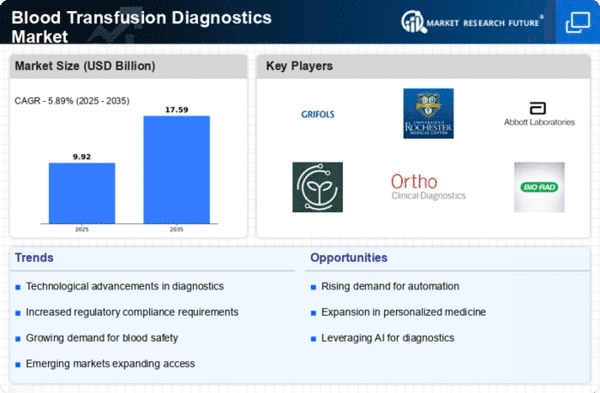
As per MRFR analysis, the Blood Transfusion Diagnostics Market was estimated at 9.37 USD Billion in 2024. The Blood Transfusion Diagnostics industry is projected to grow from 9.92 USD Billion in 2025 to 17.59 USD Billion by 2035, exhibiting a compound annual growth rate (CAGR) of 5.89 during the forecast period 2025 - 2035.

Key Market Trends & Highlights

The Blood Transfusion Diagnostics Market is poised for substantial growth driven by technological advancements and increasing awareness of blood safety.

  • North America remains the largest market for blood transfusion diagnostics, driven by advanced healthcare infrastructure and regulatory frameworks. The Asia-Pacific region is emerging as the fastest-growing market, fueled by increasing investments in healthcare and rising population awareness. Blood typing continues to dominate the market, while cross-matching is experiencing rapid growth due to its critical role in ensuring transfusion safety. Technological advancements and rising awareness of blood safety are key drivers propelling the market forward, alongside an increase in surgical procedures.

Market Size & Forecast

2024 Market Size 9.37 (USD Billion)
2035 Market Size 17.59 (USD Billion)
CAGR (2025 - 2035) 5.89%
Largest Regional Market Share in 2024 North America

Major Players

<p>Grifols (ES), Roche (CH), Abbott (US), Terumo (JP), Ortho Clinical Diagnostics (US), Bio-Rad Laboratories (US), Beckman Coulter (US), Siemens Healthineers (DE), Hologic (US)</p>

Market Trends

The Blood Transfusion Diagnostics Market is currently experiencing a transformative phase, driven by advancements in technology and an increasing emphasis on patient safety. The integration of automated systems and artificial intelligence is enhancing the accuracy and efficiency of blood testing processes which are often required at hospitals, blood banks and independent laboratories.. This evolution is not only streamlining operations but also reducing the risk of transfusion-related complications. Furthermore, the growing awareness of the importance of blood type compatibility and infectious disease screening is propelling the demand for sophisticated diagnostic tools positively influencing the broader blood market.. As healthcare providers strive to improve patient outcomes, the Blood Transfusion Diagnostics Market is poised for substantial growth within the expanding blood bank industry..

In addition, regulatory bodies are intensifying their focus on ensuring the safety and quality of blood products. This heightened scrutiny is likely to encourage innovation within the sector, as companies seek to develop cutting-edge solutions that comply with stringent guidelines. The market landscape is also witnessing a shift towards point-of-care testing, which offers rapid results and enhances the decision-making process in critical situations. Overall, the Blood Transfusion Diagnostics Market appears to be on a promising trajectory, with numerous opportunities for stakeholders to explore and capitalize on emerging trends.

Technological Advancements

The Blood Transfusion Diagnostics Market is witnessing a notable shift towards the adoption of advanced technologies. Innovations such as automated blood screening systems and molecular diagnostics are becoming increasingly prevalent. These technologies not only enhance the accuracy of testing but also streamline the overall process, thereby improving efficiency in blood transfusion practices.

Regulatory Changes

The evolving regulatory landscape surrounding blood transfusion practices is significantly influencing the market. Stricter guidelines and standards imposed by health authorities are compelling manufacturers to enhance their product offerings. This trend may lead to increased investments in quality assurance and compliance measures, ultimately benefiting patient safety.

Rising Awareness of Blood Safety

There is a growing global awareness regarding the importance of blood safety and the prevention of transfusion-transmitted infections. This heightened consciousness is driving demand for comprehensive diagnostic solutions that ensure the safety of blood products. As healthcare providers prioritize patient welfare, the market is likely to expand to meet these critical needs.

Blood Transfusion Diagnostics Market Market Drivers

Growing Awareness of Blood Safety

There is a growing awareness of the importance of blood safety among healthcare providers and patients, which is driving the Global Blood Transfusion Diagnostics Market Industry. Educational campaigns and initiatives aimed at promoting safe blood transfusion practices are becoming more prevalent. This heightened awareness leads to increased demand for reliable diagnostic tools that can ensure the safety of blood products. As healthcare systems prioritize patient safety, the market for blood transfusion diagnostics is expected to benefit, with projections indicating a market value of 6.5 USD Billion by 2035, underscoring the long-term potential of this driver.

Regulatory Support and Guidelines

Supportive regulatory frameworks and guidelines established by health authorities are fostering growth in the Global Blood Transfusion Diagnostics Market Industry. Agencies such as the Food and Drug Administration and the European Medicines Agency are continuously updating regulations to ensure the safety and efficacy of blood transfusion diagnostics. These regulations encourage innovation and compliance among manufacturers, leading to the introduction of new diagnostic products. As a result, the market is likely to expand, with a projected compound annual growth rate of 3.42% from 2025 to 2035, reflecting the positive impact of regulatory support on industry growth.

Rising Demand for Blood Components

The increasing demand for various blood components, such as red blood cells, platelets, and plasma, is significantly influencing the Global Blood Transfusion Diagnostics Market Industry. Factors such as an aging population and the rise in surgical procedures contribute to this demand. For instance, the American Red Cross reports that blood donations are essential to meet the needs of patients undergoing surgeries or treatments for chronic illnesses. This growing requirement for blood components necessitates efficient diagnostic tools to ensure compatibility and safety, thereby propelling market growth in the coming years.

Increasing Prevalence of Blood Disorders

The rising incidence of blood disorders, such as hemophilia, thalassemia, and sickle cell anemia, is a pivotal driver for the Global Blood Transfusion Diagnostics Market Industry. As these conditions necessitate frequent blood transfusions, the demand for accurate and efficient diagnostic tools is expected to surge. For instance, the World Health Organization reports that millions of people worldwide suffer from these disorders, leading to an increased need for reliable transfusion diagnostics. This trend is anticipated to contribute significantly to the market's growth, with projections indicating a market value of 4.49 USD Billion in 2024.

Technological Advancements in Diagnostic Tools

Innovations in blood transfusion diagnostics, including the development of automated systems and advanced molecular techniques, are transforming the Global Blood Transfusion Diagnostics Market Industry. These advancements enhance the accuracy and speed of blood testing, thereby improving patient outcomes. For example, the introduction of next-generation sequencing and multiplex assays allows for the simultaneous detection of multiple pathogens in blood samples. Such technological progress not only streamlines the diagnostic process but also reduces the risk of transfusion-related infections, which is crucial for maintaining patient safety and trust in blood transfusion practices.

Market Segment Insights

By Application: Blood Typing (Largest) vs. Cross-Matching (Fastest-Growing)

<p>The Blood Transfusion Diagnostics Market is primarily segmented into Blood Typing, Cross-Matching, Infectious Disease Testing, and Compatibility Testing. Among these, Blood Typing holds the largest market share, driven by its critical role in ensuring safe blood transfusions. Cross-Matching, on the other hand, is rapidly gaining traction, recognized for its essential function in verifying compatibility between donors and recipients, thus reducing transfusion reactions. Infectious Disease Testing and Compatibility Testing also play significant roles but are comparatively smaller segments in terms of market share.</p>

<p>Blood Typing (Dominant) vs. Compatibility Testing (Emerging)</p>

<p>Blood Typing remains the dominant force in the Blood Transfusion Diagnostics Market, thanks to its crucial importance in transfusion safety protocols and regulatory compliance. It involves determining the ABO and Rh blood groups, which are foundational to effective transfusion practices. Compatibility Testing, while emerging, holds significant potential as healthcare systems increasingly prioritize patient safety and tailored transfusion strategies. It assesses antigen and antibody interactions to prevent adverse reactions, rapidly growing in applicability with advancements in technology and personalized medicine. Together, these segments are pivotal in enhancing transfusion efficacy and safety.</p>

By End Use: Hospitals (Largest) vs. Blood Banks (Fastest-Growing)

<p>The Blood Transfusion Diagnostics Market is primarily segmented into hospitals, blood banks, diagnostic laboratories, and research institutions. Among these, hospitals hold the largest share, driven by their critical need for blood transfusion diagnostics to ensure patient safety and effective treatment. Blood banks, however, are experiencing rapid growth as the demand for donated blood increases, prompting investments in diagnostic technologies to enhance blood screening and compatibility testing, thus reflecting the shifting dynamics in the market.</p>

<p>Hospitals (Dominant) vs. Blood Banks (Emerging)</p>

<p>Hospitals are at the forefront of the Blood Transfusion Diagnostics Market due to their essential role in patient care and surgical procedures. They require sophisticated diagnostic tools to manage blood supplies efficiently, ensuring compatibility and safety for transfusions. Conversely, blood banks are emerging as a significant segment driven by rising awareness of blood donation and the need for advanced diagnostic equipment to meet stringent regulatory standards. This growth is further fueled by partnerships with hospitals and healthcare providers, focusing on improving donor screening and product quality to enhance patient outcomes. Both segments are vital to developing safer transfusion practices, albeit from different operational perspectives.</p>

By Product Type: Reagents (Largest) vs. Consumables (Fastest-Growing)

<p>In the Blood Transfusion Diagnostics Market, the product type segmentation reveals that reagents dominate the market with the largest share, reflecting their essential role in blood testing and compatibility assessments. Instruments and software follow, but it is consumables that present the most significant growth potential as demand for efficient and safe blood transfusion processes expands. This distribution underscores the critical importance of reagents in diagnostics, with increasing utilization across hospitals and diagnostic centers. The growth trends highlight an increasing focus on enhancing blood safety and the rising prevalence of blood-related disorders. Factor such as technological advancements in reagent formulations and the demand for rapid and accurate results contribute to the growth of consumables. The emergence of point-of-care testing solutions further propels their adoption, making them a vital component of future diagnostics strategies which are increasingly aligned with patient-centered care.</p>

<p>Reagents (Dominant) vs. Instruments (Emerging)</p>

<p>Reagents represent the most dominant product type within the Blood Transfusion Diagnostics Market, primarily due to their integral role in various laboratory procedures for blood testing and cross-matching processes. Their extensive use in clinical laboratories and hospitals ensures a steady demand, supported by ongoing advancements in their formulations that enhance accuracy and reliability. Meanwhile, instruments are gradually emerging, driven by advancements in technology and automation that improve testing efficiency and throughput. The ongoing shift towards more sophisticated diagnostic tools encourages innovation in instrument development, creating a competitive landscape where reagents maintain their lead while instruments grow in relevance. This dynamic highlights the complementary nature of both segments, as instruments enable more efficient use of reagents, fostering a collaborative ecosystem in the diagnostics market.</p>

By Technology: Nucleic Acid Testing (Largest) vs. Molecular Diagnostics (Fastest-Growing)

<p>In the Blood Transfusion Diagnostics Market, the technology segment is characterized by a diverse range of testing solutions, primarily including Nucleic Acid Testing, Molecular Diagnostics, Serological Testing, and Microarray Technology. Nucleic Acid Testing holds the largest market share due to its precision and ability to detect infections at an early stage, thereby playing a critical role in transfusion safety. Meanwhile, Molecular Diagnostics is rapidly gaining traction as it offers sophisticated methodologies for pathogen detection and is recognized for significantly enhancing transfusion outcomes across various demographics. The growth trends within this segment are primarily driven by advancements in technology and increasing awareness about the safety of blood transfusions. The rise in infectious diseases has spurred the adoption of more accurate and efficient testing methods, with Nucleic Acid Testing leading the charge due to its sensitivity. Additionally, the emergence of Molecular Diagnostics is being propelled by innovations in genomic technologies and an increasing focus on personalized medicine, which further amplifies its appeal in the blood transfusion sector.</p>

<p>Nucleic Acid Testing: Dominant vs. Molecular Diagnostics: Emerging</p>

<p>Nucleic Acid Testing has established itself as a dominant force within the Blood Transfusion Diagnostics Market, recognized for its high accuracy and ability to detect minimal amounts of viral RNA or DNA. This technology is integral for blood safety, as it can identify pathogens even before antibodies develop, thus ensuring timely intervention. On the other hand, Molecular Diagnostics represents an emerging trend, leveraging cutting-edge techniques to provide rapid and reliable results. It is increasingly favored for its application in disease screening and compatibility testing due to its advancements in multiplexing capabilities, which allow multiple tests to be conducted in a single run. Both segments are vital, with Nucleic Acid Testing being essential for immediate detection and Molecular Diagnostics paving the way for future innovations in transfusion protocols.</p>

Get more detailed insights about Blood Transfusion Diagnostics Market Research Report - Forecast to 2035

Regional Insights

North America : Market Leader in Diagnostics

North America is poised to maintain its leadership in the Blood Transfusion Diagnostics Market, holding a significant market share of 4.68 billion. The region's growth is driven by advanced healthcare infrastructure, increasing demand for blood transfusions, and stringent regulatory frameworks that ensure safety and efficacy. The rise in chronic diseases and the need for timely diagnostics further fuel market expansion. The United States is the primary contributor, with key players like Abbott, Grifols, and Hologic leading the competitive landscape. The presence of established healthcare systems and ongoing investments in R&D enhance the region's market position. Additionally, collaborations between public and private sectors are expected to drive innovation and improve diagnostic capabilities.

Europe : Emerging Market Dynamics

Europe's Blood Transfusion Diagnostics Market is valued at 2.8 billion, reflecting a robust growth trajectory. Factors such as an aging population, increasing awareness of blood safety, and advancements in diagnostic technologies are propelling market demand. Regulatory bodies are also enhancing guidelines to ensure the highest standards in blood transfusion practices, which is a significant catalyst for market growth. Leading countries like Germany, France, and the UK are at the forefront, with major players such as Roche and Siemens Healthineers driving innovation. The competitive landscape is characterized by strategic partnerships and mergers aimed at expanding product portfolios. The European market is expected to witness further growth as healthcare systems adapt to evolving patient needs and regulatory requirements.

Asia-Pacific : Rapidly Growing Market

The Asia-Pacific region is experiencing significant growth in the Blood Transfusion Diagnostics Market, currently valued at 1.8 billion. This growth is driven by increasing healthcare expenditures, rising awareness of blood safety, and the expansion of healthcare infrastructure. Countries like China and India are witnessing a surge in demand for blood transfusion diagnostics due to their large populations and increasing prevalence of chronic diseases. The competitive landscape is evolving, with local and international players like Terumo and Ortho Clinical Diagnostics expanding their presence. Government initiatives aimed at improving healthcare access and quality are also contributing to market growth. As the region continues to develop, the demand for advanced diagnostic solutions is expected to rise, further enhancing market dynamics.

Middle East and Africa : Emerging Market Potential

The Middle East and Africa (MEA) region, though currently valued at 0.09 billion, presents significant growth opportunities in the Blood Transfusion Diagnostics Market. Factors such as increasing healthcare investments, rising awareness of blood safety, and the need for improved diagnostic capabilities are driving market potential. Regulatory bodies are beginning to implement stricter guidelines to enhance blood transfusion safety, which is expected to catalyze market growth. Countries like South Africa and the UAE are leading the way in adopting advanced diagnostic technologies. The competitive landscape is characterized by a mix of local and international players, with a focus on expanding access to quality healthcare. As the region continues to develop, the demand for innovative blood diagnostics solutions is anticipated to grow, creating new market opportunities.

Key Players and Competitive Insights

The Blood Transfusion Diagnostics Market is characterized by a dynamic competitive landscape, driven by technological advancements, regulatory changes, and an increasing demand for safe blood transfusions. Key players such as Grifols (ES), Roche (CH), and Abbott (US) are strategically positioned to leverage innovation and expand their market presence. Grifols (ES) focuses on enhancing its product portfolio through research and development, while Roche (CH) emphasizes digital transformation and data analytics to improve diagnostic accuracy. Abbott (US) is actively pursuing partnerships to broaden its reach in emerging markets, collectively shaping a competitive environment that prioritizes innovation and strategic collaborations.In terms of business tactics, companies are increasingly localizing manufacturing to reduce costs and enhance supply chain efficiency. The market structure appears moderately fragmented, with several players vying for market share. However, the collective influence of major companies like Siemens Healthineers (DE) and Bio-Rad Laboratories (US) is notable, as they continue to innovate and optimize their operations to meet the growing demands of healthcare providers.


In November Siemens Healthineers (DE) announced the launch of a new automated blood screening system designed to enhance the efficiency of blood transfusion diagnostics. This strategic move is significant as it not only addresses the increasing demand for rapid testing but also positions Siemens Healthineers as a leader in automation within the sector. The introduction of this system is likely to streamline workflows in blood banks and hospitals, thereby improving patient outcomes.


In October Roche (CH) expanded its collaboration with a leading biotechnology firm to develop next-generation blood screening assays. This partnership is pivotal as it underscores Roche's commitment to innovation and its focus on integrating advanced technologies into its diagnostic solutions. By leveraging the expertise of its partner, Roche aims to enhance the sensitivity and specificity of its assays, which could lead to improved safety in blood transfusions.


In September Abbott (US) completed the acquisition of a regional diagnostics company, thereby strengthening its foothold in the Asia-Pacific market. This acquisition is strategically important as it allows Abbott to tap into a rapidly growing market, enhancing its product offerings and distribution capabilities. The move reflects Abbott's broader strategy to expand its global presence and cater to diverse healthcare needs.


As of December current trends in the Blood Transfusion Diagnostics Market indicate a strong emphasis on digitalization, sustainability, and the integration of artificial intelligence (AI) in diagnostic processes. Strategic alliances are increasingly shaping the competitive landscape, enabling companies to pool resources and expertise. Looking ahead, competitive differentiation is likely to evolve from traditional price-based competition to a focus on innovation, technological advancements, and supply chain reliability, as companies strive to meet the complex demands of the healthcare sector.

Key Companies in the Blood Transfusion Diagnostics Market include

Industry Developments

Recent developments in the Blood Transfusion Diagnostics Market have showcased significant advancements and strategic movements among key players. Abbott Laboratories, Hologic, and  have been focusing on enhancing their product portfolios through innovative technology and improved testing methods, leading to increased reliability and efficiencies in transfusion diagnostics.

In September 2023, Thermo Fisher Scientific announced the launch of a new molecular diagnostic platform, aiming to streamline blood screening processes. Roche has also expanded its offerings with a new automated testing solution, catering to a growing demand for accurate results.

Regarding mergers and acquisitions, Siemens Healthineers completed the acquisition of Varian Medical Systems in October 2020, strengthening its position in the diagnostics segment, although it is more focused on cancer care.

Additionally, Becton Dickinson made a strategic investment in a startup dedicated to blood collection technologies earlier this year, aiming at enhancing operational capabilities.

The market has been experiencing notable growth, driven by an increasing demand for safe blood transfusion practices and technological innovations, with expectations from industry authorities projecting consistent growth throughout the coming years.

Future Outlook

Blood Transfusion Diagnostics Market Future Outlook

<p>The Blood Transfusion Diagnostics Market is projected to grow at a 5.89% CAGR from 2025 to 2035, driven by technological advancements, increasing demand for safe blood transfusions, and regulatory support.</p>

New opportunities lie in:

  • <p>Development of portable blood testing devices for remote diagnostics. Integration of AI-driven analytics for enhanced blood compatibility assessments. Expansion of telehealth services for pre-transfusion consultations.</p>

<p>By 2035, the market is expected to achieve substantial growth, driven by innovation and increased healthcare investments.</p>

Market Segmentation

Blood Transfusion Diagnostics Market End Use Outlook

  • Hospitals
  • Blood Banks
  • Diagnostic Laboratories
  • Research Institutions

Blood Transfusion Diagnostics Market Technology Outlook

  • Molecular Diagnostics
  • Serological Testing
  • Microarray Technology
  • Nucleic Acid Testing

Blood Transfusion Diagnostics Market Application Outlook

  • Blood Typing
  • Cross-Matching
  • Infectious Disease Testing
  • Compatibility Testing

Blood Transfusion Diagnostics Market Product Type Outlook

  • Reagents
  • Instruments
  • Software
  • Consumables

Report Scope

MARKET SIZE 2024 9.37(USD Billion)
MARKET SIZE 2025 9.92(USD Billion)
MARKET SIZE 2035 17.59(USD Billion)
COMPOUND ANNUAL GROWTH RATE (CAGR) 5.89% (2025 - 2035)
REPORT COVERAGE Revenue Forecast, Competitive Landscape, Growth Factors, and Trends
BASE YEAR 2024
Market Forecast Period 2025 - 2035
Historical Data 2019 - 2024
Market Forecast Units USD Billion
Key Companies Profiled Grifols (ES), Roche (CH), Abbott (US), Terumo (JP), Ortho Clinical Diagnostics (US), Bio-Rad Laboratories (US), Beckman Coulter (US), Siemens Healthineers (DE), Hologic (US)
Segments Covered Application, End Use, Product Type, Technology
Key Market Opportunities Integration of advanced molecular diagnostics enhances safety and efficiency in the Blood Transfusion Diagnostics Market.
Key Market Dynamics Technological advancements and regulatory changes drive innovation and competition in the Blood Transfusion Diagnostics Market.
Countries Covered North America, Europe, APAC, South America, MEA

FAQs

What is the projected growth of the Blood Transfusion Diagnostics market?

The Blood Transfusion Diagnostics market is the expected increase in total market value of 17.59 USD billion over a defined forecast period 2025–2035. It is driven by factors such as demand trends, technological advances, regulatory changes, and geographic expansion.

What is the size of the Blood Transfusion Diagnostics market?

Blood Transfusion Diagnostics market size was valued at approximately 9.37 billion USD in 2024. This figure will reach 17.59 billion USD covering all regions (America, Europe, Asia, MEA and ROW), focusing its segments / services / distribution channels till 2035.

What is the CAGR of the Blood Transfusion Diagnostics market?

Blood Transfusion Diagnostics market is expected to grow at a CAGR of 5.89% between 2025 and 2035.

How much will the Blood Transfusion Diagnostics market be worth by 2035?

Blood Transfusion Diagnostics market is expected to be worth of 17.59 billion USD, reflecting growth driven by usage, technology and global demands by the end of 2035.

How will the Blood Transfusion Diagnostics market perform over the next 10 years?

Over the next 10 years the Blood Transfusion Diagnostics market is expected to shift from usd billion 9.37 to 17.59 billion USD, led by adoption of advanced tech, demographic trends, regulatory approvals, with potential headwinds from 2025 to 2035.

What was the market size of the Blood Transfusion Diagnostics Market by 2035?

The Blood Transfusion Diagnostics Market was valued at 6.5 USD Billion by 2035.

Which region dominated the Blood Transfusion Diagnostics Market in 2024?

North America dominated the market with a valuation of 1.8 USD Billion in 2024.

What are the market values for the main product types in the Blood Transfusion Diagnostics Market in 2024?

In 2024, the main product types are valued as follows: Infectious Disease Testing at 1.5 USD Billion, Blood Grouping Tests at 1.2 USD Billion, Compatibility Testing at 1.1 USD Billion, and Nucleic Acid Testing at 0.69 USD Billion.

Who are the key players in the Blood Transfusion Diagnostics Market?

Major players in the market include Becton Dickinson, Beckman Coulter, bioMérieux, Thermo Fisher Scientific, and Roche Diagnostics.

The Blood Grouping Tests segment was valued at 1.2 USD Billion in 2024of the Asia Pacific region in 2035?

The projected market value of the Asia Pacific region is expected to reach 1.3 USD Billion by 2035.

  1. SECTION I: EXECUTIVE SUMMARY AND KEY HIGHLIGHTS
    1. | 1.1 EXECUTIVE SUMMARY
    2. | 1.1.1 Market Overview
    3. | 1.1.2 Key Findings
    4. | 1.1.3 Market Segmentation
    5. | 1.1.4 Competitive Landscape
    6. | 1.1.5 Challenges and Opportunities
    7. | 1.1.6 Future Outlook
  2. SECTION II: SCOPING, METHODOLOGY AND MARKET STRUCTURE
    1. | 2.1 MARKET INTRODUCTION
    2. | 2.1.1 Definition
    3. | 2.1.2 Scope of the study
    4. |-- 2.1.2.1 Research Objective
    5. |-- 2.1.2.2 Assumption
    6. |-- 2.1.2.3 Limitations
    7. | 2.2 RESEARCH METHODOLOGY
    8. | 2.2.1 Overview
    9. | 2.2.2 Data Mining
    10. | 2.2.3 Secondary Research
    11. | 2.2.4 Primary Research
    12. |-- 2.2.4.1 Primary Interviews and Information Gathering Process
    13. |-- 2.2.4.2 Breakdown of Primary Respondents
    14. | 2.2.5 Forecasting Model
    15. | 2.2.6 Market Size Estimation
    16. |-- 2.2.6.1 Bottom-Up Approach
    17. |-- 2.2.6.2 Top-Down Approach
    18. | 2.2.7 Data Triangulation
    19. | 2.2.8 Validation
  3. SECTION III: QUALITATIVE ANALYSIS
    1. | 3.1 MARKET DYNAMICS
    2. | 3.1.1 Overview
    3. | 3.1.2 Drivers
    4. | 3.1.3 Restraints
    5. | 3.1.4 Opportunities
    6. | 3.2 MARKET FACTOR ANALYSIS
    7. | 3.2.1 Value chain Analysis
    8. | 3.2.2 Porter's Five Forces Analysis
    9. |-- 3.2.2.1 Bargaining Power of Suppliers
    10. |-- 3.2.2.2 Bargaining Power of Buyers
    11. |-- 3.2.2.3 Threat of New Entrants
    12. |-- 3.2.2.4 Threat of Substitutes
    13. |-- 3.2.2.5 Intensity of Rivalry
    14. | 3.2.3 COVID-19 Impact Analysis
    15. |-- 3.2.3.1 Market Impact Analysis
    16. |-- 3.2.3.2 Regional Impact
    17. |-- 3.2.3.3 Opportunity and Threat Analysis
  4. SECTION IV: QUANTITATIVE ANALYSIS
    1. | 4.1 Healthcare, BY Application (USD Billion)
    2. | 4.1.1 Blood Typing
    3. | 4.1.2 Cross-Matching
    4. | 4.1.3 Infectious Disease Testing
    5. | 4.1.4 Compatibility Testing
    6. | 4.2 Healthcare, BY End Use (USD Billion)
    7. | 4.2.1 Hospitals
    8. | 4.2.2 Blood Banks
    9. | 4.2.3 Diagnostic Laboratories
    10. | 4.2.4 Research Institutions
    11. | 4.3 Healthcare, BY Product Type (USD Billion)
    12. | 4.3.1 Reagents
    13. | 4.3.2 Instruments
    14. | 4.3.3 Software
    15. | 4.3.4 Consumables
    16. | 4.4 Healthcare, BY Technology (USD Billion)
    17. | 4.4.1 Molecular Diagnostics
    18. | 4.4.2 Serological Testing
    19. | 4.4.3 Microarray Technology
    20. | 4.4.4 Nucleic Acid Testing
    21. | 4.5 Healthcare, BY Region (USD Billion)
    22. | 4.5.1 North America
    23. |-- 4.5.1.1 US
    24. |-- 4.5.1.2 Canada
    25. | 4.5.2 Europe
    26. |-- 4.5.2.1 Germany
    27. |-- 4.5.2.2 UK
    28. |-- 4.5.2.3 France
    29. |-- 4.5.2.4 Russia
    30. |-- 4.5.2.5 Italy
    31. |-- 4.5.2.6 Spain
    32. |-- 4.5.2.7 Rest of Europe
    33. | 4.5.3 APAC
    34. |-- 4.5.3.1 China
    35. |-- 4.5.3.2 India
    36. |-- 4.5.3.3 Japan
    37. |-- 4.5.3.4 South Korea
    38. |-- 4.5.3.5 Malaysia
    39. |-- 4.5.3.6 Thailand
    40. |-- 4.5.3.7 Indonesia
    41. |-- 4.5.3.8 Rest of APAC
    42. | 4.5.4 South America
    43. |-- 4.5.4.1 Brazil
    44. |-- 4.5.4.2 Mexico
    45. |-- 4.5.4.3 Argentina
    46. |-- 4.5.4.4 Rest of South America
    47. | 4.5.5 MEA
    48. |-- 4.5.5.1 GCC Countries
    49. |-- 4.5.5.2 South Africa
    50. |-- 4.5.5.3 Rest of MEA
  5. SECTION V: COMPETITIVE ANALYSIS
    1. | 5.1 Competitive Landscape
    2. | 5.1.1 Overview
    3. | 5.1.2 Competitive Analysis
    4. | 5.1.3 Market share Analysis
    5. | 5.1.4 Major Growth Strategy in the Healthcare
    6. | 5.1.5 Competitive Benchmarking
    7. | 5.1.6 Leading Players in Terms of Number of Developments in the Healthcare
    8. | 5.1.7 Key developments and growth strategies
    9. |-- 5.1.7.1 New Product Launch/Service Deployment
    10. |-- 5.1.7.2 Merger & Acquisitions
    11. |-- 5.1.7.3 Joint Ventures
    12. | 5.1.8 Major Players Financial Matrix
    13. |-- 5.1.8.1 Sales and Operating Income
    14. |-- 5.1.8.2 Major Players R&D Expenditure. 2023
    15. | 5.2 Company Profiles
    16. | 5.2.1 Grifols (ES)
    17. |-- 5.2.1.1 Financial Overview
    18. |-- 5.2.1.2 Products Offered
    19. |-- 5.2.1.3 Key Developments
    20. |-- 5.2.1.4 SWOT Analysis
    21. |-- 5.2.1.5 Key Strategies
    22. | 5.2.2 Roche (CH)
    23. |-- 5.2.2.1 Financial Overview
    24. |-- 5.2.2.2 Products Offered
    25. |-- 5.2.2.3 Key Developments
    26. |-- 5.2.2.4 SWOT Analysis
    27. |-- 5.2.2.5 Key Strategies
    28. | 5.2.3 Abbott (US)
    29. |-- 5.2.3.1 Financial Overview
    30. |-- 5.2.3.2 Products Offered
    31. |-- 5.2.3.3 Key Developments
    32. |-- 5.2.3.4 SWOT Analysis
    33. |-- 5.2.3.5 Key Strategies
    34. | 5.2.4 Terumo (JP)
    35. |-- 5.2.4.1 Financial Overview
    36. |-- 5.2.4.2 Products Offered
    37. |-- 5.2.4.3 Key Developments
    38. |-- 5.2.4.4 SWOT Analysis
    39. |-- 5.2.4.5 Key Strategies
    40. | 5.2.5 Ortho Clinical Diagnostics (US)
    41. |-- 5.2.5.1 Financial Overview
    42. |-- 5.2.5.2 Products Offered
    43. |-- 5.2.5.3 Key Developments
    44. |-- 5.2.5.4 SWOT Analysis
    45. |-- 5.2.5.5 Key Strategies
    46. | 5.2.6 Bio-Rad Laboratories (US)
    47. |-- 5.2.6.1 Financial Overview
    48. |-- 5.2.6.2 Products Offered
    49. |-- 5.2.6.3 Key Developments
    50. |-- 5.2.6.4 SWOT Analysis
    51. |-- 5.2.6.5 Key Strategies
    52. | 5.2.7 Beckman Coulter (US)
    53. |-- 5.2.7.1 Financial Overview
    54. |-- 5.2.7.2 Products Offered
    55. |-- 5.2.7.3 Key Developments
    56. |-- 5.2.7.4 SWOT Analysis
    57. |-- 5.2.7.5 Key Strategies
    58. | 5.2.8 Siemens Healthineers (DE)
    59. |-- 5.2.8.1 Financial Overview
    60. |-- 5.2.8.2 Products Offered
    61. |-- 5.2.8.3 Key Developments
    62. |-- 5.2.8.4 SWOT Analysis
    63. |-- 5.2.8.5 Key Strategies
    64. | 5.2.9 Hologic (US)
    65. |-- 5.2.9.1 Financial Overview
    66. |-- 5.2.9.2 Products Offered
    67. |-- 5.2.9.3 Key Developments
    68. |-- 5.2.9.4 SWOT Analysis
    69. |-- 5.2.9.5 Key Strategies
    70. | 5.3 Appendix
    71. | 5.3.1 References
    72. | 5.3.2 Related Reports

Healthcare Market Segmentation

Healthcare By Application (USD Billion, 2025-2035)

  • Blood Typing
  • Cross-Matching
  • Infectious Disease Testing
  • Compatibility Testing

Healthcare By End Use (USD Billion, 2025-2035)

  • Hospitals
  • Blood Banks
  • Diagnostic Laboratories
  • Research Institutions

Healthcare By Product Type (USD Billion, 2025-2035)

  • Reagents
  • Instruments
  • Software
  • Consumables

Healthcare By Technology (USD Billion, 2025-2035)

  • Molecular Diagnostics
  • Serological Testing
  • Microarray Technology
  • Nucleic Acid Testing
Infographic

Free Sample Request

Kindly complete the form below to receive a free sample of this Report

Get Free Sample

Customer Strories

Compare Licence

×
Features License Type
Single User Multiuser License Enterprise User
Price $4,950 $5,950 $7,250
Maximum User Access Limit 1 User Upto 10 Users Unrestricted Access Throughout the Organization
Free Customization
Direct Access to Analyst
Deliverable Format
Platform Access
Discount on Next Purchase 10% 15% 15%
Printable Versions