×
Request Free Sample ×

Kindly complete the form below to receive a free sample of this Report

* Please use a valid business email

Leading companies partner with us for data-driven Insights

clients tt-cursor
Hero Background

Beauty Products Market

ID: MRFR/CG/53590-CR
325 Pages
Pradeep Nandi
May 2025

Beauty Products Market Size, Share, Industry Trend & Analysis Research Report Information by Product Type (Skincare (Face (Cleansers, Toners, Moisturizers, Serums, Masks, Eye Creams), Body (Body Wash/Shower Gel, Body Lotion, Body Scrub, Hand Cream)), Makeup (Face (Foundation, Concealer, Compact powder, Loose powder, Blush, Bronzer, Highlighter), Eyes (Eyeshadow, Eyeliner, Mascara, Brows), Lips (Lipstick, Lip Gloss, Lip Liner, Lip Balm)), Haircare (Shampoos, Conditioners, Hair Masks, Hair Oils, Hair Styling Products), Nail Care, Fragrance (Perfume, Deodorants, Others)), by Category (Natural, Conventional, Vegan), by Form (Powder, Liquid, Gel), by Demographics (Gen X, Gen Z, Millennials, Boomers), by Packaging Type (Airless Packaging (Airless Bottles, Airless Jars, Airless Tubes), Dip Tube Bottles and Pumps (Dip Tube Bottles, Dip Tube Pumps- Perfume/Mist, Dip Tube Pumps- Lotion), Traditional Bottles and Tubes (Bottles, Tottles (Tube-Bottle Hybrids), Tubes (Squeeze Tubes)), Jars and Compacts (Jars, Compacts, Cushion Compacts), Droppers and Applicators, Lip and Eye Packaging, Specialty Packaging), by Distribution Channel (Supermarkets & Hypermarkets, Convenience Stores, Specialty Stores, Online, Others) and Region (North America, Europe, Asia-Pacific, South America, Middle East, Africa) - Forecast till 2035

Share:
Download PDF ×

We do not share your information with anyone. However, we may send you emails based on your report interest from time to time. You may contact us at any time to opt-out.

Beauty Products Market  Infographic
Purchase Options

Beauty Products Market Summary

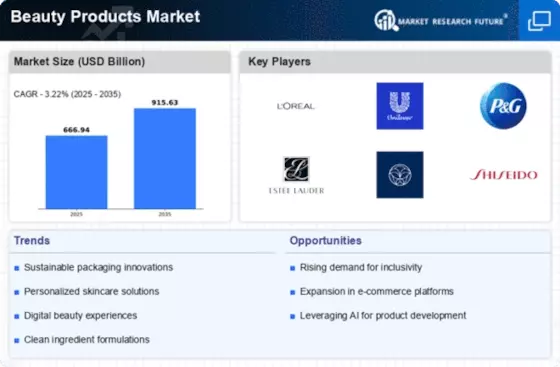
As per MRFR analysis, the Beauty Products Market was estimated at 646.13 USD Billion in 2024. The beauty products industry is projected to grow from 666.94 USD Billion in 2025 to 915.63 USD Billion by 2035, exhibiting a compound annual growth rate (CAGR) of 3.22 during the forecast period 2025 - 2035.

Key Market Trends & Highlights

The Beauty Products Market is experiencing a transformative shift towards sustainability and personalization.

  • The market is increasingly prioritizing sustainability, with brands adopting eco-friendly practices and materials.
  • Personalized beauty solutions are gaining traction, as consumers seek products tailored to their individual needs.
  • In North America, the influence of social media and beauty influencers is shaping consumer preferences and purchasing decisions.
  • The rise of e-commerce platforms and the growing demand for natural ingredients are driving market growth, particularly in the Asia-Pacific region.

Market Size & Forecast

2024 Market Size 646.13 (USD Billion)
2035 Market Size 915.63 (USD Billion)
CAGR (2025 - 2035) 3.22%

Major Players

L'Oreal (FR), Unilever (GB), Procter & Gamble (US), Estée Lauder (US), Coty (US), Shiseido (JP), Revlon (US), Avon (GB), Beiersdorf (DE)

Our Impact
Enabled $4.3B Revenue Impact for Fortune 500 and Leading Multinationals
Partnering with 2000+ Global Organizations Each Year
30K+ Citations by Top-Tier Firms in the Industry

Beauty Products Market Trends

The Beauty Products Market is currently experiencing a dynamic evolution, driven by shifting consumer preferences and an increasing emphasis on sustainability. As individuals become more conscious of their purchasing decisions, there is a noticeable trend towards products that are not only effective but also environmentally friendly. This shift is prompting brands to innovate, focusing on natural ingredients and eco-friendly packaging. Furthermore, the rise of social media influencers plays a pivotal role in shaping consumer perceptions, as they often promote beauty products that align with contemporary values of authenticity and transparency. In addition to sustainability, the Beauty Products Market is witnessing a surge in demand for personalized beauty solutions. Consumers are seeking products tailored to their unique skin types and preferences, leading to the development of customized formulations. This trend is indicative of a broader movement towards individualism in beauty, where one-size-fits-all approaches are increasingly viewed as outdated. As the market continues to evolve, it appears that brands that prioritize both sustainability and personalization will likely thrive in this competitive landscape.

Sustainability Focus

The Beauty Products Market is increasingly prioritizing sustainability, with brands adopting eco-friendly practices and natural ingredients. This trend reflects a growing consumer demand for products that are both effective and environmentally responsible.

Personalized Beauty Solutions

There is a notable rise in the demand for personalized beauty products, as consumers seek solutions tailored to their specific needs. This trend indicates a shift towards individualized approaches in the Beauty Products Market.

Influencer Impact

Social media influencers are significantly shaping consumer choices within the Beauty Products Market. Their endorsements often highlight products that resonate with contemporary values, such as authenticity and transparency.

Beauty Products Market Drivers

Rise of E-commerce Platforms

The Beauty Products Market is experiencing a notable shift towards e-commerce platforms, which appears to be reshaping consumer purchasing behaviors. With the increasing penetration of the internet and mobile devices, online sales channels are projected to account for a substantial share of the market. In 2025, e-commerce sales in the beauty sector reached approximately 30 percent of total sales, indicating a growing preference for online shopping. This trend is likely to continue as consumers seek convenience and a wider variety of products. Additionally, the rise of social media marketing and targeted online advertising enhances brand visibility, further driving sales through digital platforms. As a result, businesses in the Beauty Products Market are increasingly investing in their online presence to capture this expanding consumer base.

Rising Awareness of Personal Grooming

The Beauty Products Market is experiencing a surge in consumer awareness regarding personal grooming and self-care. This trend is particularly evident among younger demographics, who are increasingly prioritizing beauty and wellness as integral aspects of their lifestyles. Recent studies indicate that nearly 60 percent of millennials and Gen Z consumers consider personal grooming essential for their overall well-being. This heightened awareness is likely to drive demand for a diverse range of beauty products, from skincare to cosmetics. As a result, brands are expanding their product offerings to cater to this growing consumer base, which is expected to contribute to a projected market growth rate of around 7 percent annually over the next few years. Consequently, the Beauty Products Market is poised for continued expansion as consumers increasingly invest in their personal grooming routines.

Growing Demand for Natural Ingredients

The Beauty Products Market is witnessing a significant shift towards products formulated with natural and organic ingredients. This trend is driven by a rising consumer awareness regarding the potential harmful effects of synthetic chemicals. According to recent surveys, approximately 70 percent of consumers express a preference for beauty products that contain natural ingredients. This inclination is likely to propel the growth of brands that prioritize sustainability and transparency in their ingredient sourcing. Furthermore, the demand for clean beauty products is expected to contribute to a projected annual growth rate of around 8 percent in the natural beauty segment over the next five years. Consequently, companies within the Beauty Products Market are reformulating existing products and launching new lines that align with this consumer preference.

Influence of Social Media and Influencers

The Beauty Products Market is significantly influenced by social media platforms and the rise of beauty influencers. These influencers, who often have large followings, play a crucial role in shaping consumer perceptions and purchasing decisions. Recent data suggests that nearly 50 percent of beauty consumers are influenced by social media recommendations when making purchases. This trend indicates that brands are increasingly collaborating with influencers to enhance their visibility and credibility. As a result, marketing strategies within the Beauty Products Market are evolving to incorporate influencer partnerships, which can lead to increased brand loyalty and sales. The effectiveness of these campaigns is likely to continue driving growth in the industry as more consumers turn to social media for beauty advice and product recommendations.

Technological Advancements in Product Development

The Beauty Products Market is benefiting from rapid technological advancements that enhance product development and consumer engagement. Innovations such as augmented reality (AR) and artificial intelligence (AI) are being integrated into the beauty shopping experience, allowing consumers to virtually try on products before purchasing. This technology not only improves customer satisfaction but also reduces return rates, which can be a significant issue in the beauty sector. Furthermore, advancements in formulation technology enable brands to create more effective and targeted products, catering to specific consumer needs. As these technologies become more prevalent, they are likely to drive growth in the Beauty Products Market, with companies investing in research and development to stay competitive and meet evolving consumer expectations.

Market Segment Insights

By Product Type: Skincare (Largest) vs. Makeup (Fastest-Growing)

The Beauty Products Market exhibits diverse segment values, with Skincare commanding the largest share due to its essential nature of daily skincare routines. This segment encompasses a wide range of products, including moisturizers, serums, and sunscreen, appealing to various demographics. Makeup follows as a robust contender, experiencing rapid growth as consumer trends shift towards self-expression and creativity through cosmetics. Makeup products increasingly attract younger consumers who seek innovative and versatile options to enhance their appearance. The growth trends in the Beauty Products Market, particularly in Skincare and Makeup segments, are primarily driven by shifting consumer preferences towards clean and sustainable beauty products. Skincare continues to thrive as consumers become more health-conscious and seek products that promote skin wellness. The Makeup segment has seen a surge in interest in bold looks, leading brands to innovate and launch captivating collections. As social media influences purchasing decisions, both segments are expected to expand further, catering to the evolving needs of beauty enthusiasts.

Beauty Products: Skincare (Dominant) vs. Makeup (Emerging)

Skincare stands out as the dominant product type in the Beauty Products Market due to its essential role in consumers' daily routines and a growing focus on self-care. Products such as cleansers, moisturizers, and treatments are crucial for maintaining skin health, and brands have responded by offering a vast variety of formulations to cater to specific skin concerns. On the other hand, Makeup is an emerging segment, catching the attention of younger consumers seeking ways to express their individuality. This segment thrives on innovation and trends, with a rise in demand for multifunctional products. As consumers become more adventurous, Makeup brands are expanding their offerings to include bold colors and new textures, leading to a dynamic market landscape.

By Distribution Channel: E-commerce (Largest) vs. Offline (Fastest-Growing)

In the Beauty Products Market, distribution channels exhibit significant diversity, with E-commerce leading as the largest segment. This channel has experienced substantial uptake due to changing consumer behaviors favoring online shopping, convenience, and a broader product selection. Concurrently, Offline channels, encompassing traditional retail outlets, are making a notable resurgence as brands seek to restore in-person experiences following pandemic restrictions. While still trailing behind in market share, this resurgence is supported by enhanced customer engagement strategies at physical locations. Growth trends in the Beauty Products Market are driven by shifting consumer preferences and advancements in technology. E-commerce continues to dominate due to the increase in smartphone penetration and the rise of social media marketing, which effectively targets beauty-conscious consumers. On the other hand, Offline channels are experiencing a revival as brands invest in experiential retail concepts and personalized in-store services, aiming to attract customers seeking tangible experiences. Moreover, the integration of online and offline strategies further fuels growth across channels, enabling brand recognition and increased accessibility for consumers.

E-commerce: Dominant vs. Offline: Emerging

E-commerce has emerged as a dominant force in the Beauty Products Market, capitalizing on the digital shift in consumer behavior. This distribution channel offers unparalleled convenience, allowing consumers to shop from the comfort of their homes and access a wider variety of products than traditional retailers can offer. Furthermore, personalized marketing through data analytics enhances customer experience, driving higher conversion rates. In contrast, Offline retail channels are classified as emerging due to their renewed focus on creating immersive shopping experiences that engage customers. Brands are innovating in this space by transforming physical stores into experiential hubs that emphasize customer interaction, and product trial. With the strategic combination of digital tools and physical presence, both channels have the potential to thrive, yet they cater to distinct consumer needs and preferences.

By End User: Women (Largest) vs. Men (Fastest-Growing)

In the Beauty Products Market, the distribution among end user segments shows that women constitute the largest demographic, significantly influencing product variety and marketing strategies. Women-focused beauty products, including skincare, makeup, and hair care, dominate market share due to higher spending and brand loyalty, making them a key target for brands innovating in product lines and sustainability practices. On the other hand, men represent the fastest-growing segment as more brands cater to their specific beauty and grooming needs. With increasing awareness about personal grooming and tailored marketing campaigns, the male segment is rapidly expanding, driving innovation in men’s skincare, fragrances, and grooming products, reshaping the overall landscape of the beauty industry.

Women (Dominant) vs. Men (Emerging)

Women have long been the dominant force in the Beauty Products Market, primarily due to their higher engagement with diverse product lines and a broader range of responsive marketing efforts. This segment favors products that emphasize quality, effectiveness, and packaging aesthetics, often characterized by brand loyalty and a willingness to try new innovations. In contrast, the men’s segment, classified as emerging, is seeing growing interest in skincare and grooming products, traditionally dominated by women. Brands are tapping into this shift by introducing targeted marketing and product lines that resonate with men's preferences, showcasing an evolution in consumer behavior that increasingly prioritizes personal care across genders.

Get more detailed insights about Beauty Products Market

Regional Insights

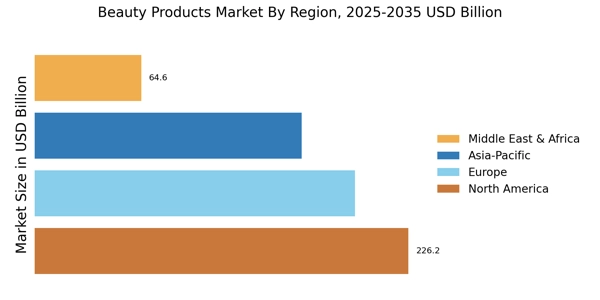
Based on the Region, the global Beauty Products is segmented into North America, Europe, Asia-Pacific, South America, Middle East and Africa. Major demand factors driving the Asia Pacific market are the increasing use in automotive industry and surge in energy harvesting applications. Countries like China, Japan, South Korea, and India dominate the region due to their strong cultural emphasis on beauty and skincare. The adoption of natural and organic products, coupled with the influence of K-beauty and J-beauty trends, has significantly shaped consumer preferences.

South Korea continues to set global beauty trends with innovations such as multi-functional cosmetics and skincare products infused with probiotics, snail mucin, and centella asiatica. 

The Chinese market, driven by Gen Z and millennials, has seen robust demand for luxury beauty brands and domestic indie labels. For example, Perfect Diary, a Chinese beauty brand, has leveraged e-commerce platforms like Tmall and social media influencers to capture significant market share. India's market is expanding due to a surge in e-commerce, urbanization, and a growing inclination toward Ayurvedic and herbal beauty products. Brands like Forest Essentials and Mamaearth have gained prominence by blending traditional remedies with modern formulations. Moreover, the region has witnessed an uptick in male grooming products, fueled by increasing social acceptance and self-care awareness.

Leading companies, including L’Oréal, Shiseido, and Amorepacific, have heavily invested in R&D and marketing strategies tailored to local markets. With e-commerce giants such as Alibaba and Lazada and the rise of social commerce, beauty products are reaching even remote consumers, reinforcing the Asia Pacific's position as a global beauty hub.

FIGURE 3: BEAUTY PRODUCTS MARKET VALUE BY REGION 2024 AND 2035 (USD BILLION)

Further, the countries considered in the scope of the Application Tracking System Market are the US, Canada, Mexico, Germany, the UK, France, Spain, Italy, Poland, Benelux, Nordics, China, India, Japan, South Korea, Australia & New Zealand, Brazil, Argentina, GCC Countries, Turkey, Iran, Iraq, Southern Africa, Ethiopia, Namibia, Ghana and others.

Beauty Products Market  Regional Image

Key Players and Competitive Insights

The Beauty Products Market is currently characterized by a dynamic competitive landscape, driven by innovation, sustainability, and digital transformation. Major players such as L'Oreal (FR), Unilever (GB), and Estée Lauder (US) are strategically positioning themselves to leverage these growth drivers. L'Oreal (FR) has focused on enhancing its digital presence and expanding its product lines to cater to diverse consumer preferences, while Unilever (GB) emphasizes sustainability in its product formulations and packaging. Estée Lauder (US) has been investing in personalized beauty solutions, indicating a shift towards customization in consumer offerings. Collectively, these strategies contribute to a competitive environment that is increasingly focused on meeting evolving consumer demands and preferences.

Key business tactics within the Beauty Products Market include localizing manufacturing and optimizing supply chains to enhance efficiency and responsiveness. The market structure appears moderately fragmented, with a mix of established brands and emerging players. The influence of key players is substantial, as they set trends and standards that smaller companies often follow. This competitive structure fosters innovation and encourages brands to differentiate themselves through unique value propositions.

In January 2026, L'Oreal (FR) announced a partnership with a leading tech firm to develop AI-driven beauty solutions aimed at personalizing consumer experiences. This strategic move underscores L'Oreal's commitment to integrating technology into its product offerings, potentially enhancing customer engagement and satisfaction. The collaboration may also position L'Oreal as a frontrunner in the digital beauty space, allowing it to capture a larger market share.

In December 2025, Unilever (GB) launched a new line of eco-friendly beauty products, which are packaged in biodegradable materials. This initiative aligns with the growing consumer demand for sustainable products and reflects Unilever's broader strategy to reduce its environmental footprint. By prioritizing sustainability, Unilever not only meets regulatory expectations but also appeals to environmentally conscious consumers, thereby strengthening its market position.

In November 2025, Estée Lauder (US) expanded its presence in Asia by acquiring a local skincare brand known for its innovative formulations. This acquisition is strategically significant as it allows Estée Lauder to tap into the rapidly growing Asian beauty market, which is characterized by a strong demand for high-quality skincare products. The move may enhance Estée Lauder's portfolio and provide access to new consumer segments, further solidifying its competitive edge.

As of February 2026, current trends in the Beauty Products Market indicate a pronounced shift towards digitalization, sustainability, and the integration of AI technologies. Strategic alliances are increasingly shaping the competitive landscape, enabling companies to pool resources and expertise. Looking ahead, competitive differentiation is likely to evolve, with a greater emphasis on innovation and technology rather than solely on price. The ability to deliver reliable supply chains and unique, high-quality products will become paramount in maintaining a competitive advantage.

Key Companies in the Beauty Products Market include

Industry Developments

May 2024: Dove has launched its new Bond Strength Collection, designed to repair damaged hair and deliver visible results in just one minute. This innovative range includes four breakthrough products, all powered by Dove's proprietary Bio-Protein Care™ and peptides, offering a comprehensive damage repair routine.

June 2024: The Estée Lauder Companies Inc. has announced the completion of its acquisition of DECIEM Beauty Group Inc., a Canadian-based, vertically integrated multi-brand company.

January 2023: Olay has introduced the Niacinamide+Peptide 24 Face Moisturizer, a product packed with powerful niacinamide and amino acid peptides. Formulated with some of the most popular skincare ingredients of 2023, this moisturizer is the result of extensive research designed to meet consumer needs.

November 2022: Kao Corporation has entered into a strategic agreement with Daiichi Sankyo Healthcare to collaborate on joint development within the Life Care Business, with a focus on skincare and oral care products. This partnership aims to expand Kao's product portfolio, enhancing its offerings in the skincare and oral care sectors.

Beauty Products Market Segmentation

Beauty Products by Product Type Outlook

  • Skincare
    • Face
      • Cleansers
      • Toners
      • Moisturizers
      • Serums
      • Masks
      • Eye Creams
    • Body
      • Body Wash/Shower Gel
      • Body Lotion
      • Body Scrub
      • Hand Cream
  • Makeup
    • Face
      • Foundation
      • Concealer
      • Compact powder
      • Loose powder
      • Blush
      • Bronzer
      • Highlighter
    • Eyes
      • Eyeshadow
      • Eyeliner
      • Mascara
      • Brows
    • Lips
      • Lipstick
      • Lip Gloss
      • Lip Liner
      • Lip Balm
  • Haircare
    • Shampoos
    • Conditioners
    • Hair Masks
    • Hair Oils
    • Hair Styling Products
  • Nail Care
  • Fragrance
    • Perfume
    • Deodorants
    • Others

Beauty Products by Category Outlook

  • Natural
  • Conventional
  • Vegan

Beauty Products by Form Outlook

  • Powder
  • Liquid
  • Gel

Beauty Products by Demographics Outlook

  • Gen X
  • Gen Z
  • Millennials
  • Boomers

Beauty Products by Packaging Type Outlook

  • Airless Packaging
    • Airless Bottles
    • Airless Jars
    • Airless Tubes
  • Dip Tube Bottles and Pumps
    • Dip Tube Bottles
    • Dip Tube Pumps- Perfume/Mist
    • Dip Tube Pumps- Lotion
  • Traditional Bottles and Tubes
    • Bottles
    • Tottles (Tube-Bottle Hybrids)
    • Tubes (Squeeze Tubes)
  • Jars and Compacts
    • Jars
    • Compacts
    • Cushion Compacts
  • Droppers and Applicators
  • Lip and Eye Packaging
  • Specialty Packaging

Beauty Products by Distribution Channel Outlook

  • Supermarkets & Hypermarkets
  • Convenience Stores
  • Specialty Stores
  • Online
  • Others

Beauty Products Regional Outlook

  • North America
    • US
    • Canada
    • Mexico
  • Europe
    • Germany
    • UK
    • France
    • Spain
    • Italy
    • Poland
    • Benelux
    • Nordics
    • Rest of Europe
  • Asia Pacific
    • China
    • India
    • Japan
    • South Korea
    • Australia & New Zealand
    • Rest of Asia-Pacific
  • South America
    • Brazil
    • Argentina
    • Rest of South America
  • Middle East
    • GCC Countries
    • Turkey
    • Iran
    • Iraq
    • Rest of Middle East
  • Africa
    • Southern Africa
    • Ethiopia
    • Namibia
    • Ghana
    • Rest of Africa

Future Outlook

Beauty Products Market Future Outlook

The Beauty Products Market is projected to grow at a 3.22% CAGR from 2024 to 2035, driven by innovation, sustainability, and digital transformation.

New opportunities lie in:

  • Expansion of personalized skincare solutions through AI technology.
  • Development of eco-friendly packaging to attract environmentally conscious consumers.
  • Integration of augmented reality for virtual try-on experiences in retail.

By 2035, the market is expected to achieve robust growth, driven by innovation and consumer demand.

Market Segmentation

Beauty Products Market End User Outlook

  • Women
  • Men
  • Unisex
  • Teenagers
  • Children

Beauty Products Market Product Type Outlook

  • Skincare
  • Makeup
  • Haircare
  • Fragrance
  • Personal Care

Beauty Products Market Distribution Channel Outlook

  • Online
  • Offline
  • Direct Sales
  • Retail
  • E-commerce

Report Scope

MARKET SIZE 2024646.13(USD Billion)
MARKET SIZE 2025666.94(USD Billion)
MARKET SIZE 2035915.63(USD Billion)
COMPOUND ANNUAL GROWTH RATE (CAGR)3.22% (2024 - 2035)
REPORT COVERAGERevenue Forecast, Competitive Landscape, Growth Factors, and Trends
BASE YEAR2024
Market Forecast Period2025 - 2035
Historical Data2019 - 2024
Market Forecast UnitsUSD Billion
Key Companies ProfiledL'Oreal (FR), Unilever (GB), Procter & Gamble (US), Estée Lauder (US), Coty (US), Shiseido (JP), Revlon (US), Avon (GB), Beiersdorf (DE)
Segments CoveredProduct Type, Distribution Channel, End User
Key Market OpportunitiesIntegration of sustainable practices and clean ingredients in the Beauty Products Market.
Key Market DynamicsRising consumer demand for sustainable beauty products drives innovation and reshapes competitive dynamics in the market.
Countries CoveredNorth America, Europe, APAC, South America, MEA
Leave a Comment

FAQs

What is the current valuation of the US-Japan beauty market?

As of 2024, the US-Japan beauty market was valued at 145.38 USD Billion.

What is the projected market size for the US-Japan beauty market by 2035?

The market is expected to reach a valuation of 199.59 USD Billion by 2035.

What is the expected CAGR for the US-Japan beauty market during the forecast period?

The expected CAGR for the US-Japan beauty market from 2025 to 2035 is 2.92%.

Which product segment holds the largest market share in the US-Japan beauty market?

Skincare appears to hold the largest market share, with a valuation range of 45.0 to 60.0 USD Billion.

How does the makeup segment perform in the US-Japan beauty market?

The makeup segment is projected to generate between 30.0 and 40.0 USD Billion.

Download Free Sample

Kindly complete the form below to receive a free sample of this Report

Compare Licence

×
Features License Type
Single User Multiuser License Enterprise User
Price $4,950 $5,950 $7,250
Maximum User Access Limit 1 User Upto 10 Users Unrestricted Access Throughout the Organization
Free Customization
Direct Access to Analyst
Deliverable Format
Platform Access
Discount on Next Purchase 10% 15% 15%
Printable Versions