×
Request Free Sample ×

Kindly complete the form below to receive a free sample of this Report

* Please use a valid business email

Leading companies partner with us for data-driven Insights

clients tt-cursor
Hero Background
English
Chinese
French
Japanese
Korean
German
Spanish

Backup Power Market Share

ID: MRFR/EnP/9265-HCR
128 Pages
Garvit Vyas
February 2026

Backup Power Market Research Report Information By Type (Diesel Generators, Gas Generators, Solar Generators, And Others (Such as Wind Turbines, Battery Systems, etc.)), By Application (Standby Power, Prime Power, And Peak Power), By End User (Residential, Commercial, Industrial, And Others (Such as Healthcare, Data Centers, etc.)) And By Region (North America, Europe, Asia-Pacific, And Rest Of The World) - Growth & Industry Forecast to 2035

Share:
Download PDF ×

We do not share your information with anyone. However, we may send you emails based on your report interest from time to time. You may contact us at any time to opt-out.

Backup Power Market Infographic
Purchase Options

Market Share

Backup Power Market Share Analysis

In the dynamic landscape of the Backup Power Market, companies employ various market share positioning strategies to gain a competitive edge and enhance their presence. One prevalent approach is differentiation, wherein companies strive to distinguish their products or services from competitors. This can be done through distinctive features, outstanding performance or novel technology. In this way, companies aim to stand out in the market and attract a particular segment of customers who appreciate specific attributes that define their backup power solutions. For instance, a firm can specialize in making eco-friendly energy efficient backup power systems to target environmentally conscious consumers.

Another major strategy is cost leadership, that is the drive to become a price leader in the market. is streamlining the production processes, optimizing supply chains and reducing operational costs to provide backup power solutions at a lower cost. By offering low-cost choices, businesses may attract cost conscious customers and expand their market share. Nevertheless, it is necessary to strike a balance between cost reduction and maintaining product quality so as not tarnish the brand’s reputation.

In addition, firms often resort to a niche approach whereby they focus on select market segments or particular geographic areas. Specialization enables companies to design their backup power solutions after the needs of a given customer segment. For instance, a company could specialize in offering backup power systems for data centers serving the needs of this market segment. This strategy makes it possible for companies to become specialists in their niche and establish strong customer relations with people who appreciate expertise-based offering.

Collaborative strategies as well are contributing to market share positioning. Partnerships, alliances and collaborative ventures with other firms can open up new markets, technologies or distribution channels. For example, a provider of backup power solutions might partner with a renewable energy company to provide hybrid systems that integrate conventional back up power supplies with ecological forms of generating electricity. These joint ventures can create synergies and increase the overall value proposition for customers.

Apart from these, continuous innovation is necessary to maintain and grow market share. The Backup Power Market is heavily influenced by technological advancements, and companies need to keep ahead of the curve through investment in research and development. Developing new and upgraded products, integrating advanced technologies, or getting accustomed to the current tendencies makes a company relevant in the dynamic market.

Further, proper marketing and branding strategies play an important role in building market share position. A set of targeted marketing campaigns aimed at enhancing brand image, focusing on the unique selling propositions associated with backup power solutions can shape customer opinions and preferences. Companies investing in brand equity are usually further positioned in the sector because customers have faith and choose brands that it recognizes. Satisfied customers are more likely to become repeat buyers and advocates for a particular brand, ultimately helping to expand the company's market share. Providing reliable customer support, warranties, and maintenance services can enhance the overall customer experience and contribute to long-term success in the Backup Power Market.

Author
Garvit Vyas
Analyst

Explore the profile of Garvit Vyas, one of our esteemed authors at Market Research Future, and access their expert research contributions in the field of market research and industry analysis

Leave a Comment

FAQs

What is the current valuation of the Backup Power Market as of 2024?

<p>The Backup Power Market was valued at 18.64 USD Billion in 2024.</p>

What is the projected market size for the Backup Power Market in 2035?

<p>The market is projected to reach 37.27 USD Billion by 2035.</p>

What is the expected CAGR for the Backup Power Market during the forecast period 2025 - 2035?

<p>The expected CAGR for the Backup Power Market during 2025 - 2035 is 6.5%.</p>

Which application segments are included in the Backup Power Market?

<p>The market includes application segments such as Residential, Commercial, Industrial, Telecommunications, and Healthcare.</p>

What were the valuations for the Residential segment in 2024 and its projected value in 2035?

<p>The Residential segment was valued at 3.73 USD Billion in 2024 and is projected to reach 7.45 USD Billion by 2035.</p>

How does the Commercial segment's valuation compare between 2024 and 2035?

<p>The Commercial segment was valued at 4.96 USD Billion in 2024 and is expected to grow to 9.92 USD Billion by 2035.</p>

What power sources are utilized in the Backup Power Market?

The market utilizes power sources such as Internal Combustion Engine, Battery, Solar, Fuel Cell, and Hybrid.

What was the valuation of the Battery power source in 2024 and its forecast for 2035?

The Battery power source was valued at 5.0 USD Billion in 2024 and is projected to reach 10.0 USD Billion by 2035.

Which key players dominate the Backup Power Market?

Key players in the market include Generac Holdings Inc, Kohler Co, Cummins Inc, and Eaton Corporation plc.

What are the end-use segments in the Backup Power Market?

End-use segments include Uninterruptible Power Supply, Standby Power, Peak Shaving, Load Management, and Remote Power.

Market Summary

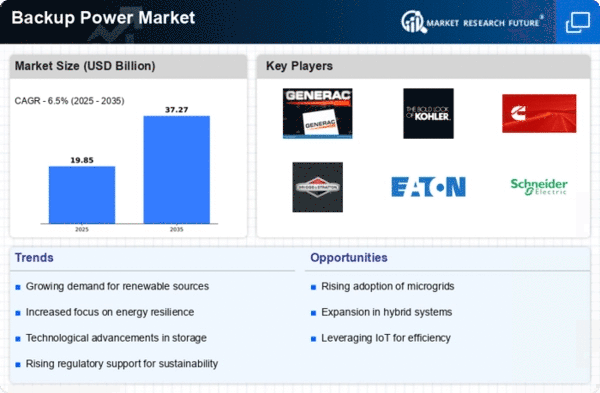
As per MRFR analysis, the Backup Power Market Size was estimated at 18.64 USD Billion in 2024. The Backup Power industry is projected to grow from 19.85 USD Billion in 2025 to 37.27 USD Billion by 2035, exhibiting a compound annual growth rate (CAGR) of 6.5% during the forecast period 2025 - 2035.

Key Market Trends & Highlights

The Backup Power Market is experiencing a transformative shift towards renewable energy and smart solutions.

  • North America remains the largest market for backup power solutions, driven by increasing energy demands and infrastructure needs. The Asia-Pacific region is emerging as the fastest-growing market, fueled by rapid urbanization and industrialization. The residential segment continues to dominate the market, while the commercial segment is witnessing the fastest growth due to rising energy resilience requirements. Key market drivers include the increasing frequency of power outages and regulatory support for energy resilience, which are propelling the adoption of advanced backup systems.

Market Size & Forecast

2024 Market Size 18.64 (USD Billion)
2035 Market Size 37.27 (USD Billion)
CAGR (2025 - 2035) 6.5%
Largest Regional Market Share in 2024 North America

Major Players

Generac Holdings Inc (US), Kohler Co (US), Cummins Inc (US), Briggs &amp; Stratton Corporation (US), Eaton Corporation plc (GB), Schneider Electric SE (FR), Honda Motor Co Ltd (JP), Atlas Copco AB (SE), Siemens AG (DE)

Market Trends

The Backup Power Market is currently experiencing a notable transformation, driven by increasing demand for reliable energy solutions across various sectors. This market encompasses a range of technologies, including generators, uninterruptible power supplies, and energy storage systems. As energy security becomes a priority for both residential and commercial users, the market is witnessing a shift towards more sustainable and efficient power sources. Innovations in battery technology and renewable energy integration are reshaping the landscape, suggesting a future where backup power systems are not only reliable but also environmentally friendly. Moreover, the growing frequency of power outages and the rising costs of electricity are compelling consumers to invest in backup power solutions. This trend is particularly evident in regions prone to natural disasters or unstable grid infrastructure. The increasing awareness of energy independence and the need for uninterrupted power supply are further propelling the market forward. As a result, manufacturers are focusing on developing advanced systems that offer enhanced performance and user-friendly features, indicating a robust growth trajectory for the Backup Power Market in the coming years.

Shift Towards Renewable Energy Sources

The Backup Power Market is increasingly leaning towards renewable energy solutions, such as solar and wind power. This shift is driven by the need for sustainable energy alternatives that reduce carbon footprints. As technology advances, integrating renewable sources into backup systems becomes more feasible, allowing users to harness clean energy even during outages.

Technological Advancements in Energy Storage

Recent innovations in energy storage technologies are significantly impacting the Backup Power Market. Enhanced battery systems, including lithium-ion and solid-state batteries, offer improved efficiency and longer lifespans. These advancements enable users to store excess energy for later use, ensuring a reliable power supply during critical times.

Growing Demand for Smart Backup Solutions

The rise of smart technology is influencing the Backup Power Market, with consumers increasingly seeking intelligent systems that offer real-time monitoring and automated management. These smart solutions provide users with insights into energy consumption and system performance, enhancing overall efficiency and reliability.

Backup Power Market Market Drivers

Market Growth Projections

The Global Backup Power Market Industry is projected to witness substantial growth over the next decade. With a market value expected to reach 18.5 USD Billion in 2024 and 35.1 USD Billion by 2035, the industry is poised for a robust trajectory. The compound annual growth rate of 6.0% from 2025 to 2035 indicates a sustained demand for backup power solutions across various sectors. This growth is likely to be fueled by factors such as technological advancements, increasing energy demands, and the need for reliable power sources in the face of climate change and natural disasters.

Government Initiatives and Incentives

Government initiatives and incentives play a pivotal role in shaping the Global Backup Power Market Industry. Various governments are implementing policies aimed at promoting energy resilience and sustainability, which often include financial incentives for adopting backup power systems. For instance, tax credits and rebates for renewable energy solutions are becoming increasingly common. These measures not only encourage the adoption of backup power technologies but also align with broader environmental goals. As a result, the market is poised for growth, with a projected compound annual growth rate of 6.0% from 2025 to 2035, reflecting a commitment to enhancing energy security.

Rising Frequency of Natural Disasters

The Global Backup Power Market Industry is significantly influenced by the rising frequency of natural disasters, which has led to increased awareness regarding the necessity of backup power systems. Events such as hurricanes, floods, and wildfires have underscored the vulnerability of power grids, prompting both residential and commercial entities to invest in backup solutions. This trend is expected to contribute to the market's growth, with projections indicating a value of 35.1 USD Billion by 2035. The urgency to safeguard against unpredictable weather patterns is likely to drive innovation and adoption of advanced backup power technologies.

Expanding Industrial and Commercial Sectors

The Global Backup Power Market Industry is experiencing growth driven by the expansion of industrial and commercial sectors. As industries increasingly rely on continuous power for operations, the demand for backup power systems is rising. Sectors such as manufacturing, healthcare, and information technology are particularly dependent on reliable power sources to maintain productivity and service delivery. This trend is likely to contribute to the market's expansion, as businesses recognize the importance of investing in backup solutions to prevent operational disruptions. The increasing complexity of industrial processes further emphasizes the need for robust backup power systems.

Technological Advancements in Energy Storage

Technological advancements in energy storage solutions are transforming the Global Backup Power Market Industry. Innovations such as lithium-ion batteries and advanced inverter technologies are enhancing the efficiency and reliability of backup power systems. These advancements enable longer storage durations and faster response times, making backup power solutions more appealing to consumers and businesses. As the market evolves, the integration of smart technologies and IoT capabilities is expected to further optimize energy management. This evolution not only meets the growing demand for sustainable energy solutions but also positions the market for substantial growth in the coming years.

Increasing Demand for Uninterrupted Power Supply

The Global Backup Power Market Industry experiences a notable surge in demand for uninterrupted power supply solutions. This trend is largely driven by the increasing reliance on technology across various sectors, including healthcare, telecommunications, and data centers. As businesses and consumers alike seek to mitigate the risks associated with power outages, the market is projected to reach 18.5 USD Billion in 2024. This growing dependency on reliable power sources indicates a shift towards backup power systems that can ensure operational continuity, thereby enhancing the overall resilience of critical infrastructure.

Market Segment Insights

By Application: Residential (Largest) vs. Commercial (Fastest-Growing)

Among the various applications in the Backup Power Market, residential applications currently hold the largest market share. This is primarily driven by the increasing consumer awareness regarding energy security and the rising number of natural disasters, prompting more households to invest in backup power solutions. Commercial applications closely follow, contributing significantly to market dynamics, particularly in urban areas where power interruptions can severely impact business operations.

Residential: Dominant vs. Commercial: Emerging

The residential backup power segment is characterized by its substantial demand driven by consumers seeking reliable energy sources during outages. Homeowners are increasingly opting for portable generators and home battery systems to ensure uninterrupted power supply. On the other hand, the commercial segment is rapidly emerging, particularly due to the increasing reliance on technology and a surge in data centers. Businesses are prioritizing backup power solutions to minimize downtime and ensure operational continuity, reflecting a strong growth trajectory as companies invest in more robust energy solutions.

By Power Source: Battery (Largest) vs. Internal Combustion Engine (Fastest-Growing)

<p>In the Backup Power Market, the distribution among power sources reveals a significant dominance of batteries, which hold the largest market share due to their efficiency, reliability, and increasing application in various sectors. Internal combustion engines, however, are emerging with rapid growth, especially in regions where traditional power sources have faltered, indicating a shift in preference towards versatile backup solutions.</p>

<p>Battery (Dominant) vs. Internal Combustion Engine (Emerging)</p>

<p>Batteries represent the dominant power source in the backup power market, attributed to their ease of use, rapid deployment, and advancements in technology that enhance their lifespan and charge capacity. On the other hand, internal combustion engines are carving out an emerging niche, driven by their powerful performance in larger applications and as a response to the need for immediate backup solutions in critical environments. This competitive landscape signifies a transition, with batteries leading in residential and portable sectors, while internal combustion engines remain essential for industrial and high-demand scenarios.</p>

By End Use: Uninterruptible Power Supply (Largest) vs. Standby Power (Fastest-Growing)

<p>In the Backup Power Market, Uninterruptible Power Supply (UPS) systems dominate the end-use segment, holding a significant share due to their critical role in providing immediate power backup during outages. Meanwhile, Standby Power has emerged as a crucial solution, catering to businesses and industries that require reliable electricity to ensure seamless operations in the face of power disruption. These two segment values highlight the necessity of effective power solutions in today’s infrastructure. The growth of Standby Power is particularly noteworthy, driven by increasing electricity demands and the rise of renewable energy sources. Market drivers also include heightened awareness regarding the importance of uninterrupted power supply in critical sectors such as healthcare and data centers, fostering innovative developments in standby systems. Together, these segments present a strong foundation for continued growth and innovation in the market as both companies and consumers seek reliable back-up power solutions.</p>

<p>Uninterruptible Power Supply (Dominant) vs. Load Management (Emerging)</p>

<p>Uninterruptible Power Supply (UPS) technology remains the dominant player in the Backup Power Market, favored for its ability to deliver instantaneous power during disruptions, thus preventing data loss and operational downtime. Industries such as telecommunications and healthcare rely heavily on UPS systems to maintain continuous service. In contrast, Load Management systems are gaining ground as an emerging solution, designed to optimize power consumption and enhance energy efficiency. These systems help organizations reduce peak demand charges and manage their energy profiles better. With advancements in smart grid technology, Load Management is becoming increasingly critical, as organizations seek ways to balance energy use with economic and environmental goals. As these segments evolve, they will significantly shape the landscape of backup power solutions in the coming years.</p>

Get more detailed insights about Backup Power Market Research Report – Forecast till 2035

Regional Insights

North America : Market Leader in Backup Power

North America continues to lead the Backup Power Market, holding a significant market share of 9.32 billion. The growth is driven by increasing demand for reliable power solutions, especially in residential and commercial sectors. Regulatory support for renewable energy integration and energy efficiency initiatives further catalyze market expansion. The region's focus on disaster preparedness and resilience against power outages also boosts demand for backup power systems. The competitive landscape is robust, with key players like Generac Holdings Inc, Kohler Co, and Cummins Inc dominating the market. The U.S. remains the largest contributor, supported by advanced technology and innovation in power generation. Companies are increasingly investing in R&D to enhance product offerings, focusing on hybrid and renewable energy solutions to meet evolving consumer needs. The presence of established manufacturers ensures a dynamic market environment.

Europe : Emerging Market with Growth Potential

Europe's Backup Power Market is valued at 4.96 billion, reflecting a growing demand for energy security and sustainability. The region is witnessing a shift towards cleaner energy sources, driven by stringent regulations aimed at reducing carbon emissions. Government incentives for renewable energy adoption and energy storage solutions are key growth drivers. The increasing frequency of extreme weather events has also heightened the need for reliable backup power systems across various sectors. Leading countries in this market include Germany, France, and the UK, where major players like Schneider Electric SE and Siemens AG are actively innovating. The competitive landscape is characterized by a mix of established firms and emerging startups focusing on energy efficiency and smart grid technologies. The European market is poised for growth as it aligns with the EU's Green Deal objectives, promoting sustainable energy solutions.

Asia-Pacific : Rapidly Growing Power Market

The Asia-Pacific region, valued at 3.2 billion, is experiencing rapid growth in the Backup Power Market, driven by urbanization and industrialization. Countries like China and India are witnessing increased demand for uninterrupted power supply due to rising population and economic activities. Government initiatives promoting renewable energy and energy storage solutions are also significant growth catalysts. The region's focus on infrastructure development and disaster management further enhances the need for reliable backup power systems. China leads the market, followed by India and Japan, with key players such as Honda Motor Co Ltd and Atlas Copco AB making substantial contributions. The competitive landscape is evolving, with companies investing in advanced technologies to improve efficiency and reduce emissions. As the region continues to develop, the demand for innovative backup power solutions is expected to rise significantly, aligning with global sustainability goals.

Middle East and Africa : Emerging Market with Unique Challenges

The Middle East and Africa region, valued at 1.16 billion, presents unique challenges and opportunities in the Backup Power Market. The demand for reliable power solutions is driven by frequent power outages and the need for energy security in both urban and rural areas. Government initiatives aimed at improving infrastructure and increasing access to electricity are key growth drivers. Additionally, the region's focus on diversifying energy sources, including renewables, is shaping market dynamics. Leading countries include South Africa and the UAE, where companies like Eaton Corporation plc are making significant inroads. The competitive landscape is characterized by a mix of local and international players, each striving to meet the growing demand for backup power solutions. As the region continues to develop, the emphasis on sustainable energy practices is expected to drive further growth in the backup power sector.

Key Players and Competitive Insights

The Backup Power Market is currently characterized by a dynamic competitive landscape, driven by increasing demand for reliable power solutions across various sectors. Key players are actively engaging in strategies that emphasize innovation, regional expansion, and partnerships to enhance their market positioning. For instance, Generac Holdings Inc (US) has focused on expanding its product portfolio to include advanced energy management systems, which cater to both residential and commercial sectors. Similarly, Cummins Inc (US) has been investing in hybrid power solutions, indicating a shift towards more sustainable energy options. These strategic moves collectively shape a competitive environment that is increasingly focused on technological advancement and customer-centric solutions.In terms of business tactics, companies are localizing manufacturing to reduce lead times and optimize supply chains, which is crucial in a market that is moderately fragmented. This approach not only enhances operational efficiency but also allows for better responsiveness to regional demands. The competitive structure is influenced by the collective actions of major players, which include mergers, acquisitions, and strategic partnerships aimed at consolidating market share and enhancing product offerings.
In November Kohler Co (US) announced a strategic partnership with a leading renewable energy firm to develop integrated backup power solutions that leverage solar technology. This collaboration is significant as it positions Kohler to tap into the growing market for sustainable energy solutions, aligning with global trends towards decarbonization. The integration of renewable sources into backup power systems could potentially redefine customer expectations and expand market reach.
In October Schneider Electric SE (FR) launched a new line of smart generators that incorporate IoT technology for enhanced monitoring and management. This move underscores the importance of digital transformation in the Backup Power Market, as customers increasingly seek solutions that offer real-time data and analytics. The introduction of smart technology not only improves operational efficiency but also enhances customer engagement, thereby fostering brand loyalty.
In September Eaton Corporation plc (GB) expanded its operations in Asia by establishing a new manufacturing facility in India, aimed at meeting the rising demand for backup power solutions in the region. This strategic expansion is indicative of Eaton's commitment to localizing production and enhancing supply chain reliability, which is essential in a market that is becoming increasingly competitive. By establishing a presence in a high-growth market, Eaton is likely to strengthen its competitive position and capitalize on emerging opportunities.
As of December current trends in the Backup Power Market are heavily influenced by digitalization, sustainability, and the integration of AI technologies. Strategic alliances are becoming more prevalent, as companies recognize the need to collaborate in order to innovate and meet evolving customer demands. The competitive differentiation is shifting from price-based strategies to a focus on innovation, technology, and supply chain reliability. This evolution suggests that companies that prioritize these aspects will likely emerge as leaders in the market, shaping the future landscape of backup power solutions.

Key Companies in the Backup Power Market include

Industry Developments

May 2022:Cisco opened its first data center in India. The company wants to meet customers' growing needs in terms of data localization and cyber defense. As a result, India is now the location of Cisco's Duo's first data center.

July 2022:the upgraded EcoStruxure Service Plan for 10-40 Kva Three-Phase Uninterrupted Power Supply (UPS) devices was announced by Schneider Electric. The EcoStruxure Service Plan offered clients round-the-clock remote and onsite knowledge and support by fusing traditional onsite services with digital capabilities made possible by the EcoStruxure architecture enabled by the Internet of Things.

April 2022:Eaton, a leader in solutions for massive data centers and an intelligent power management firm, revealed plans to expand its current operations by constructing a new campus for its essential power systems in Vantaa, Finland.

Future Outlook

Backup Power Market Future Outlook

The Backup Power Market is projected to grow at a 6.5% CAGR from 2025 to 2035, driven by increasing demand for reliable energy solutions and technological advancements.

New opportunities lie in:

  • <p>Development of hybrid power systems integrating renewable sources Expansion of energy storage solutions for commercial applications Implementation of smart grid technologies for enhanced efficiency</p>

By 2035, the Backup Power Market is expected to be robust, driven by innovation and increasing energy demands.

Market Segmentation

Backup Power Market End Use Outlook

  • Emergency Backup
  • Peak Shaving
  • Load Management
  • Renewable Integration
  • Data Center Support

Backup Power Market Application Outlook

  • Residential
  • Commercial
  • Industrial
  • Telecommunications
  • Healthcare

Backup Power Market Power Source Outlook

  • Internal Combustion Engine
  • Battery
  • Solar
  • Fuel Cell
  • Uninterruptible Power Supply

Report Scope

MARKET SIZE 2024 18.64(USD Billion)
MARKET SIZE 2025 19.85(USD Billion)
MARKET SIZE 2035 37.27(USD Billion)
COMPOUND ANNUAL GROWTH RATE (CAGR) 6.5% (2025 - 2035)
REPORT COVERAGE Revenue Forecast, Competitive Landscape, Growth Factors, and Trends
BASE YEAR 2024
Market Forecast Period 2025 - 2035
Historical Data 2019 - 2024
Market Forecast Units USD Billion
Key Companies Profiled Generac Holdings Inc (US), Kohler Co (US), Cummins Inc (US), Briggs & Stratton Corporation (US), Eaton Corporation plc (GB), Schneider Electric SE (FR), Honda Motor Co Ltd (JP), Atlas Copco AB (SE), Siemens AG (DE)
Segments Covered Application, Power Source, End Use
Key Market Opportunities Integration of renewable energy sources enhances resilience in the Backup Power Market.

Key Market Dynamics Rising demand for reliable energy sources drives innovation and competition in the Backup Power Market.
Countries Covered North America, Europe, APAC, South America, MEA

FAQs

What is the current valuation of the Backup Power Market as of 2024?

<p>The Backup Power Market was valued at 18.64 USD Billion in 2024.</p>

What is the projected market size for the Backup Power Market in 2035?

<p>The market is projected to reach 37.27 USD Billion by 2035.</p>

What is the expected CAGR for the Backup Power Market during the forecast period 2025 - 2035?

<p>The expected CAGR for the Backup Power Market during 2025 - 2035 is 6.5%.</p>

Which application segments are included in the Backup Power Market?

<p>The market includes application segments such as Residential, Commercial, Industrial, Telecommunications, and Healthcare.</p>

What were the valuations for the Residential segment in 2024 and its projected value in 2035?

<p>The Residential segment was valued at 3.73 USD Billion in 2024 and is projected to reach 7.45 USD Billion by 2035.</p>

How does the Commercial segment's valuation compare between 2024 and 2035?

<p>The Commercial segment was valued at 4.96 USD Billion in 2024 and is expected to grow to 9.92 USD Billion by 2035.</p>

What power sources are utilized in the Backup Power Market?

The market utilizes power sources such as Internal Combustion Engine, Battery, Solar, Fuel Cell, and Hybrid.

What was the valuation of the Battery power source in 2024 and its forecast for 2035?

The Battery power source was valued at 5.0 USD Billion in 2024 and is projected to reach 10.0 USD Billion by 2035.

Which key players dominate the Backup Power Market?

Key players in the market include Generac Holdings Inc, Kohler Co, Cummins Inc, and Eaton Corporation plc.

What are the end-use segments in the Backup Power Market?

End-use segments include Uninterruptible Power Supply, Standby Power, Peak Shaving, Load Management, and Remote Power.

  1. SECTION I: EXECUTIVE SUMMARY AND KEY HIGHLIGHTS
    1. | 1.1 EXECUTIVE SUMMARY
    2. | | 1.1.1 Market Overview
    3. | | 1.1.2 Key Findings
    4. | | 1.1.3 Market Segmentation
    5. | | 1.1.4 Competitive Landscape
    6. | | 1.1.5 Challenges and Opportunities
    7. | | 1.1.6 Future Outlook
  2. SECTION II: SCOPING, METHODOLOGY AND MARKET STRUCTURE
    1. | 2.1 MARKET INTRODUCTION
    2. | | 2.1.1 Definition
    3. | | 2.1.2 Scope of the study
    4. | | | 2.1.2.1 Research Objective
    5. | | | 2.1.2.2 Assumption
    6. | | | 2.1.2.3 Limitations
    7. | 2.2 RESEARCH METHODOLOGY
    8. | | 2.2.1 Overview
    9. | | 2.2.2 Data Mining
    10. | | 2.2.3 Secondary Research
    11. | | 2.2.4 Primary Research
    12. | | | 2.2.4.1 Primary Interviews and Information Gathering Process
    13. | | | 2.2.4.2 Breakdown of Primary Respondents
    14. | | 2.2.5 Forecasting Model
    15. | | 2.2.6 Market Size Estimation
    16. | | | 2.2.6.1 Bottom-Up Approach
    17. | | | 2.2.6.2 Top-Down Approach
    18. | | 2.2.7 Data Triangulation
    19. | | 2.2.8 Validation
  3. SECTION III: QUALITATIVE ANALYSIS
    1. | 3.1 MARKET DYNAMICS
    2. | | 3.1.1 Overview
    3. | | 3.1.2 Drivers
    4. | | 3.1.3 Restraints
    5. | | 3.1.4 Opportunities
    6. | 3.2 MARKET FACTOR ANALYSIS
    7. | | 3.2.1 Value chain Analysis
    8. | | 3.2.2 Porter's Five Forces Analysis
    9. | | | 3.2.2.1 Bargaining Power of Suppliers
    10. | | | 3.2.2.2 Bargaining Power of Buyers
    11. | | | 3.2.2.3 Threat of New Entrants
    12. | | | 3.2.2.4 Threat of Substitutes
    13. | | | 3.2.2.5 Intensity of Rivalry
    14. | | 3.2.3 COVID-19 Impact Analysis
    15. | | | 3.2.3.1 Market Impact Analysis
    16. | | | 3.2.3.2 Regional Impact
    17. | | | 3.2.3.3 Opportunity and Threat Analysis
  4. SECTION IV: QUANTITATIVE ANALYSIS
    1. | 4.1 Energy & Power, BY Application (USD Billion)
    2. | | 4.1.1 Residential
    3. | | 4.1.2 Commercial
    4. | | 4.1.3 Industrial
    5. | | 4.1.4 Telecommunications
    6. | | 4.1.5 Healthcare
    7. | 4.2 Energy & Power, BY Power Source (USD Billion)
    8. | | 4.2.1 Internal Combustion Engine
    9. | | 4.2.2 Battery
    10. | | 4.2.3 Solar
    11. | | 4.2.4 Fuel Cell
    12. | | 4.2.5 Hybrid
    13. | 4.3 Energy & Power, BY End Use (USD Billion)
    14. | | 4.3.1 Uninterruptible Power Supply
    15. | | 4.3.2 Standby Power
    16. | | 4.3.3 Peak Shaving
    17. | | 4.3.4 Load Management
    18. | | 4.3.5 Remote Power
    19. | 4.4 Energy & Power, BY Region (USD Billion)
    20. | | 4.4.1 North America
    21. | | | 4.4.1.1 US
    22. | | | 4.4.1.2 Canada
    23. | | 4.4.2 Europe
    24. | | | 4.4.2.1 Germany
    25. | | | 4.4.2.2 UK
    26. | | | 4.4.2.3 France
    27. | | | 4.4.2.4 Russia
    28. | | | 4.4.2.5 Italy
    29. | | | 4.4.2.6 Spain
    30. | | | 4.4.2.7 Rest of Europe
    31. | | 4.4.3 APAC
    32. | | | 4.4.3.1 China
    33. | | | 4.4.3.2 India
    34. | | | 4.4.3.3 Japan
    35. | | | 4.4.3.4 South Korea
    36. | | | 4.4.3.5 Malaysia
    37. | | | 4.4.3.6 Thailand
    38. | | | 4.4.3.7 Indonesia
    39. | | | 4.4.3.8 Rest of APAC
    40. | | 4.4.4 South America
    41. | | | 4.4.4.1 Brazil
    42. | | | 4.4.4.2 Mexico
    43. | | | 4.4.4.3 Argentina
    44. | | | 4.4.4.4 Rest of South America
    45. | | 4.4.5 MEA
    46. | | | 4.4.5.1 GCC Countries
    47. | | | 4.4.5.2 South Africa
    48. | | | 4.4.5.3 Rest of MEA
  5. SECTION V: COMPETITIVE ANALYSIS
    1. | 5.1 Competitive Landscape
    2. | | 5.1.1 Overview
    3. | | 5.1.2 Competitive Analysis
    4. | | 5.1.3 Market share Analysis
    5. | | 5.1.4 Major Growth Strategy in the Energy & Power
    6. | | 5.1.5 Competitive Benchmarking
    7. | | 5.1.6 Leading Players in Terms of Number of Developments in the Energy & Power
    8. | | 5.1.7 Key developments and growth strategies
    9. | | | 5.1.7.1 New Product Launch/Service Deployment
    10. | | | 5.1.7.2 Merger & Acquisitions
    11. | | | 5.1.7.3 Joint Ventures
    12. | | 5.1.8 Major Players Financial Matrix
    13. | | | 5.1.8.1 Sales and Operating Income
    14. | | | 5.1.8.2 Major Players R&D Expenditure. 2023
    15. | 5.2 Company Profiles
    16. | | 5.2.1 Generac Holdings Inc (US)
    17. | | | 5.2.1.1 Financial Overview
    18. | | | 5.2.1.2 Products Offered
    19. | | | 5.2.1.3 Key Developments
    20. | | | 5.2.1.4 SWOT Analysis
    21. | | | 5.2.1.5 Key Strategies
    22. | | 5.2.2 Kohler Co (US)
    23. | | | 5.2.2.1 Financial Overview
    24. | | | 5.2.2.2 Products Offered
    25. | | | 5.2.2.3 Key Developments
    26. | | | 5.2.2.4 SWOT Analysis
    27. | | | 5.2.2.5 Key Strategies
    28. | | 5.2.3 Cummins Inc (US)
    29. | | | 5.2.3.1 Financial Overview
    30. | | | 5.2.3.2 Products Offered
    31. | | | 5.2.3.3 Key Developments
    32. | | | 5.2.3.4 SWOT Analysis
    33. | | | 5.2.3.5 Key Strategies
    34. | | 5.2.4 Briggs & Stratton Corporation (US)
    35. | | | 5.2.4.1 Financial Overview
    36. | | | 5.2.4.2 Products Offered
    37. | | | 5.2.4.3 Key Developments
    38. | | | 5.2.4.4 SWOT Analysis
    39. | | | 5.2.4.5 Key Strategies
    40. | | 5.2.5 Eaton Corporation plc (GB)
    41. | | | 5.2.5.1 Financial Overview
    42. | | | 5.2.5.2 Products Offered
    43. | | | 5.2.5.3 Key Developments
    44. | | | 5.2.5.4 SWOT Analysis
    45. | | | 5.2.5.5 Key Strategies
    46. | | 5.2.6 Honda Motor Co Ltd (JP)
    47. | | | 5.2.6.1 Financial Overview
    48. | | | 5.2.6.2 Products Offered
    49. | | | 5.2.6.3 Key Developments
    50. | | | 5.2.6.4 SWOT Analysis
    51. | | | 5.2.6.5 Key Strategies
    52. | | 5.2.7 Atlas Copco AB (SE)
    53. | | | 5.2.7.1 Financial Overview
    54. | | | 5.2.7.2 Products Offered
    55. | | | 5.2.7.3 Key Developments
    56. | | | 5.2.7.4 SWOT Analysis
    57. | | | 5.2.7.5 Key Strategies
    58. | | 5.2.8 Schneider Electric SE (FR)
    59. | | | 5.2.8.1 Financial Overview
    60. | | | 5.2.8.2 Products Offered
    61. | | | 5.2.8.3 Key Developments
    62. | | | 5.2.8.4 SWOT Analysis
    63. | | | 5.2.8.5 Key Strategies
    64. | | 5.2.9 Siemens AG (DE)
    65. | | | 5.2.9.1 Financial Overview
    66. | | | 5.2.9.2 Products Offered
    67. | | | 5.2.9.3 Key Developments
    68. | | | 5.2.9.4 SWOT Analysis
    69. | | | 5.2.9.5 Key Strategies
    70. | | 5.2.10 GE Power (US)
    71. | | | 5.2.10.1 Financial Overview
    72. | | | 5.2.10.2 Products Offered
    73. | | | 5.2.10.3 Key Developments
    74. | | | 5.2.10.4 SWOT Analysis
    75. | | | 5.2.10.5 Key Strategies
    76. | 5.3 Appendix
    77. | | 5.3.1 References
    78. | | 5.3.2 Related Reports
  6. LIST OF FIGURES
    1. | 6.1 MARKET SYNOPSIS
    2. | 6.2 NORTH AMERICA MARKET ANALYSIS
    3. | 6.3 US MARKET ANALYSIS BY APPLICATION
    4. | 6.4 US MARKET ANALYSIS BY POWER SOURCE
    5. | 6.5 US MARKET ANALYSIS BY END USE
    6. | 6.6 CANADA MARKET ANALYSIS BY APPLICATION
    7. | 6.7 CANADA MARKET ANALYSIS BY POWER SOURCE
    8. | 6.8 CANADA MARKET ANALYSIS BY END USE
    9. | 6.9 EUROPE MARKET ANALYSIS
    10. | 6.10 GERMANY MARKET ANALYSIS BY APPLICATION
    11. | 6.11 GERMANY MARKET ANALYSIS BY POWER SOURCE
    12. | 6.12 GERMANY MARKET ANALYSIS BY END USE
    13. | 6.13 UK MARKET ANALYSIS BY APPLICATION
    14. | 6.14 UK MARKET ANALYSIS BY POWER SOURCE
    15. | 6.15 UK MARKET ANALYSIS BY END USE
    16. | 6.16 FRANCE MARKET ANALYSIS BY APPLICATION
    17. | 6.17 FRANCE MARKET ANALYSIS BY POWER SOURCE
    18. | 6.18 FRANCE MARKET ANALYSIS BY END USE
    19. | 6.19 RUSSIA MARKET ANALYSIS BY APPLICATION
    20. | 6.20 RUSSIA MARKET ANALYSIS BY POWER SOURCE
    21. | 6.21 RUSSIA MARKET ANALYSIS BY END USE
    22. | 6.22 ITALY MARKET ANALYSIS BY APPLICATION
    23. | 6.23 ITALY MARKET ANALYSIS BY POWER SOURCE
    24. | 6.24 ITALY MARKET ANALYSIS BY END USE
    25. | 6.25 SPAIN MARKET ANALYSIS BY APPLICATION
    26. | 6.26 SPAIN MARKET ANALYSIS BY POWER SOURCE
    27. | 6.27 SPAIN MARKET ANALYSIS BY END USE
    28. | 6.28 REST OF EUROPE MARKET ANALYSIS BY APPLICATION
    29. | 6.29 REST OF EUROPE MARKET ANALYSIS BY POWER SOURCE
    30. | 6.30 REST OF EUROPE MARKET ANALYSIS BY END USE
    31. | 6.31 APAC MARKET ANALYSIS
    32. | 6.32 CHINA MARKET ANALYSIS BY APPLICATION
    33. | 6.33 CHINA MARKET ANALYSIS BY POWER SOURCE
    34. | 6.34 CHINA MARKET ANALYSIS BY END USE
    35. | 6.35 INDIA MARKET ANALYSIS BY APPLICATION
    36. | 6.36 INDIA MARKET ANALYSIS BY POWER SOURCE
    37. | 6.37 INDIA MARKET ANALYSIS BY END USE
    38. | 6.38 JAPAN MARKET ANALYSIS BY APPLICATION
    39. | 6.39 JAPAN MARKET ANALYSIS BY POWER SOURCE
    40. | 6.40 JAPAN MARKET ANALYSIS BY END USE
    41. | 6.41 SOUTH KOREA MARKET ANALYSIS BY APPLICATION
    42. | 6.42 SOUTH KOREA MARKET ANALYSIS BY POWER SOURCE
    43. | 6.43 SOUTH KOREA MARKET ANALYSIS BY END USE
    44. | 6.44 MALAYSIA MARKET ANALYSIS BY APPLICATION
    45. | 6.45 MALAYSIA MARKET ANALYSIS BY POWER SOURCE
    46. | 6.46 MALAYSIA MARKET ANALYSIS BY END USE
    47. | 6.47 THAILAND MARKET ANALYSIS BY APPLICATION
    48. | 6.48 THAILAND MARKET ANALYSIS BY POWER SOURCE
    49. | 6.49 THAILAND MARKET ANALYSIS BY END USE
    50. | 6.50 INDONESIA MARKET ANALYSIS BY APPLICATION
    51. | 6.51 INDONESIA MARKET ANALYSIS BY POWER SOURCE
    52. | 6.52 INDONESIA MARKET ANALYSIS BY END USE
    53. | 6.53 REST OF APAC MARKET ANALYSIS BY APPLICATION
    54. | 6.54 REST OF APAC MARKET ANALYSIS BY POWER SOURCE
    55. | 6.55 REST OF APAC MARKET ANALYSIS BY END USE
    56. | 6.56 SOUTH AMERICA MARKET ANALYSIS
    57. | 6.57 BRAZIL MARKET ANALYSIS BY APPLICATION
    58. | 6.58 BRAZIL MARKET ANALYSIS BY POWER SOURCE
    59. | 6.59 BRAZIL MARKET ANALYSIS BY END USE
    60. | 6.60 MEXICO MARKET ANALYSIS BY APPLICATION
    61. | 6.61 MEXICO MARKET ANALYSIS BY POWER SOURCE
    62. | 6.62 MEXICO MARKET ANALYSIS BY END USE
    63. | 6.63 ARGENTINA MARKET ANALYSIS BY APPLICATION
    64. | 6.64 ARGENTINA MARKET ANALYSIS BY POWER SOURCE
    65. | 6.65 ARGENTINA MARKET ANALYSIS BY END USE
    66. | 6.66 REST OF SOUTH AMERICA MARKET ANALYSIS BY APPLICATION
    67. | 6.67 REST OF SOUTH AMERICA MARKET ANALYSIS BY POWER SOURCE
    68. | 6.68 REST OF SOUTH AMERICA MARKET ANALYSIS BY END USE
    69. | 6.69 MEA MARKET ANALYSIS
    70. | 6.70 GCC COUNTRIES MARKET ANALYSIS BY APPLICATION
    71. | 6.71 GCC COUNTRIES MARKET ANALYSIS BY POWER SOURCE
    72. | 6.72 GCC COUNTRIES MARKET ANALYSIS BY END USE
    73. | 6.73 SOUTH AFRICA MARKET ANALYSIS BY APPLICATION
    74. | 6.74 SOUTH AFRICA MARKET ANALYSIS BY POWER SOURCE
    75. | 6.75 SOUTH AFRICA MARKET ANALYSIS BY END USE
    76. | 6.76 REST OF MEA MARKET ANALYSIS BY APPLICATION
    77. | 6.77 REST OF MEA MARKET ANALYSIS BY POWER SOURCE
    78. | 6.78 REST OF MEA MARKET ANALYSIS BY END USE
    79. | 6.79 KEY BUYING CRITERIA OF ENERGY & POWER
    80. | 6.80 RESEARCH PROCESS OF MRFR
    81. | 6.81 DRO ANALYSIS OF ENERGY & POWER
    82. | 6.82 DRIVERS IMPACT ANALYSIS: ENERGY & POWER
    83. | 6.83 RESTRAINTS IMPACT ANALYSIS: ENERGY & POWER
    84. | 6.84 SUPPLY / VALUE CHAIN: ENERGY & POWER
    85. | 6.85 ENERGY & POWER, BY APPLICATION, 2024 (% SHARE)
    86. | 6.86 ENERGY & POWER, BY APPLICATION, 2024 TO 2035 (USD Billion)
    87. | 6.87 ENERGY & POWER, BY POWER SOURCE, 2024 (% SHARE)
    88. | 6.88 ENERGY & POWER, BY POWER SOURCE, 2024 TO 2035 (USD Billion)
    89. | 6.89 ENERGY & POWER, BY END USE, 2024 (% SHARE)
    90. | 6.90 ENERGY & POWER, BY END USE, 2024 TO 2035 (USD Billion)
    91. | 6.91 BENCHMARKING OF MAJOR COMPETITORS
  7. LIST OF TABLES
    1. | 7.1 LIST OF ASSUMPTIONS
    2. | | 7.1.1
    3. | 7.2 North America MARKET SIZE ESTIMATES; FORECAST
    4. | | 7.2.1 BY APPLICATION, 2025-2035 (USD Billion)
    5. | | 7.2.2 BY POWER SOURCE, 2025-2035 (USD Billion)
    6. | | 7.2.3 BY END USE, 2025-2035 (USD Billion)
    7. | 7.3 US MARKET SIZE ESTIMATES; FORECAST
    8. | | 7.3.1 BY APPLICATION, 2025-2035 (USD Billion)
    9. | | 7.3.2 BY POWER SOURCE, 2025-2035 (USD Billion)
    10. | | 7.3.3 BY END USE, 2025-2035 (USD Billion)
    11. | 7.4 Canada MARKET SIZE ESTIMATES; FORECAST
    12. | | 7.4.1 BY APPLICATION, 2025-2035 (USD Billion)
    13. | | 7.4.2 BY POWER SOURCE, 2025-2035 (USD Billion)
    14. | | 7.4.3 BY END USE, 2025-2035 (USD Billion)
    15. | 7.5 Europe MARKET SIZE ESTIMATES; FORECAST
    16. | | 7.5.1 BY APPLICATION, 2025-2035 (USD Billion)
    17. | | 7.5.2 BY POWER SOURCE, 2025-2035 (USD Billion)
    18. | | 7.5.3 BY END USE, 2025-2035 (USD Billion)
    19. | 7.6 Germany MARKET SIZE ESTIMATES; FORECAST
    20. | | 7.6.1 BY APPLICATION, 2025-2035 (USD Billion)
    21. | | 7.6.2 BY POWER SOURCE, 2025-2035 (USD Billion)
    22. | | 7.6.3 BY END USE, 2025-2035 (USD Billion)
    23. | 7.7 UK MARKET SIZE ESTIMATES; FORECAST
    24. | | 7.7.1 BY APPLICATION, 2025-2035 (USD Billion)
    25. | | 7.7.2 BY POWER SOURCE, 2025-2035 (USD Billion)
    26. | | 7.7.3 BY END USE, 2025-2035 (USD Billion)
    27. | 7.8 France MARKET SIZE ESTIMATES; FORECAST
    28. | | 7.8.1 BY APPLICATION, 2025-2035 (USD Billion)
    29. | | 7.8.2 BY POWER SOURCE, 2025-2035 (USD Billion)
    30. | | 7.8.3 BY END USE, 2025-2035 (USD Billion)
    31. | 7.9 Russia MARKET SIZE ESTIMATES; FORECAST
    32. | | 7.9.1 BY APPLICATION, 2025-2035 (USD Billion)
    33. | | 7.9.2 BY POWER SOURCE, 2025-2035 (USD Billion)
    34. | | 7.9.3 BY END USE, 2025-2035 (USD Billion)
    35. | 7.10 Italy MARKET SIZE ESTIMATES; FORECAST
    36. | | 7.10.1 BY APPLICATION, 2025-2035 (USD Billion)
    37. | | 7.10.2 BY POWER SOURCE, 2025-2035 (USD Billion)
    38. | | 7.10.3 BY END USE, 2025-2035 (USD Billion)
    39. | 7.11 Spain MARKET SIZE ESTIMATES; FORECAST
    40. | | 7.11.1 BY APPLICATION, 2025-2035 (USD Billion)
    41. | | 7.11.2 BY POWER SOURCE, 2025-2035 (USD Billion)
    42. | | 7.11.3 BY END USE, 2025-2035 (USD Billion)
    43. | 7.12 Rest of Europe MARKET SIZE ESTIMATES; FORECAST
    44. | | 7.12.1 BY APPLICATION, 2025-2035 (USD Billion)
    45. | | 7.12.2 BY POWER SOURCE, 2025-2035 (USD Billion)
    46. | | 7.12.3 BY END USE, 2025-2035 (USD Billion)
    47. | 7.13 APAC MARKET SIZE ESTIMATES; FORECAST
    48. | | 7.13.1 BY APPLICATION, 2025-2035 (USD Billion)
    49. | | 7.13.2 BY POWER SOURCE, 2025-2035 (USD Billion)
    50. | | 7.13.3 BY END USE, 2025-2035 (USD Billion)
    51. | 7.14 China MARKET SIZE ESTIMATES; FORECAST
    52. | | 7.14.1 BY APPLICATION, 2025-2035 (USD Billion)
    53. | | 7.14.2 BY POWER SOURCE, 2025-2035 (USD Billion)
    54. | | 7.14.3 BY END USE, 2025-2035 (USD Billion)
    55. | 7.15 India MARKET SIZE ESTIMATES; FORECAST
    56. | | 7.15.1 BY APPLICATION, 2025-2035 (USD Billion)
    57. | | 7.15.2 BY POWER SOURCE, 2025-2035 (USD Billion)
    58. | | 7.15.3 BY END USE, 2025-2035 (USD Billion)
    59. | 7.16 Japan MARKET SIZE ESTIMATES; FORECAST
    60. | | 7.16.1 BY APPLICATION, 2025-2035 (USD Billion)
    61. | | 7.16.2 BY POWER SOURCE, 2025-2035 (USD Billion)
    62. | | 7.16.3 BY END USE, 2025-2035 (USD Billion)
    63. | 7.17 South Korea MARKET SIZE ESTIMATES; FORECAST
    64. | | 7.17.1 BY APPLICATION, 2025-2035 (USD Billion)
    65. | | 7.17.2 BY POWER SOURCE, 2025-2035 (USD Billion)
    66. | | 7.17.3 BY END USE, 2025-2035 (USD Billion)
    67. | 7.18 Malaysia MARKET SIZE ESTIMATES; FORECAST
    68. | | 7.18.1 BY APPLICATION, 2025-2035 (USD Billion)
    69. | | 7.18.2 BY POWER SOURCE, 2025-2035 (USD Billion)
    70. | | 7.18.3 BY END USE, 2025-2035 (USD Billion)
    71. | 7.19 Thailand MARKET SIZE ESTIMATES; FORECAST
    72. | | 7.19.1 BY APPLICATION, 2025-2035 (USD Billion)
    73. | | 7.19.2 BY POWER SOURCE, 2025-2035 (USD Billion)
    74. | | 7.19.3 BY END USE, 2025-2035 (USD Billion)
    75. | 7.20 Indonesia MARKET SIZE ESTIMATES; FORECAST
    76. | | 7.20.1 BY APPLICATION, 2025-2035 (USD Billion)
    77. | | 7.20.2 BY POWER SOURCE, 2025-2035 (USD Billion)
    78. | | 7.20.3 BY END USE, 2025-2035 (USD Billion)
    79. | 7.21 Rest of APAC MARKET SIZE ESTIMATES; FORECAST
    80. | | 7.21.1 BY APPLICATION, 2025-2035 (USD Billion)
    81. | | 7.21.2 BY POWER SOURCE, 2025-2035 (USD Billion)
    82. | | 7.21.3 BY END USE, 2025-2035 (USD Billion)
    83. | 7.22 South America MARKET SIZE ESTIMATES; FORECAST
    84. | | 7.22.1 BY APPLICATION, 2025-2035 (USD Billion)
    85. | | 7.22.2 BY POWER SOURCE, 2025-2035 (USD Billion)
    86. | | 7.22.3 BY END USE, 2025-2035 (USD Billion)
    87. | 7.23 Brazil MARKET SIZE ESTIMATES; FORECAST
    88. | | 7.23.1 BY APPLICATION, 2025-2035 (USD Billion)
    89. | | 7.23.2 BY POWER SOURCE, 2025-2035 (USD Billion)
    90. | | 7.23.3 BY END USE, 2025-2035 (USD Billion)
    91. | 7.24 Mexico MARKET SIZE ESTIMATES; FORECAST
    92. | | 7.24.1 BY APPLICATION, 2025-2035 (USD Billion)
    93. | | 7.24.2 BY POWER SOURCE, 2025-2035 (USD Billion)
    94. | | 7.24.3 BY END USE, 2025-2035 (USD Billion)
    95. | 7.25 Argentina MARKET SIZE ESTIMATES; FORECAST
    96. | | 7.25.1 BY APPLICATION, 2025-2035 (USD Billion)
    97. | | 7.25.2 BY POWER SOURCE, 2025-2035 (USD Billion)
    98. | | 7.25.3 BY END USE, 2025-2035 (USD Billion)
    99. | 7.26 Rest of South America MARKET SIZE ESTIMATES; FORECAST
    100. | | 7.26.1 BY APPLICATION, 2025-2035 (USD Billion)
    101. | | 7.26.2 BY POWER SOURCE, 2025-2035 (USD Billion)
    102. | | 7.26.3 BY END USE, 2025-2035 (USD Billion)
    103. | 7.27 MEA MARKET SIZE ESTIMATES; FORECAST
    104. | | 7.27.1 BY APPLICATION, 2025-2035 (USD Billion)
    105. | | 7.27.2 BY POWER SOURCE, 2025-2035 (USD Billion)
    106. | | 7.27.3 BY END USE, 2025-2035 (USD Billion)
    107. | 7.28 GCC Countries MARKET SIZE ESTIMATES; FORECAST
    108. | | 7.28.1 BY APPLICATION, 2025-2035 (USD Billion)
    109. | | 7.28.2 BY POWER SOURCE, 2025-2035 (USD Billion)
    110. | | 7.28.3 BY END USE, 2025-2035 (USD Billion)
    111. | 7.29 South Africa MARKET SIZE ESTIMATES; FORECAST
    112. | | 7.29.1 BY APPLICATION, 2025-2035 (USD Billion)
    113. | | 7.29.2 BY POWER SOURCE, 2025-2035 (USD Billion)
    114. | | 7.29.3 BY END USE, 2025-2035 (USD Billion)
    115. | 7.30 Rest of MEA MARKET SIZE ESTIMATES; FORECAST
    116. | | 7.30.1 BY APPLICATION, 2025-2035 (USD Billion)
    117. | | 7.30.2 BY POWER SOURCE, 2025-2035 (USD Billion)
    118. | | 7.30.3 BY END USE, 2025-2035 (USD Billion)
    119. | 7.31 PRODUCT LAUNCH/PRODUCT DEVELOPMENT/APPROVAL
    120. | | 7.31.1
    121. | 7.32 ACQUISITION/PARTNERSHIP
    122. | | 7.32.1

Energy & Power Market Segmentation

Energy & Power By Application (USD Billion, 2025-2035)

  • Residential
  • Commercial
  • Industrial
  • Telecommunications
  • Healthcare

Energy & Power By Power Source (USD Billion, 2025-2035)

  • Internal Combustion Engine
  • Battery
  • Solar
  • Fuel Cell
  • Hybrid

Energy & Power By End Use (USD Billion, 2025-2035)

  • Uninterruptible Power Supply
  • Standby Power
  • Peak Shaving
  • Load Management
  • Remote Power
Infographic

Free Sample Request

Kindly complete the form below to receive a free sample of this Report

Get Free Sample

Customer Strories

Compare Licence

×
Features License Type
Single User Multiuser License Enterprise User
Price $4,950 $5,950 $7,250
Maximum User Access Limit 1 User Upto 10 Users Unrestricted Access Throughout the Organization
Free Customization
Direct Access to Analyst
Deliverable Format
Platform Access
Discount on Next Purchase 10% 15% 15%
Printable Versions