×
Request Free Sample ×

Kindly complete the form below to receive a free sample of this Report

* Please use a valid business email

Leading companies partner with us for data-driven Insights

clients tt-cursor
Hero Background

Automotive Noise Filter Market

ID: MRFR/AT/36651-HCR
128 Pages
Sejal Akre
February 2026

Automotive Noise Filter Market Research Report By Type (Active Noise Filters, Passive Noise Filters, Combined Noise Filters), By Application (Engine Noise Reduction, Cabin Noise Reduction, Road Noise Reduction), By Material (Foam, Rubber, Metal, Plastic), By End Use (Passenger Vehicles, Commercial Vehicles, Two-Wheelers) and By Regional (North America, Europe, South America, Asia Pacific, Middle East and Africa) - Forecast to 2035

Share:
Download PDF ×

We do not share your information with anyone. However, we may send you emails based on your report interest from time to time. You may contact us at any time to opt-out.

Automotive Noise Filter Market Infographic
Purchase Options

Automotive Noise Filter Market Summary

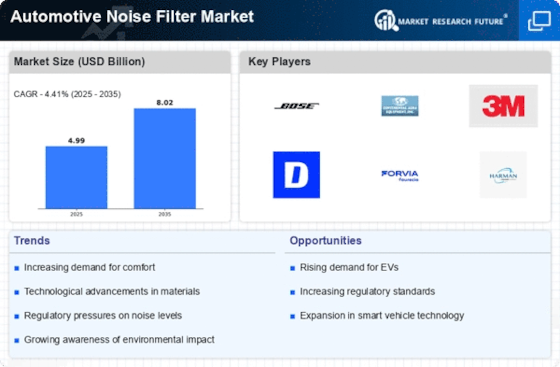
As per Market Research Future analysis, the Automotive Noise Filter Market Size was estimated at 4.986 USD Billion in 2024. The Automotive Noise Filter industry is projected to grow from 5.206 USD Billion in 2025 to 8.016 USD Billion by 2035, exhibiting a compound annual growth rate (CAGR) of 4.41% during the forecast period 2025 - 2035

Key Market Trends & Highlights

The Automotive Noise Filter Market is poised for substantial growth driven by technological advancements and evolving consumer preferences.

  • The integration of advanced materials is enhancing the performance of automotive noise filters across various vehicle types.
  • North America remains the largest market for automotive noise filters, while Asia-Pacific is emerging as the fastest-growing region.
  • Active noise filters dominate the market, whereas combined noise filters are witnessing the fastest growth due to increasing demand for innovative solutions.
  • Growing consumer demand for comfort and regulatory pressure for noise control are key drivers propelling market expansion.

Market Size & Forecast

2024 Market Size 4.986 (USD Billion)
2035 Market Size 8.016 (USD Billion)
CAGR (2025 - 2035) 4.41%

Major Players

Bose Corporation (US), Continental AG (DE), 3M Company (US), Delphi Technologies (GB), Faurecia (FR), Harman International (US), Tenneco Inc. (US), Schaeffler AG (DE), Magna International Inc. (CA)

Our Impact
Enabled $4.3B Revenue Impact for Fortune 500 and Leading Multinationals
Partnering with 2000+ Global Organizations Each Year
30K+ Citations by Top-Tier Firms in the Industry

Automotive Noise Filter Market Trends

The Automotive Noise Filter Market is currently experiencing a notable transformation, driven by the increasing demand for enhanced passenger comfort and the growing emphasis on reducing vehicular noise pollution. As consumers become more discerning regarding their driving experiences, manufacturers are compelled to innovate and integrate advanced noise reduction technologies into their vehicles. This shift is not merely a response to consumer preferences; it also aligns with regulatory pressures aimed at minimizing environmental noise, thereby fostering a more sustainable automotive ecosystem. Furthermore, the rise of electric vehicles, which inherently produce less noise, is influencing the market dynamics, prompting traditional automakers to adapt their strategies accordingly. In addition to technological advancements, the Automotive Noise Filter Market is witnessing a surge in collaborations between automotive manufacturers and technology firms. These partnerships aim to develop cutting-edge solutions that address the complexities of noise management in modern vehicles. As the industry evolves, it appears that the focus will increasingly shift towards integrating noise filter systems that not only enhance acoustic comfort but also contribute to overall vehicle performance. This evolving landscape suggests a promising future for the Automotive Noise Filter Market, characterized by innovation and a commitment to improving the driving experience for consumers worldwide.

Integration of Advanced Materials

The Automotive Noise Filter Market is seeing a trend towards the use of innovative materials that enhance sound absorption and vibration damping. Manufacturers are exploring composites and specialized foams that offer superior performance in noise reduction, thereby improving overall vehicle acoustics.

Rise of Electric Vehicles

The growing prevalence of electric vehicles is reshaping the Automotive Noise Filter Market. As these vehicles operate more quietly than traditional combustion engines, there is an increasing focus on optimizing noise filter systems to manage the unique sound profiles of electric drivetrains.

Regulatory Compliance and Standards

With heightened awareness of environmental issues, regulatory bodies are imposing stricter noise control standards. This trend is compelling automotive manufacturers to invest in advanced noise filter technologies to ensure compliance, thereby driving innovation within the Automotive Noise Filter Market.

Automotive Noise Filter Market Drivers

Growing Consumer Demand for Comfort

The Automotive Noise Filter Market is experiencing a notable increase in consumer demand for enhanced comfort within vehicles. As consumers become more discerning regarding their driving experience, the need for effective noise reduction solutions has intensified. This trend is particularly evident in premium and luxury vehicle segments, where manufacturers are investing in advanced noise filtering technologies to meet customer expectations. According to recent data, the market for automotive noise filters is projected to grow at a compound annual growth rate of approximately 5.2% over the next five years. This growth is driven by the desire for quieter cabins, which not only improves comfort but also enhances overall driving satisfaction. Consequently, automotive manufacturers are prioritizing the integration of sophisticated noise filter systems to cater to this evolving consumer preference.

Rise of Electric and Hybrid Vehicles

The rise of electric and hybrid vehicles is significantly impacting the Automotive Noise Filter Market. Unlike traditional internal combustion engine vehicles, electric and hybrid models often operate more quietly, which can lead to an increased perception of road noise and other external sounds. Consequently, there is a growing need for effective noise filtering solutions to enhance the driving experience in these vehicles. Market analysis indicates that the electric vehicle segment is expected to grow at a rate of approximately 7% annually, creating substantial opportunities for noise filter manufacturers. As automakers focus on delivering a serene driving environment, the integration of advanced noise filtering technologies becomes crucial, thereby driving the demand within the automotive noise filter market.

Regulatory Pressure for Noise Control

The Automotive Noise Filter Market is increasingly influenced by regulatory pressures aimed at controlling vehicle noise emissions. Governments worldwide are implementing stringent noise regulations to address environmental concerns and improve public health. These regulations compel automotive manufacturers to adopt effective noise reduction technologies in their vehicles. As a result, the demand for automotive noise filters is expected to rise, as manufacturers seek compliance with these evolving standards. Recent data suggests that regions with stricter noise regulations are witnessing a faster adoption of noise filtering solutions, thereby propelling market growth. This regulatory landscape not only drives innovation in noise control technologies but also encourages manufacturers to invest in research and development, further enhancing the automotive noise filter market.

Technological Advancements in Noise Reduction

Technological advancements play a pivotal role in shaping the Automotive Noise Filter Market. Innovations in materials and engineering techniques have led to the development of more effective noise filtering solutions. For instance, the introduction of lightweight composite materials and advanced sound-absorbing foams has significantly improved the performance of noise filters. These advancements not only enhance the acoustic comfort of vehicles but also contribute to weight reduction, which is crucial for fuel efficiency. Market data indicates that the adoption of such technologies is expected to increase, with a projected market growth of around 6% annually. As manufacturers strive to remain competitive, the integration of cutting-edge noise reduction technologies becomes essential, thereby driving the overall growth of the automotive noise filter market.

Increased Focus on Vehicle Aesthetics and Design

The Automotive Noise Filter Market is also influenced by an increased focus on vehicle aesthetics and design. Modern consumers are not only concerned with performance but also with the overall look and feel of their vehicles. As a result, manufacturers are integrating noise filtering solutions that complement the vehicle's design while providing effective sound insulation. This trend is particularly prominent in the luxury and high-end vehicle segments, where aesthetics play a critical role in consumer purchasing decisions. Market data suggests that the demand for aesthetically pleasing noise filter solutions is on the rise, with a projected growth rate of around 5.5% in the coming years. This focus on design and aesthetics is likely to drive innovation in the automotive noise filter market, as manufacturers seek to balance functionality with visual appeal.


Market Segment Insights

By Type: Active Noise Filters (Largest) vs. Combined Noise Filters (Fastest-Growing)

In the Automotive Noise Filter Market, Active Noise Filters hold the largest share, primarily due to their advanced technologies that provide effective noise cancellation in vehicles. These filters utilize real-time adjustments to counteract ambient noise, making them popular among manufacturers seeking to enhance passenger comfort. On the other hand, Combined Noise Filters are emerging as a strong contender in this space, driven by their ability to integrate both active and passive noise reduction techniques, appealing to consumers who desire comprehensive sound control in automobiles. Growth trends indicate a rising demand for Combined Noise Filters, identified as the fastest-growing segment as manufacturers increasingly prioritize noise reduction in their designs. Innovations in automotive technology and stricter noise regulations are fueling this trend, pushing vehicle manufacturers to adopt hybrid solutions that can cater to diverse customer needs. The growing awareness of the importance of acoustics in vehicle design is further propelling the market for noise filtering solutions, allowing both Active and Combined Filters to thrive in an evolving marketplace.

Active Noise Filters (Dominant) vs. Passive Noise Filters (Emerging)

Active Noise Filters are characterized by sophisticated noise-cancellation technology that actively counteracts unwanted sound waves, making them the dominant player in the automotive sector. They are widely used in premium vehicles to provide a superior driving experience, reducing high decibel levels and enhancing passenger comfort. Meanwhile, Passive Noise Filters, while traditionally less advanced, are gaining traction as an emerging solution due to their effectiveness in blocking out external noise without the need for electronic processing. Their straightforward design and cost-effectiveness make them attractive to manufacturers aiming to meet noise compliance without significant investment. Together, these segments create a comprehensive noise filtration landscape, catering to diverse automotive requirements.

By Application: Engine Noise Reduction (Largest) vs. Cabin Noise Reduction (Fastest-Growing)

In the Automotive Noise Filter Market, engine noise reduction stands out as the largest application segment, significantly contributing to the overall performance and comfort of vehicles. This segment garners a noteworthy share, driven by the increasing demand for quieter vehicles and stringent emissions regulations. Following closely, cabin noise reduction is rapidly gaining traction as the fastest-growing segment, fueled by rising consumer expectations for luxury and comfort in automotive design.

Engine Noise Reduction (Dominant) vs. Cabin Noise Reduction (Emerging)

Engine noise reduction remains the dominant application in the automotive noise filter market, primarily due to its direct impact on vehicle performance and consumer satisfaction. This segment focuses on minimizing noise generated by the engine, ensuring a smoother driving experience. Conversely, cabin noise reduction is emerging as a critical focus area, driven by the modern consumer's desire for quiet and comfortable interiors. Innovations in materials and design are enhancing the effectiveness of cabin noise filters, making this segment a vital area for growth as manufacturers strive to meet evolving consumer preferences.

By Material: Foam (Largest) vs. Rubber (Fastest-Growing)

In the Automotive Noise Filter Market, the material segment showcases a diverse distribution among foam, rubber, metal, and plastic. Foam currently holds the largest market share, favored for its lightweight and excellent noise-absorbing properties. Closely following foam, rubber is steadily gaining traction due to its flexibility and durability, while metal and plastic are utilized in niche applications where structural integrity or specific design requirements are essential.

Foam: (Dominant) vs. Rubber (Emerging)

Foam is recognized as the dominant material within the Automotive Noise Filter Market segment, appreciated for its sound attenuation capabilities and versatility in various applications. It addresses a wide array of noise frequencies effectively, making it preferred for interior automotive parts. Conversely, rubber is emerging as a significant player due to advancements in material technology that enhance its performance. Its resilience and ability to dampen vibrations make it increasingly popular for manufacturers looking for cost-effective, durable solutions. This has resulted in rising adoption rates, indicating rubber's potential to become a stronger competitor in the noise filter market.

By End Use: Passenger Vehicles (Largest) vs. Commercial Vehicles (Fastest-Growing)

In the Automotive Noise Filter Market, the end-use segment of Passenger Vehicles holds the largest market share, driven by the increasing demand for noise reduction in personal transportation. Consumer preferences lean towards vehicles that offer quiet cabin experiences, leading automakers to invest in advanced noise-filtering technologies. This trend is further compounded by the rise in disposable income and the growing popularity of electric vehicles, which inherently require good noise management solutions. On the other hand, the Commercial Vehicles segment is noted as the fastest-growing segment, fueled by the expanding logistics and transportation industry. As noise regulations become stringent and fleet operators seek to enhance comfort for drivers, the demand for effective noise filter solutions continues to rise. Additionally, advancements in materials and technology are further driving growth in this segment, making it a key area for future investment and innovation.

Passenger Vehicles (Dominant) vs. Commercial Vehicles (Emerging)

Passenger Vehicles serve as the dominant segment within the Automotive Noise Filter Market, primarily due to consumer expectations for comfort and noise reduction. These vehicles are equipped with sophisticated noise-filtering systems that improve driving experiences by minimizing external disturbances. In contrast, the Commercial Vehicles segment is emerging, as operators increasingly recognize the importance of noise control for enhancing driver comfort and safety. While traditionally focused on utility, there is a notable shift toward integrating higher-quality noise filtration solutions in commercial applications. This transition not only addresses compliance with noise regulations but also enhances operator productivity by reducing fatigue, positioning the Commercial Vehicles segment as an essential area for future market growth.

Get more detailed insights about Automotive Noise Filter Market

Regional Insights

North America : Market Leader in Innovation

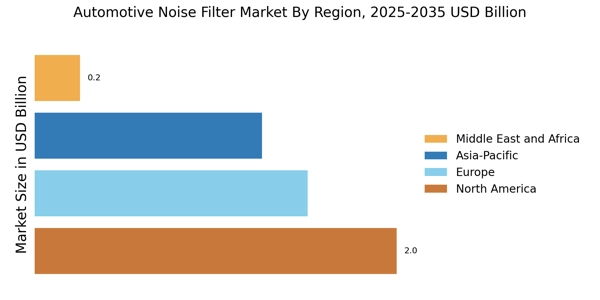
North America is the largest market for automotive noise filters, holding approximately 40% of the global market share. The region's growth is driven by stringent noise regulations and a rising demand for luxury vehicles equipped with advanced noise reduction technologies. The increasing focus on electric vehicles (EVs) also propels the market, as manufacturers seek to enhance cabin comfort and reduce noise levels. The United States and Canada are the leading countries in this region, with major players like Bose Corporation and Harman International driving innovation. The competitive landscape is characterized by significant investments in R&D and collaborations among key players. The presence of established automotive manufacturers further strengthens the market, ensuring a robust supply chain and distribution network.

Europe : Regulatory-Driven Market Growth

Europe is the second-largest market for automotive noise filters, accounting for around 30% of the global share. The region's growth is significantly influenced by stringent environmental regulations aimed at reducing vehicular noise pollution. The European Union's commitment to sustainability and noise reduction in urban areas drives demand for advanced noise filter technologies in vehicles, particularly in electric and hybrid models. Germany, France, and the UK are the leading countries in this market, with key players like Continental AG and Faurecia leading the charge. The competitive landscape is marked by innovation and collaboration among manufacturers, as they strive to meet regulatory standards while enhancing vehicle comfort. The presence of numerous automotive OEMs in the region further fuels market growth.

Asia-Pacific : Emerging Market Potential

Asia-Pacific is witnessing rapid growth in the automotive noise filter market, holding approximately 25% of the global market share. The region's expansion is driven by increasing vehicle production and sales, particularly in countries like China and India. The rising awareness of noise pollution and its impact on health is prompting consumers to seek vehicles equipped with effective noise reduction technologies, further boosting demand. China is the largest market in this region, followed by Japan and India. The competitive landscape is evolving, with both local and international players, such as 3M Company and Delphi Technologies, vying for market share. The presence of a robust automotive manufacturing base and increasing investments in R&D are key factors contributing to the region's growth in automotive noise filters.

Middle East and Africa : Untapped Market Opportunities

The Middle East and Africa region is gradually emerging in the automotive noise filter market, holding about 5% of the global share. The growth is primarily driven by increasing vehicle ownership and a growing awareness of noise pollution's effects on health and comfort. As urbanization accelerates, the demand for quieter vehicles is expected to rise, presenting significant opportunities for market players. Countries like South Africa and the UAE are leading the market in this region, with a growing number of automotive manufacturers establishing operations. The competitive landscape is still developing, with key players like Tenneco Inc. and Schaeffler AG beginning to expand their presence. The region's unique challenges, such as varying regulations and economic conditions, require tailored strategies for market penetration.

Automotive Noise Filter Market Regional Image

Key Players and Competitive Insights

The Automotive Noise Filter Market is currently characterized by a dynamic competitive landscape, driven by increasing consumer demand for quieter vehicles and stringent noise regulations across various regions. Key players such as Bose Corporation (US), Continental AG (DE), and Harman International (US) are strategically positioned to leverage their technological expertise and innovative capabilities. Bose Corporation (US) focuses on advanced acoustic technologies, aiming to enhance sound quality while minimizing unwanted noise. Meanwhile, Continental AG (DE) emphasizes its commitment to sustainability and digital transformation, integrating smart technologies into its noise reduction solutions. Harman International (US) is also investing heavily in connected vehicle technologies, which may enhance the overall user experience by providing tailored noise management solutions. Collectively, these strategies indicate a shift towards innovation and technological advancement as primary competitive differentiators in the market.In terms of business tactics, companies are increasingly localizing manufacturing to reduce costs and improve supply chain efficiency. This approach appears to be particularly relevant in the context of the Automotive Noise Filter Market, which is moderately fragmented, with several players vying for market share. The collective influence of these key players shapes a competitive structure that encourages collaboration and innovation, as companies seek to differentiate their offerings through unique value propositions.

In August Bose Corporation (US) announced a partnership with a leading automotive manufacturer to develop a new line of active noise cancellation systems tailored for electric vehicles. This strategic move is significant as it aligns with the growing trend towards electrification in the automotive sector, where noise management is becoming increasingly critical. By leveraging its expertise in sound technology, Bose Corporation (US) positions itself as a frontrunner in providing innovative solutions that cater to the evolving needs of the market.

In September Continental AG (DE) unveiled its latest noise reduction technology, which utilizes advanced materials and design techniques to enhance acoustic performance in vehicles. This development underscores Continental AG's focus on sustainability, as the new materials are sourced from recycled products. The introduction of this technology not only strengthens Continental AG's product portfolio but also reflects a broader industry trend towards environmentally friendly solutions, which may resonate well with eco-conscious consumers.

In July Harman International (US) launched a new suite of software solutions aimed at optimizing noise management in connected vehicles. This initiative highlights the company's commitment to integrating artificial intelligence and machine learning into its products, potentially revolutionizing how noise is managed in real-time. By focusing on digitalization, Harman International (US) is likely to enhance its competitive edge, as the automotive industry increasingly embraces smart technologies.

As of October the competitive trends in the Automotive Noise Filter Market are heavily influenced by digitalization, sustainability, and the integration of artificial intelligence. Strategic alliances among key players are shaping the landscape, fostering innovation and collaboration. Looking ahead, it appears that competitive differentiation will increasingly pivot from traditional price-based competition to a focus on technological innovation, supply chain reliability, and sustainable practices. This evolution suggests that companies that prioritize these aspects may be better positioned to thrive in the rapidly changing market.

Key Companies in the Automotive Noise Filter Market include

Industry Developments

Recent developments in the Automotive Noise Filter Market have been influenced by increasing consumer demand for quieter vehicles, as well as stricter regulatory noise standards. Johnson Controls has been actively enhancing its noise control technologies, which is expected to bolster its market presence. Magna International has also announced innovations in sound insulation technologies that aim to minimize cabin noise. Valeo and Aisin Seiki are collaborating on new materials designed for enhanced sound absorption in automotive applications. Additionally, Parker Hannifin's advancements in active noise cancellation systems are gaining attention.

In terms of mergers and acquisitions, Denso has been noted for expanding its noise control product portfolio through strategic acquisitions, reflecting an ongoing trend in the market where companies aim to optimize their offerings. The growth in market valuation for companies such as Delphi Technologies and BorgWarner is indicative of increased investments in research and development to advance noise filter technologies. Continental and Eaton's ongoing efforts to integrate noise reduction features in their products also highlight this competitive market landscape. Overall, these dynamics indicate a robust focus on enhancing vehicle comfort through effective noise management solutions in the automotive industry.

Future Outlook

Automotive Noise Filter Market Future Outlook

The Automotive Noise Filter Market is projected to grow at 4.41% CAGR from 2025 to 2035, driven by increasing consumer demand for quieter vehicles and stringent noise regulations.

New opportunities lie in:

  • Development of advanced composite materials for enhanced noise reduction
  • Integration of smart technology for real-time noise monitoring
  • Expansion into electric vehicle noise management solutions

By 2035, the market is expected to be robust, driven by innovation and evolving consumer preferences.

Market Segmentation

Automotive Noise Filter Market Type Outlook

  • Active Noise Filters
  • Passive Noise Filters
  • Combined Noise Filters

Automotive Noise Filter Market End Use Outlook

  • Passenger Vehicles
  • Commercial Vehicles
  • Two-Wheelers

Automotive Noise Filter Market Material Outlook

  • Foam
  • Rubber
  • Metal
  • Plastic

Automotive Noise Filter Market Application Outlook

  • Engine Noise Reduction
  • Cabin Noise Reduction
  • Road Noise Reduction

Report Scope

MARKET SIZE 20244.986(USD Billion)
MARKET SIZE 20255.206(USD Billion)
MARKET SIZE 20358.016(USD Billion)
COMPOUND ANNUAL GROWTH RATE (CAGR)4.41% (2025 - 2035)
REPORT COVERAGERevenue Forecast, Competitive Landscape, Growth Factors, and Trends
BASE YEAR2024
Market Forecast Period2025 - 2035
Historical Data2019 - 2024
Market Forecast UnitsUSD Billion
Key Companies ProfiledBose Corporation (US), Continental AG (DE), 3M Company (US), Delphi Technologies (GB), Faurecia (FR), Harman International (US), Tenneco Inc. (US), Schaeffler AG (DE), Magna International Inc. (CA)
Segments CoveredType, Application, Material, End Use, Regional
Key Market OpportunitiesIntegration of advanced materials for enhanced sound absorption in the Automotive Noise Filter Market.
Key Market DynamicsRising consumer demand for quieter vehicles drives innovation in automotive noise filter technologies and materials.
Countries CoveredNorth America, Europe, APAC, South America, MEA
Leave a Comment

FAQs

What is the projected market valuation of the Automotive Noise Filter Market by 2035?

The projected market valuation for the Automotive Noise Filter Market is 8.016 USD Billion by 2035.

What was the market valuation of the Automotive Noise Filter Market in 2024?

The overall market valuation of the Automotive Noise Filter Market was 4.986 USD Billion in 2024.

What is the expected CAGR for the Automotive Noise Filter Market during the forecast period 2025 - 2035?

The expected CAGR for the Automotive Noise Filter Market during the forecast period 2025 - 2035 is 4.41%.

Which segment of the Automotive Noise Filter Market had the highest valuation in 2024?

In 2024, the segment for Passive Noise Filters had the highest valuation at 2.493 USD Billion.

What are the key applications of Automotive Noise Filters?

The key applications of Automotive Noise Filters include Engine Noise Reduction, Cabin Noise Reduction, and Road Noise Reduction.

Which material segment is projected to grow the most by 2035?

The Rubber material segment is projected to grow significantly, reaching 2.356 USD Billion by 2035.

Who are the leading players in the Automotive Noise Filter Market?

Key players in the Automotive Noise Filter Market include Bose Corporation, Continental AG, and Harman International.

What was the valuation of the Engine Noise Reduction application in 2024?

The valuation of the Engine Noise Reduction application was 1.495 USD Billion in 2024.

How does the market for Two-Wheelers compare to Passenger Vehicles in 2024?

In 2024, the market for Passenger Vehicles was valued at 2.493 USD Billion, while Two-Wheelers were valued at 0.998 USD Billion.

What is the projected valuation for Combined Noise Filters by 2035?

The projected valuation for Combined Noise Filters is expected to reach 1.024 USD Billion by 2035.

Download Free Sample

Kindly complete the form below to receive a free sample of this Report

Compare Licence

×
Features License Type
Single User Multiuser License Enterprise User
Price $4,950 $5,950 $7,250
Maximum User Access Limit 1 User Upto 10 Users Unrestricted Access Throughout the Organization
Free Customization
Direct Access to Analyst
Deliverable Format
Platform Access
Discount on Next Purchase 10% 15% 15%
Printable Versions