
×
Request Free Sample ×

Kindly complete the form below to receive a free sample of this Report

* Please use a valid business email

Leading companies partner with us for data-driven Insights

clients tt-cursor
Hero Background
English
Chinese
French
Japanese
Korean
German
Spanish

Automotive Axle Market Share

ID: MRFR/AT/1727-HCR
110 Pages
Sejal Akre
February 2026

Automotive Axle Market Size, Share & Growth Analysis Report By Type (Front Axle, Rear Axle, Composite Axle, Drive Axle, Steering Axle), By Vehicle Type (Passenger Cars, Light Commercial Vehicles, Heavy Commercial Vehicles, Buses, Two Wheelers), By Vehicle Drive Type (Front Wheel Drive, Rear Wheel Drive, All Wheel Drive), By Material (Steel, Aluminum, Composite) and By Regional (North America, Europe, South America, Asia-Pacific, Middle East and Africa) - Forecast to 2035

Share:
Download PDF ×

We do not share your information with anyone. However, we may send you emails based on your report interest from time to time. You may contact us at any time to opt-out.

Automotive Axle Market Infographic
Purchase Options

Market Share

Automotive Axle Market Share Analysis

Companies looking to gain a strong foothold in this competitive industry must implement market share positioning strategies in the Automotive Axle Market. One crucial procedure includes separation through item development. Organizations endeavor to foster axles with cutting edge highlights, like lightweight materials, upgraded strength, and further developed eco-friendliness. Organizations can expand their portion of the overall industry and draw in a bigger client base by giving state-of-the-art items that are unique. To remain in front of the opposition and meet the steadily changing necessities of the car business, continuous endeavors in innovative work are vital.

Value seriousness is one more significant system in piece of the pie situating. Numerous shoppers focus on cost while settling on buying choices, making serious evaluating a vital thought for organizations in the automotive axle market. Finding some kind of harmony among quality and moderateness is critical, as clients look for an incentive for their cash. It is likely that businesses will acquire a sizable portion of the market if they are able to provide solutions that are economical without sacrificing performance.

Vital organizations and joint efforts address a cooperative way to deal with piece of the pie situating. By shaping collusions with car makers, hub organizations can get long haul contracts and favored provider status. This gives soundness as far as interest as well as upgrades brand perceivability. Joint efforts with OEMs empower pivot producers to incorporate their items flawlessly into the auto production network, adding to a more grounded market position.

A method for expanding into new markets and gaining more market share is geographical expansion. In order to reach a larger number of customers, businesses in the automotive axle market frequently establish global operations. Venturing into arising economies with developing auto businesses permits organizations to exploit expanding vehicle creation and rising interest for hub frameworks. Redoing items to meet provincial inclinations and administrative necessities is critical for effective market development.

Market share acquisition relies heavily on brand positioning and marketing strategies. Laying out major areas of strength for a picture, upheld by viable showcasing efforts, assists organizations with separating themselves in a packed market. Underscoring variables like item unwavering quality, execution, and consumer loyalty can add to building a positive brand discernment. Powerful correspondence of these characteristics to target crowds is key for organizations expecting to build their portion of the overall industry.

CRM is a fundamental technique for holding existing clients and drawing in new ones. Offering fantastic post-deals support, guarantee administration, and responsive correspondence channels encourages client reliability. Positive word-of-mouth marketing is made possible by satisfied customers who are more likely to recommend a brand to others. Organizations that focus on consumer loyalty can profit from rehash business and positive surveys, eventually reinforcing their piece of the pie.

Companies seeking rapid market share expansion make strategic moves through mergers and acquisitions (M&A). It is possible to gain immediate market access, technological expertise, and a broader customer base by acquiring established players in the automotive axle market. Nonetheless, fruitful coordination and combination of gained substances are basic to understanding the full advantages of such procedures.

A multifaceted strategy is required to position oneself for market share in the Automotive Axle Market. Product development, cutthroat estimating, vital organizations, geological extension, proficient marking, client relationship the executives, and, in certain examples, consolidations and acquisitions are fundamental parts for organizations to join. Organizations can fabricate a practical and cutthroat situation in the steadily developing auto pivot industry by joining these techniques in a professional way.

Author
Sejal Akre
Senior Research Analyst

She has over 5 years of rich experience, in market research and consulting providing valuable market insights to client. Hands on expertise in management consulting, and extensive knowledge in domain including ICT, Automotive & Transportation and Aerospace & Defense. She is skilled in Go-to market strategy, industry analysis, market sizing, in depth company profiling, competitive intelligence & benchmarking and value chain amongst others.

Leave a Comment

FAQs

What is the projected market valuation of the Automotive Axle Market by 2035?

<p>The Automotive Axle Market is projected to reach a valuation of 50.04 USD Billion by 2035.</p>

What was the market valuation of the Automotive Axle Market in 2024?

<p>In 2024, the Automotive Axle Market was valued at 33.98 USD Billion.</p>

What is the expected CAGR for the Automotive Axle Market during the forecast period 2025 - 2035?

<p>The expected CAGR for the Automotive Axle Market during the forecast period 2025 - 2035 is 3.58%.</p>

Which companies are considered key players in the Automotive Axle Market?

<p>Key players in the Automotive Axle Market include ZF Friedrichshafen AG, Dana Incorporated, GKN Automotive, and others.</p>

What are the projected valuations for different axle types in 2035?

<p>By 2035, the projected valuations for axle types include Front Axle at 9.12 USD Billion, Rear Axle at 11.25 USD Billion, and others.</p>

How does the market valuation for passenger cars compare to that of heavy commercial vehicles in 2035?

<p>In 2035, the market valuation for passenger cars is projected at 18.0 USD Billion, whereas heavy commercial vehicles are expected to reach 10.0 USD Billion.</p>

What is the projected market size for aluminum axles by 2035?

<p>The projected market size for aluminum axles is expected to reach 12.0 USD Billion by 2035.</p>

What are the expected valuations for different vehicle drive types in 2035?

<p>In 2035, the expected valuations for vehicle drive types include Front Wheel Drive at 14.25 USD Billion and All Wheel Drive at 19.79 USD Billion.</p>

What is the projected valuation for composite axles in 2035?

<p>The projected valuation for composite axles is expected to be 5.6 USD Billion by 2035.</p>

How do the projected valuations for light commercial vehicles compare to those for buses in 2035?

<p>In 2035, light commercial vehicles are projected to reach 12.0 USD Billion, while buses are expected to reach 5.0 USD Billion.</p>

Market Summary

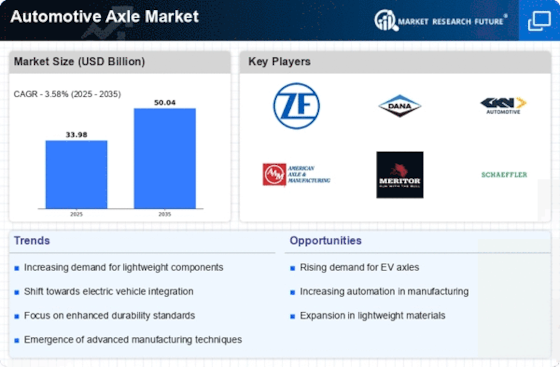
As per Market Research Future analysis, the Automotive Axle Market Size was estimated at 33.98 USD Billion in 2024. The Automotive Axle industry is projected to grow from 35.2 USD Billion in 2025 to 50.04 USD Billion by 2035, exhibiting a compound annual growth rate (CAGR) of 3.5% during the forecast period 2025 - 2035

Key Market Trends & Highlights

The Automotive Axle Market is experiencing a transformative shift driven by technological advancements and changing consumer preferences.

  • The market is witnessing a notable shift towards electric vehicles, particularly in North America, which remains the largest market. Sustainability initiatives are gaining traction, influencing axle design and manufacturing processes across the Asia-Pacific region. Integration of advanced technologies is becoming increasingly prevalent, especially in the front axle segment, which holds the largest market share. Rising demand for electric vehicles and a focus on fuel efficiency are key drivers propelling growth in both the passenger car and two-wheeler segments.

Market Size & Forecast

2024 Market Size 33.98 (USD Billion)
2035 Market Size 50.04 (USD Billion)
CAGR (2025 - 2035) 3.58%
Largest Regional Market Share in 2024 Asia Pacific

Major Players

ZF Friedrichshafen AG (DE), Dana Incorporated (US), GKN Automotive (GB), American Axle &amp; Manufacturing (US), Meritor Inc. (US), Schaeffler AG (DE), JTEKT Corporation (JP), Hyundai Transys Inc. (KR), Aisin Seiki Co., Ltd. (JP)

Market Trends

The Automotive Axle Market is currently experiencing a transformative phase, driven by advancements in technology and evolving consumer preferences. The shift towards electric vehicles is reshaping the automotive axle & propeller shaft market , as manufacturers seek to develop axles that are lightweight yet robust, enhancing efficiency and performance. Additionally, the increasing emphasis on sustainability is prompting companies within the automotive axle propeller shaft market to explore eco-friendly materials and production methods, which may lead to innovative designs and improved functionality. As the market adapts to these changes, collaboration between automotive manufacturers and suppliers appears to be intensifying, fostering a more integrated approach to product development. Moreover, the automotive axle market is witnessing a growing demand for advanced features such as enhanced safety systems and improved handling capabilities. This trend is likely influenced by consumer expectations for higher performance and reliability in vehicles. Furthermore, the rise of autonomous driving technology could potentially alter axle design requirements, as vehicles may need to accommodate new functionalities. Overall, the Automotive Axle Market seems poised for growth, with various factors converging to create a dynamic environment that encourages innovation and responsiveness to market needs.

Shift Towards Electric Vehicles

The transition to electric vehicles is significantly influencing the Automotive Axle Market. Manufacturers are focusing on developing lightweight axles that enhance energy efficiency while maintaining strength and durability.

Sustainability Initiatives

There is a notable trend towards sustainability within the Automotive Axle Market. Companies are increasingly exploring eco-friendly materials and production techniques, aiming to reduce environmental impact and meet consumer demand for greener products.

Integration of Advanced Technologies

The incorporation of advanced technologies is reshaping the Automotive Axle Market. Features such as enhanced safety systems and improved handling are becoming essential, driven by consumer expectations for higher performance and reliability.

Automotive Axle Market Market Drivers

Increasing Vehicle Production Rates

The rising production rates of vehicles across various segments are a crucial driver for the Automotive Axle Market. As automotive manufacturers ramp up production to meet consumer demand, the need for axles is expected to surge. In 2025, vehicle production is projected to reach unprecedented levels, particularly in emerging markets where automotive ownership is on the rise. This increase in production not only boosts the demand for axles but also encourages manufacturers to optimize their supply chains and production processes. Consequently, the Automotive Axle Market is likely to experience robust growth as a result of these production trends.

Rising Demand for Electric Vehicles

The increasing demand for electric vehicles (EVs) is a pivotal driver for the Automotive Axle Market. As consumers become more environmentally conscious, the shift towards EVs necessitates the development of specialized axles that can support electric drivetrains. In 2025, it is estimated that the market for electric vehicles will account for a substantial portion of total vehicle sales, leading to a corresponding rise in demand for lightweight and efficient axles. This trend is likely to encourage manufacturers to innovate and adapt their axle designs to meet the unique requirements of electric vehicles, thereby propelling growth in the Automotive Axle Market.

Expansion of the Aftermarket Segment

The expansion of the aftermarket segment is emerging as a significant driver for the Automotive Axle Market. As vehicle ownership increases, the demand for replacement and upgraded axles is also on the rise. Consumers are increasingly seeking high-performance and durable axles to enhance their vehicles' capabilities. In 2025, the aftermarket for automotive components, including axles, is projected to grow substantially, driven by trends such as vehicle customization and maintenance. This growth presents opportunities for manufacturers to diversify their product offerings and cater to the evolving needs of consumers, thereby fueling the Automotive Axle Market.

Technological Advancements in Axle Design

Technological advancements are significantly influencing the Automotive Axle Market. Innovations such as the integration of lightweight materials and advanced manufacturing techniques are enhancing axle performance and efficiency. For instance, the use of carbon fiber and aluminum alloys is becoming more prevalent, allowing for the production of axles that are not only lighter but also stronger. This shift is expected to improve fuel efficiency and vehicle handling, which are critical factors for consumers. As manufacturers continue to invest in research and development, the Automotive Axle Market is poised for substantial growth driven by these technological enhancements.

Focus on Fuel Efficiency and Emissions Reduction

The growing emphasis on fuel efficiency and emissions reduction is shaping the Automotive Axle Market. Regulatory bodies are implementing stricter emissions standards, compelling manufacturers to develop vehicles that are more fuel-efficient. This trend necessitates the design of axles that contribute to overall vehicle efficiency. In 2025, it is anticipated that vehicles equipped with advanced axle systems will be favored in the market, as they offer improved performance and lower emissions. As a result, the Automotive Axle Market is expected to expand as manufacturers respond to these regulatory pressures and consumer preferences for greener vehicles.

Market Segment Insights

By Type: Front Axle (Largest) vs. Drive Axle (Fastest-Growing)

In the Automotive Axle Market, the Front Axle holds the largest share among segment types, providing stability and support to a diverse range of vehicles, from passenger cars to heavy-duty trucks. Meanwhile, the Drive Axle is emerging as the fastest-growing segment, primarily due to the increasing demand for <a href="https://www.marketresearchfuture.com/reports/all-wheel-drive-market-7647">all-wheel drive (AWD)</a> and electric vehicles (EVs), which require advanced driveline solutions to enhance performance and efficiency. The growth in the Drive Axle segment is driven by technological advancements and consumer preferences shifting towards electric mobility. As manufacturers innovate to produce lightweight and high-strength axles, the Drive Axle is gaining traction in the market. Additionally, strict emissions regulations encourage the adoption of electric powertrains, further boosting the demand for Drive Axles, which are integral to modern vehicular design and functionality.

Front Axle (Dominant) vs. Composite Axle (Emerging)

The Front Axle remains the dominant player in the Automotive Axle Market, recognized for its critical role in vehicle stability and handling. It supports the front section of vehicles, most notably passenger cars and SUVs, and is essential for steering. Composite Axle, an emerging segment, is gaining attention due to its lightweight properties and potential for improved fuel efficiency. The adoption of composite materials is driven by the automotive industry's commitment to enhance performance while reducing weight. Composite Axles are increasingly popular in high-performance and <a href="https://www.marketresearchfuture.com/reports/automotive-luxury-vehicle-market-5783">luxury vehicles</a>, showcasing their exceptional strength-to-weight ratio. As technology progresses, we expect Composite Axle to carve out a significant niche alongside traditional metal axles, reflecting the industry's shift towards innovative materials.

By Vehicle Type: Passenger Cars (Largest) vs. Two Wheelers (Fastest-Growing)

In the Automotive Axle Market, Passenger Cars hold the largest share among vehicle types, reflecting their widespread consumer demand and production volumes. This segment benefits from a robust automotive infrastructure and offers a variety of models, making it a key player in the market landscape. In contrast, Two Wheelers are rapidly gaining traction, driven by urbanization and the need for cost-effective transportation solutions. The growing inclination towards personal mobility has also contributed to their emergence in the market.

Passenger Cars (Dominant) vs. Two Wheelers (Emerging)

Passenger Cars are the dominant segment in the Automotive Axle Market, characterized by advanced axle designs that cater to a wide array of consumer preferences and enhanced safety features. Their extensive market presence is bolstered by continuous innovations to improve fuel efficiency and performance, catering to eco-conscious consumers. On the other hand, Two Wheelers represent an emerging segment, driven by increasing urban traffic congestion and a rising trend for economical transport options. This segment is experiencing rapid growth due to favorable regulations and technological advancements that are making Two Wheelers more appealing to a diverse demographic, including young urban consumers seeking flexibility in mobility.

By Vehicle Drive Type: Front Wheel Drive (Largest) vs. All Wheel Drive (Fastest-Growing)

In the Automotive Axle Market, Front Wheel Drive (FWD) systems currently dominate the vehicle drive type segment, largely due to their cost-effectiveness and efficient use of space. They cater primarily to compact cars and economy vehicles, which have a significant market presence. In contrast, Rear Wheel Drive (RWD) systems hold a smaller share, primarily being utilized in sports cars and trucks. All Wheel Drive (AWD) is gaining traction year over year, appealing to consumers looking for enhanced handling and performance, especially in diverse driving conditions.

Front Wheel Drive (Dominant) vs. All Wheel Drive (Emerging)

Front Wheel Drive (FWD) systems are characterized by their design where the front wheels are responsible for both propulsion and steering, leading to better fuel efficiency and interior space optimization. This makes them highly favored among manufacturers of small to mid-size vehicles. On the other hand, All Wheel Drive (AWD) systems are becoming increasingly popular due to their ability to distribute power to all wheels, providing superior traction and control, especially in adverse weather conditions. The growth of AWD systems is spurred by rising consumer demand for SUVs and crossovers, which in turn is encouraging manufacturers to innovate and enhance the performance of these systems.

By Material: Steel (Largest) vs. Aluminum (Fastest-Growing)

In the Automotive Axle Market, the steel segment holds the largest market share due to its established use in axle manufacturing, attributed to its strength and durability. Steel remains the preferred material for a majority of vehicles, especially in heavy-duty applications, accounting for a significant proportion of new vehicle production. In contrast, the aluminum segment, while smaller in comparison, is gaining traction due to its lightweight properties that enhance fuel efficiency, appealing particularly to electric vehicle manufacturers who prioritize energy efficiency.

Material: Steel (Dominant) vs. Aluminum (Emerging)

Steel has long been the dominant material in the automotive axle market, renowned for its high tensile strength and lateral stability which are crucial for performance and safety. This material is especially favored in larger vehicles that require greater durability under challenging conditions. Conversely, aluminum is emerging as a key player in the market thanks to its lightweight characteristics, which contribute to lower vehicle weight and improved fuel efficiency. The shift towards lighter materials is being driven by regulatory demands for emissions reduction. As a result, many manufacturers are increasingly incorporating aluminum axles in their designs, particularly in the rising segment of electric and hybrid vehicles.

Get more detailed insights about Automotive Axle Market Research Report — Global Forecast till 2035

Regional Insights

The Automotive Axle Market is experiencing noteworthy dynamics across various regions. In 2023, North America held a significant market revenue of 9.8 USD Billion, paving the way for growth to 13.5 USD Billion by 2032, showcasing its major role in the industry. Europe follows closely with a valuation of 8.5 USD Billion in 2023 projected to reach 11.5 USD Billion in 2032, driven by the growing automotive sector and technological advancements.

The APAC region stands as a key player with an initial value of 10.0 USD Billion in 2023, expected to grow to 14.5 USD Billion by 2032, reflecting its vast manufacturing capabilities and demand for automobile production.

South America contributes a smaller yet significant amount, valued at 2.5 USD Billion in 2023, with expectations of rising to 3.5 USD Billion by 2032, indicating potential growth opportunities amidst increasing automotive needs. Meanwhile, the MEA region is valued at 1.0 USD Billion in 2023, advancing to 2.0 USD Billion by 2032, highlighting its emerging market for automotive production. The diverse automotive landscape and regional manufacturing focus position these segments uniquely within the Automotive Axle Market statistics.

Key Players and Competitive Insights

The Automotive Axle Market has witnessed significant growth, driven by the rising demand for advanced vehicle technologies and increasing automobile production across the globe. The market is characterized by a competitive landscape where various players strive to enhance their offerings through innovation, technology advancements, and strategic partnerships. Emerging trends, such as the shift towards electric vehicles and the growing focus on fuel efficiency, are influencing the dynamics of the axle market. Competition among manufacturers revolves around product quality, performance, pricing, and customer service. Companies are increasingly investing in research and development to create axles that meet the evolving requirements of modern vehicles. Furthermore, regulatory frameworks and sustainability initiatives play a crucial role in shaping market strategies, pushing manufacturers to adopt environmentally friendly practices while ensuring safety and reliability in their products.ANDREW has positioned itself effectively within the Automotive Axle Market by leveraging its strong reputation for producing high-quality axles that meet rigorous industry standards. This company has developed a robust manufacturing process that combines advanced technology with traditional craftsmanship, enabling it to deliver reliable and durable axle solutions for various vehicle types. The key strength of ANDREW lies in its ability to adapt to market trends, particularly the growing demand for electric and hybrid vehicles. The company has invested significantly in research and development to create innovative axle designs that enhance performance while reducing weight, contributing to better overall vehicle efficiency. Additionally, ANDREW's focus on building strong relationships with original equipment manufacturers and its commitment to excellent customer service has further solidified its position in the market.Bharat Forge stands out in the Automotive Axle Market due to its comprehensive product portfolio and global manufacturing footprint. The company has established itself as a leader in the production of high-quality forged components, which include a wide range of axles tailored for both commercial and passenger vehicles. Bharat Forge's strength lies in its state-of-the-art manufacturing facilities equipped with cutting-edge technology that allows for efficient production processes and the ability to scale rapidly according to market needs. The company also emphasizes innovation, continuously exploring new materials and design methodologies to enhance the performance and sustainability of its axles. By leveraging its deep engineering expertise and significant investments in technology, Bharat Forge is well-positioned to meet the evolving demands of the automotive industry and maintain a strong competitive edge in the Automotive Axle Market.

Key Companies in the Automotive Axle Market include

Industry Developments

Recent developments in the Automotive Axle Market have seen substantial activity, particularly among key players such as Bharat Forge and Dana, which are focusing on technology advancements to enhance performance and sustainability. Korea Delco and JTEKT are also actively involved in strategic partnerships to bolster their manufacturing capabilities. The market is witnessing significant growth in electrification and lightweight materials, influencing major companies like ZF Friedrichshafen and Schaeffler to innovate their product lines.In terms of mergers and acquisitions, American Axle & Manufacturing has been involved in expanding its portfolio through targeted acquisitions, strengthening its position in the market.

Meanwhile, Meritor's recent strategic moves align with a growing demand for advanced axle solutions amid increased electric vehicle production.

Additionally, the valuation of companies in the sector is on the rise, spurred by an increasing demand for efficient and high-performance axle systems, which is anticipated to have a positive impact on the overall market landscape. As automotive manufacturers navigate supply chain challenges, the collaboration among companies like Nexteer Automotive and Aisin is noteworthy, aiming to enhance the efficiency of their operations.

Future Outlook

Automotive Axle Market Future Outlook

The Automotive Axle Market is projected to grow at a 3.58% CAGR from 2025 to 2035, driven by advancements in electric vehicles, increasing demand for lightweight materials, and enhanced safety regulations.

New opportunities lie in:

  • <p>Development of lightweight composite axles for electric vehicles. Integration of smart axle technologies for real-time performance monitoring. Expansion into emerging markets with tailored axle solutions.</p>

By 2035, the Automotive Axle Market is expected to achieve robust growth, driven by innovation and strategic market positioning.

Market Segmentation

Automotive Axle Market Type Outlook

  • Front Axle
  • Rear Axle
  • Composite Axle
  • Drive Axle
  • Steering Axle

Automotive Axle Market Material Outlook

  • Steel
  • Aluminum
  • Composite

Automotive Axle Market Vehicle Type Outlook

  • Passenger Cars
  • Light Commercial Vehicles
  • Heavy Commercial Vehicles
  • Buses
  • Two Wheelers

Automotive Axle Market Vehicle Drive Type Outlook

  • Front Wheel Drive
  • Rear Wheel Drive
  • All Wheel Drive

Report Scope

MARKET SIZE 2024 33.98(USD Billion)
MARKET SIZE 2025 35.2(USD Billion)
MARKET SIZE 2035 50.04(USD Billion)
COMPOUND ANNUAL GROWTH RATE (CAGR) 3.58% (2025 - 2035)
REPORT COVERAGE Revenue Forecast, Competitive Landscape, Growth Factors, and Trends
BASE YEAR 2024
Market Forecast Period 2025 - 2035
Historical Data 2019 - 2024
Market Forecast Units USD Billion
Key Companies Profiled ZF Friedrichshafen AG (DE), Dana Incorporated (US), GKN Automotive (GB), American Axle & Manufacturing (US), Meritor Inc. (US), Schaeffler AG (DE), JTEKT Corporation (JP), Hyundai Transys Inc. (KR), Aisin Seiki Co., Ltd. (JP)
Segments Covered Type, Vehicle Type, Vehicle Drive Type, Material, Regional
Key Market Opportunities Integration of lightweight materials and electric vehicle compatibility in the Automotive Axle Market.
Key Market Dynamics Technological advancements in electric vehicles drive demand for lightweight and efficient automotive axles.
Countries Covered North America, Europe, APAC, South America, MEA

FAQs

What is the projected market valuation of the Automotive Axle Market by 2035?

<p>The Automotive Axle Market is projected to reach a valuation of 50.04 USD Billion by 2035.</p>

What was the market valuation of the Automotive Axle Market in 2024?

<p>In 2024, the Automotive Axle Market was valued at 33.98 USD Billion.</p>

What is the expected CAGR for the Automotive Axle Market during the forecast period 2025 - 2035?

<p>The expected CAGR for the Automotive Axle Market during the forecast period 2025 - 2035 is 3.58%.</p>

Which companies are considered key players in the Automotive Axle Market?

<p>Key players in the Automotive Axle Market include ZF Friedrichshafen AG, Dana Incorporated, GKN Automotive, and others.</p>

What are the projected valuations for different axle types in 2035?

<p>By 2035, the projected valuations for axle types include Front Axle at 9.12 USD Billion, Rear Axle at 11.25 USD Billion, and others.</p>

How does the market valuation for passenger cars compare to that of heavy commercial vehicles in 2035?

<p>In 2035, the market valuation for passenger cars is projected at 18.0 USD Billion, whereas heavy commercial vehicles are expected to reach 10.0 USD Billion.</p>

What is the projected market size for aluminum axles by 2035?

<p>The projected market size for aluminum axles is expected to reach 12.0 USD Billion by 2035.</p>

What are the expected valuations for different vehicle drive types in 2035?

<p>In 2035, the expected valuations for vehicle drive types include Front Wheel Drive at 14.25 USD Billion and All Wheel Drive at 19.79 USD Billion.</p>

What is the projected valuation for composite axles in 2035?

<p>The projected valuation for composite axles is expected to be 5.6 USD Billion by 2035.</p>

How do the projected valuations for light commercial vehicles compare to those for buses in 2035?

<p>In 2035, light commercial vehicles are projected to reach 12.0 USD Billion, while buses are expected to reach 5.0 USD Billion.</p>

  1. SECTION I: EXECUTIVE SUMMARY AND KEY HIGHLIGHTS
    1. | 1.1 EXECUTIVE SUMMARY
    2. | | 1.1.1 Market Overview
    3. | | 1.1.2 Key Findings
    4. | | 1.1.3 Market Segmentation
    5. | | 1.1.4 Competitive Landscape
    6. | | 1.1.5 Challenges and Opportunities
    7. | | 1.1.6 Future Outlook
  2. SECTION II: SCOPING, METHODOLOGY AND MARKET STRUCTURE
    1. | 2.1 MARKET INTRODUCTION
    2. | | 2.1.1 Definition
    3. | | 2.1.2 Scope of the study
    4. | | | 2.1.2.1 Research Objective
    5. | | | 2.1.2.2 Assumption
    6. | | | 2.1.2.3 Limitations
    7. | 2.2 RESEARCH METHODOLOGY
    8. | | 2.2.1 Overview
    9. | | 2.2.2 Data Mining
    10. | | 2.2.3 Secondary Research
    11. | | 2.2.4 Primary Research
    12. | | | 2.2.4.1 Primary Interviews and Information Gathering Process
    13. | | | 2.2.4.2 Breakdown of Primary Respondents
    14. | | 2.2.5 Forecasting Model
    15. | | 2.2.6 Market Size Estimation
    16. | | | 2.2.6.1 Bottom-Up Approach
    17. | | | 2.2.6.2 Top-Down Approach
    18. | | 2.2.7 Data Triangulation
    19. | | 2.2.8 Validation
  3. SECTION III: QUALITATIVE ANALYSIS
    1. | 3.1 MARKET DYNAMICS
    2. | | 3.1.1 Overview
    3. | | 3.1.2 Drivers
    4. | | 3.1.3 Restraints
    5. | | 3.1.4 Opportunities
    6. | 3.2 MARKET FACTOR ANALYSIS
    7. | | 3.2.1 Value chain Analysis
    8. | | 3.2.2 Porter's Five Forces Analysis
    9. | | | 3.2.2.1 Bargaining Power of Suppliers
    10. | | | 3.2.2.2 Bargaining Power of Buyers
    11. | | | 3.2.2.3 Threat of New Entrants
    12. | | | 3.2.2.4 Threat of Substitutes
    13. | | | 3.2.2.5 Intensity of Rivalry
    14. | | 3.2.3 COVID-19 Impact Analysis
    15. | | | 3.2.3.1 Market Impact Analysis
    16. | | | 3.2.3.2 Regional Impact
    17. | | | 3.2.3.3 Opportunity and Threat Analysis
  4. SECTION IV: QUANTITATIVE ANALYSIS
    1. | 4.1 Automobile, BY Type (USD Billion)
    2. | | 4.1.1 Front Axle
    3. | | 4.1.2 Rear Axle
    4. | | 4.1.3 Composite Axle
    5. | | 4.1.4 Drive Axle
    6. | | 4.1.5 Steering Axle
    7. | 4.2 Automobile, BY Vehicle Type (USD Billion)
    8. | | 4.2.1 Passenger Cars
    9. | | 4.2.2 Light Commercial Vehicles
    10. | | 4.2.3 Heavy Commercial Vehicles
    11. | | 4.2.4 Buses
    12. | | 4.2.5 Two Wheelers
    13. | 4.3 Automobile, BY Vehicle Drive Type (USD Billion)
    14. | | 4.3.1 Front Wheel Drive
    15. | | 4.3.2 Rear Wheel Drive
    16. | | 4.3.3 All Wheel Drive
    17. | 4.4 Automobile, BY Material (USD Billion)
    18. | | 4.4.1 Steel
    19. | | 4.4.2 Aluminum
    20. | | 4.4.3 Composite
    21. | 4.5 Automobile, BY Region (USD Billion)
    22. | | 4.5.1 North America
    23. | | | 4.5.1.1 US
    24. | | | 4.5.1.2 Canada
    25. | | 4.5.2 Europe
    26. | | | 4.5.2.1 Germany
    27. | | | 4.5.2.2 UK
    28. | | | 4.5.2.3 France
    29. | | | 4.5.2.4 Russia
    30. | | | 4.5.2.5 Italy
    31. | | | 4.5.2.6 Spain
    32. | | | 4.5.2.7 Rest of Europe
    33. | | 4.5.3 APAC
    34. | | | 4.5.3.1 China
    35. | | | 4.5.3.2 India
    36. | | | 4.5.3.3 Japan
    37. | | | 4.5.3.4 South Korea
    38. | | | 4.5.3.5 Malaysia
    39. | | | 4.5.3.6 Thailand
    40. | | | 4.5.3.7 Indonesia
    41. | | | 4.5.3.8 Rest of APAC
    42. | | 4.5.4 South America
    43. | | | 4.5.4.1 Brazil
    44. | | | 4.5.4.2 Mexico
    45. | | | 4.5.4.3 Argentina
    46. | | | 4.5.4.4 Rest of South America
    47. | | 4.5.5 MEA
    48. | | | 4.5.5.1 GCC Countries
    49. | | | 4.5.5.2 South Africa
    50. | | | 4.5.5.3 Rest of MEA
  5. SECTION V: COMPETITIVE ANALYSIS
    1. | 5.1 Competitive Landscape
    2. | | 5.1.1 Overview
    3. | | 5.1.2 Competitive Analysis
    4. | | 5.1.3 Market share Analysis
    5. | | 5.1.4 Major Growth Strategy in the Automobile
    6. | | 5.1.5 Competitive Benchmarking
    7. | | 5.1.6 Leading Players in Terms of Number of Developments in the Automobile
    8. | | 5.1.7 Key developments and growth strategies
    9. | | | 5.1.7.1 New Product Launch/Service Deployment
    10. | | | 5.1.7.2 Merger & Acquisitions
    11. | | | 5.1.7.3 Joint Ventures
    12. | | 5.1.8 Major Players Financial Matrix
    13. | | | 5.1.8.1 Sales and Operating Income
    14. | | | 5.1.8.2 Major Players R&D Expenditure. 2023
    15. | 5.2 Company Profiles
    16. | | 5.2.1 ZF Friedrichshafen AG (DE)
    17. | | | 5.2.1.1 Financial Overview
    18. | | | 5.2.1.2 Products Offered
    19. | | | 5.2.1.3 Key Developments
    20. | | | 5.2.1.4 SWOT Analysis
    21. | | | 5.2.1.5 Key Strategies
    22. | | 5.2.2 Dana Incorporated (US)
    23. | | | 5.2.2.1 Financial Overview
    24. | | | 5.2.2.2 Products Offered
    25. | | | 5.2.2.3 Key Developments
    26. | | | 5.2.2.4 SWOT Analysis
    27. | | | 5.2.2.5 Key Strategies
    28. | | 5.2.3 GKN Automotive (GB)
    29. | | | 5.2.3.1 Financial Overview
    30. | | | 5.2.3.2 Products Offered
    31. | | | 5.2.3.3 Key Developments
    32. | | | 5.2.3.4 SWOT Analysis
    33. | | | 5.2.3.5 Key Strategies
    34. | | 5.2.4 American Axle & Manufacturing (US)
    35. | | | 5.2.4.1 Financial Overview
    36. | | | 5.2.4.2 Products Offered
    37. | | | 5.2.4.3 Key Developments
    38. | | | 5.2.4.4 SWOT Analysis
    39. | | | 5.2.4.5 Key Strategies
    40. | | 5.2.5 Meritor Inc. (US)
    41. | | | 5.2.5.1 Financial Overview
    42. | | | 5.2.5.2 Products Offered
    43. | | | 5.2.5.3 Key Developments
    44. | | | 5.2.5.4 SWOT Analysis
    45. | | | 5.2.5.5 Key Strategies
    46. | | 5.2.6 Schaeffler AG (DE)
    47. | | | 5.2.6.1 Financial Overview
    48. | | | 5.2.6.2 Products Offered
    49. | | | 5.2.6.3 Key Developments
    50. | | | 5.2.6.4 SWOT Analysis
    51. | | | 5.2.6.5 Key Strategies
    52. | | 5.2.7 JTEKT Corporation (JP)
    53. | | | 5.2.7.1 Financial Overview
    54. | | | 5.2.7.2 Products Offered
    55. | | | 5.2.7.3 Key Developments
    56. | | | 5.2.7.4 SWOT Analysis
    57. | | | 5.2.7.5 Key Strategies
    58. | | 5.2.8 Hyundai Transys Inc. (KR)
    59. | | | 5.2.8.1 Financial Overview
    60. | | | 5.2.8.2 Products Offered
    61. | | | 5.2.8.3 Key Developments
    62. | | | 5.2.8.4 SWOT Analysis
    63. | | | 5.2.8.5 Key Strategies
    64. | | 5.2.9 Aisin Seiki Co., Ltd. (JP)
    65. | | | 5.2.9.1 Financial Overview
    66. | | | 5.2.9.2 Products Offered
    67. | | | 5.2.9.3 Key Developments
    68. | | | 5.2.9.4 SWOT Analysis
    69. | | | 5.2.9.5 Key Strategies
    70. | 5.3 Appendix
    71. | | 5.3.1 References
    72. | | 5.3.2 Related Reports
  6. LIST OF FIGURES
    1. | 6.1 MARKET SYNOPSIS
    2. | 6.2 NORTH AMERICA MARKET ANALYSIS
    3. | 6.3 US MARKET ANALYSIS BY TYPE
    4. | 6.4 US MARKET ANALYSIS BY VEHICLE TYPE
    5. | 6.5 US MARKET ANALYSIS BY VEHICLE DRIVE TYPE
    6. | 6.6 US MARKET ANALYSIS BY MATERIAL
    7. | 6.7 CANADA MARKET ANALYSIS BY TYPE
    8. | 6.8 CANADA MARKET ANALYSIS BY VEHICLE TYPE
    9. | 6.9 CANADA MARKET ANALYSIS BY VEHICLE DRIVE TYPE
    10. | 6.10 CANADA MARKET ANALYSIS BY MATERIAL
    11. | 6.11 EUROPE MARKET ANALYSIS
    12. | 6.12 GERMANY MARKET ANALYSIS BY TYPE
    13. | 6.13 GERMANY MARKET ANALYSIS BY VEHICLE TYPE
    14. | 6.14 GERMANY MARKET ANALYSIS BY VEHICLE DRIVE TYPE
    15. | 6.15 GERMANY MARKET ANALYSIS BY MATERIAL
    16. | 6.16 UK MARKET ANALYSIS BY TYPE
    17. | 6.17 UK MARKET ANALYSIS BY VEHICLE TYPE
    18. | 6.18 UK MARKET ANALYSIS BY VEHICLE DRIVE TYPE
    19. | 6.19 UK MARKET ANALYSIS BY MATERIAL
    20. | 6.20 FRANCE MARKET ANALYSIS BY TYPE
    21. | 6.21 FRANCE MARKET ANALYSIS BY VEHICLE TYPE
    22. | 6.22 FRANCE MARKET ANALYSIS BY VEHICLE DRIVE TYPE
    23. | 6.23 FRANCE MARKET ANALYSIS BY MATERIAL
    24. | 6.24 RUSSIA MARKET ANALYSIS BY TYPE
    25. | 6.25 RUSSIA MARKET ANALYSIS BY VEHICLE TYPE
    26. | 6.26 RUSSIA MARKET ANALYSIS BY VEHICLE DRIVE TYPE
    27. | 6.27 RUSSIA MARKET ANALYSIS BY MATERIAL
    28. | 6.28 ITALY MARKET ANALYSIS BY TYPE
    29. | 6.29 ITALY MARKET ANALYSIS BY VEHICLE TYPE
    30. | 6.30 ITALY MARKET ANALYSIS BY VEHICLE DRIVE TYPE
    31. | 6.31 ITALY MARKET ANALYSIS BY MATERIAL
    32. | 6.32 SPAIN MARKET ANALYSIS BY TYPE
    33. | 6.33 SPAIN MARKET ANALYSIS BY VEHICLE TYPE
    34. | 6.34 SPAIN MARKET ANALYSIS BY VEHICLE DRIVE TYPE
    35. | 6.35 SPAIN MARKET ANALYSIS BY MATERIAL
    36. | 6.36 REST OF EUROPE MARKET ANALYSIS BY TYPE
    37. | 6.37 REST OF EUROPE MARKET ANALYSIS BY VEHICLE TYPE
    38. | 6.38 REST OF EUROPE MARKET ANALYSIS BY VEHICLE DRIVE TYPE
    39. | 6.39 REST OF EUROPE MARKET ANALYSIS BY MATERIAL
    40. | 6.40 APAC MARKET ANALYSIS
    41. | 6.41 CHINA MARKET ANALYSIS BY TYPE
    42. | 6.42 CHINA MARKET ANALYSIS BY VEHICLE TYPE
    43. | 6.43 CHINA MARKET ANALYSIS BY VEHICLE DRIVE TYPE
    44. | 6.44 CHINA MARKET ANALYSIS BY MATERIAL
    45. | 6.45 INDIA MARKET ANALYSIS BY TYPE
    46. | 6.46 INDIA MARKET ANALYSIS BY VEHICLE TYPE
    47. | 6.47 INDIA MARKET ANALYSIS BY VEHICLE DRIVE TYPE
    48. | 6.48 INDIA MARKET ANALYSIS BY MATERIAL
    49. | 6.49 JAPAN MARKET ANALYSIS BY TYPE
    50. | 6.50 JAPAN MARKET ANALYSIS BY VEHICLE TYPE
    51. | 6.51 JAPAN MARKET ANALYSIS BY VEHICLE DRIVE TYPE
    52. | 6.52 JAPAN MARKET ANALYSIS BY MATERIAL
    53. | 6.53 SOUTH KOREA MARKET ANALYSIS BY TYPE
    54. | 6.54 SOUTH KOREA MARKET ANALYSIS BY VEHICLE TYPE
    55. | 6.55 SOUTH KOREA MARKET ANALYSIS BY VEHICLE DRIVE TYPE
    56. | 6.56 SOUTH KOREA MARKET ANALYSIS BY MATERIAL
    57. | 6.57 MALAYSIA MARKET ANALYSIS BY TYPE
    58. | 6.58 MALAYSIA MARKET ANALYSIS BY VEHICLE TYPE
    59. | 6.59 MALAYSIA MARKET ANALYSIS BY VEHICLE DRIVE TYPE
    60. | 6.60 MALAYSIA MARKET ANALYSIS BY MATERIAL
    61. | 6.61 THAILAND MARKET ANALYSIS BY TYPE
    62. | 6.62 THAILAND MARKET ANALYSIS BY VEHICLE TYPE
    63. | 6.63 THAILAND MARKET ANALYSIS BY VEHICLE DRIVE TYPE
    64. | 6.64 THAILAND MARKET ANALYSIS BY MATERIAL
    65. | 6.65 INDONESIA MARKET ANALYSIS BY TYPE
    66. | 6.66 INDONESIA MARKET ANALYSIS BY VEHICLE TYPE
    67. | 6.67 INDONESIA MARKET ANALYSIS BY VEHICLE DRIVE TYPE
    68. | 6.68 INDONESIA MARKET ANALYSIS BY MATERIAL
    69. | 6.69 REST OF APAC MARKET ANALYSIS BY TYPE
    70. | 6.70 REST OF APAC MARKET ANALYSIS BY VEHICLE TYPE
    71. | 6.71 REST OF APAC MARKET ANALYSIS BY VEHICLE DRIVE TYPE
    72. | 6.72 REST OF APAC MARKET ANALYSIS BY MATERIAL
    73. | 6.73 SOUTH AMERICA MARKET ANALYSIS
    74. | 6.74 BRAZIL MARKET ANALYSIS BY TYPE
    75. | 6.75 BRAZIL MARKET ANALYSIS BY VEHICLE TYPE
    76. | 6.76 BRAZIL MARKET ANALYSIS BY VEHICLE DRIVE TYPE
    77. | 6.77 BRAZIL MARKET ANALYSIS BY MATERIAL
    78. | 6.78 MEXICO MARKET ANALYSIS BY TYPE
    79. | 6.79 MEXICO MARKET ANALYSIS BY VEHICLE TYPE
    80. | 6.80 MEXICO MARKET ANALYSIS BY VEHICLE DRIVE TYPE
    81. | 6.81 MEXICO MARKET ANALYSIS BY MATERIAL
    82. | 6.82 ARGENTINA MARKET ANALYSIS BY TYPE
    83. | 6.83 ARGENTINA MARKET ANALYSIS BY VEHICLE TYPE
    84. | 6.84 ARGENTINA MARKET ANALYSIS BY VEHICLE DRIVE TYPE
    85. | 6.85 ARGENTINA MARKET ANALYSIS BY MATERIAL
    86. | 6.86 REST OF SOUTH AMERICA MARKET ANALYSIS BY TYPE
    87. | 6.87 REST OF SOUTH AMERICA MARKET ANALYSIS BY VEHICLE TYPE
    88. | 6.88 REST OF SOUTH AMERICA MARKET ANALYSIS BY VEHICLE DRIVE TYPE
    89. | 6.89 REST OF SOUTH AMERICA MARKET ANALYSIS BY MATERIAL
    90. | 6.90 MEA MARKET ANALYSIS
    91. | 6.91 GCC COUNTRIES MARKET ANALYSIS BY TYPE
    92. | 6.92 GCC COUNTRIES MARKET ANALYSIS BY VEHICLE TYPE
    93. | 6.93 GCC COUNTRIES MARKET ANALYSIS BY VEHICLE DRIVE TYPE
    94. | 6.94 GCC COUNTRIES MARKET ANALYSIS BY MATERIAL
    95. | 6.95 SOUTH AFRICA MARKET ANALYSIS BY TYPE
    96. | 6.96 SOUTH AFRICA MARKET ANALYSIS BY VEHICLE TYPE
    97. | 6.97 SOUTH AFRICA MARKET ANALYSIS BY VEHICLE DRIVE TYPE
    98. | 6.98 SOUTH AFRICA MARKET ANALYSIS BY MATERIAL
    99. | 6.99 REST OF MEA MARKET ANALYSIS BY TYPE
    100. | 6.100 REST OF MEA MARKET ANALYSIS BY VEHICLE TYPE
    101. | 6.101 REST OF MEA MARKET ANALYSIS BY VEHICLE DRIVE TYPE
    102. | 6.102 REST OF MEA MARKET ANALYSIS BY MATERIAL
    103. | 6.103 KEY BUYING CRITERIA OF AUTOMOBILE
    104. | 6.104 RESEARCH PROCESS OF MRFR
    105. | 6.105 DRO ANALYSIS OF AUTOMOBILE
    106. | 6.106 DRIVERS IMPACT ANALYSIS: AUTOMOBILE
    107. | 6.107 RESTRAINTS IMPACT ANALYSIS: AUTOMOBILE
    108. | 6.108 SUPPLY / VALUE CHAIN: AUTOMOBILE
    109. | 6.109 AUTOMOBILE, BY TYPE, 2024 (% SHARE)
    110. | 6.110 AUTOMOBILE, BY TYPE, 2024 TO 2035 (USD Billion)
    111. | 6.111 AUTOMOBILE, BY VEHICLE TYPE, 2024 (% SHARE)
    112. | 6.112 AUTOMOBILE, BY VEHICLE TYPE, 2024 TO 2035 (USD Billion)
    113. | 6.113 AUTOMOBILE, BY VEHICLE DRIVE TYPE, 2024 (% SHARE)
    114. | 6.114 AUTOMOBILE, BY VEHICLE DRIVE TYPE, 2024 TO 2035 (USD Billion)
    115. | 6.115 AUTOMOBILE, BY MATERIAL, 2024 (% SHARE)
    116. | 6.116 AUTOMOBILE, BY MATERIAL, 2024 TO 2035 (USD Billion)
    117. | 6.117 BENCHMARKING OF MAJOR COMPETITORS
  7. LIST OF TABLES
    1. | 7.1 LIST OF ASSUMPTIONS
    2. | | 7.1.1
    3. | 7.2 North America MARKET SIZE ESTIMATES; FORECAST
    4. | | 7.2.1 BY TYPE, 2025-2035 (USD Billion)
    5. | | 7.2.2 BY VEHICLE TYPE, 2025-2035 (USD Billion)
    6. | | 7.2.3 BY VEHICLE DRIVE TYPE, 2025-2035 (USD Billion)
    7. | | 7.2.4 BY MATERIAL, 2025-2035 (USD Billion)
    8. | 7.3 US MARKET SIZE ESTIMATES; FORECAST
    9. | | 7.3.1 BY TYPE, 2025-2035 (USD Billion)
    10. | | 7.3.2 BY VEHICLE TYPE, 2025-2035 (USD Billion)
    11. | | 7.3.3 BY VEHICLE DRIVE TYPE, 2025-2035 (USD Billion)
    12. | | 7.3.4 BY MATERIAL, 2025-2035 (USD Billion)
    13. | 7.4 Canada MARKET SIZE ESTIMATES; FORECAST
    14. | | 7.4.1 BY TYPE, 2025-2035 (USD Billion)
    15. | | 7.4.2 BY VEHICLE TYPE, 2025-2035 (USD Billion)
    16. | | 7.4.3 BY VEHICLE DRIVE TYPE, 2025-2035 (USD Billion)
    17. | | 7.4.4 BY MATERIAL, 2025-2035 (USD Billion)
    18. | 7.5 Europe MARKET SIZE ESTIMATES; FORECAST
    19. | | 7.5.1 BY TYPE, 2025-2035 (USD Billion)
    20. | | 7.5.2 BY VEHICLE TYPE, 2025-2035 (USD Billion)
    21. | | 7.5.3 BY VEHICLE DRIVE TYPE, 2025-2035 (USD Billion)
    22. | | 7.5.4 BY MATERIAL, 2025-2035 (USD Billion)
    23. | 7.6 Germany MARKET SIZE ESTIMATES; FORECAST
    24. | | 7.6.1 BY TYPE, 2025-2035 (USD Billion)
    25. | | 7.6.2 BY VEHICLE TYPE, 2025-2035 (USD Billion)
    26. | | 7.6.3 BY VEHICLE DRIVE TYPE, 2025-2035 (USD Billion)
    27. | | 7.6.4 BY MATERIAL, 2025-2035 (USD Billion)
    28. | 7.7 UK MARKET SIZE ESTIMATES; FORECAST
    29. | | 7.7.1 BY TYPE, 2025-2035 (USD Billion)
    30. | | 7.7.2 BY VEHICLE TYPE, 2025-2035 (USD Billion)
    31. | | 7.7.3 BY VEHICLE DRIVE TYPE, 2025-2035 (USD Billion)
    32. | | 7.7.4 BY MATERIAL, 2025-2035 (USD Billion)
    33. | 7.8 France MARKET SIZE ESTIMATES; FORECAST
    34. | | 7.8.1 BY TYPE, 2025-2035 (USD Billion)
    35. | | 7.8.2 BY VEHICLE TYPE, 2025-2035 (USD Billion)
    36. | | 7.8.3 BY VEHICLE DRIVE TYPE, 2025-2035 (USD Billion)
    37. | | 7.8.4 BY MATERIAL, 2025-2035 (USD Billion)
    38. | 7.9 Russia MARKET SIZE ESTIMATES; FORECAST
    39. | | 7.9.1 BY TYPE, 2025-2035 (USD Billion)
    40. | | 7.9.2 BY VEHICLE TYPE, 2025-2035 (USD Billion)
    41. | | 7.9.3 BY VEHICLE DRIVE TYPE, 2025-2035 (USD Billion)
    42. | | 7.9.4 BY MATERIAL, 2025-2035 (USD Billion)
    43. | 7.10 Italy MARKET SIZE ESTIMATES; FORECAST
    44. | | 7.10.1 BY TYPE, 2025-2035 (USD Billion)
    45. | | 7.10.2 BY VEHICLE TYPE, 2025-2035 (USD Billion)
    46. | | 7.10.3 BY VEHICLE DRIVE TYPE, 2025-2035 (USD Billion)
    47. | | 7.10.4 BY MATERIAL, 2025-2035 (USD Billion)
    48. | 7.11 Spain MARKET SIZE ESTIMATES; FORECAST
    49. | | 7.11.1 BY TYPE, 2025-2035 (USD Billion)
    50. | | 7.11.2 BY VEHICLE TYPE, 2025-2035 (USD Billion)
    51. | | 7.11.3 BY VEHICLE DRIVE TYPE, 2025-2035 (USD Billion)
    52. | | 7.11.4 BY MATERIAL, 2025-2035 (USD Billion)
    53. | 7.12 Rest of Europe MARKET SIZE ESTIMATES; FORECAST
    54. | | 7.12.1 BY TYPE, 2025-2035 (USD Billion)
    55. | | 7.12.2 BY VEHICLE TYPE, 2025-2035 (USD Billion)
    56. | | 7.12.3 BY VEHICLE DRIVE TYPE, 2025-2035 (USD Billion)
    57. | | 7.12.4 BY MATERIAL, 2025-2035 (USD Billion)
    58. | 7.13 APAC MARKET SIZE ESTIMATES; FORECAST
    59. | | 7.13.1 BY TYPE, 2025-2035 (USD Billion)
    60. | | 7.13.2 BY VEHICLE TYPE, 2025-2035 (USD Billion)
    61. | | 7.13.3 BY VEHICLE DRIVE TYPE, 2025-2035 (USD Billion)
    62. | | 7.13.4 BY MATERIAL, 2025-2035 (USD Billion)
    63. | 7.14 China MARKET SIZE ESTIMATES; FORECAST
    64. | | 7.14.1 BY TYPE, 2025-2035 (USD Billion)
    65. | | 7.14.2 BY VEHICLE TYPE, 2025-2035 (USD Billion)
    66. | | 7.14.3 BY VEHICLE DRIVE TYPE, 2025-2035 (USD Billion)
    67. | | 7.14.4 BY MATERIAL, 2025-2035 (USD Billion)
    68. | 7.15 India MARKET SIZE ESTIMATES; FORECAST
    69. | | 7.15.1 BY TYPE, 2025-2035 (USD Billion)
    70. | | 7.15.2 BY VEHICLE TYPE, 2025-2035 (USD Billion)
    71. | | 7.15.3 BY VEHICLE DRIVE TYPE, 2025-2035 (USD Billion)
    72. | | 7.15.4 BY MATERIAL, 2025-2035 (USD Billion)
    73. | 7.16 Japan MARKET SIZE ESTIMATES; FORECAST
    74. | | 7.16.1 BY TYPE, 2025-2035 (USD Billion)
    75. | | 7.16.2 BY VEHICLE TYPE, 2025-2035 (USD Billion)
    76. | | 7.16.3 BY VEHICLE DRIVE TYPE, 2025-2035 (USD Billion)
    77. | | 7.16.4 BY MATERIAL, 2025-2035 (USD Billion)
    78. | 7.17 South Korea MARKET SIZE ESTIMATES; FORECAST
    79. | | 7.17.1 BY TYPE, 2025-2035 (USD Billion)
    80. | | 7.17.2 BY VEHICLE TYPE, 2025-2035 (USD Billion)
    81. | | 7.17.3 BY VEHICLE DRIVE TYPE, 2025-2035 (USD Billion)
    82. | | 7.17.4 BY MATERIAL, 2025-2035 (USD Billion)
    83. | 7.18 Malaysia MARKET SIZE ESTIMATES; FORECAST
    84. | | 7.18.1 BY TYPE, 2025-2035 (USD Billion)
    85. | | 7.18.2 BY VEHICLE TYPE, 2025-2035 (USD Billion)
    86. | | 7.18.3 BY VEHICLE DRIVE TYPE, 2025-2035 (USD Billion)
    87. | | 7.18.4 BY MATERIAL, 2025-2035 (USD Billion)
    88. | 7.19 Thailand MARKET SIZE ESTIMATES; FORECAST
    89. | | 7.19.1 BY TYPE, 2025-2035 (USD Billion)
    90. | | 7.19.2 BY VEHICLE TYPE, 2025-2035 (USD Billion)
    91. | | 7.19.3 BY VEHICLE DRIVE TYPE, 2025-2035 (USD Billion)
    92. | | 7.19.4 BY MATERIAL, 2025-2035 (USD Billion)
    93. | 7.20 Indonesia MARKET SIZE ESTIMATES; FORECAST
    94. | | 7.20.1 BY TYPE, 2025-2035 (USD Billion)
    95. | | 7.20.2 BY VEHICLE TYPE, 2025-2035 (USD Billion)
    96. | | 7.20.3 BY VEHICLE DRIVE TYPE, 2025-2035 (USD Billion)
    97. | | 7.20.4 BY MATERIAL, 2025-2035 (USD Billion)
    98. | 7.21 Rest of APAC MARKET SIZE ESTIMATES; FORECAST
    99. | | 7.21.1 BY TYPE, 2025-2035 (USD Billion)
    100. | | 7.21.2 BY VEHICLE TYPE, 2025-2035 (USD Billion)
    101. | | 7.21.3 BY VEHICLE DRIVE TYPE, 2025-2035 (USD Billion)
    102. | | 7.21.4 BY MATERIAL, 2025-2035 (USD Billion)
    103. | 7.22 South America MARKET SIZE ESTIMATES; FORECAST
    104. | | 7.22.1 BY TYPE, 2025-2035 (USD Billion)
    105. | | 7.22.2 BY VEHICLE TYPE, 2025-2035 (USD Billion)
    106. | | 7.22.3 BY VEHICLE DRIVE TYPE, 2025-2035 (USD Billion)
    107. | | 7.22.4 BY MATERIAL, 2025-2035 (USD Billion)
    108. | 7.23 Brazil MARKET SIZE ESTIMATES; FORECAST
    109. | | 7.23.1 BY TYPE, 2025-2035 (USD Billion)
    110. | | 7.23.2 BY VEHICLE TYPE, 2025-2035 (USD Billion)
    111. | | 7.23.3 BY VEHICLE DRIVE TYPE, 2025-2035 (USD Billion)
    112. | | 7.23.4 BY MATERIAL, 2025-2035 (USD Billion)
    113. | 7.24 Mexico MARKET SIZE ESTIMATES; FORECAST
    114. | | 7.24.1 BY TYPE, 2025-2035 (USD Billion)
    115. | | 7.24.2 BY VEHICLE TYPE, 2025-2035 (USD Billion)
    116. | | 7.24.3 BY VEHICLE DRIVE TYPE, 2025-2035 (USD Billion)
    117. | | 7.24.4 BY MATERIAL, 2025-2035 (USD Billion)
    118. | 7.25 Argentina MARKET SIZE ESTIMATES; FORECAST
    119. | | 7.25.1 BY TYPE, 2025-2035 (USD Billion)
    120. | | 7.25.2 BY VEHICLE TYPE, 2025-2035 (USD Billion)
    121. | | 7.25.3 BY VEHICLE DRIVE TYPE, 2025-2035 (USD Billion)
    122. | | 7.25.4 BY MATERIAL, 2025-2035 (USD Billion)
    123. | 7.26 Rest of South America MARKET SIZE ESTIMATES; FORECAST
    124. | | 7.26.1 BY TYPE, 2025-2035 (USD Billion)
    125. | | 7.26.2 BY VEHICLE TYPE, 2025-2035 (USD Billion)
    126. | | 7.26.3 BY VEHICLE DRIVE TYPE, 2025-2035 (USD Billion)
    127. | | 7.26.4 BY MATERIAL, 2025-2035 (USD Billion)
    128. | 7.27 MEA MARKET SIZE ESTIMATES; FORECAST
    129. | | 7.27.1 BY TYPE, 2025-2035 (USD Billion)
    130. | | 7.27.2 BY VEHICLE TYPE, 2025-2035 (USD Billion)
    131. | | 7.27.3 BY VEHICLE DRIVE TYPE, 2025-2035 (USD Billion)
    132. | | 7.27.4 BY MATERIAL, 2025-2035 (USD Billion)
    133. | 7.28 GCC Countries MARKET SIZE ESTIMATES; FORECAST
    134. | | 7.28.1 BY TYPE, 2025-2035 (USD Billion)
    135. | | 7.28.2 BY VEHICLE TYPE, 2025-2035 (USD Billion)
    136. | | 7.28.3 BY VEHICLE DRIVE TYPE, 2025-2035 (USD Billion)
    137. | | 7.28.4 BY MATERIAL, 2025-2035 (USD Billion)
    138. | 7.29 South Africa MARKET SIZE ESTIMATES; FORECAST
    139. | | 7.29.1 BY TYPE, 2025-2035 (USD Billion)
    140. | | 7.29.2 BY VEHICLE TYPE, 2025-2035 (USD Billion)
    141. | | 7.29.3 BY VEHICLE DRIVE TYPE, 2025-2035 (USD Billion)
    142. | | 7.29.4 BY MATERIAL, 2025-2035 (USD Billion)
    143. | 7.30 Rest of MEA MARKET SIZE ESTIMATES; FORECAST
    144. | | 7.30.1 BY TYPE, 2025-2035 (USD Billion)
    145. | | 7.30.2 BY VEHICLE TYPE, 2025-2035 (USD Billion)
    146. | | 7.30.3 BY VEHICLE DRIVE TYPE, 2025-2035 (USD Billion)
    147. | | 7.30.4 BY MATERIAL, 2025-2035 (USD Billion)
    148. | 7.31 PRODUCT LAUNCH/PRODUCT DEVELOPMENT/APPROVAL
    149. | | 7.31.1
    150. | 7.32 ACQUISITION/PARTNERSHIP
    151. | | 7.32.1

Automobile Market Segmentation

Automobile By Type (USD Billion, 2025-2035)

  • Front Axle
  • Rear Axle
  • Composite Axle
  • Drive Axle
  • Steering Axle

Automobile By Vehicle Type (USD Billion, 2025-2035)

  • Passenger Cars
  • Light Commercial Vehicles
  • Heavy Commercial Vehicles
  • Buses
  • Two Wheelers

Automobile By Vehicle Drive Type (USD Billion, 2025-2035)

  • Front Wheel Drive
  • Rear Wheel Drive
  • All Wheel Drive

Automobile By Material (USD Billion, 2025-2035)

  • Steel
  • Aluminum
  • Composite
Infographic

Free Sample Request

Kindly complete the form below to receive a free sample of this Report

Get Free Sample

Customer Strories

Compare Licence

×
Features License Type
Single User Multiuser License Enterprise User
Price $4,950 $5,950 $7,250
Maximum User Access Limit 1 User Upto 10 Users Unrestricted Access Throughout the Organization
Free Customization
Direct Access to Analyst
Deliverable Format
Platform Access
Discount on Next Purchase 10% 15% 15%
Printable Versions