×
Request Free Sample ×

Kindly complete the form below to receive a free sample of this Report

* Please use a valid business email

Leading companies partner with us for data-driven Insights

clients tt-cursor
Hero Background
English
Chinese
French
Japanese
Korean
German
Spanish

Automotive Airbag Sensor Market Analysis

ID: MRFR/AT/10204-HCR
128 Pages
Swapnil Palwe
February 2026

Automotive Airbag Sensor Market Research Report Information By Types of Airbags (Side, Knee, Rear, and Front), By Mode of Sensors (Mechanical and Electrical), By Types of Sensors (Accelerometer, Impact, Pressure, Tachometers, Brake Sensors, and Gyroscopes), By Application (Cars, Motor Bikes, Air Planes, Spacecraft, and Military), and By Region (North America, Europe, Asia-Pacific, And Rest Of The World) – Market Forecast Till 2035

Share:
Download PDF ×

We do not share your information with anyone. However, we may send you emails based on your report interest from time to time. You may contact us at any time to opt-out.

Automotive Airbag Sensor Market Infographic
Purchase Options

Market Analysis

In-depth Analysis of Automotive Airbag Sensor Market Industry Landscape

As security guidelines become more rigid all around the world, the automobile business is constrained to take on refined airbag sensor advancements, driving the interest for these basic parts. Also, the joining of artificial intelligence and AI in sensor systems upgrades their capacity to examine crash information and enhance airbag deployment, further developing by and large vehicle wellbeing. As the worldwide car market extends, especially in arising economies, the interest for security highlights, including airbag systems, rises. Also, the car business' push towards autonomous vehicles and associated vehicles further highlights the significance of advanced sensor innovations for improved wellbeing and mishap counteraction. Organizations are participated in consistent innovative work endeavors to further develop sensor execution, lessen expenses, and upgrade similarity with advancing vehicle designs. Vital organizations between sensor makers and automakers are normal as the business tries to incorporate state of the art sensor advances into new vehicle models. Inventory network elements, including the obtaining of unrefined substances and parts, influence the market elements of auto airbag sensors. The availability and evaluating of materials like semiconductors, accelerometers, and strain sensitive materials can impact manufacturing expenses and estimating procedures. Proficient production network management is fundamental to guaranteeing a consistent and practical stock of airbag sensors to satisfy the developing need from the car business. End-client inclinations and shopper mindfulness add to the market elements of auto airbag sensors. Purchasers progressively focus on vehicles furnished with advanced security highlights, affecting automakers to coordinate complex airbag sensor systems. Schooling and awareness campaigns on the significance of vehicle safety and the job of airbag sensors in forestalling damages further impact buyer inclinations and drive the reception of advanced security advances.


Author
Swapnil Palwe
Team Lead - Research

With a technical background as Bachelor's in Mechanical Engineering, with MBA in Operations Management , Swapnil has 6+ years of experience in market research, consulting and analytics with the tasks of data mining, analysis, and project execution. He is the POC for our clients, for their consulting projects running under the Automotive/A&D domain. Swapnil has worked on major projects in verticals such as Aerospace & Defense, Automotive and many other domain projects. He has worked on projects for fortune 500 companies' syndicate and consulting projects along with several government projects.

Leave a Comment

FAQs

What is the projected market valuation for the Automotive Airbag Sensor Market in 2035?

<p>The projected market valuation for the Automotive Airbag Sensor Market in 2035 is 7.756 USD Billion.</p>

What was the market valuation for the Automotive Airbag Sensor Market in 2024?

<p>The overall market valuation for the Automotive Airbag Sensor Market was 3.935 USD Billion in 2024.</p>

What is the expected CAGR for the Automotive Airbag Sensor Market during the forecast period 2025 - 2035?

<p>The expected CAGR for the Automotive Airbag Sensor Market during the forecast period 2025 - 2035 is 6.36%.</p>

Which companies are considered key players in the Automotive Airbag Sensor Market?

<p>Key players in the Automotive Airbag Sensor Market include TRW Automotive, Autoliv, Takata, Denso, Bosch, Continental, ZF Friedrichshafen, Aisin Seiki, and Delphi Technologies.</p>

What are the projected valuations for different types of airbags in the market?

<p>Projected valuations for different types of airbags include Front airbags at 2.97 USD Billion, Side airbags at 1.95 USD Billion, Knee airbags at 1.57 USD Billion, and Rear airbags at 1.27 USD Billion.</p>

How do the valuations of mechanical and electrical sensors compare in the market?

<p>The projected valuation for mechanical sensors is 3.912 USD Billion, while electrical sensors is slightly lower at 3.844 USD Billion.</p>

What types of sensors are utilized in the Automotive Airbag Sensor Market?

Types of sensors utilized in the market include Accelerometers, Impact sensors, Pressure sensors, Tachometers, Brake sensors, and Gyroscopes, each projected at 1.563 USD Billion.

What applications are driving the demand for automotive airbag sensors?

Applications driving demand include Cars at 3.0 USD Billion, Motor bikes at 1.0 USD Billion, Airplanes at 1.5 USD Billion, Spacecraft at 0.6 USD Billion, and Military at 1.5 USD Billion.

What trends are influencing the growth of the Automotive Airbag Sensor Market?

Trends influencing growth include advancements in sensor technology and increasing safety regulations, which may enhance market demand.

How does the Automotive Airbag Sensor Market's growth potential appear for the next decade?

The Automotive Airbag Sensor Market's growth potential appears robust, with a projected increase in valuation from 3.935 USD Billion in 2024 to 7.756 USD Billion by 2035.

Market Summary

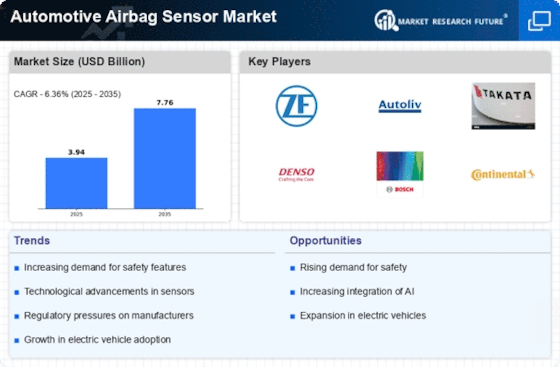
As per Market Research Future analysis, the Automotive Airbag Sensor Market Size was estimated at 3.935 USD Billion in 2024. The Automotive Airbag Sensor industry is projected to grow from 4.186 USD Billion in 2025 to 7.756 USD Billion by 2035, exhibiting a compound annual growth rate (CAGR) of 6.36% during the forecast period 2025 - 2035

Key Market Trends & Highlights

The Automotive Airbag Sensor Market is poised for growth driven by technological advancements and increasing safety regulations.

  • Technological advancements in sensors are enhancing the performance and reliability of automotive airbag systems. North America remains the largest market, while Asia-Pacific is emerging as the fastest-growing region for airbag sensors. The front airbag segment dominates the market, whereas the side airbag segment is experiencing rapid growth. Key market drivers include rising consumer awareness of vehicle safety and regulatory mandates pushing for enhanced safety features.

Market Size & Forecast

2024 Market Size 3.935 (USD Billion)
2035 Market Size 7.756 (USD Billion)
CAGR (2025 - 2035) 6.36%
Largest Regional Market Share in 2024 North America

Major Players

<a href="https://aftermarket.zf.com/us/aftermarket-portal/our-brands/trw/">TRW Automotive</a> (US), Autoliv (SE), Takata (JP), Denso (JP), Bosch (DE), Continental (DE), <a href="https://aftermarket.zf.com/us/aftermarket-portal/our-brands/trw/">ZF Friedrichshafen</a> (DE), Aisin Seiki (JP), Delphi Technologies (GB)

Market Trends

The Automotive Airbag Sensor Market is currently experiencing a transformative phase, driven by advancements in technology and increasing safety regulations. Manufacturers are focusing on developing more sophisticated sensors that enhance the reliability and efficiency of airbag systems. This evolution is largely influenced by the growing demand for enhanced vehicle safety features, as consumers and regulatory bodies alike prioritize occupant protection. Furthermore, the integration of smart technologies into vehicles is reshaping the landscape, as automakers seek to incorporate sensors that can adapt to various crash scenarios, thereby improving overall safety outcomes. In addition to technological advancements, the Automotive Airbag Sensor Market is also witnessing a shift towards sustainability. As environmental concerns gain prominence, manufacturers are exploring eco-friendly materials and production processes. This trend not only aligns with global sustainability goals but also appeals to a more environmentally conscious consumer base. The interplay between innovation and sustainability is likely to define the future trajectory of the market, as stakeholders strive to balance performance with ecological responsibility. Overall, the Automotive Airbag Sensor Market appears poised for growth, driven by a combination of regulatory pressures, consumer expectations, and technological innovations.

Technological Advancements in Sensors

The Automotive Airbag Sensor Market is seeing rapid technological progress, with manufacturers developing advanced sensors that improve the accuracy and responsiveness of airbag deployment. These innovations include the integration of multi-axis accelerometers and pressure sensors, which enhance the system's ability to assess crash severity and occupant position.

Focus on Sustainability

There is a growing emphasis on sustainability within the Automotive Airbag Sensor Market, as manufacturers seek to utilize eco-friendly materials and processes. This trend reflects a broader commitment to environmental responsibility, appealing to consumers who prioritize sustainable practices in their purchasing decisions.

Regulatory Influence on Safety Standards

Regulatory bodies are increasingly mandating higher safety standards for vehicles, which directly impacts the Automotive Airbag Sensor Market. These regulations drive manufacturers to enhance their airbag systems, ensuring that they meet stringent safety requirements and contribute to overall vehicle safety.

Automotive Airbag Sensor Market Market Drivers

Regulatory Mandates and Safety Standards

Regulatory mandates play a crucial role in shaping the Automotive Airbag Sensor Market. Governments worldwide are implementing stringent safety regulations that require vehicles to be equipped with advanced airbag systems. For example, regulations may stipulate the inclusion of side airbags and advanced sensor technologies to ensure optimal protection during collisions. These mandates drive manufacturers to innovate and enhance their airbag sensor offerings, thereby expanding the market. The increasing focus on compliance with safety standards is expected to propel the automotive airbag sensor market, as manufacturers strive to meet regulatory requirements while also appealing to safety-conscious consumers.

Growth of Electric and Autonomous Vehicles

The rise of electric and autonomous vehicles is significantly influencing the Automotive Airbag Sensor Market. As these vehicles become more prevalent, there is a corresponding need for advanced airbag systems that can adapt to new safety challenges. Electric vehicles often have different weight distributions and structural designs, necessitating the development of specialized airbag sensors. Furthermore, autonomous vehicles require sophisticated sensor technologies to ensure passenger safety in various driving conditions. This evolving landscape presents opportunities for innovation within the airbag sensor market, as manufacturers seek to create solutions that cater to the unique requirements of electric and autonomous vehicles.

Rising Demand for Enhanced Safety Features

The demand for enhanced safety features in vehicles is a primary driver of the Automotive Airbag Sensor Market. Consumers are increasingly prioritizing safety when purchasing vehicles, leading to a heightened focus on airbag systems. Market analysis suggests that vehicles equipped with advanced airbag sensors are perceived as safer, which influences consumer purchasing decisions. This trend is further supported by data indicating that vehicles with multiple airbags can reduce the risk of injury during accidents. As a result, automotive manufacturers are investing in the development of innovative airbag sensor technologies to meet this growing demand, thereby contributing to the expansion of the market.

Increasing Consumer Awareness of Vehicle Safety

Consumer awareness regarding vehicle safety is a pivotal driver for the Automotive Airbag Sensor Market. As individuals become more informed about the importance of safety features, there is a growing demand for vehicles equipped with advanced airbag systems. This trend is reflected in market data, which indicates that vehicles with multiple airbags and sophisticated sensor systems are increasingly preferred by consumers. Consequently, automotive manufacturers are compelled to invest in the development of cutting-edge airbag sensor technologies to meet these consumer expectations. This shift not only enhances vehicle safety but also contributes to the overall growth of the automotive airbag sensor market.

Technological Innovations in Automotive Airbag Sensors

The Automotive Airbag Sensor Market is experiencing a surge in technological innovations, particularly with the integration of advanced sensor technologies. These innovations include the development of more sensitive and reliable sensors that can detect a wider range of impact scenarios. For instance, the introduction of multi-axis accelerometers and pressure sensors enhances the accuracy of airbag deployment, thereby improving passenger safety. As manufacturers increasingly adopt these technologies, the market is projected to grow at a compound annual growth rate (CAGR) of approximately 6% over the next five years. This growth is driven by the demand for enhanced safety features in vehicles, which is becoming a standard expectation among consumers.

Market Segment Insights

By Type of Airbags: Front (Largest) vs. Side (Fastest-Growing)

In the Automotive Airbag Sensor Market, the segment distribution shows that Front airbags hold a significant share, primarily due to their widespread adoption in vehicles as standard safety features. Side airbags have been gaining traction, driven by increasing consumer awareness regarding safety measures and regulatory pressures for enhanced passenger protection. Meanwhile, Knee and Rear airbags account for smaller shares but are crucial in providing comprehensive safety solutions. As automotive manufacturers continue to innovate and enhance vehicle safety, the growth trends in the airbag sensor segment are influenced by advancements in technology. Features such as smarter sensors and integrated systems are pushing Side airbags to emerge as the fastest-growing segment, while Front airbags remain the dominant choice among manufacturers, reflecting a shift towards dual airbag deployments that bolster overall safety systems.

Front (Dominant) vs. Side (Emerging)

Front airbags have established themselves as the dominant force in the Automotive Airbag Sensor Market due to their critical role in reducing injury during frontal collisions. Their presence is a standard practice in modern vehicles, making them a non-negotiable safety component. Conversely, Side airbags are emerging rapidly as manufacturers recognize the growing importance of protecting passengers from lateral impacts. The increasing focus on passenger safety, coupled with regulatory standards mandating additional safety features, has propelled Side airbags into a faster growth trajectory. Their ability to deploy effectively in various scenarios supports their emergence, making them a key area of investment for automakers aiming to enhance overall vehicle safety.

By Mode of Sensors: Mechanical (Largest) vs. Electrical (Fastest-Growing)

In the Automotive Airbag Sensor Market, the mode of sensors is primarily divided into two segments: Mechanical and Electrical. Among these, Mechanical sensors hold the largest market share, as they have been a traditional choice for airbag deployments due to their reliability and proven effectiveness in various accident scenarios. On the other hand, Electrical sensors are rapidly gaining traction and represent a significant portion of the market, especially in modern vehicles that prioritize advanced safety features and consumer preferences for technology integration.

Mode of Sensors: Mechanical (Dominant) vs. Electrical (Emerging)

Mechanical sensors are well-established in the automotive airbag sector, offering robustness and reliability that car manufacturers trust for occupant safety. They function based on physical principles, activating airbags during collisions. However, the shift towards more complex automotive safety systems drives the emergence of Electrical sensors. These sensors leverage electronics and advanced algorithms, providing faster response times and integration with other vehicle safety technologies, thus appealing to tech-savvy consumers and enhanced safety regulatory requirements.

By Types of Sensors: Accelerometer (Largest) vs. Brake Sensors (Fastest-Growing)

In the Automotive Airbag Sensor Market, the accelerometer segment holds the largest share, driven by its critical role in determining velocity and deceleration during collisions. This segment is essential for the adequacy and efficiency of airbag deployment systems, ensuring the safety of vehicle occupants. Meanwhile, brake sensors are rapidly gaining traction as the fastest-growing segment due to increasing safety regulations and advancements in brake technology. These sensors play a vital role in monitoring braking forces, thus enhancing overall vehicle safety.

Accelerometer (Dominant) vs. Brake Sensors (Emerging)

The accelerometer sensor segment remains dominant in the automotive airbag sensor market, primarily due to its essential role in measuring changes in velocity during a crash, prompting timely airbag deployment. This technology ensures more efficient protection for occupants, and its integration into modern vehicles is becoming standard practice. In contrast, brake sensors, although emerging, are increasingly recognized for their importance in enhancing overall vehicle safety. Companies are innovating within this space to develop systems that monitor brake functionality in real-time, aligning with trends towards automated braking systems and improved driver-assist technologies. As safety regulations amplify, both segments are poised for significant growth.

By Application: Cars (Largest) vs. Motor Bikes (Fastest-Growing)

In the Automotive Airbag Sensor Market, the application segment demonstrates a diverse distribution of market share among various vehicle types. Cars hold the largest share, driven by the increasing demand for safety features and stringent regulations mandating airbag installations. Motor bikes, while capturing a smaller portion of the market, are rapidly gaining attention as manufacturers innovate to enhance rider safety, indicating a trend towards increased integration of airbag sensors in two-wheeled vehicles.

Cars (Dominant) vs. Motor Bikes (Emerging)

The car segment remains dominant in the automotive airbag sensor market, fueled by consumer preference for safety and the prevalence of airbag systems in modern vehicles. Major automotive manufacturers have invested heavily in advanced airbag technology, contributing to the high market penetration of these safety features. Conversely, the motor bike segment is emerging as a crucial area for growth. As awareness and demand for rider safety escalate, manufacturers are developing specialized airbag systems tailored to motor bikes, including deployable airbag jackets and integrated systems. This innovation not only enhances rider safety but is expected to attract new consumers eager for improved safety measures.

Get more detailed insights about Automotive Airbag Sensor Market Research Report—Global Forecast till 2035

Regional Insights

North America : Market Leader in Innovation

North America is the largest market for automotive airbag sensors, holding approximately 40% of the global market share. The region's growth is driven by stringent safety regulations and increasing consumer awareness regarding vehicle safety. The demand for advanced airbag systems is further fueled by the rising production of electric and autonomous vehicles, which require enhanced safety features. The United States and Canada are the leading countries in this market, with major automotive manufacturers investing heavily in airbag technology. Key players such as TRW Automotive and Autoliv dominate the landscape, focusing on innovation and compliance with safety standards. The competitive environment is characterized by continuous advancements in sensor technology, ensuring high safety performance in vehicles.

Europe : Regulatory-Driven Market Growth

Europe is the second-largest market for automotive airbag sensors, accounting for around 30% of the global share. The region's growth is significantly influenced by stringent EU regulations mandating advanced safety features in vehicles. The increasing focus on reducing road fatalities and enhancing passenger safety drives demand for innovative airbag systems. Leading countries in this market include Germany, France, and the UK, where major automotive manufacturers are investing in research and development. Companies like Bosch and Continental are at the forefront, developing cutting-edge airbag technologies. The competitive landscape is robust, with a focus on collaboration between manufacturers and technology providers to meet regulatory requirements and consumer expectations.

Asia-Pacific : Emerging Market Potential

Asia-Pacific is witnessing rapid growth in the automotive airbag sensor market, holding approximately 25% of the global share. The region's expansion is driven by increasing vehicle production, rising disposable incomes, and growing awareness of vehicle safety. Countries like China and India are leading this growth, with significant investments in automotive safety technologies. China is the largest market in the region, with numerous domestic and international players competing for market share. Companies such as Takata and Denso are expanding their operations to meet the rising demand. The competitive landscape is evolving, with a focus on innovation and compliance with safety standards, ensuring that manufacturers can cater to the growing consumer base.

Middle East and Africa : Untapped Market Opportunities

The Middle East and Africa region is gradually emerging in the automotive airbag sensor market, currently holding about 5% of the global share. The growth is primarily driven by increasing vehicle sales and a rising focus on safety features among consumers. Governments in several countries are beginning to implement regulations that mandate the inclusion of advanced safety systems in vehicles, which is expected to boost market growth. Leading countries in this region include South Africa and the UAE, where automotive manufacturers are increasingly adopting advanced safety technologies. The competitive landscape is still developing, with both local and international players vying for market presence. Companies are focusing on establishing partnerships to enhance their product offerings and meet the evolving safety standards.

Key Players and Competitive Insights

Leading market players are investing heavily in research and development in order to expand their product lines, which will help the Automotive Airbag Sensor Market, grow even more. Market participants are also undertaking a variety of strategic activities to expand their global footprint, with important market developments including new product launches, contractual agreements, mergers and acquisitions, higher investments, and collaboration with other organizations. To expand and survive in a more competitive and rising market climate, Automotive Airbag Sensor industry must offer cost-effective items. Manufacturing locally to minimize operational costs is one of the key business tactics used by manufacturers in the global Automotive Airbag Sensor industry to benefit clients and increase the market sector. In recent years, the Automotive Airbag Sensor industry has offered some of the most significant advantages to medicine. Major players in the Automotive Airbag Sensor Market, including Autoliv Inc., Continental AG, Denso Corporation, Freescale Semiconductor, Key Safety Systems, Mitsubishi Electric Co., Ltd., Robert Bosch Corporation, Takata Corporation, Toyoda Gosei, and TRW Automotive, are attempting to increase market demand by investing in research and development operations. The automobile firm Continental AG (Continental) produces and sells brake systems, powertrain and chassis systems, vehicle electronics, instruments, infotainment solutions, tires, and technical elastomers. For a variety of customers, including those who own passenger cars, trucks, buses, and vehicles used on construction sites as well as special vehicles, bicycles, and motorbikes, the company also sells tires and offers tire repair services. Under the Elektrobit, VDO, Uniroyal, Phoenix, Matador, and other brands, Continental markets its products. Customers from Asia, Europe, North America, and other continents are catered to by the company. North America, Africa, South America, Europe, Asia, and Australia are the continents where it has operational facilities. The headquarters of Continental are in Hannover, Niedersachsen, Germany. The production of one million Airbag Control Units (ACUs) at Continental's Bengaluru factory accomplished a significant milestone in December 2021. The company Mitsubishi Electric Corp. creates, produces, and sells electrical and electronic equipment. Among the products offered by the company are turbine generators, nuclear power plant, and power electronics equipment, as well as motors, transformers, circuit breakers, gas-insulated switchgear, switch control, and display devices. Additionally, it offers building security and management systems, escalators, elevators, electrical equipment for locomotives and rolling stock, transmission and distribution systems, and more. The business offers a variety of services, including logistics, finance, real estate, and advertising. Mitsubishi Electric provides services to the information processing and communications, satellite communications, consumer electronics, industrial technology, construction equipment, energy, and transportation industries. The business conducts business throughout the CIS, the Americas, the Asia-Pacific, Europe, Middle East, and Africa. The headquarters of Mitsubishi Electric are located in Chiyoda-Ku, Tokyo, Japan. Mitsubishi Electric stated in October 2019 that a new car component manufacturing would be established in Gujarat.

Key Companies in the Automotive Airbag Sensor Market include

Industry Developments

September2022 In order to improve road safety, DENSO Corporation has revealed that it has increased the detecting angle of its vision sensor. This will enable the sensor to better identify bicycles and pedestrians around a moving vehicle. Some versions of the Subaru Legacy Outback, which was unveiled on April 13, 2022 for the North American market, and the brand-new Subaru Crosstrek*1, which was unveiled on September 15, 2022 for the Japanese market, both use the vision sensor.

Future Outlook

Automotive Airbag Sensor Market Future Outlook

The Automotive Airbag Sensor Market is projected to grow at a 6.36% CAGR from 2025 to 2035, driven by advancements in safety regulations, technological innovations, and increasing consumer demand for vehicle safety features.

New opportunities lie in:

  • <p>Integration of AI-driven predictive analytics for sensor performance optimization. Development of lightweight, cost-effective materials for sensor manufacturing. Expansion into emerging markets with tailored airbag sensor solutions.</p>

By 2035, the market is expected to be robust, reflecting significant advancements and increased adoption of airbag sensor technologies.

Market Segmentation

Automotive Airbag Sensor Market Application Outlook

  • Cars
  • Motor bikes
  • Air planes
  • Spacecraft
  • Military

Automotive Airbag Sensor Market Mode of Sensors Outlook

  • Mechanical
  • Electrical

Automotive Airbag Sensor Market Type of Airbags Outlook

  • Side
  • Knee
  • Rear
  • Front

Automotive Airbag Sensor Market Types of Sensors Outlook

  • Accelerometer
  • Impact
  • Pressure
  • Tachometers
  • Brake Sensors
  • Gyroscopes

Report Scope

MARKET SIZE 2024 3.935(USD Billion)
MARKET SIZE 2025 4.186(USD Billion)
MARKET SIZE 2035 7.756(USD Billion)
COMPOUND ANNUAL GROWTH RATE (CAGR) 6.36% (2025 - 2035)
REPORT COVERAGE Revenue Forecast, Competitive Landscape, Growth Factors, and Trends
BASE YEAR 2024
Market Forecast Period 2025 - 2035
Historical Data 2019 - 2024
Market Forecast Units USD Billion
Key Companies Profiled TRW Automotive (US), Autoliv (SE), Takata (JP), Denso (JP), Bosch (DE), Continental (DE), ZF Friedrichshafen (DE), Aisin Seiki (JP), Delphi Technologies (GB)
Segments Covered Types of Airbags, Mode of Sensors, Types of Sensors, Application, Region
Key Market Opportunities Integration of advanced sensing technologies enhances safety features in the Automotive Airbag Sensor Market.
Key Market Dynamics Technological advancements in sensor accuracy and regulatory pressures drive innovation in the automotive airbag sensor market.
Countries Covered North America, Europe, APAC, South America, MEA

FAQs

What is the projected market valuation for the Automotive Airbag Sensor Market in 2035?

<p>The projected market valuation for the Automotive Airbag Sensor Market in 2035 is 7.756 USD Billion.</p>

What was the market valuation for the Automotive Airbag Sensor Market in 2024?

<p>The overall market valuation for the Automotive Airbag Sensor Market was 3.935 USD Billion in 2024.</p>

What is the expected CAGR for the Automotive Airbag Sensor Market during the forecast period 2025 - 2035?

<p>The expected CAGR for the Automotive Airbag Sensor Market during the forecast period 2025 - 2035 is 6.36%.</p>

Which companies are considered key players in the Automotive Airbag Sensor Market?

<p>Key players in the Automotive Airbag Sensor Market include TRW Automotive, Autoliv, Takata, Denso, Bosch, Continental, ZF Friedrichshafen, Aisin Seiki, and Delphi Technologies.</p>

What are the projected valuations for different types of airbags in the market?

<p>Projected valuations for different types of airbags include Front airbags at 2.97 USD Billion, Side airbags at 1.95 USD Billion, Knee airbags at 1.57 USD Billion, and Rear airbags at 1.27 USD Billion.</p>

How do the valuations of mechanical and electrical sensors compare in the market?

<p>The projected valuation for mechanical sensors is 3.912 USD Billion, while electrical sensors is slightly lower at 3.844 USD Billion.</p>

What types of sensors are utilized in the Automotive Airbag Sensor Market?

Types of sensors utilized in the market include Accelerometers, Impact sensors, Pressure sensors, Tachometers, Brake sensors, and Gyroscopes, each projected at 1.563 USD Billion.

What applications are driving the demand for automotive airbag sensors?

Applications driving demand include Cars at 3.0 USD Billion, Motor bikes at 1.0 USD Billion, Airplanes at 1.5 USD Billion, Spacecraft at 0.6 USD Billion, and Military at 1.5 USD Billion.

What trends are influencing the growth of the Automotive Airbag Sensor Market?

Trends influencing growth include advancements in sensor technology and increasing safety regulations, which may enhance market demand.

How does the Automotive Airbag Sensor Market's growth potential appear for the next decade?

The Automotive Airbag Sensor Market's growth potential appears robust, with a projected increase in valuation from 3.935 USD Billion in 2024 to 7.756 USD Billion by 2035.

  1. SECTION I: EXECUTIVE SUMMARY AND KEY HIGHLIGHTS
    1. | 1.1 EXECUTIVE SUMMARY
    2. | | 1.1.1 Market Overview
    3. | | 1.1.2 Key Findings
    4. | | 1.1.3 Market Segmentation
    5. | | 1.1.4 Competitive Landscape
    6. | | 1.1.5 Challenges and Opportunities
    7. | | 1.1.6 Future Outlook
  2. SECTION II: SCOPING, METHODOLOGY AND MARKET STRUCTURE
    1. | 2.1 MARKET INTRODUCTION
    2. | | 2.1.1 Definition
    3. | | 2.1.2 Scope of the study
    4. | | | 2.1.2.1 Research Objective
    5. | | | 2.1.2.2 Assumption
    6. | | | 2.1.2.3 Limitations
    7. | 2.2 RESEARCH METHODOLOGY
    8. | | 2.2.1 Overview
    9. | | 2.2.2 Data Mining
    10. | | 2.2.3 Secondary Research
    11. | | 2.2.4 Primary Research
    12. | | | 2.2.4.1 Primary Interviews and Information Gathering Process
    13. | | | 2.2.4.2 Breakdown of Primary Respondents
    14. | | 2.2.5 Forecasting Model
    15. | | 2.2.6 Market Size Estimation
    16. | | | 2.2.6.1 Bottom-Up Approach
    17. | | | 2.2.6.2 Top-Down Approach
    18. | | 2.2.7 Data Triangulation
    19. | | 2.2.8 Validation
  3. SECTION III: QUALITATIVE ANALYSIS
    1. | 3.1 MARKET DYNAMICS
    2. | | 3.1.1 Overview
    3. | | 3.1.2 Drivers
    4. | | 3.1.3 Restraints
    5. | | 3.1.4 Opportunities
    6. | 3.2 MARKET FACTOR ANALYSIS
    7. | | 3.2.1 Value chain Analysis
    8. | | 3.2.2 Porter's Five Forces Analysis
    9. | | | 3.2.2.1 Bargaining Power of Suppliers
    10. | | | 3.2.2.2 Bargaining Power of Buyers
    11. | | | 3.2.2.3 Threat of New Entrants
    12. | | | 3.2.2.4 Threat of Substitutes
    13. | | | 3.2.2.5 Intensity of Rivalry
    14. | | 3.2.3 COVID-19 Impact Analysis
    15. | | | 3.2.3.1 Market Impact Analysis
    16. | | | 3.2.3.2 Regional Impact
    17. | | | 3.2.3.3 Opportunity and Threat Analysis
  4. SECTION IV: QUANTITATIVE ANALYSIS
    1. | 4.1 Automobile, BY Type of Airbags (USD Billion)
    2. | | 4.1.1 Side
    3. | | 4.1.2 Knee
    4. | | 4.1.3 Rear
    5. | | 4.1.4 Front
    6. | 4.2 Automobile, BY Mode of Sensors (USD Billion)
    7. | | 4.2.1 Mechanical
    8. | | 4.2.2 Electrical
    9. | 4.3 Automobile, BY Types of Sensors (USD Billion)
    10. | | 4.3.1 Accelerometer
    11. | | 4.3.2 Impact
    12. | | 4.3.3 Pressure
    13. | | 4.3.4 Tachometers
    14. | | 4.3.5 Brake Sensors
    15. | | 4.3.6 Gyroscopes
    16. | 4.4 Automobile, BY Application (USD Billion)
    17. | | 4.4.1 Cars
    18. | | 4.4.2 Motor bikes
    19. | | 4.4.3 Air planes
    20. | | 4.4.4 Spacecraft
    21. | | 4.4.5 Military
    22. | 4.5 Automobile, BY Region (USD Billion)
    23. | | 4.5.1 North America
    24. | | | 4.5.1.1 US
    25. | | | 4.5.1.2 Canada
    26. | | 4.5.2 Europe
    27. | | | 4.5.2.1 Germany
    28. | | | 4.5.2.2 UK
    29. | | | 4.5.2.3 France
    30. | | | 4.5.2.4 Russia
    31. | | | 4.5.2.5 Italy
    32. | | | 4.5.2.6 Spain
    33. | | | 4.5.2.7 Rest of Europe
    34. | | 4.5.3 APAC
    35. | | | 4.5.3.1 China
    36. | | | 4.5.3.2 India
    37. | | | 4.5.3.3 Japan
    38. | | | 4.5.3.4 South Korea
    39. | | | 4.5.3.5 Malaysia
    40. | | | 4.5.3.6 Thailand
    41. | | | 4.5.3.7 Indonesia
    42. | | | 4.5.3.8 Rest of APAC
    43. | | 4.5.4 South America
    44. | | | 4.5.4.1 Brazil
    45. | | | 4.5.4.2 Mexico
    46. | | | 4.5.4.3 Argentina
    47. | | | 4.5.4.4 Rest of South America
    48. | | 4.5.5 MEA
    49. | | | 4.5.5.1 GCC Countries
    50. | | | 4.5.5.2 South Africa
    51. | | | 4.5.5.3 Rest of MEA
  5. SECTION V: COMPETITIVE ANALYSIS
    1. | 5.1 Competitive Landscape
    2. | | 5.1.1 Overview
    3. | | 5.1.2 Competitive Analysis
    4. | | 5.1.3 Market share Analysis
    5. | | 5.1.4 Major Growth Strategy in the Automobile
    6. | | 5.1.5 Competitive Benchmarking
    7. | | 5.1.6 Leading Players in Terms of Number of Developments in the Automobile
    8. | | 5.1.7 Key developments and growth strategies
    9. | | | 5.1.7.1 New Product Launch/Service Deployment
    10. | | | 5.1.7.2 Merger & Acquisitions
    11. | | | 5.1.7.3 Joint Ventures
    12. | | 5.1.8 Major Players Financial Matrix
    13. | | | 5.1.8.1 Sales and Operating Income
    14. | | | 5.1.8.2 Major Players R&D Expenditure. 2023
    15. | 5.2 Company Profiles
    16. | | 5.2.1 TRW Automotive (US)
    17. | | | 5.2.1.1 Financial Overview
    18. | | | 5.2.1.2 Products Offered
    19. | | | 5.2.1.3 Key Developments
    20. | | | 5.2.1.4 SWOT Analysis
    21. | | | 5.2.1.5 Key Strategies
    22. | | 5.2.2 Autoliv (SE)
    23. | | | 5.2.2.1 Financial Overview
    24. | | | 5.2.2.2 Products Offered
    25. | | | 5.2.2.3 Key Developments
    26. | | | 5.2.2.4 SWOT Analysis
    27. | | | 5.2.2.5 Key Strategies
    28. | | 5.2.3 Takata (JP)
    29. | | | 5.2.3.1 Financial Overview
    30. | | | 5.2.3.2 Products Offered
    31. | | | 5.2.3.3 Key Developments
    32. | | | 5.2.3.4 SWOT Analysis
    33. | | | 5.2.3.5 Key Strategies
    34. | | 5.2.4 Denso (JP)
    35. | | | 5.2.4.1 Financial Overview
    36. | | | 5.2.4.2 Products Offered
    37. | | | 5.2.4.3 Key Developments
    38. | | | 5.2.4.4 SWOT Analysis
    39. | | | 5.2.4.5 Key Strategies
    40. | | 5.2.5 Bosch (DE)
    41. | | | 5.2.5.1 Financial Overview
    42. | | | 5.2.5.2 Products Offered
    43. | | | 5.2.5.3 Key Developments
    44. | | | 5.2.5.4 SWOT Analysis
    45. | | | 5.2.5.5 Key Strategies
    46. | | 5.2.6 Continental (DE)
    47. | | | 5.2.6.1 Financial Overview
    48. | | | 5.2.6.2 Products Offered
    49. | | | 5.2.6.3 Key Developments
    50. | | | 5.2.6.4 SWOT Analysis
    51. | | | 5.2.6.5 Key Strategies
    52. | | 5.2.7 ZF Friedrichshafen (DE)
    53. | | | 5.2.7.1 Financial Overview
    54. | | | 5.2.7.2 Products Offered
    55. | | | 5.2.7.3 Key Developments
    56. | | | 5.2.7.4 SWOT Analysis
    57. | | | 5.2.7.5 Key Strategies
    58. | | 5.2.8 Aisin Seiki (JP)
    59. | | | 5.2.8.1 Financial Overview
    60. | | | 5.2.8.2 Products Offered
    61. | | | 5.2.8.3 Key Developments
    62. | | | 5.2.8.4 SWOT Analysis
    63. | | | 5.2.8.5 Key Strategies
    64. | | 5.2.9 Delphi Technologies (GB)
    65. | | | 5.2.9.1 Financial Overview
    66. | | | 5.2.9.2 Products Offered
    67. | | | 5.2.9.3 Key Developments
    68. | | | 5.2.9.4 SWOT Analysis
    69. | | | 5.2.9.5 Key Strategies
    70. | 5.3 Appendix
    71. | | 5.3.1 References
    72. | | 5.3.2 Related Reports
  6. LIST OF FIGURES
    1. | 6.1 MARKET SYNOPSIS
    2. | 6.2 NORTH AMERICA MARKET ANALYSIS
    3. | 6.3 US MARKET ANALYSIS BY TYPE OF AIRBAGS
    4. | 6.4 US MARKET ANALYSIS BY MODE OF SENSORS
    5. | 6.5 US MARKET ANALYSIS BY TYPES OF SENSORS
    6. | 6.6 US MARKET ANALYSIS BY APPLICATION
    7. | 6.7 CANADA MARKET ANALYSIS BY TYPE OF AIRBAGS
    8. | 6.8 CANADA MARKET ANALYSIS BY MODE OF SENSORS
    9. | 6.9 CANADA MARKET ANALYSIS BY TYPES OF SENSORS
    10. | 6.10 CANADA MARKET ANALYSIS BY APPLICATION
    11. | 6.11 EUROPE MARKET ANALYSIS
    12. | 6.12 GERMANY MARKET ANALYSIS BY TYPE OF AIRBAGS
    13. | 6.13 GERMANY MARKET ANALYSIS BY MODE OF SENSORS
    14. | 6.14 GERMANY MARKET ANALYSIS BY TYPES OF SENSORS
    15. | 6.15 GERMANY MARKET ANALYSIS BY APPLICATION
    16. | 6.16 UK MARKET ANALYSIS BY TYPE OF AIRBAGS
    17. | 6.17 UK MARKET ANALYSIS BY MODE OF SENSORS
    18. | 6.18 UK MARKET ANALYSIS BY TYPES OF SENSORS
    19. | 6.19 UK MARKET ANALYSIS BY APPLICATION
    20. | 6.20 FRANCE MARKET ANALYSIS BY TYPE OF AIRBAGS
    21. | 6.21 FRANCE MARKET ANALYSIS BY MODE OF SENSORS
    22. | 6.22 FRANCE MARKET ANALYSIS BY TYPES OF SENSORS
    23. | 6.23 FRANCE MARKET ANALYSIS BY APPLICATION
    24. | 6.24 RUSSIA MARKET ANALYSIS BY TYPE OF AIRBAGS
    25. | 6.25 RUSSIA MARKET ANALYSIS BY MODE OF SENSORS
    26. | 6.26 RUSSIA MARKET ANALYSIS BY TYPES OF SENSORS
    27. | 6.27 RUSSIA MARKET ANALYSIS BY APPLICATION
    28. | 6.28 ITALY MARKET ANALYSIS BY TYPE OF AIRBAGS
    29. | 6.29 ITALY MARKET ANALYSIS BY MODE OF SENSORS
    30. | 6.30 ITALY MARKET ANALYSIS BY TYPES OF SENSORS
    31. | 6.31 ITALY MARKET ANALYSIS BY APPLICATION
    32. | 6.32 SPAIN MARKET ANALYSIS BY TYPE OF AIRBAGS
    33. | 6.33 SPAIN MARKET ANALYSIS BY MODE OF SENSORS
    34. | 6.34 SPAIN MARKET ANALYSIS BY TYPES OF SENSORS
    35. | 6.35 SPAIN MARKET ANALYSIS BY APPLICATION
    36. | 6.36 REST OF EUROPE MARKET ANALYSIS BY TYPE OF AIRBAGS
    37. | 6.37 REST OF EUROPE MARKET ANALYSIS BY MODE OF SENSORS
    38. | 6.38 REST OF EUROPE MARKET ANALYSIS BY TYPES OF SENSORS
    39. | 6.39 REST OF EUROPE MARKET ANALYSIS BY APPLICATION
    40. | 6.40 APAC MARKET ANALYSIS
    41. | 6.41 CHINA MARKET ANALYSIS BY TYPE OF AIRBAGS
    42. | 6.42 CHINA MARKET ANALYSIS BY MODE OF SENSORS
    43. | 6.43 CHINA MARKET ANALYSIS BY TYPES OF SENSORS
    44. | 6.44 CHINA MARKET ANALYSIS BY APPLICATION
    45. | 6.45 INDIA MARKET ANALYSIS BY TYPE OF AIRBAGS
    46. | 6.46 INDIA MARKET ANALYSIS BY MODE OF SENSORS
    47. | 6.47 INDIA MARKET ANALYSIS BY TYPES OF SENSORS
    48. | 6.48 INDIA MARKET ANALYSIS BY APPLICATION
    49. | 6.49 JAPAN MARKET ANALYSIS BY TYPE OF AIRBAGS
    50. | 6.50 JAPAN MARKET ANALYSIS BY MODE OF SENSORS
    51. | 6.51 JAPAN MARKET ANALYSIS BY TYPES OF SENSORS
    52. | 6.52 JAPAN MARKET ANALYSIS BY APPLICATION
    53. | 6.53 SOUTH KOREA MARKET ANALYSIS BY TYPE OF AIRBAGS
    54. | 6.54 SOUTH KOREA MARKET ANALYSIS BY MODE OF SENSORS
    55. | 6.55 SOUTH KOREA MARKET ANALYSIS BY TYPES OF SENSORS
    56. | 6.56 SOUTH KOREA MARKET ANALYSIS BY APPLICATION
    57. | 6.57 MALAYSIA MARKET ANALYSIS BY TYPE OF AIRBAGS
    58. | 6.58 MALAYSIA MARKET ANALYSIS BY MODE OF SENSORS
    59. | 6.59 MALAYSIA MARKET ANALYSIS BY TYPES OF SENSORS
    60. | 6.60 MALAYSIA MARKET ANALYSIS BY APPLICATION
    61. | 6.61 THAILAND MARKET ANALYSIS BY TYPE OF AIRBAGS
    62. | 6.62 THAILAND MARKET ANALYSIS BY MODE OF SENSORS
    63. | 6.63 THAILAND MARKET ANALYSIS BY TYPES OF SENSORS
    64. | 6.64 THAILAND MARKET ANALYSIS BY APPLICATION
    65. | 6.65 INDONESIA MARKET ANALYSIS BY TYPE OF AIRBAGS
    66. | 6.66 INDONESIA MARKET ANALYSIS BY MODE OF SENSORS
    67. | 6.67 INDONESIA MARKET ANALYSIS BY TYPES OF SENSORS
    68. | 6.68 INDONESIA MARKET ANALYSIS BY APPLICATION
    69. | 6.69 REST OF APAC MARKET ANALYSIS BY TYPE OF AIRBAGS
    70. | 6.70 REST OF APAC MARKET ANALYSIS BY MODE OF SENSORS
    71. | 6.71 REST OF APAC MARKET ANALYSIS BY TYPES OF SENSORS
    72. | 6.72 REST OF APAC MARKET ANALYSIS BY APPLICATION
    73. | 6.73 SOUTH AMERICA MARKET ANALYSIS
    74. | 6.74 BRAZIL MARKET ANALYSIS BY TYPE OF AIRBAGS
    75. | 6.75 BRAZIL MARKET ANALYSIS BY MODE OF SENSORS
    76. | 6.76 BRAZIL MARKET ANALYSIS BY TYPES OF SENSORS
    77. | 6.77 BRAZIL MARKET ANALYSIS BY APPLICATION
    78. | 6.78 MEXICO MARKET ANALYSIS BY TYPE OF AIRBAGS
    79. | 6.79 MEXICO MARKET ANALYSIS BY MODE OF SENSORS
    80. | 6.80 MEXICO MARKET ANALYSIS BY TYPES OF SENSORS
    81. | 6.81 MEXICO MARKET ANALYSIS BY APPLICATION
    82. | 6.82 ARGENTINA MARKET ANALYSIS BY TYPE OF AIRBAGS
    83. | 6.83 ARGENTINA MARKET ANALYSIS BY MODE OF SENSORS
    84. | 6.84 ARGENTINA MARKET ANALYSIS BY TYPES OF SENSORS
    85. | 6.85 ARGENTINA MARKET ANALYSIS BY APPLICATION
    86. | 6.86 REST OF SOUTH AMERICA MARKET ANALYSIS BY TYPE OF AIRBAGS
    87. | 6.87 REST OF SOUTH AMERICA MARKET ANALYSIS BY MODE OF SENSORS
    88. | 6.88 REST OF SOUTH AMERICA MARKET ANALYSIS BY TYPES OF SENSORS
    89. | 6.89 REST OF SOUTH AMERICA MARKET ANALYSIS BY APPLICATION
    90. | 6.90 MEA MARKET ANALYSIS
    91. | 6.91 GCC COUNTRIES MARKET ANALYSIS BY TYPE OF AIRBAGS
    92. | 6.92 GCC COUNTRIES MARKET ANALYSIS BY MODE OF SENSORS
    93. | 6.93 GCC COUNTRIES MARKET ANALYSIS BY TYPES OF SENSORS
    94. | 6.94 GCC COUNTRIES MARKET ANALYSIS BY APPLICATION
    95. | 6.95 SOUTH AFRICA MARKET ANALYSIS BY TYPE OF AIRBAGS
    96. | 6.96 SOUTH AFRICA MARKET ANALYSIS BY MODE OF SENSORS
    97. | 6.97 SOUTH AFRICA MARKET ANALYSIS BY TYPES OF SENSORS
    98. | 6.98 SOUTH AFRICA MARKET ANALYSIS BY APPLICATION
    99. | 6.99 REST OF MEA MARKET ANALYSIS BY TYPE OF AIRBAGS
    100. | 6.100 REST OF MEA MARKET ANALYSIS BY MODE OF SENSORS
    101. | 6.101 REST OF MEA MARKET ANALYSIS BY TYPES OF SENSORS
    102. | 6.102 REST OF MEA MARKET ANALYSIS BY APPLICATION
    103. | 6.103 KEY BUYING CRITERIA OF AUTOMOBILE
    104. | 6.104 RESEARCH PROCESS OF MRFR
    105. | 6.105 DRO ANALYSIS OF AUTOMOBILE
    106. | 6.106 DRIVERS IMPACT ANALYSIS: AUTOMOBILE
    107. | 6.107 RESTRAINTS IMPACT ANALYSIS: AUTOMOBILE
    108. | 6.108 SUPPLY / VALUE CHAIN: AUTOMOBILE
    109. | 6.109 AUTOMOBILE, BY TYPE OF AIRBAGS, 2024 (% SHARE)
    110. | 6.110 AUTOMOBILE, BY TYPE OF AIRBAGS, 2024 TO 2035 (USD Billion)
    111. | 6.111 AUTOMOBILE, BY MODE OF SENSORS, 2024 (% SHARE)
    112. | 6.112 AUTOMOBILE, BY MODE OF SENSORS, 2024 TO 2035 (USD Billion)
    113. | 6.113 AUTOMOBILE, BY TYPES OF SENSORS, 2024 (% SHARE)
    114. | 6.114 AUTOMOBILE, BY TYPES OF SENSORS, 2024 TO 2035 (USD Billion)
    115. | 6.115 AUTOMOBILE, BY APPLICATION, 2024 (% SHARE)
    116. | 6.116 AUTOMOBILE, BY APPLICATION, 2024 TO 2035 (USD Billion)
    117. | 6.117 BENCHMARKING OF MAJOR COMPETITORS
  7. LIST OF TABLES
    1. | 7.1 LIST OF ASSUMPTIONS
    2. | | 7.1.1
    3. | 7.2 North America MARKET SIZE ESTIMATES; FORECAST
    4. | | 7.2.1 BY TYPE OF AIRBAGS, 2025-2035 (USD Billion)
    5. | | 7.2.2 BY MODE OF SENSORS, 2025-2035 (USD Billion)
    6. | | 7.2.3 BY TYPES OF SENSORS, 2025-2035 (USD Billion)
    7. | | 7.2.4 BY APPLICATION, 2025-2035 (USD Billion)
    8. | 7.3 US MARKET SIZE ESTIMATES; FORECAST
    9. | | 7.3.1 BY TYPE OF AIRBAGS, 2025-2035 (USD Billion)
    10. | | 7.3.2 BY MODE OF SENSORS, 2025-2035 (USD Billion)
    11. | | 7.3.3 BY TYPES OF SENSORS, 2025-2035 (USD Billion)
    12. | | 7.3.4 BY APPLICATION, 2025-2035 (USD Billion)
    13. | 7.4 Canada MARKET SIZE ESTIMATES; FORECAST
    14. | | 7.4.1 BY TYPE OF AIRBAGS, 2025-2035 (USD Billion)
    15. | | 7.4.2 BY MODE OF SENSORS, 2025-2035 (USD Billion)
    16. | | 7.4.3 BY TYPES OF SENSORS, 2025-2035 (USD Billion)
    17. | | 7.4.4 BY APPLICATION, 2025-2035 (USD Billion)
    18. | 7.5 Europe MARKET SIZE ESTIMATES; FORECAST
    19. | | 7.5.1 BY TYPE OF AIRBAGS, 2025-2035 (USD Billion)
    20. | | 7.5.2 BY MODE OF SENSORS, 2025-2035 (USD Billion)
    21. | | 7.5.3 BY TYPES OF SENSORS, 2025-2035 (USD Billion)
    22. | | 7.5.4 BY APPLICATION, 2025-2035 (USD Billion)
    23. | 7.6 Germany MARKET SIZE ESTIMATES; FORECAST
    24. | | 7.6.1 BY TYPE OF AIRBAGS, 2025-2035 (USD Billion)
    25. | | 7.6.2 BY MODE OF SENSORS, 2025-2035 (USD Billion)
    26. | | 7.6.3 BY TYPES OF SENSORS, 2025-2035 (USD Billion)
    27. | | 7.6.4 BY APPLICATION, 2025-2035 (USD Billion)
    28. | 7.7 UK MARKET SIZE ESTIMATES; FORECAST
    29. | | 7.7.1 BY TYPE OF AIRBAGS, 2025-2035 (USD Billion)
    30. | | 7.7.2 BY MODE OF SENSORS, 2025-2035 (USD Billion)
    31. | | 7.7.3 BY TYPES OF SENSORS, 2025-2035 (USD Billion)
    32. | | 7.7.4 BY APPLICATION, 2025-2035 (USD Billion)
    33. | 7.8 France MARKET SIZE ESTIMATES; FORECAST
    34. | | 7.8.1 BY TYPE OF AIRBAGS, 2025-2035 (USD Billion)
    35. | | 7.8.2 BY MODE OF SENSORS, 2025-2035 (USD Billion)
    36. | | 7.8.3 BY TYPES OF SENSORS, 2025-2035 (USD Billion)
    37. | | 7.8.4 BY APPLICATION, 2025-2035 (USD Billion)
    38. | 7.9 Russia MARKET SIZE ESTIMATES; FORECAST
    39. | | 7.9.1 BY TYPE OF AIRBAGS, 2025-2035 (USD Billion)
    40. | | 7.9.2 BY MODE OF SENSORS, 2025-2035 (USD Billion)
    41. | | 7.9.3 BY TYPES OF SENSORS, 2025-2035 (USD Billion)
    42. | | 7.9.4 BY APPLICATION, 2025-2035 (USD Billion)
    43. | 7.10 Italy MARKET SIZE ESTIMATES; FORECAST
    44. | | 7.10.1 BY TYPE OF AIRBAGS, 2025-2035 (USD Billion)
    45. | | 7.10.2 BY MODE OF SENSORS, 2025-2035 (USD Billion)
    46. | | 7.10.3 BY TYPES OF SENSORS, 2025-2035 (USD Billion)
    47. | | 7.10.4 BY APPLICATION, 2025-2035 (USD Billion)
    48. | 7.11 Spain MARKET SIZE ESTIMATES; FORECAST
    49. | | 7.11.1 BY TYPE OF AIRBAGS, 2025-2035 (USD Billion)
    50. | | 7.11.2 BY MODE OF SENSORS, 2025-2035 (USD Billion)
    51. | | 7.11.3 BY TYPES OF SENSORS, 2025-2035 (USD Billion)
    52. | | 7.11.4 BY APPLICATION, 2025-2035 (USD Billion)
    53. | 7.12 Rest of Europe MARKET SIZE ESTIMATES; FORECAST
    54. | | 7.12.1 BY TYPE OF AIRBAGS, 2025-2035 (USD Billion)
    55. | | 7.12.2 BY MODE OF SENSORS, 2025-2035 (USD Billion)
    56. | | 7.12.3 BY TYPES OF SENSORS, 2025-2035 (USD Billion)
    57. | | 7.12.4 BY APPLICATION, 2025-2035 (USD Billion)
    58. | 7.13 APAC MARKET SIZE ESTIMATES; FORECAST
    59. | | 7.13.1 BY TYPE OF AIRBAGS, 2025-2035 (USD Billion)
    60. | | 7.13.2 BY MODE OF SENSORS, 2025-2035 (USD Billion)
    61. | | 7.13.3 BY TYPES OF SENSORS, 2025-2035 (USD Billion)
    62. | | 7.13.4 BY APPLICATION, 2025-2035 (USD Billion)
    63. | 7.14 China MARKET SIZE ESTIMATES; FORECAST
    64. | | 7.14.1 BY TYPE OF AIRBAGS, 2025-2035 (USD Billion)
    65. | | 7.14.2 BY MODE OF SENSORS, 2025-2035 (USD Billion)
    66. | | 7.14.3 BY TYPES OF SENSORS, 2025-2035 (USD Billion)
    67. | | 7.14.4 BY APPLICATION, 2025-2035 (USD Billion)
    68. | 7.15 India MARKET SIZE ESTIMATES; FORECAST
    69. | | 7.15.1 BY TYPE OF AIRBAGS, 2025-2035 (USD Billion)
    70. | | 7.15.2 BY MODE OF SENSORS, 2025-2035 (USD Billion)
    71. | | 7.15.3 BY TYPES OF SENSORS, 2025-2035 (USD Billion)
    72. | | 7.15.4 BY APPLICATION, 2025-2035 (USD Billion)
    73. | 7.16 Japan MARKET SIZE ESTIMATES; FORECAST
    74. | | 7.16.1 BY TYPE OF AIRBAGS, 2025-2035 (USD Billion)
    75. | | 7.16.2 BY MODE OF SENSORS, 2025-2035 (USD Billion)
    76. | | 7.16.3 BY TYPES OF SENSORS, 2025-2035 (USD Billion)
    77. | | 7.16.4 BY APPLICATION, 2025-2035 (USD Billion)
    78. | 7.17 South Korea MARKET SIZE ESTIMATES; FORECAST
    79. | | 7.17.1 BY TYPE OF AIRBAGS, 2025-2035 (USD Billion)
    80. | | 7.17.2 BY MODE OF SENSORS, 2025-2035 (USD Billion)
    81. | | 7.17.3 BY TYPES OF SENSORS, 2025-2035 (USD Billion)
    82. | | 7.17.4 BY APPLICATION, 2025-2035 (USD Billion)
    83. | 7.18 Malaysia MARKET SIZE ESTIMATES; FORECAST
    84. | | 7.18.1 BY TYPE OF AIRBAGS, 2025-2035 (USD Billion)
    85. | | 7.18.2 BY MODE OF SENSORS, 2025-2035 (USD Billion)
    86. | | 7.18.3 BY TYPES OF SENSORS, 2025-2035 (USD Billion)
    87. | | 7.18.4 BY APPLICATION, 2025-2035 (USD Billion)
    88. | 7.19 Thailand MARKET SIZE ESTIMATES; FORECAST
    89. | | 7.19.1 BY TYPE OF AIRBAGS, 2025-2035 (USD Billion)
    90. | | 7.19.2 BY MODE OF SENSORS, 2025-2035 (USD Billion)
    91. | | 7.19.3 BY TYPES OF SENSORS, 2025-2035 (USD Billion)
    92. | | 7.19.4 BY APPLICATION, 2025-2035 (USD Billion)
    93. | 7.20 Indonesia MARKET SIZE ESTIMATES; FORECAST
    94. | | 7.20.1 BY TYPE OF AIRBAGS, 2025-2035 (USD Billion)
    95. | | 7.20.2 BY MODE OF SENSORS, 2025-2035 (USD Billion)
    96. | | 7.20.3 BY TYPES OF SENSORS, 2025-2035 (USD Billion)
    97. | | 7.20.4 BY APPLICATION, 2025-2035 (USD Billion)
    98. | 7.21 Rest of APAC MARKET SIZE ESTIMATES; FORECAST
    99. | | 7.21.1 BY TYPE OF AIRBAGS, 2025-2035 (USD Billion)
    100. | | 7.21.2 BY MODE OF SENSORS, 2025-2035 (USD Billion)
    101. | | 7.21.3 BY TYPES OF SENSORS, 2025-2035 (USD Billion)
    102. | | 7.21.4 BY APPLICATION, 2025-2035 (USD Billion)
    103. | 7.22 South America MARKET SIZE ESTIMATES; FORECAST
    104. | | 7.22.1 BY TYPE OF AIRBAGS, 2025-2035 (USD Billion)
    105. | | 7.22.2 BY MODE OF SENSORS, 2025-2035 (USD Billion)
    106. | | 7.22.3 BY TYPES OF SENSORS, 2025-2035 (USD Billion)
    107. | | 7.22.4 BY APPLICATION, 2025-2035 (USD Billion)
    108. | 7.23 Brazil MARKET SIZE ESTIMATES; FORECAST
    109. | | 7.23.1 BY TYPE OF AIRBAGS, 2025-2035 (USD Billion)
    110. | | 7.23.2 BY MODE OF SENSORS, 2025-2035 (USD Billion)
    111. | | 7.23.3 BY TYPES OF SENSORS, 2025-2035 (USD Billion)
    112. | | 7.23.4 BY APPLICATION, 2025-2035 (USD Billion)
    113. | 7.24 Mexico MARKET SIZE ESTIMATES; FORECAST
    114. | | 7.24.1 BY TYPE OF AIRBAGS, 2025-2035 (USD Billion)
    115. | | 7.24.2 BY MODE OF SENSORS, 2025-2035 (USD Billion)
    116. | | 7.24.3 BY TYPES OF SENSORS, 2025-2035 (USD Billion)
    117. | | 7.24.4 BY APPLICATION, 2025-2035 (USD Billion)
    118. | 7.25 Argentina MARKET SIZE ESTIMATES; FORECAST
    119. | | 7.25.1 BY TYPE OF AIRBAGS, 2025-2035 (USD Billion)
    120. | | 7.25.2 BY MODE OF SENSORS, 2025-2035 (USD Billion)
    121. | | 7.25.3 BY TYPES OF SENSORS, 2025-2035 (USD Billion)
    122. | | 7.25.4 BY APPLICATION, 2025-2035 (USD Billion)
    123. | 7.26 Rest of South America MARKET SIZE ESTIMATES; FORECAST
    124. | | 7.26.1 BY TYPE OF AIRBAGS, 2025-2035 (USD Billion)
    125. | | 7.26.2 BY MODE OF SENSORS, 2025-2035 (USD Billion)
    126. | | 7.26.3 BY TYPES OF SENSORS, 2025-2035 (USD Billion)
    127. | | 7.26.4 BY APPLICATION, 2025-2035 (USD Billion)
    128. | 7.27 MEA MARKET SIZE ESTIMATES; FORECAST
    129. | | 7.27.1 BY TYPE OF AIRBAGS, 2025-2035 (USD Billion)
    130. | | 7.27.2 BY MODE OF SENSORS, 2025-2035 (USD Billion)
    131. | | 7.27.3 BY TYPES OF SENSORS, 2025-2035 (USD Billion)
    132. | | 7.27.4 BY APPLICATION, 2025-2035 (USD Billion)
    133. | 7.28 GCC Countries MARKET SIZE ESTIMATES; FORECAST
    134. | | 7.28.1 BY TYPE OF AIRBAGS, 2025-2035 (USD Billion)
    135. | | 7.28.2 BY MODE OF SENSORS, 2025-2035 (USD Billion)
    136. | | 7.28.3 BY TYPES OF SENSORS, 2025-2035 (USD Billion)
    137. | | 7.28.4 BY APPLICATION, 2025-2035 (USD Billion)
    138. | 7.29 South Africa MARKET SIZE ESTIMATES; FORECAST
    139. | | 7.29.1 BY TYPE OF AIRBAGS, 2025-2035 (USD Billion)
    140. | | 7.29.2 BY MODE OF SENSORS, 2025-2035 (USD Billion)
    141. | | 7.29.3 BY TYPES OF SENSORS, 2025-2035 (USD Billion)
    142. | | 7.29.4 BY APPLICATION, 2025-2035 (USD Billion)
    143. | 7.30 Rest of MEA MARKET SIZE ESTIMATES; FORECAST
    144. | | 7.30.1 BY TYPE OF AIRBAGS, 2025-2035 (USD Billion)
    145. | | 7.30.2 BY MODE OF SENSORS, 2025-2035 (USD Billion)
    146. | | 7.30.3 BY TYPES OF SENSORS, 2025-2035 (USD Billion)
    147. | | 7.30.4 BY APPLICATION, 2025-2035 (USD Billion)
    148. | 7.31 PRODUCT LAUNCH/PRODUCT DEVELOPMENT/APPROVAL
    149. | | 7.31.1
    150. | 7.32 ACQUISITION/PARTNERSHIP
    151. | | 7.32.1

Automobile Market Segmentation

Automobile By Type of Airbags (USD Billion, 2025-2035)

  • Side
  • Knee
  • Rear
  • Front

Automobile By Mode of Sensors (USD Billion, 2025-2035)

  • Mechanical
  • Electrical

Automobile By Types of Sensors (USD Billion, 2025-2035)

  • Accelerometer
  • Impact
  • Pressure
  • Tachometers
  • Brake Sensors
  • Gyroscopes

Automobile By Application (USD Billion, 2025-2035)

  • Cars
  • Motor bikes
  • Air planes
  • Spacecraft
  • Military
Infographic

Free Sample Request

Kindly complete the form below to receive a free sample of this Report

Get Free Sample

Customer Strories

Compare Licence

×
Features License Type
Single User Multiuser License Enterprise User
Price $4,950 $5,950 $7,250
Maximum User Access Limit 1 User Upto 10 Users Unrestricted Access Throughout the Organization
Free Customization
Direct Access to Analyst
Deliverable Format
Platform Access
Discount on Next Purchase 10% 15% 15%
Printable Versions