×
Request Free Sample ×

Kindly complete the form below to receive a free sample of this Report

* Please use a valid business email

Leading companies partner with us for data-driven Insights

clients tt-cursor
Hero Background

Audiological Device Market

ID: MRFR/HC/39524-HCR
128 Pages
Rahul Gotadki
February 2026

Audiological Device Market Research Report: Size, Share, Trend Analysis By Device Type (Hearing Aids, Audiometric Equipment, Assistive Listening Devices, Diagnostic Devices), By Technology (Digital Hearing Aids, Analog Hearing Aids, Bone Conduction Devices, In-the-Ear Devices), By End Users (Individuals, Healthcare Institutions, Audiology Clinics, Research Organizations), By Distribution Channel (Online Stores, Retail Pharmacies, Hospitals, Specialty Stores) and  By Regional (North America, Europe, South America, Asia Pacific, Middle East and Africa)  - Growth Outlook & Industry Forecast 2025 To 2035

Share:
Download PDF ×

We do not share your information with anyone. However, we may send you emails based on your report interest from time to time. You may contact us at any time to opt-out.

Audiological Device Market Infographic
Purchase Options

Audiological Device Market Summary

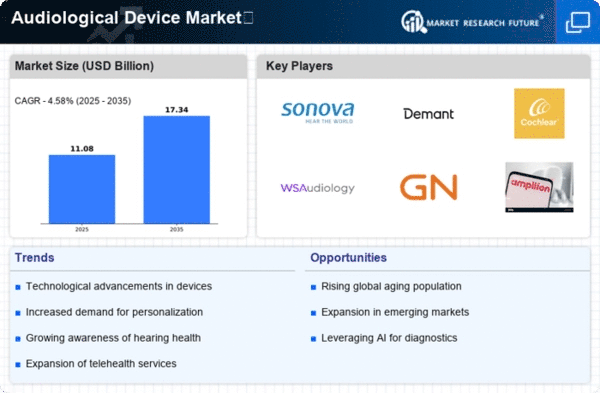
As per MRFR analysis, the Audiological Device Market was estimated at 10.59 USD Billion in 2024. The Audiological Device industry is projected to grow from 11.08 USD Billion in 2025 to 17.34 USD Billion by 2035, exhibiting a compound annual growth rate (CAGR) of 4.58 during the forecast period 2025 - 2035.

Key Market Trends & Highlights

The Audiological Device Market is experiencing robust growth driven by technological advancements and demographic shifts.

  • North America remains the largest market for audiological devices, primarily due to its advanced healthcare infrastructure.
  • The Asia-Pacific region is emerging as the fastest-growing market, fueled by increasing investments in healthcare technology.
  • Hearing aids dominate the market as the largest segment, while cochlear implants are witnessing rapid growth due to innovative technologies.
  • Key market drivers include the rising prevalence of hearing loss and increased awareness and education regarding hearing health.

Market Size & Forecast

2024 Market Size 10.59 (USD Billion)
2035 Market Size 17.34 (USD Billion)
CAGR (2025 - 2035) 4.58%

Major Players

Sonova Holding AG (CH), Demant A/S (DK), Cochlear Limited (AU), WS Audiology A/S (DK), GN Store Nord A/S (DK), Amplifon S.p.A. (IT), Eargo, Inc. (US), Starkey Hearing Technologies (US), Hearing Life (US)

Our Impact
Enabled $4.3B Revenue Impact for Fortune 500 and Leading Multinationals
Partnering with 2000+ Global Organizations Each Year
30K+ Citations by Top-Tier Firms in the Industry

Audiological Device Market Trends

The Audiological Device Market is currently experiencing a transformative phase characterized by rapid technological advancements and an increasing awareness of hearing health. The integration of artificial intelligence and machine learning into audiological devices is enhancing their functionality, allowing for personalized hearing experiences. This trend appears to be driven by a growing demand for devices that not only amplify sound but also adapt to individual user preferences and environments. Furthermore, the rise of telehealth services is facilitating remote consultations and adjustments, making audiological care more accessible to a broader population. In addition to technological innovations, demographic shifts are influencing the Audiological Device Market. An aging global population is likely to contribute to a higher prevalence of hearing loss, thereby increasing the demand for effective audiological solutions. Moreover, younger generations are becoming more proactive about their hearing health, which may lead to a shift in market dynamics. As awareness campaigns and educational initiatives proliferate, the market is poised for growth, with an emphasis on both preventive measures and advanced treatment options. This evolving landscape suggests a promising future for the Audiological Device Market, as it adapts to meet the diverse needs of its consumers.

Technological Integration

The incorporation of advanced technologies such as artificial intelligence and machine learning into audiological devices is reshaping the market. These innovations enable devices to offer personalized sound experiences, adapting to various environments and user preferences.

Demographic Influences

The aging population is a significant factor driving demand within the Audiological Device Market. As more individuals experience hearing loss, the need for effective solutions is likely to increase, prompting manufacturers to develop tailored products.

Telehealth Expansion

The growth of telehealth services is enhancing access to audiological care. Remote consultations and device adjustments are becoming more common, allowing users to receive timely support without the need for in-person visits.

Audiological Device Market Drivers

Market Growth Projections

The Global Audiological Device Market Industry is projected to experience substantial growth in the coming years. With an estimated market value of 10.6 USD Billion in 2024, the industry is anticipated to expand further, reaching 17.3 USD Billion by 2035. This growth trajectory indicates a compound annual growth rate of 4.58% from 2025 to 2035. Factors contributing to this growth include the rising prevalence of hearing loss, technological advancements, and increased awareness of hearing health. The market's expansion reflects the growing recognition of the importance of audiological devices in enhancing communication and overall quality of life for individuals with hearing impairments.

Rising Prevalence of Hearing Loss

The increasing incidence of hearing loss globally serves as a primary driver for the Global Audiological Device Market Industry. According to estimates, approximately 466 million people worldwide experience disabling hearing loss, a figure projected to rise significantly in the coming years. This growing demographic necessitates the adoption of audiological devices, including hearing aids and cochlear implants, to enhance communication and quality of life. As awareness of hearing health expands, the demand for innovative solutions is likely to grow, contributing to the market's expansion. The Global Audiological Device Market Industry is expected to reach 10.6 USD Billion by 2024, reflecting this urgent need.

Government Initiatives and Support

Government initiatives and support for hearing health are emerging as a vital driver for the Global Audiological Device Market Industry. Various countries are implementing policies to improve access to audiological services and devices, recognizing the impact of hearing loss on public health and quality of life. Funding programs, subsidies, and awareness campaigns are being introduced to facilitate access to audiological devices, particularly for underserved populations. These initiatives not only promote the adoption of hearing aids and cochlear implants but also encourage research and development in the field. As governments continue to prioritize hearing health, the market is likely to benefit from increased investment and support.

Aging Population and Demographic Shifts

The aging population is a significant factor influencing the Global Audiological Device Market Industry. As life expectancy increases, a larger segment of the population is entering age groups where hearing loss becomes more prevalent. This demographic shift is particularly pronounced in developed countries, where the proportion of elderly individuals is rising. Consequently, there is a growing need for audiological devices to address age-related hearing impairments. The market is poised for growth as healthcare providers and policymakers prioritize hearing health in aging populations, thereby driving demand for audiological solutions. This trend is expected to contribute to a compound annual growth rate of 4.58% from 2025 to 2035.

Technological Advancements in Audiological Devices

Technological innovation plays a crucial role in shaping the Global Audiological Device Market Industry. Recent advancements in digital signal processing, wireless connectivity, and artificial intelligence have led to the development of more sophisticated hearing aids and cochlear implants. These devices now offer features such as noise cancellation, smartphone integration, and personalized sound profiles, which enhance user experience and satisfaction. As manufacturers continue to invest in research and development, the market is likely to witness a surge in demand for these advanced products. This trend suggests that the Global Audiological Device Market Industry will experience robust growth, potentially reaching 17.3 USD Billion by 2035.

Increased Awareness and Education on Hearing Health

There is a notable increase in awareness and education regarding hearing health, which is positively impacting the Global Audiological Device Market Industry. Campaigns aimed at promoting hearing health and the importance of early intervention are gaining traction globally. Organizations and healthcare providers are actively engaging in outreach efforts to educate the public about the risks of untreated hearing loss and the benefits of using audiological devices. This heightened awareness is likely to lead to an increase in demand for hearing aids and other audiological solutions, as individuals become more proactive about their hearing health. As a result, the market is expected to expand significantly in the coming years.


Market Segment Insights

By Application: Hearing Aids (Largest) vs. Cochlear Implants (Fastest-Growing)

The audiological device market is primarily dominated by hearing aids, which constitute the largest share among the application segments. This category benefits from a broad base of adoption, driven largely by aging populations and increasing awareness of hearing health. Cochlear implants, while smaller in overall market share, exhibit rapid growth rates as advancements in technology and surgical techniques make them more accessible and effective, contributing to their rising acceptance among consumers.

Hearing Aids (Dominant) vs. Cochlear Implants (Emerging)

Hearing aids stand as the most dominant segment within the audiological devices market, offering a range of options tailored to various levels of hearing loss. Their widespread adoption is due to improved designs and features that enhance user experience. In contrast, cochlear implants, considered an emerging segment, are gaining traction due to innovations that enhance sound quality and postoperative outcomes. They target individuals with severe hearing losses who do not benefit from traditional hearing aids, offering a life-changing solution and expanding their appeal in the market.

By End Use: Hospitals (Largest) vs. Clinics (Fastest-Growing)

The Audiological Device Market is distinctly segmented by end-use, with hospitals commanding a significant share due to their comprehensive healthcare services and access to advanced audiological technologies. Clinics, on the other hand, are emerging as a vital segment in the market, benefiting from rising outpatient volumes and the growing demand for audiological assessments and hearing aids. Growth trends indicate that while hospitals continue to lead in terms of overall service utilization, clinics are expected to see the fastest growth. This surge is driven by a shift towards preventive healthcare measures and increased public awareness of hearing health. Factors such as technological advancements in audiology tools and increased access to audiological services in community settings are propelling this growth.

Hospitals (Dominant) vs. Clinics (Emerging)

Hospitals remain the dominant end-use segment in the Audiological Device Market, providing a wide range of services for hearing impairments and leveraging advanced technologies. They offer thorough diagnostic evaluations, treatment options, and rehabilitation services, making them essential for complex cases. In contrast, clinics are an emerging segment that caters to the rising demand for hearing assessments and rehabilitation in more accessible settings. Clinics are adept at providing targeted services that encourage early intervention, thus capturing a younger demographic. They leverage technology by integrating tele-audiology services which enhance patient convenience and expand their market reach, positioning them well for future growth in the industry.

By Product Type: Digital Hearing Aids (Largest) vs. Cochlear Implants (Fastest-Growing)

In the Audiological Device Market, the product type segment is robustly defined by four primary categories: Digital Hearing Aids, Analog Hearing Aids, Bone Anchored Hearing Aids, and Cochlear Implants. Digital Hearing Aids hold a significant portion of the market share, predominantly due to advancements in technology that enhance user experience. Analog Hearing Aids remain relevant but face challenges in capturing a larger market share as digital solutions become more prevalent. Bone Anchored Hearing Aids cater to a niche audience, while Cochlear Implants are emerging as a critical option for individuals with severe hearing loss, showcasing increased adoption rates.

Hearing Aids: Digital (Dominant) vs. Bone Anchored (Emerging)

Digital Hearing Aids dominate the market, driven by their advanced functionalities, such as Bluetooth connectivity and customizable sound profiles, which cater to a wide range of consumer preferences. Their seamless integration with smart devices enhances the user experience, making them a preferred choice among consumers. Conversely, Bone Anchored Hearing Aids represent an emerging segment aimed at individuals with specific hearing challenges, like those with conductive hearing loss or chronic ear infections. Although their adoption is less widespread, they offer a viable solution for a targeted demographic, presenting opportunities for growth in the audiological device landscape.

By Technology: Wireless Technology (Largest) vs. Bluetooth Technology (Fastest-Growing)

In the Audiological Device Market, the technology segment is primarily dominated by Wireless Technology, which constitutes a significant share of the market due to its widespread adoption and consumer preference for convenient and user-friendly devices. Bluetooth Technology is notably the fastest-growing segment, reflecting the increasing demand for connectivity and interoperability of hearing aids with smartphones and other devices. This trend is driven by the necessity for innovative solutions that cater to the needs of tech-savvy consumers seeking enhanced functionalities in their hearing devices. The market for audiological devices is evolving rapidly, with manufacturers focusing on integrating advanced technologies into their products. The surge in Bluetooth technology highlights the trend of smart hearing aids, which are becoming increasingly popular among users. Additionally, the rise in rechargeable technologies showcases an inclination toward sustainability and cost-effectiveness, appealing to a demographic that prioritizes long-term value. As these technologies advance, they are likely to enhance the user experience significantly, driving further growth in the segment.

Wireless Technology: Bluetooth (Dominant) vs. Rechargeable Technology (Emerging)

Wireless Technology, particularly Bluetooth, has established itself as the dominant force in the Audiological Device Market. Its ability to seamlessly connect hearing aids to various devices allows users to stream audio and manage settings conveniently, making it highly sought after. This dominance is complemented by the emerging trend of Rechargeable Technology, which appeals to consumers looking for sustainability and ease of use. Rechargeable hearing aids eliminate the need for frequent battery replacements, aligning with modern lifestyles that favor convenience. As the market progresses, the integration of Bluetooth functionalities into rechargeable devices is expected to create innovative solutions, catering to consumers who value both connectivity and sustainability in their hearing aids.

Get more detailed insights about Audiological Device Market

Regional Insights

North America : Market Leader in Audiological Devices

North America continues to lead the audiological device market, holding a significant share of 4.8 billion in 2024. The growth is driven by an aging population, increasing awareness of hearing health, and advancements in technology. Regulatory support, including initiatives for better healthcare access, further fuels demand. The region's robust healthcare infrastructure and high disposable income also contribute to the market's expansion. The United States is the primary market player, with key companies like Eargo, Inc. and Starkey Hearing Technologies leading the charge. The competitive landscape is characterized by innovation and strategic partnerships among major players such as Sonova Holding AG and Demant A/S. This dynamic environment fosters continuous improvement in product offerings, catering to diverse consumer needs.

Europe : Emerging Market with Growth Potential

Europe's audiological device market is valued at 3.5 billion, reflecting a growing demand driven by an increasing prevalence of hearing loss and supportive healthcare policies. The region benefits from a strong regulatory framework that encourages innovation and accessibility in hearing solutions. Additionally, rising awareness about hearing health and advancements in technology are key growth drivers, positioning Europe as a significant player in the global market. Leading countries include Germany, France, and the UK, where companies like Amplifon S.p.A. and GN Store Nord A/S are prominent. The competitive landscape is marked by a mix of established firms and emerging startups, fostering innovation. The European market is characterized by a focus on personalized solutions and enhanced user experience, ensuring a diverse range of products for consumers.

Asia-Pacific : Rapidly Growing Market Segment

The Asia-Pacific audiological device market, valued at 2.0 billion, is experiencing rapid growth due to increasing awareness of hearing health and rising disposable incomes. The region's expanding elderly population and urbanization trends are significant drivers of demand. Additionally, government initiatives aimed at improving healthcare access and affordability are catalyzing market expansion, making it a key area for future growth in the audiological sector. Countries like Australia, Japan, and China are leading the market, with major players such as Cochlear Limited and WS Audiology A/S establishing a strong presence. The competitive landscape is evolving, with a focus on innovative technologies and tailored solutions to meet diverse consumer needs. This dynamic environment is expected to attract further investments and enhance product offerings in the region.

Middle East and Africa : Emerging Market with Challenges

The Middle East and Africa audiological device market, valued at 0.29 billion, presents unique growth opportunities despite facing challenges such as limited healthcare infrastructure and awareness. The increasing prevalence of hearing loss and a growing middle class are driving demand for audiological solutions. Government initiatives aimed at improving healthcare access and affordability are also contributing to market growth, making this region an emerging player in the global landscape. Countries like South Africa and the UAE are at the forefront of this market, with key players like Starkey Hearing Technologies expanding their reach. The competitive landscape is characterized by a mix of local and international companies, focusing on affordable and accessible solutions. As awareness of hearing health increases, the market is expected to grow, attracting investments and enhancing product availability.

Key Players and Competitive Insights

The Audiological Device Market is characterized by a dynamic competitive landscape, driven by technological advancements, an aging population, and increasing awareness of hearing health. Key players such as Sonova Holding AG (CH), Demant A/S (DK), and Cochlear Limited (AU) are at the forefront, each adopting distinct strategies to enhance their market positioning. Sonova, for instance, emphasizes innovation through its extensive R&D investments, focusing on developing advanced hearing solutions that integrate seamlessly with digital platforms. Meanwhile, Demant has pursued strategic partnerships to expand its product offerings and enhance customer engagement, thereby solidifying its presence in various regions. Cochlear, on the other hand, has concentrated on expanding its global footprint, particularly in emerging markets, which appears to be a critical component of its growth strategy.The business tactics employed by these companies reflect a concerted effort to optimize operations and adapt to market demands. Localizing manufacturing has become a prevalent strategy, allowing firms to reduce costs and improve supply chain efficiency. The competitive structure of the market is moderately fragmented, with several players vying for market share, yet the influence of major companies remains substantial, shaping industry standards and consumer expectations.


In November Sonova Holding AG (CH) announced the launch of its latest hearing aid model, which incorporates AI-driven features aimed at enhancing user experience. This strategic move not only underscores Sonova's commitment to innovation but also positions the company to capture a larger share of the tech-savvy consumer segment. The integration of AI technology is likely to set new benchmarks in the industry, compelling competitors to accelerate their own technological advancements.


In October Demant A/S (DK) entered into a strategic alliance with a leading telehealth provider to enhance remote audiology services. This partnership is indicative of a broader trend towards digital health solutions, allowing Demant to leverage telehealth capabilities to reach underserved populations. Such initiatives may significantly improve access to hearing care, thereby expanding the company's market reach and reinforcing its competitive edge.


In September Cochlear Limited (AU) expanded its operations in Asia by establishing a new manufacturing facility in Vietnam. This strategic decision is likely to enhance production capabilities and reduce lead times, thereby improving responsiveness to market demands. The move also reflects Cochlear's commitment to tapping into the growing demand for hearing solutions in the Asia-Pacific region, which is expected to witness substantial growth in the coming years.


As of December the competitive trends in the Audiological Device Market are increasingly defined by digitalization, sustainability, and the integration of AI technologies. Strategic alliances are becoming more prevalent, enabling companies to pool resources and expertise to address complex market challenges. Looking ahead, competitive differentiation is expected to evolve, with a pronounced shift from price-based competition towards innovation, technological advancements, and supply chain reliability. This transition suggests that companies that prioritize R&D and strategic partnerships will likely emerge as leaders in the market.

Key Companies in the Audiological Device Market include

Industry Developments

  • Q2 2024: Trends in U.S. Hearing Aid Coverage and Access, 2024-2025 The U.S. hearing aid market in 2024 saw a continued shift toward over-the-counter (OTC) hearing aids, with younger users seeking simpler, at-home fitting processes and situational use devices. The OTC market, now two years old, is evolving with new product launches featuring rechargeability, Bluetooth connectivity, and telecare services.

Future Outlook

Audiological Device Market Future Outlook

The Audiological Device Market is projected to grow at a 4.58% CAGR from 2025 to 2035, driven by technological advancements, increasing awareness, and an aging population.

New opportunities lie in:

  • Expansion of telehealth audiology services Development of AI-driven hearing aids Integration of audiological devices with smart home technology

By 2035, the market is expected to be robust, driven by innovation and increased accessibility.

Market Segmentation

Audiological Device Market End Use Outlook

  • Hospitals
  • Clinics
  • Home Care Settings
  • Rehabilitation Centers

Audiological Device Market Technology Outlook

  • Wireless Technology
  • Bluetooth Technology
  • Rechargeable Technology
  • Smart Hearing Aids

Audiological Device Market Application Outlook

  • Hearing Aids
  • Cochlear Implants
  • Assistive Listening Devices
  • Auditory Brainstem Implants

Audiological Device Market Product Type Outlook

  • Digital Hearing Aids
  • Analog Hearing Aids
  • Bone Anchored Hearing Aids
  • Cochlear Implants

Report Scope

MARKET SIZE 2024 10.59(USD Billion)
MARKET SIZE 2025 11.08(USD Billion)
MARKET SIZE 2035 17.34(USD Billion)
COMPOUND ANNUAL GROWTH RATE (CAGR) 4.58% (2025 - 2035)
REPORT COVERAGE Revenue Forecast, Competitive Landscape, Growth Factors, and Trends
BASE YEAR 2024
Market Forecast Period 2025 - 2035
Historical Data 2019 - 2024
Market Forecast Units USD Billion
Key Companies Profiled Sonova Holding AG (CH), Demant A/S (DK), Cochlear Limited (AU), WS Audiology A/S (DK), GN Store Nord A/S (DK), Amplifon S.p.A. (IT), Eargo, Inc. (US), Starkey Hearing Technologies (US), Hearing Life (US)
Segments Covered Application, End Use, Product Type, Technology
Key Market Opportunities Integration of artificial intelligence in hearing aids enhances user experience and personalization in the Audiological Device Market.
Key Market Dynamics Technological advancements drive innovation in audiological devices, enhancing user experience and expanding market accessibility.
Countries Covered North America, Europe, APAC, South America, MEA
Leave a Comment

FAQs

What is the projected growth of the Audiological Device market?

The Audiological Device market is the expected increase in total market value of 17.34 USD billion over a defined forecast period 2025–2035. It is driven by factors such as demand trends, technological advances, regulatory changes, and geographic expansion.

What is the size of the Audiological Device market?

Audiological Device market size was valued at approximately 10.59 billion USD in 2024. This figure will reach 17.34 billion USD covering all regions (America, Europe, Asia, MEA and ROW), focusing its segments / services / distribution channels till 2035.

What is the CAGR of the Audiological Device market?

Audiological Device market is expected to grow at a CAGR of 4.58% between 2025 and 2035.

How much will the Audiological Device market be worth by 2035?

Audiological Device market is expected to be worth of 17.34 billion USD, reflecting growth driven by usage, technology and global demands by the end of 2035.

How will the Audiological Device market perform over the next 10 years?

Over the next 10 years the Audiological Device market is expected to shift from usd billion 10.59 to 17.34 billion USD, led by adoption of advanced tech, demographic trends, regulatory approvals, with potential headwinds from 2025 to 2035.

Which region is projected to dominate the market share in 2035?

North America is projected to dominate the market share, estimated at 6.0 USD Billion in 2035.

What is the value of the Hearing Aids segment in the Audiological Device Market in 2035?

The Hearing Aids segment is projected to be valued at 7.3 USD Billion in 2035.

How much is the Audiometric Equipment segment expected to be valued in 2035?

The Audiometric Equipment segment is expected to be valued at 3.5 USD Billion in 2035.

Who are the major players in the Global Audiological Device Market?

Major players in the market include Starkey Hearing Technologies, GN Store Nord, and Cochlear among others.

What is the projected value of the Assistive Listening Devices segment in 2035?

The Assistive Listening Devices segment is projected to be valued at 2.2 USD Billion in 2035.

Download Free Sample

Kindly complete the form below to receive a free sample of this Report

Compare Licence

×
Features License Type
Single User Multiuser License Enterprise User
Price $4,950 $5,950 $7,250
Maximum User Access Limit 1 User Upto 10 Users Unrestricted Access Throughout the Organization
Free Customization
Direct Access to Analyst
Deliverable Format
Platform Access
Discount on Next Purchase 10% 15% 15%
Printable Versions