×
Request Free Sample ×

Kindly complete the form below to receive a free sample of this Report

* Please use a valid business email

Leading companies partner with us for data-driven Insights

clients tt-cursor
Hero Background
English
Chinese
French
Japanese
Korean
German
Spanish

Armored Personnel Carrier Market Analysis

ID: MRFR/AD/9197-CR
148 Pages
Sejal Akre
September 2021

\nArmoured Personnel Carrier Market Size, Share, Industry Trend & Analysis Research Report By Application (Military Operations, Civilian Protection, Peacekeeping Missions, Counter-Terrorism Operations), By Armour Type (Composite Armour, Steel Armour, Ceramic Armour, Soft Armour), By Vehicle Capacity (2-4 Personnel, 5-10 Personnel, 11-20 Personnel, 21+ Personnel), By End Use (Defense Forces, Law Enforcement Agencies, Private Security) andBy Regional (North America, Europe, South America, Asia Pacific, Middle East and Africa)- Forecast to ... read more

Share:
Download PDF ×

We do not share your information with anyone. However, we may send you emails based on your report interest from time to time. You may contact us at any time to opt-out.

Armored Personnel Carrier Market Infographic
Purchase Options

Market Analysis

In-depth Analysis of Armored Personnel Carrier Market Industry Landscape

The Armored Personnel Carrier (APC) market is influenced by many factors that make up its dynamics and trajectory trends, which are evolving and collectively shaping this market structure. Geopolitical tensions and security concerns play significant roles here. The demand for APCs is driven by what countries perceive to be threats as well as their strategic considerations; they aim at bolstering their military capacity and guarding their borders. On the other hand, defense technology advancements are defining forces of the Armored Personnel Carrier market drivers. Advanced features in this sector of defense technologies require modern APCs to meet the rising demand for these vehicles with cutting-edge characteristics. Market dynamics shift due to innovations in armor materials, communication systems, and electronic warfare capabilities, which all become vital market factors. Manufacturers strive to keep pace with technological advancement, resulting in more sophisticated and technologically advanced APCs that suit today's demanding military operations. Defense budgets and procurement strategies form another key factor influencing the Armored Personnel Carrier market. Military expenditures set by government allocations directly determine APC purchases. This can be attributed to various aspects of armed conflicts that dictate how APs should look in terms of design, making it a significant factor influencing the market factors for armored personnel carriers (APCs). Asymmetric warfare, counter-insurgencies, or the need for quick reaction force calls upon manufacturers to consider specific details when designing an APC (Armored Personnel Carrier). The market responds by emphasizing the development of flexible APCs capable of addressing different kinds of threats ranging from conventional war scenarios to counter-terrorism tasks. Therefore, adaptability to different threat environments became one of the main factors determining current trends in the market. Global partnerships and geopolitical alliances also shape the market factors of the Armored Personnel Carrier (APC) industry. The specifications and designs of APCs are influenced by joint development programs and cooperation among countries, thereby promoting interoperability between allied forces. Additionally, research and development are among the market factors that affect armed personnel carriers. This means that the quest for technological advancement always drives innovation within the industry. Market factors of Armored Personal Carriers are increasingly shaped by humanitarian concerns and ethical use of military technology as well. As civilian populations around the world become more aware of how armed conflicts affect them, there has been a rapid growth in the number of APCs with features designed to prioritize the safety of non-combatants as well as military personnel.

Author
Sejal Akre
Senior Research Analyst

She has over 5 years of rich experience, in market research and consulting providing valuable market insights to client. Hands on expertise in management consulting, and extensive knowledge in domain including ICT, Automotive & Transportation and Aerospace & Defense. She is skilled in Go-to market strategy, industry analysis, market sizing, in depth company profiling, competitive intelligence & benchmarking and value chain amongst others.

Leave a Comment

FAQs

What is the estimated market size of the Armoured Personnel Carrier Market in 2032?

The Armoured Personnel Carrier Market is expected to reach a valuation of 15.22 USD Billion in 2032.

What is the expected CAGR for the Armoured Personnel Carrier Market from 2024 to 2032?

The market is projected to grow at a CAGR of 3.39% from 2024 to 2032.

Which region is anticipated to hold the largest market share in the Armoured Personnel Carrier Market by 2032?

North America is expected to hold the largest market share, valued at 5.5 USD Billion in 2032.

What applications are driving the Armoured Personnel Carrier Market?

The market is driven by applications in military operations, civilian protection, peacekeeping missions, and counter-terrorism operations.

What is the market size for military operations within the Armoured Personnel Carrier Market in 2032?

The market size for military operations is expected to reach 6.82 USD Billion in 2032.

Who are the key players in the Armoured Personnel Carrier Market?

Key players in the market include Navistar International, General Dynamics, KraussMaffei Wegmann, FNSS Defense Systems, and BAE Systems.

What is the projected market size for Europe in the Armoured Personnel Carrier Market by 2032?

The market size for Europe is projected to be 4.2 USD Billion by 2032.

What is the anticipated growth rate for the APAC region in the Armoured Personnel Carrier Market?

The APAC region is anticipated to grow to 3.2 USD Billion by 2032.

How much is the Counter-Terrorism Operations segment valued in 2032?

The Counter-Terrorism Operations segment is expected to be valued at 2.13 USD Billion in 2032.

What is the expected market size for civilian protection in the Armoured Personnel Carrier Market by 2032?

The market for civilian protection is anticipated to reach 3.42 USD Billion by 2032.

Market Summary

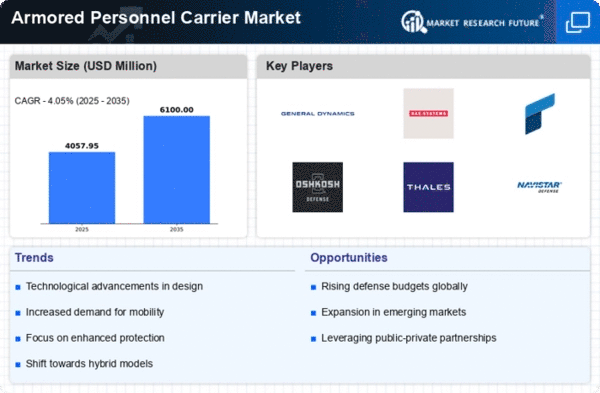
As per MRFR analysis, the Armored Personnel Carrier Market Size was estimated at 3900.0 USD Million in 2024. The Armored Personnel Carrier industry is projected to grow from 4100.0 in 2025 to 6100.0 by 2035, exhibiting a compound annual growth rate (CAGR) of 4.05 during the forecast period 2025 - 2035.

Key Market Trends & Highlights

The Armored Personnel Carrier Market is poised for substantial growth driven by technological advancements and increasing defense budgets.

  • Technological advancements are enhancing the capabilities and performance of armored personnel carriers, particularly in North America.
  • The diversification of applications for armored personnel carriers is evident, with military operations being the largest segment and peacekeeping missions emerging as the fastest-growing.
  • A focus on mobility and versatility is shaping the design and functionality of armored personnel carriers, especially in the Asia-Pacific region.
  • Increasing defense budgets and rising threats are key drivers propelling demand for armored personnel carriers among defense forces and private security firms.

Market Size & Forecast

2024 Market Size 3900.0 (USD Million)
2035 Market Size 6100.0 (USD Million)
CAGR (2025 - 2035) 4.05%
Largest Regional Market Share in 2024 North America

Major Players

General Dynamics (US), BAE Systems (GB), Rheinmetall (DE), Oshkosh Defense (US), Thales Group (FR), Navistar Defense (US), Krauss-Maffei Wegmann (DE), L3Harris Technologies (US), Elbit Systems (IL)

Market Trends

Armored Personnel Carrier

Armored Personnel Carrier Market Market Drivers

Increasing Defense Budgets

The Global armored personnel carrier Industry is experiencing growth driven by rising defense budgets across various nations. Countries are prioritizing military modernization and enhancing their defense capabilities, leading to increased procurement of armored vehicles. For instance, nations like the United States and India have allocated substantial portions of their budgets to upgrade their military fleets. In 2024, the market is projected to reach 11.6 USD Billion, reflecting the urgency for advanced armored personnel carriers that can withstand modern warfare challenges. This trend indicates a robust demand for innovative designs and technologies in the armored personnel carrier segment.

Market Segment Insights

By Application: Military Operations (Largest) vs. Peacekeeping Missions (Fastest-Growing)

The Armored Personnel Carrier Market is primarily driven by military operations, which holds the largest share among various applications. This segment is characterized by a significant demand for advanced armored vehicles capable of ensuring troop protection in hostile environments. The military operations category is closely followed by peacekeeping missions, which, while smaller in share, are rapidly gaining traction, specifically through international collaboration and support for various peace initiatives.

Military Operations (Dominant) vs. Peacekeeping Missions (Emerging)

Military operations remain the dominant application within the Armored Personnel Carrier Market due to ongoing geopolitical tensions and defense strategy enhancements. Armored personnel carriers designed for military use are optimized for rugged terrains, providing crucial mobility and protection for troops. Conversely, the peacekeeping missions segment represents an emerging opportunity, as countries increasingly contribute to stabilizing regions in conflict. These specialized vehicles in peacekeeping operations focus on humanitarian access and protection, indicating a shift in how armored vehicles adapt to support both combat and non-combat roles.

By End Use: Defense Forces (Largest) vs. Private Security Firms (Fastest-Growing)

In the Armored Personnel Carrier (APC) market, Defense Forces represent the largest segment, driven by continued investments in military capabilities and modernization initiatives. Paramilitary Forces and Government Agencies also hold significant shares, albeit smaller than Defense Forces. Private Security Firms are rapidly increasing their presence in the market, showing an upward trend due to rising security concerns and demand for enhanced protection solutions.

Defense Forces: Dominant vs. Private Security Firms: Emerging

The Defense Forces segment remains dominant in the APC market due to the high demand for advanced armored vehicles equipped with the latest technology for troop transport and battlefield support. These forces prioritize reliability, defense capabilities, and operational flexibility. On the other hand, the Private Security Firms segment is emerging rapidly as they adapt APCs for high-risk environments, focusing on security detail services where mobility and quick response are crucial. Security firms are increasingly procuring vehicles that meet specific operational needs, thus capitalizing on the evolving landscape of civil security.

By Mobility Type: Wheeled (Largest) vs. Tracked (Fastest-Growing)

In the Armored Personnel Carrier Market, the mobility type segment is predominantly driven by wheeled armored personnel carriers, which hold the largest share due to their versatility and ease of deployment. Tracked armored personnel carriers, while currently smaller in market share, are rapidly gaining traction due to their enhanced mobility in rugged terrains and combat scenarios. Amphibious armored personnel carriers serve a specialized role, catering to niche applications but remain limited in market appeal compared to their wheeled and tracked counterparts.

Wheeled Armored Personnel Carriers (Dominant) vs. Tracked Armored Personnel Carriers (Emerging)

Wheeled armored personnel carriers are characterized by their speed and maneuverability, making them suitable for a variety of combat and peacekeeping missions. Their ability to traverse urban landscapes and maintain logistical support positions them as the dominant choice among military forces. On the other hand, tracked armored personnel carriers are emerging as a favored alternative in challenging terrains due to their superior off-road capabilities. They are particularly valued for their stability and protection in combat situations, appealing to defense organizations looking for robust solutions.

By Vehicle Type: Light Armored Personnel Carriers (Largest) vs. Heavy Armored Personnel Carriers (Fastest-Growing)

In the Armored Personnel Carrier (APC) market, Light Armored Personnel Carriers (LAPCs) hold the largest share due to their versatility and adaptability across various operational terrains. They are favored by military forces for their balance of protection and mobility. Meanwhile, Medium and Heavy Armored Personnel Carriers are gaining traction, particularly in conflict regions where enhanced protection is paramount. Heavy APCs cater to specialized missions, offering advanced weapon systems and better defense capabilities, which is reflected in their increasing market share. Growth trends within the APC sector indicate a significant shift toward Heavy Armored Personnel Carriers, which are becoming crucial for modern warfare dynamics. The demand for enhanced security against evolving threats drives manufacturers to innovate in protection systems and technology integration. Additionally, geopolitical tensions have spurred investment in heavier units, resulting in a faster growth trajectory for Heavy APCs compared to their lighter counterparts. This trend showcases how the APC market is adapting to contemporary military strategies.

Light Armored Personnel Carriers (Dominant) vs. Heavy Armored Personnel Carriers (Emerging)

Light Armored Personnel Carriers dominate the APC market owing to their agile design and resource efficiency. They are ideal for rapid deployment and provide a balance between mobility and protection, making them suitable for various military operations, including peacekeeping missions and reconnaissance. On the other hand, Heavy Armored Personnel Carriers are emerging as vital assets for modern military strategies, designed to withstand significant threats and protect larger contingents. These vehicles are equipped with advanced armor technologies and heavier weapon systems, positioning them well against current security challenges. As defense forces focus on both mobility and robust defense capabilities, the complementary strengths of these vehicle types facilitate a strategic response to evolving combat scenarios.

Get more detailed insights about Armored Personnel Carrier Market Research Report—Global Forecast till 2035

Regional Insights

North America : Market Leader in Defense

North America continues to lead the Armored Personnel Carrier (APC) market, holding a significant share of 1950.0 million in 2024. The region's growth is driven by increasing defense budgets, modernization of military fleets, and heightened geopolitical tensions. Regulatory support for advanced military technologies further fuels demand, ensuring a robust market environment for APCs. The United States is the primary player, with key companies like General Dynamics, Oshkosh Defense, and L3Harris Technologies dominating the landscape. The competitive environment is characterized by innovation and strategic partnerships, enhancing the capabilities of APCs. As military needs evolve, the focus on advanced protection and mobility solutions remains paramount, solidifying North America's position in the global market.

Europe : Emerging Defense Innovations

Europe's Armored Personnel Carrier market is projected to reach 1100.0 million by 2025, driven by increasing defense expenditures and a focus on modernization. The region is witnessing a shift towards advanced technologies, including autonomous systems and enhanced survivability features. Regulatory frameworks are evolving to support these innovations, ensuring compliance with NATO standards and enhancing interoperability among member states. Leading countries such as Germany, the UK, and France are at the forefront, with companies like Rheinmetall and BAE Systems playing pivotal roles. The competitive landscape is marked by collaborations and joint ventures aimed at developing next-generation APCs. As European nations prioritize defense readiness, the market is expected to expand, reflecting a commitment to maintaining robust military capabilities.

Asia-Pacific : Growing Defense Budgets

The Asia-Pacific Armored Personnel Carrier market is anticipated to grow significantly, reaching 650.0 million by 2025. This growth is fueled by rising defense budgets, regional security concerns, and the need for modernization of military capabilities. Countries are increasingly investing in advanced APC technologies to enhance operational effectiveness and ensure national security, supported by favorable government policies. Key players in this region include countries like India, China, and Australia, with companies such as Thales Group and Elbit Systems leading the charge. The competitive landscape is characterized by a mix of domestic and international players, focusing on innovation and technology transfer. As regional tensions persist, the demand for reliable and advanced APCs is expected to rise, driving market growth.

Middle East and Africa : Strategic Defense Investments

The Middle East and Africa Armored Personnel Carrier market is projected to reach 200.0 million by 2025, driven by strategic defense investments and regional conflicts. Countries in this region are increasingly prioritizing military modernization, leading to a surge in demand for advanced APCs. Government initiatives aimed at enhancing defense capabilities are also contributing to market growth, supported by international partnerships and collaborations. Leading countries such as the UAE and South Africa are focusing on acquiring state-of-the-art APCs to bolster their military readiness. The competitive landscape features both local and international manufacturers, with a focus on providing tailored solutions to meet specific regional needs. As security challenges evolve, the demand for effective armored solutions is expected to rise, shaping the future of the market.

Key Players and Competitive Insights

The Armored Personnel Carrier Market is currently characterized by a dynamic competitive landscape, driven by increasing defense budgets and the rising need for enhanced troop protection in conflict zones. Major players such as General Dynamics (US), BAE Systems (GB), and Rheinmetall (DE) are strategically positioned to leverage innovation and technological advancements. General Dynamics (US) focuses on integrating advanced technologies into their vehicles, while BAE Systems (GB) emphasizes partnerships with local defense contractors to enhance regional capabilities. Rheinmetall (DE) appears to be concentrating on expanding its product portfolio to include hybrid and electric vehicles, reflecting a broader industry trend towards sustainability. Collectively, these strategies contribute to a competitive environment that is increasingly focused on technological differentiation and operational efficiency.Key business tactics within the market include localizing manufacturing and optimizing supply chains to enhance responsiveness to regional demands. The competitive structure of the Armored Personnel Carrier Market is moderately fragmented, with several key players exerting influence over various segments. This fragmentation allows for niche players to emerge, while larger companies often engage in strategic partnerships to consolidate their market positions and enhance their offerings.

In November General Dynamics (US) announced a collaboration with a leading technology firm to develop AI-driven systems for their armored vehicles. This strategic move is likely to enhance operational capabilities and improve decision-making processes on the battlefield, positioning General Dynamics (US) as a frontrunner in the integration of cutting-edge technology into military applications. The emphasis on AI reflects a broader industry trend towards automation and smart technologies, which could redefine operational paradigms in the coming years.

In October BAE Systems (GB) secured a contract with a European nation to supply a new generation of armored personnel carriers, which are designed with modular capabilities. This contract not only underscores BAE Systems' commitment to innovation but also highlights the importance of adaptability in modern military operations. The modular design allows for rapid reconfiguration based on mission requirements, potentially setting a new standard in the market.

In September Rheinmetall (DE) unveiled its latest hybrid armored vehicle, which aims to reduce fuel consumption and emissions. This development is indicative of a growing trend towards sustainability within the defense sector, as governments increasingly prioritize environmentally friendly solutions. The hybrid technology may not only appeal to eco-conscious buyers but also align with global regulatory trends aimed at reducing the carbon footprint of military operations.

As of December current competitive trends in the Armored Personnel Carrier Market are heavily influenced by digitalization, sustainability, and the integration of AI technologies. Strategic alliances are becoming increasingly vital, as companies seek to pool resources and expertise to navigate the complexities of modern defense requirements. Looking ahead, competitive differentiation is likely to evolve from traditional price-based competition towards a focus on innovation, technological advancements, and supply chain reliability. This shift may redefine market dynamics, compelling companies to invest in R&D and collaborative ventures to maintain a competitive edge.

Key Companies in the Armored Personnel Carrier Market include

Industry Developments

An uptick in defense spending globally has catalyzed advancements within the armoured personnel carrier Market, with companies such as BAE Systems, General Dynamics, and Rheinmetall recently unveiling new models featuring enhanced technologies like autonomous systems and improved armor capabilities.

Navistar International and Oshkosh Corporation continue to engage in fruitful partnerships to innovate logistics and sustainment solutions. Notably, FNSS Defense Systems has expanded its footprint in Asia, signing contracts worth millions to supply armored vehicles, which reflects the increasing demand in that region.

Mergers and acquisitions have also shaped the market, with Lockheed Martin eyeing strategic collaborations to bolster its capabilities in armored systems. Elbit Systems has recently merged with a smaller tech firm focused on defense electronics, streamlining its production processes.

On the valuation front, the market has seen significant growth, projected to expand at a noteworthy CAGR over the coming years, bolstered by increasing geopolitical tensions and military modernization initiatives. This growth trajectory is impacting companies like Textron and Hanwha Defense as they position themselves to capitalize on emerging opportunities within diverse international markets.

Future Outlook

Armored Personnel Carrier Market Future Outlook

The Armored Personnel Carrier Market is projected to grow at 4.05% CAGR from 2025 to 2035, driven by increasing defense budgets, technological advancements, and rising geopolitical tensions.

New opportunities lie in:

  • Development of hybrid-electric <a href="https://www.marketresearchfuture.com/reports/armored-vehicles-market-3238" target="_blank">armored vehicles</a> for enhanced fuel efficiency.
  • Integration of advanced surveillance systems for improved situational awareness.
  • Expansion into emerging markets with tailored APC solutions.

By 2035, the market is expected to solidify its position as a critical component of global defense strategies.

Market Segmentation

Armored Personnel Carrier Market End Use Outlook

  • Defense Forces
  • Paramilitary Forces
  • Private Security Firms
  • Government Agencies

Armored Personnel Carrier Market Application Outlook

  • Military Operations
  • Peacekeeping Missions
  • Humanitarian Assistance
  • Counter-Terrorism Operations

Armored Personnel Carrier Market Vehicle Type Outlook

  • Light Armored Personnel Carriers
  • Medium Armored Personnel Carriers
  • Heavy Armored Personnel Carriers

Armored Personnel Carrier Market Mobility Type Outlook

  • Wheeled Armored Personnel Carriers
  • Tracked Armored Personnel Carriers
  • Amphibious Armored Personnel Carriers

Report Scope

MARKET SIZE 20243900.0(USD Million)
MARKET SIZE 20254100.0(USD Million)
MARKET SIZE 20356100.0(USD Million)
COMPOUND ANNUAL GROWTH RATE (CAGR)4.05% (2025 - 2035)
REPORT COVERAGERevenue Forecast, Competitive Landscape, Growth Factors, and Trends
BASE YEAR2024
Market Forecast Period2025 - 2035
Historical Data2019 - 2024
Market Forecast UnitsUSD Million
Key Companies ProfiledGeneral Dynamics (US), BAE Systems (GB), Rheinmetall (DE), Oshkosh Defense (US), Thales Group (FR), Navistar Defense (US), Krauss-Maffei Wegmann (DE), L3Harris Technologies (US), Elbit Systems (IL)
Segments CoveredApplication, End Use, Mobility Type, Vehicle Type
Key Market OpportunitiesIntegration of advanced technologies enhances operational efficiency in the Armored Personnel Carrier Market.
Key Market DynamicsTechnological advancements and regulatory changes drive innovation and competition in the Armored Personnel Carrier market.
Countries CoveredNorth America, Europe, APAC, South America, MEA

FAQs

What is the estimated market size of the Armoured Personnel Carrier Market in 2032?

The Armoured Personnel Carrier Market is expected to reach a valuation of 15.22 USD Billion in 2032.

What is the expected CAGR for the Armoured Personnel Carrier Market from 2024 to 2032?

The market is projected to grow at a CAGR of 3.39% from 2024 to 2032.

Which region is anticipated to hold the largest market share in the Armoured Personnel Carrier Market by 2032?

North America is expected to hold the largest market share, valued at 5.5 USD Billion in 2032.

What applications are driving the Armoured Personnel Carrier Market?

The market is driven by applications in military operations, civilian protection, peacekeeping missions, and counter-terrorism operations.

What is the market size for military operations within the Armoured Personnel Carrier Market in 2032?

The market size for military operations is expected to reach 6.82 USD Billion in 2032.

Who are the key players in the Armoured Personnel Carrier Market?

Key players in the market include Navistar International, General Dynamics, KraussMaffei Wegmann, FNSS Defense Systems, and BAE Systems.

What is the projected market size for Europe in the Armoured Personnel Carrier Market by 2032?

The market size for Europe is projected to be 4.2 USD Billion by 2032.

What is the anticipated growth rate for the APAC region in the Armoured Personnel Carrier Market?

The APAC region is anticipated to grow to 3.2 USD Billion by 2032.

How much is the Counter-Terrorism Operations segment valued in 2032?

The Counter-Terrorism Operations segment is expected to be valued at 2.13 USD Billion in 2032.

What is the expected market size for civilian protection in the Armoured Personnel Carrier Market by 2032?

The market for civilian protection is anticipated to reach 3.42 USD Billion by 2032.

  1. SECTION I: EXECUTIVE SUMMARY AND KEY HIGHLIGHTS
    1. | 1.1 EXECUTIVE SUMMARY
    2. | 1.1.1 Market Overview
    3. | 1.1.2 Key Findings
    4. | 1.1.3 Market Segmentation
    5. | 1.1.4 Competitive Landscape
    6. | 1.1.5 Challenges and Opportunities
    7. | 1.1.6 Future Outlook
  2. SECTION II: SCOPING, METHODOLOGY AND MARKET STRUCTURE
    1. | 2.1 MARKET INTRODUCTION
    2. | 2.1.1 Definition
    3. | 2.1.2 Scope of the study
    4. |-- 2.1.2.1 Research Objective
    5. |-- 2.1.2.2 Assumption
    6. |-- 2.1.2.3 Limitations
    7. | 2.2 RESEARCH METHODOLOGY
    8. | 2.2.1 Overview
    9. | 2.2.2 Data Mining
    10. | 2.2.3 Secondary Research
    11. | 2.2.4 Primary Research
    12. |-- 2.2.4.1 Primary Interviews and Information Gathering Process
    13. |-- 2.2.4.2 Breakdown of Primary Respondents
    14. | 2.2.5 Forecasting Model
    15. | 2.2.6 Market Size Estimation
    16. |-- 2.2.6.1 Bottom-Up Approach
    17. |-- 2.2.6.2 Top-Down Approach
    18. | 2.2.7 Data Triangulation
    19. | 2.2.8 Validation
  3. SECTION III: QUALITATIVE ANALYSIS
    1. | 3.1 MARKET DYNAMICS
    2. | 3.1.1 Overview
    3. | 3.1.2 Drivers
    4. | 3.1.3 Restraints
    5. | 3.1.4 Opportunities
    6. | 3.2 MARKET FACTOR ANALYSIS
    7. | 3.2.1 Value chain Analysis
    8. | 3.2.2 Porter's Five Forces Analysis
    9. |-- 3.2.2.1 Bargaining Power of Suppliers
    10. |-- 3.2.2.2 Bargaining Power of Buyers
    11. |-- 3.2.2.3 Threat of New Entrants
    12. |-- 3.2.2.4 Threat of Substitutes
    13. |-- 3.2.2.5 Intensity of Rivalry
    14. | 3.2.3 COVID-19 Impact Analysis
    15. |-- 3.2.3.1 Market Impact Analysis
    16. |-- 3.2.3.2 Regional Impact
    17. |-- 3.2.3.3 Opportunity and Threat Analysis
  4. SECTION IV: QUANTITATIVE ANALYSIS
    1. | 4.1 Aerospace & Defense, BY Application (USD Million)
    2. | 4.1.1 Military Operations
    3. | 4.1.2 Peacekeeping Missions
    4. | 4.1.3 Humanitarian Assistance
    5. | 4.1.4 Counter-Terrorism Operations
    6. | 4.2 Aerospace & Defense, BY End Use (USD Million)
    7. | 4.2.1 Defense Forces
    8. | 4.2.2 Paramilitary Forces
    9. | 4.2.3 Private Security Firms
    10. | 4.2.4 Government Agencies
    11. | 4.3 Aerospace & Defense, BY Mobility Type (USD Million)
    12. | 4.3.1 Wheeled Armored Personnel Carriers
    13. | 4.3.2 Tracked Armored Personnel Carriers
    14. | 4.3.3 Amphibious Armored Personnel Carriers
    15. | 4.4 Aerospace & Defense, BY Vehicle Type (USD Million)
    16. | 4.4.1 Light Armored Personnel Carriers
    17. | 4.4.2 Medium Armored Personnel Carriers
    18. | 4.4.3 Heavy Armored Personnel Carriers
    19. | 4.5 Aerospace & Defense, BY Region (USD Million)
    20. | 4.5.1 North America
    21. |-- 4.5.1.1 US
    22. |-- 4.5.1.2 Canada
    23. | 4.5.2 Europe
    24. |-- 4.5.2.1 Germany
    25. |-- 4.5.2.2 UK
    26. |-- 4.5.2.3 France
    27. |-- 4.5.2.4 Russia
    28. |-- 4.5.2.5 Italy
    29. |-- 4.5.2.6 Spain
    30. |-- 4.5.2.7 Rest of Europe
    31. | 4.5.3 APAC
    32. |-- 4.5.3.1 China
    33. |-- 4.5.3.2 India
    34. |-- 4.5.3.3 Japan
    35. |-- 4.5.3.4 South Korea
    36. |-- 4.5.3.5 Malaysia
    37. |-- 4.5.3.6 Thailand
    38. |-- 4.5.3.7 Indonesia
    39. |-- 4.5.3.8 Rest of APAC
    40. | 4.5.4 South America
    41. |-- 4.5.4.1 Brazil
    42. |-- 4.5.4.2 Mexico
    43. |-- 4.5.4.3 Argentina
    44. |-- 4.5.4.4 Rest of South America
    45. | 4.5.5 MEA
    46. |-- 4.5.5.1 GCC Countries
    47. |-- 4.5.5.2 South Africa
    48. |-- 4.5.5.3 Rest of MEA
  5. SECTION V: COMPETITIVE ANALYSIS
    1. | 5.1 Competitive Landscape
    2. | 5.1.1 Overview
    3. | 5.1.2 Competitive Analysis
    4. | 5.1.3 Market share Analysis
    5. | 5.1.4 Major Growth Strategy in the Aerospace & Defense
    6. | 5.1.5 Competitive Benchmarking
    7. | 5.1.6 Leading Players in Terms of Number of Developments in the Aerospace & Defense
    8. | 5.1.7 Key developments and growth strategies
    9. |-- 5.1.7.1 New Product Launch/Service Deployment
    10. |-- 5.1.7.2 Merger & Acquisitions
    11. |-- 5.1.7.3 Joint Ventures
    12. | 5.1.8 Major Players Financial Matrix
    13. |-- 5.1.8.1 Sales and Operating Income
    14. |-- 5.1.8.2 Major Players R&D Expenditure. 2023
    15. | 5.2 Company Profiles
    16. | 5.2.1 General Dynamics (US)
    17. |-- 5.2.1.1 Financial Overview
    18. |-- 5.2.1.2 Products Offered
    19. |-- 5.2.1.3 Key Developments
    20. |-- 5.2.1.4 SWOT Analysis
    21. |-- 5.2.1.5 Key Strategies
    22. | 5.2.2 BAE Systems (GB)
    23. |-- 5.2.2.1 Financial Overview
    24. |-- 5.2.2.2 Products Offered
    25. |-- 5.2.2.3 Key Developments
    26. |-- 5.2.2.4 SWOT Analysis
    27. |-- 5.2.2.5 Key Strategies
    28. | 5.2.3 Rheinmetall (DE)
    29. |-- 5.2.3.1 Financial Overview
    30. |-- 5.2.3.2 Products Offered
    31. |-- 5.2.3.3 Key Developments
    32. |-- 5.2.3.4 SWOT Analysis
    33. |-- 5.2.3.5 Key Strategies
    34. | 5.2.4 Oshkosh Defense (US)
    35. |-- 5.2.4.1 Financial Overview
    36. |-- 5.2.4.2 Products Offered
    37. |-- 5.2.4.3 Key Developments
    38. |-- 5.2.4.4 SWOT Analysis
    39. |-- 5.2.4.5 Key Strategies
    40. | 5.2.5 Thales Group (FR)
    41. |-- 5.2.5.1 Financial Overview
    42. |-- 5.2.5.2 Products Offered
    43. |-- 5.2.5.3 Key Developments
    44. |-- 5.2.5.4 SWOT Analysis
    45. |-- 5.2.5.5 Key Strategies
    46. | 5.2.6 Navistar Defense (US)
    47. |-- 5.2.6.1 Financial Overview
    48. |-- 5.2.6.2 Products Offered
    49. |-- 5.2.6.3 Key Developments
    50. |-- 5.2.6.4 SWOT Analysis
    51. |-- 5.2.6.5 Key Strategies
    52. | 5.2.7 Krauss-Maffei Wegmann (DE)
    53. |-- 5.2.7.1 Financial Overview
    54. |-- 5.2.7.2 Products Offered
    55. |-- 5.2.7.3 Key Developments
    56. |-- 5.2.7.4 SWOT Analysis
    57. |-- 5.2.7.5 Key Strategies
    58. | 5.2.8 L3Harris Technologies (US)
    59. |-- 5.2.8.1 Financial Overview
    60. |-- 5.2.8.2 Products Offered
    61. |-- 5.2.8.3 Key Developments
    62. |-- 5.2.8.4 SWOT Analysis
    63. |-- 5.2.8.5 Key Strategies
    64. | 5.2.9 Elbit Systems (IL)
    65. |-- 5.2.9.1 Financial Overview
    66. |-- 5.2.9.2 Products Offered
    67. |-- 5.2.9.3 Key Developments
    68. |-- 5.2.9.4 SWOT Analysis
    69. |-- 5.2.9.5 Key Strategies
    70. | 5.3 Appendix
    71. | 5.3.1 References
    72. | 5.3.2 Related Reports

Aerospace & Defense Market Segmentation

Aerospace & Defense By Application (USD Million, 2025-2035)

  • Military Operations
  • Peacekeeping Missions
  • Humanitarian Assistance
  • Counter-Terrorism Operations

Aerospace & Defense By End Use (USD Million, 2025-2035)

  • Defense Forces
  • Paramilitary Forces
  • Private Security Firms
  • Government Agencies

Aerospace & Defense By Mobility Type (USD Million, 2025-2035)

  • Wheeled Armored Personnel Carriers
  • Tracked Armored Personnel Carriers
  • Amphibious Armored Personnel Carriers

Aerospace & Defense By Vehicle Type (USD Million, 2025-2035)

  • Light Armored Personnel Carriers
  • Medium Armored Personnel Carriers
  • Heavy Armored Personnel Carriers
Infographic

Free Sample Request

Kindly complete the form below to receive a free sample of this Report

Get Free Sample

Customer Strories

Compare Licence

×
Features License Type
Single User Multiuser License Enterprise User
Price $4,950 $5,950 $7,250
Maximum User Access Limit 1 User Upto 10 Users Unrestricted Access Throughout the Organization
Free Customization
Direct Access to Analyst
Deliverable Format
Platform Access
Discount on Next Purchase 10% 15% 15%
Printable Versions