×
Hero Background
English
Chinese
French
Japanese
Korean
German
Spanish

Aquaculture Market Share

ID: MRFR/Agri/6609-HCR
200 Pages
Snehal Singh
October 2025

Aquaculture Market Research Report By Environment (Freshwater, Marine Water, Brackish Water), By Type (Fishes, Crustaceans, Mollusca, Others) and By Region (North America, Europe, South America, Asia Pacific, Middle East and Africa) - Forecast to 2035

Share:
Download PDF ×

We do not share your information with anyone. However, we may send you emails based on your report interest from time to time. You may contact us at any time to opt-out.

Aquaculture Market Infographic
Purchase Options

Market Share

Aquaculture Market Share Analysis

Approach strategies used in market share positioning in the aqua cultural industry include a set of techniques focused on creating a competitive advantage, increasing brand visibility, dealing with consumers, and other stakeholders operating within the industry. An adequate strategy is also intelligent exploitation of aqua culture which we can sustain and at the same time responsible. Companies that are several glimpses towards the environment include IMTA and RAS, gaining footholds in sustainability. It also inclines to the consumer need that seafood is socially responsible and environmentally sound; therefore, this strategy helps to establish a competitive advantage in the market. Strategic partnerships and certifications stand as an essential tool when striving to achieve market positioning. The partnerships with the organizations such as Aquaculture Stewardship Council (ASC) and Best Aquaculture Practices (BAP) help companies to follow and showcase industry acknowledged ethical standards in aquaculture farming. Certification by these organizations make it easy for the aqua operations to be credible thus have a positive market standing hence customer trust. This partnership also enables the knowledge transfer, research cooperation, and the wide influence. Innovation in technology and production method is one of the population’s market share positions. Companies who are adopting new technologies that include automated monitoring systems, precision farming tools and advanced genetics for precisely targeted breeding establish themselves as agencies of efficiency in terms as resource management. These innovations help consumers to realize their own resource utilization, disease control measures and other farm management. In this way, aquaculture companies keep at the frontline of technological development, thus distinguishing themselves from their competitors and addressing that segment of customers who wish to buy high-standard environmental-friendly seafood. Product differentiation is critical for market segment market share positioning in the environment of aquaculture. Further, value-added product can also be a source of differentiation; and prepared products for ready cooking or marinated fish is an example. Provision of consumer specific demands and consolidation of the seafood market grow a greater percentage to improve the market share by capturing more of the varied seafood market.

Author
Snehal Singh
Assistant Manager - Research

High acumen in analyzing complex macro & micro markets with more than 6 years of work experience in the field of market research. By implementing her analytical skills in forecasting and estimation into market research reports, she has expertise in Packaging, Construction, and Equipment domains. She handles a team size of 20-25 resources and ensures smooth running of the projects, associated marketing activities, and client servicing.

Leave a Comment

FAQs

What is the current valuation of the Aquaculture Market as of 2024?

The Aquaculture Market was valued at 160.9 USD Billion in 2024.

Market Summary

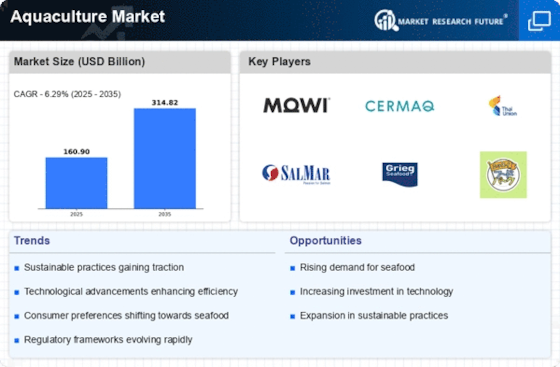
As per MRFR analysis, the Aquaculture Market Size was estimated at 160.9 USD Billion in 2024. The Aquaculture industry is projected to grow from 171.02 USD Billion in 2025 to 314.82 USD Billion by 2035, exhibiting a compound annual growth rate (CAGR) of 6.29 during the forecast period 2025 - 2035.

Key Market Trends & Highlights

The Aquaculture Market is experiencing a robust shift towards sustainability and technological integration.

  • Sustainable practices are increasingly being adopted across the aquaculture sector, particularly in North America.
  • Technological integration is enhancing operational efficiencies, especially in the rapidly growing marine water segment.
  • Consumer awareness and demand for transparency are driving changes in product labeling and sourcing practices.
  • Rising demand for seafood and regulatory support are key drivers propelling growth in both freshwater and crustacean markets.

Market Size & Forecast

2024 Market Size 160.9 (USD Billion)
2035 Market Size 314.82 (USD Billion)
CAGR (2025 - 2035) 6.29%
Largest Regional Market Share in 2024 Asia Pacific

Major Players

<p>Mowi ASA (NO), Cermaq Group AS (NO), Thai Union Group PCL (TH), SalMar ASA (NO), Grieg Seafood ASA (NO), Nissui (JP), Maruha Nichiro Corporation (JP), Bakkafrost (FO)</p>

Market Trends

The Aquaculture Market is currently experiencing a dynamic evolution, driven by increasing global demand for seafood and the need for sustainable food production methods. As populations grow and dietary preferences shift towards healthier protein sources, aquaculture emerges as a viable solution to meet these needs. Innovations in breeding techniques, feed formulations, and farming practices are enhancing productivity and efficiency within the sector. Furthermore, the integration of technology, such as automation and data analytics, is streamlining operations and improving yield quality. In addition to technological advancements, environmental considerations are becoming paramount in the Aquaculture Market. Stakeholders are increasingly focused on sustainable practices that minimize ecological impact while maximizing output. This shift is prompting the adoption of eco-friendly farming methods and responsible sourcing of feed ingredients. As consumers become more aware of the origins of their food, transparency in aquaculture operations is likely to gain importance. Overall, the Aquaculture Market appears poised for growth, with a focus on sustainability and innovation shaping its future trajectory.

Sustainable Practices

The Aquaculture Market is witnessing a notable shift towards sustainable farming methods. Stakeholders are increasingly prioritizing eco-friendly practices that reduce environmental impact. This trend encompasses the use of organic feeds, integrated multi-trophic aquaculture, and improved waste management systems. As consumers demand responsibly sourced seafood, the emphasis on sustainability is likely to shape production strategies.

Technological Integration

The integration of advanced technologies is transforming the Aquaculture Market. Innovations such as automation, artificial intelligence, and data analytics are enhancing operational efficiency and productivity. These technologies facilitate better monitoring of water quality, fish health, and feeding practices, potentially leading to improved yields and reduced resource consumption.

Consumer Awareness and Transparency

There is a growing trend towards consumer awareness regarding the origins of seafood products. The Aquaculture Market is responding by increasing transparency in production processes. This includes providing information about farming practices, sourcing of feed, and environmental impact. As consumers become more discerning, this trend may drive demand for certified sustainable aquaculture products.

Aquaculture Market Market Drivers

Rising Demand for Seafood

The increasing The Aquaculture Industry. As populations grow and dietary preferences shift towards healthier protein sources, seafood consumption is on the rise. According to recent data, seafood consumption has increased by approximately 20% over the last decade. This trend is likely to continue, as consumers become more health-conscious and seek sustainable food sources. The Aquaculture Market is positioned to meet this demand, providing a reliable supply of fish and shellfish. Furthermore, the shift towards aquaculture is seen as a solution to overfishing in wild fisheries, thereby ensuring the sustainability of seafood supplies. As a result, investments in aquaculture technologies and practices are expected to grow, further enhancing production capabilities.

Technological Advancements

Technological advancements play a crucial role in shaping the Aquaculture Market. Innovations such as automated feeding systems, water quality monitoring, and genetic improvements in fish breeding are enhancing productivity and efficiency. For instance, the adoption of recirculating aquaculture systems (RAS) has been gaining traction, allowing for higher stocking densities and reduced environmental impact. Data indicates that RAS can increase production by up to 30% compared to traditional methods. Additionally, the integration of artificial intelligence and data analytics is enabling farmers to optimize feeding schedules and monitor fish health more effectively. These technological improvements not only boost production but also contribute to the sustainability of the Aquaculture Market, making it more attractive to investors and stakeholders.

Regulatory Support and Policies

Regulatory support and favorable policies are increasingly influencing the Aquaculture Market. Governments are recognizing the importance of aquaculture in ensuring food security and promoting sustainable practices. Many countries are implementing policies that encourage investment in aquaculture, such as subsidies for sustainable practices and research funding. For example, certain regions have established frameworks that facilitate the development of aquaculture while ensuring environmental protection. This regulatory environment is likely to foster growth in the Aquaculture Market, as it provides a stable foundation for businesses to operate. Furthermore, international agreements aimed at promoting sustainable fishing practices are also benefiting aquaculture, as they shift focus towards farmed seafood as a viable alternative.

Growing Investment in Aquaculture

Growing investment in the Aquaculture Market is a significant driver of its expansion. Investors are increasingly recognizing the potential of aquaculture as a sustainable and profitable sector. Reports indicate that investments in aquaculture have surged, with funding directed towards innovative technologies, infrastructure development, and research initiatives. This influx of capital is likely to enhance production capabilities and improve the overall efficiency of aquaculture operations. Moreover, venture capital firms and private equity are showing interest in aquaculture startups, further fueling growth. As the industry matures, the availability of funding is expected to increase, enabling aquaculture businesses to scale operations and meet the rising demand for seafood. This trend may lead to a more competitive and resilient Aquaculture Market.

Environmental Sustainability Initiatives

Environmental sustainability initiatives are becoming increasingly vital for the Aquaculture Market. As concerns about overfishing and habitat destruction grow, aquaculture is often viewed as a more sustainable alternative to wild fisheries. The industry is actively adopting practices that minimize environmental impact, such as integrated multi-trophic aquaculture (IMTA), which promotes biodiversity and resource efficiency. Data suggests that IMTA can enhance overall productivity by utilizing waste from one species as feed for another. Additionally, certifications for sustainable aquaculture practices are gaining traction, with consumers increasingly seeking products that meet these standards. This shift towards sustainability not only addresses environmental concerns but also enhances the marketability of aquaculture products, potentially leading to increased consumer trust and demand.

Market Segment Insights

By Environment: Freshwater (Largest) vs. Marine Water (Fastest-Growing)

<p>The aquaculture market's environment segment is characterized by distinct preferences for freshwater, marine water, and brackish water cultivation methods. Freshwater aquaculture holds the largest share of the market, benefiting from its established infrastructure and widespread practice among producers. Meanwhile, marine water aquaculture, while smaller in proportion, exhibits rapid growth due to increasing consumer demand for marine species and advancements in cultivation technology. This dynamic creates a competitive landscape where both environments vie for attention from stakeholders.</p>

<p>Freshwater (Dominant) vs. Marine Water (Emerging)</p>

<p>Freshwater aquaculture remains the dominant force in the market, attributed to its long history and the suitability of various species for inland production. This segment often includes fish species like tilapia and catfish, which thrive in freshwater environments. Conversely, marine water aquaculture is emerging rapidly, focusing on species such as salmon and shrimp. This segment's growth is fueled by innovations in breeding and feed efficiency, as well as a shift towards sustainable practices that cater to modern consumption trends. The contrast between established freshwater practices and the innovative approaches in marine environments illustrates the evolving nature of aquaculture.</p>

By Type: Fishes (Largest) vs. Crustaceans (Fastest-Growing)

<p>The aquaculture market is significantly influenced by various types of products, with fishes commanding the largest share. This segment is primarily driven by the high demand for seafood among consumers, contributing greatly to the overall market dynamics. Crustaceans, while currently smaller in share compared to fishes, are rapidly gaining traction due to increasing consumer preferences for luxury seafood options. Both segments contribute to the diverse landscape of the aquaculture market.</p>

<p>Fishes: Dominant vs. Crustaceans: Emerging</p>

<p>Fishes dominate the aquaculture market, favored for their nutritional value, daily consumption rates, and adaptability to various farming conditions. Their prominence is supported by an extensive variety of species cultivated globally, from salmon to tilapia, providing essential dietary proteins. Conversely, crustaceans are emerging as a significant market force, driven by their unique flavors and culinary versatility. As consumer tastes evolve towards more gourmet seafood experiences, the demand for shrimp, crabs, and lobsters is witnessing rapid growth, reflecting broader trends in luxury food consumption. This dual focus highlights distinct consumer preferences, with fishes being a staple and crustaceans carving a niche in premium segments.</p>

Get more detailed insights about Aquaculture Market Research Report - Global Forecast till 2035

Regional Insights

North America : Sustainable Growth Leader

North America is witnessing significant growth in the aquaculture market, driven by increasing consumer demand for sustainable seafood and advancements in aquaculture technology. The United States holds the largest market share at approximately 45%, followed by Canada with around 25%. Regulatory support for sustainable practices and environmental conservation is further catalyzing market expansion. The U.S. and Canada are the leading countries in this region, with a competitive landscape featuring key players like Mowi ASA and Thai Union Group. The focus on innovation and sustainability is evident, as companies invest in research and development to enhance production efficiency. The presence of regulatory bodies ensures compliance with environmental standards, fostering a robust aquaculture sector.

Europe : Regulatory Framework Strengthens Market

Europe's aquaculture market is characterized by a strong regulatory framework that promotes sustainable practices and innovation. The region is the second-largest market, holding approximately 30% of the global share, with Norway and the UK leading the way. The European Union's Common Fisheries Policy encourages sustainable aquaculture, driving growth and investment in the sector. Norway is the dominant player, contributing significantly to production, while the UK follows closely. Key players like Cermaq Group and SalMar ASA are at the forefront, focusing on sustainable practices and technological advancements. The competitive landscape is robust, with increasing investments in R&D to enhance productivity and environmental sustainability, ensuring the region remains a leader in aquaculture.

Asia-Pacific : Emerging Market Potential

The Asia-Pacific region is rapidly emerging as a powerhouse in the aquaculture market, driven by rising seafood consumption and advancements in farming techniques. This region holds approximately 20% of the global market share, with China being the largest contributor, accounting for over 60% of the total production. Regulatory initiatives aimed at improving sustainability and food safety are also gaining traction. Countries like Thailand and Japan are significant players, with companies such as Thai Union Group and Nissui leading the market. The competitive landscape is marked by a mix of large corporations and small-scale farmers, all striving to meet the growing demand for seafood. Investments in technology and sustainable practices are crucial for maintaining growth and addressing environmental concerns in this dynamic market.

Middle East and Africa : Resource-Rich Opportunities

The Middle East and Africa region is witnessing a gradual rise in aquaculture, driven by the need for food security and sustainable seafood sources. This region currently holds about 5% of the global market share, with countries like Egypt and South Africa leading the charge. Government initiatives aimed at boosting local production and reducing reliance on imports are key growth drivers. Egypt is particularly notable for its aquaculture advancements, focusing on tilapia farming. The competitive landscape includes both local and international players, with investments in technology and infrastructure to enhance production capabilities. As the region continues to develop its aquaculture sector, the potential for growth remains significant, supported by favorable climatic conditions and increasing consumer demand for seafood.

Key Players and Competitive Insights

The  Aquaculture Market has witnessed significant growth due to increasing demand for seafood, rising health consciousness among consumers, and advancements in aquaculture technology. The competitive landscape of this market is characterized by numerous players, ranging from small-scale producers to large multinational corporations. Companies are continuously innovating to enhance production efficiency, improve sustainability practices, and meet the evolving preferences of consumers. The market is not only influenced by fish farming techniques but also by factors such as regulatory frameworks, environmental sustainability, and international trade dynamics.

Key players are focusing on establishing strong distribution networks, forming strategic partnerships, and investing in research and development to gain a competitive edge.AquaBounty Technologies stands out in the  Aquaculture Market due to its innovative approaches, primarily centered around biotechnology. This company has revolutionized aquaculture with its genetically engineered fish, designed to grow faster and utilize feed more efficiently compared to traditional varieties. AquaBounty's strong market presence is bolstered by its commitment to sustainability, allowing it to appeal to environmentally conscious consumers and investors alike.

The company is recognized for its pioneering role in the advancement of aquaculture technologies that enhance productivity while minimizing ecological impact. Its strategic focus on research and development has enabled AquaBounty Technologies to position itself as a leader in the genetic modification segment, ensuring it remains competitive against traditional aquaculture practice as it navigates through regulatory landscapes and market demands.Dainichi Corporation is another significant player within the  Aquaculture Market, recognized for its comprehensive portfolio of products and services focused on aquatic farming solutions.

The company specializes in the production of high-quality fish feeds, which are pivotal for the growth and health of farmed fish. Dainichi's strengths lie in its advanced R&D capabilities that enable it to develop nutritional products tailored to different species' specific needs. With a robust  distribution network, Dainichi has established a solid market presence, effectively reaching aquaculture farms across various regions. The company's emphasis on sustainability and high product quality has fostered strong relationships with clients, reinforcing its reputation.

In recent years, Dainichi Corporation has also engaged in strategic mergers and acquisitions to enhance its capabilities and expand its market reach, allowing it to maintain competitiveness in the dynamic  aquaculture environment.

Key Companies in the Aquaculture Market market include

Industry Developments

Recent developments in the  Aquaculture Market have shown significant growth driven by rising seafood consumption and advancements in aquaculture technology. Notable companies such as AquaBounty Technologies and Mowi are leading in innovative practices and genetic improvements, while major players like Thai Union Group and Grieg Seafood are expanding their sustainable sourcing initiatives. In December 2022, Cooke Aquaculture Market announced the acquisition of a significant stake in a Canadian fish farming company, which is expected to enhance its production capacity. Meanwhile, Salmar has reported an increase in its operational efficiency, contributing to a stronger position in the market.

In 2021, lean methodologies in fish farming, adopted by companies like LeanFish, have set new industry standards, optimizing production processes. The valuation of Aquaculture Market North America also saw an uptick due to increasing demand for eco-friendly fish products. Furthermore, government regulations ly are shifting towards more sustainable practices, prompting all major companies, including Nippon Suisan Kaisha and Skretting, to adapt their operations for compliance. The cumulative effects of these trends signal a robust future for  aquaculture, as innovation melds with sustainability efforts across the financial landscape.


Future Outlook

Aquaculture Market Future Outlook

<p>The Aquaculture Market is projected to grow at a 6.29% CAGR from 2024 to 2035, driven by increasing demand for sustainable seafood and technological advancements.</p>

New opportunities lie in:

  • <p>Development of integrated aquaponics systems for urban farming</p>
  • <p>Investment in automated feeding technologies to enhance efficiency</p>
  • <p>Expansion of online platforms for direct-to-consumer seafood sales</p>

<p>By 2035, the Aquaculture Market is expected to be robust, driven by innovation and sustainability.</p>

Market Segmentation

Aquaculture Market Type Outlook

  • Fishes
  • Crustaceans
  • Mollusca
  • Others

Aquaculture Market Environment Outlook

  • Freshwater
  • Marine Water
  • Brackish Water

Report Scope

MARKET SIZE 2024160.9(USD Billion)
MARKET SIZE 2025171.02(USD Billion)
MARKET SIZE 2035314.82(USD Billion)
COMPOUND ANNUAL GROWTH RATE (CAGR)6.29% (2024 - 2035)
REPORT COVERAGERevenue Forecast, Competitive Landscape, Growth Factors, and Trends
BASE YEAR2024
Market Forecast Period2025 - 2035
Historical Data2019 - 2024
Market Forecast UnitsUSD Billion
Key Companies ProfiledMarket analysis in progress
Segments CoveredMarket segmentation analysis in progress
Key Market OpportunitiesIntegration of sustainable practices and innovative technologies enhances growth potential in the Aquaculture Market.
Key Market DynamicsRising consumer demand for sustainable seafood drives innovation and regulatory changes in the aquaculture sector.
Countries CoveredNorth America, Europe, APAC, South America, MEA

FAQs

What is the current valuation of the Aquaculture Market as of 2024?

The Aquaculture Market was valued at 160.9 USD Billion in 2024.

  1. SECTION I: EXECUTIVE SUMMARY AND KEY HIGHLIGHTS
    1. EXECUTIVE SUMMARY
      1. Market Overview
      2. Key Findings
      3. Market Segmentation
      4. Competitive Landscape
      5. Challenges and Opportunities
      6. Future Outlook
  2. SECTION II: SCOPING, METHODOLOGY AND MARKET STRUCTURE
    1. MARKET INTRODUCTION
      1. Definition
      2. Scope of the study
    2. RESEARCH METHODOLOGY
      1. Overview
      2. Data Mining
      3. Secondary Research
      4. Primary Research
      5. Forecasting Model
      6. Market Size Estimation
      7. Data Triangulation
      8. Validation
  3. SECTION III: QUALITATIVE ANALYSIS
    1. MARKET DYNAMICS
      1. Overview
      2. Drivers
      3. Restraints
      4. Opportunities
    2. MARKET FACTOR ANALYSIS
      1. Value chain Analysis
      2. Porter's Five Forces Analysis
      3. COVID-19 Impact Analysis
  4. SECTION IV: QUANTITATIVE ANALYSIS
    1. Chemicals and Materials, BY Environment (USD Billion)
      1. Freshwater
      2. Marine Water
      3. Brackish Water
    2. Chemicals and Materials, BY Type (USD Billion)
      1. Fishes
      2. Crustaceans
      3. Mollusca
      4. Others
    3. Chemicals and Materials, BY Region (USD Billion)
      1. North America
      2. Europe
      3. APAC
      4. South America
      5. MEA
  5. SECTION V: COMPETITIVE ANALYSIS
    1. Competitive Landscape
      1. Overview
      2. Competitive Analysis
      3. Market share Analysis
      4. Major Growth Strategy in the Chemicals and Materials
      5. Competitive Benchmarking
      6. Leading Players in Terms of Number of Developments in the Chemicals and Materials
      7. Key developments and growth strategies
      8. Major Players Financial Matrix
    2. Company Profiles
      1. Mowi ASA (NO)
      2. Cermaq Group AS (NO)
      3. Thai Union Group PCL (TH)
      4. SalMar ASA (NO)
      5. Grieg Seafood ASA (NO)
      6. Nissui (JP)
      7. Maruha Nichiro Corporation (JP)
      8. Bakkafrost (FO)
    3. Appendix
      1. References
      2. Related Reports
  6. LIST OF FIGURES
    1. MARKET SYNOPSIS
    2. NORTH AMERICA MARKET ANALYSIS
    3. US MARKET ANALYSIS BY ENVIRONMENT
    4. US MARKET ANALYSIS BY TYPE
    5. CANADA MARKET ANALYSIS BY ENVIRONMENT
    6. CANADA MARKET ANALYSIS BY TYPE
    7. EUROPE MARKET ANALYSIS
    8. GERMANY MARKET ANALYSIS BY ENVIRONMENT
    9. GERMANY MARKET ANALYSIS BY TYPE
    10. UK MARKET ANALYSIS BY ENVIRONMENT
    11. UK MARKET ANALYSIS BY TYPE
    12. FRANCE MARKET ANALYSIS BY ENVIRONMENT
    13. FRANCE MARKET ANALYSIS BY TYPE
    14. RUSSIA MARKET ANALYSIS BY ENVIRONMENT
    15. RUSSIA MARKET ANALYSIS BY TYPE
    16. ITALY MARKET ANALYSIS BY ENVIRONMENT
    17. ITALY MARKET ANALYSIS BY TYPE
    18. SPAIN MARKET ANALYSIS BY ENVIRONMENT
    19. SPAIN MARKET ANALYSIS BY TYPE
    20. REST OF EUROPE MARKET ANALYSIS BY ENVIRONMENT
    21. REST OF EUROPE MARKET ANALYSIS BY TYPE
    22. APAC MARKET ANALYSIS
    23. CHINA MARKET ANALYSIS BY ENVIRONMENT
    24. CHINA MARKET ANALYSIS BY TYPE
    25. INDIA MARKET ANALYSIS BY ENVIRONMENT
    26. INDIA MARKET ANALYSIS BY TYPE
    27. JAPAN MARKET ANALYSIS BY ENVIRONMENT
    28. JAPAN MARKET ANALYSIS BY TYPE
    29. SOUTH KOREA MARKET ANALYSIS BY ENVIRONMENT
    30. SOUTH KOREA MARKET ANALYSIS BY TYPE
    31. MALAYSIA MARKET ANALYSIS BY ENVIRONMENT
    32. MALAYSIA MARKET ANALYSIS BY TYPE
    33. THAILAND MARKET ANALYSIS BY ENVIRONMENT
    34. THAILAND MARKET ANALYSIS BY TYPE
    35. INDONESIA MARKET ANALYSIS BY ENVIRONMENT
    36. INDONESIA MARKET ANALYSIS BY TYPE
    37. REST OF APAC MARKET ANALYSIS BY ENVIRONMENT
    38. REST OF APAC MARKET ANALYSIS BY TYPE
    39. SOUTH AMERICA MARKET ANALYSIS
    40. BRAZIL MARKET ANALYSIS BY ENVIRONMENT
    41. BRAZIL MARKET ANALYSIS BY TYPE
    42. MEXICO MARKET ANALYSIS BY ENVIRONMENT
    43. MEXICO MARKET ANALYSIS BY TYPE
    44. ARGENTINA MARKET ANALYSIS BY ENVIRONMENT
    45. ARGENTINA MARKET ANALYSIS BY TYPE
    46. REST OF SOUTH AMERICA MARKET ANALYSIS BY ENVIRONMENT
    47. REST OF SOUTH AMERICA MARKET ANALYSIS BY TYPE
    48. MEA MARKET ANALYSIS
    49. GCC COUNTRIES MARKET ANALYSIS BY ENVIRONMENT
    50. GCC COUNTRIES MARKET ANALYSIS BY TYPE
    51. SOUTH AFRICA MARKET ANALYSIS BY ENVIRONMENT
    52. SOUTH AFRICA MARKET ANALYSIS BY TYPE
    53. REST OF MEA MARKET ANALYSIS BY ENVIRONMENT
    54. REST OF MEA MARKET ANALYSIS BY TYPE
    55. KEY BUYING CRITERIA OF CHEMICALS AND MATERIALS
    56. RESEARCH PROCESS OF MRFR
    57. DRO ANALYSIS OF CHEMICALS AND MATERIALS
    58. DRIVERS IMPACT ANALYSIS: CHEMICALS AND MATERIALS
    59. RESTRAINTS IMPACT ANALYSIS: CHEMICALS AND MATERIALS
    60. SUPPLY / VALUE CHAIN: CHEMICALS AND MATERIALS
    61. CHEMICALS AND MATERIALS, BY ENVIRONMENT, 2024 (% SHARE)
    62. CHEMICALS AND MATERIALS, BY ENVIRONMENT, 2024 TO 2035 (USD Billion)
    63. CHEMICALS AND MATERIALS, BY TYPE, 2024 (% SHARE)
    64. CHEMICALS AND MATERIALS, BY TYPE, 2024 TO 2035 (USD Billion)
    65. BENCHMARKING OF MAJOR COMPETITORS
  7. LIST OF TABLES
    1. LIST OF ASSUMPTIONS
    2. North America MARKET SIZE ESTIMATES; FORECAST
      1. BY ENVIRONMENT, 2025-2035 (USD Billion)
      2. BY TYPE, 2025-2035 (USD Billion)
    3. US MARKET SIZE ESTIMATES; FORECAST
      1. BY ENVIRONMENT, 2025-2035 (USD Billion)
      2. BY TYPE, 2025-2035 (USD Billion)
    4. Canada MARKET SIZE ESTIMATES; FORECAST
      1. BY ENVIRONMENT, 2025-2035 (USD Billion)
      2. BY TYPE, 2025-2035 (USD Billion)
    5. Europe MARKET SIZE ESTIMATES; FORECAST
      1. BY ENVIRONMENT, 2025-2035 (USD Billion)
      2. BY TYPE, 2025-2035 (USD Billion)
    6. Germany MARKET SIZE ESTIMATES; FORECAST
      1. BY ENVIRONMENT, 2025-2035 (USD Billion)
      2. BY TYPE, 2025-2035 (USD Billion)
    7. UK MARKET SIZE ESTIMATES; FORECAST
      1. BY ENVIRONMENT, 2025-2035 (USD Billion)
      2. BY TYPE, 2025-2035 (USD Billion)
    8. France MARKET SIZE ESTIMATES; FORECAST
      1. BY ENVIRONMENT, 2025-2035 (USD Billion)
      2. BY TYPE, 2025-2035 (USD Billion)
    9. Russia MARKET SIZE ESTIMATES; FORECAST
      1. BY ENVIRONMENT, 2025-2035 (USD Billion)
      2. BY TYPE, 2025-2035 (USD Billion)
    10. Italy MARKET SIZE ESTIMATES; FORECAST
      1. BY ENVIRONMENT, 2025-2035 (USD Billion)
      2. BY TYPE, 2025-2035 (USD Billion)
    11. Spain MARKET SIZE ESTIMATES; FORECAST
      1. BY ENVIRONMENT, 2025-2035 (USD Billion)
      2. BY TYPE, 2025-2035 (USD Billion)
    12. Rest of Europe MARKET SIZE ESTIMATES; FORECAST
      1. BY ENVIRONMENT, 2025-2035 (USD Billion)
      2. BY TYPE, 2025-2035 (USD Billion)
    13. APAC MARKET SIZE ESTIMATES; FORECAST
      1. BY ENVIRONMENT, 2025-2035 (USD Billion)
      2. BY TYPE, 2025-2035 (USD Billion)
    14. China MARKET SIZE ESTIMATES; FORECAST
      1. BY ENVIRONMENT, 2025-2035 (USD Billion)
      2. BY TYPE, 2025-2035 (USD Billion)
    15. India MARKET SIZE ESTIMATES; FORECAST
      1. BY ENVIRONMENT, 2025-2035 (USD Billion)
      2. BY TYPE, 2025-2035 (USD Billion)
    16. Japan MARKET SIZE ESTIMATES; FORECAST
      1. BY ENVIRONMENT, 2025-2035 (USD Billion)
      2. BY TYPE, 2025-2035 (USD Billion)
    17. South Korea MARKET SIZE ESTIMATES; FORECAST
      1. BY ENVIRONMENT, 2025-2035 (USD Billion)
      2. BY TYPE, 2025-2035 (USD Billion)
    18. Malaysia MARKET SIZE ESTIMATES; FORECAST
      1. BY ENVIRONMENT, 2025-2035 (USD Billion)
      2. BY TYPE, 2025-2035 (USD Billion)
    19. Thailand MARKET SIZE ESTIMATES; FORECAST
      1. BY ENVIRONMENT, 2025-2035 (USD Billion)
      2. BY TYPE, 2025-2035 (USD Billion)
    20. Indonesia MARKET SIZE ESTIMATES; FORECAST
      1. BY ENVIRONMENT, 2025-2035 (USD Billion)
      2. BY TYPE, 2025-2035 (USD Billion)
    21. Rest of APAC MARKET SIZE ESTIMATES; FORECAST
      1. BY ENVIRONMENT, 2025-2035 (USD Billion)
      2. BY TYPE, 2025-2035 (USD Billion)
    22. South America MARKET SIZE ESTIMATES; FORECAST
      1. BY ENVIRONMENT, 2025-2035 (USD Billion)
      2. BY TYPE, 2025-2035 (USD Billion)
    23. Brazil MARKET SIZE ESTIMATES; FORECAST
      1. BY ENVIRONMENT, 2025-2035 (USD Billion)
      2. BY TYPE, 2025-2035 (USD Billion)
    24. Mexico MARKET SIZE ESTIMATES; FORECAST
      1. BY ENVIRONMENT, 2025-2035 (USD Billion)
      2. BY TYPE, 2025-2035 (USD Billion)
    25. Argentina MARKET SIZE ESTIMATES; FORECAST
      1. BY ENVIRONMENT, 2025-2035 (USD Billion)
      2. BY TYPE, 2025-2035 (USD Billion)
    26. Rest of South America MARKET SIZE ESTIMATES; FORECAST
      1. BY ENVIRONMENT, 2025-2035 (USD Billion)
      2. BY TYPE, 2025-2035 (USD Billion)
    27. MEA MARKET SIZE ESTIMATES; FORECAST
      1. BY ENVIRONMENT, 2025-2035 (USD Billion)
      2. BY TYPE, 2025-2035 (USD Billion)
    28. GCC Countries MARKET SIZE ESTIMATES; FORECAST
      1. BY ENVIRONMENT, 2025-2035 (USD Billion)
      2. BY TYPE, 2025-2035 (USD Billion)
    29. South Africa MARKET SIZE ESTIMATES; FORECAST
      1. BY ENVIRONMENT, 2025-2035 (USD Billion)
      2. BY TYPE, 2025-2035 (USD Billion)
    30. Rest of MEA MARKET SIZE ESTIMATES; FORECAST
      1. BY ENVIRONMENT, 2025-2035 (USD Billion)
      2. BY TYPE, 2025-2035 (USD Billion)
    31. PRODUCT LAUNCH/PRODUCT DEVELOPMENT/APPROVAL
    32. ACQUISITION/PARTNERSHIP

Aquaculture Market Segmentation


Aquaculture Market By Environment (USD Billion, 2019-2035)

Freshwater

Marine Water

Brackish Water


Aquaculture Market By Type (USD Billion, 2019-2035)

Fishes

Crustaceans

Mollusca

Others


Aquaculture Market By Regional (USD Billion, 2019-2035)

North America

Europe

South America

Asia Pacific

Middle East and Africa


Aquaculture Market Regional Outlook (USD Billion, 2019-2035)


North America Outlook (USD Billion, 2019-2035)

North America Aquaculture Market by Environment Type

Freshwater

Marine Water

Brackish Water

North America Aquaculture Market by Type

Fishes

Crustaceans

Mollusca

Others

North America Aquaculture Market by Regional Type

US

Canada

US Outlook (USD Billion, 2019-2035)

US Aquaculture Market by Environment Type

Freshwater

Marine Water

Brackish Water

US Aquaculture Market by Type

Fishes

Crustaceans

Mollusca

Others

CANADA Outlook (USD Billion, 2019-2035)

CANADA Aquaculture Market by Environment Type

Freshwater

Marine Water

Brackish Water

CANADA Aquaculture Market by Type

Fishes

Crustaceans

Mollusca

Others

Europe Outlook (USD Billion, 2019-2035)

Europe Aquaculture Market by Environment Type

Freshwater

Marine Water

Brackish Water

Europe Aquaculture Market by Type

Fishes

Crustaceans

Mollusca

Others

Europe Aquaculture Market by Regional Type

Germany

UK

France

Russia

Italy

Spain

Rest of Europe

GERMANY Outlook (USD Billion, 2019-2035)

GERMANY Aquaculture Market by Environment Type

Freshwater

Marine Water

Brackish Water

GERMANY Aquaculture Market by Type

Fishes

Crustaceans

Mollusca

Others

UK Outlook (USD Billion, 2019-2035)

UK Aquaculture Market by Environment Type

Freshwater

Marine Water

Brackish Water

UK Aquaculture Market by Type

Fishes

Crustaceans

Mollusca

Others

FRANCE Outlook (USD Billion, 2019-2035)

FRANCE Aquaculture Market by Environment Type

Freshwater

Marine Water

Brackish Water

FRANCE Aquaculture Market by Type

Fishes

Crustaceans

Mollusca

Others

RUSSIA Outlook (USD Billion, 2019-2035)

RUSSIA Aquaculture Market by Environment Type

Freshwater

Marine Water

Brackish Water

RUSSIA Aquaculture Market by Type

Fishes

Crustaceans

Mollusca

Others

ITALY Outlook (USD Billion, 2019-2035)

ITALY Aquaculture Market by Environment Type

Freshwater

Marine Water

Brackish Water

ITALY Aquaculture Market by Type

Fishes

Crustaceans

Mollusca

Others

SPAIN Outlook (USD Billion, 2019-2035)

SPAIN Aquaculture Market by Environment Type

Freshwater

Marine Water

Brackish Water

SPAIN Aquaculture Market by Type

Fishes

Crustaceans

Mollusca

Others

REST OF EUROPE Outlook (USD Billion, 2019-2035)

REST OF EUROPE Aquaculture Market by Environment Type

Freshwater

Marine Water

Brackish Water

REST OF EUROPE Aquaculture Market by Type

Fishes

Crustaceans

Mollusca

Others

APAC Outlook (USD Billion, 2019-2035)

APAC Aquaculture Market by Environment Type

Freshwater

Marine Water

Brackish Water

APAC Aquaculture Market by Type

Fishes

Crustaceans

Mollusca

Others

APAC Aquaculture Market by Regional Type

China

India

Japan

South Korea

Malaysia

Thailand

Indonesia

Rest of APAC

CHINA Outlook (USD Billion, 2019-2035)

CHINA Aquaculture Market by Environment Type

Freshwater

Marine Water

Brackish Water

CHINA Aquaculture Market by Type

Fishes

Crustaceans

Mollusca

Others

INDIA Outlook (USD Billion, 2019-2035)

INDIA Aquaculture Market by Environment Type

Freshwater

Marine Water

Brackish Water

INDIA Aquaculture Market by Type

Fishes

Crustaceans

Mollusca

Others

JAPAN Outlook (USD Billion, 2019-2035)

JAPAN Aquaculture Market by Environment Type

Freshwater

Marine Water

Brackish Water

JAPAN Aquaculture Market by Type

Fishes

Crustaceans

Mollusca

Others

SOUTH KOREA Outlook (USD Billion, 2019-2035)

SOUTH KOREA Aquaculture Market by Environment Type

Freshwater

Marine Water

Brackish Water

SOUTH KOREA Aquaculture Market by Type

Fishes

Crustaceans

Mollusca

Others

MALAYSIA Outlook (USD Billion, 2019-2035)

MALAYSIA Aquaculture Market by Environment Type

Freshwater

Marine Water

Brackish Water

MALAYSIA Aquaculture Market by Type

Fishes

Crustaceans

Mollusca

Others

THAILAND Outlook (USD Billion, 2019-2035)

THAILAND Aquaculture Market by Environment Type

Freshwater

Marine Water

Brackish Water

THAILAND Aquaculture Market by Type

Fishes

Crustaceans

Mollusca

Others

INDONESIA Outlook (USD Billion, 2019-2035)

INDONESIA Aquaculture Market by Environment Type

Freshwater

Marine Water

Brackish Water

INDONESIA Aquaculture Market by Type

Fishes

Crustaceans

Mollusca

Others

REST OF APAC Outlook (USD Billion, 2019-2035)

REST OF APAC Aquaculture Market by Environment Type

Freshwater

Marine Water

Brackish Water

REST OF APAC Aquaculture Market by Type

Fishes

Crustaceans

Mollusca

Others

South America Outlook (USD Billion, 2019-2035)

South America Aquaculture Market by Environment Type

Freshwater

Marine Water

Brackish Water

South America Aquaculture Market by Type

Fishes

Crustaceans

Mollusca

Others

South America Aquaculture Market by Regional Type

Brazil

Mexico

Argentina

Rest of South America

BRAZIL Outlook (USD Billion, 2019-2035)

BRAZIL Aquaculture Market by Environment Type

Freshwater

Marine Water

Brackish Water

BRAZIL Aquaculture Market by Type

Fishes

Crustaceans

Mollusca

Others

MEXICO Outlook (USD Billion, 2019-2035)

MEXICO Aquaculture Market by Environment Type

Freshwater

Marine Water

Brackish Water

MEXICO Aquaculture Market by Type

Fishes

Crustaceans

Mollusca

Others

ARGENTINA Outlook (USD Billion, 2019-2035)

ARGENTINA Aquaculture Market by Environment Type

Freshwater

Marine Water

Brackish Water

ARGENTINA Aquaculture Market by Type

Fishes

Crustaceans

Mollusca

Others

REST OF SOUTH AMERICA Outlook (USD Billion, 2019-2035)

REST OF SOUTH AMERICA Aquaculture Market by Environment Type

Freshwater

Marine Water

Brackish Water

REST OF SOUTH AMERICA Aquaculture Market by Type

Fishes

Crustaceans

Mollusca

Others

MEA Outlook (USD Billion, 2019-2035)

MEA Aquaculture Market by Environment Type

Freshwater

Marine Water

Brackish Water

MEA Aquaculture Market by Type

Fishes

Crustaceans

Mollusca

Others

MEA Aquaculture Market by Regional Type

GCC Countries

South Africa

Rest of MEA

GCC COUNTRIES Outlook (USD Billion, 2019-2035)

GCC COUNTRIES Aquaculture Market by Environment Type

Freshwater

Marine Water

Brackish Water

GCC COUNTRIES Aquaculture Market by Type

Fishes

Crustaceans

Mollusca

Others

SOUTH AFRICA Outlook (USD Billion, 2019-2035)

SOUTH AFRICA Aquaculture Market by Environment Type

Freshwater

Marine Water

Brackish Water

SOUTH AFRICA Aquaculture Market by Type

Fishes

Crustaceans

Mollusca

Others

REST OF MEA Outlook (USD Billion, 2019-2035)

REST OF MEA Aquaculture Market by Environment Type

Freshwater

Marine Water

Brackish Water

REST OF MEA Aquaculture Market by Type

Fishes

Crustaceans

Mollusca

Others

Infographic

Free Sample Request

Kindly complete the form below to receive a free sample of this Report

Get Free Sample

Customer Strories

Compare Licence

×
Features License Type
Single User Multiuser License Enterprise User
Price $4,950 $5,950 $7,250
Maximum User Access Limit 1 User Upto 10 Users Unrestricted Access Throughout the Organization
Free Customization
Direct Access to Analyst
Deliverable Format
Platform Access
Discount on Next Purchase 10% 15% 15%
Printable Versions