×
Request Free Sample ×

Kindly complete the form below to receive a free sample of this Report

* Please use a valid business email

Leading companies partner with us for data-driven Insights

clients tt-cursor
Hero Background

APAC AI Email Assistant Market

ID: MRFR/ICT/56923-HCR
200 Pages
Aarti Dhapte
February 2026

APAC AI Email Assistant Market Research Report By Type (Personal email assistants, Business email assistants), By Tool (NLP tools, Deep learning tools, ML tools), By Application (Personalization, Automation, Tracking), By Vertical (Marketing, Sales, Customer Service, Education, Media and entertainment, Others) and By Regional (China, India, Japan, South Korea, Malaysia, Thailand, Indonesia, Rest of APAC)-Forecast to 2035

Share:
Download PDF ×

We do not share your information with anyone. However, we may send you emails based on your report interest from time to time. You may contact us at any time to opt-out.

APAC AI Email Assistant Market Infographic
Purchase Options

APAC AI Email Assistant Market Summary

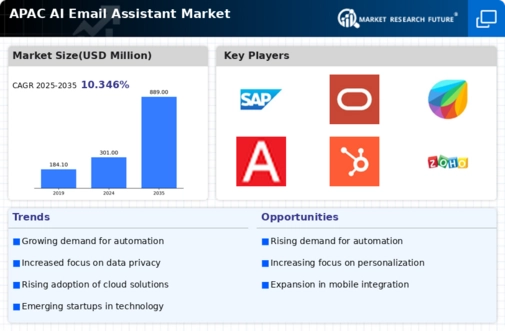
As per MRFR analysis, the APAC Ai Email Assistant Market is projected to grow from USD 283.5 Million in 2024 to USD 762.51 Million by 2035, exhibiting a compound annual growth rate (CAGR) of 9.41% during the forecast period (2025 - 2035).

Key Market Trends & Highlights

The APAC Ai Email Assistant Market is experiencing robust growth driven by automation and customization demands.

  • The demand for automation in email management is rising, particularly in China, which remains the largest market.
  • Customization and localization are becoming increasingly important, especially for small enterprises in India, the fastest-growing region.
  • Data privacy and security concerns are prompting businesses to adopt more secure AI email solutions across the region.
  • The growing adoption of AI technologies and the increasing focus on customer experience are key drivers of market expansion.

Market Size & Forecast

2024 Market Size 283.5 (USD Million)
2035 Market Size 762.51 (USD Million)
CAGR (2025 - 2035) 9.41%

Major Players

Google (US), Microsoft (US), Alibaba (CN), Zoho (IN), Salesforce (US), Naver (KR), Mailgun (US), Sendinblue (FR), Freshworks (IN)

Our Impact
Enabled $4.3B Revenue Impact for Fortune 500 and Leading Multinationals
Partnering with 2000+ Global Organizations Each Year
30K+ Citations by Top-Tier Firms in the Industry

APAC AI Email Assistant Market Trends

The APAC Ai Email Assistant Market is currently experiencing a notable transformation, driven by advancements in artificial intelligence and increasing demand for automation in communication. Businesses across various sectors are adopting these tools to enhance productivity and streamline workflows. The integration of natural language processing and machine learning technologies is enabling these assistants to understand and respond to user queries with greater accuracy. As organizations seek to improve customer engagement and operational efficiency, the adoption of Ai email assistants is likely to expand significantly in the region. Moreover, the APAC region is characterized by a diverse range of industries, each with unique communication needs. This diversity presents both challenges and opportunities for Ai email assistant providers. Companies are increasingly focusing on customization and localization of their products to cater to specific market requirements. The growing emphasis on data privacy and security is also shaping the development of these tools, as businesses strive to comply with stringent regulations. Overall, the APAC Ai Email Assistant Market appears poised for substantial growth, driven by technological advancements and evolving consumer expectations.

Rising Demand for Automation

The APAC Ai Email Assistant Market is witnessing a surge in demand for automation solutions. Organizations are increasingly recognizing the benefits of automating routine email tasks, which allows employees to focus on more strategic activities. This trend is particularly evident in sectors such as finance and customer service, where efficiency is paramount.

Focus on Customization and Localization

As the APAC region encompasses a variety of cultures and languages, there is a growing emphasis on customization and localization of Ai email assistants. Providers are tailoring their offerings to meet the specific needs of different markets, ensuring that language nuances and cultural contexts are adequately addressed.

Emphasis on Data Privacy and Security

With the rise of digital communication, concerns regarding data privacy and security are becoming increasingly prominent. The APAC Ai Email Assistant Market is responding to these concerns by developing solutions that prioritize user data protection. Compliance with local regulations is becoming a critical factor in the design and implementation of these tools.

APAC AI Email Assistant Market Drivers

Growing Adoption of AI Technologies

The APAC Ai Email Assistant Market is witnessing a notable increase in the adoption of artificial intelligence technologies across various sectors. Businesses are increasingly integrating AI-driven solutions to enhance operational efficiency and improve customer engagement. According to recent data, the AI market in the Asia-Pacific region is projected to grow at a compound annual growth rate (CAGR) of approximately 30% from 2023 to 2028. This growth is driven by the need for automation in email management, which allows organizations to streamline communication processes and reduce response times. As companies recognize the potential of AI to transform their email interactions, the demand for AI email assistants is expected to surge, thereby propelling the overall market forward.

Shift Towards Remote Work Solutions

The APAC Ai Email Assistant Market is experiencing a shift towards remote work solutions, which has been accelerated by the increasing prevalence of flexible work arrangements. As organizations adapt to remote work environments, the need for efficient email management tools becomes paramount. AI email assistants are being utilized to automate routine tasks, manage schedules, and facilitate communication among remote teams. Data indicates that companies implementing AI-driven email solutions can enhance productivity by up to 25%. This trend underscores the importance of AI email assistants in supporting the evolving work dynamics in the APAC region, making them an essential component of modern business operations.

Regulatory Support for AI Innovations

The APAC Ai Email Assistant Market benefits from a favorable regulatory environment that encourages innovation in artificial intelligence. Governments across the region are implementing policies that promote the development and deployment of AI technologies. For instance, initiatives aimed at enhancing digital infrastructure and fostering research and development are gaining traction. This regulatory support is crucial for the growth of AI email assistants, as it facilitates investment and collaboration between public and private sectors. As a result, the market is likely to experience accelerated growth, with more organizations adopting AI solutions to enhance their email communication strategies.

Rising Demand for Multilingual Support

The APAC Ai Email Assistant Market is characterized by a diverse linguistic landscape, leading to a growing demand for multilingual support in email communication. Businesses operating in this region are increasingly recognizing the importance of catering to customers in their native languages. AI email assistants equipped with multilingual capabilities can significantly enhance user experience and engagement. Market analysis suggests that companies offering multilingual support can improve customer satisfaction rates by up to 20%. As organizations strive to expand their reach in the APAC region, the integration of AI email assistants that can communicate effectively in multiple languages is becoming a critical factor for success.

Increasing Focus on Customer Experience

In the APAC Ai Email Assistant Market, there is a pronounced emphasis on enhancing customer experience. Organizations are increasingly aware that effective communication is pivotal to customer satisfaction and retention. AI email assistants are being deployed to provide personalized responses, manage inquiries efficiently, and ensure timely follow-ups. This trend is supported by market data indicating that businesses that prioritize customer experience can achieve revenue growth of up to 10-15%. As companies strive to differentiate themselves in a competitive landscape, the integration of AI email assistants becomes a strategic imperative, fostering deeper customer relationships and driving loyalty.

Market Segment Insights

By Application: Email Management (Largest) vs. Task Automation (Fastest-Growing)

In the APAC AI Email Assistant Market, the Application segment showcases diverse functionalities, with Email Management emerging as the largest value segment. This category focuses on optimizing email workflow, enhancing organization, and improving response efficiency. Following closely, Task Automation is gaining traction, primarily due to its ability to streamline repetitive processes, allowing users to focus on more strategic tasks. As businesses emphasize efficiency, these applications have seen varying degrees of market share within the segment. The growth trends indicate that while Email Management remains predominant, Task Automation is recognized as the fastest-growing area. Factors driving this trend include the increasing demand for enhanced productivity tools within organizations and the rising adoption of AI solutions that mitigate manual errors. Additionally, the need for effective time management among professionals fuels this application's popularity, thereby bolstering its growth potential in the market.

Email Management: Dominant vs. Task Automation: Emerging

Email Management stands as the dominant application in the APAC AI Email Assistant Market, characterized by its comprehensive features that assist users in managing their email communication effectively. It includes functionalities such as smart filtering, scheduling, and automated responses which enhance user engagement and streamline communication processes. Furthermore, this segment is tailored for businesses seeking to improve their customer interactions and operational efficiency. On the other hand, Task Automation is an emerging segment that capitalizes on the need for more efficient workflow management. It is characterized by AI-driven capabilities that automate routine tasks such as email sorting and meeting scheduling. This segment appeals to companies looking to minimize labor costs and accelerate decision-making processes, positioning itself as a crucial component in the evolving digital workspace landscape.

By End Use: Small Enterprises (Largest) vs. Freelancers (Fastest-Growing)

The APAC Ai Email Assistant Market showcases a diverse distribution among various end-use segments. Small Enterprises lead the market, commanding the largest share due to their need for efficient communication tools to manage customer interactions effectively. Following closely are Medium Enterprises and Large Enterprises, which also contribute significantly but at a lower rate. Freelancers represent a smaller percentage but are rapidly increasing their presence in the market as they seek cost-effective solutions for email assistance.

Small Enterprises (Dominant) vs. Freelancers (Emerging)

Small Enterprises are the dominant players in the APAC Ai Email Assistant Market, leveraging affordable and user-friendly solutions to enhance productivity and streamline communication processes. Their primary focus is on accessibility and functionality, allowing them to capitalize on affordable technology. Conversely, Freelancers represent an emerging segment, driven by the gig economy's growth. They are increasingly adopting AI email assistants to optimize workflows, reduce time spent on communications, and attract clients. This dynamic has led to a significant uptick in demand for AI solutions tailored to their unique needs, positioning them as a rapidly expanding part of the market.

By Deployment Type: Cloud-Based (Largest) vs. Hybrid (Fastest-Growing)

In the APAC Ai Email Assistant Market, the cloud-based deployment type holds the largest share, catering to a significant portion of users who prefer scalable solutions with lower upfront costs. On-premises solutions, while preferred by some organizations for security and control, are experiencing a decline in market share as businesses transition to more flexible alternatives. Hybrid deployment is gaining traction as companies look to combine the best of both worlds, offering scalability while maintaining some level of traditional infrastructure.

Cloud-Based (Dominant) vs. Hybrid (Emerging)

The cloud-based deployment type is leading the APAC Ai Email Assistant Market due to its advantages in scalability, accessibility, and cost efficiency. It enables businesses to implement complex AI solutions without heavy investments in hardware. In contrast, hybrid deployment is emerging as companies seek a tailored approach, allowing them to utilize cloud capabilities while retaining on-premises resources for sensitive data handling. Both segments are shaped by the varying preferences of businesses across the region, with cloud-based solutions providing dominant market presence and hybrid models showing potential for significant growth.

By Technology: Natural Language Processing (Largest) vs. Machine Learning (Fastest-Growing)

In the APAC AI Email Assistant Market, Natural Language Processing (NLP) currently dominates the technology segment, with a significant share attributable to its capability to understand and generate human-like responses. Machine Learning (ML) is emerging as a powerful competitor, rapidly gaining traction due to its ability to adapt and improve from user interactions. Together, these technologies are reshaping the landscape of email assistance, offering enhanced user experiences and optimized communication strategies.

Technology: NLP (Dominant) vs. ML (Emerging)

Natural Language Processing (NLP) is recognized for its profound influence on the capabilities of AI email assistants, enabling them to interpret context, emotion, and intent effectively. This positions NLP as the dominant technology, especially in automating responses and enhancing user engagement. On the other hand, Machine Learning (ML) stands out as an emerging force, propelled by its ability to analyze vast datasets, learn user preferences over time, and deliver tailored solutions. As businesses increasingly prioritize personalization and efficiency, ML is expected to drive innovation in the market, making it a critical area of focus for future developments.

By User Type: Business Users (Largest) vs. Individual Users (Fastest-Growing)

In the APAC Ai Email Assistant Market, the user type segment showcases a diverse distribution, with Business Users holding the largest share. This category significantly benefits from the increasing need for efficiency and productivity in organizations, driving demand for AI solutions that streamline communication and task management. Meanwhile, Individual Users, although smaller in market share, exhibit rapid growth, largely fueled by the rising trend of remote work and the increasing adoption of AI technologies among personal users seeking organizational assistance.

Business Users (Dominant) vs. Individual Users (Emerging)

Business Users constitute a dominant segment in the APAC Ai Email Assistant Market, characterized by their focus on collaborative tools and integration with existing organizational frameworks. They often require robust features that enhance team productivity and communication efficiency, making AI email assistants indispensable in corporate settings. In contrast, Individual Users represent an emerging segment that is quickly gaining traction due to the demand for personalized assistance and efficiency in personal tasks. This growing category is increasingly exploring solutions that cater to their specific needs for managing emails and personal workflows, indicating a shifting landscape in user preferences towards AI-driven support systems.

Get more detailed insights about APAC AI Email Assistant Market

Regional Insights

China : Unmatched Growth and Innovation

China holds a commanding market share of 112.5, representing a significant portion of the APAC AI Email Assistant market. Key growth drivers include rapid digital transformation, increasing internet penetration, and a burgeoning e-commerce sector. The demand for AI-driven solutions is fueled by a growing preference for automation in customer service and marketing. Government initiatives, such as the Digital China strategy, are enhancing infrastructure and fostering innovation in technology sectors.

India : Innovation Meets Growing Demand

India's market share stands at 65.0, driven by a vibrant startup ecosystem and increasing adoption of AI technologies. The demand for AI Email Assistants is rising as businesses seek to enhance customer engagement and streamline operations. Government initiatives like Digital India are promoting tech adoption, while investments in IT infrastructure are paving the way for growth. The trend towards remote work has further accelerated the need for efficient communication tools.

Japan : Focus on Quality and Efficiency

Japan's market share is valued at 45.0, characterized by a strong emphasis on quality and efficiency in AI Email solutions. The growth is driven by the increasing need for automation in business processes and a high level of technological adoption among enterprises. Regulatory support for AI development and a robust IT infrastructure are key enablers. The demand for personalized customer experiences is also shaping consumption patterns in this market.

South Korea : Strong Market with Competitive Edge

South Korea holds a market share of 30.0, with a competitive landscape driven by innovation and technological advancements. Major cities like Seoul and Busan are key markets, where businesses are increasingly adopting AI Email Assistants to enhance operational efficiency. The presence of local giants like Naver and global players like Microsoft creates a dynamic environment. Government policies supporting AI research and development further bolster market growth.

Malaysia : Growth Driven by Digital Adoption

Malaysia's market share is at 10.0, reflecting a growing interest in AI technologies among businesses. The key growth drivers include increasing digital adoption and government initiatives aimed at enhancing the digital economy. Cities like Kuala Lumpur and Penang are pivotal markets, where local enterprises are beginning to embrace AI Email Assistants. The competitive landscape is evolving, with both local and international players vying for market share.

Thailand : Focus on Business Efficiency

Thailand's market share is 7.0, with a rising demand for AI Email Assistants driven by the need for improved business efficiency. The government is actively promoting digital transformation through initiatives like Thailand 4.0, which encourages tech adoption across sectors. Key markets include Bangkok and Chiang Mai, where businesses are increasingly investing in AI solutions. The competitive landscape features both local startups and established international firms.

Indonesia : Digital Transformation in Progress

Indonesia's market share stands at 8.0, reflecting a growing interest in AI Email Assistants as businesses seek to enhance customer engagement. The digital economy is rapidly expanding, supported by government initiatives aimed at improving internet access and digital literacy. Key markets include Jakarta and Surabaya, where local enterprises are beginning to adopt AI solutions. The competitive landscape is characterized by a mix of local and international players.

Rest of APAC : Varied Growth Across Sub-regions

The Rest of APAC holds a market share of 6.0, showcasing diverse opportunities for AI Email Assistants. Growth is driven by varying levels of digital adoption and regulatory support across different countries. Key markets include Vietnam and the Philippines, where businesses are increasingly recognizing the value of AI solutions. The competitive landscape is fragmented, with numerous local players emerging alongside established international firms.


Key Players and Competitive Insights

The Ai Email Assistant Market is currently characterized by a dynamic competitive landscape, driven by rapid technological advancements and increasing demand for automation in communication. Major players such as Google (US), Microsoft (US), and Alibaba (CN) are at the forefront, leveraging their extensive resources and technological expertise to enhance their offerings. Google (US) focuses on integrating AI capabilities into its Gmail platform, aiming to streamline user experience through predictive text and smart replies. Meanwhile, Microsoft (US) emphasizes its Azure cloud services to bolster its email solutions, ensuring robust security and scalability. Alibaba (CN) is strategically positioning itself by expanding its ecosystem, integrating email services with its e-commerce platforms, thereby enhancing user engagement and retention.

The business tactics employed by these companies reflect a concerted effort to optimize operations and enhance customer satisfaction. The market structure appears moderately fragmented, with a mix of established giants and emerging players like Zoho (IN) and Freshworks (IN). These companies are increasingly localizing their services to cater to regional preferences, which may enhance their competitive edge. The collective influence of these key players shapes a landscape where innovation and customer-centric strategies are paramount.

In December 2025, Google (US) announced a significant upgrade to its AI-driven email assistant, incorporating advanced machine learning algorithms to improve spam detection and user personalization. This strategic move is likely to enhance user trust and engagement, positioning Google as a leader in the market. The integration of these advanced features may also set a new standard for user expectations in email management.

In November 2025, Microsoft (US) unveiled a partnership with a leading cybersecurity firm to enhance the security features of its email assistant. This collaboration aims to address growing concerns over data privacy and security, which are critical in the current digital landscape. By prioritizing security, Microsoft not only strengthens its product offering but also builds customer confidence, which is essential for long-term success.

In October 2025, Alibaba (CN) launched a new AI-driven feature within its email platform that allows users to automate responses based on previous interactions. This innovation is indicative of Alibaba's commitment to enhancing user experience and streamlining communication processes. By integrating such features, Alibaba is likely to attract more users to its ecosystem, thereby increasing its market share.

As of January 2026, the competitive trends in the Ai Email Assistant Market are increasingly defined by digitalization, AI integration, and a focus on sustainability. Strategic alliances are becoming more prevalent, as companies recognize the need to collaborate to enhance their technological capabilities. The shift from price-based competition to a focus on innovation and technology is evident, with companies striving to differentiate themselves through unique features and reliable service. This evolution suggests that future competitive differentiation will hinge on the ability to innovate and adapt to changing consumer needs.

Key Companies in the APAC AI Email Assistant Market include

Industry Developments

The APAC AI Email Assistant Market is witnessing significant developments, particularly with the growing demand for email automation and personalization. Major players like Mailgun and Zoho are expanding their product offerings to incorporate advanced AI features, enhancing user experiences. Freshworks has recently launched new AI-driven capabilities to improve customer engagement through personalized email interactions.

Additionally, Microsoft is investing heavily in its Dynamics 365 solutions, integrating AI functionalities that are expected to transform email marketing strategies in the region.

In terms of mergers and acquisitions, Salesforce announced in September 2023 the acquisition of a small AI startup specializing in natural language processing, further consolidating its position in the AI-driven market space. Similarly, SAP is also exploring collaboration opportunities with regional tech firms to strengthen its AI capabilities.

Over the past few years, the APAC market for AI Email Assistants has seen robust growth, with estimates indicating a market valuation increase to USD 1 billion by mid-2024, driven by the rising adoption of digital communication tools within enterprises.

This growth is particularly focused in key markets like India, Japan, and South Korea, where innovation in AI technologies is rapidly progressing.

Future Outlook

APAC AI Email Assistant Market Future Outlook

The APAC Ai Email Assistant Market is projected to grow at a 9.41% CAGR from 2025 to 2035, driven by increasing automation, enhanced user experience, and rising demand for efficiency.

New opportunities lie in:

  • Integration of AI email assistants with CRM systems for streamlined customer interactions.
  • Development of multilingual support features to cater to diverse APAC markets.
  • Creation of customizable templates for various business sectors to enhance user engagement.

By 2035, the APAC Ai Email Assistant Market is expected to be robust, reflecting substantial growth and innovation.

Market Segmentation

APAC AI Email Assistant Market End Use Outlook

  • Small Enterprises
  • Medium Enterprises
  • Large Enterprises
  • Freelancers

APAC AI Email Assistant Market User Type Outlook

  • Individual Users
  • Business Users
  • Enterprise Users

APAC AI Email Assistant Market Technology Outlook

  • Natural Language Processing
  • Machine Learning
  • Predictive Analytics
  • Sentiment Analysis

APAC AI Email Assistant Market Application Outlook

  • Email Management
  • Task Automation
  • Personal Assistant
  • Customer Support
  • Data Analysis

APAC AI Email Assistant Market Deployment Type Outlook

  • Cloud-Based
  • On-Premises
  • Hybrid

Report Scope

MARKET SIZE 2024283.5(USD Million)
MARKET SIZE 2025308.0(USD Million)
MARKET SIZE 2035762.51(USD Million)
COMPOUND ANNUAL GROWTH RATE (CAGR)9.41% (2024 - 2035)
REPORT COVERAGERevenue Forecast, Competitive Landscape, Growth Factors, and Trends
BASE YEAR2024
Market Forecast Period2025 - 2035
Historical Data2019 - 2024
Market Forecast UnitsUSD Million
Key Companies ProfiledGoogle (US), Microsoft (US), Alibaba (CN), Zoho (IN), Salesforce (US), Naver (KR), Mailgun (US), Sendinblue (FR), Freshworks (IN)
Segments CoveredApplication, End Use, Deployment Type, Technology, User Type
Key Market OpportunitiesGrowing demand for personalized communication solutions drives innovation in the APAC Ai Email Assistant Market.
Key Market DynamicsRapid technological advancements drive competitive growth in the APAC Ai Email Assistant Market.
Countries CoveredChina, India, Japan, South Korea, Malaysia, Thailand, Indonesia, Rest of APAC
Leave a Comment

FAQs

What is the current valuation of the APAC Ai Email Assistant Market?

The market valuation was 283.5 USD Million in 2024.

What is the projected market size for the APAC Ai Email Assistant Market by 2035?

The market is projected to reach 762.51 USD Million by 2035.

What is the expected CAGR for the APAC Ai Email Assistant Market during the forecast period?

The expected CAGR for the market from 2025 to 2035 is 9.41%.

Which companies are considered key players in the APAC Ai Email Assistant Market?

Key players include Google, Microsoft, Alibaba, Zoho, Salesforce, Naver, Mailgun, Sendinblue, and Freshworks.

What are the main application segments in the APAC Ai Email Assistant Market?

The main application segments include Email Management, Task Automation, Personal Assistant, Customer Support, and Data Analysis.

How do small enterprises contribute to the APAC Ai Email Assistant Market?

Small enterprises had a market contribution of 56.7 USD Million in 2024, with projections reaching 150.0 USD Million.

What is the market performance of cloud-based deployment in the APAC Ai Email Assistant Market?

Cloud-based deployment was valued at 113.4 USD Million in 2024 and is expected to grow to 309.5 USD Million.

What technologies are driving the APAC Ai Email Assistant Market?

Key technologies include Natural Language Processing, Machine Learning, Predictive Analytics, and Sentiment Analysis.

What is the market size for business users in the APAC Ai Email Assistant Market?

Business users had a market size of 102.5 USD Million in 2024, projected to reach 300.0 USD Million by 2035.

How does the market for large enterprises compare to other user types?

Large enterprises had a market valuation of 90.0 USD Million in 2024, with expectations of reaching 250.0 USD Million by 2035.

Download Free Sample

Kindly complete the form below to receive a free sample of this Report

Compare Licence

×
Features License Type
Single User Multiuser License Enterprise User
Price $4,950 $5,950 $7,250
Maximum User Access Limit 1 User Upto 10 Users Unrestricted Access Throughout the Organization
Free Customization
Direct Access to Analyst
Deliverable Format
Platform Access
Discount on Next Purchase 10% 15% 15%
Printable Versions