×
Request Free Sample ×

Kindly complete the form below to receive a free sample of this Report

* Please use a valid business email

Leading companies partner with us for data-driven Insights

clients tt-cursor
Hero Background
English
Chinese
French
Japanese
Korean
German
Spanish

Anthracite Market Share

ID: MRFR/CnM/2026-CR
128 Pages
Chitranshi Jaiswal
March 2024

Anthracite Market Research Report Information By Grade (Standard Grade, High Grade, Ultra-High Grade) By Application (Power Stations, Steel Production, Water Treatment & Filtration, General Industrial, Others), By End Use (Metallurgical, Energy & Power, Chemicals, Others) and By Region (North America, Europe, Asia Pacific, Latin America, Middle East & Africa) -Global Forecast to 2035

Share:
Download PDF ×

We do not share your information with anyone. However, we may send you emails based on your report interest from time to time. You may contact us at any time to opt-out.

Anthracite Market Infographic
×
Anthracite Market Infographic Full View
Purchase Options

Market Share

Anthracite Market Share Analysis

Various market share positioning strategies are used by firms operating in the Anthracite Market with the aim of establishing themselves as leaders in specialized niches while also enhancing their competitive edge. Under this strategy, companies sell products that are distinct from those offered by competition thereby differentiating them from others. This might include producing specific particle sizes for anthracites, high carbon content or customizing it to be used for things like water filtration or steel-making among others. Such companies seek to dominate particular segments within a given market thus producing unique items. Different factors contribute towards development of Anthracite Market Value. Among other uses, the superior form of coal known as anthracite is widely used both commercially and domestically. It is designed in such a way that all its components are uniform making it ideal for many places such as hospitals, homes, offices and schools during cold seasons when people want to warm themselves up. Environmental degradation when using other types of coal has made many people prefer using anthracitic substances than any other forms of fuel so far. Among the strategies that are used in the Anthracite Market, cost leadership is one of them, with companies trying to be the most efficient producers. Reducing mining cycles, large-scale production facilities and strategic control over supply chain are among the activities involved in achieving cost leadership. A company can attract more customers by lowering its expenses and pricing its products at competitive rates. However, it is important for a firm to maintain a fine balance between low costs and product quality if it wishes to sustain growth. Market segmenting has considerable importance for positioning strategies in Anthracite Market. Differentiated anthracites are made to meet different needs of consumers by analyzing customer base carefully. Such efforts may result into producing different grades of anthracites for various applications such as residential heating, power generation or industrial processes. Focusing on each of these niches will enable firms to improve their position within it thus optimizing overall market share. Innovation determines the market share positioning of firms in the Anthracite Market. In addition, this entails keeping up with technological change through adoption of advanced mining technologies; pursuing environmentally sustainable practices; and exploring new applications for anthracite. For example, clean-burning anthracite could be developed by some firms so as to comply with environmental regulations or interesting uses be found within emerging industries. This serves as a pull factor for environmentally-conscious clients while also putting such organizations ahead as innovation leaders hence contributing towards superiority above others due to technology advancement.

Author
Chitranshi Jaiswal
Research Analyst Level I

In her 3 years of experience in the market research field, she has handled critical cross-domain projects. She has an in-depth knowledge of market estimation & analysis, problem-solving, primary as well as secondary research, and team management.She holds an engineering degree and is an MBA professional from a well-known university, capable of evaluating the market and competitive conditions. An exceptional strategist with excellent communication skills and a passion for delivering cutting-edge & practical insights for the market. Proficient in multi-tasking, and can successfully deal with competing demands, while maintaining complete confidentiality. Generated business through active client and project development, networking, and high-quality responses. Her knowledge and skills have helped in making solid business decisions, securing funding from investors, and avoiding business failures.

Leave a Comment

FAQs

How much is the Anthracite Market?

US$ 1,43,501.5 Mn

What is the growth rate of the Anthracite Market?

2.10%

Which region held the largest market share in the Anthracite Market?

North America

Who are the key players in the Anthracite Market?

Blaschak Anthracite (US), Lehigh Anthracite (US), Atlantic Carbon Group Inc. (Pennsylvania), Black Diamond Corporation (India), Garcia Munte Energía S.L. (Spain), Atrum Coal (Canada), Siberian Anthracite (Russia), XCoal Energy & Resources (US), Beijing Jingmei Group Co., Ltd. (China), Kizashi Carbon (India)

Which Grade had the largest market share in the Anthracite Market?

Standard Grade

Which Application had the largest market share in the Anthracite Market?

Power Stations

Which End Use had the largest market share in the Anthracite Market?

Metallurgical

Market Summary

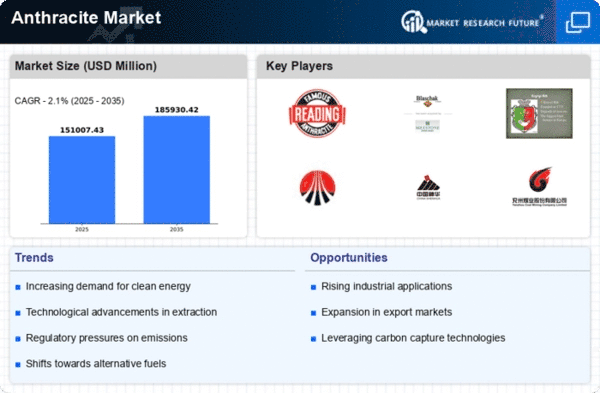
As per MRFR analysis, the Anthracite Market Size was estimated at 147901.5 USD Million in 2024. The Anthracite industry is projected to grow from 151010.43 USD Million in 2025 to 185930.42 USD Million by 2035, exhibiting a compound annual growth rate (CAGR) of 2.1 during the forecast period 2025 - 2035.

Key Market Trends & Highlights

The Anthracite Market is currently experiencing a dynamic shift driven by sustainability and technological advancements.

  • North America remains the largest market for anthracite, primarily due to its extensive industrial applications.
  • The Asia-Pacific region is emerging as the fastest-growing market, fueled by increasing energy demands and urbanization.
  • The heating segment continues to dominate the market, while the electricity generation segment is witnessing rapid growth.
  • Rising demand for clean energy and technological innovations in mining are key drivers influencing market expansion.

Market Size & Forecast

2024 Market Size 147901.5 (USD Million)
2035 Market Size 185930.42 (USD Million)
CAGR (2025 - 2035) 2.1%
Largest Regional Market Share in 2024 North America

Major Players

<p>Reading Anthracite Company (US), Blaschak Coal Corporation (US), Anthracite Coal Mining Company (US), Kryvyi Rih Iron Ore Plant (UA), Shaanxi Coal and Chemical Industry Group (CN), China Shenhua Energy Company (CN), Yanzhou Coal Mining Company Limited (CN), Czech Coal (CZ)</p>

Market Trends

The Anthracite Market is currently experiencing a dynamic phase characterized by evolving demand patterns and shifting supply dynamics. This market, known for its high carbon content and low impurities, is increasingly sought after for various applications, including energy generation and metallurgical processes. The growing emphasis on cleaner energy sources appears to be driving interest in anthracite as a viable alternative to traditional fossil fuels. Furthermore, the market is witnessing a gradual transition towards more sustainable practices, which may influence production methods and sourcing strategies in the near future. In addition to the environmental considerations, the Anthracite Market is also shaped by geopolitical factors and trade policies. Regions rich in anthracite reserves are likely to play a pivotal role in shaping global supply chains. As countries strive for energy independence and security, the strategic importance of anthracite may increase. This evolving landscape suggests that stakeholders must remain vigilant and adaptable to navigate the complexities of the market effectively. Overall, the Anthracite Market appears poised for continued evolution, driven by both demand and supply-side influences that could redefine its future trajectory.

Sustainable Energy Transition

The Anthracite Market is increasingly influenced by the global shift towards sustainable energy solutions. As nations prioritize reducing carbon emissions, anthracite is being recognized for its potential to serve as a cleaner alternative to conventional fossil fuels. This trend may lead to heightened investments in anthracite production and technology, fostering innovation in extraction and processing methods.

Geopolitical Influences

Geopolitical factors are playing a crucial role in shaping the Anthracite Market. Countries with substantial anthracite reserves are likely to leverage their resources to enhance energy security and economic stability. Trade policies and international relations may further impact supply chains, creating opportunities and challenges for market participants.

Technological Advancements

Technological innovations are expected to transform the Anthracite Market significantly. Advances in extraction techniques and processing technologies could enhance efficiency and reduce environmental impacts. As companies adopt these innovations, the market may witness a shift in production capabilities, potentially leading to increased competitiveness and sustainability.

Anthracite Market Market Drivers

Market Trends and Growth Projections

The Global Anthracite Market Industry is projected to experience a compound annual growth rate of 1.61% from 2025 to 2035. This growth trajectory is indicative of the market's resilience and adaptability in the face of evolving energy demands. As industries continue to seek reliable and efficient energy sources, anthracite is likely to maintain its relevance in the global energy mix. The anticipated growth reflects a combination of factors, including technological advancements, regulatory support, and increasing industrial applications. Stakeholders should remain vigilant to emerging trends that could shape the future landscape of the anthracite market.

Regulatory Support for Cleaner Fuels

The Global Anthracite Market Industry is likely to benefit from regulatory support aimed at promoting cleaner fuels. Governments worldwide are implementing policies that encourage the use of low-emission energy sources, which includes anthracite coal. This regulatory environment fosters investment in cleaner technologies and infrastructure, facilitating the transition towards more sustainable energy practices. As regulations evolve, the industry may see increased demand for anthracite as a cleaner alternative to other fossil fuels. This supportive framework could enhance market stability and growth, particularly as nations commit to reducing their carbon footprints.

Technological Advancements in Mining

Technological advancements in mining operations are poised to enhance the efficiency and productivity of anthracite extraction. Innovations such as automated mining equipment and improved processing techniques are likely to reduce operational costs and increase yield. These advancements not only streamline production but also contribute to safer mining practices, aligning with environmental regulations. As the Global Anthracite Market Industry adapts to these technologies, it may experience a more sustainable growth trajectory. The integration of modern technologies could potentially attract new investments, further solidifying the industry's position in the global energy landscape.

Rising Demand for Clean Energy Solutions

The Global Anthracite Market Industry is experiencing a notable increase in demand for clean energy solutions. As countries strive to reduce carbon emissions and transition towards sustainable energy sources, anthracite coal, known for its high carbon content and low impurities, is becoming a preferred choice for power generation. This shift is particularly evident in regions where coal remains a significant energy source. The market is projected to reach 147.9 USD Billion in 2024, driven by this growing emphasis on cleaner energy alternatives. The adoption of anthracite in various industrial applications further supports this trend, indicating a robust future for the industry.

Market Dynamics and Global Trade Patterns

The Global Anthracite Market Industry is influenced by shifting market dynamics and global trade patterns. Changes in supply and demand, driven by geopolitical factors and economic conditions, can significantly impact anthracite prices and availability. For instance, fluctuations in production levels in major exporting countries may create opportunities or challenges for importing nations. Additionally, trade agreements and tariffs can alter competitive landscapes, affecting market access. Understanding these dynamics is crucial for stakeholders in the industry, as they navigate the complexities of global trade and its implications for anthracite supply chains.

Industrial Applications and Steel Production

The Global Anthracite Market Industry benefits from its extensive use in industrial applications, particularly in steel production. Anthracite Market serves as a crucial component in metallurgical processes, providing the necessary carbon content for steelmaking. As global steel production continues to expand, driven by infrastructure development and urbanization, the demand for anthracite is likely to rise. The market's growth is supported by the projected increase in steel demand, which is expected to bolster anthracite consumption. This trend suggests that the industry will play a vital role in meeting the needs of the steel sector, contributing to the market's anticipated growth to 176.3 USD Billion by 2035.

Market Segment Insights

By Application: Heating (Largest) vs. Electricity Generation (Fastest-Growing)

<p>In the Anthracite Market, the application segment showcases diverse usages, with heating leading the way as the dominant application. This segment capitalizes on the high calorific value and low ash content of anthracite, making it favorable for residential and commercial heating systems. Following closely, electricity generation is emerging as a significant contributor, driven by the global shift toward cleaner energy sources. The growth trends in this segment highlight a simultaneous rise in demand for efficient energy solutions. As more industries look to reduce their carbon footprint, anthracite's role in electricity generation is becoming increasingly vital. Additionally, sectors like metallurgical processes and cement production are also using anthracite for its unique properties, further diversifying its applications and boosting its overall market presence.</p>

<p>Heating (Dominant) vs. Cement Production (Emerging)</p>

<p>Heating stands out as the dominant application within the Anthracite Market, primarily due to its efficiency and effectiveness in providing reliable warmth for various settings. Residential and commercial sectors favor anthracite for its high-energy yield and lower emissions compared to other fossil fuels. Conversely, cement production is an emerging application where anthracite is gaining traction. This use is driven by the need for high-temperature fuel in cement kilns, offering cost and performance advantages. As sustainability becomes paramount, the versatility of anthracite in both applications reflects its importance in the evolving industrial landscape, where energy source efficiency and adaptability are increasingly prioritized.</p>

By End Use: Residential (Largest) vs. Power Generation (Fastest-Growing)

<p>The Anthracite Market exhibits a diverse range of end uses, with the residential segment currently dominating the market. This sector predominantly utilizes anthracite for heating purposes and as a key ingredient in home energy solutions, making it a significant contributor to overall demand. Meanwhile, the commercial and industrial segments also hold vital positions, yet their shares trailed behind the residential category, as they engage anthracite mainly for specialized applications in manufacturing and energy generation. In contrast, the power generation segment is emerging as the fastest-growing component of the Anthracite Market. As countries strive toward reducing carbon emissions and shifting towards cleaner energy sources, anthracite's role in modern power plants becomes increasingly vital. This growth trend is fueled by technological advancements that enhance combustion efficiencies and lower environmental impacts, leading to higher adoption rates in energy generation infrastructures.</p>

<p>Residential (Dominant) vs. Power Generation (Emerging)</p>

<p>The residential segment is characterized by its traditional use of anthracite for home heating systems, accounting for a substantial portion of market demand. This sector benefits from a well-established consumer base that values the energy efficiency and environmental benefits of anthracite as a clean-burning fuel. In contrast, the power generation segment is gaining momentum as an emerging player, driven by the increasing focus on sustainable energy solutions. This segment leverages innovative technology to maximize the efficiency of anthracite in electricity generation, positioning itself as a pivotal component in the energy transition narrative. As utilities invest in modernized infrastructure, the demand from the power generation side is set to grow, creating competition with the residential market for supply.</p>

By Product Type: Nut Anthracite (Largest) vs. Rice Anthracite (Fastest-Growing)

<p>In the Anthracite Market, the product type segment demonstrates varied distribution among four key categories: Nut Anthracite, Rice Anthracite, Stove Anthracite, and Pea Anthracite. Nut Anthracite commands the largest share, primarily due to its broader applications and higher demand in residential and commercial settings. In contrast, Rice Anthracite has gained popularity, leading to a dynamic shift in market shares as it caters to specific industries requiring finer gradations of coal, thus making its mark in the market.</p>

<p>Nut Anthracite (Dominant) vs. Rice Anthracite (Emerging)</p>

<p>Nut Anthracite has solidified its position as the dominant player in the Anthracite Market, favored for its versatility in heating applications and energy generation. Its larger stone size typically means fewer impurities, making it preferred among consumers seeking quality. On the other hand, Rice Anthracite is emerging rapidly due to its advantages in automated heating systems and growing industrial use. As environmental regulations become stricter, Rice Anthracite offers a cleaner burn, appealing to eco-conscious users. This emerging market of Rice Anthracite showcases an increasing acceptance, leading to greater investments in production capabilities and market presence.</p>

By Purity Level: High Purity (Largest) vs. Low Purity (Fastest-Growing)

<p>In the Anthracite Market, the distribution of purity levels reveals a clear dominance of high purity anthracite, which caters to industries demanding superior quality, particularly in metallurgical applications. Conversely, medium and low purity anthracite occupy niche markets, with low purity demonstrating an increasingly robust share driven by cost-sensitive consumers and specific industrial processes that require less stringent purity levels. High purity anthracite currently commands the largest market share due to its applicability in high-end markets and demanding specifications. In terms of growth trends, low purity anthracite is emerging as the fastest-growing segment, attributed to growing demand from new applications in various sectors, including energy and agriculture. The appeal of lower-priced options without stringent quality requirements is propelling its uptake. Medium purity anthracite maintains stable growth as industries balance cost and quality, but the growth speed is overshadowed by the low purity segment's rapid expansion in recent years, indicating market dynamics shifting towards adaptability and pricing strategies.</p>

<p>High Purity (Dominant) vs. Low Purity (Emerging)</p>

<p>High purity anthracite is characterized by its exceptional carbon content and low impurities, making it the preferred choice for industries engaged in steel production and other metallurgical processes. It maintains a strong market presence due to stringent quality demands in high-performance applications. On the other hand, low purity anthracite is experiencing a surge in popularity as an emerging option for cost-sensitive applications. This segment is often favored in energy production and some agricultural applications where purity is less critical. The shift towards low purity is driven by increasing demand from emerging markets and industries looking for economically viable alternatives, thereby redefining the pricing and supply chain dynamics within the anthracite market.</p>

By Distribution Channel: Direct Sales (Largest) vs. Wholesale (Fastest-Growing)

<p>In the Anthracite Market, the distribution channel landscape is characterized by a robust presence of direct sales, which dominates the sector. This method facilitates close relationships between producers and customers, ensuring efficient delivery and tailored services. On the other hand, wholesale channels are gaining significant traction, capitalizing on their capacity to distribute large volumes to retailers and end-users efficiently, thus playing a crucial role in overall market dynamics.</p>

<p>Direct Sales (Dominant) vs. Wholesale (Emerging)</p>

<p>Direct sales in the Anthracite Market are identified as the dominant distribution method, allowing for personalized customer interaction and optimized logistics. This channel provides consumers with direct access to the product, enhancing transparency and trust. Conversely, wholesale distribution is emerging as a crucial player, focusing on high-volume transactions and competitive pricing strategies. Wholesalers often serve multiple retailers, expanding market reach and ensuring product availability. The increasing demand for anthracite in various industries, coupled with strategic partnerships, positions wholesale as a fast-growing channel, making it essential for adapting to shifting market needs.</p>

Get more detailed insights about Anthracite Market Research Report- Forecast to 2035

Regional Insights

North America : Leading Market in Anthracite

North America is poised to maintain its leadership in the anthracite market, holding a significant market share of 60,000.0 units. The region's growth is driven by increasing industrial demand, particularly in steel production and energy generation. Regulatory support for cleaner coal technologies and sustainable mining practices further catalyzes market expansion. The U.S. government is actively promoting initiatives to enhance coal utilization efficiency, which is expected to boost demand in the coming years. The competitive landscape in North America is characterized by key players such as Reading Anthracite Company, Blaschak Coal Corporation, and Anthracite Coal Mining Company. These companies are leveraging advanced mining technologies and sustainable practices to enhance production efficiency. The U.S. remains the leading country in this region, with a robust infrastructure supporting coal distribution and export, ensuring a steady supply to both domestic and international markets.

Europe : Emerging Anthracite Market

Europe's anthracite market is evolving, with a market size of 40,000.0 units. The region is increasingly focusing on sustainable energy solutions, driving demand for high-quality anthracite in various applications, including metallurgy and energy production. Regulatory frameworks aimed at reducing carbon emissions are encouraging the adoption of cleaner coal technologies, which is expected to enhance market growth. The European Union's Green Deal is a significant catalyst for this transition, promoting cleaner energy sources and efficient coal usage. Leading countries in Europe include Ukraine and the Czech Republic, where companies like Kryvyi Rih Iron Ore Plant and Czech Coal are prominent players. The competitive landscape is marked by a shift towards innovation and sustainability, with firms investing in cleaner extraction methods and technologies. This focus on sustainability is expected to position Europe as a key player in The Anthracite, aligning with broader environmental goals.

Asia-Pacific : Rapidly Growing Market

The Asia-Pacific region is witnessing a surge in anthracite demand, with a market size of 35,000.0 units. This growth is primarily driven by industrialization and urbanization in countries like China and India, where anthracite is essential for steel production and energy generation. Government initiatives aimed at enhancing energy security and reducing reliance on imports are further propelling market expansion. Regulatory support for cleaner coal technologies is also becoming increasingly important in this region, aligning with global sustainability trends. China stands out as the leading country in the Asia-Pacific market, with major players like Shaanxi Coal and Chemical Industry Group and China Shenhua Energy Company dominating the landscape. The competitive environment is characterized by significant investments in mining technologies and infrastructure development. As the region continues to industrialize, the demand for high-quality anthracite is expected to rise, positioning Asia-Pacific as a critical player in the global market.

Middle East and Africa : Emerging Market Potential

The Middle East and Africa region is emerging as a potential market for anthracite, with a market size of 12,801.5 units. The growth in this region is driven by increasing energy demands and the need for reliable energy sources. Countries are exploring anthracite as a viable option for energy generation and industrial applications. Regulatory frameworks are gradually evolving to support coal utilization, which is expected to enhance market opportunities in the coming years. South Africa and other countries in the region are beginning to recognize the potential of anthracite, with local companies exploring mining opportunities. The competitive landscape is still developing, with a few key players starting to emerge. As infrastructure improves and regulatory support increases, the Middle East and Africa could see significant growth in anthracite consumption, making it an area of interest for investors and stakeholders.

Key Players and Competitive Insights

The Anthracite Market is characterized by a competitive landscape that is increasingly shaped by strategic innovation and regional dynamics. Key players such as Reading Anthracite Company (US), Blaschak Coal Corporation (US), and China Shenhua Energy Company (CN) are actively positioning themselves to leverage growth opportunities. Reading Anthracite Company (US) has focused on enhancing its operational efficiency through technological advancements, while Blaschak Coal Corporation (US) emphasizes sustainable mining practices to meet evolving regulatory standards. Meanwhile, China Shenhua Energy Company (CN) is expanding its market reach through strategic partnerships, indicating a trend towards collaborative growth in the sector. Collectively, these strategies contribute to a competitive environment that is both dynamic and multifaceted.

In terms of business tactics, companies are increasingly localizing manufacturing and optimizing supply chains to enhance responsiveness to market demands. The Anthracite Market appears moderately fragmented, with a mix of established players and emerging companies. This structure allows for a diverse range of competitive strategies, as key players leverage their unique strengths to capture market share and respond to consumer preferences.

In November 2025, Reading Anthracite Company (US) announced a significant investment in a new processing facility aimed at increasing production capacity by 20%. This strategic move is likely to enhance their competitive edge by allowing for greater supply flexibility and improved product quality. The investment underscores the company's commitment to meeting rising demand while maintaining operational excellence.

In October 2025, Blaschak Coal Corporation (US) launched a new line of eco-friendly anthracite products designed to cater to environmentally conscious consumers. This initiative not only aligns with global sustainability trends but also positions the company as a leader in the green energy transition within the coal sector. The introduction of these products may attract a new customer base, thereby expanding market opportunities.

In September 2025, China Shenhua Energy Company (CN) entered into a strategic alliance with a leading technology firm to develop AI-driven solutions for optimizing coal extraction processes. This partnership is indicative of a broader trend towards digital transformation in the industry, potentially leading to enhanced operational efficiencies and reduced environmental impact. The integration of AI technologies could redefine competitive dynamics by enabling more precise and sustainable mining practices.

As of December 2025, the Anthracite Market is witnessing a shift towards digitalization, sustainability, and technological integration. Strategic alliances are becoming increasingly pivotal in shaping competitive landscapes, as companies seek to enhance their capabilities through collaboration. The evolution of competition appears to be moving away from traditional price-based strategies towards a focus on innovation, technology, and supply chain reliability. This trend suggests that future competitive differentiation will hinge on the ability to adapt to changing market conditions and consumer expectations.

Key Companies in the Anthracite Market include

Industry Developments

January 2022 : Siberian Anthracite Market plans to buy enough wind-generated electricity to meet all of its needs. It will be the first coal-mining company in Russia to do this. A power purchase agreement (PPA) has been signed by the Sibanthracite Group company, which is connected to NovaWind's wind farms located in the southwest areas of Stavropol and Adygea. The 60 MW Karmalinovskaya, 120 MW Bondarevskaya, and 150 MW Adygea wind farms are among these projects.

May 2021: García-Munté Energía introduced the "Social Commitment" channel, which highlights the social projects that GME undertakes through various charity endeavors.

Future Outlook

Anthracite Market Future Outlook

<p>The Anthracite Market is projected to grow at a 2.1% CAGR from 2024 to 2035, driven by increasing demand in industrial applications and energy production.</p>

New opportunities lie in:

  • <p>Expansion into emerging markets with tailored anthracite products.</p>
  • <p>Development of advanced carbon capture technologies for cleaner combustion.</p>
  • <p>Strategic partnerships with renewable energy firms for hybrid energy solutions.</p>

<p>By 2035, the Anthracite Market is expected to solidify its position as a key energy resource.</p>

Market Segmentation

Anthracite Market End Use Outlook

  • Residential
  • Commercial
  • Industrial
  • Power Generation

Anthracite Market Application Outlook

  • Heating
  • Electricity Generation
  • Metallurgical Processes
  • Cement Production

Anthracite Market Product Type Outlook

  • Nut Anthracite
  • Rice Anthracite
  • Stove Anthracite
  • Pea Anthracite

Anthracite Market Purity Level Outlook

  • High Purity
  • Medium Purity
  • Low Purity

Anthracite Market Distribution Channel Outlook

  • Direct Sales
  • Wholesale
  • Retail

Report Scope

MARKET SIZE 2024147901.5(USD Million)
MARKET SIZE 2025151010.43(USD Million)
MARKET SIZE 2035185930.42(USD Million)
COMPOUND ANNUAL GROWTH RATE (CAGR)2.1% (2024 - 2035)
REPORT COVERAGERevenue Forecast, Competitive Landscape, Growth Factors, and Trends
BASE YEAR2024
Market Forecast Period2025 - 2035
Historical Data2019 - 2024
Market Forecast UnitsUSD Million
Key Companies ProfiledReading Anthracite Company (US), Blaschak Coal Corporation (US), Anthracite Coal Mining Company (US), Kryvyi Rih Iron Ore Plant (UA), Shaanxi Coal and Chemical Industry Group (CN), China Shenhua Energy Company (CN), Yanzhou Coal Mining Company Limited (CN), Czech Coal (CZ)
Segments CoveredApplication, End Use, Product Type, Purity Level, Distribution Channel
Key Market OpportunitiesGrowing demand for cleaner energy sources enhances opportunities in the Anthracite Market.
Key Market DynamicsRising demand for cleaner energy sources drives innovation and competition in the anthracite market.
Countries CoveredNorth America, Europe, APAC, South America, MEA

FAQs

How much is the Anthracite Market?

US$ 1,43,501.5 Mn

What is the growth rate of the Anthracite Market?

2.10%

Which region held the largest market share in the Anthracite Market?

North America

Who are the key players in the Anthracite Market?

Blaschak Anthracite (US), Lehigh Anthracite (US), Atlantic Carbon Group Inc. (Pennsylvania), Black Diamond Corporation (India), Garcia Munte Energía S.L. (Spain), Atrum Coal (Canada), Siberian Anthracite (Russia), XCoal Energy &amp; Resources (US), Beijing Jingmei Group Co., Ltd. (China), Kizashi Carbon (India)

Which Grade had the largest market share in the Anthracite Market?

Standard Grade

Which Application had the largest market share in the Anthracite Market?

Power Stations

Which End Use had the largest market share in the Anthracite Market?

Metallurgical

  1. SECTION I: EXECUTIVE SUMMARY AND KEY HIGHLIGHTS
    1. | 1.1 EXECUTIVE SUMMARY
  2. SECTION II: SCOPING, METHODOLOGY AND MARKET STRUCTURE
    1. | 2.1 MARKET INTRODUCTION
    2. | 2.2 RESEARCH METHODOLOGY
  3. SECTION III: QUALITATIVE ANALYSIS
    1. | 3.1 MARKET DYNAMICS
    2. | 3.2 MARKET FACTOR ANALYSIS
  4. SECTION IV: QUANTITATIVE ANALYSIS
    1. | 4.1 Chemicals and Materials, BY Application (USD Million)
    2. | 4.2 Chemicals and Materials, BY End Use (USD Million)
    3. | 4.3 Chemicals and Materials, BY Product Type (USD Million)
    4. | 4.4 Chemicals and Materials, BY Purity Level (USD Million)
    5. | 4.5 Chemicals and Materials, BY Distribution Channel (USD Million)
    6. | 4.6 Chemicals and Materials, BY Region (USD Million)
  5. SECTION V: COMPETITIVE ANALYSIS
    1. | 5.1 Competitive Landscape
    2. | 5.2 Company Profiles
    3. | 5.3 Appendix

Anthracite Market Segmentation

Market Segmentation Overview

  • Detailed segmentation data will be available in the full report
  • Comprehensive analysis by multiple parameters
  • Regional and country-level breakdowns
  • Market size forecasts by segment
Infographic

Free Sample Request

Kindly complete the form below to receive a free sample of this Report

Get Free Sample

Customer Strories

Compare Licence

×
Features License Type
Single User Multiuser License Enterprise User
Price $4,950 $5,950 $7,250
Maximum User Access Limit 1 User Upto 10 Users Unrestricted Access Throughout the Organization
Free Customization
Direct Access to Analyst
Deliverable Format
Platform Access
Discount on Next Purchase 10% 15% 15%
Printable Versions