×
Request Free Sample ×

Kindly complete the form below to receive a free sample of this Report

* Please use a valid business email

Leading companies partner with us for data-driven Insights

clients tt-cursor
Hero Background

Aircraft Underwater Location Beacon Market

ID: MRFR/AD/36738-HCR
128 Pages
Sejal Akre
February 2026

Aircraft Underwater Location Beacon Market Size, Share, Industry Trend & Analysis Research Report By Application (Search and Rescue Operations, Marine Navigation, Emergency Locator Beacons), By End Use (Commercial Aviation, Military Aviation, Private Aviation), By Technology (Satellite-Based Beacons, Radio Beacons, Acoustic Beacons), By Product Type (Automatic Activation Beacons, Manual Activation Beacons, Hybrid Activation Beacons) andBy Regional (North America, Europe, South America, Asia Pacific, Middle East and Africa)- Forecast to 2035

Share:
Download PDF ×

We do not share your information with anyone. However, we may send you emails based on your report interest from time to time. You may contact us at any time to opt-out.

Aircraft Underwater Location Beacon Market Infographic
Purchase Options

Aircraft Underwater Location Beacon Market Summary

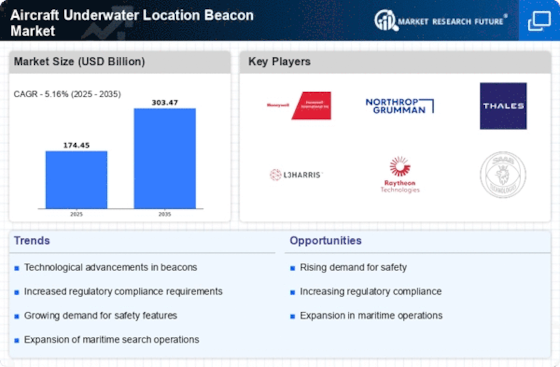
As per Market Research Future analysis, the Aircraft Underwater Location Beacon Market Size was estimated at 174.45 USD Billion in 2024. The Aircraft Underwater Location Beacon industry is projected to grow from 183.45 USD Billion in 2025 to 303.47 USD Billion by 2035, exhibiting a compound annual growth rate (CAGR) of 5.16% during the forecast period 2025 - 2035

Key Market Trends & Highlights

The Aircraft Underwater Location Beacon Market is poised for growth driven by technological advancements and increasing safety demands.

  • Technological advancements in beacon design are enhancing the effectiveness of underwater location systems.
  • North America remains the largest market, while Asia-Pacific is emerging as the fastest-growing region for underwater location beacons.
  • The search and rescue operations segment dominates the market, with emergency locator beacons showing the fastest growth.
  • Increased demand for safety equipment and regulatory compliance are key drivers propelling market expansion.

Market Size & Forecast

2024 Market Size 174.45 (USD Billion)
2035 Market Size 303.47 (USD Billion)
CAGR (2025 - 2035) 5.16%

Major Players

Honeywell International Inc. (US), Northrop Grumman Corporation (US), Thales Group (FR), L3Harris Technologies, Inc. (US), Raytheon Technologies Corporation (US), Saab AB (SE), Leonardo S.p.A. (IT), Kongsberg Gruppen (NO), Elbit Systems Ltd. (IL)

Our Impact
Enabled $4.3B Revenue Impact for Fortune 500 and Leading Multinationals
Partnering with 2000+ Global Organizations Each Year
30K+ Citations by Top-Tier Firms in the Industry

Aircraft Underwater Location Beacon Market Trends

The Aircraft Underwater Location Beacon Market is currently experiencing a notable evolution, driven by advancements in technology and increasing safety regulations. The integration of innovative features such as enhanced signal strength and improved battery life appears to be a focal point for manufacturers. This trend suggests a growing emphasis on reliability and efficiency, which is crucial for search and rescue operations. Furthermore, the rising demand for these beacons in both commercial and military aviation sectors indicates a broader recognition of their importance in ensuring safety during emergencies. As the market continues to develop, it seems likely that collaboration between technology providers and aviation authorities will play a pivotal role in shaping future standards and practices. In addition, the Aircraft Underwater Location Beacon Market is witnessing a shift towards eco-friendly materials and sustainable manufacturing processes. This movement reflects a broader industry trend towards environmental responsibility, which may resonate with consumers and regulatory bodies alike. Companies are increasingly exploring ways to minimize their ecological footprint while maintaining product efficacy. Overall, the market appears poised for growth, with innovations and sustainability at the forefront of its trajectory. The interplay of these factors suggests a dynamic landscape that could redefine safety protocols in aviation.

Technological Advancements

The Aircraft Underwater Location Beacon Market is seeing rapid technological progress, with manufacturers focusing on enhancing signal transmission and battery longevity. These improvements are essential for effective search and rescue missions, as they ensure that beacons remain operational for extended periods, even in challenging conditions.

Sustainability Initiatives

There is a noticeable trend towards the use of eco-friendly materials in the production of aircraft underwater location beacons. This shift aligns with global efforts to promote sustainability within the aviation sector, as companies seek to reduce their environmental impact while still delivering reliable safety solutions.

Regulatory Compliance

Increasingly stringent safety regulations are influencing the Aircraft Underwater Location Beacon Market. Manufacturers are adapting to these requirements by developing products that not only meet but exceed compliance standards, thereby enhancing the overall safety of aviation operations.

Aircraft Underwater Location Beacon Market Drivers

Increased Demand for Safety Equipment

The aircraft underwater location beacon Market is experiencing heightened demand for safety equipment, particularly in the aviation sector. As air travel continues to expand, the need for reliable safety measures becomes paramount. The International civil aviation Organization has emphasized the importance of safety protocols, which has led to increased investments in safety technologies. In 2023, the market for safety equipment in aviation was valued at approximately 2 billion USD, with projections indicating a steady growth rate of 5% annually. This trend suggests that the Aircraft Underwater Location Beacon Market will benefit from the growing emphasis on safety, as airlines and manufacturers seek to enhance their safety measures and comply with international regulations.

Technological Innovations in Beacon Design

Technological advancements are playing a crucial role in shaping the Aircraft Underwater Location Beacon Market. Innovations in beacon design, such as improved battery life, enhanced signal strength, and miniaturization, are making these devices more effective and user-friendly. The integration of GPS technology and advanced communication systems has further enhanced the functionality of underwater beacons. In 2024, the market for advanced beacon technologies is expected to reach 1.5 billion USD, reflecting a compound annual growth rate of 6%. This growth indicates that manufacturers are increasingly investing in research and development to create more efficient and reliable beacons, thereby driving the Aircraft Underwater Location Beacon Market forward.

Growing Focus on Search and Rescue Operations

The Aircraft Underwater Location Beacon Market is witnessing a growing focus on search and rescue operations, particularly in regions with challenging geographical conditions. As the number of flights increases, so does the potential for accidents, making effective search and rescue capabilities essential. The demand for underwater location beacons is expected to rise as aviation authorities and organizations prioritize the development of efficient rescue operations. In 2023, The Aircraft Underwater Location Beacon Market was valued at approximately 3 billion USD, with a projected growth rate of 5% annually. This trend suggests that the Aircraft Underwater Location Beacon Market will benefit from increased investments in search and rescue technologies, enhancing the overall safety of air travel.

Regulatory Pressures and Compliance Requirements

The Aircraft Underwater Location Beacon Market is significantly influenced by regulatory pressures and compliance requirements imposed by aviation authorities. Governments and international organizations are mandating the installation of underwater location beacons in aircraft to enhance search and rescue operations. For instance, the Federal Aviation Administration has set forth regulations that require all commercial aircraft to be equipped with such devices. This regulatory landscape is expected to drive market growth, as manufacturers and airlines must comply with these standards. In 2025, the market is projected to grow by 4% due to these compliance requirements, indicating a robust demand for underwater location beacons in the aviation sector.

Rising Investment in Aviation Safety Technologies

Investment in aviation safety technologies is a key driver for the Aircraft Underwater Location Beacon Market. As stakeholders recognize the importance of safety in aviation, funding for advanced safety solutions is increasing. Airlines, manufacturers, and governments are allocating resources to enhance safety measures, including the integration of underwater location beacons. In 2024, the aviation safety technology market is expected to reach 4 billion USD, with underwater beacons representing a significant segment of this growth. This trend indicates a strong commitment to improving safety standards in aviation, which will likely propel the Aircraft Underwater Location Beacon Market forward as demand for these devices continues to rise.


Market Segment Insights

By Application: Search and Rescue Operations (Largest) vs. Emergency Locator Beacons (Fastest-Growing)

In the Aircraft Underwater Location Beacon Market, the distribution of market share among the application segments reveals Search and Rescue Operations as the largest segment, primarily due to the increasing adoption of advanced beacon technology in life-saving operations at sea. This segment is crucial for enhancing safety measures for aircraft operations over water, ensuring quick and effective response in emergencies. Marine Navigation and Emergency Locator Beacons follow, with Emergency Locator Beacons rapidly gaining traction due to heightened regulatory requirements and advancements in personal locator beacon (PLB) technology, appealing to both marine and aviation sectors.

Emergency Locator Beacons (Dominant) vs. Marine Navigation (Emerging)

Emergency Locator Beacons constitute a dominant segment within the Aircraft Underwater Location Beacon Market, as they integrate advanced tracking technologies that are increasingly appealing to regulatory bodies and end-users alike. These beacons are designed to operate effectively across various emergency scenarios, ensuring swift recovery of individuals or assets lost at sea. Meanwhile, Marine Navigation emerges as a segment that is gaining increased attention, driven by technological advancements and the need for reliable navigation solutions. The evolution of digital navigation aids and increased safety measures in navigation practices are propelling this segment, making it an essential player in the broader market.

By End Use: Commercial Aviation (Largest) vs. Military Aviation (Fastest-Growing)

In the Aircraft Underwater Location Beacon Market, the distribution of market share indicates that Commercial Aviation holds a significant lead. This segment benefits from a robust demand due to the high volume of passenger air travel and the stringent safety regulations requiring effective location beacons for emergency situations. Meanwhile, Military Aviation is gaining traction, though it holds a smaller share currently. The focus on enhancing military capabilities and the necessity for strategic air operations help bolster its market presence.

Aviation: Commercial (Dominant) vs. Military (Emerging)

Commercial Aviation remains the dominant segment in the Aircraft Underwater Location Beacon Market, characterized by extensive adoption and established regulatory requirements. The growing passenger air traffic has led airlines to invest heavily in safety technologies, including underwater location beacons. Conversely, Military Aviation, while still emerging, is recognized as a fast-growing segment. This growth is driven by heightened defense budgets and increased emphasis on search and rescue operations. Both segments exhibit unique characteristics; Commercial Aviation focuses on compliance and passenger safety, while Military Aviation emphasizes advanced technology integration and strategic resource allocation.

By Technology: Satellite-Based Beacons (Largest) vs. Acoustic Beacons (Fastest-Growing)

In the Aircraft Underwater Location Beacon Market, the technology segment is primarily dominated by Satellite-Based Beacons, which command a significant share due to their advanced capabilities in providing real-time tracking and communication. Radio Beacons follow closely but are overshadowed by the superior functionalities offered by satellite technology. Acoustic Beacons, while currently a smaller part of the market, are gaining traction and attracting interest from various industries due to their effectiveness in underwater navigation and location tracking, especially in challenging environments.

Technology: Satellite-Based Beacons (Dominant) vs. Acoustic Beacons (Emerging)

Satellite-Based Beacons are known for their reliability and extensive coverage, making them the dominant choice in the Aircraft Underwater Location Beacon Market. Their ability to transmit signals across vast distances and withstand harsh conditions has led to widespread adoption in both commercial and military applications. In contrast, Acoustic Beacons are emerging as a vital technology, particularly for underwater operations. They utilize sound waves to transmit location information, which is critical in underwater environments where radio waves may not penetrate effectively. The growing need for effective search and rescue operations underwater is propelling the growth of Acoustic Beacons, as they are increasingly recognized for their niche efficiency despite being an emerging segment in this market.

By Product Type: Automatic Activation Beacons (Largest) vs. Hybrid Activation Beacons (Fastest-Growing)

In the Aircraft Underwater Location Beacon Market, the distribution of market share among the product types reveals that Automatic Activation Beacons hold the largest segment, owing to their reliability and ease of use during emergencies. Their widespread deployment in commercial and military aircraft contributes significantly to their dominant market position. In contrast, Manual Activation Beacons, while valuable, represent a smaller share of the market as advancements in technology have shifted preferences towards automated systems.

Automatic Activation Beacons (Dominant) vs. Hybrid Activation Beacons (Emerging)

Automatic Activation Beacons are recognized for their critical role in enhancing safety during water landings. Their automatic deployment feature ensures immediate location signaling without reliance on user intervention, making them indispensable in emergencies. On the other hand, Hybrid Activation Beacons are marking a significant growth trajectory in the market. Combining both automatic and manual activation methods, they provide versatility and adaptability, appealing to both traditional and modern aircraft manufacturers. As regulatory standards evolve and new technologies emerge, Hybrid Activation Beacons are positioned to capture a larger share, driven by increasing demands for innovative safety solutions.

Get more detailed insights about Aircraft Underwater Location Beacon Market

Regional Insights

North America : Market Leader in Innovation

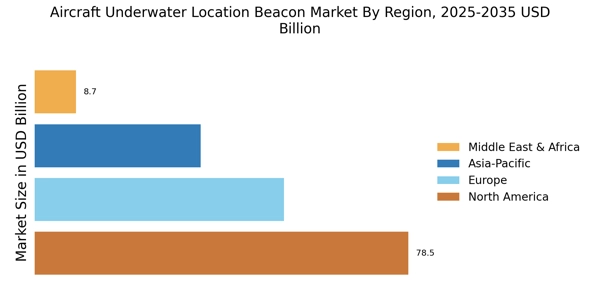
North America is the largest market for Aircraft Underwater Location Beacons, holding approximately 45% of the global market share. The region's growth is driven by increasing investments in aviation safety technologies and stringent regulatory requirements from agencies like the FAA. The demand for advanced underwater location systems is further fueled by rising air traffic and the need for enhanced search and rescue operations. The United States is the primary contributor to this market, with key players such as Honeywell International Inc., Northrop Grumman Corporation, and L3Harris Technologies leading the competitive landscape. The presence of advanced technological infrastructure and a focus on innovation positions North America as a hub for the development of next-generation underwater beacons, ensuring compliance with evolving safety standards.

Europe : Emerging Regulatory Frameworks

Europe is witnessing significant growth in the Aircraft Underwater Location Beacon Market, accounting for approximately 30% of the global share. The region's expansion is largely attributed to stringent safety regulations imposed by the European Union Aviation Safety Agency (EASA) and increasing investments in maritime safety technologies. The demand for reliable underwater beacons is also rising due to heightened awareness of aviation safety and environmental concerns. Leading countries in this region include France, Germany, and the UK, where companies like Thales Group and Leonardo S.p.A. are prominent players. The competitive landscape is characterized by collaborations between government agencies and private firms to enhance the technological capabilities of underwater beacons. This synergy is crucial for meeting the evolving safety standards and ensuring effective search and rescue operations.

Asia-Pacific : Rapidly Growing Market Potential

Asia-Pacific is rapidly emerging as a significant player in the Aircraft Underwater Location Beacon Market, holding around 20% of the global market share. The growth in this region is driven by increasing air travel, rising investments in aviation infrastructure, and a growing focus on safety regulations. Countries like China and India are leading this demand, supported by government initiatives aimed at enhancing aviation safety and operational efficiency. The competitive landscape features key players such as Kongsberg Gruppen and Saab AB, who are actively expanding their presence in the region. The increasing collaboration between local manufacturers and international firms is fostering innovation and improving the technological capabilities of underwater beacons. This trend is expected to continue as the region's aviation sector expands and safety standards evolve.

Middle East and Africa : Untapped Market Opportunities

The Middle East and Africa region is gradually emerging in the Aircraft Underwater Location Beacon Market, currently holding about 5% of the global share. The growth potential is driven by increasing investments in aviation safety and infrastructure development, particularly in countries like the UAE and South Africa. The region's strategic location as a transit hub for international flights further emphasizes the need for advanced safety technologies, including underwater beacons. Key players in this region are focusing on establishing partnerships with local governments and aviation authorities to enhance safety measures. The competitive landscape is characterized by a mix of local and international firms, with a growing emphasis on compliance with international safety standards. As the aviation sector continues to develop, the demand for reliable underwater location systems is expected to rise significantly.

Aircraft Underwater Location Beacon Market Regional Image

Key Players and Competitive Insights

The Aircraft Underwater Location Beacon Market is characterized by a dynamic competitive landscape, driven by technological advancements and increasing demand for safety in aviation. Key players such as Honeywell International Inc. (US), Northrop Grumman Corporation (US), and Thales Group (FR) are at the forefront, each adopting distinct strategies to enhance their market presence. Honeywell International Inc. (US) focuses on innovation, particularly in developing advanced beacon technologies that integrate seamlessly with modern aircraft systems. Northrop Grumman Corporation (US) emphasizes strategic partnerships and collaborations to bolster its product offerings, while Thales Group (FR) is heavily invested in digital transformation initiatives aimed at improving operational efficiency and customer engagement. Collectively, these strategies contribute to a competitive environment that is increasingly centered around technological sophistication and customer-centric solutions.In terms of business tactics, companies are localizing manufacturing and optimizing supply chains to enhance responsiveness to market demands. The market structure appears moderately fragmented, with several players vying for market share. However, the influence of major companies is substantial, as they leverage their technological capabilities and established reputations to shape industry standards and practices.

In August Honeywell International Inc. (US) announced the launch of its next-generation underwater location beacon, which features enhanced signal strength and battery life. This strategic move is significant as it positions Honeywell to meet the evolving safety regulations in the aviation sector, potentially increasing its market share and reinforcing its reputation as a leader in aviation safety technology. The introduction of this product aligns with the growing emphasis on safety and reliability in aircraft operations.

In September Northrop Grumman Corporation (US) entered into a strategic partnership with a leading aerospace manufacturer to co-develop advanced underwater location beacons. This collaboration is likely to enhance Northrop Grumman's technological capabilities and expand its product portfolio, thereby strengthening its competitive position. The partnership reflects a broader trend in the industry where collaboration is seen as a means to accelerate innovation and improve product offerings.

In July Thales Group (FR) completed the acquisition of a small tech firm specializing in underwater communication systems. This acquisition is indicative of Thales's commitment to enhancing its technological capabilities and expanding its market reach. By integrating these advanced technologies, Thales aims to offer more comprehensive solutions to its customers, thereby solidifying its position in the market.

As of October the competitive trends in the Aircraft Underwater Location Beacon Market are increasingly defined by digitalization, sustainability, and the integration of artificial intelligence. Strategic alliances are becoming more prevalent, as companies recognize the need to collaborate to drive innovation and enhance product offerings. Looking ahead, competitive differentiation is likely to evolve from traditional price-based competition to a focus on technological innovation, reliability, and supply chain efficiency. This shift underscores the importance of adapting to changing market dynamics and customer expectations.

Key Companies in the Aircraft Underwater Location Beacon Market include

Industry Developments

The Aircraft Underwater Location Beacon Market is witnessing significant developments, particularly with advancements in technology and an increasing focus on safety measures.

Major players like Northrop Grumman, Elbit Systems, and Boeing are enhancing their product offerings to integrate innovative features such as improved signal strength and battery life for underwater beacons. Simultaneously, companies such as Thales and Honeywell are focusing on developing more reliable systems that comply with international safety regulations.

Recent acquisitions and mergers in the sector, such as AeroVironment's acquisition of specific technology firms, indicate a trend toward consolidating resources to enhance capabilities and streamline operations.

Furthermore, GE Aviation and L3Harris Technologies are also exploring strategic partnerships to leverage complementary technologies which further entails a robust growth trajectory in the market valuation.

This competitive landscape is bolstered by a gradual increase in demand stemming from regulatory bodies emphasizing the necessity of robust underwater location devices for aircraft involved in maritime operations.

Overall, the market is evolving swiftly, driven by technological advancements, strategic business maneuvers, and adherence to growing safety regulations, enhancing the overall effectiveness of underwater location beacons within the aviation industry.

Future Outlook

Aircraft Underwater Location Beacon Market Future Outlook

The Aircraft Underwater Location Beacon Market is projected to grow at a 5.16% CAGR from 2025 to 2035, driven by technological advancements and increasing safety regulations.

New opportunities lie in:

  • Development of integrated beacon systems for real-time tracking
  • Expansion into emerging markets with tailored solutions
  • Partnerships with aviation authorities for compliance-driven innovations

By 2035, the market is expected to be robust, driven by innovation and regulatory support.

Market Segmentation

Aircraft Underwater Location Beacon Market End Use Outlook

  • Commercial Aviation
  • Military Aviation
  • Private Aviation

Aircraft Underwater Location Beacon Market Technology Outlook

  • Satellite-Based Beacons
  • Radio Beacons
  • Acoustic Beacons

Aircraft Underwater Location Beacon Market Application Outlook

  • Search and Rescue Operations
  • Marine Navigation
  • Emergency Locator Beacons

Aircraft Underwater Location Beacon Market Product Type Outlook

  • Automatic Activation Beacons
  • Manual Activation Beacons
  • Hybrid Activation Beacons

Report Scope

MARKET SIZE 2024174.45(USD Billion)
MARKET SIZE 2025183.45(USD Billion)
MARKET SIZE 2035303.47(USD Billion)
COMPOUND ANNUAL GROWTH RATE (CAGR)5.16% (2025 - 2035)
REPORT COVERAGERevenue Forecast, Competitive Landscape, Growth Factors, and Trends
BASE YEAR2024
Market Forecast Period2025 - 2035
Historical Data2019 - 2024
Market Forecast UnitsUSD Billion
Key Companies ProfiledHoneywell International Inc. (US), Northrop Grumman Corporation (US), Thales Group (FR), L3Harris Technologies, Inc. (US), Raytheon Technologies Corporation (US), Saab AB (SE), Leonardo S.p.A. (IT), Kongsberg Gruppen (NO), Elbit Systems Ltd. (IL)
Segments CoveredApplication, End Use, Technology, Product Type, Regional
Key Market OpportunitiesAdvancements in satellite technology enhance tracking capabilities in the Aircraft Underwater Location Beacon Market.
Key Market DynamicsTechnological advancements and regulatory changes drive innovation in the Aircraft Underwater Location Beacon market.
Countries CoveredNorth America, Europe, APAC, South America, MEA
Leave a Comment

FAQs

What is the projected market valuation for the Aircraft Underwater Location Beacon Market in 2035?

The projected market valuation for the Aircraft Underwater Location Beacon Market in 2035 is 303.47 USD Billion.

What was the overall market valuation for the Aircraft Underwater Location Beacon Market in 2024?

The overall market valuation for the Aircraft Underwater Location Beacon Market in 2024 was 174.45 USD Billion.

What is the expected CAGR for the Aircraft Underwater Location Beacon Market during the forecast period 2025 - 2035?

The expected CAGR for the Aircraft Underwater Location Beacon Market during the forecast period 2025 - 2035 is 5.16%.

Which application segment is projected to have the highest valuation in 2035?

The Emergency Locator Beacons application segment is projected to reach 138.47 USD Billion by 2035.

What are the key players in the Aircraft Underwater Location Beacon Market?

Key players in the market include Honeywell International Inc., Northrop Grumman Corporation, Thales Group, and Raytheon Technologies Corporation.

How does the Commercial Aviation segment perform in terms of market valuation?

The Commercial Aviation segment is projected to grow from 80.0 USD Billion to 140.0 USD Billion by 2035.

What is the projected valuation for Acoustic Beacons by 2035?

The projected valuation for Acoustic Beacons is expected to reach 173.47 USD Billion by 2035.

Which product type is anticipated to have the highest market valuation in 2035?

The Hybrid Activation Beacons product type is anticipated to reach 123.47 USD Billion by 2035.

What is the expected market valuation for Military Aviation in 2035?

The expected market valuation for Military Aviation is projected to grow from 50.0 USD Billion to 90.0 USD Billion by 2035.

How does the market for Satellite-Based Beacons compare to Radio Beacons in 2035?

By 2035, the market for Radio Beacons is projected to reach 80.0 USD Billion, while Satellite-Based Beacons is expected to reach 50.0 USD Billion.

Download Free Sample

Kindly complete the form below to receive a free sample of this Report

Compare Licence

×
Features License Type
Single User Multiuser License Enterprise User
Price $4,950 $5,950 $7,250
Maximum User Access Limit 1 User Upto 10 Users Unrestricted Access Throughout the Organization
Free Customization
Direct Access to Analyst
Deliverable Format
Platform Access
Discount on Next Purchase 10% 15% 15%
Printable Versions