
×
Hero Background
English
Chinese
French
Japanese
Korean
German
Spanish

Aircraft Auxiliary Power Unit Market Share

ID: MRFR/AD/4544-HCR
100 Pages
Swapnil Palwe
October 2025

Aircraft Auxiliary Power Unit Market report information by Aircraft Type (Fixed Wing (Wide body, Narrow body, others), Rotary Wing, UAV), Platform (Commercial, Military), by Product (Battery, Electric Ground Power), Region - Forecast till 2035

Share:
Download PDF ×

We do not share your information with anyone. However, we may send you emails based on your report interest from time to time. You may contact us at any time to opt-out.

Aircraft Auxiliary Power Unit Market Infographic
Purchase Options

Market Share

Aircraft Auxiliary Power Unit Market Share Analysis

The competitive battlefield of the APU market brings different features for companies to operate and enter the market, gain and retain a share from their competitors with short-term profitability considerations. These approaches include innovation and technology, strategic alliance, product/market stratification, aftermarket service provision and the emphasis on environment friendly sustainability.

Amongst these fundamental strategies specialized on continuous innovation and technological development. In addition, APU manufacturers spend large amounts of capital in R & D to produce APUs having higher output power, better fuel efficiency while keeping emissions low and reliability high. Through the use of innovative features and technologies, organizations have an opportunity to differentiate their offerings on the basis of a unique selling point or provide cutting-edge goods that can attract customers looking for something new besides securing a large market share.

One of the strategies employed by companies to gain market share position is showing how appropriate its aftermarket services and support are. Allowing customers to receive solid aftermarket services, including maintenance and repair (MRO) services, availability of spare parts, technical support as well as upgrade solutions is important to keep the brand with each customer for a long time. Businesses that provide superior aftermarket support create a competitive opportunity and solidly build their market position by assuring the desired reliability and durability of their goods. Additionally, a focus on brand reputation and customer satisfaction is vital in market share positioning. Building a strong brand image based on reliability, performance, and customer service fosters trust and loyalty among customers. Positive experiences and recommendations from satisfied customers contribute to expanding market share by attracting new customers and retaining existing ones.


Author
Swapnil Palwe
Team Lead - Research

With a technical background as Bachelor's in Mechanical Engineering, with MBA in Operations Management , Swapnil has 6+ years of experience in market research, consulting and analytics with the tasks of data mining, analysis, and project execution. He is the POC for our clients, for their consulting projects running under the Automotive/A&D domain. Swapnil has worked on major projects in verticals such as Aerospace & Defense, Automotive and many other domain projects. He has worked on projects for fortune 500 companies' syndicate and consulting projects along with several government projects.

Leave a Comment

FAQs

Which region is expected to have the highest global market value in the Aircraft Auxiliary Power Unit Market?

North America is expected to have the highest global market value in the Aircraft Auxiliary Power Unit Market due to many major key players in the region.

Who are the key players influencing the Global Aircraft Auxiliary Power Unit Market?

The major key players of the Aircraft Auxiliary Power Unit Market are AEGIS Power Systems, Inc. (U.S.), Honeywell International Inc. (U.S), Hamilton Sundstrand Corp (U.S.), etc.

Market Summary

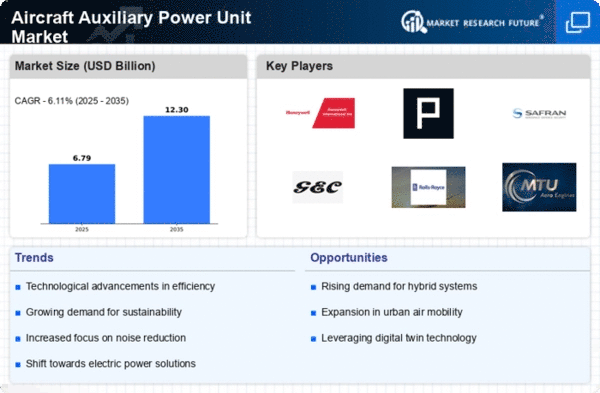
As per MRFR analysis, the Aircraft Auxiliary Power Unit Market Size was estimated at 6.4 USD Billion in 2024. The Aircraft Auxiliary Power Unit industry is projected to grow from 6.8 in 2025 to 12.3 by 2035, exhibiting a compound annual growth rate (CAGR) of 6.11 during the forecast period 2025 - 2035.

Key Market Trends & Highlights

The Aircraft Auxiliary Power Unit Market is poised for substantial growth driven by technological advancements and sustainability initiatives.

  • Technological advancements in APU design are enhancing fuel efficiency and operational performance. Sustainability initiatives are increasingly influencing the development of eco-friendly APU solutions in the market. North America remains the largest market, while the Asia-Pacific region is emerging as the fastest-growing area for APUs. The growth in air travel and fleet expansion, alongside regulatory compliance, are key drivers propelling market demand.

Market Size & Forecast

2024 Market Size 6.4 (USD Billion)
2035 Market Size 12.3 (USD Billion)
CAGR (2025 - 2035) 6.11%
Largest Regional Market Share in 2024 North America

Major Players

<p><a href="https://aerospace.honeywell.com/us/en/products-and-services/products/control-systems">Honeywell International Inc</a> (US), Pratt &amp; Whitney (US), Safran S.A. (FR), General Electric Company (US), Rolls-Royce Holdings plc (GB), MTU Aero Engines AG (DE), Boeing Company (US), Airbus S.A.S. (FR)</p>

Market Trends

The Aircraft Auxiliary Power Unit Market is currently experiencing a notable transformation, driven by advancements in technology and increasing demand for fuel efficiency. As airlines and manufacturers seek to optimize operational costs, the focus on auxiliary power units has intensified. These units, which provide energy for various aircraft systems while on the ground, are becoming more sophisticated, incorporating features that enhance performance and reduce emissions. The shift towards sustainable aviation practices is also influencing the design and functionality of these units, as stakeholders aim to align with global environmental standards. Moreover, the competitive landscape of the Aircraft Auxiliary Power Unit Market is evolving, with numerous players investing in research and development to introduce innovative solutions. The integration of digital technologies, such as predictive maintenance and smart monitoring systems, appears to be a key trend, potentially improving reliability and efficiency. As the market continues to grow, collaboration between manufacturers and airlines may foster the development of next-generation auxiliary power units that meet the changing needs of the aviation industry.

Technological Advancements

The Aircraft Auxiliary Power Unit Market is witnessing rapid technological advancements, particularly in the areas of efficiency and emissions reduction. Manufacturers are increasingly focusing on developing units that utilize cutting-edge materials and designs to enhance performance. This trend suggests a shift towards more compact and lightweight solutions that can operate effectively in various environmental conditions.

Sustainability Initiatives

Sustainability initiatives are becoming a central theme within the Aircraft Auxiliary Power Unit Market. Stakeholders are prioritizing the development of eco-friendly units that comply with stringent environmental regulations. This trend indicates a growing awareness of the aviation industry's impact on climate change, prompting efforts to minimize carbon footprints through innovative designs and alternative energy sources.

Digital Integration

The integration of digital technologies into the Aircraft Auxiliary Power Unit Market is gaining momentum. Smart monitoring systems and predictive maintenance tools are being adopted to enhance operational efficiency and reliability. This trend suggests that the future of auxiliary power units may involve greater connectivity and data-driven decision-making, potentially transforming maintenance practices and overall performance.

Aircraft Auxiliary Power Unit Market Market Drivers

Increasing Demand for Fuel Efficiency

The Global Aircraft Auxiliary Power Unit Industry is experiencing heightened demand for fuel efficiency as airlines seek to reduce operational costs. Auxiliary Power Units (APUs) play a crucial role in providing power to aircraft systems while on the ground, thus minimizing the need for main engines to run. This shift towards APUs is expected to contribute to the market's growth, with the industry projected to reach 4.3 USD Billion in 2024. Airlines are increasingly investing in modern APUs that offer improved fuel efficiency, which aligns with global sustainability goals and regulatory pressures to lower emissions.

Market Segment Insights

By Application: Commercial Aviation (Largest) vs. Military Aviation (Fastest-Growing)

<p>The Aircraft Auxiliary Power Unit market exhibits a diverse distribution across its application segments, predominantly favoring <a href="https://www.marketresearchfuture.com/reports/commercial-aviation-aircraft-seating-market-28983">Commercial Aviation</a>, which holds the largest share. This segment's extensive utilization in passenger and cargo aircraft makes it a significant contributor to the market's overall dynamics. In comparison, Military Aviation, while smaller, is rapidly adapting to advancements in technology and defense requirements, positioning it as a key player with substantial growth potential. Growth trends in the Aircraft Auxiliary Power Unit market are primarily driven by the increasing demand for efficient energy solutions in both Commercial and Military Aviation. The rise in air travel, coupled with the military's focus on modernization and efficiency, is propelling innovation within this segment. Additionally, the push for sustainable aviation technologies is fostering new developments within the market, particularly in the Military Aviation arena, which is poised to see rapid advancements and increased investments in the years to come.</p>

<p>Commercial Aviation (Dominant) vs. Helicopters (Emerging)</p>

<p>In the Aircraft Auxiliary Power Unit market, Commercial Aviation remains the dominant segment due to its vast fleet size and continuous operational requirements. These units are integral for engine starting, onboard electrical power, and environmental control systems, thereby ensuring safety and reliability in operations. On the other hand, the Helicopter segment is emerging as a noteworthy player, driven by the increasing demand for air mobility solutions in urban environments and emergency services. <a href="https://www.marketresearchfuture.com/reports/helicopters-market-9532">Helicopters </a>require specialized APU systems to maintain operational efficiency in various scenarios, highlighting their unique market needs. With technological advancements and increasing investment in rotorcraft operations, the Helicopter segment is carving out a rapidly growing niche, complementing the established dominance of Commercial Aviation.</p>

By Power Source: Gas Turbine (Largest) vs. Electric (Fastest-Growing)

<p>In the Aircraft Auxiliary Power Unit (APU) Market, Gas Turbine technology holds a significant share, revered for its efficiency and reliability in providing power to aircraft systems during ground operations. Its longstanding dominance is complemented by a stable demand from traditional aircraft manufacturers, ensuring their continued relevance as leading power sources. In contrast, Electric APUs are emerging as a transformative force in the market, driven by environmental regulations and advancements in battery technology, enticing manufacturers and operators seeking greener alternatives.</p>

<p>Gas Turbine (Dominant) vs. Electric (Emerging)</p>

<p>Gas Turbine APUs have established themselves as the dominant power source due to their robust performance and extensive integration in commercial and military aircraft. Their ability to provide consistent power with minimal weight makes them a preferred choice among airlines. On the other hand, Electric APUs are gaining traction as an emerging solution, appealing particularly to new aircraft designs focused on sustainability and reduced operating costs. They offer the potential for quieter operations and are increasingly being integrated into hybrid systems. This shift is propelled by consumer demand for greener technologies and regulatory pressures, positioning Electric APUs as a viable alternative in the evolving landscape.</p>

By End Use: New Aircraft (Largest) vs. Retrofit Aircraft (Fastest-Growing)

<p>In the Aircraft Auxiliary Power Unit Market, the segmentation by end use reveals a distinct distribution, with new aircraft taking the lead as the largest segment. This reflects ongoing trends in the aviation industry, where manufacturers focus on equipping new models with advanced APU technologies to enhance efficiency and reduce environmental impact. Retrofits, while not as dominant, represent a growing segment as airlines look to extend the life and improve the performance of existing aircraft by upgrading their auxiliary systems. Maintenance and repair also contribute to the sector, supporting overall APU efficiency and reliability in operations.</p>

<p>New Aircraft: Dominant vs. Retrofit Aircraft: Emerging</p>

<p>The New Aircraft segment stands as the dominant force in the Aircraft Auxiliary Power Unit market, primarily driven by the introduction of next-generation aircraft models equipped with state-of-the-art technology. This segment benefits from substantial investments by aircraft manufacturers focused on innovation and performance enhancement. In contrast, the Retrofit Aircraft segment emerges as a significant player, characterized by the trend of airlines opting for upgrades to extend the operational efficiency and reliability of older aircraft models. This movement is fueled by a growing need to meet stricter environmental regulations and improve fuel efficiency, showcasing the dual landscape of new technology integration alongside the optimization of existing fleets.</p>

By Type: Integrated APU (Largest) vs. Fixed APU (Fastest-Growing)

<p>In the Aircraft Auxiliary Power Unit Market, the market share distribution reveals that Integrated APUs lead as the largest segment, catering to the increasingly complex needs of modern aircraft. This segment's dominance is attributed to innovations in technology and the shift towards more integrated systems that support various aircraft functionalities. Meanwhile, Fixed APUs are rapidly gaining traction due to their efficiency and reliability, making them the fastest-growing segment in the market.</p>

<p>Integrated APU (Dominant) vs. Mobile APU (Emerging)</p>

<p>Integrated APUs are becoming the dominant choice in the market due to their ability to seamlessly integrate various aircraft systems, which enhances operational efficiency and reduces overall weight. These units provide comprehensive solutions by supplying power for various functions including air conditioning and engine starting. Conversely, Mobile APUs, while emerging, focus on portability and versatility, making them suitable for a range of applications outside traditional aviation settings. Their appeal is growing, particularly in military operations and remote locations where power supply variability exists.</p>

By Fuel Type: Jet Fuel (Largest) vs. Biofuel (Fastest-Growing)

<p>In the Aircraft Auxiliary Power Unit (APU) market, Jet Fuel dominates with a significant market share, owing to its widespread adoption across commercial and military aviation. <a href="https://www.marketresearchfuture.com/reports/aviation-fuel-market-8418">Aviation Fuel</a> follows as a vital component, serving traditional gas turbine engines efficiently. The use of Biofuel, while currently smaller, is rapidly gaining traction as environmental concerns drive airlines towards sustainable practices, thereby influencing the fuel type distribution within the APU market.</p>

<p>Jet Fuel (Dominant) vs. Biofuel (Emerging)</p>

<p>Jet Fuel is the dominant fuel type in the Aircraft Auxiliary Power Unit market, primarily due to its high performance and availability in aviation. It offers efficiency and reliability crucial for APU operations, particularly in large commercial aircraft. On the other hand, Biofuel is an emerging player, poised to transform the industry landscape. With increasing investments in sustainable aviation initiatives and regulatory support, Biofuel is becoming an attractive alternative, catering to airlines looking to reduce their carbon footprint without compromising on performance. As these two fuel types evolve, they reflect the shifting priorities of the aviation sector towards more sustainable operational practices.</p>

Get more detailed insights about Aircraft Auxiliary Power Unit Market Research Report – Forecast to 2035

Regional Insights

North America : Market Leader in APU Technology

North America is poised to maintain its leadership in the Aircraft Auxiliary Power Unit (APU) market, holding a significant share of 3.2 billion in 2024. The region's growth is driven by increasing air travel demand, stringent regulatory standards for emissions, and advancements in APU technology. The presence of major manufacturers and a robust aerospace infrastructure further catalyze market expansion, ensuring compliance with evolving safety and environmental regulations. The United States stands out as the leading country in this sector, hosting key players such as Honeywell International Inc, Pratt & Whitney, and General Electric Company. The competitive landscape is characterized by continuous innovation and strategic partnerships among these firms, enhancing their market positions. The focus on fuel efficiency and reduced operational costs is driving investments in next-generation APU systems, solidifying North America's dominance in the global market.

Europe : Emerging Market with Growth Potential

Europe's Aircraft Auxiliary Power Unit market is projected to grow, with a market size of 1.8 billion in 2024. The region benefits from increasing investments in sustainable aviation technologies and regulatory support aimed at reducing carbon emissions. The European Union's commitment to green aviation initiatives is a significant driver, encouraging innovation and adoption of advanced APU systems that meet stringent environmental standards. Leading countries in this market include France, Germany, and the UK, where major players like Safran S.A. and Rolls-Royce Holdings plc are headquartered. The competitive landscape is marked by collaborations between manufacturers and airlines to enhance APU efficiency and reliability. As the demand for eco-friendly aviation solutions rises, Europe is well-positioned to capitalize on these trends, fostering a dynamic market environment.

Asia-Pacific : Rapid Growth in Aviation Sector

The Asia-Pacific region is witnessing rapid growth in the Aircraft Auxiliary Power Unit market, with a market size of 1.5 billion in 2024. This growth is fueled by increasing air travel demand, expanding airline fleets, and government initiatives to enhance aviation infrastructure. Regulatory support for modernizing airports and improving operational efficiency is also a key driver, promoting the adoption of advanced APU technologies across the region. Countries like China, India, and Japan are leading the charge, with significant investments in aviation. The competitive landscape features key players such as Boeing Company and Airbus S.A.S., who are focusing on developing innovative APU solutions tailored to the needs of regional airlines. As the market evolves, the emphasis on fuel efficiency and sustainability will shape the future of APU technologies in Asia-Pacific, making it a critical area for growth.

Middle East and Africa : Emerging Market with Unique Challenges

The Middle East and Africa region is emerging in the Aircraft Auxiliary Power Unit market, with a market size of 0.9 billion in 2024. The growth is driven by increasing air travel and investments in aviation infrastructure, particularly in the Gulf states. However, challenges such as regulatory hurdles and economic fluctuations can impact market dynamics. The region's strategic location as a The Aircraft Auxiliary Power Unit growth. Leading countries include the UAE and South Africa, where investments in modernizing fleets are on the rise. The competitive landscape is characterized by partnerships between local and international manufacturers, aiming to enhance APU efficiency and reliability. As the region continues to develop its aviation sector, the demand for advanced APU systems is expected to grow, presenting opportunities for key players in the market.

Key Players and Competitive Insights

The Aircraft Auxiliary Power Unit Market is characterized by a competitive landscape that is increasingly shaped by innovation, sustainability, and strategic partnerships. Key players such as Honeywell International Inc (US), Pratt & Whitney (US), and Safran S.A. (FR) are actively pursuing strategies that emphasize technological advancements and operational efficiencies. Honeywell, for instance, has focused on enhancing its product offerings through digital transformation initiatives, which aim to improve fuel efficiency and reduce emissions. Meanwhile, Pratt & Whitney has been investing in next-generation APU technologies, positioning itself as a leader in the market by prioritizing reliability and performance. Collectively, these strategies contribute to a dynamic competitive environment where companies are not only vying for market share but also striving to meet evolving regulatory standards and customer expectations.

In terms of business tactics, companies are increasingly localizing manufacturing and optimizing their supply chains to enhance responsiveness and reduce costs. The market appears moderately fragmented, with several key players holding substantial shares while also facing competition from emerging firms. This structure allows for a diverse range of products and services, catering to various segments of the aviation industry. The collective influence of these major players is significant, as they set benchmarks for quality and innovation that smaller companies often strive to meet.

In November 2025, Safran S.A. (FR) announced a strategic partnership with a leading aerospace manufacturer to co-develop a new generation of environmentally friendly APUs. This collaboration is expected to leverage both companies' technological expertise, aiming to reduce the carbon footprint of auxiliary power systems significantly. The strategic importance of this partnership lies in its potential to enhance Safran's market position while addressing the growing demand for sustainable aviation solutions.

In October 2025, General Electric Company (US) unveiled its latest APU model, which incorporates advanced AI algorithms for predictive maintenance. This innovation is designed to minimize downtime and enhance operational efficiency for airlines. The introduction of this model underscores General Electric's commitment to integrating cutting-edge technology into its product line, thereby reinforcing its competitive edge in a market that increasingly values reliability and performance.

In September 2025, Rolls-Royce Holdings plc (GB) expanded its service offerings by launching a comprehensive maintenance program for its APUs, aimed at improving lifecycle management for customers. This initiative reflects a broader trend within the industry, where companies are shifting towards service-oriented business models to create additional revenue streams. By enhancing customer support and maintenance capabilities, Rolls-Royce is likely to strengthen its relationships with clients and foster long-term loyalty.

As of December 2025, the Aircraft Auxiliary Power Unit Market is witnessing trends that emphasize digitalization, sustainability, and the integration of AI technologies. Strategic alliances are becoming increasingly vital, as companies recognize the need to collaborate in order to innovate and meet regulatory demands. The competitive differentiation is likely to evolve from traditional price-based competition towards a focus on technological innovation, supply chain reliability, and sustainable practices. This shift suggests that companies that prioritize these aspects will be better positioned to thrive in an ever-evolving market landscape.

Key Companies in the Aircraft Auxiliary Power Unit Market market include

Industry Developments

  • Q2 2024: Honeywell to supply auxiliary power units for new Embraer E2 jets Honeywell announced it has secured a contract to provide its 131-9A auxiliary power units (APUs) for Embraer's E2 family of regional jets, expanding its footprint in the next-generation aircraft segment.
  • Q2 2024: Safran inaugurates new APU manufacturing facility in France Safran opened a new state-of-the-art facility dedicated to the production of aircraft auxiliary power units, aiming to increase capacity and support growing demand from commercial and military aviation customers.
  • Q1 2024: Pratt & Whitney launches next-generation APU for narrowbody aircraft Pratt & Whitney unveiled its new PW8000 APU, designed for improved fuel efficiency and lower emissions, targeting the latest generation of single-aisle commercial aircraft.
  • Q3 2024: Honeywell signs multi-year APU maintenance contract with Lufthansa Technik Honeywell and Lufthansa Technik entered a long-term agreement for the maintenance, repair, and overhaul of Honeywell APUs installed on Lufthansa's fleet, enhancing aftermarket service capabilities.
  • Q2 2024: Rolls-Royce partners with Airbus on hybrid-electric APU development Rolls-Royce and Airbus announced a strategic partnership to co-develop hybrid-electric auxiliary power units for future aircraft, aiming to reduce carbon emissions and improve operational efficiency.
  • Q1 2024: GE Aerospace secures U.S. Air Force contract for military APU upgrades GE Aerospace was awarded a contract by the U.S. Air Force to upgrade auxiliary power units on its C-130 transport aircraft, focusing on reliability and performance improvements.
  • Q2 2024: PBS Velka Bites expands APU production capacity with new Czech facility Czech manufacturer PBS Velka Bites opened a new production line to meet rising demand for APUs in both commercial and military aviation sectors.
  • Q3 2024: Honeywell introduces digital APU health monitoring platform Honeywell launched a new digital platform for real-time health monitoring of aircraft APUs, enabling predictive maintenance and reducing operational disruptions for airline customers.
  • Q2 2025: Safran signs APU supply agreement with China Southern Airlines Safran secured a multi-year contract to supply and support auxiliary power units for China Southern Airlines' expanding fleet of widebody aircraft.
  • Q1 2025: Lufthansa Technik opens new APU overhaul center in Hamburg Lufthansa Technik inaugurated a dedicated facility in Hamburg for the overhaul and repair of aircraft APUs, aiming to serve both European and international airline customers.
  • Q2 2025: Pratt & Whitney wins APU contract for Indian Air Force transport fleet Pratt & Whitney was awarded a contract to supply and maintain auxiliary power units for the Indian Air Force's new fleet of C-295 transport aircraft.
  • Q3 2025: Airbus and Safran achieve EASA certification for new-generation APU Airbus and Safran announced that their jointly developed next-generation auxiliary power unit has received certification from the European Union Aviation Safety Agency (EASA), clearing the way for commercial deployment.

Future Outlook

Aircraft Auxiliary Power Unit Market Future Outlook

<p>The Aircraft Auxiliary Power Unit Market is projected to grow at a 6.11% CAGR from 2024 to 2035, driven by increasing demand for fuel efficiency and technological advancements.</p>

New opportunities lie in:

  • <p>Development of hybrid APU systems for reduced emissions</p>
  • <p>Expansion into emerging markets with growing aviation sectors</p>
  • <p>Integration of IoT for predictive maintenance solutions</p>

<p>By 2035, the market is expected to achieve robust growth, driven by innovation and strategic investments.</p>

Market Segmentation

Aircraft Auxiliary Power Unit Market Type Outlook

  • Fixed APU
  • Mobile APU
  • Integrated APU

Aircraft Auxiliary Power Unit Market End Use Outlook

  • New Aircraft
  • Retrofit Aircraft
  • Maintenance and Repair

Aircraft Auxiliary Power Unit Market Fuel Type Outlook

  • Aviation Fuel
  • Jet Fuel
  • Biofuel

Aircraft Auxiliary Power Unit Market Application Outlook

  • Commercial Aviation
  • Military Aviation
  • Business Aviation
  • Helicopters

Aircraft Auxiliary Power Unit Market Power Source Outlook

  • Gas Turbine
  • Internal Combustion Engine
  • Electric
  • Hybrid

Report Scope

MARKET SIZE 2024 6.4(USD Billion)
MARKET SIZE 2025 6.8(USD Billion)
MARKET SIZE 2035 12.3(USD Billion)
COMPOUND ANNUAL GROWTH RATE (CAGR) 6.11% (2024 - 2035)
REPORT COVERAGE Revenue Forecast, Competitive Landscape, Growth Factors, and Trends
BASE YEAR 2024
Market Forecast Period 2025 - 2035
Historical Data 2019 - 2024
Market Forecast Units USD Billion
Key Companies Profiled Honeywell International Inc (US), Pratt & Whitney (US), Safran S.A. (FR), General Electric Company (US), Rolls-Royce Holdings plc (GB), MTU Aero Engines AG (DE), Boeing Company (US), Airbus S.A.S. (FR)
Segments Covered Application, Power Source, End Use, Type, Fuel Type
Key Market Opportunities Integration of advanced energy-efficient technologies in the Aircraft Auxiliary Power Unit Market.
Key Market Dynamics Technological advancements and regulatory changes drive innovation and efficiency in the Aircraft Auxiliary Power Unit market.
Countries Covered North America, Europe, APAC, South America, MEA

FAQs

Which region is expected to have the highest global market value in the Aircraft Auxiliary Power Unit Market?

North America is expected to have the highest global market value in the Aircraft Auxiliary Power Unit Market due to many major key players in the region.

Who are the key players influencing the Global Aircraft Auxiliary Power Unit Market?

The major key players of the Aircraft Auxiliary Power Unit Market are AEGIS Power Systems, Inc. (U.S.), Honeywell International Inc. (U.S), Hamilton Sundstrand Corp (U.S.), etc.

  1. EXECUTIVE SUMMARY
  2. SCOPE OF THE REPORT
    1. MARKET DEFINITION
    2. SCOPE OF THE STUDY
      1. DEFINITION
      2. RESEARCH OBJECTIVE
      3. ASSUMPTIONS
      4. LIMITATIONS
    3. RESEARCH PROCESS
      1. PRIMARY RESEARCH
      2. SECONDARY RESEARCH
    4. MARKET SIZE ESTIMATION
    5. FORECAST MODEL
  3. MARKET LANDSCAPE
    1. PORTER’S FIVE FORCES ANALYSIS
      1. THREAT OF NEW ENTRANTS
      2. BARGAINING POWER OF BUYERS
      3. THREAT OF SUBSTITUTES
      4. SEGMENT RIVALRY
      5. BARGAINING POWER OF BUYERS
    2. VALUE CHAIN/SUPPLY CHAIN ANALYSIS
  4. MARKET DYNAMICS
    1. INTRODUCTION
    2. MARKET DRIVERS
    3. MARKET RESTRAINTS
    4. MARKET OPPORTUNITIES
    5. MARKET TRENDS
  5. GLOBAL AIRCRAFT AUXILIARY POWER UNIT MARKET, BY AIRCRAFT TYPE
    1. INTRODUCTION
    2. FIXED WING AIRCRAFT
      1. MARKET ESTIMATES & FORECAST, 2020-2027
      2. MARKET ESTIMATES & FORECAST BY REGION, 2020-2027
      3. WIDE BODY
      4. NARROW BODY
      5. OTHERS
    3. ROTARY WING AIRCRAFT
      1. MARKET ESTIMATES & FORECAST, 2020-2027
      2. MARKET ESTIMATES & FORECAST BY REGION, 2020-2027
    4. UNMANNED AERIAL VEHICLES
      1. MARKET ESTIMATES & FORECAST, 2020-2027
      2. MARKET ESTIMATES & FORECAST BY REGION, 2020-2027
  6. GLOBAL AIRCRAFT AUXILIARY POWER UNIT MARKET, BY PLATFORM
    1. INTRODUCTION
    2. COMMERCIAL
      1. MARKET ESTIMATES & FORECAST, 2020-2027
      2. MARKET ESTIMATES & FORECAST BY REGION, 2020-2027
    3. MILITARY
      1. MARKET ESTIMATES & FORECAST, 2020-2027
      2. MARKET ESTIMATES & FORECAST BY REGION, 2020-2027
  7. GLOBAL AIRCRAFT AUXILIARY POWER UNIT MARKET, BY PRODUCT
    1. INTRODUCTION
    2. BATTERY POWER
      1. MARKET ESTIMATES & FORECAST, 2020-2027
      2. MARKET ESTIMATES & FORECAST BY REGION, 2020-2027
    3. ELECTRIC GROUND POWER
      1. MARKET ESTIMATES & FORECAST, 2020-2027
      2. MARKET ESTIMATES & FORECAST BY REGION, 2020-2027
  8. GLOBAL AIRCRAFT AUXILIARY POWER UNIT MARKET, BY REGION
    1. INTRODUCTION
    2. NORTH AMERICA
      1. MARKET ESTIMATES & FORECAST, 2020-2027
      2. MARKET ESTIMATES & FORECAST BY AIRCRAFT TYPE, 2020-2027
      3. MARKET ESTIMATES & FORECAST BY PLATFORMS, 2020-2027
      4. MARKET ESTIMATES & FORECAST BY PRODUCT, 2020-2027
      5. U.S.
      6. CANADA
    3. EUROPE
      1. MARKET ESTIMATES & FORECAST, 2020-2027
      2. MARKET ESTIMATES & FORECAST BY AIRCRAFT TYPE, 2020-2027
      3. MARKET ESTIMATES & FORECAST BY PLATFORM, 2020-2027
      4. MARKET ESTIMATES & FORECAST BY PRODUCT, 2020-2027
      5. U.K
      6. GERMANY
      7. FRANCE
      8. ITALY
      9. REST OF EUROPE
    4. ASIA PACIFIC
      1. MARKET ESTIMATES & FORECAST, 2020-2027
      2. MARKET ESTIMATES & FORECAST BY AIRCRAFT TYPE, 2020-2027
      3. MARKET ESTIMATES & FORECAST BY PLATFORM, 2020-2027
      4. MARKET ESTIMATES & FORECAST BY PRODUCT, 2020-2027
      5. CHINA
      6. JAPAN
      7. INDIA
      8. REST OF ASIA PACIFIC
    5. MIDDLE EAST & AFRICA
      1. MARKET ESTIMATES & FORECAST, 2020-2027
      2. MARKET ESTIMATES & FORECAST BY AIRCRAFT TYPE, 2020-2027
      3. MARKET ESTIMATES & FORECAST BY PLATFORM, 2020-2027
      4. MARKET ESTIMATES & FORECAST BY PRODUCT, 2020-2027
    6. SOUTH AMERICA
      1. MARKET ESTIMATES & FORECAST, 2020-2027
      2. MARKET ESTIMATES & FORECAST BY AIRCRAFT TYPE, 2020-2027
      3. MARKET ESTIMATES & FORECAST BY PLATFORM, 2020-2027
      4. MARKET ESTIMATES & FORECAST BY PRODUCT, 2020-2027
  9. COMPETITIVE LANDSCAPE
  10. COMPANY PROFILE
    1. AEGIS POWER SYSTEMS, INC.
      1. COMPANY OVERVIEW
      2. PRODUCTS/SERVICES OFFERING
      3. FINANCIAL OVERVIEW
      4. KEY DEVELOPMENTS
      5. STRATEGY
      6. SWOT ANALYSIS
    2. AEROSILA
      1. COMPANY OVERVIEW
      2. PRODUCTS/SERVICES OFFERING
      3. FINANCIAL OVERVIEW
      4. KEY DEVELOPMENTS
      5. STRATEGY
      6. SWOT ANALYSIS
    3. HONEYWELL INTERNATIONAL INC.
      1. COMPANY OVERVIEW
      2. PRODUCTS/SERVICES OFFERING
      3. FINANCIAL OVERVIEW
      4. KEY DEVELOPMENTS
      5. STRATEGY
      6. SWOT ANALYSIS
    4. HAMILTON SUNDSTRAND CORP
      1. COMPANY OVERVIEW
      2. PRODUCTS/SERVICES OFFERING
      3. FINANCIAL OVERVIEW
      4. KEY DEVELOPMENTS
      5. STRATEGY
      6. SWOT ANALYSIS
    5. KINETICS LTD.
      1. COMPANY OVERVIEW
      2. PRODUCTS/SERVICES OFFERING
      3. FINANCIAL OVERVIEW
      4. KEY DEVELOPMENTS
      5. STRATEGY
      6. SWOT ANALYSIS
    6. TECHNODINAMIKA
      1. COMPANY OVERVIEW
      2. PRODUCTS/SERVICES OFFERING
      3. FINANCIAL OVERVIEW
      4. KEY DEVELOPMENTS
      5. STRATEGY
      6. SWOT ANALYSIS
    7. SAFRAN POWER UNITS
      1. COMPANY OVERVIEW
      2. PRODUCTS/SERVICES OFFERING
      3. FINANCIAL OVERVIEW
      4. KEY DEVELOPMENTS
      5. STRATEGY
      6. SWOT ANALYSIS
    8. ROLLS-ROYCE PLC.
      1. COMPANY OVERVIEW
      2. PRODUCTS/SERVICES OFFERING
      3. FINANCIAL OVERVIEW
      4. KEY DEVELOPMENTS
      5. STRATEGY
      6. SWOT ANALYSIS
    9. UNITED TECHNOLOGIES
      1. COMPANY OVERVIEW
      2. PRODUCTS/SERVICES OFFERING
      3. FINANCIAL OVERVIEW
      4. KEY DEVELOPMENTS
      5. STRATEGY
      6. SWOT ANALYSIS
    10. UNITED TECHNOLOGIES CORPORATION—PRATT & WHITNEY DIVISION
      1. COMPANY OVERVIEW
      2. PRODUCTS/SERVICES OFFERING
      3. FINANCIAL OVERVIEW
      4. KEY DEVELOPMENTS
      5. STRATEGY
      6. SWOT ANALYSIS
  11. LIST OF TABLES
  12. GLOBAL AIRCRAFT AUXILIARY POWER UNIT MARKET: BY REGION, 2020-2027
  13. NORTH AMERICA AIRCRAFT AUXILIARY POWER UNIT MARKET: BY COUNTRY, 2020-2027
  14. EUROPE AIRCRAFT AUXILIARY POWER UNIT MARKET: BY COUNTRY, 2020-2027
  15. ASIA PACIFIC AIRCRAFT AUXILIARY POWER UNIT MARKET: BY COUNTRY, 2020-2027
  16. MIDDLE EAST & AFRICA AIRCRAFT AUXILIARY POWER UNIT MARKET: BY COUNTRY, 2020-2027
  17. SOUTH AMERICA AIRCRAFT AUXILIARY POWER UNIT MARKET: BY COUNTRY, 2020-2027
  18. GLOBAL AIRCRAFT AUXILIARY POWER UNIT MARKET, BY AIRCRAFT TYPE, BY REGIONS, 2020-2027
  19. NORTH AMERICA AIRCRAFT AUXILIARY POWER UNIT MARKET, BY AIRCRAFT TYPE, BY COUNTRY, 2020-2027
  20. EUROPE AIRCRAFT AUXILIARY POWER UNIT MARKET, BY AIRCRAFT TYPE, BY COUNTRY, 2020-2027
  21. ASIA PACIFIC AIRCRAFT AUXILIARY POWER UNIT MARKET BY AIRCRAFT TYPE, BY COUNTRY, 2020-2027
  22. MIDDLE EAST & AFRICA AIRCRAFT AUXILIARY POWER UNIT MARKET BY AIRCRAFT TYPE, BY COUNTRY, 2020-2027
  23. SOUTH AMERICA AIRCRAFT AUXILIARY POWER UNIT MARKET BY AIRCRAFT TYPE, BY COUNTRY, 2020-2027
  24. GLOBAL AIRCRAFT AUXILIARY POWER UNIT MARKET: BY REGION, 2020-2027
  25. GLOBAL AIRCRAFT AUXILIARY POWER UNIT MARKET: BY AIRCRAFT TYPE, 2020-2027
  26. GLOBAL AIRCRAFT AUXILIARY POWER UNIT MARKET: BY PLATFORM, 2020-2027
  27. NORTH AMERICA AIRCRAFT AUXILIARY POWER UNIT MARKET, BY COUNTRY
  28. NORTH AMERICA AIRCRAFT AUXILIARY POWER UNIT MARKET, BY AIRCRAFT TYPE
  29. NORTH AMERICA AIRCRAFT AUXILIARY POWER UNIT MARKET, BY PLATFORM
  30. EUROPE: AIRCRAFT AUXILIARY POWER UNIT MARKET, BY COUNTRY
  31. EUROPE: AIRCRAFT AUXILIARY POWER UNIT MARKET, BY AIRCRAFT TYPE
  32. EUROPE: AIRCRAFT AUXILIARY POWER UNIT MARKET, BY PLATFORM
  33. ASIA PACIFIC: AIRCRAFT AUXILIARY POWER UNIT MARKET, BY COUNTRY
  34. ASIA PACIFIC: AIRCRAFT AUXILIARY POWER UNIT MARKET, BY PRODUCT
  35. ASIA PACIFIC: AIRCRAFT AUXILIARY POWER UNIT MARKET, BY PLATFORM
  36. MIDDLE EAST & AFRICA: AIRCRAFT AUXILIARY POWER UNIT MARKET, BY REGION
  37. MIDDLE EAST & AFRICA: AIRCRAFT AUXILIARY POWER UNIT MARKET, BY PRODUCT
  38. MIDDLE EAST & AFRICA: AIRCRAFT AUXILIARY POWER UNIT MARKET, BY PLATFORM
  39. SOUTH AMERICA: AIRCRAFT AUXILIARY POWER UNIT MARKET, BY REGION
  40. SOUTH AMERICA AIRCRAFT AUXILIARY POWER UNIT MARKET, BY PRODUCT
  41. SOUTH AMERICA AIRCRAFT AUXILIARY POWER UNIT MARKET, BY PLATFORM
  42. LIST OF FIGURES
  43. RESEARCH PROCESS OF MRFR
  44. TOP DOWN & BOTTOM UP APPROACH
  45. MARKET DYNAMICS
  46. IMPACT ANALYSIS: MARKET DRIVERS
  47. IMPACT ANALYSIS: MARKET RESTRAINTS
  48. PORTER’S FIVE FORCES ANALYSIS
  49. VALUE CHAIN ANALYSIS
  50. GLOBAL AIRCRAFT AUXILIARY POWER UNIT MARKET SHARE, BY AIRCRAFT TYPE, 2020 (%)
  51. GLOBAL AIRCRAFT AUXILIARY POWER UNIT MARKET, BY PRODUCT, 2020-2027 (USD MILLION)
  52. GLOBAL AIRCRAFT AUXILIARY POWER UNIT MARKET SHARE, BY PLATFORM, 2020 (%)
  53. GLOBAL AIRCRAFT AUXILIARY POWER UNIT MARKET, BY PLATFORM, 2020-2027 (USD MILLION)
  54. GLOBAL AIRCRAFT AUXILIARY POWER UNIT MARKET SHARE (%), BY REGION, 2020
  55. GLOBAL AIRCRAFT AUXILIARY POWER UNIT MARKET, BY REGION, 2020-2027 (USD MILLION)
  56. NORTH AMERICA AIRCRAFT AUXILIARY POWER UNIT MARKET SHARE (%), 2020
  57. NORTH AMERICA AIRCRAFT AUXILIARY POWER UNIT MARKET BY COUNTRY, 2020-2027 (USD MILLION)
  58. EUROPE AIRCRAFT AUXILIARY POWER UNIT MARKET SHARE (%), 2020
  59. EUROPE AIRCRAFT AUXILIARY POWER UNIT MARKET BY COUNTRY, 2020-2027 (USD MILLION)
  60. ASIA PACIFIC AIRCRAFT AUXILIARY POWER UNIT MARKET SHARE (%), 2020
  61. ASIA PACIFIC AIRCRAFT AUXILIARY POWER UNIT MARKET BY COUNTRY, 2020-2027 (USD MILLION)
  62. MIDDLE EAST & AFRICA AIRCRAFT AUXILIARY POWER UNIT MARKET SHARE (%), 2020
  63. MIDDLE EAST & AFRICA AIRCRAFT AUXILIARY POWER UNIT MARKET BY COUNTRY, 2020-2027 (USD MILLION)
  64. SOUTH AMERICA AIRCRAFT AUXILIARY POWER UNIT MARKET SHARE (%), 2020
  65. SOUTH AMERICA AIRCRAFT AUXILIARY POWER UNIT MARKET BY COUNTRY, 2020-2027 (USD MILLION)

Aircraft Auxiliary Power Unit Market Segmentation

Market Segmentation Overview

  • Detailed segmentation data will be available in the full report
  • Comprehensive analysis by multiple parameters
  • Regional and country-level breakdowns
  • Market size forecasts by segment
Infographic

Free Sample Request

Kindly complete the form below to receive a free sample of this Report

Get Free Sample

Customer Strories

Compare Licence

×
Features License Type
Single User Multiuser License Enterprise User
Price $4,950 $5,950 $7,250
Maximum User Access Limit 1 User Upto 10 Users Unrestricted Access Throughout the Organization
Free Customization
Direct Access to Analyst
Deliverable Format
Platform Access
Discount on Next Purchase 10% 15% 15%
Printable Versions