×
Request Free Sample ×

Kindly complete the form below to receive a free sample of this Report

* Please use a valid business email

Leading companies partner with us for data-driven Insights

clients tt-cursor
Hero Background

AI Email Assistant Market

ID: MRFR/ICT/10685-HCR
128 Pages
Aarti Dhapte
February 2026

AI Email Assistant Market Research Report Information By Type (Personal email assistants and Business email assistants) By Tool (NLP tools, Deep learning tools, and ML tools), BY Application (Personalization, Automation and Tracking), By Vertical (Marketing, Sales, Customer Service, Education, Media and entertainment, and Others) By Region (North America, Europe, Asia-Pacific, Middle East and Africa and South America) - Forecast Till 2035

Share:
Download PDF ×

We do not share your information with anyone. However, we may send you emails based on your report interest from time to time. You may contact us at any time to opt-out.

AI Email Assistant Market Infographic
Purchase Options

AI Email Assistant Market Summary

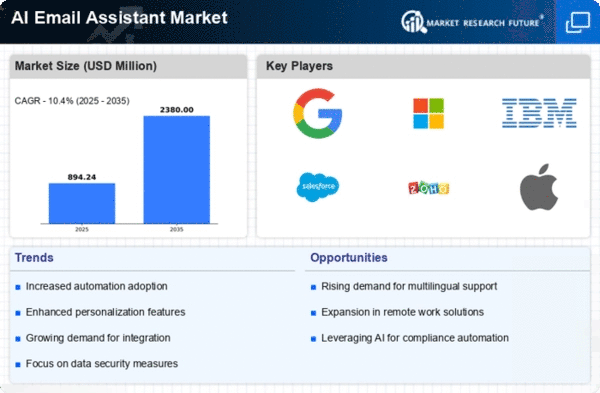
As per MRFR analysis, the AI Email Assistant Market Size was estimated at 810.0 USD Million in 2024. The AI Email Assistant industry is projected to grow from 880.0 in 2025 to 2380.0 by 2035, exhibiting a compound annual growth rate (CAGR) of 10.4 during the forecast period 2025 - 2035.

Key Market Trends & Highlights

The AI Email Assistant Market is experiencing robust growth driven by automation and integration trends.

  • The market is witnessing increased automation in email management, enhancing operational efficiency.
  • Enhanced personalization features are becoming a focal point, catering to diverse user preferences.
  • Integration with other digital tools is on the rise, facilitating seamless workflows across platforms.
  • Rising demand for efficiency in communication and advancements in natural language processing are key drivers, particularly in North America and among small enterprises.

Market Size & Forecast

2024 Market Size 810.0 (USD Million)
2035 Market Size 2380.0 (USD Million)
CAGR (2025 - 2035) 10.4%

Major Players

Google (US), Microsoft (US), IBM (US), Salesforce (US), Zoho (IN), Apple (US), Amazon (US), SAP (DE), Oracle (US)

Our Impact
Enabled $4.3B Revenue Impact for Fortune 500 and Leading Multinationals
Partnering with 2000+ Global Organizations Each Year
30K+ Citations by Top-Tier Firms in the Industry

AI Email Assistant Market Trends

The AI Email Assistant Market is currently experiencing a notable evolution, driven by advancements in artificial intelligence and machine learning technologies. Organizations are increasingly adopting these tools to enhance productivity and streamline communication processes. The integration of AI capabilities into email management systems allows for improved organization, prioritization, and response generation, which appears to be appealing to businesses seeking efficiency. Furthermore, the growing emphasis on remote work and digital collaboration has likely accelerated the demand for intelligent email solutions, as teams require effective tools to manage their communications seamlessly. In addition, the AI Email Assistant Market seems to be influenced by the rising need for personalized customer interactions. Companies are recognizing the importance of tailoring communication to meet individual preferences, which AI tools can facilitate through data analysis and user behavior insights. This trend indicates a shift towards more sophisticated email management systems that not only automate tasks but also enhance user experience. As the market continues to evolve, it may witness further innovations that address emerging challenges in communication, ultimately shaping the future landscape of email management.

Increased Automation in Email Management

The trend towards automation in email management is becoming more pronounced. AI Email Assistants are increasingly capable of handling routine tasks such as sorting, filtering, and responding to emails. This automation allows users to focus on more strategic activities, thereby enhancing overall productivity.

Enhanced Personalization Features

There is a growing emphasis on personalization within the AI Email Assistant Market. These tools are evolving to provide tailored responses and suggestions based on user behavior and preferences. This shift towards personalized communication is likely to improve user engagement and satisfaction.

Integration with Other Digital Tools

AI Email Assistants are increasingly being integrated with various digital platforms and applications. This trend facilitates seamless workflows, allowing users to manage emails alongside other tasks such as project management and customer relationship management, thereby streamlining overall operations.

AI Email Assistant Market Drivers

Rising Demand for Automation

The Global AI Email Assistant Market Industry experiences a notable surge in demand for automation solutions. Businesses increasingly seek to streamline communication processes, thereby enhancing productivity and efficiency. The integration of AI-driven email assistants allows organizations to automate routine tasks such as scheduling, follow-ups, and sorting emails. This trend is expected to contribute to the market's growth, with projections indicating a market value of 0.86 USD Billion in 2024. As companies recognize the potential of AI to reduce operational costs and improve response times, the adoption of these technologies is likely to accelerate.

Market Segment Insights

By Application: Email Management (Largest) vs. Sales Automation (Fastest-Growing)

In the AI Email Assistant Market, the application segment showcases a diverse distribution among its values. Email Management stands out as the largest segment, dominating the market due to its essential role in organizing and prioritizing email correspondence for users. Closely following, Productivity Enhancement also plays a significant role as businesses increasingly focus on improving efficiency. Meanwhile, Customer Support and Sales Automation are gaining traction, emphasizing the need for automated solutions that can handle vast quantities of inquiries and streamline sales processes.

Email Management: Dominant vs. Sales Automation: Emerging

Email Management, being the dominant player in the AI Email Assistant Market, provides robust functionalities such as sorting, filtering, and prioritizing emails, ensuring that users can focus on critical communications. The integration of AI technologies enhances user interaction by learning preferences and behaviors, thereby increasing efficiency. In contrast, Sales Automation represents an emerging force, quickly gaining popularity as businesses adopt AI-driven solutions to manage leads and automate follow-ups. This sector's rapid growth is fueled by the increasing need for sales teams to operate efficiently in a competitive landscape, where timely responses and automation of repetitive tasks are paramount.

By End Use: Small Enterprises (Largest) vs. Large Enterprises (Fastest-Growing)

In the AI Email Assistant Market, the distribution of market share among end-users showcases a significant inclination towards small enterprises, which currently hold the largest share. These entities often seek cost-effective solutions to enhance their operations. Meanwhile, large enterprises are emerging as the fastest-growing segment, reflecting a shift in their strategy towards improved operational efficiency through AI-driven solutions. The growth trends indicate strong demand from both segments, driven by the increasing necessity for personalized communication and automation in business processes. Small enterprises prioritize affordability and ease of use, while large enterprises focus on advanced features and integrations. As technology continues to evolve, both segments are expected to converge in seeking comprehensive AI solutions.

Small Enterprises: Dominant vs. Large Enterprises: Emerging

Small enterprises in the AI Email Assistant Market demonstrate a strong dominance, primarily due to their need for accessible and economical solutions to streamline communication. These enterprises often benefit from enhanced productivity, allowing them to compete effectively in a crowded marketplace. On the other hand, large enterprises are emerging as a vital segment, increasingly adopting AI email assistants to harness data-driven insights and enhance customer engagement. While still in the growth phase, their demand for sophisticated features, such as integration with existing systems and analytics, highlights the ongoing evolution in AI solutions. This dynamic indicates a robust growth potential for large enterprises as they move towards advanced automation.

By Deployment Type: Cloud-Based (Largest) vs. On-Premises (Fastest-Growing)

The AI Email Assistant Market has witnessed a significant distribution of market share among its deployment types. Cloud-Based solutions dominate the landscape due to their scalability, ease of access, and integration capabilities. These solutions have become the preferred choice for businesses seeking efficiency and flexibility in managing email correspondence. Conversely, On-Premises deployment is capturing attention as organizations increasingly desire more control over their data and processes, accounting for a growing share of the market. Growth trends in the AI Email Assistant segment indicate a vibrant shift driven by evolving business needs. The demand for Cloud-Based solutions continues to surge as remote and hybrid work models gain traction, offering users seamless access to AI capabilities. However, the On-Premises segment is emerging rapidly, fueled by heightened concerns over data security and compliance. As a result, companies are weighing their options carefully, balancing the advantages of flexibility against the desire for greater data control.

AI Email Assistant: Cloud-Based (Dominant) vs. On-Premises (Emerging)

In the AI Email Assistant Market, Cloud-Based solutions are recognized as the dominant force, offering unparalleled advantages in accessibility and user experience. These platforms utilize advanced algorithms to enhance email management, automate responses, and improve organizational efficiency. The trend towards remote work has further solidified their market position. In contrast, On-Premises solutions are emerging, appealing to businesses that prioritize data sovereignty and security. These systems provide tailored configurations and are aligned with stringent compliance requirements, attracting industries with significant regulatory obligations. As businesses navigate their digital transformation journeys, the choice between these deployment types will shape the future landscape of the AI Email Assistant segment.

By User Type: Individual Users (Largest) vs. Business Users (Fastest-Growing)

In the AI Email Assistant Market, the distribution of user types reveals significant insights. Individual Users are currently the largest segment, representing a substantial portion of the market as more individuals seek personal productivity tools to manage their daily communications efficiently. Business Users follow closely, demonstrating a growing trend as companies increasingly invest in AI-driven solutions to enhance productivity and streamline email management, indicating that the AI Email Assistant is becoming a critical tool for efficient business operations.

Individual Users (Dominant) vs. Business Users (Emerging)

Individual Users dominate the AI Email Assistant Market, characterized by a desire for personalized and user-friendly solutions that enhance day-to-day communication. This segment values simplicity and accessibility, making AI email assistants appealing as they offer tailored suggestions and proactive organization features. On the other hand, Business Users are emerging rapidly, driven by the need for collaboration, efficiency, and advanced functionalities. They seek comprehensive tools that can integrate seamlessly with existing workflows and enhance team productivity. As these two segments evolve, the distinction between personal and organizational needs will continue to shape the market dynamics.

By Integration Type: API Integration (Largest) vs. Native Integration (Fastest-Growing)

In the AI Email Assistant Market, the distribution of market share among integration types reveals a significant preference for API Integration, which is currently the largest segment. This type thrives due to its versatility and capability of connecting with various platforms seamlessly, making it popular among businesses seeking efficiency. However, Native Integration is gaining traction rapidly, appealing to companies that prefer solutions tightly integrated with their existing systems for optimal performance and user experience. Growth trends indicate a rising demand for Native Integration, driven by the need for personalized and streamlined communication within organizations. As more businesses recognize the importance of engaging experiences, native solutions are emerging as vital for enhancing user satisfaction. Furthermore, the increase in remote work has fueled the adoption of AI email assistants with integrated features, pushing the market towards more cohesive and efficient communication technologies.

API Integration (Dominant) vs. Third-Party Integration (Emerging)

API Integration stands out as a dominant force within the AI Email Assistant Market, offering unparalleled flexibility and adaptability to diverse systems. Businesses leveraging API Integration can achieve seamless communication between various applications, leading to enhanced workflow efficiencies. In contrast, Third-Party Integration, while emerging, is gradually gaining attention for its ability to provide additional functionalities and features from external vendors. This segment appeals to businesses that seek to augment their existing email solutions without significant investments in custom development. As the demand for email assistants that can easily integrate with various software rises, both segments are expected to carve out unique niches, with API Integration catering to customization seekers and Third-Party Integration appealing to those looking for quick enhancements.

Get more detailed insights about AI Email Assistant Market

Regional Insights

North America : Market Leader in AI Solutions

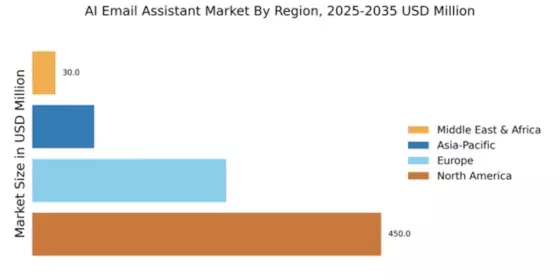
North America continues to lead the AI Email Assistant market, holding a significant share of 450.0M in 2025. The region's growth is driven by rapid technological advancements, increasing demand for automation, and a strong focus on enhancing customer experience. Regulatory support for AI innovations further catalyzes market expansion, making it a hub for AI development and deployment. The competitive landscape is dominated by major players such as Google, Microsoft, and IBM, all based in the US. These companies are continuously innovating to enhance their offerings, ensuring they meet the evolving needs of businesses. The presence of these tech giants fosters a robust ecosystem, attracting startups and smaller firms, which contribute to a dynamic market environment.

Europe : Emerging AI Market Dynamics

Europe's AI Email Assistant market is projected to reach 250.0M by 2025, driven by increasing digitalization and a growing emphasis on data privacy regulations. The region's commitment to fostering innovation through supportive policies and funding initiatives is a key growth driver. Additionally, the demand for AI solutions in customer service and communication is on the rise, further propelling market growth. Leading countries such as Germany, the UK, and France are at the forefront of this market, with companies like SAP and Oracle making significant contributions. The competitive landscape is characterized by a mix of established firms and emerging startups, all vying for market share. The European market is also witnessing collaborations and partnerships aimed at enhancing AI capabilities in email management.

Asia-Pacific : Rapidly Growing AI Sector

The Asia-Pacific region is witnessing a burgeoning AI Email Assistant market, projected to reach 80.0M by 2025. This growth is fueled by increasing internet penetration, a surge in mobile device usage, and a growing preference for automated solutions in business communications. Governments in the region are also promoting AI adoption through various initiatives and funding programs, creating a conducive environment for market expansion. Countries like India and China are emerging as key players, with companies such as Zoho leading the charge in AI email solutions. The competitive landscape is evolving, with both local and international firms striving to capture market share. The presence of a young, tech-savvy population further drives demand for innovative AI solutions in the region, making it a hotspot for investment and development.

Middle East and Africa : Developing AI Landscape

The Middle East and Africa (MEA) region is gradually developing its AI Email Assistant market, expected to reach 30.0M by 2025. The growth is primarily driven by increasing digital transformation initiatives and a rising demand for efficient communication tools. Governments are recognizing the potential of AI and are implementing strategies to foster innovation and attract investment in technology sectors. Countries like South Africa and the UAE are leading the way in AI adoption, with various initiatives aimed at enhancing digital infrastructure. The competitive landscape is still in its nascent stages, with opportunities for both local and international players to establish a foothold. As businesses increasingly seek to improve operational efficiency, the demand for AI email solutions is set to rise significantly in this region.


AI Email Assistant Market Regional Image

Key Players and Competitive Insights

The AI Email Assistant Market is currently characterized by intense competition and rapid innovation, driven by the increasing demand for automation and efficiency in communication. Major players such as Google (US), Microsoft (US), and Salesforce (US) are at the forefront, leveraging their technological prowess to enhance user experience and streamline email management. Google (US) focuses on integrating AI capabilities into its Gmail platform, emphasizing user-friendly features that enhance productivity. Meanwhile, Microsoft (US) is enhancing its Outlook service with advanced AI functionalities, aiming to create a seamless user experience across its Office suite. Salesforce (US) is strategically positioning itself by incorporating AI-driven insights into its customer relationship management (CRM) tools, thereby enhancing the overall value proposition for businesses. Collectively, these strategies indicate a competitive landscape that is increasingly defined by technological innovation and user-centric solutions.The market structure appears moderately fragmented, with a mix of established players and emerging startups. Key business tactics include localizing services to cater to diverse regional needs and optimizing supply chains to ensure rapid deployment of AI solutions. The influence of major companies is substantial, as they not only set industry standards but also drive the pace of technological advancements. This competitive dynamic fosters an environment where continuous improvement and adaptation are essential for survival.
In November Google (US) announced the launch of a new AI feature in Gmail that utilizes machine learning to predict and suggest email responses based on user behavior. This strategic move is significant as it enhances user engagement and streamlines communication, potentially increasing user retention and satisfaction. By focusing on predictive capabilities, Google (US) reinforces its commitment to innovation and user-centric design, which may further solidify its market leadership.
In October Microsoft (US) unveiled a partnership with a leading AI research firm to develop next-generation email filtering systems that utilize natural language processing (NLP). This collaboration is crucial as it aims to improve spam detection and enhance the overall email experience for users. By investing in advanced AI technologies, Microsoft (US) positions itself as a forward-thinking leader in the market, likely attracting more enterprise clients seeking robust email solutions.
In September Salesforce (US) expanded its AI capabilities by integrating a new feature that allows users to automate email follow-ups based on customer interactions. This strategic enhancement is indicative of Salesforce's focus on improving customer engagement and operational efficiency. By automating routine tasks, Salesforce (US) not only increases productivity for its users but also strengthens its competitive edge in the CRM space, where email communication plays a pivotal role.
As of December the competitive trends in the AI Email Assistant Market are increasingly shaped by digitalization, sustainability, and the integration of AI technologies. Strategic alliances among key players are fostering innovation and enhancing service offerings, which is crucial in a landscape that demands rapid adaptation. The shift from price-based competition to a focus on technological differentiation and supply chain reliability is evident. Companies that prioritize innovation and user experience are likely to thrive, as the market continues to evolve towards more sophisticated and integrated solutions.

Key Companies in the AI Email Assistant Market include

Industry Developments

  • Q2 2024: Superhuman launches AI-powered email assistant to automate inbox management Superhuman announced the launch of its new AI-powered email assistant, designed to help users automate inbox management tasks such as sorting, prioritizing, and drafting responses. The product leverages advanced natural language processing to improve productivity for professionals.
  • Q2 2024: Google introduces Gemini AI features to Gmail for smarter email composition and summarization Google unveiled new Gemini AI features for Gmail, enabling users to compose, summarize, and respond to emails more efficiently using generative AI. The rollout is part of Google's broader push to integrate AI assistants across its productivity suite.
  • Q2 2024: Microsoft expands Copilot for Outlook with advanced email assistant capabilities Microsoft announced an expansion of Copilot for Outlook, adding advanced AI email assistant features such as automated scheduling, smart replies, and contextual summarization. The update aims to streamline email workflows for enterprise users.
  • Q3 2024: Sanebox secures $10 million Series B funding to scale AI email assistant platform Sanebox raised $10 million in Series B funding to accelerate development and market expansion of its AI-powered email assistant platform, which helps users declutter inboxes and automate routine email tasks.
  • Q3 2024: Slack partners with OpenAI to launch integrated AI email assistant for enterprise messaging Slack announced a partnership with OpenAI to launch an integrated AI email assistant, enabling users to manage emails and messages within the Slack platform using generative AI for drafting, summarizing, and prioritizing communications.
  • Q3 2024: Front launches AI email assistant to automate customer support inboxes Front introduced a new AI email assistant feature aimed at automating customer support inboxes, allowing teams to triage, respond, and resolve email queries faster using machine learning and natural language understanding.
  • Q4 2024: Hiver unveils AI email assistant for Google Workspace users Hiver launched an AI email assistant for Google Workspace, offering automated email categorization, smart replies, and workflow suggestions to help teams manage shared inboxes more efficiently.
  • Q4 2024: Zoho Mail integrates AI assistant for automated email sorting and response Zoho Mail announced the integration of an AI assistant to automate email sorting, suggest responses, and flag important messages, enhancing productivity for business users.
  • Q1 2025: Mailbutler secures $5 million Series A funding to expand AI email assistant capabilities Mailbutler raised $5 million in Series A funding to further develop its AI email assistant, focusing on features such as smart scheduling, automated follow-ups, and personalized email recommendations.
  • Q1 2025: Missive launches AI-powered email assistant for collaborative inbox management Missive released a new AI-powered email assistant designed to help teams collaborate on inbox management, automate repetitive tasks, and improve response times using machine learning.
  • Q2 2025: Gmail adds regulatory-compliant AI email assistant for enterprise customers Google announced the launch of a regulatory-compliant AI email assistant for Gmail enterprise customers, featuring enhanced privacy controls and automated compliance checks for sensitive communications.
  • Q2 2025: Outlook partners with Anthropic to integrate Claude AI assistant for smarter email management Microsoft Outlook partnered with Anthropic to integrate the Claude AI assistant, providing users with advanced email management tools such as contextual summarization, smart replies, and automated prioritization.

Future Outlook

AI Email Assistant Market Future Outlook

The AI Email Assistant Market is projected to grow at a 10.4% CAGR from 2025 to 2035, driven by advancements in natural language processing and increasing demand for automation.

New opportunities lie in:

  • Integration of AI email assistants with CRM systems for enhanced customer engagement. Development of multilingual support features to capture global markets. Creation of customizable AI solutions tailored for specific industry needs.

By 2035, the AI Email Assistant Market is expected to be robust, reflecting substantial growth and innovation.

Market Segmentation

AI Email Assistant Market End Use Outlook

  • Small Enterprises
  • Medium Enterprises
  • Large Enterprises

AI Email Assistant Market User Type Outlook

  • Individual Users
  • Business Users
  • Enterprise Users

AI Email Assistant Market Application Outlook

  • Email Management
  • Productivity Enhancement
  • Customer Support
  • Sales Automation

AI Email Assistant Market Deployment Type Outlook

  • Cloud-Based
  • On-Premises

AI Email Assistant Market Integration Type Outlook

  • API Integration
  • Third-Party Integration
  • Native Integration

Report Scope

MARKET SIZE 2024 810.0(USD Million)
MARKET SIZE 2025 880.0(USD Million)
MARKET SIZE 2035 2380.0(USD Million)
COMPOUND ANNUAL GROWTH RATE (CAGR) 10.4% (2025 - 2035)
REPORT COVERAGE Revenue Forecast, Competitive Landscape, Growth Factors, and Trends
BASE YEAR 2024
Market Forecast Period 2025 - 2035
Historical Data 2019 - 2024
Market Forecast Units USD Million
Key Companies Profiled Google (US), Microsoft (US), IBM (US), Salesforce (US), Zoho (IN), Apple (US), Amazon (US), SAP (DE), Oracle (US)
Segments Covered Application, End Use, Deployment Type, User Type, Integration Type
Key Market Opportunities Integration of advanced natural language processing enhances user experience in the AI Email Assistant Market.
Key Market Dynamics Rising demand for automation drives innovation and competition in the AI Email Assistant market.
Countries Covered North America, Europe, APAC, South America, MEA

Market Highlights

Author
Aarti Dhapte
Team Lead - Research

She holds an experience of about 6+ years in Market Research and Business Consulting, working under the spectrum of Information Communication Technology, Telecommunications and Semiconductor domains. Aarti conceptualizes and implements a scalable business strategy and provides strategic leadership to the clients. Her expertise lies in market estimation, competitive intelligence, pipeline analysis, customer assessment, etc.

Leave a Comment

FAQs

How much is the AI Email Assistant market?

The global AI Email Assistant market was valued at USD 0.71 Billion in 2022.

What is the growth rate of the AI Email Assistant market?

The global market is projected to grow at a CAGR of 10.4% during the forecast period, 2023-2032.

Which region held the largest market share in the AI Email Assistant market?

North America had the largest share of the global market.

Who are the key players in the AI Email Assistant market?

The key players in the market are Mailbutler, SmartWriter, Lyne.ai, Boomerang, Flowrite, Missive, Compose.ai, Nanonets, Lavender, SaneBox., and Others.

Download Free Sample

Kindly complete the form below to receive a free sample of this Report

Compare Licence

×
Features License Type
Single User Multiuser License Enterprise User
Price $4,950 $5,950 $7,250
Maximum User Access Limit 1 User Upto 10 Users Unrestricted Access Throughout the Organization
Free Customization
Direct Access to Analyst
Deliverable Format
Platform Access
Discount on Next Purchase 10% 15% 15%
Printable Versions