×
Request Free Sample ×

Kindly complete the form below to receive a free sample of this Report

* Please use a valid business email

Leading companies partner with us for data-driven Insights

clients tt-cursor
Hero Background

Aerospace Actuators Market

ID: MRFR/AD/26908-CR
200 Pages
Sejal Akre
September 2024

Aerospace Actuators Market Size, Share, Industry Trend & Analysis Research Report By Application (Commercial Aviation, Military Aviation, Space Exploration, Unmanned Aerial Vehicles), By Type (Electrical Actuators, Hydraulic Actuators, Pneumatic Actuators), By Mechanism (Linear Actuators, Rotary Actuators, Complex Multi-Function Actuators), By End-use (Original Equipment Manufacturers, Aftermarket), and By Regional (North America, Europe, South America, Asia Pacific, Middle East and Africa)-Forecast to 2035

Share:
Download PDF ×

We do not share your information with anyone. However, we may send you emails based on your report interest from time to time. You may contact us at any time to opt-out.

Aerospace Actuators Market Infographic
Purchase Options

Aerospace Actuators Market Summary

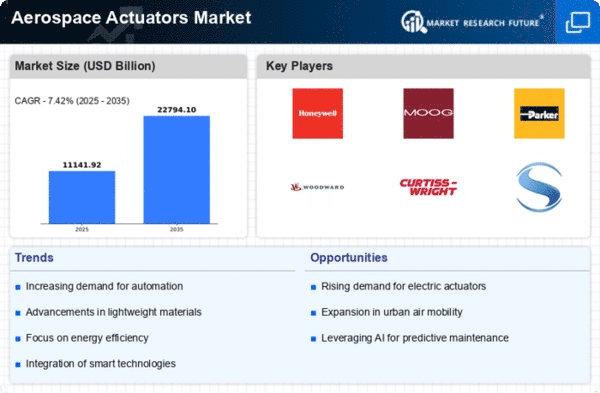
As per MRFR analysis, the Aerospace Actuators Market Size was estimated at 10372.3 USD Billion in 2024. The Aerospace Actuators industry is projected to grow from 11141.95 USD Billion in 2025 to 22794.1 USD Billion by 2035, exhibiting a compound annual growth rate (CAGR) of 7.42 during the forecast period 2025 - 2035.

Key Market Trends & Highlights

The Aerospace Actuators Market is poised for substantial growth driven by technological advancements and a shift towards sustainability.

  • North America remains the largest market for aerospace actuators, driven by robust demand in commercial aviation.
  • The Asia-Pacific region is emerging as the fastest-growing market, fueled by increasing investments in military aviation.
  • Flight control systems dominate the market, while landing gear systems are experiencing rapid growth due to innovation.
  • Key market drivers include the shift towards electric actuators and the increasing demand for unmanned aerial vehicles (UAVs).

Market Size & Forecast

2024 Market Size 10372.3 (USD Billion)
2035 Market Size 22794.1 (USD Billion)
CAGR (2025 - 2035) 7.42%

Major Players

Honeywell (US), Moog Inc. (US), Parker Hannifin (US), Woodward Inc. (US), Curtiss-Wright (US), Safran (FR), Thales Group (FR), Boeing (US), Raytheon Technologies (US)

Our Impact
Enabled $4.3B Revenue Impact for Fortune 500 and Leading Multinationals
Partnering with 2000+ Global Organizations Each Year
30K+ Citations by Top-Tier Firms in the Industry

Aerospace Actuators Market Trends

Aerospace Actuators

Aerospace Actuators Market Drivers

Market Growth Projections

The Global aerospace actuators Market Industry is poised for substantial growth, with projections indicating an increase from 10.7 USD Billion in 2024 to 15.5 USD Billion by 2035. This growth trajectory is underpinned by a compound annual growth rate of 3.45% from 2025 to 2035. The market dynamics are shaped by various factors, including technological advancements, regulatory compliance, and the expanding military and commercial aerospace sectors. As the industry evolves, stakeholders are likely to focus on innovation and efficiency to capitalize on emerging opportunities, ensuring sustained growth in the coming years.

Growing Military Aerospace Sector

The military aerospace sector represents a substantial driver for the Global Aerospace Actuators Market Industry. Increased defense budgets and modernization programs across various nations are fueling demand for advanced actuator systems in military aircraft. These systems are critical for enhancing maneuverability, control, and overall operational effectiveness. For example, the integration of advanced actuators in unmanned aerial vehicles (UAVs) and fighter jets is becoming increasingly prevalent. As governments prioritize defense capabilities, the military aerospace segment is expected to contribute significantly to the market's growth, aligning with the overall industry expansion projected to reach 15.5 USD Billion by 2035.

Emerging Markets and Globalization

Emerging markets are becoming increasingly influential in the Global Aerospace Actuators Market Industry, driven by globalization and rising air travel demand. Countries in Asia-Pacific and Latin America are witnessing rapid growth in their aerospace sectors, leading to increased investments in actuator technologies. For instance, the expansion of low-cost carriers in these regions is driving the need for efficient and reliable actuator systems. As these markets develop, they present lucrative opportunities for actuator manufacturers, contributing to the industry's projected growth. The Global Aerospace Actuators Market is expected to reach 15.5 USD Billion by 2035, reflecting the impact of these emerging economies.

Increasing Demand for Lightweight Aircraft

The Global Aerospace Actuators Market Industry experiences a notable surge in demand for lightweight aircraft, driven by the aviation sector's focus on fuel efficiency and reduced emissions. Aircraft manufacturers are increasingly adopting advanced materials and technologies to minimize weight, which directly influences actuator design and functionality. For instance, the integration of composite materials in actuator systems enhances performance while reducing overall weight. This trend is projected to contribute to the market's growth, with the industry valued at 10.7 USD Billion in 2024 and expected to reach 15.5 USD Billion by 2035, reflecting a compound annual growth rate of 3.45% from 2025 to 2035.

Regulatory Compliance and Safety Standards

The Global Aerospace Actuators Market Industry is significantly influenced by stringent regulatory compliance and safety standards imposed by aviation authorities worldwide. These regulations necessitate the incorporation of advanced actuator systems that meet safety and performance benchmarks. Manufacturers are compelled to invest in high-quality actuator technologies to ensure compliance, thereby driving market growth. For instance, the Federal Aviation Administration (FAA) and the European Union Aviation Safety Agency (EASA) enforce rigorous testing and certification processes for aerospace components. This regulatory landscape fosters innovation and enhances the demand for sophisticated actuators, contributing to the industry's anticipated growth trajectory.

Technological Advancements in Actuator Systems

Technological advancements play a pivotal role in shaping the Global Aerospace Actuators Market Industry. Innovations such as smart actuators, which incorporate sensors and control systems, enhance the precision and reliability of aircraft operations. These advancements not only improve safety but also optimize performance, leading to increased adoption by manufacturers. For example, the development of electro-mechanical actuators offers advantages over traditional hydraulic systems, including reduced maintenance and improved energy efficiency. As these technologies continue to evolve, they are likely to drive market growth, aligning with the industry's projected value increase to 15.5 USD Billion by 2035.


Market Segment Insights

By Application: Flight Control Systems (Largest) vs. Landing Gear Systems (Fastest-Growing)

The Aerospace Actuators Market displays diverse applications including Flight Control Systems, Landing Gear Systems, Thrust Vector Control, Environmental Control Systems, and Cargo Door Actuation. Among these, Flight Control Systems holds the largest market share, attributed to its critical role in ensuring aircraft maneuverability and stability. In contrast, Landing Gear Systems are emerging as the fastest-growing segment, driven by advancements in technology aimed at enhancing safety features and operational efficiency in aviation.

Flight Control Systems (Dominant) vs. Landing Gear Systems (Emerging)

Flight Control Systems are pivotal in regulating the aircraft's movements, encompassing a range of components such as ailerons, rudders, and elevators that provide directional control. This segment remains dominant due to its established technology and significant investment in R&D for improved precision and safety. On the other hand, Landing Gear Systems, while traditionally less emphasized, are seeing robust growth as innovations focus on weight reduction and enhanced durability. This segment has gained momentum from the increasing demand for efficient landing and takeoff mechanisms, making it a crucial area of investment for aerospace manufacturers.

By End Use: Commercial Aviation (Largest) vs. Military Aviation (Fastest-Growing)

The Aerospace Actuators Market has diverse applications across various end-use segments, with commercial aviation commanding the largest market share. This segment is driven by the rising global demand for air travel, leading to an increase in commercial aircraft production. On the other hand, military aviation is witnessing robust growth, attributed to the modernization of defense systems and increased defense budgets across many nations. This situation is creating a competitive landscape with significant opportunities in both sectors. In recent years, commercial aviation has been influenced by the resurgence in passenger traffic and the expansion of air fleets, which require advanced actuator systems for enhanced performance and safety. Conversely, military aviation is experiencing a surge due to the integration of advanced technologies such as drones and next-generation fighter jets, which rely heavily on innovative actuation systems for precise control and efficiency. The future outlook for these segments appears promising, with further advancements expected to drive the market further.

Commercial Aviation (Dominant) vs. Military Aviation (Emerging)

Commercial aviation remains the dominant force in the Aerospace Actuators Market, characterized by its vast and diverse fleet of aircraft, ranging from regional to long-haul jets. This segment emphasizes reliability and safety, which are critical for passenger comfort and operational efficiency. Manufacturers focus on developing lightweight, high-performance actuators that can withstand rigorous operational demands and enhance fuel efficiency. On the other hand, military aviation is an emerging segment that showcases rapid growth, driven by technological advancements and the need for upgraded defense capabilities. Military aircraft, including advanced fighters and transport planes, require precise and robust actuator systems that can operate under extreme conditions. The increasing focus on unmanned aerial vehicles (UAVs) also plays a significant role in evolving the military actuator market, marking it as a key area for innovation and investment.

By Actuator Type: Electric Actuators (Largest) vs. Hydraulic Actuators (Fastest-Growing)

In the Aerospace Actuators Market, Electric Actuators currently present the largest market share due to their efficiency and precision in control systems. They are widely adopted in various aircraft systems, contributing significantly to fuel savings and operational effectiveness. In comparison, Hydraulic Actuators, while historically dominant, are experiencing a resurgence in certain applications, aided by advancements in technology that enhance their performance and reliability. The growth trends in this segment are driven by innovations in actuator technologies, focusing on improving weight efficiency and energy consumption. Electric Actuators are increasingly favored for their ability to integrate with modern electronic systems. Meanwhile, Hydraulic Actuators are witnessing faster growth, mainly in applications that require high force outputs, indicating a balanced evolution between both types.

Electric Actuators (Dominant) vs. Hydraulic Actuators (Emerging)

Electric Actuators are distinguished by their lightweight design and high efficiency, making them ideal for modern aerospace applications. Their ability to provide precise control and reduce maintenance needs enhances their appeal among manufacturers and operators alike. Meanwhile, Hydraulic Actuators, while traditionally seen as heavy and complex, have adapted to innovative engineering solutions, making them suitable for high-load situations. This has revitalized their presence in the market. Companies that invest in advanced hydraulic systems are witnessing an emergence in applications requiring robust performance, enabling them to compete effectively in the evolving aerospace landscape.

By Technology: Position Control Technology (Largest) vs. Smart Actuation Technology (Fastest-Growing)

In the Aerospace Actuators Market, Position Control Technology holds a significant share, being the largest segment due to its essential role in positioning various components within aircraft systems. It has been widely adopted for its accuracy and reliability, catering to the demands of modern aerospace applications. Conversely, Smart Actuation Technology stands out as the fastest-growing segment, fueled by advancements in automation and digitalization in aerospace engineering. This technology integrates sensors and IoT capabilities, promoting enhanced performance and operational efficiency.

Actuation Technologies: Position Control (Dominant) vs. Smart Actuation (Emerging)

Position Control Technology has established its dominance in the aerospace sector by enabling precise positioning of aircraft surfaces and systems, crucial for flight safety and efficiency. It is widely utilized in applications like flap and rudder control. On the other hand, Smart Actuation Technology is emerging rapidly, characterized by its integration with advanced control algorithms and real-time data feedback systems. This technology enhances responsiveness and adaptability in aerospace applications, making it a key area for future developments. The convergence of AI and machine learning with actuation technology is expected to drive its growth further, making it an attractive focus for companies looking to innovate in the aerospace industry.

By Material: Aluminum Alloys (Largest) vs. Composite Materials (Fastest-Growing)

In the Aerospace Actuators Market, Aluminum Alloys hold the largest share due to their favorable strength-to-weight ratio and excellent corrosion resistance. They are widely utilized in actuator applications, contributing significantly to overall performance and reliability. Composite Materials, while having a smaller share compared to aluminum, are rapidly gaining traction due to advancements in manufacturing techniques and their lightweight, high-strength characteristics. This has led to increased adoption in modern aerospace designs, where minimizing weight without compromising performance is crucial. The growth trends in this segment are driven by the increasing demand for lightweight and fuel-efficient aircraft. Aluminum Alloys continue to dominate due to established manufacturing practices and significant industry acceptance. On the other hand, Composite Materials are considered the fastest-growing segment, propelled by innovations in material science, reducing production costs, and improvements in supply chain efficiencies. As aerospace manufacturers gravitate towards sustainable and efficient solutions, both materials will play pivotal roles in shaping future aircraft designs.

Material: Aluminum Alloys (Dominant) vs. Composite Materials (Emerging)

Aluminum Alloys are recognized as the dominant material in the Aerospace Actuators Market, primarily due to their lightweight properties, high strength, and excellent machinability. These alloys provide the necessary durability and performance needed in highly demanding aerospace environments, making them the material of choice for various actuator components. However, Composite Materials are emerging as significant contenders in the market, offering even lighter weight and enhanced design flexibility. As they continue to undergo technological advancements, such as improved manufacturing processes and better integration techniques, Composite Materials are poised to increase their market share, appealing to manufacturers focused on innovation and efficiency in aircraft design. This competition between established and emerging materials highlights the ongoing evolution within the aerospace sector.

Get more detailed insights about Aerospace Actuators Market

Regional Insights

North America : Market Leader in Aerospace Actuators

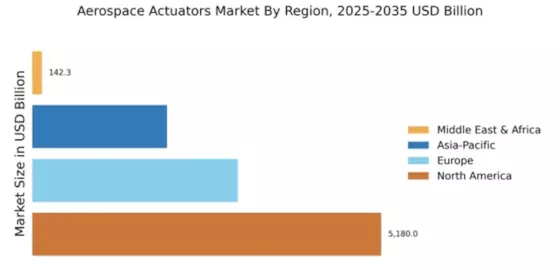
North America continues to lead the Aerospace Actuators Market, holding a significant share of 5180.0. The region's growth is driven by increasing defense budgets, advancements in aerospace technology, and a robust demand for commercial aircraft. Regulatory support from agencies like the FAA enhances safety standards, further propelling market expansion. The focus on innovation and sustainability is also shaping demand trends, with a shift towards electric and hybrid actuators. The competitive landscape in North America is characterized by the presence of major players such as Honeywell, Moog Inc., and Parker Hannifin. These companies are investing heavily in R&D to develop advanced actuator systems that meet the evolving needs of the aerospace sector. The U.S. remains the leading country, with a strong emphasis on military and commercial aviation, while Canada is also emerging as a key player in the aerospace supply chain.

Europe : Growing Market with Innovation Focus

Europe's Aerospace Actuators Market is projected to reach 2900.0, driven by increasing investments in aerospace infrastructure and a growing demand for fuel-efficient aircraft. The region benefits from stringent regulatory frameworks that promote safety and innovation, such as the European Union Aviation Safety Agency (EASA) regulations. These regulations encourage the adoption of advanced technologies, including electric actuators, which are becoming increasingly popular in new aircraft designs. Leading countries in this region include France, Germany, and the UK, where major players like Safran and Thales Group are headquartered. The competitive landscape is marked by collaborations between manufacturers and research institutions to foster innovation. The presence of established aerospace companies and a strong supply chain further enhance Europe's position in the global market.

Asia-Pacific : Emerging Market with High Potential

The Asia-Pacific Aerospace Actuators Market is valued at 1800.0, reflecting a growing demand for air travel and an expanding aerospace industry. Key growth drivers include increasing disposable incomes, urbanization, and government initiatives to boost domestic manufacturing. Regulatory bodies in the region are also enhancing safety standards, which is expected to further stimulate market growth. The shift towards modernizing fleets with advanced actuator systems is a notable trend in this region. Countries like China, Japan, and India are leading the charge in aerospace development, with significant investments in both commercial and military aviation. The competitive landscape features local and international players, including Boeing and Raytheon Technologies, who are establishing partnerships to tap into the burgeoning market. The region's focus on innovation and technology adoption is set to drive future growth in the aerospace sector.

Middle East and Africa : Niche Market with Growth Opportunities

The Middle East and Africa Aerospace Actuators Market is valued at 492.3, with growth driven by increasing air travel and investments in aviation infrastructure. The region is witnessing a rise in demand for modern aircraft, supported by government initiatives to enhance connectivity and tourism. Regulatory frameworks are evolving to ensure safety and compliance, which is crucial for attracting foreign investments in the aerospace sector. Leading countries in this region include the UAE and South Africa, where there is a growing presence of both local and international aerospace companies. The competitive landscape is characterized by partnerships and collaborations aimed at enhancing technological capabilities. As the region continues to develop its aerospace industry, opportunities for growth in the actuator market are expected to expand significantly.

Aerospace Actuators Market Regional Image

Key Players and Competitive Insights

The Aerospace Actuators Market is currently characterized by a dynamic competitive landscape, driven by technological advancements and increasing demand for efficient flight control systems. Key players such as Honeywell (US), Moog Inc. (US), and Parker Hannifin (US) are strategically positioned to leverage innovation and operational excellence. Honeywell (US) focuses on enhancing its product portfolio through continuous research and development, while Moog Inc. (US) emphasizes strategic partnerships to expand its market reach. Parker Hannifin (US) is actively pursuing digital transformation initiatives to optimize its manufacturing processes, thereby enhancing its competitive edge. Collectively, these strategies contribute to a robust competitive environment, fostering innovation and efficiency across the sector.In terms of business tactics, companies are increasingly localizing manufacturing to reduce lead times and enhance supply chain resilience. The market structure appears moderately fragmented, with several key players exerting influence over various segments. This fragmentation allows for niche players to thrive, while larger corporations consolidate their positions through mergers and acquisitions, thereby shaping the overall competitive dynamics.

In November Honeywell (US) announced a strategic partnership with a leading aerospace manufacturer to co-develop next-generation actuators aimed at improving fuel efficiency. This collaboration is expected to enhance Honeywell's technological capabilities and expand its market presence, aligning with the growing emphasis on sustainability in aerospace design. The partnership signifies a proactive approach to addressing industry challenges and meeting evolving customer demands.

In October Moog Inc. (US) unveiled a new line of electric actuators designed for unmanned aerial vehicles (UAVs). This launch reflects Moog's commitment to innovation and its strategic focus on the burgeoning UAV market. By diversifying its product offerings, Moog positions itself to capture emerging opportunities in a rapidly evolving sector, potentially increasing its market share and reinforcing its competitive stance.

In September Parker Hannifin (US) completed the acquisition of a European actuator manufacturer, enhancing its capabilities in the aerospace sector. This acquisition not only broadens Parker's product range but also strengthens its foothold in the European market, allowing for greater operational synergies and improved customer service. The move underscores the importance of strategic acquisitions in maintaining competitive advantage in a fragmented market.

As of December current trends in the Aerospace Actuators Market indicate a pronounced shift towards digitalization, sustainability, and AI integration. Strategic alliances are increasingly shaping the competitive landscape, enabling companies to pool resources and expertise. Looking ahead, competitive differentiation is likely to evolve, with a greater emphasis on innovation and technology rather than price-based competition. The focus on supply chain reliability and advanced technological solutions will be paramount as companies navigate the complexities of the aerospace industry.

Key Companies in the Aerospace Actuators Market include

Industry Developments

Recent developments in the Aerospace Actuators Market indicate a robust growth trend due to increasing demand for reliable and efficient flight control systems. Companies like Moog and Raytheon Technologies are at the forefront of innovation, with significant investments in Research and Development aimed at enhancing actuator performance.

In October 2023, Honeywell announced advancements in its actuator technologies for both commercial and military applications, reflecting a shift towards smarter, more integrated systems. Current affairs also highlight the increasing focus on sustainability within the industry, as firms like GKN Aerospace and Safran are developing lightweight materials to improve fuel efficiency.

Notably, in June 2023, Curtiss-Wright Corporation acquired a specialized actuator manufacturer, bolstering its presence in the aerospace sector and expanding its product portfolio. Additionally, the global market valuation of aerospace actuators is projected to grow due to the recovery of the aviation sector post-pandemic, with Northrop Grumman and Boeing also poised to benefit from this trend.

In recent years, there has been a notable rise in cooperation among these leading firms to address common challenges, paving the way for enhanced functionality and performance of aerospace actuators.

Future Outlook

Aerospace Actuators Market Future Outlook

The Aerospace Actuators Market is projected to grow at a 7.42% CAGR from 2025 to 2035, driven by advancements in automation, increasing demand for fuel efficiency, and the rise of electric aircraft.

New opportunities lie in:

  • Development of smart actuators with integrated IoT capabilities for predictive maintenance.
  • Expansion into emerging markets with tailored actuator solutions for regional aircraft.
  • Partnerships with electric aircraft manufacturers to supply lightweight, high-efficiency actuators.

By 2035, the Aerospace Actuators Market is expected to be robust, driven by innovation and strategic partnerships.

Market Segmentation

Aerospace Actuators Market End Use Outlook

  • Commercial Aviation
  • Military Aviation
  • Business Aviation
  • Space Exploration

Aerospace Actuators Market Material Outlook

  • Aluminum Alloys
  • Titanium Alloys
  • Composite Materials
  • Steel Alloys

Aerospace Actuators Market Technology Outlook

  • Position Control Technology
  • Force Control Technology
  • Velocity Control Technology
  • Smart Actuation Technology

Aerospace Actuators Market Application Outlook

  • Flight Control Systems
  • Landing Gear Systems
  • Thrust Vector Control
  • Environmental Control Systems
  • Cargo Door Actuation

Aerospace Actuators Market Actuator Type Outlook

  • Electric Actuators
  • Hydraulic Actuators
  • Pneumatic Actuators
  • Mechanical Actuators

Report Scope

MARKET SIZE 202410372.3(USD Billion)
MARKET SIZE 202511141.95(USD Billion)
MARKET SIZE 203522794.1(USD Billion)
COMPOUND ANNUAL GROWTH RATE (CAGR)7.42% (2025 - 2035)
REPORT COVERAGERevenue Forecast, Competitive Landscape, Growth Factors, and Trends
BASE YEAR2024
Market Forecast Period2025 - 2035
Historical Data2019 - 2024
Market Forecast UnitsUSD Billion
Key Companies ProfiledHoneywell (US), Moog Inc. (US), Parker Hannifin (US), Woodward Inc. (US), Curtiss-Wright (US), Safran (FR), Thales Group (FR), Boeing (US), Raytheon Technologies (US)
Segments CoveredApplication, End Use, Actuator Type, Technology, Material
Key Market OpportunitiesIntegration of advanced materials and automation technologies enhances efficiency in the Aerospace Actuators Market.
Key Market DynamicsTechnological advancements and regulatory changes drive innovation and competition in the Aerospace Actuators Market.
Countries CoveredNorth America, Europe, APAC, South America, MEA
Leave a Comment

FAQs

What was the Market Was at a the Aerospace Actuators Market in 2024?

The Aerospace Actuators Market 10372.30 Billion USD by 2024

Download Free Sample

Kindly complete the form below to receive a free sample of this Report

Compare Licence

×
Features License Type
Single User Multiuser License Enterprise User
Price $4,950 $5,950 $7,250
Maximum User Access Limit 1 User Upto 10 Users Unrestricted Access Throughout the Organization
Free Customization
Direct Access to Analyst
Deliverable Format
Platform Access
Discount on Next Purchase 10% 15% 15%
Printable Versions