×
Request Free Sample ×

Kindly complete the form below to receive a free sample of this Report

* Please use a valid business email

Leading companies partner with us for data-driven Insights

clients tt-cursor
Hero Background
English
Chinese
French
Japanese
Korean
German
Spanish

Adenomyosis Treatment Market Share

ID: MRFR/Pharma/2331-HCR
76 Pages
Kinjoll Dey
October 2025

Adenomyosis Treatment Market Research Report Information By Type (Focal, Adenomyoma, Diffuse, and Others), By Diagnosis (Endometrial Biopsy, Ultrasound {Transabdominal, and Transvaginal/Endovaginal}, Magnetic Resonance Imaging (MRI), and Others), By Treatment (Anti-Inflammatory Drugs {Ibuprofen, Motrin IB, Advil, and Others}, Hormone Medications {Gonadotropin-Releasing Hormone (GnRH) Agonists, Aromatase Inhibitors, and Others}, Hysterectomy {Supracervial or Subtotal Hysterectomy, Total Hysterectomy, Radical Hysterectomy}, and Others) And By ... read more

Share:
Download PDF ×

We do not share your information with anyone. However, we may send you emails based on your report interest from time to time. You may contact us at any time to opt-out.

Adenomyosis Treatment Market Infographic
Purchase Options

Market Share

Adenomyosis Treatment Market Share Analysis

Adenomyosis Treatment Market is a competitive and vibrant landscape in which pharmaceutical companies are competing for strong market share positioning. Increasingly, adenomyosis, an abnormal tissue growth of the uterus, has become a focus for development of novel therapies by pharmaceutical firms. One strategic key determinant in this sector’s success for these businesses is the market share positioning strategy.

Differentiation is one of the commonly used strategies by pharmaceutical firms. Companies seek to make their adenomyosis treatments different from other competitors through developing unique delivery mechanisms or formulations. This may involve the introduction of new drugs that have improved effectiveness as compared to existing treatments or reduced side effects. Thus, they highlight these differences so as to attract both doctors treating patients and patients themselves thus increasing their share capitalization.

Collaboration and partnerships are also important aspects of market share positioning in the Adenomyosis Treatment Market. In some instances, companies enter into strategic alliances with academic institutions, research organizations or other drug manufacturing entities to pool resources as well as expertise. Such collaborations speed up the process of researching and developing new drugs while improving company reputation involved in such alliances. These enable such organizations are at the forefront of technological advancement while further strengthening their positions in this market.

Additionally pricing strategies play a vital role in determining market share position although they have implications on availability of drugs to diverse patient population sizes hence impacting profitability by pharmaceuticals companies. Competitive pricing, discounts and reimbursement programs are often applied with a view to attracting a wider customer base. Furthermore, enterprises can establish partnerships with care providers and insurance firms that would facilitate access to reasonably priced adenomyosis remedies; hence growing their markets.

Another factor that determines market share positioning on companies is geographic expansion .They typically focus either on areas characterized by high prevalence rates or those where there is already awareness about adenomyosis condition. By tailoring marketing approaches and distribution channels according to various regions’ unique requirements, drug makers can manage to have a strong presence in the key areas, and therefore consolidate their market share.

Besides that, it is also important to consider research and development as a strategy for maintaining competitive advantage in Adenomyosis Treatment Market. Consistently improving current treatment options, finding new therapeutic approaches and investing in state-of-the-art technologies enable a company remains ahead of competition. This means that pharmaceutical companies targeting this market should keep innovating so as to enhance their share capitalization and stay on top in the Adenomyosis Treatment Market.”


Author
Kinjoll Dey
Research Analyst Level I

He is an extremely curious individual currently working in Healthcare and Medical Devices Domain. Kinjoll is comfortably versed in data centric research backed by healthcare educational background. He leverages extensive data mining and analytics tools such as Primary and Secondary Research, Statistical Analysis, Machine Learning, Data Modelling. His key role also involves Technical Sales Support, Client Interaction and Project management within the Healthcare team. Lastly, he showcases extensive affinity towards learning new skills and remain fascinated in implementing them.

Leave a Comment

FAQs

What is the projected growth of the Adenomyosis Treatment market?

The Adenomyosis Treatment market is the expected increase in total market value of 0.66 USD billion over a defined forecast period 2025–2035. It is driven by factors such as demand trends, technological advances, regulatory changes, and geographic expansion.

What is the size of the Adenomyosis Treatment market?

Adenomyosis Treatment market size was valued at approximately 0.34 billion USD in 2024. This figure will reach 0.66 billion USD covering all regions (America, Europe, Asia, MEA and ROW), focusing its segments / services / distribution channels till 2035.

What is the CAGR of the Adenomyosis Treatment market?

Adenomyosis Treatment market is expected to grow at a CAGR of 6.2% between 2025 and 2035.

How much will the Adenomyosis Treatment market be worth by 2035?

Adenomyosis Treatment market is expected to be worth of 0.66 billion USD, reflecting growth driven by usage, technology and global demands by the end of 2035.

How will the Adenomyosis Treatment market perform over the next 10 years?

Over the next 10 years the Adenomyosis Treatment market is expected to shift from usd billion 0.34 to 0.66 billion USD, led by adoption of advanced tech, demographic trends, regulatory approvals, with potential headwinds from 2025 to 2035.

Which region held the most extensive market share in the adenomyosis treatment market?

North America had the most extensive share of the market

Who are the key players in the adenomyosis treatment market?

The key players in the market are Hikma Pharmaceuticals PLC, Context Therapeutics Inc., Viatris Inc., Bayer AG, Teva Pharmaceutical Industries Ltd., AstraZeneca, Pfizer Inc., Zydus Pharmaceuticals, Inc., Sun Pharmaceutical Industries Ltd, AbbVie Inc., Abbott, GlaxoSmithKline plc.

Market Summary

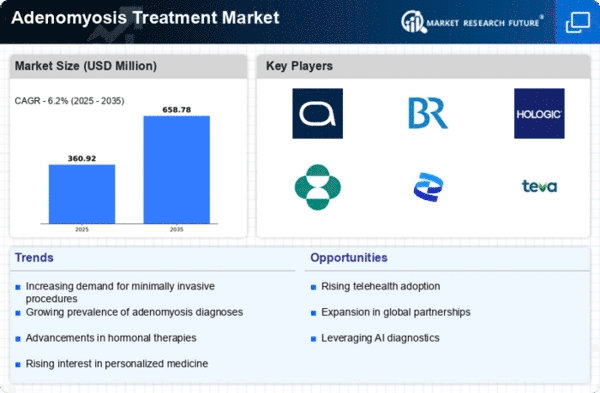
As per MRFR analysis, the Adenomyosis Treatment Market Size was estimated at 339.85 USD Million in 2024. The Adenomyosis Treatment industry is projected to grow from 360.92 USD Million in 2025 to 658.78 USD Million by 2035, exhibiting a compound annual growth rate (CAGR) of 6.2 during the forecast period 2025 - 2035.

Key Market Trends & Highlights

The Adenomyosis Treatment Market is experiencing significant growth driven by rising awareness and technological advancements.

  • The market is characterized by a rising awareness and diagnosis of adenomyosis, particularly in North America, which remains the largest market.
  • Technological advancements in treatment options are fostering a shift towards personalized treatment approaches, especially in the Asia-Pacific region, the fastest-growing market.
  • Hormonal therapy continues to dominate the market as the largest segment, while surgical intervention is emerging as the fastest-growing segment due to increasing patient demand.
  • Key market drivers include the increasing prevalence of adenomyosis and a growing demand for non-invasive treatment options, reflecting a broader focus on women's health.

Market Size & Forecast

2024 Market Size 339.85 (USD Million)
2035 Market Size 658.78 (USD Million)
CAGR (2025 - 2035) 6.2%
Largest Regional Market Share in 2024 North America

Major Players

AbbVie (US), Bayer (DE), Hologic (US), Merck (US), Pfizer (US), Teva Pharmaceuticals (IL), AstraZeneca (GB), Ferring Pharmaceuticals (CH), Bristol-Myers Squibb (US)

Market Trends

The Adenomyosis Treatment Market is currently experiencing a notable evolution, driven by a combination of increasing awareness regarding the condition and advancements in therapeutic options. As more individuals become informed about adenomyosis, the demand for effective treatments appears to be rising. This growing recognition is likely influencing healthcare providers to explore innovative solutions, thereby expanding the range of available therapies. Furthermore, the integration of technology in treatment methodologies may enhance patient outcomes, suggesting a shift towards more personalized care approaches. In addition, the market landscape is characterized by a diverse array of treatment modalities, including hormonal therapies, surgical interventions, and emerging non-invasive techniques. This variety indicates a potential for tailored treatment plans that cater to individual patient needs. As research continues to unveil new insights into adenomyosis, the market may witness the introduction of novel therapies that could redefine standard care practices. Overall, the Adenomyosis Treatment Market appears poised for growth, with evolving treatment paradigms and heightened patient engagement shaping its future trajectory.

Rising Awareness and Diagnosis

The increasing awareness surrounding adenomyosis is leading to more accurate diagnoses. As healthcare professionals become more knowledgeable about the condition, patients are more likely to receive timely and appropriate treatment. This trend suggests a shift in the healthcare landscape, where early intervention may improve patient outcomes.

Technological Advancements in Treatment

Innovations in medical technology are playing a crucial role in the Adenomyosis Treatment Market. New treatment modalities, including minimally invasive surgical techniques and advanced imaging technologies, are enhancing the precision of interventions. This trend indicates a movement towards more effective and patient-friendly treatment options.

Personalized Treatment Approaches

The market is witnessing a growing emphasis on personalized treatment strategies. Tailoring therapies to individual patient profiles may lead to improved efficacy and satisfaction. This trend reflects a broader shift in healthcare towards customized care, which could significantly impact the management of adenomyosis.

Adenomyosis Treatment Market Market Drivers

Rising Awareness and Education

The increasing awareness and education surrounding adenomyosis are pivotal in driving the Global Adenomyosis Treatment Market Industry. Healthcare campaigns aimed at educating women about the symptoms and treatment options available have led to more women seeking medical advice. This heightened awareness is crucial, as many women may previously have been unaware of their condition. As educational initiatives continue to expand, the market is likely to see a surge in demand for treatments. This trend aligns with the projected compound annual growth rate of 6.19% from 2025 to 2035, indicating a robust market trajectory.

Advancements in Treatment Modalities

Innovations in treatment modalities for adenomyosis are significantly influencing the Global Adenomyosis Treatment Market Industry. Recent developments in hormonal therapies, minimally invasive surgical techniques, and alternative treatments have provided patients with more options. For instance, the introduction of new medications that target specific hormonal pathways has shown promise in alleviating symptoms. These advancements not only improve patient outcomes but also encourage healthcare providers to adopt these new therapies, thereby expanding the market. As a result, the market is projected to grow, with an estimated value of 0.66 USD Billion by 2035.

Growing Investment in Women's Health

The growing investment in women's health initiatives is a significant factor propelling the Global Adenomyosis Treatment Market Industry. Governments and private organizations are increasingly recognizing the importance of addressing women's health issues, including adenomyosis. This investment is reflected in funding for research and development of new treatments, as well as initiatives aimed at improving access to care. As more resources are allocated to this sector, the market is expected to benefit from enhanced treatment options and increased patient access. This trend is likely to contribute to the overall growth of the market in the coming years.

Increasing Prevalence of Adenomyosis

The rising incidence of adenomyosis globally is a primary driver for the Global Adenomyosis Treatment Market Industry. As awareness of this condition grows, more women are seeking diagnosis and treatment options. Reports indicate that adenomyosis affects approximately 20-30% of women with uterine disorders, leading to a heightened demand for effective therapies. This trend is expected to contribute to the market's growth, with projections estimating the market value to reach 0.34 USD Billion in 2024. The increasing prevalence necessitates a broader range of treatment options, thereby stimulating market expansion.

Integration of Telemedicine in Treatment

The integration of telemedicine into the treatment landscape for adenomyosis is transforming the Global Adenomyosis Treatment Market Industry. Telehealth services enable patients to consult with specialists remotely, improving access to care, particularly for those in underserved areas. This shift towards digital health solutions has been accelerated by the need for convenient and timely medical consultations. As telemedicine continues to gain traction, it is likely to enhance patient engagement and adherence to treatment plans. This evolution in healthcare delivery could significantly impact market growth, as more patients seek out these accessible treatment options.

Market Segment Insights

By Treatment Type: Hormonal Therapy (Largest) vs. Surgical Intervention (Fastest-Growing)

The Adenomyosis Treatment Market reveals a diverse array of treatment types that cater to various patient needs. Hormonal Therapy holds the largest share due to its non-invasive nature and widespread acceptance among women experiencing adenomyosis. This segment encompasses therapies that regulate hormonal levels to alleviate symptoms and improve the quality of life, positioning it as the preferred choice for many. Surgical Intervention, while smaller in market share, is rapidly gaining traction as more patients seek definitive solutions, driven by advancements in minimally invasive procedures and a growing awareness of treatment options. Market dynamics are shifting, with an increasing number of healthcare providers favoring Surgical Intervention as a viable treatment choice, contributing to its status as the fastest-growing segment in the Adenomyosis Treatment Market. The rise of telemedicine and patient education initiatives is also influencing this trend, as patients become more informed about their options. Furthermore, the prevalence of adenomyosis and a rising emphasis on personalized treatment plans are prompting patients to explore various treatments, ultimately benefiting both Hormonal Therapy and Surgical Intervention segments through evolving patient preferences and expectations.

Hormonal Therapy: (Dominant) vs. Surgical Intervention (Emerging)

Hormonal Therapy has established itself as the dominant force in the Adenomyosis Treatment Market, primarily due to its efficacy and non-invasive nature. Patients often prefer these therapies to manage their symptoms effectively without undergoing surgery. The segment offers a range of options, including oral contraceptives and hormone-regulating medications, allowing for tailored approaches to treatment. On the other hand, Surgical Intervention represents an emerging option, gaining popularity due to its transformative potential for women seeking long-term alleviation of adenomyosis symptoms. Innovations in surgical techniques, such as laparoscopic procedures, have made surgical options less daunting for patients. This segment appeals particularly to those who do not respond well to hormonal therapies, marking a decisive trend towards more aggressive treatment modalities in managing adenomyosis.

By Patient Demographics: Age Group (Largest) vs. Severity of Symptoms (Fastest-Growing)

In the Adenomyosis Treatment Market, the distribution of patient demographics reveals significant insights into age groups, menstrual history, severity of symptoms, and comorbid conditions. The largest age group comprises women aged 30-40, who contribute significantly to the current market due to increased awareness and diagnosis during these years. Meanwhile, the severity of symptoms emerges as a critical factor, with a notable market share from patients experiencing moderate to severe symptoms driving demand for effective treatments. Growth trends indicate that the fastest-growing segment is represented by patients with severe symptoms, reflecting a surge in targeted therapies and increased healthcare accessibility. Additionally, the rise in awareness surrounding adenomyosis among younger women suggests a promising future for treatments tailored to diverse menstrual histories. These movements underscore the need for continued innovation and research in treatments that cater to the unique challenges faced by this demographic.

Menstrual History: Irregular Cycles (Dominant) vs. Comorbid Conditions (Emerging)

In the Adenomyosis Treatment Market, irregular menstrual cycles are a dominant segment, as they strongly correlate with the diagnosis of adenomyosis, leading to heightened awareness and treatment seeking among women. Patients with irregular cycles often present with complex symtomology, prompting healthcare providers to explore tailored therapeutic approaches. On the other hand, the emerging segment of comorbid conditions, such as endometriosis or fibroids, reflects a growing recognition of the interconnectedness of these disorders. As more evidence links adenomyosis with other gynecological issues, there is an increasing demand for comprehensive treatment plans that address multiple conditions simultaneously. This trend highlights the opportunity for healthcare professionals to innovate in treatment modalities to better cater to this intricate patient profile.

By Administration Route: Oral (Largest) vs. Injectable (Fastest-Growing)

In the Adenomyosis Treatment Market, the administration routes are critical in determining therapeutic efficacy and patient adherence. The oral administration route stands out as the largest segment due to its convenience and established efficacy in managing the symptoms of adenomyosis. This method's widespread acceptance among patients and healthcare providers has ensured a significant market share, making it the preferred choice in many treatment protocols. Meanwhile, the injectable route is gaining momentum and is recognized as the fastest-growing segment, favored for its effectiveness in delivering medications that may require immediate systemic action.

Administration: Oral (Dominant) vs. Injectable (Emerging)

The oral administration route has solidified its position as the dominant method in treating adenomyosis, primarily due to its ease of use and favorable patient compliance. It is often preferred for long-term management because it allows patients to integrate treatment seamlessly into their daily routines. On the other hand, the injectable route is emerging rapidly as a preferred alternative, particularly for patients requiring swift relief from severe symptoms. Injectable treatments can offer a more potent therapeutic effect, providing immediate relief, which is increasingly appealing in acute scenarios. Both methods reflect the evolving landscape of treatment options in the Adenomyosis Treatment Market, catering to diverse patient needs.

Get more detailed insights about Adenomyosis Treatment Market Research Report -Forecast to 2035

Regional Insights

North America : Market Leader in Treatment

North America is poised to maintain its leadership in the Adenomyosis Treatment Market, holding a significant market share of $170.0M in 2024. The region's growth is driven by increasing awareness of adenomyosis, advancements in treatment options, and supportive healthcare policies. Regulatory bodies are actively promoting research and development, which further fuels market expansion. The rising prevalence of adenomyosis among women in the U.S. and Canada is also a key demand driver, leading to a surge in treatment options and patient engagement. The competitive landscape in North America is robust, featuring key players such as AbbVie, Hologic, and Pfizer. These companies are investing heavily in innovative therapies and clinical trials to enhance treatment efficacy. The U.S. remains the largest market, supported by a well-established healthcare infrastructure and a high rate of healthcare spending. The presence of leading pharmaceutical companies ensures a continuous flow of new treatments, catering to the growing patient population.

Europe : Emerging Market Dynamics

Europe is witnessing a significant transformation in the Adenomyosis Treatment Market, with a market size of $100.0M. The region benefits from increasing healthcare investments and a growing focus on women's health issues. Regulatory frameworks are evolving to support innovative treatment options, enhancing patient access to necessary therapies. The rising awareness of adenomyosis and its impact on women's quality of life is driving demand for effective treatments, leading to a more favorable market environment. Leading countries in Europe, such as Germany, France, and the UK, are at the forefront of this market growth. The competitive landscape includes major players like Bayer and Merck, who are actively involved in developing new therapies. The European market is characterized by a mix of established pharmaceutical companies and emerging biotech firms, fostering innovation and collaboration. The European Medicines Agency (EMA) is committed to ensuring that effective treatments are available to patients, further supporting market growth.

Asia-Pacific : Rapidly Growing Market

The Asia-Pacific region is emerging as a significant player in the Adenomyosis Treatment Market, with a market size of $55.0M. The growth is driven by increasing healthcare expenditure, rising awareness of women's health issues, and a growing population. Countries like China and India are witnessing a surge in demand for effective adenomyosis treatments, supported by government initiatives aimed at improving healthcare access. The regulatory environment is gradually becoming more favorable, encouraging the introduction of new therapies in the market. In Asia-Pacific, the competitive landscape is evolving, with both local and international players vying for market share. Key companies such as Teva Pharmaceuticals and AstraZeneca are focusing on expanding their presence in this region. The increasing prevalence of adenomyosis, coupled with a lack of awareness, presents both challenges and opportunities for market players. As healthcare systems improve, the potential for growth in this market is substantial, making it an attractive area for investment.

Middle East and Africa : Untapped Market Potential

The Middle East and Africa region is characterized by an untapped Adenomyosis Treatment Market, currently valued at $14.85M. The growth potential is significant, driven by increasing awareness of women's health issues and a rising demand for effective treatments. Government initiatives aimed at improving healthcare infrastructure and access to medical services are crucial for market development. The region's diverse healthcare landscape presents both challenges and opportunities for market players looking to establish a foothold in this emerging market. Countries such as South Africa and the UAE are leading the way in terms of healthcare advancements, with a growing focus on women's health. The competitive landscape is still developing, with a mix of local and international players. Companies like Ferring Pharmaceuticals are exploring opportunities to introduce innovative treatments tailored to the unique needs of the region. As awareness and access improve, the Adenomyosis Treatment Market in the Middle East and Africa is expected to grow significantly in the coming years.

Key Players and Competitive Insights

The Adenomyosis Treatment Market is currently characterized by a dynamic competitive landscape, driven by increasing awareness of the condition and advancements in treatment options. Key players such as AbbVie (US), Bayer (DE), and Hologic (US) are strategically positioned to leverage their extensive research capabilities and established market presence. AbbVie (US) focuses on innovation through its robust pipeline of therapies, while Bayer (DE) emphasizes partnerships to enhance its product offerings. Hologic (US) is concentrating on technological advancements in diagnostic tools, which collectively shape a competitive environment that is increasingly reliant on innovation and strategic collaborations.In terms of business tactics, companies are localizing manufacturing and optimizing supply chains to enhance efficiency and responsiveness to market demands. The market appears moderately fragmented, with a mix of established players and emerging companies. The collective influence of these key players is significant, as they drive trends in treatment modalities and patient engagement strategies, thereby shaping the overall market structure.

In November AbbVie (US) announced a strategic partnership with a leading biotechnology firm to co-develop a novel treatment for adenomyosis, which is expected to enhance its product portfolio and accelerate time-to-market. This collaboration underscores AbbVie's commitment to innovation and its proactive approach to addressing unmet medical needs in the adenomyosis space. The partnership is likely to strengthen AbbVie’s competitive position by expanding its therapeutic offerings and enhancing its research capabilities.

In October Bayer (DE) launched a new digital platform aimed at improving patient access to adenomyosis treatments. This initiative reflects Bayer's focus on digital transformation and patient-centric care, which may enhance patient engagement and adherence to treatment regimens. By integrating technology into its service offerings, Bayer is positioning itself as a leader in the evolving landscape of adenomyosis treatment, potentially setting a benchmark for other companies in the market.

In September Hologic (US) unveiled an innovative diagnostic tool designed to facilitate early detection of adenomyosis. This development is indicative of Hologic's strategic emphasis on technological advancements and its commitment to improving patient outcomes. The introduction of this tool may not only enhance diagnostic accuracy but also solidify Hologic's reputation as a pioneer in women's health, thereby reinforcing its competitive edge in the market.

As of December current trends in the Adenomyosis Treatment Market are increasingly defined by digitalization, sustainability, and the integration of artificial intelligence (AI) in treatment protocols. Strategic alliances are becoming more prevalent, as companies recognize the value of collaboration in driving innovation and expanding market reach. Looking ahead, competitive differentiation is likely to evolve, with a shift from price-based competition to a focus on innovation, technology, and supply chain reliability. This transition may ultimately lead to enhanced patient outcomes and a more sustainable market environment.

Key Companies in the Adenomyosis Treatment Market include

Industry Developments

November 2021 Theramex obtained the Femarelle product license to treat menopause symptoms. These products will be available in different markets from the middle of 2022. This drug is used to balance the estrogen levels in women from perimenopause through menopause to post-menopause, relieving the symptoms and conditions.

October 2021 Bayer AG initiated the phase III clinical program OASIS. Under the program, elinzanetant, a dual neurokinin-1, 3 receptor antagonist, will be evaluated on the efficacy and safety standards for treating menopausal symptoms such as vasomotor symptoms.

September 2019 Professor Caroline Gargett and collaborators at the University of Queensland and Monash IVF were awarded a three-year USD 2.07 Million grant to determine the cause of adenomyosis and the physiological processes associated with the disease.

Future Outlook

Adenomyosis Treatment Market Future Outlook

The Adenomyosis Treatment Market is projected to grow at a 6.2% CAGR from 2025 to 2035, driven by increasing awareness, advancements in treatment options, and rising healthcare expenditure.

New opportunities lie in:

  • Development of personalized treatment plans leveraging genetic profiling.
  • Expansion of telehealth services for remote patient monitoring.
  • Investment in innovative drug delivery systems for enhanced efficacy.

By 2035, the Adenomyosis Treatment Market is expected to achieve substantial growth and innovation.

Market Segmentation

Adenomyosis Treatment Market Treatment Type Outlook

  • Hormonal Therapy
  • Surgical Intervention
  • Pain Management
  • Lifestyle Modifications

Adenomyosis Treatment Market Administration Route Outlook

  • Oral
  • Injectable
  • Transdermal
  • Surgical

Adenomyosis Treatment Market Patient Demographics Outlook

  • Age Group
  • Menstrual History
  • Severity of Symptoms
  • Comorbid Conditions

Report Scope

MARKET SIZE 2024339.85(USD Million)
MARKET SIZE 2025360.92(USD Million)
MARKET SIZE 2035658.78(USD Million)
COMPOUND ANNUAL GROWTH RATE (CAGR)6.2% (2025 - 2035)
REPORT COVERAGERevenue Forecast, Competitive Landscape, Growth Factors, and Trends
BASE YEAR2024
Market Forecast Period2025 - 2035
Historical Data2019 - 2024
Market Forecast UnitsUSD Million
Key Companies ProfiledAbbVie (US), Bayer (DE), Hologic (US), Merck (US), Pfizer (US), Teva Pharmaceuticals (IL), AstraZeneca (GB), Ferring Pharmaceuticals (CH), Bristol-Myers Squibb (US)
Segments CoveredTreatment Type, Patient Demographics, Administration Route
Key Market OpportunitiesEmergence of innovative therapies and personalized medicine in the Adenomyosis Treatment Market.
Key Market DynamicsRising demand for minimally invasive procedures drives innovation in adenomyosis treatment options and competitive market dynamics.
Countries CoveredNorth America, Europe, APAC, South America, MEA

FAQs

What is the projected growth of the Adenomyosis Treatment market?

The Adenomyosis Treatment market is the expected increase in total market value of 0.66 USD billion over a defined forecast period 2025–2035. It is driven by factors such as demand trends, technological advances, regulatory changes, and geographic expansion.

What is the size of the Adenomyosis Treatment market?

Adenomyosis Treatment market size was valued at approximately 0.34 billion USD in 2024. This figure will reach 0.66 billion USD covering all regions (America, Europe, Asia, MEA and ROW), focusing its segments / services / distribution channels till 2035.

What is the CAGR of the Adenomyosis Treatment market?

Adenomyosis Treatment market is expected to grow at a CAGR of 6.2% between 2025 and 2035.

How much will the Adenomyosis Treatment market be worth by 2035?

Adenomyosis Treatment market is expected to be worth of 0.66 billion USD, reflecting growth driven by usage, technology and global demands by the end of 2035.

How will the Adenomyosis Treatment market perform over the next 10 years?

Over the next 10 years the Adenomyosis Treatment market is expected to shift from usd billion 0.34 to 0.66 billion USD, led by adoption of advanced tech, demographic trends, regulatory approvals, with potential headwinds from 2025 to 2035.

Which region held the most extensive market share in the adenomyosis treatment market?

North America had the most extensive share of the market

Who are the key players in the adenomyosis treatment market?

The key players in the market are Hikma Pharmaceuticals PLC, Context Therapeutics Inc., Viatris Inc., Bayer AG, Teva Pharmaceutical Industries Ltd., AstraZeneca, Pfizer Inc., Zydus Pharmaceuticals, Inc., Sun Pharmaceutical Industries Ltd, AbbVie Inc., Abbott, GlaxoSmithKline plc.

  1. SECTION I: EXECUTIVE SUMMARY AND KEY HIGHLIGHTS
    1. | 1.1 EXECUTIVE SUMMARY
    2. | 1.1.1 Market Overview
    3. | 1.1.2 Key Findings
    4. | 1.1.3 Market Segmentation
    5. | 1.1.4 Competitive Landscape
    6. | 1.1.5 Challenges and Opportunities
    7. | 1.1.6 Future Outlook
  2. SECTION II: SCOPING, METHODOLOGY AND MARKET STRUCTURE
    1. | 2.1 MARKET INTRODUCTION
    2. | 2.1.1 Definition
    3. | 2.1.2 Scope of the study
    4. |-- 2.1.2.1 Research Objective
    5. |-- 2.1.2.2 Assumption
    6. |-- 2.1.2.3 Limitations
    7. | 2.2 RESEARCH METHODOLOGY
    8. | 2.2.1 Overview
    9. | 2.2.2 Data Mining
    10. | 2.2.3 Secondary Research
    11. | 2.2.4 Primary Research
    12. |-- 2.2.4.1 Primary Interviews and Information Gathering Process
    13. |-- 2.2.4.2 Breakdown of Primary Respondents
    14. | 2.2.5 Forecasting Model
    15. | 2.2.6 Market Size Estimation
    16. |-- 2.2.6.1 Bottom-Up Approach
    17. |-- 2.2.6.2 Top-Down Approach
    18. | 2.2.7 Data Triangulation
    19. | 2.2.8 Validation
  3. SECTION III: QUALITATIVE ANALYSIS
    1. | 3.1 MARKET DYNAMICS
    2. | 3.1.1 Overview
    3. | 3.1.2 Drivers
    4. | 3.1.3 Restraints
    5. | 3.1.4 Opportunities
    6. | 3.2 MARKET FACTOR ANALYSIS
    7. | 3.2.1 Value chain Analysis
    8. | 3.2.2 Porter's Five Forces Analysis
    9. |-- 3.2.2.1 Bargaining Power of Suppliers
    10. |-- 3.2.2.2 Bargaining Power of Buyers
    11. |-- 3.2.2.3 Threat of New Entrants
    12. |-- 3.2.2.4 Threat of Substitutes
    13. |-- 3.2.2.5 Intensity of Rivalry
    14. | 3.2.3 COVID-19 Impact Analysis
    15. |-- 3.2.3.1 Market Impact Analysis
    16. |-- 3.2.3.2 Regional Impact
    17. |-- 3.2.3.3 Opportunity and Threat Analysis
  4. SECTION IV: QUANTITATIVE ANALYSIS
    1. | 4.1 Healthcare, BY Treatment Type (USD Million)
    2. | 4.1.1 Hormonal Therapy
    3. | 4.1.2 Surgical Intervention
    4. | 4.1.3 Pain Management
    5. | 4.1.4 Lifestyle Modifications
    6. | 4.2 Healthcare, BY Patient Demographics (USD Million)
    7. | 4.2.1 Age Group
    8. | 4.2.2 Menstrual History
    9. | 4.2.3 Severity of Symptoms
    10. | 4.2.4 Comorbid Conditions
    11. | 4.3 Healthcare, BY Administration Route (USD Million)
    12. | 4.3.1 Oral
    13. | 4.3.2 Injectable
    14. | 4.3.3 Transdermal
    15. | 4.3.4 Surgical
    16. | 4.4 Healthcare, BY Region (USD Million)
    17. | 4.4.1 North America
    18. |-- 4.4.1.1 US
    19. |-- 4.4.1.2 Canada
    20. | 4.4.2 Europe
    21. |-- 4.4.2.1 Germany
    22. |-- 4.4.2.2 UK
    23. |-- 4.4.2.3 France
    24. |-- 4.4.2.4 Russia
    25. |-- 4.4.2.5 Italy
    26. |-- 4.4.2.6 Spain
    27. |-- 4.4.2.7 Rest of Europe
    28. | 4.4.3 APAC
    29. |-- 4.4.3.1 China
    30. |-- 4.4.3.2 India
    31. |-- 4.4.3.3 Japan
    32. |-- 4.4.3.4 South Korea
    33. |-- 4.4.3.5 Malaysia
    34. |-- 4.4.3.6 Thailand
    35. |-- 4.4.3.7 Indonesia
    36. |-- 4.4.3.8 Rest of APAC
    37. | 4.4.4 South America
    38. |-- 4.4.4.1 Brazil
    39. |-- 4.4.4.2 Mexico
    40. |-- 4.4.4.3 Argentina
    41. |-- 4.4.4.4 Rest of South America
    42. | 4.4.5 MEA
    43. |-- 4.4.5.1 GCC Countries
    44. |-- 4.4.5.2 South Africa
    45. |-- 4.4.5.3 Rest of MEA
  5. SECTION V: COMPETITIVE ANALYSIS
    1. | 5.1 Competitive Landscape
    2. | 5.1.1 Overview
    3. | 5.1.2 Competitive Analysis
    4. | 5.1.3 Market share Analysis
    5. | 5.1.4 Major Growth Strategy in the Healthcare
    6. | 5.1.5 Competitive Benchmarking
    7. | 5.1.6 Leading Players in Terms of Number of Developments in the Healthcare
    8. | 5.1.7 Key developments and growth strategies
    9. |-- 5.1.7.1 New Product Launch/Service Deployment
    10. |-- 5.1.7.2 Merger & Acquisitions
    11. |-- 5.1.7.3 Joint Ventures
    12. | 5.1.8 Major Players Financial Matrix
    13. |-- 5.1.8.1 Sales and Operating Income
    14. |-- 5.1.8.2 Major Players R&D Expenditure. 2023
    15. | 5.2 Company Profiles
    16. | 5.2.1 AbbVie (US)
    17. |-- 5.2.1.1 Financial Overview
    18. |-- 5.2.1.2 Products Offered
    19. |-- 5.2.1.3 Key Developments
    20. |-- 5.2.1.4 SWOT Analysis
    21. |-- 5.2.1.5 Key Strategies
    22. | 5.2.2 Bayer (DE)
    23. |-- 5.2.2.1 Financial Overview
    24. |-- 5.2.2.2 Products Offered
    25. |-- 5.2.2.3 Key Developments
    26. |-- 5.2.2.4 SWOT Analysis
    27. |-- 5.2.2.5 Key Strategies
    28. | 5.2.3 Hologic (US)
    29. |-- 5.2.3.1 Financial Overview
    30. |-- 5.2.3.2 Products Offered
    31. |-- 5.2.3.3 Key Developments
    32. |-- 5.2.3.4 SWOT Analysis
    33. |-- 5.2.3.5 Key Strategies
    34. | 5.2.4 Merck (US)
    35. |-- 5.2.4.1 Financial Overview
    36. |-- 5.2.4.2 Products Offered
    37. |-- 5.2.4.3 Key Developments
    38. |-- 5.2.4.4 SWOT Analysis
    39. |-- 5.2.4.5 Key Strategies
    40. | 5.2.5 Pfizer (US)
    41. |-- 5.2.5.1 Financial Overview
    42. |-- 5.2.5.2 Products Offered
    43. |-- 5.2.5.3 Key Developments
    44. |-- 5.2.5.4 SWOT Analysis
    45. |-- 5.2.5.5 Key Strategies
    46. | 5.2.6 Teva Pharmaceuticals (IL)
    47. |-- 5.2.6.1 Financial Overview
    48. |-- 5.2.6.2 Products Offered
    49. |-- 5.2.6.3 Key Developments
    50. |-- 5.2.6.4 SWOT Analysis
    51. |-- 5.2.6.5 Key Strategies
    52. | 5.2.7 AstraZeneca (GB)
    53. |-- 5.2.7.1 Financial Overview
    54. |-- 5.2.7.2 Products Offered
    55. |-- 5.2.7.3 Key Developments
    56. |-- 5.2.7.4 SWOT Analysis
    57. |-- 5.2.7.5 Key Strategies
    58. | 5.2.8 Ferring Pharmaceuticals (CH)
    59. |-- 5.2.8.1 Financial Overview
    60. |-- 5.2.8.2 Products Offered
    61. |-- 5.2.8.3 Key Developments
    62. |-- 5.2.8.4 SWOT Analysis
    63. |-- 5.2.8.5 Key Strategies
    64. | 5.2.9 Bristol-Myers Squibb (US)
    65. |-- 5.2.9.1 Financial Overview
    66. |-- 5.2.9.2 Products Offered
    67. |-- 5.2.9.3 Key Developments
    68. |-- 5.2.9.4 SWOT Analysis
    69. |-- 5.2.9.5 Key Strategies
    70. | 5.3 Appendix
    71. | 5.3.1 References
    72. | 5.3.2 Related Reports

Healthcare Market Segmentation

Healthcare By Treatment Type (USD Million, 2025-2035)

  • Hormonal Therapy
  • Surgical Intervention
  • Pain Management
  • Lifestyle Modifications

Healthcare By Patient Demographics (USD Million, 2025-2035)

  • Age Group
  • Menstrual History
  • Severity of Symptoms
  • Comorbid Conditions

Healthcare By Administration Route (USD Million, 2025-2035)

  • Oral
  • Injectable
  • Transdermal
  • Surgical
Infographic

Free Sample Request

Kindly complete the form below to receive a free sample of this Report

Get Free Sample

Customer Strories

Compare Licence

×
Features License Type
Single User Multiuser License Enterprise User
Price $4,950 $5,950 $7,250
Maximum User Access Limit 1 User Upto 10 Users Unrestricted Access Throughout the Organization
Free Customization
Direct Access to Analyst
Deliverable Format
Platform Access
Discount on Next Purchase 10% 15% 15%
Printable Versions