Request Free Sample ×

Kindly complete the form below to receive a free sample of this Report

* Please use a valid business email

Leading companies partner with us for data-driven Insights

clients tt-cursor
Hero Background
English
Chinese
French
Japanese
Korean
German
Spanish

A2P SMS Market Share

ID: MRFR/ICT/5070-CR
127 Pages
Ankit Gupta
November 2020

A2P Messaging Market Size, Share and Research Report: By Application (Promotional Messaging, Transactional Messaging, Customer Engagement), By Industry (Retail, Banking, Healthcare, Travel, Telecommunications), By Technology (SMS, Push Notifications, Email), By End Use (Enterprise, Small and Medium Businesses, Government) and By Regional (North America, Europe, South America, Asia Pacific, Middle East and Africa) - Industry Forecast to 2035.

Share:
Download PDF ×

We do not share your information with anyone. However, we may send you emails based on your report interest from time to time. You may contact us at any time to opt-out.

A2P SMS Market Infographic
Purchase Options

Market Share

Introduction: Navigating the Competitive Landscape of A2P Messaging

The A2P Messaging market is experiencing unprecedented competition. This is due to the fast development of technology, the evolving regulatory framework and the heightened expectations of consumers for seamless communication. The major players, telecommunications operators, IT system integrators and new artificial intelligence companies, are vying for leadership by using advanced capabilities, such as data analytics and automation, to improve customer engagement and operational efficiency. The telecommunications operators are investing in their network and in enhancing the high volume of messages, while the IT system integrators are integrating A2P into the enterprise communication strategy. In addition, the emerging players, especially in the field of the Internet of Things and biometrics, are reshaping the market by introducing new use cases and improving security. As regional growth opportunities continue to expand, especially in Asia-Pacific and Latin America, strategic deployments will increasingly focus on scalability and resilience, thereby creating a more dynamic and competitive environment in the coming years.

Competitive Positioning

Full-Suite Integrators

These vendors offer comprehensive A2P messaging solutions, integrating multiple communication channels and services.

Vendor Competitive Edge Solution Focus Regional Focus
Twilio Robust API ecosystem for developers Cloud communications platform Global
MessageBird Omnichannel messaging capabilities Communication API platform Global
Infobip End-to-end customer engagement solutions Messaging and engagement platform Global
Vonage Unified communications and messaging Cloud communication services Global

Specialized Technology Vendors

These vendors focus on specific technologies or services within the A2P messaging ecosystem.

Vendor Competitive Edge Solution Focus Regional Focus
Sinch Strong focus on mobile engagement Messaging and voice services Global
Tyntec Direct connections to mobile networks A2P messaging and verification Global
Clickatell Focus on customer engagement via chat Messaging and chat solutions Global
Telesign Security-focused messaging solutions Fraud prevention and messaging Global

Infrastructure & Equipment Providers

These vendors provide the underlying infrastructure and equipment necessary for A2P messaging services.

Vendor Competitive Edge Solution Focus Regional Focus
Cisco Strong networking and security capabilities Networking and communication solutions Global
Plivo Cost-effective communication solutions Voice and messaging API Global
Route Mobile Focus on messaging and cloud solutions A2P messaging and cloud services Asia, Middle East, Africa
Telstra Strong telecommunications infrastructure Telecom and messaging services Australia, Asia-Pacific
Soprano Design Enterprise-grade messaging solutions Mobile messaging platform Global
Nexmo Developer-friendly messaging APIs Communication APIs Global

Emerging Players & Regional Champions

  • Twilio (US): Cloud communications platform, APIs for voice, SMS, and video. Challenges the market leaders Nexmo and Plivo with more flexible price and integration models.
  • Sinch (Sweden): specializes in cloud communications and has a strong focus on business-to-business instant messages. Recently it has landed a number of contracts with large e-commerce companies for order notification and customer service, which will make it a serious competitor to the established telecommunications companies.
  • MessageBird (Netherlands) - provides a wide range of communication APIs, including SMS, voice and chat. Recently expanded its services in the Asian-Pacific region, establishing local partners in the country, which compete with the leaders of the industry with their local solutions.
  • Infobip (Croatia): Provides a complete A2P platform with a focus on omni-channel communication. Recently, it has provided solutions for several large European retail chains, enhancing their existing suppliers’ offerings with advanced analytics and customer engagement tools.
  • The 'Route' (India) - specializes in A2P communication solutions for the Indian market. It offers SMS, voice and email services. The company has recently won a contract with several government departments for the distribution of public information announcements, challenging the larger players with its low prices and local support.

Regional Trends: The A2P Messages market in Asia-Pacific and Europe will continue to grow significantly in 2024. This growth is mainly due to the increasing penetration of smart phones and the increasing demand for customer engagement solutions. The companies in this field are specializing in omni-channel communication and integrating AI-driven analytics to provide a better experience for users. In addition, the regulatory changes in various regions have prompted companies to adopt compliance solutions, which will lead to opportunities for emerging players to seize the market share of traditional vendors.

Collaborations & M&A Movements

  • Twilio and WhatsApp partnered to enhance A2P messaging capabilities, aiming to streamline customer engagement for businesses and strengthen their competitive positioning in the messaging market.
  • Sinch acquired MessageBird's A2P messaging division in early 2024 to expand its global footprint and enhance service offerings, significantly increasing its market share in the A2P segment.
  • Vonage and Google Cloud entered a collaboration to integrate A2P messaging solutions with cloud services, enhancing scalability and performance for enterprise customers in a competitive landscape.

Competitive Summary Table

Capability Leading Players Remarks
Biometric Self-Boarding Twilio, Sinch Twilio has integrated biometric verification into its messaging solutions, enhancing security and user experience. Sinch has successfully implemented biometric self-boarding in several airports, reducing boarding times and improving passenger flow.
AI-Powered Ops Mgmt MessageBird, Infobip MessageBird utilizes AI to optimize messaging operations, allowing for real-time adjustments based on user engagement. Infobip's AI-driven analytics provide insights that help businesses tailor their messaging strategies effectively.
Border Control Vonage, Telesign Vonage offers A2P messaging solutions that integrate with border control systems to enhance communication during customs processes. Telesign's messaging services are used for identity verification, streamlining border control operations.
Sustainability Plivo, Nexmo Plivo has committed to reducing its carbon footprint by optimizing its messaging infrastructure. Nexmo has implemented eco-friendly practices in its data centers, showcasing a commitment to sustainability in A2P messaging.
Passenger Experience Airship, Zendesk Airship focuses on enhancing passenger experience through personalized messaging, leading to higher engagement rates. Zendesk integrates A2P messaging into customer support, improving response times and overall satisfaction.

Conclusion: Navigating A2P Messaging's Competitive Landscape

The A2P Messaging Market in 2024 is characterized by high competition and significant fragmentation. Both the old and new players will compete for market share. The regional trends point to the need for localized solutions, which will also have an impact on the strategies of the suppliers. The established players are using their existing networks and customer bases, while the newcomers are focusing on new capabilities, such as AI-based analytics, automation, and sustainable development, to differentiate themselves. In the future, the ability to offer flexible and scalable solutions will be decisive for leadership. The suppliers who focus on these capabilities will not only be able to position themselves better, but will also meet the diverse needs of businesses seeking effective solutions.


Author
Ankit Gupta
Team Lead - Research

Ankit Gupta is a seasoned market intelligence and strategic research professional with over six plus years of experience in the ICT and Semiconductor industries. With academic roots in Telecom, Marketing, and Electronics, he blends technical insight with business strategy. Ankit has led 200+ projects, including work for Fortune 500 clients like Microsoft and Rio Tinto, covering market sizing, tech forecasting, and go-to-market strategies. Known for bridging engineering and enterprise decision-making, his insights support growth, innovation, and investment planning across diverse technology markets.

Leave a Comment

FAQs

What is the current valuation of the A2P Messaging Market as of 2024?

<p>The A2P Messaging Market was valued at 74.86 USD Billion in 2024.</p>

What is the projected market size for the A2P Messaging Market in 2035?

<p>The market is projected to reach 120.47 USD Billion by 2035.</p>

What is the expected CAGR for the A2P Messaging Market during the forecast period 2025 - 2035?

<p>The expected CAGR for the A2P Messaging Market during 2025 - 2035 is 4.42%.</p>

Which segments are included in the A2P Messaging Market?

<p>The market includes segments such as Promotional Messaging, Transactional Messaging, and Customer Engagement.</p>

How much is the Promotional Messaging segment projected to grow by 2035?

<p>The Promotional Messaging segment is projected to grow from 20.0 USD Billion in 2024 to 32.0 USD Billion by 2035.</p>

What are the key industries driving the A2P Messaging Market?

<p>Key industries include Retail, Banking, Healthcare, Travel, and Telecommunications.</p>

What is the projected growth for the Telecommunications segment by 2035?

<p>The Telecommunications segment is expected to grow from 21.86 USD Billion in 2024 to 36.47 USD Billion by 2035.</p>

Which technology segments are relevant to the A2P Messaging Market?

<p>Relevant technology segments include SMS, Push Notifications, and Email.</p>

What is the expected growth for the SMS segment by 2035?

<p>The SMS segment is projected to grow from 30.0 USD Billion in 2024 to 50.0 USD Billion by 2035.</p>

Who are the key players in the A2P Messaging Market?

<p>Key players include Twilio, Sinch, Infobip, MessageBird, Vonage, Nexmo, Plivo, Telesign, and Route Mobile.</p>

Market Summary

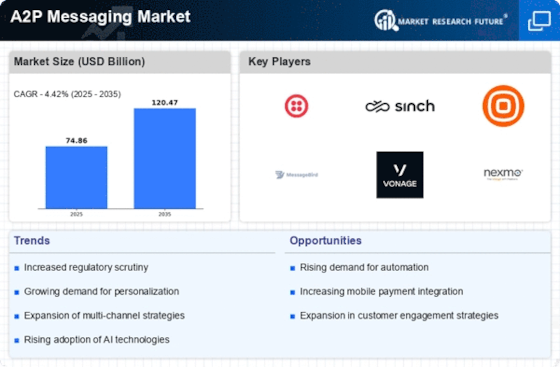
As per Market Research Future analysis, the A2P Messaging Market Size was estimated at 74.86 USD Billion in 2024. The A2P Messaging industry is projected to grow from 78.17 USD Billion in 2025 to 120.47 USD Billion by 2035, exhibiting a compound annual growth rate (CAGR) of 4.42% during the forecast period 2025 - 2035

Key Market Trends & Highlights

The A2P Messaging Market is experiencing robust growth driven by technological advancements and evolving customer engagement strategies.

  • The adoption of Rich Communication Services is on the rise, enhancing user experience and engagement. Security and compliance are becoming paramount as businesses prioritize data protection in messaging solutions. Integration with omnichannel strategies is increasingly common, allowing businesses to streamline customer interactions across platforms. Rising demand for customer engagement and technological advancements in messaging solutions are key drivers propelling the market forward, particularly in North America and Asia-Pacific, with promotional messaging leading the market and transactional messaging growing rapidly.

Market Size & Forecast

2024 Market Size 74.86 (USD Billion)
2035 Market Size 120.47 (USD Billion)
CAGR (2025 - 2035) 4.42%
Largest Regional Market Share in 2024 North America

Major Players

Twilio (US), <a title="Sinch" href="https://sinch.com/resources/a2p-messaging-business-of-communication/" target="_blank" rel="noopener">Sinch</a> (SE), Infobip (HR), MessageBird (NL), Vonage (US), Nexmo (US), <a title="Plivo" href="https://www.plivo.com/blog/a2p-sms/" target="_blank" rel="noopener">Plivo</a> (US), Telesign (US), Route Mobile (IN)

Market Trends

The A2P Messaging Market is currently experiencing a transformative phase, driven by the increasing demand for efficient communication solutions across various sectors. Businesses are increasingly recognizing the value of Application-to-Person messaging as a vital tool for enhancing customer engagement and streamlining operations. This trend is particularly evident in industries such as retail, finance, and healthcare, where timely and personalized communication can significantly impact customer satisfaction and loyalty. Moreover, the proliferation of mobile devices and the growing reliance on digital platforms further amplify the need for effective messaging solutions. As organizations seek to optimize their outreach strategies, the A2P Messaging Market appears poised for substantial growth. In addition to the rising demand, regulatory frameworks are evolving to address the complexities associated with A2P messaging. Governments and regulatory bodies are implementing guidelines to ensure compliance and protect consumer privacy. This regulatory landscape may influence how businesses approach their messaging strategies, potentially leading to increased investment in secure and compliant messaging solutions. Furthermore, advancements in technology, such as artificial intelligence and machine learning, are likely to enhance the capabilities of A2P messaging platforms, enabling more sophisticated targeting and personalization. Overall, the A2P Messaging Market is on a trajectory of innovation and expansion, reflecting the dynamic nature of communication in the digital age. The growing importance of customer engagement and real-time communication has made A2P messaging business solutions essential for enterprises across retail, banking, and healthcare sectors.

Increased Adoption of Rich Communication Services

The A2P Messaging Market is witnessing a notable shift towards Rich Communication Services (RCS), which offer enhanced features compared to traditional SMS. RCS enables businesses to engage customers through multimedia content, interactive elements, and branded messaging. This evolution appears to be driven by the desire for more engaging and visually appealing communication, allowing brands to create a more immersive customer experience.

Focus on Security and Compliance

As the A2P Messaging Market expands, there is a growing emphasis on security and compliance measures. Organizations are increasingly prioritizing the protection of customer data and adherence to regulatory standards. This trend suggests that businesses are investing in secure messaging solutions to mitigate risks associated with data breaches and to build trust with their customers.

Integration with Omnichannel Strategies

The integration of A2P messaging into broader omnichannel marketing strategies is becoming more prevalent. Businesses are recognizing the importance of delivering a seamless customer experience across various touchpoints. This trend indicates that A2P messaging is not only a standalone solution but also a critical component of a comprehensive communication strategy that enhances customer engagement and retention.

A2P SMS Market Market Drivers

Rising Demand for Customer Engagement

The A2P Messaging Market experiences a notable surge in demand for customer engagement solutions. Businesses increasingly recognize the importance of direct communication with customers, leading to a higher adoption of A2P messaging services. This trend is driven by the need for personalized interactions, which enhance customer satisfaction and loyalty. According to recent data, the A2P messaging segment is projected to grow at a compound annual growth rate of approximately 4.5% over the next few years. Companies are leveraging A2P messaging to send promotional offers, reminders, and updates, thereby fostering a more interactive relationship with their clientele. As organizations strive to improve their customer experience, the A2P Messaging Market is likely to expand, reflecting the growing emphasis on effective communication strategies.

Shift Towards Mobile-First Communication

The A2P Messaging Market is significantly influenced by the shift towards mobile-first communication. With the proliferation of smartphones and mobile applications, consumers are increasingly relying on mobile devices for communication. This trend has prompted businesses to adopt A2P messaging as a primary channel for reaching their audience. Data indicates that mobile messaging is becoming the preferred method for receiving notifications, alerts, and promotional content. As a result, companies are investing in A2P messaging solutions to ensure they remain relevant in a mobile-centric environment. The market is likely to expand as businesses recognize the necessity of adapting to changing consumer preferences, thereby reinforcing the importance of A2P messaging in their communication strategies.

Emergence of New Use Cases for A2P Messaging

The A2P Messaging Market is witnessing the emergence of new use cases that expand its applicability across various sectors. Industries such as healthcare, finance, and retail are increasingly utilizing A2P messaging for purposes beyond traditional marketing. For instance, healthcare providers are employing A2P messaging for appointment reminders and patient notifications, while financial institutions use it for transaction alerts and security notifications. This diversification of use cases is likely to drive growth in the A2P messaging segment, as businesses recognize the versatility of messaging solutions. The market is expected to evolve, with innovative applications emerging that cater to specific industry needs, thereby enhancing the overall value proposition of the A2P Messaging Market.

Regulatory Compliance and Data Privacy Concerns

The A2P Messaging Market is also shaped by increasing regulatory compliance and data privacy concerns. As governments implement stricter regulations regarding data protection, businesses must ensure that their A2P messaging practices adhere to these legal frameworks. Compliance with regulations such as the General Data Protection Regulation (GDPR) and the Telephone Consumer Protection Act (TCPA) is essential for maintaining consumer trust. Companies that prioritize compliance are likely to gain a competitive edge in the A2P messaging landscape. This focus on regulatory adherence may drive investment in secure messaging solutions, further propelling the growth of the A2P Messaging Market. As organizations navigate these complexities, the demand for compliant A2P messaging services is expected to rise.

Technological Advancements in Messaging Solutions

Technological innovations play a pivotal role in shaping the A2P Messaging Market. The advent of advanced messaging platforms and APIs has facilitated seamless integration of A2P messaging into various business processes. Enhanced features such as automation, analytics, and real-time tracking are becoming increasingly prevalent, allowing businesses to optimize their messaging strategies. The integration of artificial intelligence and machine learning into messaging solutions is also noteworthy, as it enables more personalized and targeted communication. As organizations seek to leverage these technologies, the A2P messaging segment is expected to witness substantial growth. The market is projected to reach a valuation of several billion dollars, underscoring the significance of technology in driving the A2P Messaging Market forward.

Market Segment Insights

By Application: Promotional Messaging (Largest) vs. Transactional Messaging (Fastest-Growing)

<p>In the A2P Messaging Market, the distribution of market share among the key application segments reveals a clear dominance of Promotional Messaging, which has established itself as the largest segment. This is attributed to its expansive reach in marketing campaigns and promotions, allowing businesses to broadcast messages to a large audience effectively. In contrast, Transactional Messaging, while smaller in overall share, is gaining significant traction due to its essential role in facilitating real-time communications for services such as authentication codes and transactional alerts. The growth trends within the application segments showcase a dynamic shift driven by technological advancements and increased consumer demand. Transactional Messaging is recognized as the fastest-growing segment, fueled by the rise of mobile banking and e-commerce, where timely and secure messaging is paramount. Meanwhile, Promotional Messaging continues to evolve, incorporating more personalized content that resonates with consumers, thus ensuring its sustained traction in the market.</p>

<p>Promotional Messaging (Dominant) vs. Customer Engagement (Emerging)</p>

<p>Promotional Messaging remains the dominant force in the A2P Messaging Market, largely due to its strategic importance in advertising and engagement strategies. Companies leverage this segment to disseminate promotional content, special offers, and brand announcements, making it a valuable tool for customer acquisition and retention. On the other hand, Customer Engagement is emerging as a vital area of focus, driven by the need for companies to foster ongoing interactions with consumers. This includes personalized messages that enhance user experience and encourage brand loyalty. While Promotional Messaging appeals to a wider audience, the tailored approach of Customer Engagement is gaining momentum, particularly among businesses looking to create lasting customer relationships.</p>

By Industry: Retail (Largest) vs. Banking (Fastest-Growing)

<p>The A2P Messaging Market exhibits diverse market share distributions across various industries, with the Retail sector commanding the largest share. This segment benefits from the widespread use of promotional messages, transaction notifications, and customer engagement strategies. Following closely, Banking has emerged as a significant segment due to the increasing reliance on secure messaging for alerts, transactions, and customer service, marking it as a crucial player in the market distribution. In terms of growth trends, the Banking sector is the fastest-growing segment, primarily driven by advancements in technology and regulatory requirements for secure communication channels. This growth is augmented by the proliferation of mobile banking and digital payment solutions, which require reliable A2P messaging for effective user engagement. Meanwhile, Retail continues to evolve, leveraging A2P messaging for personalized marketing, thereby reinforcing its dominant position in the marketplace.</p>

<p>Retail: Largest vs. Banking: Fastest-Growing</p>

<p>The Retail industry stands as the largest segment in the A2P Messaging Market, characterized by its extensive use of messaging services for promotions, order confirmations, and customer service interactions. Retailers utilize A2P messaging to enhance customer experiences through personalized offers and timely notifications, facilitating a more direct line of communication with consumers. On the other hand, Banking, marked as the fastest-growing sector, is rapidly adopting A2P messaging to strengthen security measures and improve customer engagement. With a focus on transactional messages and alerts, banks are increasingly implementing advanced A2P solutions to cater to the demands of a digital-savvy clientele, ensuring timely communication that builds trust and reliability in their service offerings.</p>

By Technology: SMS (Largest) vs. Push Notifications (Fastest-Growing)

<p>Within the A2P Messaging Market, SMS holds the largest share as the most preferred method of communication. Its widespread adoption across various industries ensures that it remains the cornerstone of A2P messaging, particularly for transactional messages such as OTPs and alerts. In contrast, Push Notifications are rapidly gaining traction thanks to their engagement capabilities and low costs, marking them as a leading choice for businesses focusing on customer retention and interaction.</p>

<p>Technology: SMS (Dominant) vs. Push Notifications (Emerging)</p>

<p>SMS is characterized by its reliability and universal reach, making it the dominant force in the A2P Messaging Market. Brands utilize SMS for critical communications, assured of its high open rates and immediate deliverability. Conversely, Push Notifications are emerging as a dynamic tool, leveraging app-based platforms for enhanced customer engagement. They offer personalized, timely messaging which is crucial for user interaction, especially in sectors like retail and e-commerce. As businesses pivot towards mobile-first strategies, the emergence of Push Notifications signifies a shift toward more interactive communication methods, complementing the established SMS framework.</p>

By End-Use: Enterprise (Largest) vs. Small and Medium Businesses (Fastest-Growing)

The A2P Messaging Market is witnessing significant share distribution among its end-use segments, with enterprises capturing the largest portion. Enterprises leverage A2P messaging for customer engagement and real-time notifications, making it a vital communication tool. Small and medium businesses (SMBs) are also gaining traction, utilizing A2P messaging for promotional and transactional purposes, which is increasingly vital for their growth and customer outreach strategies. As businesses digitize, the demand for effective A2P communication channels is surging. Growth trends in the A2P Messaging Market indicate that while enterprises remain dominant, SMBs are experiencing the fastest growth due to increased mobile penetration and digital transformations. The sector is being driven by the rising demand for personalized customer interaction, cost-effectiveness of messaging solutions, and enhanced ROI through targeted campaigns. Furthermore, the ability of A2P messaging to integrate with various applications is propelling growth among SMBs, making them key players in this evolving market.

Enterprise (Dominant) vs. Small and Medium Businesses (Emerging)

In the A2P Messaging Market, enterprises dominate with their expansive communication needs, employing A2P messaging for notifications, alerts, and customer engagement. They benefit from large-scale applications and a robust infrastructure, allowing for seamless integration of messaging into their customer relation management systems. Conversely, small and medium businesses are emerging as a significant force, as they increasingly adopt A2P messaging for marketing campaigns and transactional communications. These SMBs are known for their agility and innovative approaches, enabling them to leverage messaging to enhance customer experience and engagement. As the digital landscape continues to evolve, both segments are expected to adapt and expand their use of A2P messaging to stay competitive.

Get more detailed insights about A2P Messaging Market Research Report - Global Forecast to 2035

Regional Insights

The Global A2P Messaging Market showcases a significant regional diversity, with distinct valuations across various areas. In 2024, North America leads the market with a value of 27.0 USD Billion, showcasing a robust demand for application-to-person messaging solutions driven by the growing digital transformation and business communications. The United States A2P messaging market dominates North America, driven by high enterprise adoption, digital transformation initiatives, and strong regulatory compliance frameworks. The Canada A2P messaging market is witnessing steady growth, supported by rising demand for secure enterprise communication and omnichannel customer engagement. Following closely, Europe holds a market valuation of 20.0 USD Billion in the same year, characterized by strong regulatory frameworks that endorse messaging security and privacy.


The APAC region, valued at 19.0 USD Billion, benefits from a rapidly expanding mobile user base and increasing smartphone penetration, propelling the market growth in this significant segment. The China A2P messaging market is expanding rapidly due to large-scale mobile adoption, strong telecom infrastructure, and increasing enterprise messaging volumes. The India A2P messaging market is experiencing robust growth, fueled by digital payments, e-commerce expansion, and widespread use of transactional messaging. The Japan A2P messaging market benefits from high mobile penetration and strong demand for secure authentication and notification services. The South Korea A2P messaging market is driven by advanced mobile ecosystems and the integration of messaging services with digital platforms.


South America and MEA present smaller but noteworthy contributions, valued at 5.0 USD Billion and 3.86 USD Billion, respectively, in 2024, indicating rising opportunities for growth fueled by increased internet access and mobile service adoption. The GCC A2P messaging market is developing at a moderate pace, supported by rising enterprise digitalization and telecom infrastructure investments. Each of these regions contributes uniquely to the Global A2P Messaging Market statistics, with North America and Europe demonstrating majority holdings that dominate the industry's landscape, driven by advanced telecommunications infrastructures and a high volume of messaging services. The UK A2P messaging market remains one of the most mature in Europe, supported by enterprise adoption and strict data protection regulations. The Germany A2P messaging market is driven by enterprise digitization, particularly in banking, retail, and automotive sectors. The France A2P messaging market continues to grow as businesses invest in secure and compliant customer communication solutions. The Italy A2P messaging market is gradually expanding, supported by increasing adoption in retail and travel industries. The Spain A2P messaging market is emerging steadily, driven by growing digital engagement across enterprises. At the same time, APAC exhibits a growing trend toward digital engagement in various sectors, including healthcare and retail.

Figure 3: A2P Messaging Market Regional Insights

Key Players and Competitive Insights

The Global A2P Messaging Market has seen substantial growth driven by the increasing demand for direct communication solutions that facilitate the exchange of important transactional and promotional messages between businesses and their customers. Leading A2P messaging companies such as Twilio, Sinch, Infobip, and MessageBird are focusing on platform innovation, security, and global scalability to strengthen their market positions. Businesses across various industries are integrating A2P messaging solutions into their customer engagement strategies, leading to intense competition among providers. Key players in the market are continuously innovating their offerings, focusing on improving scalability, reliability, and compliance with regional regulations.
 
As organizations seek out effective communication channels to enhance customer interaction and streamline operations, understanding the competitive landscape becomes critical for both new entrants and established players aiming to strengthen their market position.MessageBird stands out in the Global A2P Messaging Market due to its extensive range of messaging solutions that cater to businesses' messaging needs regardless of their size.
 
The company's robust infrastructure allows for seamless integration with various communication channels, thus providing a comprehensive platform for sending and receiving messages globally. MessageBird’s strengths lie in its adaptability and responsiveness to changing market demands, empowering businesses with innovative APIs that simplify the messaging process. Additionally, the company has built a solid reputation for its reliability, delivering messages promptly and ensuring high delivery rates. This strong market presence, coupled with exceptional customer service, has enabled MessageBird to establish long-lasting relationships with its clients, further solidifying its position as a key player in the A2P messaging space.
 
Syniverse operates as a significant entity in the Global A2P Messaging Market, known for its advanced connectivity and messaging solutions. The company provides a wide array of services that enable businesses to communicate effectively with their customers through SMS, MMS, and other digital messaging formats. Syniverse's strengths are evident in its global reach, allowing the businesses to engage customers across various regions seamlessly. The company's innovative approach is also highlighted through its consistent investment in technology, which enhances the reliability and security of messaging infrastructure.
 
Furthermore, Syniverse has made strategic mergers and acquisitions that have allowed it to expand its capabilities and partnerships, enhancing service offerings tailored to specific industries. This intense focus on innovation and expansion has positioned Syniverse as a formidable competitor in the Global A2P Messaging Market, thus reinforcing its commitment to delivering comprehensive messaging solutions to businesses worldwide.

Key Companies in the A2P SMS Market include

Industry Developments

  • Q2 2024: Sinch launches new AI-powered A2P messaging platform for enterprises Sinch announced the launch of an AI-powered A2P messaging platform designed to help enterprises automate and personalize customer communications at scale. The platform integrates advanced analytics and supports omnichannel messaging.
  • Q2 2024: Twilio and WhatsApp announce partnership to expand A2P messaging services Twilio and WhatsApp entered a partnership to enable businesses to send application-to-person (A2P) messages via WhatsApp through Twilio’s platform, expanding reach for enterprise clients in regulated industries.
  • Q3 2024: Vonage launches new global A2P SMS Market API for secure enterprise messaging Vonage introduced a new global A2P SMS Market API, enabling enterprises to send secure, high-volume messages for authentication, alerts, and customer engagement across multiple regions.
  • Q3 2024: Infobip acquires SMS API provider OpenMarket to strengthen A2P messaging portfolio Infobip completed the acquisition of OpenMarket, a leading SMS API provider, to expand its A2P messaging capabilities and global reach, particularly in North America and Europe.
  • Q4 2024: Route Mobile partners with Google to deliver A2P messaging via RCS Business Messaging Route Mobile announced a partnership with Google to offer A2P messaging through RCS Business Messaging, enabling richer, interactive communications for enterprise clients.
  • Q4 2024: AT&T launches enterprise-grade A2P messaging service for U.S. businesses AT&T introduced a new enterprise-grade A2P messaging service, providing U.S. businesses with secure, scalable SMS and MMS solutions for customer engagement and notifications.
  • Q1 2025: China Mobile unveils next-generation A2P messaging platform with enhanced security features China Mobile launched a next-generation A2P messaging platform featuring advanced security protocols and anti-fraud measures, targeting financial and e-commerce sectors.
  • Q1 2025: BICS and Orange announce strategic partnership to expand A2P messaging reach in Africa BICS and Orange formed a strategic partnership to enhance A2P messaging delivery and reliability across African markets, leveraging both companies’ infrastructure.
  • Q2 2025: Comviva launches cloud-based A2P messaging hub for telecom operators Comviva introduced a cloud-based A2P messaging hub, enabling telecom operators to manage and monetize enterprise messaging traffic more efficiently.
  • Q2 2025: Sinch appoints new Chief Product Officer to drive A2P messaging innovation Sinch announced the appointment of a new Chief Product Officer, tasked with accelerating product development and innovation in the A2P messaging segment.
  • Q3 2025: Twilio secures major contract to provide A2P messaging for global e-commerce platform Twilio secured a contract to deliver A2P messaging services for a leading global e-commerce platform, supporting order notifications and customer engagement worldwide.
  • Q3 2025: Infobip raises $200 million in Series D funding to expand A2P messaging services Infobip closed a $200 million Series D funding round to accelerate the expansion of its A2P messaging services and invest in new technology development.

Future Outlook

A2P SMS Market Future Outlook

The A2P Messaging Market is projected to grow at a 4.42% CAGR from 2025 to 2035, driven by increasing mobile penetration, demand for customer engagement, and the rise of digital marketing.

New opportunities lie in:

  • <p>Integration of AI-driven chatbots for enhanced customer interaction. Development of industry-specific messaging solutions for healthcare and finance. Expansion of cross-border messaging services to tap into emerging markets.</p>

By 2035, the A2P Messaging Market is expected to solidify its position as a vital communication channel.

Market Segmentation

A2P SMS Market End-Use Outlook

  • Enterprise
  • Small and Medium Businesses
  • Government

A2P SMS Market Industry Outlook

  • Retail
  • Banking
  • Healthcare
  • Travel
  • Telecommunications

A2P SMS Market Technology Outlook

  • SMS
  • Push Notifications
  • Email

A2P SMS Market Application Outlook

  • Promotional Messaging
  • Transactional Messaging
  • Customer Engagement

Report Scope

MARKET SIZE 2024 74.86(USD Billion)
MARKET SIZE 2025 78.17(USD Billion)
MARKET SIZE 2035 120.47(USD Billion)
COMPOUND ANNUAL GROWTH RATE (CAGR) 4.42% (2025 - 2035)
REPORT COVERAGE Revenue Forecast, Competitive Landscape, Growth Factors, and Trends
BASE YEAR 2024
Market Forecast Period 2025 - 2035
Historical Data 2019 - 2024
Market Forecast Units USD Billion
Key Companies Profiled Twilio (US), Sinch (SE), Infobip (HR), MessageBird (NL), Vonage (US), Nexmo (US), Plivo (US), Telesign (US), Route Mobile (IN)
Segments Covered Application, Industry, Technology, End Use, Regional
Key Market Opportunities Integration of artificial intelligence enhances personalization in the A2P Messaging Market.
Key Market Dynamics Rising demand for personalized communication drives innovation and competition in the A2P Messaging Market.
Countries Covered North America, Europe, APAC, South America, MEA

FAQs

What is the current valuation of the A2P Messaging Market as of 2024?

<p>The A2P Messaging Market was valued at 74.86 USD Billion in 2024.</p>

What is the projected market size for the A2P Messaging Market in 2035?

<p>The market is projected to reach 120.47 USD Billion by 2035.</p>

What is the expected CAGR for the A2P Messaging Market during the forecast period 2025 - 2035?

<p>The expected CAGR for the A2P Messaging Market during 2025 - 2035 is 4.42%.</p>

Which segments are included in the A2P Messaging Market?

<p>The market includes segments such as Promotional Messaging, Transactional Messaging, and Customer Engagement.</p>

How much is the Promotional Messaging segment projected to grow by 2035?

<p>The Promotional Messaging segment is projected to grow from 20.0 USD Billion in 2024 to 32.0 USD Billion by 2035.</p>

What are the key industries driving the A2P Messaging Market?

<p>Key industries include Retail, Banking, Healthcare, Travel, and Telecommunications.</p>

What is the projected growth for the Telecommunications segment by 2035?

<p>The Telecommunications segment is expected to grow from 21.86 USD Billion in 2024 to 36.47 USD Billion by 2035.</p>

Which technology segments are relevant to the A2P Messaging Market?

<p>Relevant technology segments include SMS, Push Notifications, and Email.</p>

What is the expected growth for the SMS segment by 2035?

<p>The SMS segment is projected to grow from 30.0 USD Billion in 2024 to 50.0 USD Billion by 2035.</p>

Who are the key players in the A2P Messaging Market?

<p>Key players include Twilio, Sinch, Infobip, MessageBird, Vonage, Nexmo, Plivo, Telesign, and Route Mobile.</p>

  1. SECTION I: EXECUTIVE SUMMARY AND KEY HIGHLIGHTS
    1. | 1.1 EXECUTIVE SUMMARY
    2. | | 1.1.1 Market Overview
    3. | | 1.1.2 Key Findings
    4. | | 1.1.3 Market Segmentation
    5. | | 1.1.4 Competitive Landscape
    6. | | 1.1.5 Challenges and Opportunities
    7. | | 1.1.6 Future Outlook
  2. SECTION II: SCOPING, METHODOLOGY AND MARKET STRUCTURE
    1. | 2.1 MARKET INTRODUCTION
    2. | | 2.1.1 Definition
    3. | | 2.1.2 Scope of the study
    4. | | | 2.1.2.1 Research Objective
    5. | | | 2.1.2.2 Assumption
    6. | | | 2.1.2.3 Limitations
    7. | 2.2 RESEARCH METHODOLOGY
    8. | | 2.2.1 Overview
    9. | | 2.2.2 Data Mining
    10. | | 2.2.3 Secondary Research
    11. | | 2.2.4 Primary Research
    12. | | | 2.2.4.1 Primary Interviews and Information Gathering Process
    13. | | | 2.2.4.2 Breakdown of Primary Respondents
    14. | | 2.2.5 Forecasting Model
    15. | | 2.2.6 Market Size Estimation
    16. | | | 2.2.6.1 Bottom-Up Approach
    17. | | | 2.2.6.2 Top-Down Approach
    18. | | 2.2.7 Data Triangulation
    19. | | 2.2.8 Validation
  3. SECTION III: QUALITATIVE ANALYSIS
    1. | 3.1 MARKET DYNAMICS
    2. | | 3.1.1 Overview
    3. | | 3.1.2 Drivers
    4. | | 3.1.3 Restraints
    5. | | 3.1.4 Opportunities
    6. | 3.2 MARKET FACTOR ANALYSIS
    7. | | 3.2.1 Value chain Analysis
    8. | | 3.2.2 Porter's Five Forces Analysis
    9. | | | 3.2.2.1 Bargaining Power of Suppliers
    10. | | | 3.2.2.2 Bargaining Power of Buyers
    11. | | | 3.2.2.3 Threat of New Entrants
    12. | | | 3.2.2.4 Threat of Substitutes
    13. | | | 3.2.2.5 Intensity of Rivalry
    14. | | 3.2.3 COVID-19 Impact Analysis
    15. | | | 3.2.3.1 Market Impact Analysis
    16. | | | 3.2.3.2 Regional Impact
    17. | | | 3.2.3.3 Opportunity and Threat Analysis
  4. SECTION IV: QUANTITATIVE ANALYSIS
    1. | 4.1 Information and Communications Technology, BY Application (USD Billion)
    2. | | 4.1.1 Promotional Messaging
    3. | | 4.1.2 Transactional Messaging
    4. | | 4.1.3 Customer Engagement
    5. | 4.2 Information and Communications Technology, BY Industry (USD Billion)
    6. | | 4.2.1 Retail
    7. | | 4.2.2 Banking
    8. | | 4.2.3 Healthcare
    9. | | 4.2.4 Travel
    10. | | 4.2.5 Telecommunications
    11. | 4.3 Information and Communications Technology, BY Technology (USD Billion)
    12. | | 4.3.1 SMS
    13. | | 4.3.2 Push Notifications
    14. | | 4.3.3 Email
    15. | 4.4 Information and Communications Technology, BY End-Use (USD Billion)
    16. | | 4.4.1 Enterprise
    17. | | 4.4.2 Small and Medium Businesses
    18. | | 4.4.3 Government
    19. | 4.5 Information and Communications Technology, BY Region (USD Billion)
    20. | | 4.5.1 North America
    21. | | | 4.5.1.1 US
    22. | | | 4.5.1.2 Canada
    23. | | 4.5.2 Europe
    24. | | | 4.5.2.1 Germany
    25. | | | 4.5.2.2 UK
    26. | | | 4.5.2.3 France
    27. | | | 4.5.2.4 Russia
    28. | | | 4.5.2.5 Italy
    29. | | | 4.5.2.6 Spain
    30. | | | 4.5.2.7 Rest of Europe
    31. | | 4.5.3 APAC
    32. | | | 4.5.3.1 China
    33. | | | 4.5.3.2 India
    34. | | | 4.5.3.3 Japan
    35. | | | 4.5.3.4 South Korea
    36. | | | 4.5.3.5 Malaysia
    37. | | | 4.5.3.6 Thailand
    38. | | | 4.5.3.7 Indonesia
    39. | | | 4.5.3.8 Rest of APAC
    40. | | 4.5.4 South America
    41. | | | 4.5.4.1 Brazil
    42. | | | 4.5.4.2 Mexico
    43. | | | 4.5.4.3 Argentina
    44. | | | 4.5.4.4 Rest of South America
    45. | | 4.5.5 MEA
    46. | | | 4.5.5.1 GCC Countries
    47. | | | 4.5.5.2 South Africa
    48. | | | 4.5.5.3 Rest of MEA
  5. SECTION V: COMPETITIVE ANALYSIS
    1. | 5.1 Competitive Landscape
    2. | | 5.1.1 Overview
    3. | | 5.1.2 Competitive Analysis
    4. | | 5.1.3 Market share Analysis
    5. | | 5.1.4 Major Growth Strategy in the Information and Communications Technology
    6. | | 5.1.5 Competitive Benchmarking
    7. | | 5.1.6 Leading Players in Terms of Number of Developments in the Information and Communications Technology
    8. | | 5.1.7 Key developments and growth strategies
    9. | | | 5.1.7.1 New Product Launch/Service Deployment
    10. | | | 5.1.7.2 Merger & Acquisitions
    11. | | | 5.1.7.3 Joint Ventures
    12. | | 5.1.8 Major Players Financial Matrix
    13. | | | 5.1.8.1 Sales and Operating Income
    14. | | | 5.1.8.2 Major Players R&D Expenditure. 2023
    15. | 5.2 Company Profiles
    16. | | 5.2.1 Twilio (US)
    17. | | | 5.2.1.1 Financial Overview
    18. | | | 5.2.1.2 Products Offered
    19. | | | 5.2.1.3 Key Developments
    20. | | | 5.2.1.4 SWOT Analysis
    21. | | | 5.2.1.5 Key Strategies
    22. | | 5.2.2 Sinch (SE)
    23. | | | 5.2.2.1 Financial Overview
    24. | | | 5.2.2.2 Products Offered
    25. | | | 5.2.2.3 Key Developments
    26. | | | 5.2.2.4 SWOT Analysis
    27. | | | 5.2.2.5 Key Strategies
    28. | | 5.2.3 Infobip (HR)
    29. | | | 5.2.3.1 Financial Overview
    30. | | | 5.2.3.2 Products Offered
    31. | | | 5.2.3.3 Key Developments
    32. | | | 5.2.3.4 SWOT Analysis
    33. | | | 5.2.3.5 Key Strategies
    34. | | 5.2.4 MessageBird (NL)
    35. | | | 5.2.4.1 Financial Overview
    36. | | | 5.2.4.2 Products Offered
    37. | | | 5.2.4.3 Key Developments
    38. | | | 5.2.4.4 SWOT Analysis
    39. | | | 5.2.4.5 Key Strategies
    40. | | 5.2.5 Vonage (US)
    41. | | | 5.2.5.1 Financial Overview
    42. | | | 5.2.5.2 Products Offered
    43. | | | 5.2.5.3 Key Developments
    44. | | | 5.2.5.4 SWOT Analysis
    45. | | | 5.2.5.5 Key Strategies
    46. | | 5.2.6 Nexmo (US)
    47. | | | 5.2.6.1 Financial Overview
    48. | | | 5.2.6.2 Products Offered
    49. | | | 5.2.6.3 Key Developments
    50. | | | 5.2.6.4 SWOT Analysis
    51. | | | 5.2.6.5 Key Strategies
    52. | | 5.2.7 Plivo (US)
    53. | | | 5.2.7.1 Financial Overview
    54. | | | 5.2.7.2 Products Offered
    55. | | | 5.2.7.3 Key Developments
    56. | | | 5.2.7.4 SWOT Analysis
    57. | | | 5.2.7.5 Key Strategies
    58. | | 5.2.8 Telesign (US)
    59. | | | 5.2.8.1 Financial Overview
    60. | | | 5.2.8.2 Products Offered
    61. | | | 5.2.8.3 Key Developments
    62. | | | 5.2.8.4 SWOT Analysis
    63. | | | 5.2.8.5 Key Strategies
    64. | | 5.2.9 Route Mobile (IN)
    65. | | | 5.2.9.1 Financial Overview
    66. | | | 5.2.9.2 Products Offered
    67. | | | 5.2.9.3 Key Developments
    68. | | | 5.2.9.4 SWOT Analysis
    69. | | | 5.2.9.5 Key Strategies
    70. | 5.3 Appendix
    71. | | 5.3.1 References
    72. | | 5.3.2 Related Reports
  6. LIST OF FIGURES
    1. | 6.1 MARKET SYNOPSIS
    2. | 6.2 NORTH AMERICA MARKET ANALYSIS
    3. | 6.3 US MARKET ANALYSIS BY APPLICATION
    4. | 6.4 US MARKET ANALYSIS BY INDUSTRY
    5. | 6.5 US MARKET ANALYSIS BY TECHNOLOGY
    6. | 6.6 US MARKET ANALYSIS BY END-USE
    7. | 6.7 CANADA MARKET ANALYSIS BY APPLICATION
    8. | 6.8 CANADA MARKET ANALYSIS BY INDUSTRY
    9. | 6.9 CANADA MARKET ANALYSIS BY TECHNOLOGY
    10. | 6.10 CANADA MARKET ANALYSIS BY END-USE
    11. | 6.11 EUROPE MARKET ANALYSIS
    12. | 6.12 GERMANY MARKET ANALYSIS BY APPLICATION
    13. | 6.13 GERMANY MARKET ANALYSIS BY INDUSTRY
    14. | 6.14 GERMANY MARKET ANALYSIS BY TECHNOLOGY
    15. | 6.15 GERMANY MARKET ANALYSIS BY END-USE
    16. | 6.16 UK MARKET ANALYSIS BY APPLICATION
    17. | 6.17 UK MARKET ANALYSIS BY INDUSTRY
    18. | 6.18 UK MARKET ANALYSIS BY TECHNOLOGY
    19. | 6.19 UK MARKET ANALYSIS BY END-USE
    20. | 6.20 FRANCE MARKET ANALYSIS BY APPLICATION
    21. | 6.21 FRANCE MARKET ANALYSIS BY INDUSTRY
    22. | 6.22 FRANCE MARKET ANALYSIS BY TECHNOLOGY
    23. | 6.23 FRANCE MARKET ANALYSIS BY END-USE
    24. | 6.24 RUSSIA MARKET ANALYSIS BY APPLICATION
    25. | 6.25 RUSSIA MARKET ANALYSIS BY INDUSTRY
    26. | 6.26 RUSSIA MARKET ANALYSIS BY TECHNOLOGY
    27. | 6.27 RUSSIA MARKET ANALYSIS BY END-USE
    28. | 6.28 ITALY MARKET ANALYSIS BY APPLICATION
    29. | 6.29 ITALY MARKET ANALYSIS BY INDUSTRY
    30. | 6.30 ITALY MARKET ANALYSIS BY TECHNOLOGY
    31. | 6.31 ITALY MARKET ANALYSIS BY END-USE
    32. | 6.32 SPAIN MARKET ANALYSIS BY APPLICATION
    33. | 6.33 SPAIN MARKET ANALYSIS BY INDUSTRY
    34. | 6.34 SPAIN MARKET ANALYSIS BY TECHNOLOGY
    35. | 6.35 SPAIN MARKET ANALYSIS BY END-USE
    36. | 6.36 REST OF EUROPE MARKET ANALYSIS BY APPLICATION
    37. | 6.37 REST OF EUROPE MARKET ANALYSIS BY INDUSTRY
    38. | 6.38 REST OF EUROPE MARKET ANALYSIS BY TECHNOLOGY
    39. | 6.39 REST OF EUROPE MARKET ANALYSIS BY END-USE
    40. | 6.40 APAC MARKET ANALYSIS
    41. | 6.41 CHINA MARKET ANALYSIS BY APPLICATION
    42. | 6.42 CHINA MARKET ANALYSIS BY INDUSTRY
    43. | 6.43 CHINA MARKET ANALYSIS BY TECHNOLOGY
    44. | 6.44 CHINA MARKET ANALYSIS BY END-USE
    45. | 6.45 INDIA MARKET ANALYSIS BY APPLICATION
    46. | 6.46 INDIA MARKET ANALYSIS BY INDUSTRY
    47. | 6.47 INDIA MARKET ANALYSIS BY TECHNOLOGY
    48. | 6.48 INDIA MARKET ANALYSIS BY END-USE
    49. | 6.49 JAPAN MARKET ANALYSIS BY APPLICATION
    50. | 6.50 JAPAN MARKET ANALYSIS BY INDUSTRY
    51. | 6.51 JAPAN MARKET ANALYSIS BY TECHNOLOGY
    52. | 6.52 JAPAN MARKET ANALYSIS BY END-USE
    53. | 6.53 SOUTH KOREA MARKET ANALYSIS BY APPLICATION
    54. | 6.54 SOUTH KOREA MARKET ANALYSIS BY INDUSTRY
    55. | 6.55 SOUTH KOREA MARKET ANALYSIS BY TECHNOLOGY
    56. | 6.56 SOUTH KOREA MARKET ANALYSIS BY END-USE
    57. | 6.57 MALAYSIA MARKET ANALYSIS BY APPLICATION
    58. | 6.58 MALAYSIA MARKET ANALYSIS BY INDUSTRY
    59. | 6.59 MALAYSIA MARKET ANALYSIS BY TECHNOLOGY
    60. | 6.60 MALAYSIA MARKET ANALYSIS BY END-USE
    61. | 6.61 THAILAND MARKET ANALYSIS BY APPLICATION
    62. | 6.62 THAILAND MARKET ANALYSIS BY INDUSTRY
    63. | 6.63 THAILAND MARKET ANALYSIS BY TECHNOLOGY
    64. | 6.64 THAILAND MARKET ANALYSIS BY END-USE
    65. | 6.65 INDONESIA MARKET ANALYSIS BY APPLICATION
    66. | 6.66 INDONESIA MARKET ANALYSIS BY INDUSTRY
    67. | 6.67 INDONESIA MARKET ANALYSIS BY TECHNOLOGY
    68. | 6.68 INDONESIA MARKET ANALYSIS BY END-USE
    69. | 6.69 REST OF APAC MARKET ANALYSIS BY APPLICATION
    70. | 6.70 REST OF APAC MARKET ANALYSIS BY INDUSTRY
    71. | 6.71 REST OF APAC MARKET ANALYSIS BY TECHNOLOGY
    72. | 6.72 REST OF APAC MARKET ANALYSIS BY END-USE
    73. | 6.73 SOUTH AMERICA MARKET ANALYSIS
    74. | 6.74 BRAZIL MARKET ANALYSIS BY APPLICATION
    75. | 6.75 BRAZIL MARKET ANALYSIS BY INDUSTRY
    76. | 6.76 BRAZIL MARKET ANALYSIS BY TECHNOLOGY
    77. | 6.77 BRAZIL MARKET ANALYSIS BY END-USE
    78. | 6.78 MEXICO MARKET ANALYSIS BY APPLICATION
    79. | 6.79 MEXICO MARKET ANALYSIS BY INDUSTRY
    80. | 6.80 MEXICO MARKET ANALYSIS BY TECHNOLOGY
    81. | 6.81 MEXICO MARKET ANALYSIS BY END-USE
    82. | 6.82 ARGENTINA MARKET ANALYSIS BY APPLICATION
    83. | 6.83 ARGENTINA MARKET ANALYSIS BY INDUSTRY
    84. | 6.84 ARGENTINA MARKET ANALYSIS BY TECHNOLOGY
    85. | 6.85 ARGENTINA MARKET ANALYSIS BY END-USE
    86. | 6.86 REST OF SOUTH AMERICA MARKET ANALYSIS BY APPLICATION
    87. | 6.87 REST OF SOUTH AMERICA MARKET ANALYSIS BY INDUSTRY
    88. | 6.88 REST OF SOUTH AMERICA MARKET ANALYSIS BY TECHNOLOGY
    89. | 6.89 REST OF SOUTH AMERICA MARKET ANALYSIS BY END-USE
    90. | 6.90 MEA MARKET ANALYSIS
    91. | 6.91 GCC COUNTRIES MARKET ANALYSIS BY APPLICATION
    92. | 6.92 GCC COUNTRIES MARKET ANALYSIS BY INDUSTRY
    93. | 6.93 GCC COUNTRIES MARKET ANALYSIS BY TECHNOLOGY
    94. | 6.94 GCC COUNTRIES MARKET ANALYSIS BY END-USE
    95. | 6.95 SOUTH AFRICA MARKET ANALYSIS BY APPLICATION
    96. | 6.96 SOUTH AFRICA MARKET ANALYSIS BY INDUSTRY
    97. | 6.97 SOUTH AFRICA MARKET ANALYSIS BY TECHNOLOGY
    98. | 6.98 SOUTH AFRICA MARKET ANALYSIS BY END-USE
    99. | 6.99 REST OF MEA MARKET ANALYSIS BY APPLICATION
    100. | 6.100 REST OF MEA MARKET ANALYSIS BY INDUSTRY
    101. | 6.101 REST OF MEA MARKET ANALYSIS BY TECHNOLOGY
    102. | 6.102 REST OF MEA MARKET ANALYSIS BY END-USE
    103. | 6.103 KEY BUYING CRITERIA OF INFORMATION AND COMMUNICATIONS TECHNOLOGY
    104. | 6.104 RESEARCH PROCESS OF MRFR
    105. | 6.105 DRO ANALYSIS OF INFORMATION AND COMMUNICATIONS TECHNOLOGY
    106. | 6.106 DRIVERS IMPACT ANALYSIS: INFORMATION AND COMMUNICATIONS TECHNOLOGY
    107. | 6.107 RESTRAINTS IMPACT ANALYSIS: INFORMATION AND COMMUNICATIONS TECHNOLOGY
    108. | 6.108 SUPPLY / VALUE CHAIN: INFORMATION AND COMMUNICATIONS TECHNOLOGY
    109. | 6.109 INFORMATION AND COMMUNICATIONS TECHNOLOGY, BY APPLICATION, 2024 (% SHARE)
    110. | 6.110 INFORMATION AND COMMUNICATIONS TECHNOLOGY, BY APPLICATION, 2024 TO 2035 (USD Billion)
    111. | 6.111 INFORMATION AND COMMUNICATIONS TECHNOLOGY, BY INDUSTRY, 2024 (% SHARE)
    112. | 6.112 INFORMATION AND COMMUNICATIONS TECHNOLOGY, BY INDUSTRY, 2024 TO 2035 (USD Billion)
    113. | 6.113 INFORMATION AND COMMUNICATIONS TECHNOLOGY, BY TECHNOLOGY, 2024 (% SHARE)
    114. | 6.114 INFORMATION AND COMMUNICATIONS TECHNOLOGY, BY TECHNOLOGY, 2024 TO 2035 (USD Billion)
    115. | 6.115 INFORMATION AND COMMUNICATIONS TECHNOLOGY, BY END-USE, 2024 (% SHARE)
    116. | 6.116 INFORMATION AND COMMUNICATIONS TECHNOLOGY, BY END-USE, 2024 TO 2035 (USD Billion)
    117. | 6.117 BENCHMARKING OF MAJOR COMPETITORS
  7. LIST OF TABLES
    1. | 7.1 LIST OF ASSUMPTIONS
    2. | | 7.1.1
    3. | 7.2 North America MARKET SIZE ESTIMATES; FORECAST
    4. | | 7.2.1 BY APPLICATION, 2025-2035 (USD Billion)
    5. | | 7.2.2 BY INDUSTRY, 2025-2035 (USD Billion)
    6. | | 7.2.3 BY TECHNOLOGY, 2025-2035 (USD Billion)
    7. | | 7.2.4 BY END-USE, 2025-2035 (USD Billion)
    8. | 7.3 US MARKET SIZE ESTIMATES; FORECAST
    9. | | 7.3.1 BY APPLICATION, 2025-2035 (USD Billion)
    10. | | 7.3.2 BY INDUSTRY, 2025-2035 (USD Billion)
    11. | | 7.3.3 BY TECHNOLOGY, 2025-2035 (USD Billion)
    12. | | 7.3.4 BY END-USE, 2025-2035 (USD Billion)
    13. | 7.4 Canada MARKET SIZE ESTIMATES; FORECAST
    14. | | 7.4.1 BY APPLICATION, 2025-2035 (USD Billion)
    15. | | 7.4.2 BY INDUSTRY, 2025-2035 (USD Billion)
    16. | | 7.4.3 BY TECHNOLOGY, 2025-2035 (USD Billion)
    17. | | 7.4.4 BY END-USE, 2025-2035 (USD Billion)
    18. | 7.5 Europe MARKET SIZE ESTIMATES; FORECAST
    19. | | 7.5.1 BY APPLICATION, 2025-2035 (USD Billion)
    20. | | 7.5.2 BY INDUSTRY, 2025-2035 (USD Billion)
    21. | | 7.5.3 BY TECHNOLOGY, 2025-2035 (USD Billion)
    22. | | 7.5.4 BY END-USE, 2025-2035 (USD Billion)
    23. | 7.6 Germany MARKET SIZE ESTIMATES; FORECAST
    24. | | 7.6.1 BY APPLICATION, 2025-2035 (USD Billion)
    25. | | 7.6.2 BY INDUSTRY, 2025-2035 (USD Billion)
    26. | | 7.6.3 BY TECHNOLOGY, 2025-2035 (USD Billion)
    27. | | 7.6.4 BY END-USE, 2025-2035 (USD Billion)
    28. | 7.7 UK MARKET SIZE ESTIMATES; FORECAST
    29. | | 7.7.1 BY APPLICATION, 2025-2035 (USD Billion)
    30. | | 7.7.2 BY INDUSTRY, 2025-2035 (USD Billion)
    31. | | 7.7.3 BY TECHNOLOGY, 2025-2035 (USD Billion)
    32. | | 7.7.4 BY END-USE, 2025-2035 (USD Billion)
    33. | 7.8 France MARKET SIZE ESTIMATES; FORECAST
    34. | | 7.8.1 BY APPLICATION, 2025-2035 (USD Billion)
    35. | | 7.8.2 BY INDUSTRY, 2025-2035 (USD Billion)
    36. | | 7.8.3 BY TECHNOLOGY, 2025-2035 (USD Billion)
    37. | | 7.8.4 BY END-USE, 2025-2035 (USD Billion)
    38. | 7.9 Russia MARKET SIZE ESTIMATES; FORECAST
    39. | | 7.9.1 BY APPLICATION, 2025-2035 (USD Billion)
    40. | | 7.9.2 BY INDUSTRY, 2025-2035 (USD Billion)
    41. | | 7.9.3 BY TECHNOLOGY, 2025-2035 (USD Billion)
    42. | | 7.9.4 BY END-USE, 2025-2035 (USD Billion)
    43. | 7.10 Italy MARKET SIZE ESTIMATES; FORECAST
    44. | | 7.10.1 BY APPLICATION, 2025-2035 (USD Billion)
    45. | | 7.10.2 BY INDUSTRY, 2025-2035 (USD Billion)
    46. | | 7.10.3 BY TECHNOLOGY, 2025-2035 (USD Billion)
    47. | | 7.10.4 BY END-USE, 2025-2035 (USD Billion)
    48. | 7.11 Spain MARKET SIZE ESTIMATES; FORECAST
    49. | | 7.11.1 BY APPLICATION, 2025-2035 (USD Billion)
    50. | | 7.11.2 BY INDUSTRY, 2025-2035 (USD Billion)
    51. | | 7.11.3 BY TECHNOLOGY, 2025-2035 (USD Billion)
    52. | | 7.11.4 BY END-USE, 2025-2035 (USD Billion)
    53. | 7.12 Rest of Europe MARKET SIZE ESTIMATES; FORECAST
    54. | | 7.12.1 BY APPLICATION, 2025-2035 (USD Billion)
    55. | | 7.12.2 BY INDUSTRY, 2025-2035 (USD Billion)
    56. | | 7.12.3 BY TECHNOLOGY, 2025-2035 (USD Billion)
    57. | | 7.12.4 BY END-USE, 2025-2035 (USD Billion)
    58. | 7.13 APAC MARKET SIZE ESTIMATES; FORECAST
    59. | | 7.13.1 BY APPLICATION, 2025-2035 (USD Billion)
    60. | | 7.13.2 BY INDUSTRY, 2025-2035 (USD Billion)
    61. | | 7.13.3 BY TECHNOLOGY, 2025-2035 (USD Billion)
    62. | | 7.13.4 BY END-USE, 2025-2035 (USD Billion)
    63. | 7.14 China MARKET SIZE ESTIMATES; FORECAST
    64. | | 7.14.1 BY APPLICATION, 2025-2035 (USD Billion)
    65. | | 7.14.2 BY INDUSTRY, 2025-2035 (USD Billion)
    66. | | 7.14.3 BY TECHNOLOGY, 2025-2035 (USD Billion)
    67. | | 7.14.4 BY END-USE, 2025-2035 (USD Billion)
    68. | 7.15 India MARKET SIZE ESTIMATES; FORECAST
    69. | | 7.15.1 BY APPLICATION, 2025-2035 (USD Billion)
    70. | | 7.15.2 BY INDUSTRY, 2025-2035 (USD Billion)
    71. | | 7.15.3 BY TECHNOLOGY, 2025-2035 (USD Billion)
    72. | | 7.15.4 BY END-USE, 2025-2035 (USD Billion)
    73. | 7.16 Japan MARKET SIZE ESTIMATES; FORECAST
    74. | | 7.16.1 BY APPLICATION, 2025-2035 (USD Billion)
    75. | | 7.16.2 BY INDUSTRY, 2025-2035 (USD Billion)
    76. | | 7.16.3 BY TECHNOLOGY, 2025-2035 (USD Billion)
    77. | | 7.16.4 BY END-USE, 2025-2035 (USD Billion)
    78. | 7.17 South Korea MARKET SIZE ESTIMATES; FORECAST
    79. | | 7.17.1 BY APPLICATION, 2025-2035 (USD Billion)
    80. | | 7.17.2 BY INDUSTRY, 2025-2035 (USD Billion)
    81. | | 7.17.3 BY TECHNOLOGY, 2025-2035 (USD Billion)
    82. | | 7.17.4 BY END-USE, 2025-2035 (USD Billion)
    83. | 7.18 Malaysia MARKET SIZE ESTIMATES; FORECAST
    84. | | 7.18.1 BY APPLICATION, 2025-2035 (USD Billion)
    85. | | 7.18.2 BY INDUSTRY, 2025-2035 (USD Billion)
    86. | | 7.18.3 BY TECHNOLOGY, 2025-2035 (USD Billion)
    87. | | 7.18.4 BY END-USE, 2025-2035 (USD Billion)
    88. | 7.19 Thailand MARKET SIZE ESTIMATES; FORECAST
    89. | | 7.19.1 BY APPLICATION, 2025-2035 (USD Billion)
    90. | | 7.19.2 BY INDUSTRY, 2025-2035 (USD Billion)
    91. | | 7.19.3 BY TECHNOLOGY, 2025-2035 (USD Billion)
    92. | | 7.19.4 BY END-USE, 2025-2035 (USD Billion)
    93. | 7.20 Indonesia MARKET SIZE ESTIMATES; FORECAST
    94. | | 7.20.1 BY APPLICATION, 2025-2035 (USD Billion)
    95. | | 7.20.2 BY INDUSTRY, 2025-2035 (USD Billion)
    96. | | 7.20.3 BY TECHNOLOGY, 2025-2035 (USD Billion)
    97. | | 7.20.4 BY END-USE, 2025-2035 (USD Billion)
    98. | 7.21 Rest of APAC MARKET SIZE ESTIMATES; FORECAST
    99. | | 7.21.1 BY APPLICATION, 2025-2035 (USD Billion)
    100. | | 7.21.2 BY INDUSTRY, 2025-2035 (USD Billion)
    101. | | 7.21.3 BY TECHNOLOGY, 2025-2035 (USD Billion)
    102. | | 7.21.4 BY END-USE, 2025-2035 (USD Billion)
    103. | 7.22 South America MARKET SIZE ESTIMATES; FORECAST
    104. | | 7.22.1 BY APPLICATION, 2025-2035 (USD Billion)
    105. | | 7.22.2 BY INDUSTRY, 2025-2035 (USD Billion)
    106. | | 7.22.3 BY TECHNOLOGY, 2025-2035 (USD Billion)
    107. | | 7.22.4 BY END-USE, 2025-2035 (USD Billion)
    108. | 7.23 Brazil MARKET SIZE ESTIMATES; FORECAST
    109. | | 7.23.1 BY APPLICATION, 2025-2035 (USD Billion)
    110. | | 7.23.2 BY INDUSTRY, 2025-2035 (USD Billion)
    111. | | 7.23.3 BY TECHNOLOGY, 2025-2035 (USD Billion)
    112. | | 7.23.4 BY END-USE, 2025-2035 (USD Billion)
    113. | 7.24 Mexico MARKET SIZE ESTIMATES; FORECAST
    114. | | 7.24.1 BY APPLICATION, 2025-2035 (USD Billion)
    115. | | 7.24.2 BY INDUSTRY, 2025-2035 (USD Billion)
    116. | | 7.24.3 BY TECHNOLOGY, 2025-2035 (USD Billion)
    117. | | 7.24.4 BY END-USE, 2025-2035 (USD Billion)
    118. | 7.25 Argentina MARKET SIZE ESTIMATES; FORECAST
    119. | | 7.25.1 BY APPLICATION, 2025-2035 (USD Billion)
    120. | | 7.25.2 BY INDUSTRY, 2025-2035 (USD Billion)
    121. | | 7.25.3 BY TECHNOLOGY, 2025-2035 (USD Billion)
    122. | | 7.25.4 BY END-USE, 2025-2035 (USD Billion)
    123. | 7.26 Rest of South America MARKET SIZE ESTIMATES; FORECAST
    124. | | 7.26.1 BY APPLICATION, 2025-2035 (USD Billion)
    125. | | 7.26.2 BY INDUSTRY, 2025-2035 (USD Billion)
    126. | | 7.26.3 BY TECHNOLOGY, 2025-2035 (USD Billion)
    127. | | 7.26.4 BY END-USE, 2025-2035 (USD Billion)
    128. | 7.27 MEA MARKET SIZE ESTIMATES; FORECAST
    129. | | 7.27.1 BY APPLICATION, 2025-2035 (USD Billion)
    130. | | 7.27.2 BY INDUSTRY, 2025-2035 (USD Billion)
    131. | | 7.27.3 BY TECHNOLOGY, 2025-2035 (USD Billion)
    132. | | 7.27.4 BY END-USE, 2025-2035 (USD Billion)
    133. | 7.28 GCC Countries MARKET SIZE ESTIMATES; FORECAST
    134. | | 7.28.1 BY APPLICATION, 2025-2035 (USD Billion)
    135. | | 7.28.2 BY INDUSTRY, 2025-2035 (USD Billion)
    136. | | 7.28.3 BY TECHNOLOGY, 2025-2035 (USD Billion)
    137. | | 7.28.4 BY END-USE, 2025-2035 (USD Billion)
    138. | 7.29 South Africa MARKET SIZE ESTIMATES; FORECAST
    139. | | 7.29.1 BY APPLICATION, 2025-2035 (USD Billion)
    140. | | 7.29.2 BY INDUSTRY, 2025-2035 (USD Billion)
    141. | | 7.29.3 BY TECHNOLOGY, 2025-2035 (USD Billion)
    142. | | 7.29.4 BY END-USE, 2025-2035 (USD Billion)
    143. | 7.30 Rest of MEA MARKET SIZE ESTIMATES; FORECAST
    144. | | 7.30.1 BY APPLICATION, 2025-2035 (USD Billion)
    145. | | 7.30.2 BY INDUSTRY, 2025-2035 (USD Billion)
    146. | | 7.30.3 BY TECHNOLOGY, 2025-2035 (USD Billion)
    147. | | 7.30.4 BY END-USE, 2025-2035 (USD Billion)
    148. | 7.31 PRODUCT LAUNCH/PRODUCT DEVELOPMENT/APPROVAL
    149. | | 7.31.1
    150. | 7.32 ACQUISITION/PARTNERSHIP
    151. | | 7.32.1

Information and Communications Technology Market Segmentation

Information and Communications Technology By Application (USD Billion, 2025-2035)

  • Promotional Messaging
  • Transactional Messaging
  • Customer Engagement

Information and Communications Technology By Industry (USD Billion, 2025-2035)

  • Retail
  • Banking
  • Healthcare
  • Travel
  • Telecommunications

Information and Communications Technology By Technology (USD Billion, 2025-2035)

  • SMS
  • Push Notifications
  • Email

Information and Communications Technology By End-Use (USD Billion, 2025-2035)

  • Enterprise
  • Small and Medium Businesses
  • Government
Infographic

Free Sample Request

Kindly complete the form below to receive a free sample of this Report

Get Free Sample

Customer Strories

Compare Licence

×
Features License Type
Single User Multiuser License Enterprise User
Price $4,950 $5,950 $7,250
Maximum User Access Limit 1 User Upto 10 Users Unrestricted Access Throughout the Organization
Free Customization
Direct Access to Analyst
Deliverable Format
Platform Access
Discount on Next Purchase 10% 15% 15%
Printable Versions