×
Request Free Sample ×

Kindly complete the form below to receive a free sample of this Report

* Please use a valid business email

Leading companies partner with us for data-driven Insights

clients tt-cursor
Hero Background
English
Chinese
French
Japanese
Korean
German
Spanish

3D Concrete Printing Market Share

ID: MRFR/PCM/1460-CR
135 Pages
Harshita Gorade
August 2017

3D Concrete Printing Market Size, Share & Industry Analysis Research Report Information By Concrete Type (Ready Mix Concrete, Precast Concrete, Shotcrete, and High-Density Concrete), By Application (Residential, Industrial, Agricultural, and Others), By End-Use (Walls, Roofs, Floor, Staircase, and Others) And By Region (North America, Europe, Asia-Pacific, And Rest Of The World) –Market Forecast Till 2035

Share:
Download PDF ×

We do not share your information with anyone. However, we may send you emails based on your report interest from time to time. You may contact us at any time to opt-out.

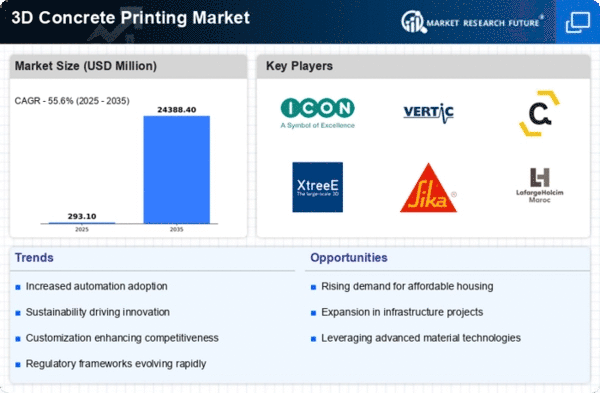
3D Concrete Printing Market Infographic
Purchase Options

Market Share

3D Concrete Printing Market Share Analysis

To stand out in the fast-changing 3D Concrete Printing Market, organizations use a variety of methods. The strategy is to innovate 3D concrete printing technology. Companies invest in R&D to improve printing system efficiency, speed, and precision, focusing on design flexibility, sustainability, and concrete mix compatibility. Companies can attract clients seeking modern and sustainable approaches for residential and infrastructure construction by delivering cutting-edge solutions.

The 3D concrete printing market is expected to increase due to its rapid growth at a stable CAGR rate through 2028. Studies show that the market is demanding more personalized and cost-effective constructions, which will encourage producers to perform larger and more complex activities to suit diversification and expanding needs. The market is also seeing an increase in finances and investment for robust infrastructure that will help it expand and recover from the pandemic.

3D Concrete Printing Market share positioning depends on pricing tactics. Cost leadership companies provide 3D concrete printing at low prices to attract budget-conscious building organizations. Conversely, organizations that emphasize printing precision, customization, or automation use premium pricing tactics. This premium approach attracts consumers who seek top-tier 3D concrete printing solutions, increasing profit margins and value.

A large network is essential for market share positioning. To provide extensive 3D concrete printing, companies work with construction businesses, architects, and real estate developers. A well-organized distribution system increases market reach and makes novel technology accessible for clients to use when planning or executing construction projects. Accessibility influences buying decisions, so organizations position themselves to fulfill demand.

Strategic relationships and collaborations with construction and architectural leaders are also important for 3D Concrete Printing Market market share positioning. By partnering with design, engineering, and construction businesses, enterprises may share experience, reach new markets, and solve 3D concrete printing specifications and project requirements issues. Joint ventures, strategic acquisitions, and collaborations boost a 3D Concrete Printing Market company's market share and position.

Effective marketing and branding are key to market share growth. Digital marketing, construction events, and industry professional involvement help companies build brand awareness and promote 3D concrete printing services. A strong brand attracts new customers and earns architects, engineers, and construction managers' trust, strengthening a company's 3D concrete printing solutions market share.

Innovation drives market share in the 3D Concrete Printing Market. Companies invest in R&D to develop new printing technologies that meet construction, sustainability, and design trends. New printing materials, greater printing capabilities, or automation and robotics can make a company a leader in 3D concrete printing solutions.

Market share positioning also depends on customer-centric tactics. Company 3D concrete printing services and solutions are tailored to construction enterprises, architects, and project managers' demands. Excellent customer service, technical assistance, and smooth 3D printing integration into construction projects generate trust and long-term connections. Happy consumers are more likely to return, boosting a company's reputation and market share.


Author
Harshita Gorade
Research Analyst

Harshita Post graduate MBA in Business Administration from Welingkar Institute, Mumbai and 5 years of experience in the field of product market research. As a Research Analyst, I have cross-domain experience in packaging, and industrial Automation & Equipment. I am currently looking after the research process of packaging, logistics & transportation, and industrial automation & equipment at Market Research Future Reports. My responsibilities at the organization involve handling syndicate and custom reports as well as responding to client inquiries, and organize, co-ordinate with a group of 5 to 6 persons to manage all workflows.

Leave a Comment

FAQs

What is the projected market valuation for the 3D Concrete Printing Market in 2035?

<p>The projected market valuation for the 3D Concrete Printing Market in 2035 is 24,388.4 USD Million.</p>

What was the overall market valuation for the 3D Concrete Printing Market in 2024?

<p>The overall market valuation for the 3D Concrete Printing Market in 2024 was 188.37 USD Million.</p>

What is the expected CAGR for the 3D Concrete Printing Market during the forecast period 2025 - 2035?

<p>The expected CAGR for the 3D Concrete Printing Market during the forecast period 2025 - 2035 is 55.6%.</p>

Which application segment had the highest valuation in 2024?

<p>The Infrastructure Development application segment had the highest valuation in 2024, amounting to 6,000.0 USD Million.</p>

What are the key technologies used in 3D Concrete Printing?

<p>Key technologies in 3D Concrete Printing include Extrusion-Based Printing, Binder Jetting, Powder-Based Printing, and Material Jetting.</p>

Which end-use segment is projected to grow the most by 2035?

<p>The Custom Structures end-use segment is projected to grow significantly by 2035, with a valuation of 8,000.0 USD Million.</p>

Who are the leading companies in the 3D Concrete Printing Market?

<p>Leading companies in the 3D Concrete Printing Market include ICON, Vertico, Apis Cor, and LafargeHolcim.</p>

What was the valuation of the Repair and Maintenance application segment in 2024?

The Repair and Maintenance application segment had a valuation of 6,388.4 USD Million in 2024.

Which material type is expected to dominate the market by 2035?

Concrete is expected to dominate the market by 2035, with a projected valuation of 10,000.0 USD Million.

What is the significance of layered construction in the 3D Concrete Printing process?

Layered construction is significant in the 3D Concrete Printing process, with a projected valuation of 16,388.4 USD Million by 2035.

Market Summary

As per MRFR analysis, the 3D Concrete Printing Market Size was estimated at 481.9 USD Billion in 2024. The 3D Concrete Printing industry is projected to grow from 709.8 USD Billion in 2025 to 34,134.0 USD Billion by 2035, exhibiting a compound annual growth rate (CAGR) of 47.3% during the forecast period 2025 - 2035.

Key Market Trends & Highlights

The 3D Concrete Printing Market is poised for substantial growth driven by technological advancements and sustainability initiatives.

  • North America remains the largest market for 3D concrete printing, reflecting a robust demand in residential construction. Asia-Pacific is emerging as the fastest-growing region, propelled by rapid urbanization and infrastructure development. The residential construction segment dominates the market, while the infrastructure development segment is witnessing the highest growth rates. Cost efficiency and environmental sustainability are key drivers fueling the expansion of the 3D concrete printing market.

Market Size & Forecast

2024 Market Size 481.9 (USD Billion)
2035 Market Size 34,134.0 (USD Billion)
CAGR (2025 - 2035) 47.3%
Largest Regional Market Share in 2024 North America

Major Players

ICON (US), Vertico (NL), Apis Cor (RU), XtreeE (FR), Sika AG (CH), LafargeHolcim (CH), BetAbram (IT), 3D Concrete Printing (DE), COBOD International (DK)

Market Trends

The 3D Concrete Printing Market is currently experiencing a transformative phase, characterized by advancements in technology and increasing adoption across various sectors. The expanding 3D concrete printing market size reflects growing confidence in this innovative construction methodology, which offers reduced material waste, enhanced design flexibility, and significantly accelerated project timelines. . As stakeholders recognize the potential of 3D printing to revolutionize traditional building practices, investments in research and development are likely to rise. Furthermore, the integration of sustainable materials and eco-friendly practices within this market appears to be gaining traction, aligning with global efforts towards sustainability and environmental responsibility.

In addition, the 3D concrete printing market is witnessing heightened interest from both public and private sector entities seeking efficient solutions to housing shortages and large-scale infrastructure demands. The rising 3D concrete printing market size can be attributed to the technology’s ability to construct complex architectural designs with reduced labor dependency, resulting in considerable cost efficiencies. As the technology continues to mature, the market is likely to expand into new applications, driving innovation and reshaping the construction industry landscape in the years ahead.

Technological Advancements

The 3D Concrete Printing Market is benefiting from rapid technological innovations that enhance printing capabilities. These advancements include improved printer designs, more efficient materials, and sophisticated software solutions that streamline the printing process. As technology evolves, it is likely to enable more complex structures and reduce production times, thereby attracting a wider range of applications.

Sustainability Focus

There is a noticeable trend towards sustainability within the 3D Concrete Printing Market. Companies are increasingly exploring eco-friendly materials and practices to minimize environmental impact. This focus on sustainability not only aligns with global environmental goals but also appeals to consumers who prioritize green building solutions.

Customization Demand

The demand for customized construction solutions is rising within the 3D Concrete Printing Market. Clients are seeking unique designs that cater to their specific needs and preferences. This trend indicates a shift towards personalized architecture, prompting companies to innovate and offer tailored services that stand out in a competitive landscape.

3D Concrete Printing Market Market Drivers

Sustainability Initiatives

Sustainability is becoming a pivotal driver in the Global 3D Concrete Printing Market Industry as environmental concerns gain prominence. The ability to utilize recycled materials and reduce waste during construction aligns with global sustainability goals. Moreover, 3D concrete printing minimizes the carbon footprint associated with traditional construction methods. This shift towards eco-friendly practices is likely to attract investments and foster growth in the sector. As the market evolves, the emphasis on sustainable construction practices could lead to a compound annual growth rate of 55.48% from 2025 to 2035, reflecting a growing preference for environmentally responsible building solutions.

Technological Advancements

The Global 3D Concrete Printing Market Industry is experiencing rapid technological advancements that enhance the efficiency and capabilities of construction processes. Innovations in materials, such as high-performance concrete and additives, allow for more complex designs and improved structural integrity. For instance, the integration of robotics and automation in 3D printing processes reduces labor costs and construction time. As a result, the market is projected to grow from 0.19 USD Billion in 2024 to an astounding 24.4 USD Billion by 2035, indicating a robust demand for advanced construction technologies.

Cost Efficiency and Labor Reduction

Cost efficiency and labor reduction are vital factors influencing the Global 3D Concrete Printing Market Industry. The technology significantly lowers construction costs by minimizing material waste and reducing the need for extensive labor. Automated processes streamline production, allowing for faster project completion. This economic advantage is particularly appealing in regions facing labor shortages or high labor costs. As the industry continues to evolve, the potential for further cost savings may enhance the attractiveness of 3D concrete printing, thereby encouraging broader adoption across various construction sectors.

Customization and Design Flexibility

Customization and design flexibility are increasingly recognized as key advantages of the Global 3D Concrete Printing Market Industry. Unlike traditional construction methods, 3D printing allows for the creation of intricate designs and tailored structures that meet specific client needs. This capability not only enhances aesthetic appeal but also optimizes functionality. As architects and builders embrace this technology, the demand for customized solutions is likely to rise, further driving market growth. The ability to produce unique structures efficiently positions 3D concrete printing as a preferred choice in modern construction.

Urbanization and Infrastructure Development

The ongoing trend of urbanization and the need for infrastructure development are significant drivers of the Global 3D Concrete Printing Market Industry. Rapid population growth in urban areas necessitates innovative construction solutions to meet housing and infrastructure demands. Governments worldwide are investing in smart city initiatives, which often incorporate advanced construction technologies like 3D concrete printing. This trend is expected to propel the market forward, as urban planners and developers seek efficient and cost-effective methods to construct residential and commercial buildings, thereby contributing to the projected market growth.

Market Segment Insights

By Application: Residential Construction (Largest) vs. Infrastructure Development (Fastest-Growing)

In the 3D concrete printing market, the application landscape is primarily dominated by <a href="https://www.marketresearchfuture.com/reports/residential-construction-market-25834">residential construction</a>, which leverages this technology to streamline building processes and enhance design flexibility. The commercial construction sector also plays a significant role but tends to adopt these innovations more gradually. Meanwhile, infrastructure development is emerging as the fastest-growing segment, driven by increasing public and private investments in smart cities and sustainable infrastructure solutions.

Residential Construction (Dominant) vs. Infrastructure Development (Emerging)

The residential construction segment holds a dominant position in the 3D concrete printing market, characterized by its ability to reduce labor costs and construction time while offering unique architectural possibilities. It serves not only single-family homes but also multi-family units, showcasing versatility in design. Meanwhile, infrastructure development has emerged as a key growth area, propelled by the need for innovative solutions to aging infrastructure and the expansion of urban areas. This segment is gaining traction through the adoption of automated printing techniques that improve efficiency and sustainability in large-scale projects, making it an attractive area for investment and future growth in the market.

By Technology: Extrusion-Based Printing (Largest) vs. Binder Jetting (Fastest-Growing)

In the 3D concrete printing market, Extrusion-Based Printing holds the largest share, effectively leading the market due to its versatility and established application in large-scale constructions. In contrast, Binder Jetting is rapidly gaining attention for its innovative approach and efficiency in creating complex structures with minimal waste, positioning it as the fastest-growing technology in this segment. Both technologies cater to different market needs, contributing to the diversity and overall growth of the industry.

Technology: Extrusion-Based Printing (Dominant) vs. Binder Jetting (Emerging)

Extrusion-Based Printing stands as the dominant technology in the 3D concrete printing market, characterized by its robust ability to create large-scale structures with high precision and material efficacy. It utilizes a continuous process, allowing for quicker project completion while minimizing material waste. On the other hand, Binder Jetting is emerging as a promising alternative, appealing to projects requiring detailed and intricate designs. It operates by depositing a binding agent onto powder materials, enabling the formation of complex geometries. This flexibility, coupled with reduced material usage and the potential for multi-material construction, distinguishes Binder Jetting in a competitive landscape, highlighting its potential as a game-changing technology.

By End Use: Building Components (Largest) vs. Art Installations (Fastest-Growing)

<p>The 3D Concrete Printing Market showcases a diverse array of end-use segments, prominently featuring Building Components, Precast Elements, Custom Structures, and Art Installations. Among these, Building Components represent the largest share, driven by their widespread application in construction projects. In contrast, while Precast Elements and Custom Structures hold significant importance, Art Installations are emerging as the fastest-growing segment due to increasing interest in innovative design and unique artistic expressions in urban spaces.</p>

<p>Building Components (Dominant) vs. Art Installations (Emerging)</p>

<p>Building Components are at the forefront of the 3D Concrete Printing Market, favored for their practicality and efficiency in construction settings. They encompass essential structural elements like walls, slabs, and other foundational aspects, ensuring durability and reduced material waste. On the other hand, Art Installations represent an emerging trend where creativity and technology converge. This segment is gaining traction as artists and designers leverage 3D printing techniques to create unique pieces that challenge conventional artistic mediums. The appeal of personalized art within public spaces is attracting new audiences, thus driving growth in this area of the market.</p>

By Material Type: Concrete (Largest) vs. Composite Materials (Fastest-Growing)

<p>In the 3D Concrete Printing Market, Concrete remains the largest segment, commanding a significant share of the overall market due to its widespread application and established manufacturing processes. Its robustness and versatility make Concrete a preferred choice for various construction projects, leading to a stable demand in both residential and commercial sectors. Meanwhile, Composite Materials are emerging as a fast-growing segment, attracting attention for their potential to enhance material performance and reduce waste, thereby appealing to environmentally conscious builders and architects alike. The growth trajectory for Composite Materials in this market is driven by technological advancements and an increasing emphasis on sustainability. The development of innovative composite mixes that offer improved strength, flexibility, and lighter weight is reshaping traditional construction methodologies. This shift is not only fostering growth in the use of composite materials but also encouraging the broader adoption of 3D printing technologies in construction, creating significant opportunities for manufacturers and investors alike.</p>

<p>Concrete (Dominant) vs. Geopolymer Concrete (Emerging)</p>

<p>Concrete is undeniably the dominant material in the 3D Concrete Printing Market, primarily due to its long history of reliable use and performance in construction. Its extensive adaptability to various project needs, from residential homes to large-scale infrastructure, solidifies its market leadership. In contrast, Geopolymer Concrete is an emerging segment gaining traction thanks to its eco-friendly nature and potential to significantly reduce carbon emissions. It utilizes industrial by-products, such as fly ash and slag, making it a sustainable alternative. As awareness of environmental impact grows, Geopolymer Concrete is beginning to capture interest for its strength, durability, and lower environmental footprint, challenging traditional concrete and carving out a niche in the sustainable construction sector.</p>

By Process Type: Digital Fabrication (Largest) vs. Additive Manufacturing (Fastest-Growing)

<p>In the 3D Concrete Printing Market, the process types exhibit a distinct distribution of market share. Digital Fabrication currently represents the largest segment, leveraging advanced technologies to create intricate designs and structures. Additive Manufacturing follows closely, gaining traction due to technological advancements and a growing demand for customization in concrete structures. Layered Construction, while important, occupies a smaller share in this dynamic market landscape. Growth trends signify that Additive Manufacturing is the fastest-growing segment within the 3D Concrete Printing market. This surge is driven by increased adoption of innovative materials and techniques that enhance efficiency in construction processes. The demand for sustainable practices and eco-friendly solutions further propels the growth of this segment, as more construction firms seek to integrate 3D printing to reduce waste and improve overall project timelines.</p>

<p>Process Type: Digital Fabrication (Dominant) vs. Layered Construction (Emerging)</p>

<p>Digital Fabrication dominates the 3D Concrete Printing market due to its ability to produce high-precision and complex structures. It employs advanced technologies that allow for greater design flexibility and the efficient use of materials, making it favored by architects and builders aiming for innovative construction solutions. In contrast, Layered Construction is emerging as a viable alternative, focusing on simplified methods of stacking materials to create concrete forms. Although it currently has a smaller market presence, its appeal lies in straightforward applications, cost-effectiveness, and edge in rapid construction, positioning it as a segment to watch in upcoming years.</p>

Get more detailed insights about 3D Concrete Printing Market Research Report - Global Forecast to 2035

Regional Insights

North America : Leading Market Innovators

North America is poised to maintain its leadership in the 3D Concrete Printing market, holding a significant market share of 94.19 in 2024. The region's growth is driven by increasing demand for sustainable construction practices, advancements in technology, and supportive regulatory frameworks. Government initiatives promoting innovation and infrastructure development further catalyze market expansion, making it a hub for cutting-edge construction solutions. The competitive landscape in North America is characterized by the presence of key players such as ICON, LafargeHolcim, and Sika AG. These companies are at the forefront of technological advancements, focusing on enhancing the efficiency and sustainability of construction processes. The U.S. leads the market, with significant investments in R&D and a growing trend towards modular construction, positioning the region as a global leader in 3D Concrete Printing.

Europe : Emerging Technological Hub

Europe is rapidly emerging as a technological hub in the 3D Concrete Printing market, with a market size of 50.51. The region benefits from stringent regulations promoting sustainable building practices and innovative construction methods. Countries like Germany and the Netherlands are leading the charge, supported by government incentives for green technologies and infrastructure projects, which are crucial for market growth. The competitive landscape in Europe features key players such as Vertico and COBOD International, who are pioneering advancements in 3D printing technology. The presence of robust research institutions and collaborative projects between academia and industry further enhances the region's capabilities. As Europe continues to invest in smart construction solutions, it is set to play a pivotal role in the global 3D Concrete Printing market. "The European Commission is committed to fostering innovation in construction to achieve sustainability goals," said a spokesperson from the European Commission.

Asia-Pacific : Rapidly Growing Market

Asia-Pacific is witnessing rapid growth in the 3D Concrete Printing market, with a market size of 36.67. The region's expansion is fueled by increasing urbanization, a rising demand for affordable housing, and government initiatives aimed at modernizing infrastructure. Countries like China and India are at the forefront, leveraging technology to address construction challenges and improve efficiency in building processes. The competitive landscape in Asia-Pacific is evolving, with local players and international companies vying for market share. Key players such as Apis Cor and XtreeE are making significant strides in the region, focusing on innovative solutions tailored to local needs. As the demand for sustainable construction practices grows, Asia-Pacific is set to become a major player in the global 3D Concrete Printing market.

Middle East and Africa : Emerging Market Potential

The Middle East and Africa region is beginning to explore the potential of 3D Concrete Printing, with a market size of 6.0. The growth is driven by increasing investments in infrastructure and a push towards innovative construction methods. Governments in countries like the UAE are actively promoting 3D printing technologies as part of their vision for future cities, which is expected to catalyze market development. The competitive landscape is still in its infancy, with a few key players starting to establish a presence. Local firms are beginning to collaborate with international companies to leverage expertise and technology. As the region continues to invest in smart construction solutions, it holds significant potential for growth in the 3D Concrete Printing market.

Key Players and Competitive Insights

The 3D Concrete Printing Market is currently characterized by a dynamic competitive landscape, driven by technological advancements and increasing demand for sustainable construction solutions. Key players such as ICON (US), Sika AG (CH), and Apis Cor (RU) are strategically positioning themselves through innovation and partnerships. ICON (US) has focused on developing advanced printing technologies that enhance construction efficiency, while Sika AG (CH) emphasizes the integration of smart materials in its concrete solutions. Apis Cor (RU) is leveraging its unique mobile 3D printing technology to penetrate emerging markets, collectively shaping a competitive environment that prioritizes technological differentiation and sustainability.In terms of business tactics, companies are increasingly localizing manufacturing to reduce lead times and optimize supply chains. The market appears moderately fragmented, with several players vying for market share. However, the collective influence of major companies is significant, as they drive innovation and set industry standards. This competitive structure fosters an environment where collaboration and strategic partnerships are essential for growth and market penetration.
In November ICON (US) announced a partnership with a leading architectural firm to develop a series of eco-friendly housing projects utilizing their latest 3D printing technology. This collaboration is expected to enhance ICON's market presence and demonstrate the viability of sustainable construction practices. The strategic importance of this partnership lies in its potential to attract environmentally conscious consumers and investors, thereby positioning ICON as a leader in sustainable building solutions.
In October Sika AG (CH) launched a new line of 3D printable concrete that incorporates recycled materials, aiming to reduce the carbon footprint of construction projects. This initiative not only aligns with global sustainability goals but also showcases Sika's commitment to innovation in material science. The introduction of this product is likely to strengthen Sika's competitive edge by appealing to a growing segment of eco-aware clients and regulatory bodies focused on sustainability.
In September Apis Cor (RU) expanded its operations into Southeast Asia, establishing a manufacturing facility to cater to the region's burgeoning construction market. This strategic move is significant as it allows Apis Cor to capitalize on the increasing demand for affordable housing solutions in developing countries. By localizing production, the company can reduce costs and improve delivery times, enhancing its competitive position in the global market.
As of December current trends in the 3D Concrete Printing Market indicate a strong emphasis on digitalization, sustainability, and the integration of AI technologies. Strategic alliances are increasingly shaping the competitive landscape, as companies recognize the value of collaboration in driving innovation. Looking ahead, competitive differentiation is likely to evolve from traditional price-based competition to a focus on technological advancements, innovative materials, and reliable supply chains. This shift underscores the importance of adaptability and forward-thinking strategies in maintaining a competitive edge in the market.

Key Companies in the 3D Concrete Printing Market include

Industry Developments

January 2022:  MiCoB Pvt. Ltd stated that it had achieved a record delivery speed of 30 days for a 3D concrete printed runway controller hut to the Military Engineer Services for the Airbase in Pune. The finished building is India's first hybrid "G+1" structure to combine 3D concrete printing with a prefabricated steel frame.

April 2021: Project Milestone is a projected residential complex in Eindhoven, the Netherlands, consisting of five 3D-printed structures designed by Houben/Van Mierlo Architects. The first structure, a single-story single-family dwelling, has been built.

October 2023: A startup in California unveils a new 3D concrete printing system that uses recycled materials, promoting eco-friendly construction practices in the industry.

Future Outlook

3D Concrete Printing Market Future Outlook

The 3D Concrete Printing Market is projected to grow at a 47.3% CAGR from 2025 to 2035, driven by technological advancements, sustainability initiatives, and increasing demand for customized construction solutions.

New opportunities lie in:

  • <p>Development of automated 3D printing construction sites Integration of AI for design optimization and material usage Expansion into residential and commercial building sectors</p>

By 2035, the market is expected to be a cornerstone of modern construction practices.

Market Segmentation

3D Concrete Printing Market End Use Outlook

  • Building Components
  • Precast Elements
  • Custom Structures
  • Art Installations

3D Concrete Printing Market Technology Outlook

  • Extrusion-Based Printing
  • Binder Jetting
  • Powder-Based Printing
  • Material Jetting

3D Concrete Printing Market Application Outlook

  • Residential Construction
  • Commercial Construction
  • Infrastructure Development
  • Art and Design
  • Repair and Maintenance

3D Concrete Printing Market Material Type Outlook

  • Concrete
  • Composite Materials
  • Reinforced Concrete
  • Geopolymer Concrete

Report Scope

MARKET SIZE 2024 481.9(USD Billion)
MARKET SIZE 2025 709.8(USD Billion)
MARKET SIZE 2035 34,134.0(USD Billion)
COMPOUND ANNUAL GROWTH RATE (CAGR) 47.3% (2025 - 2035)
REPORT COVERAGE Revenue Forecast, Competitive Landscape, Growth Factors, and Trends
BASE YEAR 2024
Market Forecast Period 2025 - 2035
Historical Data 2019 - 2024
Market Forecast Units USD Million
Key Companies Profiled ICON (US), Vertico (NL), Apis Cor (RU), XtreeE (FR), Sika AG (CH), LafargeHolcim (CH), BetAbram (IT), 3D Concrete Printing (DE), COBOD International (DK)
Segments Covered Application, Technology, End Use, Material Type
Key Market Opportunities Integration of sustainable materials in the 3D Concrete Printing Market enhances eco-friendly construction solutions.
Key Market Dynamics Technological advancements in materials and processes drive competitive dynamics in the 3D concrete printing market.
Countries Covered North America, Europe, APAC, South America, MEA

FAQs

What is the projected market valuation for the 3D Concrete Printing Market in 2035?

<p>The projected market valuation for the 3D Concrete Printing Market in 2035 is 24,388.4 USD Million.</p>

What was the overall market valuation for the 3D Concrete Printing Market in 2024?

<p>The overall market valuation for the 3D Concrete Printing Market in 2024 was 188.37 USD Million.</p>

What is the expected CAGR for the 3D Concrete Printing Market during the forecast period 2025 - 2035?

<p>The expected CAGR for the 3D Concrete Printing Market during the forecast period 2025 - 2035 is 55.6%.</p>

Which application segment had the highest valuation in 2024?

<p>The Infrastructure Development application segment had the highest valuation in 2024, amounting to 6,000.0 USD Million.</p>

What are the key technologies used in 3D Concrete Printing?

<p>Key technologies in 3D Concrete Printing include Extrusion-Based Printing, Binder Jetting, Powder-Based Printing, and Material Jetting.</p>

Which end-use segment is projected to grow the most by 2035?

<p>The Custom Structures end-use segment is projected to grow significantly by 2035, with a valuation of 8,000.0 USD Million.</p>

Who are the leading companies in the 3D Concrete Printing Market?

<p>Leading companies in the 3D Concrete Printing Market include ICON, Vertico, Apis Cor, and LafargeHolcim.</p>

What was the valuation of the Repair and Maintenance application segment in 2024?

The Repair and Maintenance application segment had a valuation of 6,388.4 USD Million in 2024.

Which material type is expected to dominate the market by 2035?

Concrete is expected to dominate the market by 2035, with a projected valuation of 10,000.0 USD Million.

What is the significance of layered construction in the 3D Concrete Printing process?

Layered construction is significant in the 3D Concrete Printing process, with a projected valuation of 16,388.4 USD Million by 2035.

  1. SECTION I: EXECUTIVE SUMMARY AND KEY HIGHLIGHTS
    1. | 1.1 EXECUTIVE SUMMARY
    2. | | 1.1.1 Market Overview
    3. | | 1.1.2 Key Findings
    4. | | 1.1.3 Market Segmentation
    5. | | 1.1.4 Competitive Landscape
    6. | | 1.1.5 Challenges and Opportunities
    7. | | 1.1.6 Future Outlook
  2. SECTION II: SCOPING, METHODOLOGY AND MARKET STRUCTURE
    1. | 2.1 MARKET INTRODUCTION
    2. | | 2.1.1 Definition
    3. | | 2.1.2 Scope of the study
    4. | | | 2.1.2.1 Research Objective
    5. | | | 2.1.2.2 Assumption
    6. | | | 2.1.2.3 Limitations
    7. | 2.2 RESEARCH METHODOLOGY
    8. | | 2.2.1 Overview
    9. | | 2.2.2 Data Mining
    10. | | 2.2.3 Secondary Research
    11. | | 2.2.4 Primary Research
    12. | | | 2.2.4.1 Primary Interviews and Information Gathering Process
    13. | | | 2.2.4.2 Breakdown of Primary Respondents
    14. | | 2.2.5 Forecasting Model
    15. | | 2.2.6 Market Size Estimation
    16. | | | 2.2.6.1 Bottom-Up Approach
    17. | | | 2.2.6.2 Top-Down Approach
    18. | | 2.2.7 Data Triangulation
    19. | | 2.2.8 Validation
  3. SECTION III: QUALITATIVE ANALYSIS
    1. | 3.1 MARKET DYNAMICS
    2. | | 3.1.1 Overview
    3. | | 3.1.2 Drivers
    4. | | 3.1.3 Restraints
    5. | | 3.1.4 Opportunities
    6. | 3.2 MARKET FACTOR ANALYSIS
    7. | | 3.2.1 Value chain Analysis
    8. | | 3.2.2 Porter's Five Forces Analysis
    9. | | | 3.2.2.1 Bargaining Power of Suppliers
    10. | | | 3.2.2.2 Bargaining Power of Buyers
    11. | | | 3.2.2.3 Threat of New Entrants
    12. | | | 3.2.2.4 Threat of Substitutes
    13. | | | 3.2.2.5 Intensity of Rivalry
    14. | | 3.2.3 COVID-19 Impact Analysis
    15. | | | 3.2.3.1 Market Impact Analysis
    16. | | | 3.2.3.2 Regional Impact
    17. | | | 3.2.3.3 Opportunity and Threat Analysis
  4. SECTION IV: QUANTITATIVE ANALYSIS
    1. | 4.1 Packaging & Transport, BY Application (USD Million)
    2. | | 4.1.1 Residential Construction
    3. | | 4.1.2 Commercial Construction
    4. | | 4.1.3 Infrastructure Development
    5. | | 4.1.4 Art and Design
    6. | | 4.1.5 Repair and Maintenance
    7. | 4.2 Packaging & Transport, BY Technology (USD Million)
    8. | | 4.2.1 Extrusion-Based Printing
    9. | | 4.2.2 Binder Jetting
    10. | | 4.2.3 Powder-Based Printing
    11. | | 4.2.4 Material Jetting
    12. | 4.3 Packaging & Transport, BY End Use (USD Million)
    13. | | 4.3.1 Building Components
    14. | | 4.3.2 Precast Elements
    15. | | 4.3.3 Custom Structures
    16. | | 4.3.4 Art Installations
    17. | 4.4 Packaging & Transport, BY Material Type (USD Million)
    18. | | 4.4.1 Concrete
    19. | | 4.4.2 Composite Materials
    20. | | 4.4.3 Reinforced Concrete
    21. | | 4.4.4 Geopolymer Concrete
    22. | 4.5 Packaging & Transport, BY Process Type (USD Million)
    23. | | 4.5.1 Digital Fabrication
    24. | | 4.5.2 Additive Manufacturing
    25. | | 4.5.3 Layered Construction
    26. | 4.6 Packaging & Transport, BY Region (USD Million)
    27. | | 4.6.1 North America
    28. | | | 4.6.1.1 US
    29. | | | 4.6.1.2 Canada
    30. | | 4.6.2 Europe
    31. | | | 4.6.2.1 Germany
    32. | | | 4.6.2.2 UK
    33. | | | 4.6.2.3 France
    34. | | | 4.6.2.4 Russia
    35. | | | 4.6.2.5 Italy
    36. | | | 4.6.2.6 Spain
    37. | | | 4.6.2.7 Rest of Europe
    38. | | 4.6.3 APAC
    39. | | | 4.6.3.1 China
    40. | | | 4.6.3.2 India
    41. | | | 4.6.3.3 Japan
    42. | | | 4.6.3.4 South Korea
    43. | | | 4.6.3.5 Malaysia
    44. | | | 4.6.3.6 Thailand
    45. | | | 4.6.3.7 Indonesia
    46. | | | 4.6.3.8 Rest of APAC
    47. | | 4.6.4 South America
    48. | | | 4.6.4.1 Brazil
    49. | | | 4.6.4.2 Mexico
    50. | | | 4.6.4.3 Argentina
    51. | | | 4.6.4.4 Rest of South America
    52. | | 4.6.5 MEA
    53. | | | 4.6.5.1 GCC Countries
    54. | | | 4.6.5.2 South Africa
    55. | | | 4.6.5.3 Rest of MEA
  5. SECTION V: COMPETITIVE ANALYSIS
    1. | 5.1 Competitive Landscape
    2. | | 5.1.1 Overview
    3. | | 5.1.2 Competitive Analysis
    4. | | 5.1.3 Market share Analysis
    5. | | 5.1.4 Major Growth Strategy in the Packaging & Transport
    6. | | 5.1.5 Competitive Benchmarking
    7. | | 5.1.6 Leading Players in Terms of Number of Developments in the Packaging & Transport
    8. | | 5.1.7 Key developments and growth strategies
    9. | | | 5.1.7.1 New Product Launch/Service Deployment
    10. | | | 5.1.7.2 Merger & Acquisitions
    11. | | | 5.1.7.3 Joint Ventures
    12. | | 5.1.8 Major Players Financial Matrix
    13. | | | 5.1.8.1 Sales and Operating Income
    14. | | | 5.1.8.2 Major Players R&D Expenditure. 2023
    15. | 5.2 Company Profiles
    16. | | 5.2.1 ICON (US)
    17. | | | 5.2.1.1 Financial Overview
    18. | | | 5.2.1.2 Products Offered
    19. | | | 5.2.1.3 Key Developments
    20. | | | 5.2.1.4 SWOT Analysis
    21. | | | 5.2.1.5 Key Strategies
    22. | | 5.2.2 Vertico (NL)
    23. | | | 5.2.2.1 Financial Overview
    24. | | | 5.2.2.2 Products Offered
    25. | | | 5.2.2.3 Key Developments
    26. | | | 5.2.2.4 SWOT Analysis
    27. | | | 5.2.2.5 Key Strategies
    28. | | 5.2.3 Apis Cor (RU)
    29. | | | 5.2.3.1 Financial Overview
    30. | | | 5.2.3.2 Products Offered
    31. | | | 5.2.3.3 Key Developments
    32. | | | 5.2.3.4 SWOT Analysis
    33. | | | 5.2.3.5 Key Strategies
    34. | | 5.2.4 XtreeE (FR)
    35. | | | 5.2.4.1 Financial Overview
    36. | | | 5.2.4.2 Products Offered
    37. | | | 5.2.4.3 Key Developments
    38. | | | 5.2.4.4 SWOT Analysis
    39. | | | 5.2.4.5 Key Strategies
    40. | | 5.2.5 Sika AG (CH)
    41. | | | 5.2.5.1 Financial Overview
    42. | | | 5.2.5.2 Products Offered
    43. | | | 5.2.5.3 Key Developments
    44. | | | 5.2.5.4 SWOT Analysis
    45. | | | 5.2.5.5 Key Strategies
    46. | | 5.2.6 LafargeHolcim (CH)
    47. | | | 5.2.6.1 Financial Overview
    48. | | | 5.2.6.2 Products Offered
    49. | | | 5.2.6.3 Key Developments
    50. | | | 5.2.6.4 SWOT Analysis
    51. | | | 5.2.6.5 Key Strategies
    52. | | 5.2.7 BetAbram (IT)
    53. | | | 5.2.7.1 Financial Overview
    54. | | | 5.2.7.2 Products Offered
    55. | | | 5.2.7.3 Key Developments
    56. | | | 5.2.7.4 SWOT Analysis
    57. | | | 5.2.7.5 Key Strategies
    58. | | 5.2.8 3D Concrete Printing (DE)
    59. | | | 5.2.8.1 Financial Overview
    60. | | | 5.2.8.2 Products Offered
    61. | | | 5.2.8.3 Key Developments
    62. | | | 5.2.8.4 SWOT Analysis
    63. | | | 5.2.8.5 Key Strategies
    64. | | 5.2.9 COBOD International (DK)
    65. | | | 5.2.9.1 Financial Overview
    66. | | | 5.2.9.2 Products Offered
    67. | | | 5.2.9.3 Key Developments
    68. | | | 5.2.9.4 SWOT Analysis
    69. | | | 5.2.9.5 Key Strategies
    70. | 5.3 Appendix
    71. | | 5.3.1 References
    72. | | 5.3.2 Related Reports
  6. LIST OF FIGURES
    1. | 6.1 MARKET SYNOPSIS
    2. | 6.2 NORTH AMERICA MARKET ANALYSIS
    3. | 6.3 US MARKET ANALYSIS BY APPLICATION
    4. | 6.4 US MARKET ANALYSIS BY TECHNOLOGY
    5. | 6.5 US MARKET ANALYSIS BY END USE
    6. | 6.6 US MARKET ANALYSIS BY MATERIAL TYPE
    7. | 6.7 US MARKET ANALYSIS BY PROCESS TYPE
    8. | 6.8 CANADA MARKET ANALYSIS BY APPLICATION
    9. | 6.9 CANADA MARKET ANALYSIS BY TECHNOLOGY
    10. | 6.10 CANADA MARKET ANALYSIS BY END USE
    11. | 6.11 CANADA MARKET ANALYSIS BY MATERIAL TYPE
    12. | 6.12 CANADA MARKET ANALYSIS BY PROCESS TYPE
    13. | 6.13 EUROPE MARKET ANALYSIS
    14. | 6.14 GERMANY MARKET ANALYSIS BY APPLICATION
    15. | 6.15 GERMANY MARKET ANALYSIS BY TECHNOLOGY
    16. | 6.16 GERMANY MARKET ANALYSIS BY END USE
    17. | 6.17 GERMANY MARKET ANALYSIS BY MATERIAL TYPE
    18. | 6.18 GERMANY MARKET ANALYSIS BY PROCESS TYPE
    19. | 6.19 UK MARKET ANALYSIS BY APPLICATION
    20. | 6.20 UK MARKET ANALYSIS BY TECHNOLOGY
    21. | 6.21 UK MARKET ANALYSIS BY END USE
    22. | 6.22 UK MARKET ANALYSIS BY MATERIAL TYPE
    23. | 6.23 UK MARKET ANALYSIS BY PROCESS TYPE
    24. | 6.24 FRANCE MARKET ANALYSIS BY APPLICATION
    25. | 6.25 FRANCE MARKET ANALYSIS BY TECHNOLOGY
    26. | 6.26 FRANCE MARKET ANALYSIS BY END USE
    27. | 6.27 FRANCE MARKET ANALYSIS BY MATERIAL TYPE
    28. | 6.28 FRANCE MARKET ANALYSIS BY PROCESS TYPE
    29. | 6.29 RUSSIA MARKET ANALYSIS BY APPLICATION
    30. | 6.30 RUSSIA MARKET ANALYSIS BY TECHNOLOGY
    31. | 6.31 RUSSIA MARKET ANALYSIS BY END USE
    32. | 6.32 RUSSIA MARKET ANALYSIS BY MATERIAL TYPE
    33. | 6.33 RUSSIA MARKET ANALYSIS BY PROCESS TYPE
    34. | 6.34 ITALY MARKET ANALYSIS BY APPLICATION
    35. | 6.35 ITALY MARKET ANALYSIS BY TECHNOLOGY
    36. | 6.36 ITALY MARKET ANALYSIS BY END USE
    37. | 6.37 ITALY MARKET ANALYSIS BY MATERIAL TYPE
    38. | 6.38 ITALY MARKET ANALYSIS BY PROCESS TYPE
    39. | 6.39 SPAIN MARKET ANALYSIS BY APPLICATION
    40. | 6.40 SPAIN MARKET ANALYSIS BY TECHNOLOGY
    41. | 6.41 SPAIN MARKET ANALYSIS BY END USE
    42. | 6.42 SPAIN MARKET ANALYSIS BY MATERIAL TYPE
    43. | 6.43 SPAIN MARKET ANALYSIS BY PROCESS TYPE
    44. | 6.44 REST OF EUROPE MARKET ANALYSIS BY APPLICATION
    45. | 6.45 REST OF EUROPE MARKET ANALYSIS BY TECHNOLOGY
    46. | 6.46 REST OF EUROPE MARKET ANALYSIS BY END USE
    47. | 6.47 REST OF EUROPE MARKET ANALYSIS BY MATERIAL TYPE
    48. | 6.48 REST OF EUROPE MARKET ANALYSIS BY PROCESS TYPE
    49. | 6.49 APAC MARKET ANALYSIS
    50. | 6.50 CHINA MARKET ANALYSIS BY APPLICATION
    51. | 6.51 CHINA MARKET ANALYSIS BY TECHNOLOGY
    52. | 6.52 CHINA MARKET ANALYSIS BY END USE
    53. | 6.53 CHINA MARKET ANALYSIS BY MATERIAL TYPE
    54. | 6.54 CHINA MARKET ANALYSIS BY PROCESS TYPE
    55. | 6.55 INDIA MARKET ANALYSIS BY APPLICATION
    56. | 6.56 INDIA MARKET ANALYSIS BY TECHNOLOGY
    57. | 6.57 INDIA MARKET ANALYSIS BY END USE
    58. | 6.58 INDIA MARKET ANALYSIS BY MATERIAL TYPE
    59. | 6.59 INDIA MARKET ANALYSIS BY PROCESS TYPE
    60. | 6.60 JAPAN MARKET ANALYSIS BY APPLICATION
    61. | 6.61 JAPAN MARKET ANALYSIS BY TECHNOLOGY
    62. | 6.62 JAPAN MARKET ANALYSIS BY END USE
    63. | 6.63 JAPAN MARKET ANALYSIS BY MATERIAL TYPE
    64. | 6.64 JAPAN MARKET ANALYSIS BY PROCESS TYPE
    65. | 6.65 SOUTH KOREA MARKET ANALYSIS BY APPLICATION
    66. | 6.66 SOUTH KOREA MARKET ANALYSIS BY TECHNOLOGY
    67. | 6.67 SOUTH KOREA MARKET ANALYSIS BY END USE
    68. | 6.68 SOUTH KOREA MARKET ANALYSIS BY MATERIAL TYPE
    69. | 6.69 SOUTH KOREA MARKET ANALYSIS BY PROCESS TYPE
    70. | 6.70 MALAYSIA MARKET ANALYSIS BY APPLICATION
    71. | 6.71 MALAYSIA MARKET ANALYSIS BY TECHNOLOGY
    72. | 6.72 MALAYSIA MARKET ANALYSIS BY END USE
    73. | 6.73 MALAYSIA MARKET ANALYSIS BY MATERIAL TYPE
    74. | 6.74 MALAYSIA MARKET ANALYSIS BY PROCESS TYPE
    75. | 6.75 THAILAND MARKET ANALYSIS BY APPLICATION
    76. | 6.76 THAILAND MARKET ANALYSIS BY TECHNOLOGY
    77. | 6.77 THAILAND MARKET ANALYSIS BY END USE
    78. | 6.78 THAILAND MARKET ANALYSIS BY MATERIAL TYPE
    79. | 6.79 THAILAND MARKET ANALYSIS BY PROCESS TYPE
    80. | 6.80 INDONESIA MARKET ANALYSIS BY APPLICATION
    81. | 6.81 INDONESIA MARKET ANALYSIS BY TECHNOLOGY
    82. | 6.82 INDONESIA MARKET ANALYSIS BY END USE
    83. | 6.83 INDONESIA MARKET ANALYSIS BY MATERIAL TYPE
    84. | 6.84 INDONESIA MARKET ANALYSIS BY PROCESS TYPE
    85. | 6.85 REST OF APAC MARKET ANALYSIS BY APPLICATION
    86. | 6.86 REST OF APAC MARKET ANALYSIS BY TECHNOLOGY
    87. | 6.87 REST OF APAC MARKET ANALYSIS BY END USE
    88. | 6.88 REST OF APAC MARKET ANALYSIS BY MATERIAL TYPE
    89. | 6.89 REST OF APAC MARKET ANALYSIS BY PROCESS TYPE
    90. | 6.90 SOUTH AMERICA MARKET ANALYSIS
    91. | 6.91 BRAZIL MARKET ANALYSIS BY APPLICATION
    92. | 6.92 BRAZIL MARKET ANALYSIS BY TECHNOLOGY
    93. | 6.93 BRAZIL MARKET ANALYSIS BY END USE
    94. | 6.94 BRAZIL MARKET ANALYSIS BY MATERIAL TYPE
    95. | 6.95 BRAZIL MARKET ANALYSIS BY PROCESS TYPE
    96. | 6.96 MEXICO MARKET ANALYSIS BY APPLICATION
    97. | 6.97 MEXICO MARKET ANALYSIS BY TECHNOLOGY
    98. | 6.98 MEXICO MARKET ANALYSIS BY END USE
    99. | 6.99 MEXICO MARKET ANALYSIS BY MATERIAL TYPE
    100. | 6.100 MEXICO MARKET ANALYSIS BY PROCESS TYPE
    101. | 6.101 ARGENTINA MARKET ANALYSIS BY APPLICATION
    102. | 6.102 ARGENTINA MARKET ANALYSIS BY TECHNOLOGY
    103. | 6.103 ARGENTINA MARKET ANALYSIS BY END USE
    104. | 6.104 ARGENTINA MARKET ANALYSIS BY MATERIAL TYPE
    105. | 6.105 ARGENTINA MARKET ANALYSIS BY PROCESS TYPE
    106. | 6.106 REST OF SOUTH AMERICA MARKET ANALYSIS BY APPLICATION
    107. | 6.107 REST OF SOUTH AMERICA MARKET ANALYSIS BY TECHNOLOGY
    108. | 6.108 REST OF SOUTH AMERICA MARKET ANALYSIS BY END USE
    109. | 6.109 REST OF SOUTH AMERICA MARKET ANALYSIS BY MATERIAL TYPE
    110. | 6.110 REST OF SOUTH AMERICA MARKET ANALYSIS BY PROCESS TYPE
    111. | 6.111 MEA MARKET ANALYSIS
    112. | 6.112 GCC COUNTRIES MARKET ANALYSIS BY APPLICATION
    113. | 6.113 GCC COUNTRIES MARKET ANALYSIS BY TECHNOLOGY
    114. | 6.114 GCC COUNTRIES MARKET ANALYSIS BY END USE
    115. | 6.115 GCC COUNTRIES MARKET ANALYSIS BY MATERIAL TYPE
    116. | 6.116 GCC COUNTRIES MARKET ANALYSIS BY PROCESS TYPE
    117. | 6.117 SOUTH AFRICA MARKET ANALYSIS BY APPLICATION
    118. | 6.118 SOUTH AFRICA MARKET ANALYSIS BY TECHNOLOGY
    119. | 6.119 SOUTH AFRICA MARKET ANALYSIS BY END USE
    120. | 6.120 SOUTH AFRICA MARKET ANALYSIS BY MATERIAL TYPE
    121. | 6.121 SOUTH AFRICA MARKET ANALYSIS BY PROCESS TYPE
    122. | 6.122 REST OF MEA MARKET ANALYSIS BY APPLICATION
    123. | 6.123 REST OF MEA MARKET ANALYSIS BY TECHNOLOGY
    124. | 6.124 REST OF MEA MARKET ANALYSIS BY END USE
    125. | 6.125 REST OF MEA MARKET ANALYSIS BY MATERIAL TYPE
    126. | 6.126 REST OF MEA MARKET ANALYSIS BY PROCESS TYPE
    127. | 6.127 KEY BUYING CRITERIA OF PACKAGING & TRANSPORT
    128. | 6.128 RESEARCH PROCESS OF MRFR
    129. | 6.129 DRO ANALYSIS OF PACKAGING & TRANSPORT
    130. | 6.130 DRIVERS IMPACT ANALYSIS: PACKAGING & TRANSPORT
    131. | 6.131 RESTRAINTS IMPACT ANALYSIS: PACKAGING & TRANSPORT
    132. | 6.132 SUPPLY / VALUE CHAIN: PACKAGING & TRANSPORT
    133. | 6.133 PACKAGING & TRANSPORT, BY APPLICATION, 2024 (% SHARE)
    134. | 6.134 PACKAGING & TRANSPORT, BY APPLICATION, 2024 TO 2035 (USD Million)
    135. | 6.135 PACKAGING & TRANSPORT, BY TECHNOLOGY, 2024 (% SHARE)
    136. | 6.136 PACKAGING & TRANSPORT, BY TECHNOLOGY, 2024 TO 2035 (USD Million)
    137. | 6.137 PACKAGING & TRANSPORT, BY END USE, 2024 (% SHARE)
    138. | 6.138 PACKAGING & TRANSPORT, BY END USE, 2024 TO 2035 (USD Million)
    139. | 6.139 PACKAGING & TRANSPORT, BY MATERIAL TYPE, 2024 (% SHARE)
    140. | 6.140 PACKAGING & TRANSPORT, BY MATERIAL TYPE, 2024 TO 2035 (USD Million)
    141. | 6.141 PACKAGING & TRANSPORT, BY PROCESS TYPE, 2024 (% SHARE)
    142. | 6.142 PACKAGING & TRANSPORT, BY PROCESS TYPE, 2024 TO 2035 (USD Million)
    143. | 6.143 BENCHMARKING OF MAJOR COMPETITORS
  7. LIST OF TABLES
    1. | 7.1 LIST OF ASSUMPTIONS
    2. | | 7.1.1
    3. | 7.2 North America MARKET SIZE ESTIMATES; FORECAST
    4. | | 7.2.1 BY APPLICATION, 2025-2035 (USD Million)
    5. | | 7.2.2 BY TECHNOLOGY, 2025-2035 (USD Million)
    6. | | 7.2.3 BY END USE, 2025-2035 (USD Million)
    7. | | 7.2.4 BY MATERIAL TYPE, 2025-2035 (USD Million)
    8. | | 7.2.5 BY PROCESS TYPE, 2025-2035 (USD Million)
    9. | 7.3 US MARKET SIZE ESTIMATES; FORECAST
    10. | | 7.3.1 BY APPLICATION, 2025-2035 (USD Million)
    11. | | 7.3.2 BY TECHNOLOGY, 2025-2035 (USD Million)
    12. | | 7.3.3 BY END USE, 2025-2035 (USD Million)
    13. | | 7.3.4 BY MATERIAL TYPE, 2025-2035 (USD Million)
    14. | | 7.3.5 BY PROCESS TYPE, 2025-2035 (USD Million)
    15. | 7.4 Canada MARKET SIZE ESTIMATES; FORECAST
    16. | | 7.4.1 BY APPLICATION, 2025-2035 (USD Million)
    17. | | 7.4.2 BY TECHNOLOGY, 2025-2035 (USD Million)
    18. | | 7.4.3 BY END USE, 2025-2035 (USD Million)
    19. | | 7.4.4 BY MATERIAL TYPE, 2025-2035 (USD Million)
    20. | | 7.4.5 BY PROCESS TYPE, 2025-2035 (USD Million)
    21. | 7.5 Europe MARKET SIZE ESTIMATES; FORECAST
    22. | | 7.5.1 BY APPLICATION, 2025-2035 (USD Million)
    23. | | 7.5.2 BY TECHNOLOGY, 2025-2035 (USD Million)
    24. | | 7.5.3 BY END USE, 2025-2035 (USD Million)
    25. | | 7.5.4 BY MATERIAL TYPE, 2025-2035 (USD Million)
    26. | | 7.5.5 BY PROCESS TYPE, 2025-2035 (USD Million)
    27. | 7.6 Germany MARKET SIZE ESTIMATES; FORECAST
    28. | | 7.6.1 BY APPLICATION, 2025-2035 (USD Million)
    29. | | 7.6.2 BY TECHNOLOGY, 2025-2035 (USD Million)
    30. | | 7.6.3 BY END USE, 2025-2035 (USD Million)
    31. | | 7.6.4 BY MATERIAL TYPE, 2025-2035 (USD Million)
    32. | | 7.6.5 BY PROCESS TYPE, 2025-2035 (USD Million)
    33. | 7.7 UK MARKET SIZE ESTIMATES; FORECAST
    34. | | 7.7.1 BY APPLICATION, 2025-2035 (USD Million)
    35. | | 7.7.2 BY TECHNOLOGY, 2025-2035 (USD Million)
    36. | | 7.7.3 BY END USE, 2025-2035 (USD Million)
    37. | | 7.7.4 BY MATERIAL TYPE, 2025-2035 (USD Million)
    38. | | 7.7.5 BY PROCESS TYPE, 2025-2035 (USD Million)
    39. | 7.8 France MARKET SIZE ESTIMATES; FORECAST
    40. | | 7.8.1 BY APPLICATION, 2025-2035 (USD Million)
    41. | | 7.8.2 BY TECHNOLOGY, 2025-2035 (USD Million)
    42. | | 7.8.3 BY END USE, 2025-2035 (USD Million)
    43. | | 7.8.4 BY MATERIAL TYPE, 2025-2035 (USD Million)
    44. | | 7.8.5 BY PROCESS TYPE, 2025-2035 (USD Million)
    45. | 7.9 Russia MARKET SIZE ESTIMATES; FORECAST
    46. | | 7.9.1 BY APPLICATION, 2025-2035 (USD Million)
    47. | | 7.9.2 BY TECHNOLOGY, 2025-2035 (USD Million)
    48. | | 7.9.3 BY END USE, 2025-2035 (USD Million)
    49. | | 7.9.4 BY MATERIAL TYPE, 2025-2035 (USD Million)
    50. | | 7.9.5 BY PROCESS TYPE, 2025-2035 (USD Million)
    51. | 7.10 Italy MARKET SIZE ESTIMATES; FORECAST
    52. | | 7.10.1 BY APPLICATION, 2025-2035 (USD Million)
    53. | | 7.10.2 BY TECHNOLOGY, 2025-2035 (USD Million)
    54. | | 7.10.3 BY END USE, 2025-2035 (USD Million)
    55. | | 7.10.4 BY MATERIAL TYPE, 2025-2035 (USD Million)
    56. | | 7.10.5 BY PROCESS TYPE, 2025-2035 (USD Million)
    57. | 7.11 Spain MARKET SIZE ESTIMATES; FORECAST
    58. | | 7.11.1 BY APPLICATION, 2025-2035 (USD Million)
    59. | | 7.11.2 BY TECHNOLOGY, 2025-2035 (USD Million)
    60. | | 7.11.3 BY END USE, 2025-2035 (USD Million)
    61. | | 7.11.4 BY MATERIAL TYPE, 2025-2035 (USD Million)
    62. | | 7.11.5 BY PROCESS TYPE, 2025-2035 (USD Million)
    63. | 7.12 Rest of Europe MARKET SIZE ESTIMATES; FORECAST
    64. | | 7.12.1 BY APPLICATION, 2025-2035 (USD Million)
    65. | | 7.12.2 BY TECHNOLOGY, 2025-2035 (USD Million)
    66. | | 7.12.3 BY END USE, 2025-2035 (USD Million)
    67. | | 7.12.4 BY MATERIAL TYPE, 2025-2035 (USD Million)
    68. | | 7.12.5 BY PROCESS TYPE, 2025-2035 (USD Million)
    69. | 7.13 APAC MARKET SIZE ESTIMATES; FORECAST
    70. | | 7.13.1 BY APPLICATION, 2025-2035 (USD Million)
    71. | | 7.13.2 BY TECHNOLOGY, 2025-2035 (USD Million)
    72. | | 7.13.3 BY END USE, 2025-2035 (USD Million)
    73. | | 7.13.4 BY MATERIAL TYPE, 2025-2035 (USD Million)
    74. | | 7.13.5 BY PROCESS TYPE, 2025-2035 (USD Million)
    75. | 7.14 China MARKET SIZE ESTIMATES; FORECAST
    76. | | 7.14.1 BY APPLICATION, 2025-2035 (USD Million)
    77. | | 7.14.2 BY TECHNOLOGY, 2025-2035 (USD Million)
    78. | | 7.14.3 BY END USE, 2025-2035 (USD Million)
    79. | | 7.14.4 BY MATERIAL TYPE, 2025-2035 (USD Million)
    80. | | 7.14.5 BY PROCESS TYPE, 2025-2035 (USD Million)
    81. | 7.15 India MARKET SIZE ESTIMATES; FORECAST
    82. | | 7.15.1 BY APPLICATION, 2025-2035 (USD Million)
    83. | | 7.15.2 BY TECHNOLOGY, 2025-2035 (USD Million)
    84. | | 7.15.3 BY END USE, 2025-2035 (USD Million)
    85. | | 7.15.4 BY MATERIAL TYPE, 2025-2035 (USD Million)
    86. | | 7.15.5 BY PROCESS TYPE, 2025-2035 (USD Million)
    87. | 7.16 Japan MARKET SIZE ESTIMATES; FORECAST
    88. | | 7.16.1 BY APPLICATION, 2025-2035 (USD Million)
    89. | | 7.16.2 BY TECHNOLOGY, 2025-2035 (USD Million)
    90. | | 7.16.3 BY END USE, 2025-2035 (USD Million)
    91. | | 7.16.4 BY MATERIAL TYPE, 2025-2035 (USD Million)
    92. | | 7.16.5 BY PROCESS TYPE, 2025-2035 (USD Million)
    93. | 7.17 South Korea MARKET SIZE ESTIMATES; FORECAST
    94. | | 7.17.1 BY APPLICATION, 2025-2035 (USD Million)
    95. | | 7.17.2 BY TECHNOLOGY, 2025-2035 (USD Million)
    96. | | 7.17.3 BY END USE, 2025-2035 (USD Million)
    97. | | 7.17.4 BY MATERIAL TYPE, 2025-2035 (USD Million)
    98. | | 7.17.5 BY PROCESS TYPE, 2025-2035 (USD Million)
    99. | 7.18 Malaysia MARKET SIZE ESTIMATES; FORECAST
    100. | | 7.18.1 BY APPLICATION, 2025-2035 (USD Million)
    101. | | 7.18.2 BY TECHNOLOGY, 2025-2035 (USD Million)
    102. | | 7.18.3 BY END USE, 2025-2035 (USD Million)
    103. | | 7.18.4 BY MATERIAL TYPE, 2025-2035 (USD Million)
    104. | | 7.18.5 BY PROCESS TYPE, 2025-2035 (USD Million)
    105. | 7.19 Thailand MARKET SIZE ESTIMATES; FORECAST
    106. | | 7.19.1 BY APPLICATION, 2025-2035 (USD Million)
    107. | | 7.19.2 BY TECHNOLOGY, 2025-2035 (USD Million)
    108. | | 7.19.3 BY END USE, 2025-2035 (USD Million)
    109. | | 7.19.4 BY MATERIAL TYPE, 2025-2035 (USD Million)
    110. | | 7.19.5 BY PROCESS TYPE, 2025-2035 (USD Million)
    111. | 7.20 Indonesia MARKET SIZE ESTIMATES; FORECAST
    112. | | 7.20.1 BY APPLICATION, 2025-2035 (USD Million)
    113. | | 7.20.2 BY TECHNOLOGY, 2025-2035 (USD Million)
    114. | | 7.20.3 BY END USE, 2025-2035 (USD Million)
    115. | | 7.20.4 BY MATERIAL TYPE, 2025-2035 (USD Million)
    116. | | 7.20.5 BY PROCESS TYPE, 2025-2035 (USD Million)
    117. | 7.21 Rest of APAC MARKET SIZE ESTIMATES; FORECAST
    118. | | 7.21.1 BY APPLICATION, 2025-2035 (USD Million)
    119. | | 7.21.2 BY TECHNOLOGY, 2025-2035 (USD Million)
    120. | | 7.21.3 BY END USE, 2025-2035 (USD Million)
    121. | | 7.21.4 BY MATERIAL TYPE, 2025-2035 (USD Million)
    122. | | 7.21.5 BY PROCESS TYPE, 2025-2035 (USD Million)
    123. | 7.22 South America MARKET SIZE ESTIMATES; FORECAST
    124. | | 7.22.1 BY APPLICATION, 2025-2035 (USD Million)
    125. | | 7.22.2 BY TECHNOLOGY, 2025-2035 (USD Million)
    126. | | 7.22.3 BY END USE, 2025-2035 (USD Million)
    127. | | 7.22.4 BY MATERIAL TYPE, 2025-2035 (USD Million)
    128. | | 7.22.5 BY PROCESS TYPE, 2025-2035 (USD Million)
    129. | 7.23 Brazil MARKET SIZE ESTIMATES; FORECAST
    130. | | 7.23.1 BY APPLICATION, 2025-2035 (USD Million)
    131. | | 7.23.2 BY TECHNOLOGY, 2025-2035 (USD Million)
    132. | | 7.23.3 BY END USE, 2025-2035 (USD Million)
    133. | | 7.23.4 BY MATERIAL TYPE, 2025-2035 (USD Million)
    134. | | 7.23.5 BY PROCESS TYPE, 2025-2035 (USD Million)
    135. | 7.24 Mexico MARKET SIZE ESTIMATES; FORECAST
    136. | | 7.24.1 BY APPLICATION, 2025-2035 (USD Million)
    137. | | 7.24.2 BY TECHNOLOGY, 2025-2035 (USD Million)
    138. | | 7.24.3 BY END USE, 2025-2035 (USD Million)
    139. | | 7.24.4 BY MATERIAL TYPE, 2025-2035 (USD Million)
    140. | | 7.24.5 BY PROCESS TYPE, 2025-2035 (USD Million)
    141. | 7.25 Argentina MARKET SIZE ESTIMATES; FORECAST
    142. | | 7.25.1 BY APPLICATION, 2025-2035 (USD Million)
    143. | | 7.25.2 BY TECHNOLOGY, 2025-2035 (USD Million)
    144. | | 7.25.3 BY END USE, 2025-2035 (USD Million)
    145. | | 7.25.4 BY MATERIAL TYPE, 2025-2035 (USD Million)
    146. | | 7.25.5 BY PROCESS TYPE, 2025-2035 (USD Million)
    147. | 7.26 Rest of South America MARKET SIZE ESTIMATES; FORECAST
    148. | | 7.26.1 BY APPLICATION, 2025-2035 (USD Million)
    149. | | 7.26.2 BY TECHNOLOGY, 2025-2035 (USD Million)
    150. | | 7.26.3 BY END USE, 2025-2035 (USD Million)
    151. | | 7.26.4 BY MATERIAL TYPE, 2025-2035 (USD Million)
    152. | | 7.26.5 BY PROCESS TYPE, 2025-2035 (USD Million)
    153. | 7.27 MEA MARKET SIZE ESTIMATES; FORECAST
    154. | | 7.27.1 BY APPLICATION, 2025-2035 (USD Million)
    155. | | 7.27.2 BY TECHNOLOGY, 2025-2035 (USD Million)
    156. | | 7.27.3 BY END USE, 2025-2035 (USD Million)
    157. | | 7.27.4 BY MATERIAL TYPE, 2025-2035 (USD Million)
    158. | | 7.27.5 BY PROCESS TYPE, 2025-2035 (USD Million)
    159. | 7.28 GCC Countries MARKET SIZE ESTIMATES; FORECAST
    160. | | 7.28.1 BY APPLICATION, 2025-2035 (USD Million)
    161. | | 7.28.2 BY TECHNOLOGY, 2025-2035 (USD Million)
    162. | | 7.28.3 BY END USE, 2025-2035 (USD Million)
    163. | | 7.28.4 BY MATERIAL TYPE, 2025-2035 (USD Million)
    164. | | 7.28.5 BY PROCESS TYPE, 2025-2035 (USD Million)
    165. | 7.29 South Africa MARKET SIZE ESTIMATES; FORECAST
    166. | | 7.29.1 BY APPLICATION, 2025-2035 (USD Million)
    167. | | 7.29.2 BY TECHNOLOGY, 2025-2035 (USD Million)
    168. | | 7.29.3 BY END USE, 2025-2035 (USD Million)
    169. | | 7.29.4 BY MATERIAL TYPE, 2025-2035 (USD Million)
    170. | | 7.29.5 BY PROCESS TYPE, 2025-2035 (USD Million)
    171. | 7.30 Rest of MEA MARKET SIZE ESTIMATES; FORECAST
    172. | | 7.30.1 BY APPLICATION, 2025-2035 (USD Million)
    173. | | 7.30.2 BY TECHNOLOGY, 2025-2035 (USD Million)
    174. | | 7.30.3 BY END USE, 2025-2035 (USD Million)
    175. | | 7.30.4 BY MATERIAL TYPE, 2025-2035 (USD Million)
    176. | | 7.30.5 BY PROCESS TYPE, 2025-2035 (USD Million)
    177. | 7.31 PRODUCT LAUNCH/PRODUCT DEVELOPMENT/APPROVAL
    178. | | 7.31.1
    179. | 7.32 ACQUISITION/PARTNERSHIP
    180. | | 7.32.1

Packaging & Transport Market Segmentation

Packaging & Transport By Application (USD Million, 2025-2035)

  • Residential Construction
  • Commercial Construction
  • Infrastructure Development
  • Art and Design
  • Repair and Maintenance

Packaging & Transport By Technology (USD Million, 2025-2035)

  • Extrusion-Based Printing
  • Binder Jetting
  • Powder-Based Printing
  • Material Jetting

Packaging & Transport By End Use (USD Million, 2025-2035)

  • Building Components
  • Precast Elements
  • Custom Structures
  • Art Installations

Packaging & Transport By Material Type (USD Million, 2025-2035)

  • Concrete
  • Composite Materials
  • Reinforced Concrete
  • Geopolymer Concrete

Packaging & Transport By Process Type (USD Million, 2025-2035)

  • Digital Fabrication
  • Additive Manufacturing
  • Layered Construction
Infographic

Free Sample Request

Kindly complete the form below to receive a free sample of this Report

Get Free Sample

Customer Strories

Compare Licence

×
Features License Type
Single User Multiuser License Enterprise User
Price $4,950 $5,950 $7,250
Maximum User Access Limit 1 User Upto 10 Users Unrestricted Access Throughout the Organization
Free Customization
Direct Access to Analyst
Deliverable Format
Platform Access
Discount on Next Purchase 10% 15% 15%
Printable Versions