×
Request Free Sample ×

Kindly complete the form below to receive a free sample of this Report

* Please use a valid business email

Leading companies partner with us for data-driven Insights

clients tt-cursor
Hero Background

Thermal spray Market

ID: MRFR/CnM/4112-HCR
139 Pages
Priya Nagrale
February 2026

Thermal Spray Market Research Report: Information By Product (Metals, Ceramics, Intermetallics, Polymers, Carbides), By Technology (Cold Spray, Flame Spray, Plasma, Spray), By Application (Automotive, Oil & Gas, Mining, Aerospace, Medical) And By Region (North America, Europe, Asia-Pacific, And Rest Of The World) –Market Forecast Till 2035

Share:
Download PDF ×

We do not share your information with anyone. However, we may send you emails based on your report interest from time to time. You may contact us at any time to opt-out.

Thermal spray Market Infographic
Purchase Options

Thermal spray Market Summary

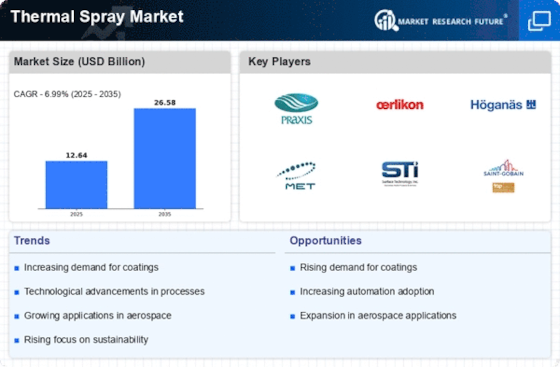
As per Market Research Future analysis, the Thermal Spray Market Size was estimated at 12.64 USD Billion in 2024. The Thermal Spray industry is projected to grow from USD 13.52 Billion in 2025 to USD 26.58 Billion by 2035, exhibiting a compound annual growth rate (CAGR) of 6.9% during the forecast period 2025 - 2035

Key Market Trends & Highlights

The Thermal Spray Market is experiencing robust growth driven by technological advancements and increasing industrial applications.

  • North America remains the largest market for thermal spray technologies, driven by its established aerospace and defense sectors.
  • Asia-Pacific is emerging as the fastest-growing region, fueled by rapid industrialization and rising manufacturing activities.
  • Metals dominate the thermal spray segment, while ceramics are witnessing the fastest growth due to their unique properties and applications.
  • Key market drivers include the rising demand for coatings and advancements in thermal spray technology, particularly in energy efficiency.

Market Size & Forecast

2024 Market Size 12.64 (USD Billion)
2035 Market Size 26.58 (USD Billion)
CAGR (2025 - 2035) 6.99%

Major Players

Praxis (US), Oerlikon (CH), Höganäs (SE), Metco (US), Surface Technology (DE), Saint-Gobain (FR), Kennametal (US), Tafa (US), Aremco Products (US)

Our Impact
Enabled $4.3B Revenue Impact for Fortune 500 and Leading Multinationals
Partnering with 2000+ Global Organizations Each Year
30K+ Citations by Top-Tier Firms in the Industry

Thermal spray Market Trends

The Thermal Spray Market is currently experiencing a dynamic evolution, driven by advancements in technology and increasing demand across various industries. This market encompasses a range of coating processes that enhance the performance and durability of components in sectors such as aerospace, automotive, and energy. The growing emphasis on improving product lifespan and efficiency is propelling the adoption of thermal spray techniques. Furthermore, the rising need for surface protection against wear, corrosion, and high temperatures is fostering innovation in material formulations and application methods. In addition, the Thermal Spray Market is witnessing a shift towards environmentally friendly practices. Companies are increasingly focusing on sustainable solutions, which may involve the use of eco-friendly materials and processes. This trend aligns with global efforts to reduce environmental impact and promote sustainability in manufacturing. As industries continue to evolve, the Thermal Spray Market is poised for growth, with potential opportunities emerging from technological advancements and changing consumer preferences. The interplay of these factors suggests a promising future for thermal spray applications across diverse sectors.

Technological Advancements

The Thermal Spray Market is benefiting from continuous technological innovations that enhance coating processes. New techniques and equipment are being developed, allowing for improved precision and efficiency in application. These advancements may lead to better adhesion, reduced waste, and enhanced performance of coatings.

Sustainability Initiatives

There is a noticeable trend towards sustainability within the Thermal Spray Market. Companies are increasingly adopting eco-friendly materials and processes to minimize environmental impact. This shift not only meets regulatory requirements but also aligns with consumer demand for greener solutions.

Diverse Industry Applications

The Thermal Spray Market is expanding its reach across various industries, including aerospace, automotive, and energy. Each sector presents unique challenges and requirements, driving the need for tailored thermal spray solutions. This diversification indicates a robust potential for growth and innovation.

Thermal spray Market Drivers

Rising Demand for Coatings

The Thermal Spray Market experiences a notable increase in demand for protective coatings across various sectors. Industries such as aerospace, automotive, and energy are increasingly adopting thermal spray coatings to enhance the durability and performance of components. For instance, the aerospace sector utilizes thermal spray coatings to protect engine parts from extreme temperatures and wear. This trend is supported by data indicating that the thermal spray coatings segment is projected to grow at a compound annual growth rate of approximately 6.5% over the next few years. As industries seek to improve the longevity of their products, the demand for thermal spray coatings is likely to continue its upward trajectory.

Increasing Focus on Energy Efficiency

The Thermal Spray Market is influenced by a growing emphasis on energy efficiency and sustainability. Industries are increasingly adopting thermal spray coatings to improve the energy efficiency of their equipment and machinery. For example, thermal spray coatings can reduce friction and wear in mechanical systems, leading to lower energy consumption and extended service life. This trend aligns with broader sustainability initiatives, as companies seek to minimize their environmental impact. Market data suggests that the energy efficiency segment within the thermal spray industry is expected to expand, driven by regulatory pressures and consumer demand for greener technologies.

Emerging Markets and Industrialization

The Thermal Spray Market is poised for growth due to the industrialization of emerging markets. Countries in Asia and South America are experiencing rapid industrial development, leading to increased investments in manufacturing and infrastructure. This industrial growth drives the demand for thermal spray coatings, as industries seek to enhance the performance and durability of their products. Additionally, the rising awareness of advanced coating technologies among manufacturers in these regions is likely to further propel market growth. As these emerging markets continue to develop, the thermal spray industry is expected to benefit from the expanding opportunities in various applications.

Advancements in Thermal Spray Technology

Technological innovations play a crucial role in shaping the Thermal Spray Market. Recent advancements in thermal spray techniques, such as High Velocity Oxygen Fuel (HVOF) and Plasma Spray, have significantly improved the efficiency and effectiveness of coating applications. These technologies enable the deposition of coatings with superior adhesion and microstructure, which enhances the performance of coated components. Furthermore, the integration of automation and robotics in thermal spray processes is streamlining operations, reducing labor costs, and increasing production rates. As a result, the market is witnessing a shift towards more sophisticated thermal spray solutions, which are expected to drive growth in the coming years.

Expansion of Aerospace and Defense Sectors

The Thermal Spray Market is significantly impacted by the expansion of the aerospace and defense sectors. As these industries continue to grow, the demand for high-performance materials and coatings is increasing. Thermal spray Market coatings are essential for protecting critical components in aircraft and military equipment from corrosion, wear, and high temperatures. The aerospace sector alone is projected to witness a substantial increase in spending, which is likely to boost the demand for thermal spray applications. This growth presents opportunities for manufacturers and service providers within the thermal spray market, as they cater to the evolving needs of these sectors.

Market Segment Insights

By Product: Metals (Largest) vs. Ceramics (Fastest-Growing)

In the Thermal Spray Market, the 'Product' segment is diversified into several key categories, including Metals, Ceramics, Intermetallics, Polymers, and Carbides. Metals hold the largest market share, attributed to their widespread application in various industries, such as aerospace, automotive, and energy. Ceramics, on the other hand, are rapidly gaining traction due to their superior wear resistance and thermal stability, marking them as a significant player that is catching up in terms of market share.

Metals (Dominant) vs. Ceramics (Emerging)

Metals, being the most established category in the Thermal Spray Market, are recognized for their excellent mechanical properties and extensive applications across multiple sectors. They provide unparalleled durability and can withstand harsh operational environments, making them indispensable in industries like aerospace and automotive. On the contrary, Ceramics have emerged as a compelling alternative, preferred for applications requiring high-temperature resistance and low thermal conductivity. Their unique properties make them suitable for advanced applications such as turbine engines and biomedical implants. As technology advances, the growth of Ceramics in this segment signifies a shift towards more innovative and efficient thermal spraying solutions.

By Technology: Plasma (Largest) vs. Cold Spray (Fastest-Growing)

In the Thermal Spray Market, segments like Plasma, Cold Spray, Flame Spray, and traditional Spray techniques exhibit varying market shares. Among these, Plasma technology holds the largest share due to its superior ability to create dense coatings suitable for high-stress applications. Cold Spray, on the other hand, is quickly gaining traction and is positioned as the fastest-growing segment, appealing to industries seeking innovative solutions for metal deposition without the need for high temperatures. The competitive dynamics among these technologies reflect a landscape in which advanced coating solutions are increasingly in demand.

Technology: Plasma (Dominant) vs. Cold Spray (Emerging)

Plasma technology dominates the thermal spray landscape due to its versatility and efficiency in producing high-quality coatings with excellent adhesion and durability. This technique is particularly esteemed in industries such as aerospace and defense, where performance and precision are paramount. Conversely, Cold Spray emerges as an innovative alternative, utilizing kinetic energy to bond particles at lower temperatures. This method is favored for applications requiring minimal heat distortion of substrates, driving its recent popularity in various sectors. The unique benefits of both technologies illustrate a market ripe for advancement, with practitioners focused on optimizing performance while ensuring cost-effective production.

By Application: Automotive (Largest) vs. Aerospace (Fastest-Growing)

In the Thermal Spray Market, the Automotive segment holds the largest share, driven by the increasing demand for durable coatings that enhance engine efficiency and fuel economy. This market segment benefits significantly from the growing automotive industry, particularly with advancements in technology that necessitate high-performance coatings for various components. Conversely, the Aerospace segment is witnessing rapid growth, fueled by the rising demand for lightweight materials and the need for thermal barrier coatings to prolong component lifespan in aviation applications. As regulations for fuel efficiency and emissions become stricter, both segments are poised for transformative growth, albeit at different scales and trajectories.

Automotive: Dominant vs. Aerospace: Emerging

The Automotive segment in the Thermal Spray Market remains dominant due to its vast applications, including engine parts, exhaust systems, and other critical components requiring high-performance coatings. With the automotive sector focusing on sustainability and performance, thermal sprays offer solutions that reduce wear and tear while enhancing efficiency. Meanwhile, the Aerospace segment is emerging robustly, driven by innovations in turbomachinery coatings that increase thermal resistance and reduce weight. This segment's growth is supported by technological advancements in material science, as aerospace manufacturers seek to improve fuel efficiency and extend the life of expensive components. Both segments are integral to the evolving landscape of the Thermal Spray Market.

Get more detailed insights about Thermal spray Market

Regional Insights

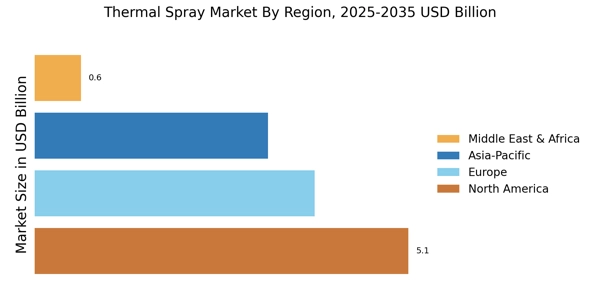
By region, the study provides market insights into North America, Europe, Asia-Pacific, and the Rest of the World. North America dominated the market in 2022, accounting for more than 45.80% of total revenue. The strong demand for Thermal Spray coatings in North America is primarily driven by high demand from key industries such as aerospace, oil and gas, automotive, medical, and power generation. Furthermore, governments in the United States and Canada are sponsoring studies to produce new coatings that might act as a driving factor for market growth.

Further, the major countries studied in the market report are The US, Canada, German, France, the UK, Italy, Spain, China, Japan, India, Australia, South Korea, and Brazil.

Figure2: THERMAL SPRAY MARKET SHARE BY REGION 2022 (USD Billion)

Europe Thermal Spray Market accounts for the second-largest market share due to major aviation manufacturers such as Airbus establishing production operations in the region and purchasing aircraft components from regional Indian firms such as the Tata Group, Dynamatic Technologies, and Mahindra Group Companies. Further, the German Thermal Spray Market held the largest market share, and the UK Thermal Spray Market was the fastest-growing market in the European region

The Asia-Pacific Thermal Spray Market is expected to grow at the fastest CAGR from 2023 to 2032. This is due to the rising demand for Thermal Spray coatings in the aerospace and automotive industries in developing countries such as India and China. Moreover, China’s Thermal Spray Market held the largest market share, and the Indian Thermal Spray Market was the fastest-growing market in the Asia-Pacific region.

Thermal spray Market Regional Image

Key Players and Competitive Insights

Leading market players are investing heavily in research and development in order to expand their product lines, which will help the Thermal Spray Market, grow even more. Market participants are also undertaking a variety of strategic activities to expand their footprint, with important market developments including new product launches, contractual agreements, mergers and acquisitions, higher investments, and collaboration with other organizations. To expand and survive in a more competitive and rising market climate, Thermal Spray industry must offer cost-effective items.Manufacturing locally to minimize operational costs is one of the key business tactics used by manufacturers in the Thermal Spray industry to benefit clients and increase the market sector. In recent years, the Thermal Spray industry has offered some of the most significant advantages to medicine. Major players in the Thermal Spray Market, including General Magnaplate Corporation (U.S.), Praxair Surface Technologies, Inc. (U.S.), Oerlikon Metco (Switzerland), Plasma-Tec, Inc. (U.S.), Surface Technology Inc (U.K.) and others, are attempting to increase market demand by investing in research and development operations.Praxair, Inc. was an industrial gas corporation based in the United States. Praxair, founded in 1907, was the largest industrial gas firm in North and South America and the third-largest in the world by revenue. Linde plc was formed in 2018 by the merger of Linde AG and Linde plc. In the United States, the Praxair brand will be phased out. In 2021, Praxair Surface Technologies, Inc. signed a long-term deal to purchase metal powders and Thermal Spray powders from H.C. Starck, a leading supplier of refractory metals, for use in its Thermal Spray coatings business.The arrangement aims to expand Praxair's reach and boost its product offering.Sulzer Ltd. is a Swiss industrial engineering and manufacturing corporation started in 1775 by Salomon Sulzer-Bernet and incorporated in 1834 as Sulzer Brothers Ltd. in Winterthur, Switzerland. It is now a publicly traded firm with around 180 manufacturing and service sites worldwide. The shares of the corporation are traded on the Swiss Stock Exchange. In 2020, Sulzer Metco announced a collaboration with Interplex Engineered Products, a company based in the United States that specializes in precision Metal Stamping and injection molding. The collaboration sought to develop and manufacture sophisticated Thermal Spray coatings for the aerospace and defense industries.

Key Companies in the Thermal spray Market include

Industry Developments

 July 2019, AMT AG in Kleindöttingen, Switzerland, was acquired by Oerlikon. With this acquisition, Oerlikon gains access to AMT Thermal Spray coating equipment, as well as expanding its surface solution technologies and improving market applications and service accessibility to customers, all of which will promote market growth.

February 2023, Kennametal Inc. debuted a new high-performance turning grade with enhanced coating technology. For steel-turning applications, KCP25C with KENGold is the preferred choice for metal-cutting inserts with improved wear and higher metal removal rates.

In November 2022, Bodycote announced the expansion of its Thermal Spray coatings capabilities throughout the Middle East. Bodycote formed a cooperation with Mathevon Group to expand the business in the area, particularly in Saudi Arabia.

Future Outlook

Thermal spray Market Future Outlook

The Thermal Spray Market is projected to grow at a 6.99% CAGR from 2025 to 2035, driven by advancements in technology, increasing demand for protective coatings, and expanding applications across industries.

New opportunities lie in:

  • Development of advanced thermal spray materials for aerospace applications.
  • Integration of automation in thermal spray processes to enhance efficiency.
  • Expansion into emerging markets with tailored thermal spray solutions.

By 2035, the Thermal Spray Market is expected to achieve robust growth, solidifying its position as a key industry.

Market Segmentation

Thermal spray Market Product Outlook

  • Metals
  • Ceramics
  • Intermetallics
  • Polymers
  • Carbides

Thermal spray Market Technology Outlook

  • Cold Spray
  • Flame Spray
  • Plasma
  • Spray

Thermal spray Market Application Outlook

  • Automotive
  • Oil & Gas
  • Mining
  • Aerospace
  • Medical

Report Scope

MARKET SIZE 202412.64(USD Billion)
MARKET SIZE 202513.52(USD Billion)
MARKET SIZE 203526.58(USD Billion)
COMPOUND ANNUAL GROWTH RATE (CAGR)6.99% (2025 - 2035)
REPORT COVERAGERevenue Forecast, Competitive Landscape, Growth Factors, and Trends
BASE YEAR2024
Market Forecast Period2025 - 2035
Historical Data2019 - 2024
Market Forecast UnitsUSD Billion
Key Companies ProfiledPraxis (US), Oerlikon (CH), Höganäs (SE), Metco (US), Surface Technology (DE), Saint-Gobain (FR), Kennametal (US), Tafa (US), Aremco Products (US)
Segments CoveredProduct, Technology, Application, Region
Key Market OpportunitiesAdvancements in additive manufacturing drive demand for innovative applications in the Thermal Spray Market.
Key Market DynamicsTechnological advancements and regulatory changes drive innovation and competition in the thermal spray market.
Countries CoveredNorth America, Europe, APAC, South America, MEA

Market Highlights

Author
Priya Nagrale
Senior Research Analyst

With an experience of over five years in market research industry (Chemicals & Materials domain), I gather and analyze market data from diverse sources to produce results, which are then presented back to a client. Also, provide recommendations based on the findings. As a Senior Research Analyst, I perform quality checks (QC) for market estimations, QC for reports, and handle queries and work extensively on client customizations. Also, handle the responsibilities of client proposals, report planning, report finalization, and execution

Leave a Comment

FAQs

What is the projected market valuation of the Thermal Spray Market by 2035?

The Thermal Spray Market is projected to reach a valuation of 26.58 USD Billion by 2035.

What was the market valuation of the Thermal Spray Market in 2024?

In 2024, the Thermal Spray Market was valued at 12.64 USD Billion.

What is the expected CAGR for the Thermal Spray Market during the forecast period 2025 - 2035?

The expected CAGR for the Thermal Spray Market during the forecast period 2025 - 2035 is 6.99%.

Which product segment is anticipated to have the highest growth in the Thermal Spray Market?

The Metals segment, valued at 4.5 USD Billion in 2024, is anticipated to grow significantly, reaching 9.5 USD Billion by 2035.

What are the key technologies driving the Thermal Spray Market?

Key technologies include Flame Spray, projected to grow from 3.0 USD Billion in 2024 to 6.5 USD Billion by 2035, and Plasma technology.

Which application segment is expected to see substantial growth in the Thermal Spray Market?

The Automotive application segment, valued at 3.5 USD Billion in 2024, is expected to grow to 7.5 USD Billion by 2035.

Research Approach

Research Methodology on Thermal Spray Market

 Introduction

Thermal spray is an advanced material processing technique, utilized to augment a particular material's characteristics, consisting of erosion, chemical level of resistance, and wear resistance. Thermal spray strategies are utilized in the refurbishment and coating of metallic and nonmetallic parts, which are subsequently utilized as original equipment parts. The thermal spray sector has seen remarkable development in the last couple of years, owing to an increase in direct exposure to various areas, such as engineering, automobile, aerospace, thermal power, marine, and so on.

Thermal spray strategies are primarily employed for putting on brand-new or reconditioning existing parts for various end-use industries. Various thermospray strategies, such as arc spray, flame spray, plasma and high-velocity oxy-fuel (HVOF), are frequently utilized for metallic and non-metallic parts. The innovation is predominantly seen in usage in the production sector, as it assists in reducing the effect of deterioration and wear and tear.

The global thermal spray market size is expected to grow at a healthy CAGR during the forecast period 2023 to 2030.

Research Objectives

The broader goal of the study is to analyze the key trends and dynamics of the thermal spray market. To accomplish this goal, the study includes the following objectives:

1. To analyze the impact of the COVID-19 pandemic on the market by studying the historical data of the market for the period 2019-2022 and to make appropriate estimates for 2030.

2. To identify the market dynamics, such as drivers, restraints, opportunities, and challenges, that are likely to influence the growth of the thermal spray market during the forecast period 2023 to 2030.

3. To conduct a micro and macro analysis of the global market and analyze the size of the market, including the value chain.

4. To study the impact of the global market’s key participants on the thermal spray market.

5. To develop a regional as well as a global analysis of the market and identify the most profitable region for investments.

6. To identify the various end-use industries for the thermal spray market and their respective production capacities and utilization rates.

Research Methodology

To conduct the market research, various market approaches have been employed, such as bottom-up, top-down and factor analysis, as well as data triangulation. These approaches have been used to validate and cross-check the information obtained from reliable market sources, such as industry associations, magazines, and other secondary sources.

Secondary Research

The report has been validated and cross-checked using both primary and secondary sources. Several sources have been utilized to gain an in-depth understanding of the market including industry/sector associations, FAO as well as governments, magazine articles, country statistics, and databases.

Primary Research

Primary research methods are used to validate the market size and forecast and the factors influencing the market. The primary research questionnaire was completed by drawing data from the global economy and industry experts. An interactive process was used to derive the forecasted numbers through a process of intelligent discussion and questioning with industry experts.

Approach

To provide a comprehensive view of the market, various approaches have been followed while formulating the report. The approach taken for deriving the forecast includes:

Bottom-Up Approach: The demand was established by calculating the actual market size for major thermal spray products and sub-products and was extrapolated to regional and global levels, which was then cross-checked and balanced with the top-down number.

Top-Down Approach: The top-down approach was used to derive the market size by utilizing the base year shipment data as the base number and estimating the overall demand in the global thermal spray market.

Factor Analysis: The factor analysis approach was used to identify and analyze the various technological and economic trends, such as raw material availability, cost of production, end-use industry demand, etc.

Time-Series Analysis: The time-series analysis approach was used to include the impact of geopolitics, macroeconomic indicators, technological developments, and other drivers on the market during the forecast period.

Demand Side and Supply Side Data Triangulation

The demand-side and supply-side data triangulation approach was used to study the actual growth rate and trends, as well as losses and profit associated with the thermal spray market. This approach allowed us to calculate the exact market size of the thermal spray market.

Conclusion

Thermal spray technology is gaining traction in a range of industries due to its ability to provide stronger, more durable, and more corrosion-resistant products. Therefore, the primary and secondary research approaches taken have helped to gain in-depth insights into the trends and dynamics of the thermal spray market. The bottom-up, top-down, and other approaches were employed to accurately forecast the size of the market, its growth rate, and the various drivers and restraints impacting it. The demand-side and supply-side data triangulation approach was used to gain a comprehensive understanding of the market and to determine the exact size of the market. The data gathered through these approaches will help stakeholders to gain a holistic overview of the market.


Download Free Sample

Kindly complete the form below to receive a free sample of this Report

Compare Licence

×
Features License Type
Single User Multiuser License Enterprise User
Price $4,950 $5,950 $7,250
Maximum User Access Limit 1 User Upto 10 Users Unrestricted Access Throughout the Organization
Free Customization
Direct Access to Analyst
Deliverable Format
Platform Access
Discount on Next Purchase 10% 15% 15%
Printable Versions