×
Request Free Sample ×

Kindly complete the form below to receive a free sample of this Report

* Please use a valid business email

Leading companies partner with us for data-driven Insights

clients tt-cursor
Hero Background

Smart Gas Meter Market

ID: MRFR/EnP/1154-CR
111 Pages
Priya Nagrale
June 2018

Smart Gas Meters Market Research Report Information By Product (Diaphragm, Turbine, Rotary Piston, and others), By Application (Residential, Commercial, and Industrial), And By Region (North America, Europe, Asia-Pacific, And Rest Of The World) – Market Forecast Till 2035

Share:
Download PDF ×

We do not share your information with anyone. However, we may send you emails based on your report interest from time to time. You may contact us at any time to opt-out.

Purchase Options

Smart Gas Meter Market Summary

As per Market Research Future Analysis, the Global Smart Gas Meters Market was valued at USD 1.73 billion in 2024 and is projected to grow to USD 2.50 billion by 2035, with a CAGR of 3.40% from 2025 to 2035. The market is driven by the need for efficient energy usage, increased investment in smart grid projects, and rising safety regulations. The Demand For Advanced Metering Infrastructure Is Also A Significant Factor Contributing To market growth. The residential sector is expected to dominate the market, supported by government incentives and a shift towards gas consumption for domestic purposes. Major players are focusing on R&D and strategic initiatives to enhance their market presence.

Key Market Trends & Highlights

Key trends driving the Smart Gas Meters Market include technological advancements and regulatory support.

  • Smart Gas Meters Market Size in 2024: USD 1.73 billion
  • Projected Market Size by 2035: USD 2.50 billion
  • CAGR from 2025 to 2035: 3.40%
  • Residential sector projected to be the fastest-growing segment during 2022-2030

Market Size & Forecast

2024 Market Size USD 1.73 billion
2035 Market Size USD 2.50 billion
CAGR (2024-2035) 3.40%

Major Players

Siemens AG (Germany), Schneider Electric (France), Landis+Gyr (Switzerland), Aclara Technologies LLC (U.S.), Xylem Inc. (U.S.), Badger Meter Inc. (U.S.), Itron Inc. (U.S.), Honeywell International Inc. (U.S.)

Our Impact
Enabled $4.3B Revenue Impact for Fortune 500 and Leading Multinationals
Partnering with 2000+ Global Organizations Each Year
30K+ Citations by Top-Tier Firms in the Industry

Smart Gas Meter Market Trends

High development and demand for advanced metering infrastructure to boost the market growth

Basic characteristics of the gas flowing in the pipeline, including pressure, volume, and temperature, are automatically measured by smart gas meters. The next stage is ensuring everyone has access to gas is installing smart gas meters in industrial, commercial, and residential settings. Government rules and regulations have forced the market for smart gas meters to increase the world's GDP. Collaboration between gas exploration firms and manufacturers of smart gas meters also helps with this. The market will grow quickly in the coming years because there are no discrepancies in gas meters.

In addition, rising safety regulations and concerns have caused the market for smart gas meters to grow by double digits over the past few years.

Digital technologies are predicted to improve global systems' connectivity, efficiencies, dependability, and sustainability in the upcoming years. New digital applications like shared mobility, smart appliances, and 3D printing are made possible by technological data analytics and communication improvements. The ongoing and continual development of the communication network infrastructure aids the production of advanced-level gas meters. The development of gas meters is accelerated by the availability of network infrastructure such as 5G, 4G, radio frequency, and others. The smart gas meters industry is expanding due to the manufacturers' ongoing manufacturing of advanced-level smart gas meters by the expanding network infrastructure.

Installing smart gas meters is motivated by end customers' rising desire for data. In 2019, households spent an average of GBP 655 on gas, according to the United Kingdom's Department of Business, Energy, and Industrial Strategy. In their homes, almost 23.5 million people utilize gas for cooking and heating. British Petroleum estimates that the United Kingdom consumed 78.8 billion cubic meters of natural gas in 2019. As a result of the reduction in GHG emissions, consumers are urged to understand their usage patterns to lower their overall consumption and bills.

Gas consumption is rising globally across home, industrial, and commercial applications, enhancing the Smart Gas Meters Market CAGR in recent years.

Favorable government policies, the growth of communication network infrastructure, and rapid advancements in sophisticated metering infrastructure are the main drivers of the market size for smart gas meters. Utilities are implementing these technologies due to their numerous advantages. For instance, in May 2020, Indianapolis Power & Light, a U.S. utility, chose Landis+Gyr to enhance its program for advanced metering infrastructure. To optimize data telemetry from already installed smart gas meters, they would deploy 350,000 smart meters and upgrade the utility's current network.

Market Segment Insights

Smart Gas Meters Product Insights

The Smart Gas Meters Market segmentation, based on product, includes diaphragms, turbines, rotary pistons, and others. The diaphragms segment held the majority share in 2021 of the Smart Gas Meters Market revenue. Diaphragm meters are positive displacement natural gas flow meters similar to rotary gas meters. They are generally utilized in residential and small business installations to measure a minimal gas flow for billing purposes.

Smart Gas Meters Application Insights

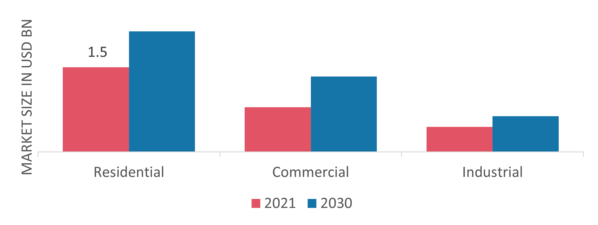
The Smart Gas Meters Market segmentation, based on application, includes residential, commercial, and industrial. The residential sector segment dominated the market in 2021 and is projected to be the faster-growing segment during the forecast period, 2022-2030. Due to the rising trend of using gas instead of fossil fuels for domestic purposes, smart gas meters are being installed more frequently in the residential sector. The government's subsidies and incentives for promoting gas consumption further strengthen the residential sector.

The continued transparency and prices based on smart gas usage also contribute to the rise in smart gas meters growth installations. Smart gas meters also aid in locating the most densely populated locations, which raises awareness of the need to cut down on energy waste, and positively impacts market growth.

Figure 2: Smart Gas Meters Market by Application, 2021 & 2030 (USD Billion)

Smart Gas Meters Market by Application, 2021 & 2030 (USD Billion)

Source: Secondary Research, Primary Research, MRFR Database and Analyst Review

Regional Insights

By Region, the study provides market insights into North America, Europe, Asia-Pacific, and the Rest of the World. Asia-Pacific Smart Gas Meters market accounted for USD 1.23 billion in 2021 and is expected to exhibit a significant CAGR growth during the study period. China holds a significant market share for smart gas meters in the Asia Pacific.

With the introduction of its smart electric meters, the nation saw success. Due to the growing energy consumption and regional aims for reducing greenhouse gas emissions, the deployment of smart gas meters has accelerated. Further, the major countries studied in the market report are: The U.S., Canada, Germany, France, UK, Italy, Spain, China, Japan, India, Australia, South Korea, and Brazil.

Europe smart gas meters market accounts for the second-largest market share. The number of smart gas meters installations has increased as we move toward renewable energy sources to meet our long-term and short-term green energy goals. Europe has been one of the target regions to increase sales of smart gas meters due to the presence of major market players and ambitious gas meter rollouts. Further, the Germany smart gas meters market held the largest market share, and the UK smart gas meters market was the fastest-growing market in the European region.

The North America Smart Gas Meters Market is expected to grow at the fastest CAGR from 2022 to 2030. The US has become one of the world's top gas producers because of efforts to promote gas use and replace outdated infrastructure with modern technologies. Moreover, the US smart gas meters market held the largest market share, and the Canada smart gas meters market was the fastest-growing market in the North America region.

Key Players and Competitive Insights

Major market players are spending a lot of money on R&D to increase their product lines, which will help the digital gas meter market grow even more. Market participants are also taking various strategic initiatives to grow their global footprint, with key market developments such as new product launches, contractual agreements, mergers and acquisitions, increased investments, and collaboration with other organizations. Competitors in the smart gas meters industry must offer cost-effective items to expand and survive in an increasingly competitive and rising market environment.
One of the primary business strategies manufacturers adopt in the global smart gas meters industry to benefit clients and expand the market sector is manufacturing locally to reduce operating costs. In recent years, the smart gas meters industry has provided some of the most significant benefits. The smart gas meters market major player such as Siemens AG. (Germany), Schneider Electric (France), Landis+Gyr (Switzerland), Aclara Technologies LLC (U.S.), and others are working on expanding the market demand by investing in research and development activities.
With its headquarters in Munich and branch offices worldwide, Siemens AG is a German multinational conglomerate business and the biggest industrial manufacturing enterprise in Europe. The company's main divisions, which correspond to its primary business operations, are Industry, Energy, Healthcare, and Infrastructure & Cities.
In August 2020, the purchase of Varian Medical Systems by Siemens AG, valued at $16.4 billion in all-stock transactions, was announced. Also, European multinational Schneider Electric is a leader in digital automation and energy management. It addresses homes, buildings, data centers, infrastructure, and industries by utilizing energy technologies, real-time automation, software, and services. A Fortune Global 500 corporation, Schneider Electric is listed on the Euronext Exchange and is a part of the Euro Stoxx 50 stock market index.
In January 2023, Schneider Electric unveiled its "smart home" energy products to improve electrical consumption and handle potential power outages. These goods primarily aim to assure "sustainable." More specifically, these "smart electrical panels" and "switches" that an app can control make up smart home energy products.

Industry Developments

March 2019: Wasion Group and Guizhou Power Grid Corporation agree to create communication and terminal items with clever force configurations and meters. April 2019: OVO Energy and Aclara Technologies have a deal to install the latter's new SMETS2 meter. OVO Energy plans to offer a dual fuel smart metering service for its gas and electric meters with these meters.

This action is being taken to comply with the UK's smart meter rollout program and upgrade the grids. December 2019: Nippon Gas Co. announced that it would give all of its current gas meters in Japan a smart upgrade. By the end of 2020, the SPACE HOTARU IoT-based reader is expected to be completely operational. It is claimed to be the largest smart utility deployment to date, upgrading about 8,50,000 gas meters.

Market Segmentation

Digital Gas Meter Product Outlook

  • Diaphragm
  • Turbine
  • Rotary Piston
  • Others

Smart Gas Meters Application Outlook

  • Residential
  • Commercial
  • Industrial

Report Scope

Attribute/Metric Details
Market Size 2024 USD 1.73 billion
Market Size 2035 2.50 (Value (USD Billion))
Compound Annual Growth Rate (CAGR) 3.40% (2025 - 2035)
Base Year 2024
Market Forecast Period 2025 - 2035
Historical Data 2018 & 2022
Market Forecast Units Value (USD Billion)
Report Coverage Revenue Forecast, Market Competitive Landscape, Growth Factors, and Trends
Segments Covered Product, Application, and Region
Geographies Covered North America, Europe, Asia Pacific, and the Rest of the World
Countries Covered The U.S, Canada, Germany, France, UK, Italy, Spain, China, Japan, India, Australia, South Korea, and Brazil
Key Companies Profiled Siemens AG. (Germany), Schneider Electric (France), Landis+Gyr (Switzerland), Aclara Technologies LLC (U.S.), Xylem, Inc. (U.S.), Badger Meter, Inc. (U.S.), Itron Inc. (U.S.), Honeywell International Inc. (U.S.), EDMI (Singapore), DIEHL Metering (Germany), Apator Group (Poland), Kamstrup A/S (Denmark), and Zenner (Germany)
Key Market Opportunities Needs for efficient energy usage
Key Market Dynamics Government roll outs Increasing investment in smart grid projects
Market Size 2025 1.79 (Value (USD Billion))

Market Highlights

Author
Priya Nagrale
Senior Research Analyst

With an experience of over five years in market research industry (Chemicals & Materials domain), I gather and analyze market data from diverse sources to produce results, which are then presented back to a client. Also, provide recommendations based on the findings. As a Senior Research Analyst, I perform quality checks (QC) for market estimations, QC for reports, and handle queries and work extensively on client customizations. Also, handle the responsibilities of client proposals, report planning, report finalization, and execution

Leave a Comment

FAQs

How much is the smart gas meters market?

The Smart Gas Meters Market size was valued at USD 1.67 Billion in 2023.

What is the growth rate of the smart gas meters market?

The global market is projected to grow at a CAGR of 3.40% during the forecast period 2024-2032.

What are the driving factors of smart gas meter market?

Increasing Investment In Smart Grid Projects, Government Roll Outs and Needs For Efficient Energy Usage are the driving factors of smart gas meter market.

Which region held the largest market share in the smart gas meters market?

Asia-Pacific had the largest share in the global market.

Who are the key players in the smart gas meters market?

The key players in the smart gas meters market are Siemens AG. (Germany), Schneider Electric (France), Landis+Gyr (Switzerland), Aclara Technologies LLC (U.S.), Xylem, Inc. (U.S.), Badger Meter, Inc. (U.S.), Itron Inc. (U.S.), Honeywell International Inc. (U.S.), EDMI (Singapore), DIEHL Metering (Germany), Apator Group (Poland), Kamstrup A/S (Denmark), and Zenner (Germany).

Which product led the smart gas meters market?

The diaphragm category dominated the market in 2021.

Which application had the largest market share in the smart gas meters market?

The residential sector had the largest share in the global market.

Research Approach

Research Methodology on Smart Gas Meter Market

1. Introduction

This research study aims to understand the current and upcoming trends in the Smart Gas Meter Market and analyze the market potential. The research methodology used to conduct this research is both primary and secondary. This market report provides a comprehensive analysis of the smart gas meter market in terms of market value and volume. The data used in this report is gathered from public and private sources as well as from industry sources.

2. Research Objectives

The research objectives of this report include:

  • To provide an overview of the global smart gas meter market
  • To analyze the growth potential of the market
  • To identify potential drivers and restraints of the market
  • To identify key market trends and developments
  • To analyze the competitive landscape

3. Research Process

The following research process is used to conduct this study:

  • Formulation of research questions
  • Literature review
  • Collection and analysis of primary and secondary data
  • Identification of key market trends
  • Market forecasting and analysis
  • Finalization and presentation of research results

4. Research Design

The research design used to conduct this study is exploratory in nature. The primary objective is to gain insights into the functioning of the smart gas meter market and identify potential trends. The research design involved both primary and secondary research.

5. Data Collection Method

The data collection involves both qualitative and quantitative techniques. The following techniques are used to collect data for this report:

• In-depth interviews:

Semi-structured interviews with industry experts are conducted to gain an in-depth understanding of the smart gas meter market.

• Focus groups:

Focus groups are conducted to collect insights into the user experience with smart gas meters and the advantages and drawbacks of using them.

• Surveys:

An online survey is conducted to collect data from key industry players.

• Secondary sources:

Secondary sources such as trade journals, reports, press releases and white papers are used to collect data related to the market and its participants. Secondary data also includes government publications and data published on the web.

• Statistical models:

Statistical models such as regression analysis are used to analyze market trends.

6. Analysis Approach

The analysis is conducted through the use of both qualitative and quantitative techniques. The following techniques are used to analyze the data collected:

• Descriptive analysis:

The descriptive analysis technique is used to gain an in-depth understanding of the market. It will help to identify key drivers and barriers of the market.

• Market forecasts:

The market forecast technique is used to analyze the market trajectory over a given period of time. The data collected is read through the use of statistical models to identify the potential growth of the market over the forecasted period.

• Competitor analysis:

The competitors in the market are analyzed in terms of their current market share and future prospects.

7. Market Forecast Methodology

The market forecast methodology used in this report is based on a bottom-up approach. The report includes an analysis of the industry value chain, market dynamics, and competitive landscape. The primary data obtained through the interviews and surveys are analyzed through the use of statistical models such as regression analysis to identify the growth potential of the market.

8. Conclusion

This report provides an exhaustive analysis of the smart gas meter market. The research methodology used follows a comprehensive approach that involves both primary and secondary research techniques. The data collection techniques used in this report are both qualitative and quantitative in nature. The data collected is analyzed using various techniques such as descriptive analysis, market forecast and competitor analysis to gain an understanding of the market and its dynamics. The market forecast methodology used in this report is based on a bottom-up approach.

Download Free Sample

Kindly complete the form below to receive a free sample of this Report

Compare Licence

×
Features License Type
Single User Multiuser License Enterprise User
Price $4,950 $5,950 $7,250
Maximum User Access Limit 1 User Upto 10 Users Unrestricted Access Throughout the Organization
Free Customization
Direct Access to Analyst
Deliverable Format
Platform Access
Discount on Next Purchase 10% 15% 15%
Printable Versions