×
Request Free Sample ×

Kindly complete the form below to receive a free sample of this Report

* Please use a valid business email

Leading companies partner with us for data-driven Insights

clients tt-cursor
Hero Background

Network as a Service Market

ID: MRFR/ICT/1653-HCR
100 Pages
Aarti Dhapte
February 2026

Network as a Service Market Size, Share and Research Report: By Type (LAN and WAN), By Service (WAN Connection, Data Center, and BOD), By Component (Infrastructure, and Technology Service), By End-User (IT & Telecommunication, BFSI, and Healthcare), And By Region (North America, Europe, Asia-Pacific, And Rest Of The World) –Market Forecast Till 2035

Share:
Download PDF ×

We do not share your information with anyone. However, we may send you emails based on your report interest from time to time. You may contact us at any time to opt-out.

Network as a Service Market Infographic
Purchase Options

Network as a Service Market Summary

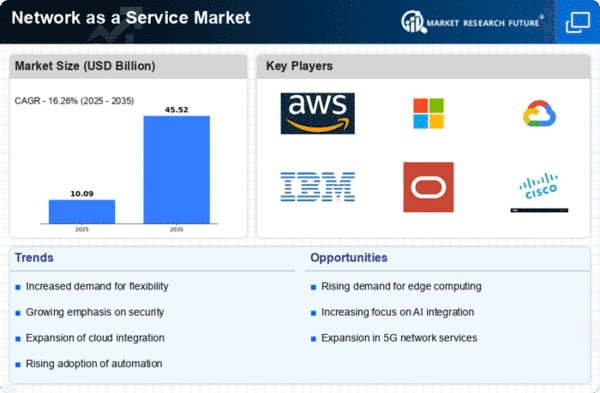
As per MRFR analysis, the Network as a Service Market Size was estimated at 8.68 USD Billion in 2024. The Network as a Service industry is projected to grow from 10.09 USD Billion in 2025 to 45.52 USD Billion by 2035, exhibiting a compound annual growth rate (CAGR) of 16.26 during the forecast period 2025 - 2035.

Key Market Trends & Highlights

The Network as a Service Market is experiencing robust growth driven by technological advancements and evolving business needs.

  • The adoption of cloud services continues to rise, particularly in North America, as organizations seek scalable solutions.
  • Security enhancements are becoming a focal point, especially among small and medium enterprises, to protect sensitive data.
  • Artificial intelligence integration is gaining traction, with large enterprises leveraging it for improved network management.
  • The growing demand for flexible networking solutions and cost efficiency are key drivers propelling market expansion in the Asia-Pacific region.

Market Size & Forecast

2024 Market Size 8.68 (USD Billion)
2035 Market Size 45.52 (USD Billion)
CAGR (2025 - 2035) 16.26%

Major Players

Amazon Web Services (US), Microsoft (US), Google Cloud (US), IBM (US), Oracle (US), Cisco Systems (US), Alibaba Cloud (CN), NTT Communications (JP), Mitel Networks (CA)

Our Impact
Enabled $4.3B Revenue Impact for Fortune 500 and Leading Multinationals
Partnering with 2000+ Global Organizations Each Year
30K+ Citations by Top-Tier Firms in the Industry

Network as a Service Market Trends

The Network as a Service Market is currently experiencing a transformative phase, characterized by a shift towards more flexible and scalable networking solutions. Organizations are increasingly adopting cloud-based services, which allow for enhanced agility and cost efficiency. This trend appears to be driven by the growing demand for remote work capabilities and the need for seamless connectivity across various devices and locations. As businesses continue to prioritize digital transformation, the Network as a Service Market is likely to expand, offering innovative solutions that cater to diverse operational needs. Moreover, the competitive landscape within the Network as a Service Market is evolving, with numerous players striving to differentiate their offerings. Partnerships and collaborations among service providers are becoming more common, as companies seek to enhance their service portfolios and deliver comprehensive solutions. This collaborative approach may lead to the development of advanced technologies, such as artificial intelligence and machine learning, which could further optimize network performance.

Overall, the Network as a Service Market seems poised for substantial growth, driven by technological advancements and changing consumer preferences. The Network as a Service Market forms a critical part of the broader network services market driven by cloud adoption. Trends in the network services market indicate rising demand for subscription-based networking models. Within the broader network industry, organizations are shifting toward flexible and software-defined networking models. The expanding networks market is creating strong demand for Network as a Service solutions. Cloud migration is a key driver of network growth across enterprise environments. Organizations are increasingly adopting networks as a service to reduce capital expenditure. The growing adoption of LAN as a Service is supporting rapid deployment of localized enterprise networks.

Increased Adoption of Cloud Services

The Network as a Service Market is witnessing a notable trend towards the adoption of cloud services. Organizations are increasingly migrating their operations to the cloud, which necessitates robust networking solutions. This shift allows businesses to enhance their agility and scalability while optimizing resource allocation.

Focus on Security Enhancements

As cyber threats continue to escalate, there is a growing emphasis on security within the Network as a Service Market. Providers are likely to invest in advanced security measures to protect sensitive data and ensure compliance with regulatory standards, thereby fostering trust among clients.

Integration of Artificial Intelligence

The integration of artificial intelligence into networking solutions is emerging as a significant trend. AI technologies can potentially streamline network management, enhance performance, and provide predictive analytics, which may lead to more efficient operations and improved user experiences.

Network as a Service Market Drivers

Enhanced Security Features

Security concerns are increasingly shaping the landscape of the Global Network as a Service Market Industry. As cyber threats become more sophisticated, organizations are prioritizing secure networking solutions. NaaS providers are responding by incorporating advanced security features such as encryption, intrusion detection, and continuous monitoring. This focus on security is crucial for businesses that handle sensitive data and require compliance with regulatory standards. The emphasis on enhanced security measures is likely to attract more organizations to adopt NaaS, thereby contributing to the overall growth of the market. As security becomes a non-negotiable aspect of networking, the Global Network as a Service Market Industry is poised for continued expansion.

Increased Adoption of Cloud Services

The rise of cloud computing is a critical factor influencing the Global Network as a Service Market Industry. As organizations migrate to cloud-based solutions, the demand for integrated networking services that support these platforms is escalating. NaaS provides the necessary infrastructure to facilitate seamless connectivity and data transfer across cloud environments. This shift is expected to contribute to a compound annual growth rate of 15.27% from 2025 to 2035, reflecting the growing reliance on cloud services. The integration of NaaS with cloud offerings not only enhances operational efficiency but also positions businesses to leverage advanced technologies, thus driving the growth of the Global Network as a Service Market Industry.

Growing Demand for Scalable Solutions

The Global Network as a Service Market Industry is witnessing a surge in demand for scalable networking solutions. Organizations are increasingly adopting NaaS to accommodate fluctuating workloads and to enhance operational efficiency. This trend is particularly pronounced among small to medium enterprises that require flexible networking capabilities without the burden of extensive infrastructure investments. The market is projected to reach 9.53 USD Billion in 2024, indicating a robust growth trajectory. As businesses continue to expand their digital footprint, the need for scalable solutions that can adapt to changing requirements becomes paramount, thereby driving the growth of the Global Network as a Service Market Industry.

Cost Efficiency and Resource Optimization

Cost efficiency remains a pivotal driver in the Global Network as a Service Market Industry. By leveraging NaaS, organizations can significantly reduce capital expenditures associated with traditional networking infrastructure. This model allows for a pay-as-you-go approach, enabling businesses to allocate resources more effectively. As a result, companies can focus on core competencies while outsourcing their networking needs. The anticipated growth from 9.53 USD Billion in 2024 to 45.5 USD Billion by 2035 underscores the financial advantages that NaaS offers. This trend suggests that organizations are increasingly recognizing the potential for resource optimization through NaaS, thereby propelling the market forward.

Market Segment Insights

By Application: Load Balancing (Largest) vs. Network Security (Fastest-Growing)

In the Network as a Service (NaaS) market, the application segment showcases a diverse array of offerings, with Load Balancing commanding a substantial share. This segment is crucial as it ensures optimal distribution of network traffic, thereby enhancing overall performance and reliability. Network Security, while not as dominant in market share, is recognized as the fastest-growing area due to increasing cybersecurity threats and the subsequent demand for robust protective measures in cloud services. The growth trends are propelled by several factors, including the rise of remote work and the increasing need for secure data transmissions. Businesses are increasingly investing in Disaster Recovery solutions as they recognize the importance of business continuity. Furthermore, evolving regulatory compliance requirements around data privacy are driving the adoption of Virtual Private Networks (VPNs), underscoring the need for enhanced network security solutions.

Load Balancing: Dominant vs. Network Security: Emerging

Load Balancing serves as a dominant force in the Network as a Service market by managing and distributing workloads across multiple servers to improve efficiency and decrease latency. It's critical for ensuring high availability and reliability of web applications, making it indispensable for businesses that require uninterrupted service delivery. On the other hand, Network Security is an emerging star, rapidly adapting to the evolving threat landscape. With businesses increasingly vulnerable to cyberattacks, the focus on securing networks has never been greater. This segment provides essential solutions such as firewalls, anti-malware systems, and encryption services that safeguard sensitive data. The compelling growth trajectory of Network Security illustrates its critical role in modern network infrastructures as organizations seek to build resilience against varied security challenges.

By End Use: Small and Medium Enterprises (Largest) vs. Large Enterprises (Fastest-Growing)

The Network as a Service market showcases a diverse distribution among its end-use segments. Small and Medium Enterprises (SMEs) lead the segment, driven by their ongoing digital transformation initiatives and the necessity for cost-effective solutions. In contrast, Large Enterprises have also carved out a significant share, leveraging NaaS to enhance operational efficiency and reduce infrastructure costs. Government Organizations and Educational Institutions round out the spectrum, benefiting from customized NaaS solutions that cater to their unique requirements. Large enterprises are increasingly outsourcing corporate network services through NaaS platforms.

Small and Medium Enterprises: Dominant vs. Large Enterprises: Emerging

Small and Medium Enterprises (SMEs) play a crucial role in the NaaS market, as they seek flexible and scalable solutions that allow them to compete with larger counterparts. SMEs benefit from lower upfront costs and reduced need for extensive IT infrastructure, which NaaS provides effectively. On the other hand, Large Enterprises are emerging as a formidable force in this sector. Their substantial investments in technology and emphasis on digital transformation drive the demand for NaaS, particularly as they aim to enhance network resilience and operational efficiency. As larger organizations adopt NaaS solutions, they are expected to drive significant market growth, fueled by their extensive networking needs and adaptability to innovative technologies.

By Deployment Model: Public Cloud (Largest) vs. Hybrid Cloud (Fastest-Growing)

In the Network as a Service (NaaS) market, the deployment model segment reveals a distinctive market share distribution among four primary categories: Public Cloud, Private Cloud, Hybrid Cloud, and Multi-Cloud. Public Cloud services hold the largest share, providing scalability and cost-effectiveness that appeal to a diverse clientele. Conversely, while Private Cloud presents stable offerings typically sought by larger enterprises focused on security, the Hybrid Cloud model is gaining traction with its flexibility and ability to cater to varied organizational needs, indicating a shift in preference among businesses.

Cloud Models: Public Cloud (Dominant) vs. Hybrid Cloud (Emerging)

Public Cloud serves as the dominant deployment model in the NaaS market, offering extensive services that facilitate rapid deployment and on-demand scalability. Its advantages include cost savings, ease of management, and broad accessibility tailored to small and medium-sized enterprises (SMEs). On the other hand, Hybrid Cloud is emerging as a pivotal model that amalgamates the benefits of both public and private clouds. It allows organizations to maintain sensitive data on private infrastructures while leveraging public cloud capabilities for less-critical operations. This model appeals significantly to businesses seeking flexible solutions that align with their unique operational and security needs. As enterprises increasingly embrace digital transformation, Hybrid Cloud's growth trajectory is expected to rise sharply.

By Service Type: Managed Services (Largest) vs. Professional Services (Fastest-Growing)

The Network as a Service Market demonstrates a diverse distribution of service types, with Managed Services taking the largest share due to their comprehensive solutions that cater to various business needs. This segment appeals to organizations seeking consistent performance and reliability, making it a preferred choice among enterprises. In contrast, Professional Services are rapidly gaining traction as more businesses recognize the necessity of tailored solutions to enhance their network efficiency and improve operational systems. Growth trends in the Network as a Service Market indicate that Professional Services are emerging as the fastest-growing segment. Factors such as the increasing demand for customized user experiences and specialized expertise in network management are driving this growth. Additionally, businesses are progressively investing in professional guidance to navigate the complexities of network solutions, thus elevating the role of Professional Services within this market.

Service Type: Managed Services (Dominant) vs. Support Services (Emerging)

Managed Services continue to dominate the Network as a Service Market, offering a range of solutions that simplify network management, enhance security, and ensure optimal performance. This segment is characterized by its all-in-one approach, which allows businesses to offload various IT tasks to service providers, leading to increased operational efficiency. In contrast, Support Services are emerging rapidly as organizations seek to bolster their existing capabilities with responsive, expert assistance. This segment caters to companies facing challenges in their deployments, providing them the necessary tools and support to overcome obstacles and maintain effective operations within the dynamic landscape of network services.

By Network Type: Wide Area Network (Largest) vs. Local Area Network (Fastest-Growing)

In the Network as a Service (NaaS) market, the Wide Area Network (WAN) segment holds the largest market share due to its ability to support numerous remote connections, making it highly valued by enterprises seeking reliable connectivity across vast geographical distances. The Local Area Network (LAN) segment, although smaller in share compared to WAN, is witnessing a rapid rise in demand as organizations expand their digital infrastructure and shift towards cloud-based solutions. This segment benefits from the increasing adoption of IoT devices and the need for efficient internal communication.

LAN (Dominant) vs. MAN (Emerging)

The Local Area Network (LAN) segment is considered dominant within the NaaS market, primarily thanks to its fundamental role in establishing effective and high-speed network connections within specific locations, such as offices or campuses. LANs offer numerous benefits like lower latency and higher data transfer rates, making them essential for enterprises that prioritize performance. On the other hand, the Metropolitan Area Network (MAN) segment is emerging, catering to connections across cities or large campuses, thus facilitating greater connectivity and collaboration among businesses. Although MAN is not as extensive as WAN, its role is growing as businesses seek to bridge the gap between local networks and broader WAN infrastructures.

Get more detailed insights about Network as a Service Market

Regional Insights

North America : Innovation and Leadership Hub

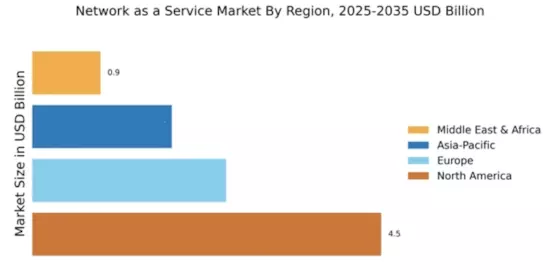
North America continues to lead the Network as a Service (NaaS) market, holding a significant share of 4.5 in 2024. The region's growth is driven by increasing demand for cloud-based solutions, enhanced connectivity, and the rise of remote work. Regulatory support for digital transformation and investments in 5G infrastructure further catalyze market expansion. Companies are increasingly adopting NaaS to improve operational efficiency and reduce costs, making it a vital component of their IT strategies. The competitive landscape in North America is robust, featuring key players such as Amazon Web Services, Microsoft, and Google Cloud. These companies are at the forefront of innovation, offering diverse NaaS solutions tailored to various industries. The presence of established tech giants and a thriving startup ecosystem fosters a dynamic environment for growth. As organizations prioritize agility and scalability, the demand for NaaS is expected to surge, solidifying North America's position as a market leader.

Europe : Emerging Market with Potential

Europe's Network as a Service market is poised for growth, with a market size of 2.5 in 2024. The region benefits from increasing digitalization, regulatory frameworks promoting cloud adoption, and a focus on sustainability. Governments are encouraging the transition to cloud services, which is driving demand for NaaS solutions. The rise of remote work and the need for flexible IT infrastructure are also significant factors contributing to market growth. Leading countries in Europe, such as Germany, the UK, and France, are witnessing a surge in NaaS adoption. The competitive landscape includes major players like IBM and Oracle, who are investing in innovative solutions to meet evolving customer needs. The presence of various startups and established firms enhances competition, fostering a vibrant ecosystem. As organizations seek to optimize their operations, the NaaS market in Europe is expected to expand significantly.

Asia-Pacific : Rapidly Growing Digital Landscape

The Asia-Pacific region is experiencing a rapid increase in Network as a Service (NaaS) adoption, with a market size of 1.8 in 2024. Factors such as rising internet penetration, the proliferation of mobile devices, and government initiatives to promote digital infrastructure are driving this growth. The demand for flexible and scalable IT solutions is pushing organizations to adopt NaaS, enabling them to respond quickly to market changes and customer needs. Countries like China, Japan, and India are leading the charge in NaaS adoption, supported by significant investments in technology and infrastructure. Major players such as Alibaba Cloud and NTT Communications are expanding their offerings to cater to the growing demand. The competitive landscape is becoming increasingly dynamic, with both established companies and startups vying for market share. As businesses prioritize digital transformation, the NaaS market in Asia-Pacific is set for substantial growth.

Middle East and Africa : Emerging Market with Opportunities

The Middle East and Africa (MEA) region is gradually unlocking its potential in the Network as a Service (NaaS) market, with a market size of 0.88 in 2024. The growth is driven by increasing investments in digital infrastructure, government initiatives to promote cloud adoption, and a rising demand for flexible IT solutions. As organizations in the region seek to enhance operational efficiency, NaaS is becoming an attractive option for businesses looking to modernize their IT environments. Leading countries such as the UAE and South Africa are at the forefront of NaaS adoption, supported by favorable regulatory frameworks and investments in technology. The competitive landscape includes both global players and local providers, creating a diverse market environment. As the region continues to embrace digital transformation, the NaaS market is expected to grow, offering significant opportunities for both established companies and new entrants.

Network as a Service Market Regional Image

Key Players and Competitive Insights

The Network as a Service Market is currently characterized by a dynamic competitive landscape, driven by rapid technological advancements and increasing demand for flexible networking solutions. Leading network as a service companies include Amazon Web Services, Microsoft, Google Cloud, and Cisco Systems. Major players such as Amazon Web Services (US), Microsoft (US), and Google Cloud (US) are at the forefront, each adopting distinct strategies to enhance their market positioning. Amazon Web Services (US) focuses on continuous innovation, particularly in enhancing its cloud infrastructure to support diverse applications. Microsoft (US), on the other hand, emphasizes strategic partnerships and integrations, particularly with its Azure platform, to provide comprehensive solutions that cater to enterprise needs. Google Cloud (US) is leveraging its strengths in artificial intelligence and machine learning to differentiate its offerings, thereby shaping a competitive environment that is increasingly reliant on technological prowess and service diversification.
In terms of business tactics, companies are increasingly localizing their services to better meet regional demands, optimizing supply chains to enhance efficiency, and investing in digital transformation initiatives. The market structure appears moderately fragmented, with a mix of established players and emerging startups. This fragmentation allows for a variety of service offerings, yet the collective influence of key players like IBM (US) and Cisco Systems (US) remains substantial, as they continue to innovate and expand their service portfolios.
In November 2025, IBM (US) announced a strategic partnership with a leading telecommunications provider to enhance its Network as a Service offerings. This collaboration aims to integrate advanced AI capabilities into network management, thereby improving operational efficiency and customer experience. Such a move underscores IBM's commitment to leveraging cutting-edge technology to maintain a competitive edge in the market.
In October 2025, Cisco Systems (US) unveiled a new suite of security-focused Network as a Service solutions designed to address the growing concerns around cybersecurity. This initiative not only reflects Cisco's proactive approach to market demands but also positions the company as a leader in providing secure networking solutions, which is increasingly critical in today's digital landscape. The emphasis on security is likely to resonate well with enterprises seeking to safeguard their data and operations.
In September 2025, Google Cloud (US) launched a new initiative aimed at enhancing its hybrid cloud capabilities, allowing businesses to seamlessly integrate on-premises and cloud resources. This strategic move is indicative of the growing trend towards hybrid solutions, as organizations seek flexibility and scalability in their networking environments. By focusing on hybrid cloud solutions, Google Cloud is likely to attract a broader customer base, further intensifying competition in the market.
As of December 2025, the competitive trends within the Network as a Service Market are increasingly defined by digitalization, sustainability, and the integration of AI technologies. Strategic alliances are playing a pivotal role in shaping the current landscape, enabling companies to pool resources and expertise to deliver innovative solutions. Looking ahead, competitive differentiation is expected to evolve, with a notable shift from price-based competition towards innovation, technological advancements, and supply chain reliability. This transition suggests that companies that prioritize these aspects will likely emerge as leaders in the Network as a Service Market.

Key Companies in the Network as a Service Market include

Industry Developments

  • Q2 2024: Cisco Launches New Network-as-a-Service Platform for Enterprises Cisco announced the launch of its new NaaS platform, designed to help enterprises manage and scale their network infrastructure with subscription-based services.
  • Q2 2024: Aryaka Raises $100 Million to Expand Network-as-a-Service Offerings Aryaka, a leading NaaS provider, secured $100 million in funding to accelerate product development and global expansion of its managed SD-WAN and SASE services.
  • Q3 2024: Verizon and HPE Announce Strategic Partnership for Network-as-a-Service Solutions Verizon and Hewlett Packard Enterprise (HPE) entered a partnership to deliver joint NaaS solutions targeting large enterprises and government clients.
  • Q3 2024: Juniper Networks Appoints New CEO to Drive Network-as-a-Service Strategy Juniper Networks named a new CEO, emphasizing a renewed focus on expanding its NaaS portfolio and cloud-based networking solutions.
  • Q4 2024: AT&T Wins $250 Million Federal Contract for Network-as-a-Service Deployment AT&T secured a $250 million contract from a U.S. federal agency to deploy NaaS solutions across multiple government sites.
  • Q4 2024: Nokia Launches NaaS Platform for 5G Private Networks Nokia introduced a new NaaS platform tailored for 5G private networks, enabling enterprises to deploy and manage secure, scalable connectivity.
  • Q1 2025: VMware Spins Off NaaS Business Unit to Focus on Cloud Networking VMware announced the spin-off of its NaaS business unit, aiming to accelerate innovation in cloud-based networking and edge services.
  • Q1 2025: Oracle Unveils Network-as-a-Service for Multi-Cloud Environments Oracle launched a new NaaS offering designed to simplify network management across multi-cloud deployments for enterprise customers.
  • Q2 2025: Telstra Acquires CloudGenix to Expand Network-as-a-Service Portfolio Telstra completed the acquisition of CloudGenix, enhancing its NaaS capabilities with advanced SD-WAN and cloud networking solutions.
  • Q2 2025: IBM Partners with Equinix to Deliver Global Network-as-a-Service Solutions IBM and Equinix announced a partnership to offer global NaaS solutions, leveraging Equinix's data center footprint and IBM's cloud networking expertise.
  • Q3 2025: Ciena Launches AI-Driven Network-as-a-Service Platform Ciena introduced an AI-powered NaaS platform, enabling automated network optimization and predictive analytics for enterprise clients.
  • Q3 2025: GTT Communications Wins Major European NaaS Contract GTT Communications secured a multi-year contract to provide NaaS solutions for a consortium of European financial institutions.

Future Outlook

Network as a Service Market Future Outlook

The Network as a Service Market is projected to grow at a 16.26% CAGR from 2025 to 2035, driven by increasing demand for flexible networking solutions and cloud integration.

New opportunities lie in:

  • Development of AI-driven network optimization tools Expansion into emerging markets with tailored NaaS solutions Partnerships with IoT providers for integrated service offerings

By 2035, the Network as a Service Market is expected to be a dominant force in global networking solutions.

Market Segmentation

Network as a Service Market End Use Outlook

  • Small and Medium Enterprises
  • Large Enterprises
  • Government Organizations
  • Educational Institutions

Network as a Service Market Application Outlook

  • Bandwidth on Demand
  • Disaster Recovery
  • Network Security
  • Virtual Private Network
  • Load Balancing

Network as a Service Market Network Type Outlook

  • Wide Area Network
  • Local Area Network
  • Metropolitan Area Network

Network as a Service Market Service Type Outlook

  • Managed Services
  • Professional Services
  • Support Services

Network as a Service Market Deployment Model Outlook

  • Public Cloud
  • Private Cloud
  • Hybrid Cloud
  • Multi-Cloud

Report Scope

MARKET SIZE 2024 8.68(USD Billion)
MARKET SIZE 2025 10.09(USD Billion)
MARKET SIZE 2035 45.52(USD Billion)
COMPOUND ANNUAL GROWTH RATE (CAGR) 16.26% (2025 - 2035)
REPORT COVERAGE Revenue Forecast, Competitive Landscape, Growth Factors, and Trends
BASE YEAR 2024
Market Forecast Period 2025 - 2035
Historical Data 2019 - 2024
Market Forecast Units USD Billion
Key Companies Profiled Amazon Web Services (US), Microsoft (US), Google Cloud (US), IBM (US), Oracle (US), Cisco Systems (US), Alibaba Cloud (CN), NTT Communications (JP), Mitel Networks (CA)
Segments Covered Application, End Use, Deployment Model, Service Type, Network Type
Key Market Opportunities Integration of artificial intelligence enhances operational efficiency in the Network as a Service Market.
Key Market Dynamics Rising demand for flexible network solutions drives competitive innovation and regulatory adaptations in the Network as a Service Market.
Countries Covered North America, Europe, APAC, South America, MEA

Market Highlights

Author
Aarti Dhapte
Team Lead - Research

She holds an experience of about 6+ years in Market Research and Business Consulting, working under the spectrum of Information Communication Technology, Telecommunications and Semiconductor domains. Aarti conceptualizes and implements a scalable business strategy and provides strategic leadership to the clients. Her expertise lies in market estimation, competitive intelligence, pipeline analysis, customer assessment, etc.

Leave a Comment

FAQs

How much is the Network as a Service market?

The Network as a Service market size was valued at USD 8.67 Billion in 2024.

What is the growth rate of the Network as a Service market?

The market is projected to grow at a CAGR of 16.26% during the forecast period, 2025-2034.

Which region held the largest market share in the Network as a Service market?

North America had the largest share in the market

Who are the key players in the Network as a Service market?

The key players in the market are Alcatel Lucent (U.S.), Brocade Communications Systems Inc. (U.S.), Ciena Corporation (U.S), Cisco Systems (U.S.), IBM Corp. (U.S.).

Which type led the Network as a Service market?

The WAN category dominated the market in 2022.

Which end user had the largest market share in the Network as a Service market?

The IT & Telecommunication had the largest share in the market.

Research Approach

Research Methodology on Network as a Service Market

1. Introduction:

Network as a Service (NaaS) is a technology that enables the delivery of a dynamic, cloud-based network infrastructure with integrated managed services to enterprises. This service helps enterprises to build, customize, monitor and manage their IT networks, with the introduction of an innovative managed services-based platform for solutions. NaaS is a revolutionary way for organizations to access, monitor and manage their network activities. It is proven to be an effective way to optimize network performance and reduce costs by enabling IT professionals to manage the network themselves.

The following research report provides a market outlook for the Network as a Service (NaaS) market. The detailed research report outlines current market trends, predicts future growth, and factors driving and inhibiting the market. This report provides an in-depth analysis of the NaaS market and its growth during the forecast period of 2023 to 2030.

2. Research Objectives

This research aims to gain a deeper understanding of the features and characteristics of the global Network as a Service (NaaS) market and to make future projections. To this end, the research objectives are as follows:

  • To identify the various market drivers, restraints, and opportunities that are driving the network as a service (NaaS) market.
  • To analyse the impact of various technological advancements on the growth of the NaaS market.
  • To profile the key players presently dominating the NaaS market.
  • To analyse the impact of government policies towards technology on the growth of the NaaS market.
  • To forecast the future growth and performance of the NaaS market from 2023 to 2030.

3. Research Methodology

The research methodology adopted for this study involves the use of both primary and secondary research data. The primary research data was collected through interviews with experts from the NaaS industry. The interviews were conducted to get a better understanding of the NaaS market and its key drivers and restraints. Secondary research data was collected from published journals, online databases, industry bodies and other relevant sources.

The research methodology adopted for the analysis of the Network as a Service (NaaS) market is a combination of primary and secondary research. The primary research involved personnel interviews with industry experts, while secondary research involved various sources such as published reports, company websites, regulatory bodies and trade associations to gain an understanding of the market. After obtaining the required data and information, the data was analysed and interpreted to conclude the market size and forecast for 2023 to 2030.

The research process was done in a hierarchical manner, starting from the highest level and gradually proceeding to a detailed market analysis. The first stage of the research process involved understanding the market environment in order to develop hypotheses and assumptions. This involves scrutiny of the market and its stakeholders, collaborating with industry experts, and an examination of the technological, social, and political environment. The second stage of research included the analysis of the existing and forecast market data. This stage involved the collection of data about the market using both primary and secondary sources, as well as the validation of the data using available industry experts.

The third stage of research involved the interpretation of the collected data using statistical and econometric tools. This stage involved the use of market and competitive analysis tools in order to assess trends in the market and to develop comprehensive interpretations and forecasts regarding the market size. The final stage of research was the development of the market intelligence that was finalized as the Network as a Service (NaaS) Market Research Report.

4. Sampling Method

In order to gain insight into the market size and forecast, the research team has conducted interviews with leading market players and key industry experts. The sampling method used for the research process was a purposive sampling method targeting experts from the NaaS industry. The purpose of using this method was to gain an in-depth understanding of the market environment and dynamics.

5. Data Collection

The primary and secondary research data was collected from various sources such as published reports, company websites, regulatory bodies, and trade associations. The primary research included interviews with leading market players and key industry experts in the NaaS industry. The collected data was then classified and analysed using various data analysis tools and techniques such as trend analysis, multivariate analysis, and correlation analysis.

6. Data Analysis

The data analysis involved the use of various statistical and econometric tools in order to interpret the collected data. The analysis was done in order to derive insights regarding the features and characteristics of the NaaS market. The statistical techniques used included trend analysis, multi-variate analysis, correlation analysis, and regressional analysis.

The trend analysis involved analysing the historical data from 2023 to 2030 regarding the market size and growth. The multivariate analysis was used to analyse the key drivers of the NaaS market. The correlation analysis was used to better understand any relationships between the drivers, Restain, and Opportunities. Lastly, the regimental analysis was used to make predictions regarding the future growth of the NaaS market.

7. Report Outline

The report is divided into several sections and subsections. The report begins with a brief introduction to the market and its players. The report then outlines the market environment, followed by an analysis of the current market scenario and an evaluation of the market trends and drivers. This is followed by an analysis of the various opportunities available in the market and their impact on the market. The report then outlines the various revenue streams and their performance over the past few years. This is followed by an analysis of the key players and their strategies. Finally, the report provides a detailed analysis of the future growth of the NaaS market over the 2023-2030 forecast period.


Download Free Sample

Kindly complete the form below to receive a free sample of this Report

Compare Licence

×
Features License Type
Single User Multiuser License Enterprise User
Price $4,950 $5,950 $7,250
Maximum User Access Limit 1 User Upto 10 Users Unrestricted Access Throughout the Organization
Free Customization
Direct Access to Analyst
Deliverable Format
Platform Access
Discount on Next Purchase 10% 15% 15%
Printable Versions