×
Request Free Sample ×

Kindly complete the form below to receive a free sample of this Report

* Please use a valid business email

Leading companies partner with us for data-driven Insights

clients tt-cursor
Hero Background
English
Chinese
French
Japanese
Korean
German
Spanish

Lighting Control System Market Analysis

ID: MRFR/SEM/2534-HCR
100 Pages
Ankit Gupta
October 2025

Lighting Control System Market Size, Share and Research Report By Component (Hardware, Software, Services), By Technology (Bluetooth, Wi-Fi, PLC), By Application (Residential, Commercial, Highways)- Industry Forecast Till 2035

Share:
Download PDF ×

We do not share your information with anyone. However, we may send you emails based on your report interest from time to time. You may contact us at any time to opt-out.

Lighting Control System Market Infographic
×
Lighting Control System Market Infographic Full View
Purchase Options

Market Analysis

In-depth Analysis of Lighting Control System Market Industry Landscape

Smart home and building management technologies are what keep the lighting control system business going. Integrating options that are simple, flexible, and energy-efficient are very popular with both companies and individuals. Lighting control systems let people change color temperatures, brightness levels, and even lighting plans. This makes the experience better for the user and saves energy. Green government programs that encourage energy economy and protection of the environment have also had a big impact on the market for lighting control systems. Different countries are trying to get people to use lighting systems that use less energy by using rewards and rules. Because of this, there has been a noticeable shift toward LED lighting. The market is also changing because the Internet of Things (IoT) is becoming more common in the lighting industry. People with smartphones or other smart devices can control and watch their lights from afar thanks to IoT-enabled lighting control systems that make it easy to connect. This connection opens up new ways to use data-driven insights and analytics to make the best use of energy and make things easier for consumers. The market for lighting control systems has grown a lot since businesses have started to use them. Companies are starting to see how these solutions can help them save energy while also making workers more comfortable and increasing productivity. Using more modern lighting control technologies, such as sun harvesting and motion monitors, is making the industrial space market grow. There are some good things about the market, but there are also a lot of problems. A hurdle that can stop people from using lighting control systems is the original investment and cost that comes with them, especially for smaller businesses or homes. But the long-term perks, like lower energy costs and a higher property value, usually beat the costs up front.


Author
Ankit Gupta
Senior Research Analyst

Ankit Gupta is an analyst in market research industry in ICT and SEMI industry. With post-graduation in "Telecom and Marketing Management" and graduation in "Electronics and Telecommunication" vertical he is well versed with recent development in ICT industry as a whole. Having worked on more than 150+ reports including consultation for fortune 500 companies such as Microsoft and Rio Tinto in identifying solutions with respect to business problems his opinions are inclined towards mixture of technical and managerial aspects.

Leave a Comment

FAQs

What is the assessment period for the Global Lighting control system Market?

2024-2032 is the assessment period for the Global Lighting control system Market.

Mention the grossing factor influencing the market for Lighting control system globally.

The high implementation various smart lighting and energy efficiency are the grossing factors influencing the market for Lighting control system globally.

Regionally, which region has occupied the highest market share currently?

Asia-Pacific has occupied the highest market share currently in the global lighting control system market, as per the analysis.

What is the valuation recorded for the Global Lighting control system Market?

USD 34.2 Billion is the valuation recorded for the Global Lighting control system Market.

Mention the top 4 key players actively functional in the Global Lighting control system Market.

Philips Lighting N.V. (Netherlands), General Electric Company (GE) (US), Legrand S.A. (France), Eaton Corporation (Ireland), Acuity Brands Inc. (US) are the top 4 key players actively functional in the Global Lighting control system Market.

Market Summary

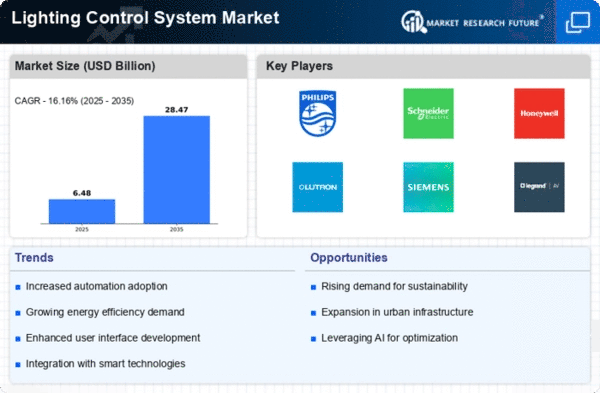
As per MRFR analysis, the Lighting Control System Market Size was estimated at 5.58 USD Billion in 2024. The Lighting Control System industry is projected to grow from 6.36 USD Billion in 2025 to 28.47 USD Billion by 2035, exhibiting a compound annual growth rate (CAGR) of 16.16 during the forecast period 2025 - 2035.

Key Market Trends & Highlights

The Lighting Control System Market is experiencing robust growth driven by technological advancements and increasing energy efficiency demands.

  • The integration of smart technologies is transforming the Lighting Control System Market, particularly in North America. Energy efficiency remains a focal point, with residential applications leading the market while smart lighting solutions are rapidly gaining traction. Customization and user-centric solutions are becoming essential, especially in the retail segment, which is currently the largest. Rising demand for energy efficiency and government regulations are key drivers propelling growth in both the residential and hospitality segments.

Market Size & Forecast

2024 Market Size 5.58 (USD Billion)
2035 Market Size 28.47 (USD Billion)
CAGR (2025 - 2035) 16.16%
Largest Regional Market Share in 2024 North America

Major Players

Philips (NL), Schneider Electric (FR), Honeywell (US), Lutron Electronics (US), Siemens (DE), Legrand (FR), Cree (US), Osram (DE), GE Lighting (US)

Market Trends

The Lighting Control System Market is currently experiencing a transformative phase, driven by advancements in technology and a growing emphasis on energy efficiency. As organizations and individuals alike become increasingly aware of the environmental impact of energy consumption, the demand for sophisticated lighting control solutions appears to be on the rise. These systems not only enhance user experience through improved convenience and customization but also contribute to significant energy savings. Furthermore, the integration of smart technologies, such as the Internet of Things (IoT), is reshaping the landscape, allowing for more intuitive and responsive lighting solutions that adapt to user preferences and environmental conditions. In addition to technological advancements, regulatory frameworks are evolving to support the adoption of energy-efficient lighting solutions. Governments worldwide are implementing policies that encourage the use of smart lighting systems, which may further stimulate market growth. The Lighting Control System Market seems poised for expansion as stakeholders recognize the potential benefits of these systems, including reduced operational costs and enhanced sustainability. As the market continues to evolve, it is likely that innovations will emerge, addressing the diverse needs of various sectors, from residential to commercial and industrial applications.

Integration of Smart Technologies

The Lighting Control System Market is witnessing a notable trend towards the integration of smart technologies. This shift enables users to control lighting through mobile applications and voice-activated devices, enhancing convenience and personalization. As smart home ecosystems gain traction, the demand for compatible lighting control systems is likely to increase.

Focus on Energy Efficiency

A growing emphasis on energy efficiency is shaping the Lighting Control System Market. Organizations are increasingly seeking solutions that not only reduce energy consumption but also lower operational costs. This trend is further supported by government initiatives promoting sustainable practices, which may drive the adoption of advanced lighting control systems.

Customization and User-Centric Solutions

The market is also trending towards customization and user-centric solutions. Consumers are looking for lighting control systems that can be tailored to their specific needs and preferences. This demand for personalized experiences is prompting manufacturers to develop more flexible and adaptable systems, potentially enhancing user satisfaction.

Lighting Control System Market Market Drivers

Technological Advancements

The Global Lighting Control System Market Industry is experiencing rapid technological advancements, particularly in smart lighting and IoT integration. These innovations enable users to control lighting remotely, optimize energy consumption, and enhance user experience. For instance, the proliferation of smart home devices has led to increased demand for sophisticated lighting control systems. As of 2024, the market is valued at approximately 5.63 USD Billion, reflecting a growing consumer preference for automation and energy efficiency. This trend is likely to continue, with advancements in sensor technology and artificial intelligence further driving market growth.

Market Segment Insights

By Application: Residential (Largest) vs. Smart Lighting (Fastest-Growing)

The Lighting Control System Market is segmented into various applications, notably Residential, Commercial, Industrial, Outdoor, and <a href="https://www.marketresearchfuture.com/reports/smart-lighting-market-991">Smart Lighting</a>. Among these, the Residential segment holds the largest market share, driven by increasing consumer demand for energy-efficient lighting solutions and intuitive control mechanisms. Following closely, the Commercial sector also represents a significant portion, catering to businesses that seek to enhance energy management and workspace flexibility. However, Smart Lighting has emerged as a rapidly growing segment, reflecting a societal shift towards automation and connectivity in everyday lighting solutions.

Residential (Dominant) vs. Smart Lighting (Emerging)

The Residential segment of the Lighting Control System Market is characterized by its user-friendly interface and efficient energy management, making it a dominant force in the market. Homeowners prioritize systems that allow for customizable lighting solutions and integration with smart home technologies. In contrast, Smart Lighting is an emerging segment that focuses on automation and advanced features like remote control and responsiveness to environmental changes. This trend is propelled by advancements in Internet of Things (IoT) technology, which enable lighting systems to enhance convenience and energy savings. As consumers increasingly adopt smart home devices, the Smart Lighting segment is poised for significant expansion.

By End Use: Retail (Largest) vs. Hospitality (Fastest-Growing)

The Lighting Control System Market has shown robust adoption across various end use segments. Among these, the retail segment stands out with the largest market share as businesses seek to enhance customer experiences through innovative lighting solutions. In contrast, the hospitality segment, driven by increasing investments in hotel renovations and smart building technologies, is rapidly growing and capturing significant attention from stakeholders aiming to create inviting and flexible environments for guests.

Retail (Dominant) vs. Hospitality (Emerging)

The retail segment dominates the Lighting Control System Market by emphasizing immersive shopping experiences through tailored lighting solutions. Retailers leverage advanced control systems to optimize energy usage while creating atmospheres that draw customers. This dominance is complemented by the hospitality segment's emergence, characterized by the rapid implementation of smart lighting systems in hotels and restaurants. As the hospitality industry increasingly prioritizes energy efficiency and guest comfort, the demand for sophisticated lighting control technologies is rising. This convergence highlights a shift towards personalized experiences in both dominant and emerging sectors, driving innovation and market growth.

By Technology: Wired (Largest) vs. Wireless (Fastest-Growing)

The Lighting Control System Market is segmented into Wired, Wireless, Hybrid, Dimming Control, and Occupancy Sensors. Among these segments, Wired systems dominate with a substantial market share due to their reliability and established technology. Consequently, they have garnered preference in commercial and industrial settings where stability is paramount. However, Wireless technology is gaining traction as the fastest-growing segment due to advancements in communication protocols and the increasing demand for smart connectivity in residential applications.

Technology: Wired (Dominant) vs. Wireless (Emerging)

Wired lighting control systems are characterized by their robustness, reliability, and vast integration capabilities, making them a preferred choice for commercial buildings and industrial applications. Their dominance is attributed to existing infrastructures and the ability to handle intricate control tasks without the interference issues associated with wireless systems. Conversely, Wireless lighting control systems represent an emerging trend, suitable for modern smart homes. They offer flexibility, ease of installation, and adaptability, allowing users to control lighting remotely via smartphones. This emergence is pushed by consumer demand for smart solutions and enhanced energy efficiency, positioning wireless systems as viable alternatives in markets aiming for modernization.

By Component: Lighting Fixtures (Largest) vs. Control Panels (Fastest-Growing)

The Lighting Control System Market is predominantly driven by lighting fixtures, which hold the largest market share due to their essential role in both commercial and residential spaces. Control panels follow closely as they gain traction, reflecting advancements in automation and energy efficiency. The distribution of market share among other components like sensors, software, and actuators highlights the diverse preferences in applications and functionalities sought by users. Demand for each segment is influenced by technological integration and sustainable practices, further shaping the competitive landscape.

Lighting Fixtures (Dominant) vs. Control Panels (Emerging)

Lighting fixtures are recognized as the dominant component in the Lighting Control System Market. They encompass a wide array of products such as LEDs and traditional lighting solutions, catering to various sectors, including residential, commercial, and industrial applications. Their versatility and essential nature ensure a stable demand. Meanwhile, control panels are emerging as essential elements, particularly with the rise of smart home technologies and Internet of Things (IoT) applications. As businesses and consumers prioritize connectivity and energy management, control panels equipped with advanced features are anticipated to capture significant market attention, driving growth in the segment.

By Installation Type: New Installation (Largest) vs. Retrofit (Fastest-Growing)

The Lighting Control System Market is segmented into various installation types, with the New Installation segment taking the lead in market share. This segment is preferred due to the expanding construction industry and the rise in smart building solutions. Retrofit installations are gaining traction as well, driven by existing infrastructure upgrades and the growing emphasis on energy efficiency in residential and commercial properties. Overall, the market distribution showcases a healthy balance between new developments and enhancement of existing systems.

Installation Types: New Installation (Dominant) vs. Retrofit (Emerging)

The New Installation segment is characterized by comprehensive setups in newly constructed buildings, often incorporating the latest technology for enhanced control and automation of lighting systems. It is primarily driven by rising new constructions and a growing trend towards smart homes. In contrast, the Retrofit segment represents an emerging market where existing lighting systems are upgraded to incorporate advanced control technologies. This segment is propelled by a push for energy savings and sustainability in older buildings, increasingly appealing to both commercial and residential users seeking energy-efficient solutions.

Get more detailed insights about Lighting Control System Market Research Report- Forecast 2035

Regional Insights

North America : Market Leader in Innovation

North America continues to lead the Lighting Control System market, holding a significant share of 2.8 billion. The growth is driven by increasing demand for energy-efficient solutions and smart home technologies. Regulatory support for energy conservation and sustainability initiatives further catalyzes market expansion. The region's focus on innovation and technology adoption is pivotal in shaping future trends. The competitive landscape is robust, with key players like Philips, Honeywell, and Lutron Electronics dominating the market. The U.S. stands out as a leader, supported by a strong infrastructure and investment in smart technologies. The presence of major companies fosters a dynamic environment, encouraging advancements in lighting control solutions. As the market evolves, collaboration among these players will be crucial for maintaining leadership.

Europe : Sustainable Growth and Innovation

Europe's Lighting Control System market is valued at 1.7 billion, driven by stringent regulations promoting energy efficiency and sustainability. The European Union's directives on energy consumption and emissions reduction are significant catalysts for market growth. The increasing adoption of smart lighting solutions in commercial and residential sectors further enhances demand, aligning with the region's green initiatives. Leading countries like Germany, France, and the UK are at the forefront of this market, with companies such as Schneider Electric and Osram playing pivotal roles. The competitive landscape is characterized by innovation and collaboration among key players, focusing on developing advanced technologies. As Europe pushes towards a sustainable future, the integration of smart technologies in lighting systems will be essential for meeting regulatory standards and consumer expectations.

Asia-Pacific : Rapid Growth and Adoption

The Asia-Pacific region, valued at 1.0 billion, is witnessing rapid growth in the Lighting Control System market. This surge is fueled by urbanization, increasing disposable incomes, and a growing emphasis on energy-efficient solutions. Governments are implementing policies to promote smart city initiatives, which significantly boost demand for advanced lighting technologies. The region's market is expected to expand as consumers become more aware of energy conservation benefits. Countries like China, Japan, and India are leading the charge, with significant investments in infrastructure and smart technologies. Key players such as Cree and GE Lighting are actively participating in this growth, enhancing their market presence. The competitive landscape is evolving, with local and international companies collaborating to innovate and meet the rising demand for smart lighting solutions.

Middle East and Africa : Emerging Market Potential

The Middle East and Africa (MEA) region, with a market size of 0.08 billion, presents emerging opportunities in the Lighting Control System sector. The growth is primarily driven by increasing urbanization and infrastructure development, particularly in the Gulf Cooperation Council (GCC) countries. Government initiatives aimed at enhancing energy efficiency and sustainability are also contributing to market expansion, as the region seeks to diversify its economies. Countries like the UAE and Saudi Arabia are leading the market, with significant investments in smart city projects. The competitive landscape is gradually evolving, with both local and international players entering the market. Companies are focusing on innovative solutions to cater to the unique needs of the region, positioning themselves for future growth as demand for advanced lighting systems increases.

Key Players and Competitive Insights

The Lighting Control System Market is currently characterized by a dynamic competitive landscape, driven by technological advancements and increasing demand for energy-efficient solutions. Major players such as Philips (NL), Schneider Electric (FR), and Honeywell (US) are strategically positioned to leverage innovation and digital transformation. Philips (NL) focuses on smart lighting solutions, enhancing user experience through IoT integration, while Schneider Electric (FR) emphasizes sustainability and energy management, aligning with global environmental goals. Honeywell (US) is advancing its portfolio through automation and smart building technologies, collectively shaping a competitive environment that prioritizes efficiency and user-centric designs.
Key business tactics within this market include localizing manufacturing and optimizing supply chains to enhance responsiveness to regional demands. The competitive structure appears moderately fragmented, with several key players exerting influence over market dynamics. This fragmentation allows for niche players to emerge, yet the collective strength of established companies like Lutron Electronics (US) and Siemens (DE) ensures a robust competitive framework, where innovation and strategic partnerships are pivotal.
In November 2025, Philips (NL) announced the launch of its latest smart lighting platform, which integrates AI-driven analytics to optimize energy consumption in commercial spaces. This strategic move not only reinforces Philips' commitment to sustainability but also positions the company as a leader in the smart lighting segment, potentially increasing its market share in a rapidly evolving landscape. The integration of AI into lighting control systems may enhance operational efficiency for businesses, thereby attracting a broader customer base.
In October 2025, Schneider Electric (FR) unveiled a new partnership with a leading tech firm to develop advanced lighting control systems that utilize machine learning algorithms. This collaboration is indicative of Schneider's strategy to enhance its product offerings through cutting-edge technology, which could lead to improved energy management solutions. By harnessing machine learning, Schneider Electric aims to provide clients with tailored solutions that adapt to their specific energy needs, thereby enhancing customer satisfaction and loyalty.
In September 2025, Honeywell (US) expanded its smart building solutions portfolio by acquiring a startup specializing in IoT-enabled lighting controls. This acquisition is strategically significant as it allows Honeywell to integrate innovative technologies into its existing offerings, thereby enhancing its competitive edge. The move reflects a broader trend of consolidation within the market, where established players seek to bolster their capabilities through strategic acquisitions, ultimately driving innovation and market growth.
As of December 2025, current competitive trends indicate a strong emphasis on digitalization, sustainability, and AI integration within the Lighting Control System Market. Strategic alliances are increasingly shaping the landscape, enabling companies to pool resources and expertise to develop advanced solutions. The shift from price-based competition to a focus on innovation, technology, and supply chain reliability is evident, suggesting that future competitive differentiation will hinge on the ability to deliver cutting-edge, sustainable solutions that meet evolving consumer demands.

Key Companies in the Lighting Control System Market include

Industry Developments

Philips Lighting N.V.:

  • October 2023, Launched a new series of cloud-based lighting control systems with advanced data analytics and insights for improved building performance.
  • December 2023, Partnered with a leading building automation company to offer integrated lighting and HVAC control solutions for enhanced energy efficiency and occupant comfort.

General Electric Company (GE):

  • September 2023, Introduced a new line of cost-effective lighting control systems targeting small and medium-sized businesses for easy retrofitting and energy savings.
  • November 2023, Collaborated with a major city government to implement a large-scale LED street lighting project with integrated control systems for improved public safety and energy savings.

Legrand S.A.:

  • August 2023, Developed a new voice-activated lighting control system for seamless integration with smart home assistants like Amazon Alexa and Google Home.
  • December 2023, Expanded their global distribution network for lighting control systems, reaching new markets and customer segments.

Eaton Corporation:

  • October 2023, Focused on developing lighting control systems with integrated daylight harvesting capabilities for maximizing natural light usage and energy savings.
  • June 2023, Partnered with a leading lighting manufacturer to offer pre-configured lighting control solutions for specific industry applications.

Future Outlook

Lighting Control System Market Future Outlook

The Lighting Control System Market is projected to grow at a 16.16% CAGR from 2025 to 2035, driven by advancements in smart technology, energy efficiency demands, and regulatory support.

New opportunities lie in:

  • Integration of IoT-enabled lighting solutions for smart cities
  • Development of energy-efficient retrofitting services for existing infrastructures
  • Expansion into emerging markets with tailored lighting control systems

By 2035, the market is expected to be robust, driven by innovation and increasing adoption of smart technologies.

Market Segmentation

Lighting Control System Market End Use Outlook

  • Retail
  • Hospitality
  • Healthcare
  • Education
  • Transportation

Lighting Control System Market Component Outlook

  • Lighting Fixtures
  • Control Panels
  • Sensors
  • Software
  • Actuators

Lighting Control System Market Technology Outlook

  • Wired
  • Wireless
  • Hybrid
  • Dimming Control
  • Occupancy Sensors

Lighting Control System Market Application Outlook

  • Residential
  • Commercial
  • Industrial
  • Outdoor
  • Smart Lighting

Lighting Control System Market Installation Type Outlook

  • New Installation
  • Retrofit
  • Integrated Systems
  • Standalone Systems
  • Modular Systems

Report Scope

MARKET SIZE 2024 5.58(USD Billion)
MARKET SIZE 2025 6.36(USD Billion)
MARKET SIZE 2035 28.47(USD Billion)
COMPOUND ANNUAL GROWTH RATE (CAGR) 16.16% (2025 - 2035)
REPORT COVERAGE Revenue Forecast, Competitive Landscape, Growth Factors, and Trends
BASE YEAR 2024
Market Forecast Period 2025 - 2035
Historical Data 2019 - 2024
Market Forecast Units USD Billion
Key Companies Profiled Philips (NL), Schneider Electric (FR), Honeywell (US), Lutron Electronics (US), Siemens (DE), Legrand (FR), Cree (US), Osram (DE), GE Lighting (US)
Segments Covered Application, End Use, Technology, Component, Installation Type
Key Market Opportunities Integration of smart technologies enhances energy efficiency in the Lighting Control System Market.
Key Market Dynamics Technological advancements and regulatory changes drive innovation and adoption in the Lighting Control System Market.
Countries Covered North America, Europe, APAC, South America, MEA

FAQs

What is the assessment period for the Global Lighting control system Market?

2024-2032 is the assessment period for the Global Lighting control system Market.

Mention the grossing factor influencing the market for Lighting control system globally.

The high implementation various smart lighting and energy efficiency are the grossing factors influencing the market for Lighting control system globally.

Regionally, which region has occupied the highest market share currently?

Asia-Pacific has occupied the highest market share currently in the global lighting control system market, as per the analysis.

What is the valuation recorded for the Global Lighting control system Market?

USD 34.2 Billion is the valuation recorded for the Global Lighting control system Market.

Mention the top 4 key players actively functional in the Global Lighting control system Market.

Philips Lighting N.V. (Netherlands), General Electric Company (GE) (US), Legrand S.A. (France), Eaton Corporation (Ireland), Acuity Brands Inc. (US) are the top 4 key players actively functional in the Global Lighting control system Market.

  1. SECTION I: EXECUTIVE SUMMARY AND KEY HIGHLIGHTS
    1. | 1.1 EXECUTIVE SUMMARY
    2. | 1.1.1 Market Overview
    3. | 1.1.2 Key Findings
    4. | 1.1.3 Market Segmentation
    5. | 1.1.4 Competitive Landscape
    6. | 1.1.5 Challenges and Opportunities
    7. | 1.1.6 Future Outlook
  2. SECTION II: SCOPING, METHODOLOGY AND MARKET STRUCTURE
    1. | 2.1 MARKET INTRODUCTION
    2. | 2.1.1 Definition
    3. | 2.1.2 Scope of the study
    4. |-- 2.1.2.1 Research Objective
    5. |-- 2.1.2.2 Assumption
    6. |-- 2.1.2.3 Limitations
    7. | 2.2 RESEARCH METHODOLOGY
    8. | 2.2.1 Overview
    9. | 2.2.2 Data Mining
    10. | 2.2.3 Secondary Research
    11. | 2.2.4 Primary Research
    12. |-- 2.2.4.1 Primary Interviews and Information Gathering Process
    13. |-- 2.2.4.2 Breakdown of Primary Respondents
    14. | 2.2.5 Forecasting Model
    15. | 2.2.6 Market Size Estimation
    16. |-- 2.2.6.1 Bottom-Up Approach
    17. |-- 2.2.6.2 Top-Down Approach
    18. | 2.2.7 Data Triangulation
    19. | 2.2.8 Validation
  3. SECTION III: QUALITATIVE ANALYSIS
    1. | 3.1 MARKET DYNAMICS
    2. | 3.1.1 Overview
    3. | 3.1.2 Drivers
    4. | 3.1.3 Restraints
    5. | 3.1.4 Opportunities
    6. | 3.2 MARKET FACTOR ANALYSIS
    7. | 3.2.1 Value chain Analysis
    8. | 3.2.2 Porter's Five Forces Analysis
    9. |-- 3.2.2.1 Bargaining Power of Suppliers
    10. |-- 3.2.2.2 Bargaining Power of Buyers
    11. |-- 3.2.2.3 Threat of New Entrants
    12. |-- 3.2.2.4 Threat of Substitutes
    13. |-- 3.2.2.5 Intensity of Rivalry
    14. | 3.2.3 COVID-19 Impact Analysis
    15. |-- 3.2.3.1 Market Impact Analysis
    16. |-- 3.2.3.2 Regional Impact
    17. |-- 3.2.3.3 Opportunity and Threat Analysis
  4. SECTION IV: QUANTITATIVE ANALYSIS
    1. | 4.1 Semiconductor & Electronics, BY Application (USD Billion)
    2. | 4.1.1 Residential
    3. | 4.1.2 Commercial
    4. | 4.1.3 Industrial
    5. | 4.1.4 Outdoor
    6. | 4.1.5 Smart Lighting
    7. | 4.2 Semiconductor & Electronics, BY End Use (USD Billion)
    8. | 4.2.1 Retail
    9. | 4.2.2 Hospitality
    10. | 4.2.3 Healthcare
    11. | 4.2.4 Education
    12. | 4.2.5 Transportation
    13. | 4.3 Semiconductor & Electronics, BY Technology (USD Billion)
    14. | 4.3.1 Wired
    15. | 4.3.2 Wireless
    16. | 4.3.3 Hybrid
    17. | 4.3.4 Dimming Control
    18. | 4.3.5 Occupancy Sensors
    19. | 4.4 Semiconductor & Electronics, BY Component (USD Billion)
    20. | 4.4.1 Lighting Fixtures
    21. | 4.4.2 Control Panels
    22. | 4.4.3 Sensors
    23. | 4.4.4 Software
    24. | 4.4.5 Actuators
    25. | 4.5 Semiconductor & Electronics, BY Installation Type (USD Billion)
    26. | 4.5.1 New Installation
    27. | 4.5.2 Retrofit
    28. | 4.5.3 Integrated Systems
    29. | 4.5.4 Standalone Systems
    30. | 4.5.5 Modular Systems
    31. | 4.6 Semiconductor & Electronics, BY Region (USD Billion)
    32. | 4.6.1 North America
    33. |-- 4.6.1.1 US
    34. |-- 4.6.1.2 Canada
    35. | 4.6.2 Europe
    36. |-- 4.6.2.1 Germany
    37. |-- 4.6.2.2 UK
    38. |-- 4.6.2.3 France
    39. |-- 4.6.2.4 Russia
    40. |-- 4.6.2.5 Italy
    41. |-- 4.6.2.6 Spain
    42. |-- 4.6.2.7 Rest of Europe
    43. | 4.6.3 APAC
    44. |-- 4.6.3.1 China
    45. |-- 4.6.3.2 India
    46. |-- 4.6.3.3 Japan
    47. |-- 4.6.3.4 South Korea
    48. |-- 4.6.3.5 Malaysia
    49. |-- 4.6.3.6 Thailand
    50. |-- 4.6.3.7 Indonesia
    51. |-- 4.6.3.8 Rest of APAC
    52. | 4.6.4 South America
    53. |-- 4.6.4.1 Brazil
    54. |-- 4.6.4.2 Mexico
    55. |-- 4.6.4.3 Argentina
    56. |-- 4.6.4.4 Rest of South America
    57. | 4.6.5 MEA
    58. |-- 4.6.5.1 GCC Countries
    59. |-- 4.6.5.2 South Africa
    60. |-- 4.6.5.3 Rest of MEA
  5. SECTION V: COMPETITIVE ANALYSIS
    1. | 5.1 Competitive Landscape
    2. | 5.1.1 Overview
    3. | 5.1.2 Competitive Analysis
    4. | 5.1.3 Market share Analysis
    5. | 5.1.4 Major Growth Strategy in the Semiconductor & Electronics
    6. | 5.1.5 Competitive Benchmarking
    7. | 5.1.6 Leading Players in Terms of Number of Developments in the Semiconductor & Electronics
    8. | 5.1.7 Key developments and growth strategies
    9. |-- 5.1.7.1 New Product Launch/Service Deployment
    10. |-- 5.1.7.2 Merger & Acquisitions
    11. |-- 5.1.7.3 Joint Ventures
    12. | 5.1.8 Major Players Financial Matrix
    13. |-- 5.1.8.1 Sales and Operating Income
    14. |-- 5.1.8.2 Major Players R&D Expenditure. 2023
    15. | 5.2 Company Profiles
    16. | 5.2.1 Philips (NL)
    17. |-- 5.2.1.1 Financial Overview
    18. |-- 5.2.1.2 Products Offered
    19. |-- 5.2.1.3 Key Developments
    20. |-- 5.2.1.4 SWOT Analysis
    21. |-- 5.2.1.5 Key Strategies
    22. | 5.2.2 Schneider Electric (FR)
    23. |-- 5.2.2.1 Financial Overview
    24. |-- 5.2.2.2 Products Offered
    25. |-- 5.2.2.3 Key Developments
    26. |-- 5.2.2.4 SWOT Analysis
    27. |-- 5.2.2.5 Key Strategies
    28. | 5.2.3 Honeywell (US)
    29. |-- 5.2.3.1 Financial Overview
    30. |-- 5.2.3.2 Products Offered
    31. |-- 5.2.3.3 Key Developments
    32. |-- 5.2.3.4 SWOT Analysis
    33. |-- 5.2.3.5 Key Strategies
    34. | 5.2.4 Lutron Electronics (US)
    35. |-- 5.2.4.1 Financial Overview
    36. |-- 5.2.4.2 Products Offered
    37. |-- 5.2.4.3 Key Developments
    38. |-- 5.2.4.4 SWOT Analysis
    39. |-- 5.2.4.5 Key Strategies
    40. | 5.2.5 Siemens (DE)
    41. |-- 5.2.5.1 Financial Overview
    42. |-- 5.2.5.2 Products Offered
    43. |-- 5.2.5.3 Key Developments
    44. |-- 5.2.5.4 SWOT Analysis
    45. |-- 5.2.5.5 Key Strategies
    46. | 5.2.6 Legrand (FR)
    47. |-- 5.2.6.1 Financial Overview
    48. |-- 5.2.6.2 Products Offered
    49. |-- 5.2.6.3 Key Developments
    50. |-- 5.2.6.4 SWOT Analysis
    51. |-- 5.2.6.5 Key Strategies
    52. | 5.2.7 Cree (US)
    53. |-- 5.2.7.1 Financial Overview
    54. |-- 5.2.7.2 Products Offered
    55. |-- 5.2.7.3 Key Developments
    56. |-- 5.2.7.4 SWOT Analysis
    57. |-- 5.2.7.5 Key Strategies
    58. | 5.2.8 Osram (DE)
    59. |-- 5.2.8.1 Financial Overview
    60. |-- 5.2.8.2 Products Offered
    61. |-- 5.2.8.3 Key Developments
    62. |-- 5.2.8.4 SWOT Analysis
    63. |-- 5.2.8.5 Key Strategies
    64. | 5.2.9 GE Lighting (US)
    65. |-- 5.2.9.1 Financial Overview
    66. |-- 5.2.9.2 Products Offered
    67. |-- 5.2.9.3 Key Developments
    68. |-- 5.2.9.4 SWOT Analysis
    69. |-- 5.2.9.5 Key Strategies
    70. | 5.3 Appendix
    71. | 5.3.1 References
    72. | 5.3.2 Related Reports

Semiconductor & Electronics Market Segmentation

Semiconductor & Electronics By Application (USD Billion, 2025-2035)

  • Residential
  • Commercial
  • Industrial
  • Outdoor
  • Smart Lighting

Semiconductor & Electronics By End Use (USD Billion, 2025-2035)

  • Retail
  • Hospitality
  • Healthcare
  • Education
  • Transportation

Semiconductor & Electronics By Technology (USD Billion, 2025-2035)

  • Wired
  • Wireless
  • Hybrid
  • Dimming Control
  • Occupancy Sensors

Semiconductor & Electronics By Component (USD Billion, 2025-2035)

  • Lighting Fixtures
  • Control Panels
  • Sensors
  • Software
  • Actuators

Semiconductor & Electronics By Installation Type (USD Billion, 2025-2035)

  • New Installation
  • Retrofit
  • Integrated Systems
  • Standalone Systems
  • Modular Systems
Infographic

Free Sample Request

Kindly complete the form below to receive a free sample of this Report

Get Free Sample

Customer Strories

Compare Licence

×
Features License Type
Single User Multiuser License Enterprise User
Price $4,950 $5,950 $7,250
Maximum User Access Limit 1 User Upto 10 Users Unrestricted Access Throughout the Organization
Free Customization
Direct Access to Analyst
Deliverable Format
Platform Access
Discount on Next Purchase 10% 15% 15%
Printable Versions