Research Methodology on Industrial Services Market
Introduction
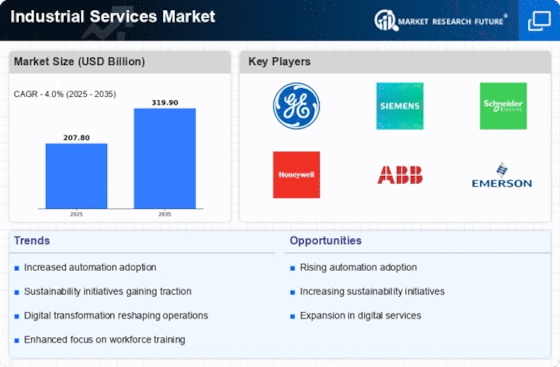
The global industrial services market is expected to exhibit a steady growth trajectory over the forecast period (2023 to 2030) due to the increasing need for the services offered to various end-use industries across the world. Industrial services refer to the services that enhance the operations of various industries and help companies save time and money.
Companies are increasingly opting for contractors and service providers to take care of their day-to-day operations. The market for industrial services is mainly driven by increasing expenditure by companies, as businesses are increasingly focusing on optimizing their efficiency and performance. The overall market is expected to be supported by the implementation of stringent regulations, initiatives towards cost optimization, and growing demand for efficiency. The industrial services market is further supported by the shifting focus towards digitalization, due to the increased use of industrial robots, machine learning and the internet of things.
Research Objectives
The objectives of this study are as follows:
- To define and understand the global industrial services market in terms of value and volume
- To analyze the market segments and dynamics of the market
- To analyze the global industrial services market in terms of market drivers, restraints, and trends
- To identify emerging opportunities in the global industrial services market
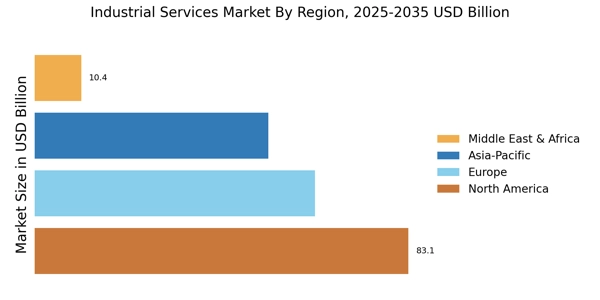
- To identify the geographical distribution of the global industrial services market in terms of size, market share, and value
- To analyze the competitive landscape of the global industrial services market and the strategies of leading players
Research Methodology
This research study makes use of both primary and secondary data sources. For this study, primary data sources are used to collect quantitative data and secondary data sources are used to validate and triangulate the information gathered from primary data sources. Primary data is gathered from surveys conducted with suppliers, manufacturers, and customers across the major countries of the industrial services market. The secondary data is derived from published reports, company websites and databases, and trade organizations.
The research methodology followed in this study is based on both qualitative and quantitative methods. First, extensive secondary research is conducted to obtain data and information related to the global industrial services market. This research includes primary interviews and extensive desk research that underscored numerous industry developments and opportunities in the global market.
Second, extensive primary research is conducted to assess the current dynamics of the global industrial services market. Primary interviews are conducted with industry experts, such as supply chain executives and industry experts. Primary interviews are used to obtain an in-depth understanding of the current dynamics of the global industrial services market and to identify the opportunities and challenges faced by the industry.
Third, a competitive landscape analysis is conducted to analyze the competitive environment of the global industrial services market and to identify the key market players. The competitive landscape is analyzed using Porter’s five forces model and the relative attractiveness of the global industrial services market is assessed. Fourth, a market sizing exercise is conducted to determine the current size of the global industrial services market and to forecast its future size.
Finally, a triangulation approach is used to validate and triangulate the data gathered from both primary and secondary sources. The analysis and triangulation of the collected data are conducted to develop a comprehensive understanding of the global industrial services market.
The research report includes data for the period 2023 -2030. The research report includes a detailed analysis of macroeconomic factors, such as the GDP, population, inflation rate, exchange rate, imports and exports, and various macroeconomic indicators.
Conclusion
The global industrial services market is estimated to grow at a steady rate over the forecast period 2023 to 2030, owing to the increasing expenditure by companies and the implementation of stringent regulations. Companies are increasingly opting for contractors and service providers to take care of their day-to-day operations, due to the need for optimizing efficiency and performance. The overall market is expected to be supported by the increased use of industrial robots, machine learning and the internet of things. The research study is conducted using a comprehensive research methodology, wherein both primary and secondary data sources are used to obtain an in-depth understanding of the global industrial services market.