×
Request Free Sample ×

Kindly complete the form below to receive a free sample of this Report

* Please use a valid business email

Leading companies partner with us for data-driven Insights

clients tt-cursor
Hero Background

Geothermal Power Market

ID: MRFR/EnP/7259-HCR
200 Pages
Chitranshi Jaiswal
February 2026

Geothermal Power Market Size, Share & Growth Analysis Report By Technology (Flash Steam, Binary Cycle, Dry Steam, Geothermal Heat Pumps), By Application (Electricity Generation, Direct Use Applications, District Heating), By End Use (Residential, Commercial, Industrial), By Resource Type (Hydrothermal, Enhanced Geothermal Systems, Hot Dry Rock) and By Regional (North America, Europe, South America, Asia Pacific, Middle East and Africa) - Trends & Industry Forecast to 2035

Share:
Download PDF ×

We do not share your information with anyone. However, we may send you emails based on your report interest from time to time. You may contact us at any time to opt-out.

Geothermal Power Market Infographic
Purchase Options

Geothermal Power Market Summary

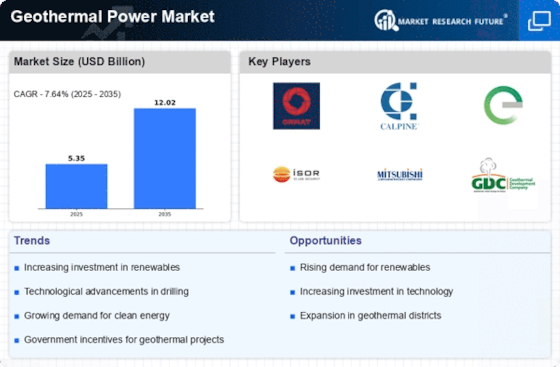
As per Market Research Future analysis, the Geothermal Power Market Size was estimated at 5.35 USD Billion in 2024. The Geothermal Power industry is projected to grow from 5.758 USD Billion in 2025 to 12.02 USD Billion by 2035, exhibiting a compound annual growth rate (CAGR) of 7.6% during the forecast period 2025 - 2035

Key Market Trends & Highlights

The Geothermal Power Market is poised for robust growth driven by technological advancements and increasing investments.

  • North America remains the largest market for geothermal power, showcasing a strong commitment to renewable energy sources.
  • The Asia-Pacific region is emerging as the fastest-growing market, fueled by rising energy demands and supportive government policies.
  • Flash steam technology dominates the market, while binary cycle systems are rapidly gaining traction due to their efficiency and lower environmental impact.
  • Key market drivers include the rising demand for renewable energy and government incentives that promote infrastructure investment.

Market Size & Forecast

2024 Market Size 5.35 (USD Billion)
2035 Market Size 12.02 (USD Billion)
CAGR (2025 - 2035) 7.64%

Major Players

Ormat Technologies (US), Calpine Corporation (US), Enel Green Power (IT), Iceland GeoSurvey (IS), Mitsubishi Materials Corporation (JP), Geothermal Development Company (KE), Contact Energy (NZ), Cyrq Energy (US), Toshiba Corporation (JP)

Our Impact
Enabled $4.3B Revenue Impact for Fortune 500 and Leading Multinationals
Partnering with 2000+ Global Organizations Each Year
30K+ Citations by Top-Tier Firms in the Industry

Geothermal Power Market Trends

The Geothermal Power Market is currently experiencing a notable transformation, driven by an increasing global emphasis on sustainable energy sources. This shift appears to be influenced by a growing awareness of climate change and the need for cleaner alternatives to fossil fuels. As nations strive to meet their energy demands while minimizing environmental impact, geothermal energy emerges as a viable solution. The technology harnesses heat from the Earth, providing a consistent and reliable energy source that can complement other renewable options. Furthermore, advancements in drilling techniques and plant efficiency are likely to enhance the attractiveness of geothermal projects, potentially leading to expanded investments in this sector. In addition to technological improvements, regulatory frameworks are evolving to support the Geothermal Power Market. Governments worldwide seem to recognize the importance of incentivizing renewable energy development, which may include tax breaks, grants, and streamlined permitting processes. This supportive environment could encourage private sector participation and foster innovation within the industry. As the market matures, collaboration between public and private entities appears essential for overcoming challenges related to resource exploration and project financing. Overall, the Geothermal Power Market is poised for growth, driven by a combination of technological advancements and favorable policy landscapes.

Technological Advancements

Recent innovations in drilling and resource assessment technologies are enhancing the efficiency and feasibility of geothermal projects. These advancements may lead to reduced costs and improved energy output, making geothermal energy more competitive with other renewable sources.

Regulatory Support

Governments are increasingly implementing policies that favor renewable energy development, including geothermal power. This regulatory support could manifest in various forms, such as financial incentives and streamlined processes, which may encourage investment and project initiation.

Increased Investment

There appears to be a growing interest from both public and private sectors in financing geothermal projects. This trend may be driven by the need for sustainable energy solutions and the potential for long-term returns, suggesting a robust future for the Geothermal Power Market.

Geothermal Power Market Drivers

Technological Innovations

Technological advancements play a crucial role in shaping the Geothermal Power Market. Innovations in drilling techniques, such as enhanced geothermal systems, have significantly reduced costs and improved efficiency. For instance, the introduction of advanced drilling technologies has enabled deeper and more efficient extraction of geothermal resources. In 2023, the average cost of geothermal electricity generation decreased by approximately 10% due to these innovations. Additionally, the integration of digital technologies, such as data analytics and remote monitoring, enhances operational efficiency and reduces maintenance costs. As these technologies continue to evolve, they are likely to attract further investment and interest in the Geothermal Power Market, fostering growth and expansion in various regions.

Government Incentives and Policies

Supportive government policies and incentives are pivotal in driving the Geothermal Power Market. Many countries have implemented favorable regulatory frameworks, including feed-in tariffs and tax credits, to encourage the development of geothermal projects. In 2023, several nations reported an increase in geothermal project approvals, attributed to these supportive measures. For example, the introduction of streamlined permitting processes has reduced the time required to bring geothermal projects online. This regulatory environment not only boosts investor confidence but also stimulates job creation in the sector. As governments continue to prioritize renewable energy, the Geothermal Power Market is expected to experience sustained growth, with an increasing number of projects coming to fruition.

Rising Demand for Renewable Energy

The increasing The Geothermal Power Industry. As nations strive to meet climate goals and reduce greenhouse gas emissions, geothermal energy emerges as a viable alternative. In 2023, the total installed geothermal capacity reached approximately 15 gigawatts, reflecting a growing recognition of its potential. This trend is likely to continue, as countries seek to diversify their energy portfolios and enhance energy security. The Geothermal Power Market stands to benefit from this shift, as it offers a stable and sustainable energy source that can complement intermittent renewables like solar and wind. Furthermore, the long-term operational efficiency of geothermal plants positions them favorably in the energy mix, potentially leading to increased investments and development in this sector.

Growing Awareness of Energy Security

The rising awareness of energy security concerns is influencing the Geothermal Power Market. As geopolitical tensions and supply chain disruptions become more prevalent, countries are seeking to reduce their dependence on fossil fuels and diversify their energy sources. Geothermal energy, with its ability to provide baseload power, offers a reliable solution to these challenges. In 2023, several nations reported a strategic shift towards renewable energy, with geothermal being a key component of their energy strategies. This trend is likely to continue, as energy security becomes a priority for governments and businesses alike. The Geothermal Power Market stands to gain from this shift, as it provides a stable and indigenous energy source that can enhance national energy resilience.

Increased Investment in Infrastructure

Investment in geothermal infrastructure is a significant driver for the Geothermal Power Market. As the demand for renewable energy grows, there is a corresponding need for enhanced geothermal facilities and supporting infrastructure. In 2023, global investments in geothermal projects reached an estimated USD 1.5 billion, reflecting a robust interest in expanding capacity. This influx of capital is likely to facilitate the development of new geothermal plants and the upgrading of existing facilities. Furthermore, partnerships between public and private sectors are emerging to finance these projects, indicating a collaborative approach to harnessing geothermal resources. As infrastructure improves, the Geothermal Power Market is expected to expand, providing more opportunities for energy generation and job creation.

Market Segment Insights

By Technology: Flash Steam (Largest) vs. Binary Cycle (Fastest-Growing)

The Geothermal Power Market showcases a diverse array of technologies, wherein Flash Steam dominates with a substantial market share. This technology harnesses high-pressure steam from geothermal reservoirs, leading to high efficiency in energy conversion. Following closely is the emerging Binary Cycle technology, which is gaining traction due to its ability to utilize lower temperature geothermal resources and lower environmental impact, thus showcasing a promising market share next to Flash Steam. Growth trends in the Geothermal Power Market indicate that while Flash Steam remains a cornerstone for geothermal energy production, the Binary Cycle's rapid adoption is driven by increasing investments in renewable energy technologies and government incentives. As countries ramp up their commitment to sustainable energy solutions, the demand for efficient systems like Binary Cycle is expected to grow, positioning it as a key player in future geothermal developments.

Technology: Flash Steam (Dominant) vs. Binary Cycle (Emerging)

Flash Steam technology is a well-established method in the geothermal power sector, facilitating efficient energy production from high-temperature geothermal resources. Its ability to convert geothermal energy into electricity efficiently cements its position as the dominant technology in this segment. In contrast, Binary Cycle technology is emerging as a viable alternative, particularly in regions with lower geothermal temperatures. It operates by using a secondary fluid with a lower boiling point, allowing for energy production from less traditional geothermal sources. This adaptability makes Binary Cycle increasingly attractive in the global shift towards renewable energy, highlighting its potential to carve out a significant market share.

By Application: Electricity Generation (Largest) vs. Direct Use Applications (Fastest-Growing)

In the Geothermal Power Market, the application segment showcases a diverse distribution of functionalities, primarily encompassing Electricity Generation, Direct Use Applications, and District Heating. Electricity Generation holds the largest share, being a fundamental output of geothermal plants, whereas Direct Use Applications and District Heating are gaining traction, reflecting a balance in market preferences. This segmentation illuminates the crucial roles these applications play in catering to varied energy needs across different sectors.

Electricity Generation (Dominant) vs. Direct Use Applications (Emerging)

Electricity Generation stands as the most dominant application in the Geothermal Power Market, serving as the cornerstone for renewable energy initiatives. It harnesses geothermal resources to produce sustainable electricity, benefiting from existing infrastructure and technology advancements. On the other hand, Direct Use Applications represent an emerging segment, utilizing geothermal heat for residential heating, industrial processes, and agricultural developments. This segment is rapidly expanding due to increasing energy efficiency demands and environmental sustainability trends. District Heating, although significant, is seen as a supportive application that complements these two by redistributing geothermal energy for communal use.

By End Use: Residential (Largest) vs. Commercial (Fastest-Growing)

In the Geothermal Power Market, the end-use segments are primarily divided into Residential, Commercial, and Industrial. Among these, Residential applications dominate, accounting for a significant share as they leverage geothermal systems for heating and cooling in homes. This segment benefits from an increasing trend towards sustainable living and energy efficiency. Meanwhile, the Commercial segment is emerging rapidly, particularly in sectors like hospitality and office buildings, where there is a growing emphasis on reducing carbon footprints and operational costs connected with energy consumption.

Residential (Dominant) vs. Commercial (Emerging)

The Residential segment holds a dominant position in the Geothermal Power Market, capitalizing on technological advancements in geothermal heat pumps that provide cost-effective heating and cooling solutions for homes. With incentives from governmental policies supporting sustainable energy usage, homeowners are increasingly adopting these systems. Conversely, the Commercial segment is classified as emerging, experiencing faster growth due to the rising adoption of geothermal solutions in commercial buildings. Businesses are becoming more aware of the long-term cost savings and environmental benefits associated with geothermal energy, thus driving installation rates. This segment is expected to continue its growth trajectory as more companies commit to sustainability goals.

By Resource Type: Hydrothermal (Largest) vs. Enhanced Geothermal Systems (Fastest-Growing)

In the Geothermal Power Market, Hydrothermal resources account for the largest share, harnessing steam or hot water from beneath the Earth's surface for energy generation. This proven technology includes both conventional and modified resources that provide reliable baseload power. Enhanced Geothermal Systems (EGS), while currently smaller in market share, are emerging rapidly as a revolutionary method for stimulating heat extraction from dry and hot rock formations, expanding the geographic reach of geothermal energy.

Hydrothermal (Dominant) vs. Enhanced Geothermal Systems (Emerging)

Hydrothermal resources are the backbone of the geothermal power sector, leveraging existing hot water reserves for efficient energy production. This segment has extensive infrastructure and operational histories, ensuring consistent energy outputs. In contrast, Enhanced Geothermal Systems (EGS) are recognized as a transformative technology that enhances the potential for geothermal energy beyond traditional locations. By artificially augmenting reservoir permeability, EGS can tap into previously inaccessible heat sources, positioning itself as an emerging player poised for significant growth as technological advancements continue to lower costs and improve efficiency.

Get more detailed insights about Geothermal Power Market

Regional Insights

The Geothermal Power Market demonstrates a robust framework with its regional segmentation revealing varied growth dynamics.

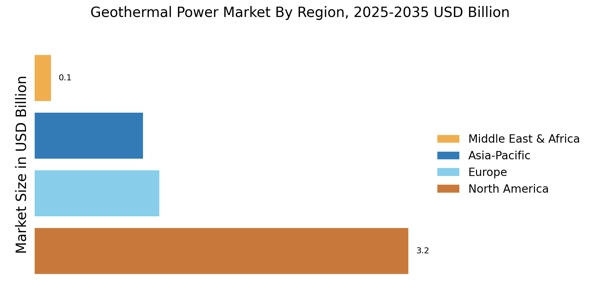
In 2024, North America stands prominent with a valuation of 1.3 USD Billion, projected to rise to 3.0 USD billion by 2035, solidifying its status as a major holding in the geothermal landscape.

Europe follows closely with a market value of 1.1 USD Billion in 2024, expecting a notable growth to 2.5 USD billion by 2035, benefitting from stringent renewable energy policies.

The Asia Pacific region, valued at 1.8 USD Billion in 2024 and anticipated to expand to 4.0 USD billion by 2035, serves as a significant hub due to its vast geothermal resources and ongoing investments in sustainable energy.

In contrast, South America, with a valuation of 0.6 USD Billion initially, and a rise to 1.5 USD billion, displays a slower growth pace but holds considerable potential for harnessing geothermal energy.

The Middle East and Africa represent the smallest segment, starting at 0.54 USD billion in 2024 and growing to 1.0 USD billion, driven by ongoing efforts to diversify energy sources.

Overall, the geographical distribution and unique growth patterns across these regions play a critical role in shaping the Geothermal Power Market revenue and segmentation outlook.

Geothermal Power Market Regional Image

Key Players and Competitive Insights

The Geothermal Power Market has been experiencing significant growth due to the increasing need for sustainable and renewable energy sources. Competitive insights in this market reveal a landscape characterized by innovation, technological advancements, and a strong commitment to reducing carbon emissions. Companies worldwide are focusing on harnessing geothermal energy as a reliable and environmentally friendly alternative to fossil fuels. This segment offers opportunities for businesses to capitalize on the global shift towards sustainability, with various players striving to enhance their portfolio through partnerships, strategic expansions, and investments in research and development. The dynamic nature of the market indicates that companies must remain agile and responsive to emerging trends, regulatory frameworks, and consumer preferences to maintain a competitive edge. Enel Green Power has established itself as a prominent player in the Geothermal Power Market, showcasing significant strengths that contribute to its competitive positioning. The company's extensive experience in the renewable energy sector allows it to leverage its expertise in geothermal technologies, resulting in efficient and sustainable energy production. Enel Green Power's strong presence in key geothermal hotspots globally enhances its capacity to capitalize on untapped resources. The company has a robust portfolio of geothermal plants, reflecting its commitment to scaling up production while adhering to environmental regulations and maintaining a low carbon footprint. Enel Green Power’s advanced operational techniques and strong customer relationship management enhance its ability to provide reliable geothermal solutions, positioning it as a trusted partner in the renewable energy landscape. Toshiba Energy Systems & Solutions Corporation plays a crucial role in the Geothermal Power Market, with a focus on innovation and advanced technology solutions. The company offers a range of products and services tailored to optimize geothermal energy generation, including cutting-edge turbine systems and integrated thermal energy solutions. Toshiba Energy Systems & Solutions Corporation has a well-established market presence, beneficially leveraging its technological prowess to design and implement customized geothermal power solutions for various regions. The company's strengths lie in its research and development capabilities, consistently delivering high-efficiency systems that cater to diverse energy demands. In addition to organic growth, Toshiba Energy Systems & Solutions Corporation has pursued strategic mergers and acquisitions to enhance its market share and technological foundation, resulting in a more comprehensive offering in the global geothermal arena. These strategic endeavors position the company favorably as it addresses the growing demand for renewable energy.

Key Companies in the Geothermal Power Market include

Industry Developments

Recent developments in the Geothermal Power Market showcase a growing focus on sustainability and clean energy. Companies such as Enel Green Power are expanding their geothermal operations, and Fervo Energy has initiated projects that utilize advanced technology to enhance efficiency.

Ormat Technologies, in collaboration with PT Medco Power Indonesia, launched the initial phase of its Ijen geothermal plant in February 2025, which contributed 35 MW to the grid of Java. The initiative is a critical component of a long-term power purchase agreement (PPA) that aims to establish a 110-MW capacity.

April 2025 - Two Ormat Energy Converter units have been installed, and the Geothermal Power Market Company of Dominica is making steady progress on its 10 MW facility at Laudat. Major equipment has been installed on the site. Commercial operations are anticipated to commence in December 2025.

In 2024, GreenEco Energy effectively commissioned the initial 24.5 MW unit of its GPP-7 geothermal plant in Denizli, Turkey. The facility will generate approximately 49 MWe cumulatively once it is fully operational.

Future Outlook

Geothermal Power Market Future Outlook

The Geothermal Power Market is projected to grow at a 7.64% CAGR from 2025 to 2035, driven by increasing energy demand, technological advancements, and supportive government policies. The future of the Geothermal Power Market is robust, driven by the demand for carbon-free baseload energy. Growth in this market is fueled by Enhanced Geothermal Systems (EGS) and binary cycle plants, which unlock lower-temperature resources, ensuring a reliable, 24/7 alternative to intermittent renewable energy sources.

New opportunities lie in:

  • Development of enhanced geothermal systems for broader resource access. Investment in geothermal district heating networks for urban areas. Partnerships with tech firms for geothermal energy storage solutions.

By 2035, the Geothermal Power Market is poised for robust growth and increased market penetration.

Market Segmentation

Geothermal Power Market End Use Outlook

  • Residential
  • Commercial
  • Industrial

Geothermal Power Market Technology Outlook

  • Flash Steam
  • Binary Cycle
  • Dry Steam
  • Geothermal Heat Pumps

Geothermal Power Market Application Outlook

  • Electricity Generation
  • Direct Use Applications
  • District Heating

Geothermal Power Market Resource Type Outlook

  • Hydrothermal
  • Enhanced Geothermal Systems
  • Hot Dry Rock

Report Scope

MARKET SIZE 2024 5.35(USD Billion)
MARKET SIZE 2025 5.758(USD Billion)
MARKET SIZE 2035 12.02(USD Billion)
COMPOUND ANNUAL GROWTH RATE (CAGR) 7.64% (2025 - 2035)
REPORT COVERAGE Revenue Forecast, Competitive Landscape, Growth Factors, and Trends
BASE YEAR 2024
Market Forecast Period 2025 - 2035
Historical Data 2019 - 2024
Market Forecast Units USD Billion
Key Companies Profiled Ormat Technologies (US), Calpine Corporation (US), Enel Green Power (IT), Iceland GeoSurvey (IS), Mitsubishi Materials Corporation (JP), Geothermal Development Company (KE), Contact Energy (NZ), Cyrq Energy (US), Toshiba Corporation (JP)
Segments Covered Technology, Application, End Use, Resource Type, Regional
Key Market Opportunities Expansion of geothermal district heating systems in urban areas presents a substantial opportunity in the Geothermal Power Market.
Key Market Dynamics Rising investments in geothermal technology drive market growth amid increasing demand for renewable energy solutions.
Countries Covered North America, Europe, APAC, South America, MEA

Market Highlights

Author
Chitranshi Jaiswal
Research Analyst Level I

In her 3 years of experience in the market research field, she has handled critical cross-domain projects. She has an in-depth knowledge of market estimation & analysis, problem-solving, primary as well as secondary research, and team management.She holds an engineering degree and is an MBA professional from a well-known university, capable of evaluating the market and competitive conditions. An exceptional strategist with excellent communication skills and a passion for delivering cutting-edge & practical insights for the market. Proficient in multi-tasking, and can successfully deal with competing demands, while maintaining complete confidentiality. Generated business through active client and project development, networking, and high-quality responses. Her knowledge and skills have helped in making solid business decisions, securing funding from investors, and avoiding business failures.

Leave a Comment

FAQs

What is the current valuation of the Geothermal Power Market as of 2024?

The Geothermal Power Market was valued at 5.35 USD Billion in 2024.

What is the projected market size for the Geothermal Power Market in 2035?

The market is projected to reach 12.02 USD Billion by 2035.

What is the expected CAGR for the Geothermal Power Market during the forecast period 2025 - 2035?

The expected CAGR for the Geothermal Power Market during 2025 - 2035 is 7.64%.

Which technology segments are included in the Geothermal Power Market?

Key technology segments include Flash Steam, Binary Cycle, Dry Steam, and Geothermal Heat Pumps.

What are the projected valuations for the Flash Steam technology segment by 2035?

The Flash Steam technology segment is projected to reach between 1.5 and 3.5 USD Billion by 2035.

How does the Direct Use Applications segment perform in the Geothermal Power Market?

The Direct Use Applications segment is expected to grow to between 1.5 and 3.5 USD Billion by 2035.

What are the anticipated valuations for the Industrial end-use segment by 2035?

The Industrial end-use segment is projected to reach between 2.65 and 5.72 USD Billion by 2035.

Which companies are considered key players in the Geothermal Power Market?

Key players include Ormat Technologies, Calpine Corporation, Enel Green Power, and Mitsubishi Materials Corporation.

What resource types are included in the Geothermal Power Market analysis?

Resource types include Hydrothermal, Enhanced Geothermal Systems, and Hot Dry Rock.

What is the projected valuation for the Hydrothermal resource type by 2035?

The Hydrothermal resource type is projected to reach between 2.68 and 6.05 USD Billion by 2035.

Research Approach

Research Methodology on Geothermal Power Market

1. Introduction

The published research report by MRFR seeks to analyse and explain the primary research that was conducted to establish the market size and market share of the global geothermal power market as outlined in Market Research Future’s (MRFR) report, “Geothermal Power Market– Global Analysis 2023-2030". This methodology provides an in-depth understanding of the research methods undertaken to generate the findings of the report. It summarises the details related to the scope of the research, the research design, data collection methods and the analytical tools used to analyse the findings.

2. Objectives of the Research

The primary aim of this research is to discover the current patterns of demand, recent market trends and growth potential of the global geothermal power market. The research embodied the core objective of identifying the potential of the geothermal power market in terms of its growth rate, market share, size, recent developments and new opportunities.

3. Scope of the Research

The scope of this research is designed to cover the global geothermal power market in terms of value, volume and revenue. Further, it provides forecast figures with respect to the size, revenue and growth rate until 2030. The research also covers various leaders such as manufacturers, industry experts and investors, who are the key stakeholders in the geothermal power sector. Furthermore, the report compiles data on various participants involved in the geothermal power industry, such as investors, suppliers and manufacturers.

4. Research Design

MRFR’s research report systematically incorporates primary and secondary research to differentiate the existing market dynamics and expansion. The secondary research comprises different statistical databases such as the United Nations Framework on Climate Change (UNFCC), World Bank and International Energy Agency (IEA). To further corroborate the information acquired from secondary research, primary research is conducted through interviews and surveys with the major participants in the industry, such as manufacturers, distributors, investors, stakeholders and other well-informed sources.

5. Data Collection

The data collection and market intelligence are conducted in a very systematic manner to ensure accuracy. The collected data is then scrutinised, weighed and examined to generate the primary market intelligence report. The data is collected from valid sources such as industry websites, the latest press releases, patent and trademark databases, scientific journals, the International Union for Geothermal Resources, the Economic and Social Commission for Asia and the Pacific (ESCAP), and international conferences and workshops. Other sources such as World Trade Organization (WTO), Indian Wind Power Association (IWPA), Global Wind Energy Council (GWEC), and Frost & Sullivan also contributed significantly to the data.

6. Analytical Tools

The collected market data and information are analysed by adopting various sophisticated analytical tools such as Porter’s Five Forces Analysis model and SWOT Analysis. Market dynamics such as drivers and restraints are categorised using the SWOT Analysis tool to provide a comprehensive assessment of the potential developments in the market. Porter’s Five Forces Analysis model is used for market segmentation and comparative market study.

7. Conclusion

The market research methodology adopted by MRFR for the global geothermal power market report demonstrates a comprehensive process that enables the collection and analysis of vital data from all relevant sources and participants. The research incorporates the most effective methods such as primary and secondary research, Porter’s Five Forces Analysis model and SWOT Analysis. The coverage of the report is restricted to certain countries, and the macro and socio-economic factors were excluded from the scope of research.


Download Free Sample

Kindly complete the form below to receive a free sample of this Report

Compare Licence

×
Features License Type
Single User Multiuser License Enterprise User
Price $4,950 $5,950 $7,250
Maximum User Access Limit 1 User Upto 10 Users Unrestricted Access Throughout the Organization
Free Customization
Direct Access to Analyst
Deliverable Format
Platform Access
Discount on Next Purchase 10% 15% 15%
Printable Versions