Research Methodology on the Deception Technology market
Introduction
This research aims to evaluate the current market status and size of the deception technology industry and its future growth prospects. To analyze the deception technology market in detail, a comprehensive research methodology is adopted that includes primary and secondary research methods. Primary research involves interaction and interviews with key industry personnel and opinion leaders and market analysts. Secondary research involves an extensive search of secondary sources such as articles, and industry and government databases, among other relevant information sources. In addition to this, publicly available information from company websites and former customer reviews, and customer brochures are also taken into account.
Objective of the Study
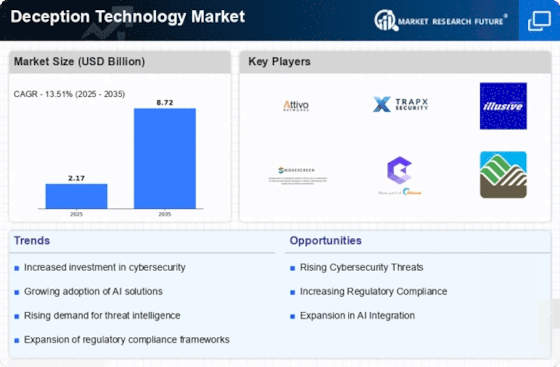
The objective of the market research is to identify the current and estimated market size of the deception technology market and to identify key trends and opportunities, as well as to assess the competitive landscape in terms of current market players.
Research Scope
The study is focusing on the market for deception technology, which is utilized for data security, identifying attacks, and detecting malware in organizations. The objectives of this research include studying current market trends, identifying and analyzing key industry trends, and providing an outline of the competitive landscape.
Research Methodology
To achieve the objectives of this study and to provide an accurate and comprehensive outlook of the deception technology market, the research methodology comprises a combination of primary and secondary research sources.
The primary research sources used are:
- Interviews and interactions with industry professionals such as technology heads, analysts, marketing heads, and research heads in the deception technology space.
- Interviews and interactions with solution providers and end-users of deception technology.
- Telephonic interviews and interactions with decision-making personnel in the deception technology industry.
The primary research gathered includes opinions, industry intelligence, and concise market data, among other relevant information.
Secondary sources of data include:
- white papers,
- company websites,
- magazines,
- news websites,
- stock market analysis websites,
- industry portals,
- industry associations,
- annual reports,
- government websites,
- industry experts’ views,
- conferences,
- and interviews conducted with industry experts.
Assumptions of the Study
- The growth of the market for deception technology is dependent on multiple factors such as inflation rate, technological progress, availability of resources, political and governmental policies, market saturation, trends in the industry, security threats, and environmental changes.
- Solutions that are in the early stages of the maturity cycle of the technology are given higher importance in the study.
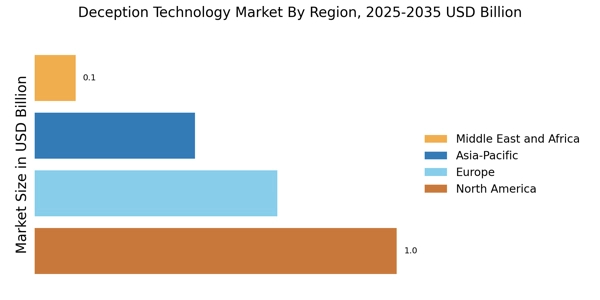
- The geographical regions that have been assessed include North America, Europe, Asia-Pacific, Middle East & Africa, and Latin America.
- The base year for the report is 2022, and the forecast period is from 2023-2030.
- Historical data and analysis are based on data collected from previous years.
- The report does not take into account the inflation rate and currency exchange rate for any of the countries or regions.
- The market is assumed to be divided into distinct categories such as appliances, software, and services.
- The segmentation is done based on geography and type.
- The market is assumed to be divided into application areas such as banking and finance, healthcare, telecommunications, public infrastructure, and others.
Research Methodology
The market research process involves a wide variety of activities such as conducting desk research, reviewing existing data sources such as internal and external sources, conducting secondary research such as reviewing existing literature, reports, and government and industry association documents, outlining key insights such as customer needs, challenges, and opportunities in the market, assessing consumer behaviour and sentiment, and conducting interviews and interactions with market players and opinion leaders. The information gathered through these activities is cross-checked and verified to ensure accuracy and reliability.
The research process is also supplemented by quantitative and qualitative data analysis undertaken by a team of market researchers. Quantitative analysis involves the use of numerical data such as CAGR, the market size of different segments, and regional growth rate. Qualitative analysis involves a wide variety of activities such as reviewing market dynamics, assessing market trends, and developing a customer-centric approach.
Report Structure
The research report is structured into several sections and includes an executive summary and a comprehensive overview of the deception technology market. The report also provides an in-depth analysis of the market segmentation, trends, current and estimated market size, and competitive landscape. The report is supplemented by a comprehensive outlook on the competitive landscape, segmentation by geography and type, application area, and other factors. The report also includes a detailed analysis of the ecosystem and a listing of key players operating in the market. The report concludes with a summation of the overall findings and provides key conclusions.
Report Delivery
The report is delivered in the form of a PDF or word document with tables and charts to present the data and analysis in an organized manner. The report is structured in such a way that it is easy to navigate and comprehend.