Research Methodology on Core HR Software Market
Introduction
The development of technology has revolutionized the way humans interact and conduct business worldwide. The development of core HR software has shifted the traditional means of carrying out human resource tasks. This has significantly reduced human resource management complexities and led to increased use of core HR software.
Core HR software acts as a foundation for the delivery of payroll, human resources, benefit programs, recruiting and retention management, workflows, compliance functions and other employee-related services. Through this software, HR personnel can easily control their costs, store employee information, track performance and manage payroll systems. The growth of core HR software is driven by the high demand for effective and efficient management of the HR system and automated payroll processes.
Research Aims
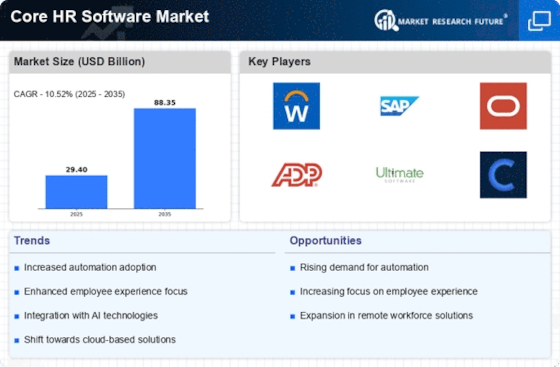
The purpose of this research is to determine the current and future market dynamics of the core HR software market. The research provides a comprehensive analysis of the key drivers and restraints that are currently impacting the market. Additionally, the research provides detailed insights into the current market opportunities, segmentation, vendor landscape, competition and regional analysis.
Research Objectives
The primary objectives of this research study are:
- To analyse the current market scenario of the core HR software market.
- To assess the historical and current market dynamics of the core HR software market.
- To identify the market drivers, restraints and opportunities of the core HR software market.
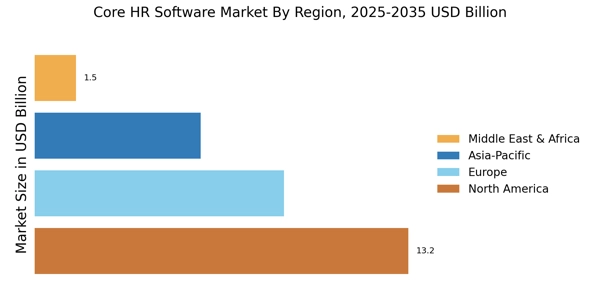
- To analyse the regional markets of the core HR software market.
- To assess the market segmentation and key vendors of the core HR software market.
- To provide insights into the competitive landscape of the core HR software market.
Research Methodology
Research Design
This research study utilizes a combination of both primary and secondary research in order to gain insights into the core HR software market. Primary research consists of interviews with industry experts, industry vendors and potential customers. Secondary research consists of company websites, press releases, industry journals and reports, trade analyses, market reports, financial reports, and industry associations/databases.
Data Collection
The data collection process involves a series of steps to ensure accurate, up-to-date information is collected. This involves industry research and analysis, vendor and customer interviews and document review. The primary sources of data collection include industry experts, vendors, and customers. The secondary sources of the data collection include company websites, press releases, industry journals and reports, trade analyses, market reports, financial reports, and industry databases.
Data Analysis
Data collection, analysis and interpretation are based on the mixed method approach. First, qualitative analyses are carried out to understand first-hand information from industry experts, vendors and customers. Secondly, a descriptive and quantitative analysis is undertaken to arrive at conclusions and recommendations. Summary tables, comparisons, statistical analysis and graphical representation will be utilized to interpret the data.
Quantitative Analysis:
The quantitative analysis involves the analysis of data collected from interviews, surveys and other industry sources. Data collected is subjected to descriptive and inferential analysis. The descriptive analysis involves analyzing the sample data using summary tables, graphical visualizations and ratios. On the other hand, inferential analysis involves applying theories of probability to analyze relationships in the data. Quantitative analysis helps to identify potential opportunities and analyse the market size and trends of the core HR software market.
Qualitative Analysis:
Qualitative analysis involves the interpretation of data collected from interviews, surveys and other sources. Qualitative analysis involves an understanding of industry trends and market insights. Through this analysis, patterns and associations between different variables in the data can be identified. Qualitative analysis helps to understand unstructured data and develop insights.
Validity and Reliability
Validity and reliability are essential aspects of the research and ensure that the results are valid, accurate and reliable. In order to ensure the reliability of the results of this research, the sample data is tested through cross-checking and triangulation.
Conclusion
A comprehensive research methodology is developed in order to conduct a study on the core HR software market. This research provides detailed insights into the current and future dynamics of the core HR software market. Data collection and analysis involve the combination of both primary and secondary research. Various qualitative and quantitative techniques are utilized to analyze the data collected from industry experts, vendors and customers. Through this study, insights are obtained regarding the drivers, restraints, opportunities and threats affecting the market. Moreover, this study provides detailed insights into the current market opportunities, segmentation, vendor landscape, competition and regional analysis in the core HR software market.