×
Request Free Sample ×

Kindly complete the form below to receive a free sample of this Report

* Please use a valid business email

Leading companies partner with us for data-driven Insights

clients tt-cursor
Hero Background

Champagne Market

ID: MRFR/FnB/10089-HCR
128 Pages
Pradeep Nandi
February 2026

Champagne Market Research Report Information By Type (Non-Vintage (NV) Champagne, Vintage Champagne, Blanc de Blancs, Blanc de Noirs, Rose Champagne, Others), By Product Method (Traditional Method, Charmat Method, Others), By Price Range (Budget Champagne, Premium Champagne, Luxury Champagne), By Packaging Type (Glass Bottles, Cans, Bag-in-Box), By Distribution Channel (Supermarkets, Specialty Stores, Liquor Stores, HoReCa, Online) and By Region (North America, Europe, Asia-Pacific, South America, And Middle East & Africa) –Market Forecast Till 2035

Share:
Download PDF ×

We do not share your information with anyone. However, we may send you emails based on your report interest from time to time. You may contact us at any time to opt-out.

Champagne Market Infographic
Purchase Options

Champagne Market Summary

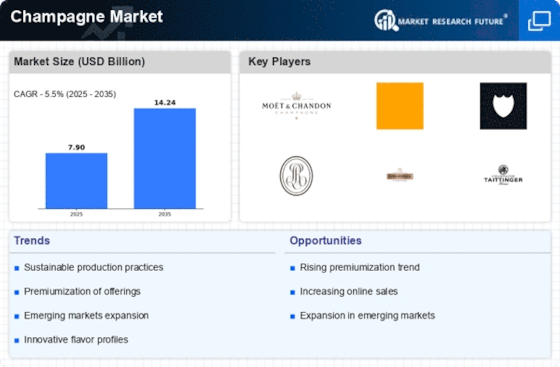
As per Market Research Future analysis, the Champagne Market Size Was Valued at USD 6,017.65 Million In 2024. The Champagne Market Industry Is Projected to grow from USD 6,144.02 Million in 2025 to USD 9,439.79 Million by 2035, Exhibiting A Compound Annual Growth Rate (CAGR) of 4.39% during the Forecast Period (2025 – 2035).

Key Market Trends & Highlights

The Champagne Market is undergoing rapid transformation driven by electrification, sustainability demands, and smart tech integration.

  • The frequency in consumption of champagne differs tremendously among all the consumers around the globe due to varying drinking patterns and the different drinking events. The biggest category that constitutes have champagne intake every two months or less.
  • Consumers who drink champagne once a month which implies a relatively small but substantial group that drinks champagne more regularly associated with frequent parties or gatherings. People who drink champagne.
  • The most frequent use of champagne is at home either alone or with family members, which makes last use of champagne by the consumer. This brings out that home consumption is the most prominent context implying that most consumers are more likely to consume champagne in cozy.
  • In-meal consumption in restaurants contributes which shows that consumption in restaurants is also a significant occasion of champagne use, and it is usually related to celebration or fine dining.

Market Size & Forecast

2024 Market Size 6,017.65 (USD Million)
2035 Market Size 9,439.79 (USD Million)
CAGR (2025 - 2035) 4.39%

Major Players

Pernod Ricard, Vranken-Pommery monopole, Remy Cointreau group, Lanson-bcc group, Arvitis, Louis Roederer, Champagne Taittinger, Laurent-Perrier, Pol Roger, Lvmh moet hennessy louis Vuitton.
Our Impact
Enabled $4.3B Revenue Impact for Fortune 500 and Leading Multinationals
Partnering with 2000+ Global Organizations Each Year
30K+ Citations by Top-Tier Firms in the Industry

Champagne Market Trends

The Champagne Market includes manufacturing, supply, and consumption of champagne- a wine that is legally safeguarded and needs to be produced using special techniques and same occurs in Champagne region of France. Sparkling wines must be governed by the Appellation d’Origine Controle (AOC) laws to bear the label champagne; this means they have to be made using authorized grape varieties such as Chardonnay, Pinot Noir, Pinot Meunier and the traditional method. It has various products segments because there are different tastes of consumer and price ranges: non-vintage, vintage, ros, blanc de blancs, and prestige cuvees are all segments of the market. Champagne has historically enjoyed a reputation as a celebration drink that should be enjoyed during special occasions and festivities and is looked upon as a sign of celebration, classic and luxury.

Nevertheless, the changing consumer behavior is slowly altering this perception with champagne being consumed more in casual or real-life situation. This expanding consumption occasion is contributing to the stable demand in developed and the evolving economies. The major competitors on the champagne market are established champagne houses such as Moet and Chandon, Veuve Clicquot, Laurent-Perrier, and Dom Perignon which have gained a universal brand recognition and produce a large volume of their products as exports. All these leading players predominantly lead in the marketing, innovation, and distribution strategies. Meanwhile, smaller producers are becoming known, with artisanal, terroir-oriented propositions that can capture niche markets and connoisseur wine drinkers. The channels of distribution used in the champagne market are varied and consist of on trade (bars, restaurants, hotels), off-trade (retail stores, supermarkets, wine stores) and e-commerce that experienced intense growth after the pandemic. 

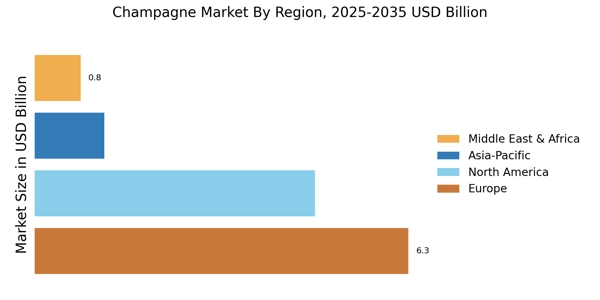
Geographically, Western Europe continues to be the biggest market especially France, United Kingdom and Germany owing to cultural identification factors and geographical closeness to the Champagne region. In the meantime, the United States is one of the top non-European markets, experiencing solid growth amid interest in the luxury and experiential consumption. The new markets like China, India, and Brazil are also experiencing a growing demand because of the growing dispensable incomes, urbanization, and impact of Western lifestyle tendencies. The future of Champagne Market is gradually being defined by sustainability, innovation and evolving consumer preferences.

Champagne Market Drivers

Growing demand for premium and luxury beverages

The increasing popularity of premium and luxury beverages is one of the key market forces that has contributed to the growth of the champagne market in the world to a great extent. With a rise in the disposable income of the consumers particularly in emerging economies and the developed areas, there is a gradual orientation towards consuming high quality and exclusive alcoholic drinks. This changing consumer preference happens to fall stereotypically with champagne because it is generally considered a luxury accompaniment to celebration and sophistication. The emerging desire towards high end and luxury products motivates people to consider products that would promise not just better taste, but also higher social status. This has brought about an immense number of developments in the demand of high-quality champagnes, not only in old style champagnes but also special editions and those with major identifiable brand legacy.

Increase in social gatherings and celebrations boosting champagne consumption

 The overall growth in social events and festivities is one of the major factors that have stimulated the expansion of the champagne market globally. The champagne is a wine that has been used in celebrations as it connotes happiness, prosperity and milestones. With the increase in the number and intensity of social gatherings like weddings, anniversaries, corporate parties and cultural festivities which are also on the increase across the world, the consumption of champagne has also enjoyed a similar growth. Increasing urbanization and the growing spending has had the effect of increasing the incidence of social interactions around the globe, especially in the developed and emerging economies where champagne is the popular drink when it comes to toasting and celebrating important occasions.

Market Segment Insights

By Product Method: Traditional Method (Largest) vs. Charmat Method (Fastest-Growing)

On Product Method, the Champagne Market has been segmented into: Traditional Method, Charmat Method. Traditional Method is the foundational process behind authentic Champagne and many of the world’s premium sparkling wines. In this technique, the secondary fermentation occurs directly inside each bottle, transforming base wine blends with added yeast and sugar into sparkling wine. This bottle fermentation creates natural carbonation, and the wine typically ages for 1 to 3 years in contact with the lees, imparting rich, complex flavors like toasted brioche, nuttiness, and creamy texture. After ageing, bottles undergo riddling and disgorgement to remove sediment, followed by dosage for balance. Charmat Method, also known as the Tank or Martinotti Method, produces sparkling wine by conducting the secondary fermentation in large, pressurized stainless-steel tanks, not in individual bottles. This high-volume, quicker process produces wines with fresh, youthful aromas and fruit-driven profiles, more approachable and less complex than those produced by the Traditional Method.

By Price Range: Budget Champagne (Largest) vs. Premium Champagne (Fastest-growing)

Based on Price Range, the Champagne Market has been segmented into: Budget Champagne, Premium Champagne, Luxury Champagne. Budget Champagne caters to the broadest consumer base by offering affordable access to Champagne’s celebratory appeal without the premium price tag. This segment typically comprises non-vintage Champagnes and entry-level cuvees produced by established houses or private labels. Premium Champagne segment encompasses more refined offerings beyond entry-level but below ultra-luxury tiers, including vintage Champagnes, prestige blends, and specialty cuvées from renowned houses. Its growth reflects the premiumization trend where consumers are willing to pay extra for higher quality, craftsmanship, and provenance, driven by greater disposable income among affluent middle classes globally. This segment benefits from the rising demand for unique, limited-edition releases as well as vintage cuvées associated with recognized terroir and heritage.

By Packaging Type: Glass Bottles (Largest) vs Cans (Fastest-growing))

Based on Packaging Type, the Champagne Market has been segmented into Glass Bottles, Cans, Bag-in-Box. Glass bottles remain the classic packaging for Champagne, underpinning its luxury image and tradition. Innovations in design, such as lightweight glass bottles like those developed by Verallia Group for Champagne Telmont are reducing environmental impact by cutting CO₂ emissions per bottle. Glass shields Champagne from light and oxygen exposure, preserving quality and enhancing shelf appeal. Canned Champagne and sparkling wine formats are gaining attention for their convenience, sustainability, and marketability. Aluminum cans are lightweight, easily recyclable, and reduce transportation costs and the product’s carbon footprint, meeting the rising consumer demand for eco-conscious products. Bag-in-Box (BiB) is a lightweight, space-saving, and sustainable packaging solution that significantly reduces the use of glass and plastic, requiring far less energy to produce and transport, thereby lowering carbon emissions and costs while minimizing landfill waste. Bag-in-Box (BiB) is recyclable since the outer carton is typically recycled paperboard, and the inner bag contains minimal BPA-free plastic thus being eco-friendly and economical.

By Distribution Channel: Liquor Stores (Largest) vs Speciality Stores (Fastest growing)

Based on Distribution Channel, the Champagne Market has been segmented into Supermarkets, Specialty Stores, Liquor Stores, HoReCa, online. Supermarkets and hypermarkets are the largest and most influential distribution channels for Champagne globally, prized for their convenience, expansive reach, and wide product assortments. Specialty stores including boutique wine merchants, high-end liquor shops, and dedicated Champagne retailers focus on curated selections, expertise, and a premium shopping experience. Liquor Stores cater to a diverse consumer, from convenience-driven shoppers to aficionados seeking specific brands or styles. HoReCa offer Champagne by the glass or bottle, frequently pairing it with gourmet cuisine or featuring it during events, tastings, and celebrations. Online sales represent the fastest-growing channel for Champagne, powered by digital transformation, the rise of home delivery, and shifting shopping habits

By Type: Non-Vintage (NV) Champagne (Largest) vs. Blanc de Noirs (Fastest-Growing)

Based on Type, the Champagne Market has been segmented into Non-Vintage (NV) Champagne, Vintage Champagne, Blanc de Blancs, Blanc de Noirs, Rose Champagne, Others. Non-Vintage Champagne represents around of global Champagne production, formed from a blend of still wines from multiple vintages. Blanc de Noirs Champagne uses only black grapes Pinot Noir and/or Pinot Meunier producing richer, more full-bodied styles with pronounced berry, stone fruit, or even toasted notes. Originally rare, Blanc de Noirs now commands a growing segment, appealing to consumers attracted by structure and complexity. Rose Champagne, made by blending still red Pinot Noir/Pinot Meunier with white base wine (or by saignee), is recognized for its vibrant color, berry fruit notes, and festive appeal.

Get more detailed insights about Champagne Market

Regional Insights

North America: Increased Growth Engine

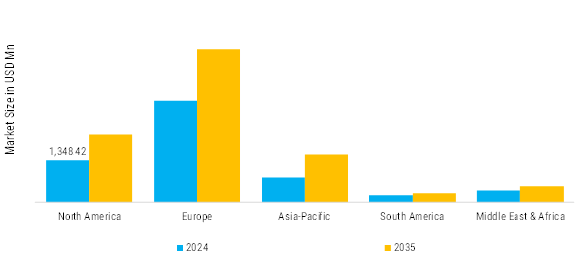
North America is a leading growth engine for the Champagne Market, driven by evolving consumer culture, premiumization, and the digital transformation of wine retail. The region’s Champagne consumption is shaped by its affluent population, rising disposable incomes, and a strong tradition of celebrating with sparkling wines. The Champagne is getting to be a popular first-choice luxury consumption by the North American consumers, it is also something they may consume daily to celebrate gatherings, gifts and other casual occasions. There is a widespread availability of Champagne because of expansion of on-trade channels such as bars, upmarket restaurants, hotels and strong off-trade retail.

Champagne Market Regional Insights

Europe: Emerging Cornerstone

Europe remains the cornerstone of the Champagne Market, benefitting from a deeply rooted cultural tradition of wine appreciation, celebrations, and luxury consumption. The region is characterized by mature markets with sophisticated consumers who value quality, heritage, and the experiential aspects of Champagne. Growth in Europe is supported by a combination of premiumization, expanding hospitality sectors, evolving consumer tastes toward lighter, drier, and vintage Champagnes, and rising tourism activities. Online retail penetration is also increasing, enhancing accessibility to niche and boutique Champagne producers.

 Asia-Pacific: Rapidly Growing Complex and Diverse

The Asia-Pacific region presents a complex and diverse market for Champagne, marked by rapid growth in some countries alongside emerging demands for luxury and premiumization. Increasing affluence, urbanization, and exposure to Western luxury lifestyles have stimulated demand for Champagne as a symbol of celebration and sophistication. The growth is also fueled by expanding hospitality sectors, e-commerce penetration, and rising interest in wine education. However, economic dynamics, cultural preferences, and competitive local sparkling wine alternatives lead to distinct consumption patterns across countries.

Middle East and Africa: Emerging Hospitality and Tourism

Middle East & Africa (MEA) Champagne market is defined by luxury-driven demand, dynamic growth in hospitality and tourism, and evolving consumer preferences for premium beverages. The market is supported by rapid urbanization, rising disposable incomes, and a cultural emphasis on milestone celebrations and social status. Hospitality and tourism sectors especially in iconic destinations like Dubai, Cape Town, and Marrakech are primary consumption drivers, where Champagne is an essential feature at luxury hotels, fine-dining restaurants, beach clubs, and exclusive events.

South America: Rapidly Develop Urbanization

South America's Champagne market is one of dynamic growth, shaped by rising urbanization, burgeoning middle classes, and greater exposure to global luxury trends. The region is increasingly seen as a promising frontier for Champagne exporters amid shifting global demand. Cultural attitudes that celebrate milestones weddings, birthdays, and business achievements with fine sparkling wine, alongside restaurant and hospitality sector growth, continually fuel interest. Challenges persist, including economic volatility and competition from local sparkling wines, but the direction is clear: premiumization and a hunger for authentic luxury experiences.

Champagne Market Regional Image

Key Players and Competitive Insights

Many global, regional, and local vendors characterize the Champagne Market. The market is highly competitive, with all the players competing to gain market share. Intense competition, rapid advances in technology, frequent changes in government policies, and environmental regulations are key factors that confront market growth. The vendors compete based on cost, product quality, reliability, and government regulations. Vendors must provide cost-efficient, high-quality products to survive and succeed in an intensely competitive market.
 
The major players in the market include Pernod Ricard, Vranken-Pommery monopole, Remy Cointreau group, Lanson-bcc group, Arvitis, Louis Roederer, Champagne Taittinger, Laurent-Perrier, Pol Roger, Lvmh moet hennessy louis Vuitton strategic market developments and decisions to improve operational effectiveness.

Key Companies in the Champagne Market include

Industry Developments

In 2024, Maison Pol Roger introduced its latest Champagne release — the Pol Roger Brut Vintage 2018. Crafted from the house’s traditional vintage blend, it features 60% Pinot Noir and 40% Chardonnay, sourced from 20 Grand and Premier Cru vineyards located in the Montagne de Reims and the Côte des Blancs. 

Future Outlook

Champagne Market Future Outlook

The Champagne Market is projected to grow at a 4.39 % CAGR from 2025 to 2035, driven by growing geriatric population and technological advancements.

New opportunities lie in:

  • Growing markets in developing regions where champagne consumption is increasing
  • Expansion of e-commerce platforms facilitating direct-to consumer sales
  • Emergence of innovative flavors and product variations attracting new consumers.
  • Partnerships with high-end hospitality and event brands

By 2035, the Champagne Market is expected to solidify its position as a leader in the global beverage industry.

Market Segmentation

Champagne Market Type Outlook

  • Non-Vintage Champagne
  • Vintage Champagne
  • Blanc De Blancs
  • Blanc De Noirs
  • Rose Champagne
  • Others

Champagne Market, By Price Range

  • Budget Champagne
  • Premium Champagne
  • Luxury Champagne

Champagne Market, By Packaging Type

  • Glass Bottles
  • Cans
  • Bag-in-Box

Champagne Market, By Production Method

  • Traditional Method
  • Charmat Method
  • Others

Champagne Market, By Distribution Channel

  • Supermarkets
  • Specialty Stores
  • Liquor Stores
  • HoReCa
  • Online

Report Scope

Market Size 2024

6,017.65 (USD Million)

Market Size 2025

6,144.02 (USD Million)

Market Size 2035

9,439.79 (USD Million)

Compound Annual Growth Rate (CAGR)

4.39% (2025 - 2035)

Report Coverage

Revenue Forecast, Competitive Landscape, Growth Factors, and Trends

Base Year

2024

Market Forecast Period

2025 - 2035

Historical Data

2019 - 2023

Market Forecast Units

USD Million

Key Companies Profiled

Pernod Ricard, Vranken-Pommery monopole, Remy Cointreau group, Lanson-bcc group, Arvitis, Louis Roederer, Champagne Taittinger, Laurent-Perrier, Pol Roger, Lvmh moet hennessy louis Vuitton.

Segments Covered

By Type, By Production, By Price Range, By Packaging, By Distribution Channel

Key Market Opportunities

·         Growing markets in developing regions where champagne consumption is increasing

·         Expansion of e-commerce platforms facilitating direct-to consumer sales

·         Emergence of innovative flavors and product variations attracting new consumers.

·         Partnerships with high-end hospitality and event brands

Key Market Dynamics

·      Growing Demand for Premium and Luxury Beverages

·      Increase In Social Gatherings and Celebrations Boosting

·      Champagne Consumption  

·      Rising Popularity of Champagne Cocktails Among Millennials       

·       Rising Tourism and Hospitality Sector Growth

Regional Covered

North America, Europe, Asia Pacific, Latin America, Middle East & Africa.


Market Highlights

Author
Pradeep Nandi
Senior Research Analyst

I have a bachelor's degree in mechanical engineering and an MBA. I have more than two years of expertise in the retail, food, and beverage, chemical, and material industries, and hence have developed a sound cross-domain expertise. A firm believer in lifelong learning and sharing of knowledge. Having a proclivity for hatching ideas and trying to absorb as much information as possible in a short amount of time. Introducing corporates to the data and insight, which enables them to move from probability to possibility, has been my key areas of interest. 

Leave a Comment

FAQs

How much is the Champagne Market?

The Champagne Market is expected to be valued at USD 9,439.79 Million in 2035.

What is the growth rate of the Champagne Market?

The global market is projected to grow at a CAGR of 4.39 % during the forecast period, 2025-2035.

Which region holds the largest market share in the Champagne Market?

Europe had the largest share of the global market.

Who are the key players in the Champagne Market?

The key players in the market are including Pernod Ricard, Vranken-Pommery monopole, Remy Cointreau group, Lanson-bcc group, Arvitis, Louis Roederer, Champagne Taittinger, Laurent-Perrier, Pol Roger, Lvmh moet hennessy louis Vuitton.
Which By Price Range had the largest market share in the Champagne Market?

The Budget Champagne Segment had the largest revenue share of the global market

Download Free Sample

Kindly complete the form below to receive a free sample of this Report

Compare Licence

×
Features License Type
Single User Multiuser License Enterprise User
Price $4,950 $5,950 $7,250
Maximum User Access Limit 1 User Upto 10 Users Unrestricted Access Throughout the Organization
Free Customization
Direct Access to Analyst
Deliverable Format
Platform Access
Discount on Next Purchase 10% 15% 15%
Printable Versions