Research Methodology on Battery Market
Introduction
The research methodology for the report “Global Battery Market by Market Research Future (MRFR) involves a comprehensive study of the primary and secondary data sources. From the qualitative and quantitative assessment of the current trends, opportunities, and challenges in the market, this report is developed using both primary sources including surveys, interviews, and observations, and secondary sources such as company financials, websites, journals, and market reviews.
Research Design
To conduct an in-depth analysis of the Global Battery Market, MRFR adopted a combination of exploratory and descriptive research designs. MRFR utilized secondary data sources such as published articles, industry journals and records, market overview reviews, investor presentations, government websites and statistics, and industry bodies such as the World Energy Council and the International Energy Agency to gain an overview of the current market size, trends, drivers, and challenges. Primary data is collected from industry experts and other stakeholders through qualitative and quantitative interviews and structured questionnaires and surveys. Both methods are used to triangulate the data and ensure that the results and findings are reliable and accurate.
The objective of the Study
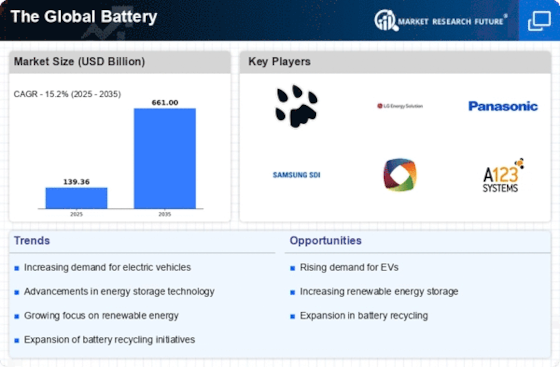
The primary objective of this report is to provide an in-depth analysis of the Global Battery Market, with an emphasis on current trends and drivers, challenges and opportunities, and key market segments. The secondary objective is to assess the market size and trends over the forecast period of 2023-2030.
Scope of the Study
The published report provides an in-depth analysis of the Global Battery Market, covering the following key aspects:
Market Size and Trends
Drivers and Challenges
Key Segments
Value Chain Analysis
Competitive Landscape
Key Market Players
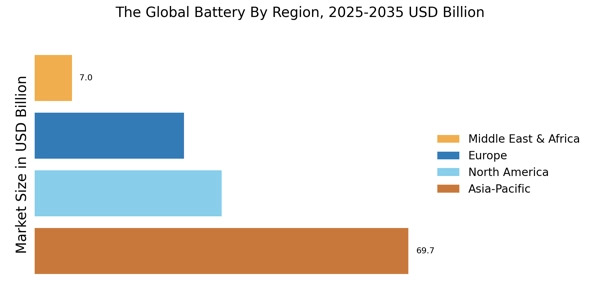
Regional Analysis
Methodology
MRFR’s research methodology for this report includes both primary and secondary sources of data. The primary sources of data include qualitative and quantitative techniques, with interviews and questionnaires administered to industry experts and other key stakeholders to gain an understanding of the market dynamics and key market segments. Secondary data sources involve the use of published articles, company websites, market overviews and reviews, investor presentations, and research papers and journals.
Data Collection
MRFR gathered primary data through qualitative and quantitative techniques. Semi-structured surveys, interviews, and discussions with industry experts, consultants, and other stakeholders were conducted to gain a better understanding of the Global Battery Market. This includes a detailed assessment of the current trends, market drivers and challenges, key market segments, value chains, competitive landscape, and regional analysis.
In addition to primary data collection, MRFR relied on comprehensive secondary data sources, including published market reports, industry journals, market reviews, government websites, websites of industry bodies and organizations, and databases of industry information. This data is triangulated to ensure accuracy and reliability.
Data Analysis
The data collected from both primary and secondary sources are used to analyze the Global Battery Market. This includes the use of both qualitative and quantitative techniques such as the Market Attractiveness Model and data analysis tools such as Porter’s Five Forces Model and SWOT Analysis. The data is analyzed and presented in a user-friendly format for easy interpretation and further decision-making.