×
Request Free Sample ×

Kindly complete the form below to receive a free sample of this Report

* Please use a valid business email

Leading companies partner with us for data-driven Insights

clients tt-cursor
Hero Background

Women Swimwear Market

ID: MRFR/CG/40015-HCR
200 Pages
Garvit Vyas
February 2026

Women Swimwear Market Size, Share, Industry Trend & Analysis Research Report By Product Type (Bikinis, One-Piece Suits, Tankinis, Swim Dresses, Cover-Ups), By Material (Polyester, Nylon, Spandex, Cotton, Others), By Distribution Channel (Online Retail, Supermarkets/Hypermarkets, Specialty Stores, Department Stores), By Wearer Age Group (Teenagers, Young Adults, Middle-aged, Elderly) andBy Regional (North America, Europe, South America, Asia Pacific, Middle East and Africa) - Forecast to 2035

Share:
Download PDF ×

We do not share your information with anyone. However, we may send you emails based on your report interest from time to time. You may contact us at any time to opt-out.

Women Swimwear Market Infographic
Purchase Options

Women Swimwear Market Summary

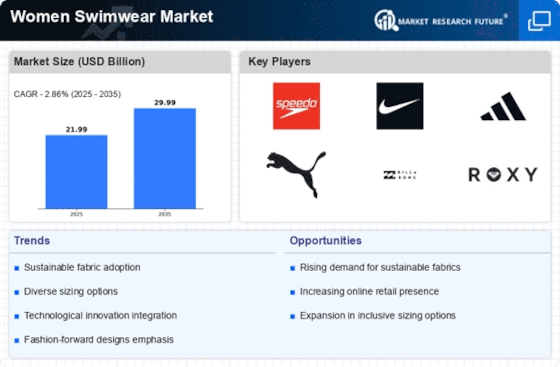
As per Market Research Future analysis, the Women Swimwear Market Size was estimated at 21.99 USD Billion in 2024. The Women Swimwear industry is projected to grow from 22.62 USD Billion in 2025 to 29.99 USD Billion by 2035, exhibiting a compound annual growth rate (CAGR) of 2.86% during the forecast period 2025 - 2035

Key Market Trends & Highlights

The Women Swimwear Market is experiencing a transformative shift towards sustainability and inclusivity.

  • The North American market remains the largest, driven by a strong demand for diverse swimwear options.
  • In the Asia-Pacific region, the market is rapidly expanding, fueled by increasing disposable incomes and changing consumer preferences.
  • Bikinis continue to dominate the market, while one-piece suits are emerging as the fastest-growing segment among consumers.
  • Rising health consciousness and the influence of social media are key drivers propelling the market towards sustainable and inclusive swimwear options.

Market Size & Forecast

2024 Market Size 21.99 (USD Billion)
2035 Market Size 29.99 (USD Billion)
CAGR (2025 - 2035) 2.86%

Major Players

Speedo (AU), Nike (US), Adidas (DE), Puma (DE), Billabong (AU), Roxy (US), Lands' End (US), Oiselle (US), Aerie (US), Zara (ES)

Our Impact
Enabled $4.3B Revenue Impact for Fortune 500 and Leading Multinationals
Partnering with 2000+ Global Organizations Each Year
30K+ Citations by Top-Tier Firms in the Industry

Women Swimwear Market Trends

The Women Swimwear Market is currently experiencing a dynamic evolution, driven by shifting consumer preferences and an increasing emphasis on sustainability. As more individuals prioritize eco-friendly products, brands are adapting their offerings to include materials that are both environmentally conscious and stylish. This trend reflects a broader societal movement towards responsible consumption, where consumers are more discerning about the origins and impacts of their purchases. Additionally, the rise of social media influences the market, as platforms showcase diverse body types and styles, encouraging brands to expand their size ranges and designs to cater to a wider audience. Moreover, the Women Swimwear Market is witnessing a surge in technological advancements, particularly in fabric innovation. The introduction of high-performance materials enhances comfort and functionality, appealing to active consumers who seek swimwear that supports their lifestyle. This focus on performance, combined with aesthetic appeal, suggests a potential for growth in segments such as athleisure swimwear. As the market continues to evolve, it appears poised to embrace a blend of style, sustainability, and performance, reflecting the multifaceted desires of modern consumers.

Sustainability Focus

The Women Swimwear Market is increasingly prioritizing sustainable practices, with brands exploring eco-friendly materials and production methods. This shift aligns with consumer demand for environmentally responsible products, prompting companies to innovate in their sourcing and manufacturing processes.

Diversity and Inclusivity

There is a growing emphasis on diversity and inclusivity within the Women Swimwear Market. Brands are expanding their size ranges and showcasing a variety of body types in their marketing campaigns, reflecting a broader societal push for representation and acceptance.

Technological Advancements

The Women Swimwear Market is benefiting from advancements in fabric technology, leading to the development of high-performance swimwear. These innovations enhance comfort, durability, and functionality, appealing to consumers who prioritize both style and practicality.

Women Swimwear Market Drivers

Diversity in Fashion

The push for diversity and inclusivity in fashion is reshaping the Women Swimwear Market. Brands are increasingly recognizing the importance of representing a wide range of body types, skin tones, and cultural backgrounds in their marketing campaigns. This shift is not only ethical but also commercially viable, as it resonates with a broader audience. Data suggests that brands embracing diversity can experience a 20% increase in customer loyalty. Furthermore, the demand for plus-size swimwear has surged, indicating a market that is becoming more inclusive. As consumers seek brands that reflect their identities, the Women Swimwear Market is likely to see continued growth driven by this commitment to diversity.

Influence of Social Media

The role of social media in shaping consumer preferences cannot be understated in the Women Swimwear Market. Platforms such as Instagram and TikTok have become vital for brands to showcase their products and engage with potential customers. Influencers and celebrities often promote swimwear brands, creating trends that resonate with their followers. This phenomenon has led to a surge in online sales, with e-commerce platforms reporting a notable increase in swimwear purchases. Data suggests that nearly 60% of women aged 18-34 are influenced by social media when making fashion-related decisions. Consequently, brands that effectively leverage social media marketing strategies are likely to thrive in the competitive landscape of the Women Swimwear Market.

Technological Innovations

Technological advancements are playing a transformative role in the Women Swimwear Market. Innovations in fabric technology, such as moisture-wicking and UV protection, are enhancing the functionality of swimwear. Additionally, the rise of 3D printing and customization options allows consumers to personalize their swimwear, catering to individual preferences. This trend is particularly appealing to younger consumers who value unique and tailored products. Market data indicates that the swimwear segment utilizing advanced technologies is expected to grow by 4% annually. As brands invest in research and development to create innovative swimwear solutions, the Women Swimwear Market is poised for significant evolution, driven by consumer demand for high-performance products.

Sustainability Initiatives

Sustainability has emerged as a crucial factor influencing consumer choices in the Women Swimwear Market. As environmental concerns grow, many brands are adopting eco-friendly practices, such as using recycled materials and sustainable production methods. This shift is not merely a trend; it reflects a broader societal movement towards responsible consumption. Research indicates that approximately 70% of consumers are willing to pay more for sustainable products, which suggests a significant opportunity for brands that prioritize environmental stewardship. The Women Swimwear Market is witnessing an influx of sustainable collections, appealing to eco-conscious consumers who seek to align their purchases with their values. This focus on sustainability is likely to reshape the competitive dynamics within the market.

Rising Health Consciousness

The increasing awareness of health and fitness among women appears to be a pivotal driver in the Women Swimwear Market. As more women engage in physical activities such as swimming, the demand for swimwear that combines functionality with style is likely to rise. Reports indicate that the swimwear segment is projected to grow at a compound annual growth rate of approximately 5.5% over the next few years. This trend suggests that brands focusing on performance-oriented swimwear may capture a larger market share. Furthermore, the emphasis on health and wellness is influencing purchasing decisions, with consumers seeking products that enhance their athletic performance while also being fashionable. Thus, the intersection of health consciousness and swimwear is shaping the Women Swimwear Market in a significant manner.


Market Segment Insights

By Type: Bikinis (Largest) vs. One-Piece Suits (Fastest-Growing)

In the Women Swimwear Market, the distribution of market share among various types of swimwear is noteworthy. Bikinis hold the largest market share, with their continued popularity among consumers. These versatile garments cater to a variety of body types and style preferences, ensuring their dominance in the market. One-Piece Suits, on the other hand, have witnessed a substantial rise in demand, particularly among those valuing comfort and modesty, signifying a shift in consumer preferences towards this segment.

Bikinis (Dominant) vs. One-Piece Suits (Emerging)

Bikinis are the dominant force in the Women Swimwear Market, characterized by their stylish designs and ability to cater to various fashion trends. Their appeal lies not only in their form and fit but also in the myriad of choices they offer, allowing consumers to express their individuality. Meanwhile, One-Piece Suits have emerged as a significant player, resonating with women seeking both style and comfort. This segment has gained traction due to an increase in active lifestyles, with many women appreciating the added support and coverage they provide. The growth of social media fashion influencers has further propelled the popularity of One-Piece Suits, making them a fashionable choice.

By Material: Polyester (Largest) vs. Nylon (Fastest-Growing)

In the Women Swimwear Market, the material segment is primarily dominated by Polyester, which commands a significant market share. This fabric is favored for its durability, quick-drying properties, and versatility, making it a popular choice among consumers. Following closely is Nylon, which is gaining traction rapidly due to its lightweight and stretchy characteristics, making it an ideal material for swimwear that prioritizes comfort and performance. Furthermore, Spandex, Cotton, and other materials contribute to the segment but to a lesser extent. The increasing demand for high-performance and fashionable swimwear fuels the growth of Nylon as it aligns with consumer preferences for stylish and functional swimwear options. Additionally, environmental consciousness is prompting manufacturers to explore sustainable materials, potentially impacting market dynamics across these categories.

Polyester: Dominant vs. Nylon: Emerging

Polyester stands as the dominant material in the Women Swimwear Market, renowned for its moisture-wicking and quick-drying capabilities. This fabric also emphasizes durability and color retention, making it a preferred choice for both consumers and manufacturers. Its robust nature allows for vibrant designs and styles that appeal to a broad range of consumers. In contrast, Nylon is emerging as a popular alternative, particularly appealing to those seeking lightweight and flexible swimwear. Its ability to provide a flattering fit while being resistant to wear makes it an attractive option for active women. As fashion trends evolve, the preference for Nylon swimwear is expected to surge, driven by increasing consumer interest in performance fabrics that enhance comfort without compromising on style.

By Distribution Channel: Online Retail (Largest) vs. Specialty Stores (Fastest-Growing)

In the Women Swimwear Market, distribution through various channels presents distinct trends. Online Retail stands as the largest segment, primarily driven by the increasing consumer preference for online shopping, resulting in a notable share of the market. Supermarkets/Hypermarkets and Department Stores follow, catering to customers who prefer traditional shopping experiences. Specialty Stores, while smaller in market share, are gaining traction by offering curated selections of swimwear that appeal to specific consumer preferences.

Online Retail (Dominant) vs. Specialty Stores (Emerging)

Online Retail is characterized by its vast reach and convenience, allowing consumers to access a wide variety of swimwear styles from the comfort of their homes. This segment benefits from user-friendly interfaces, exclusive online offers, and a growing trend towards e-commerce, enhancing customer engagement. In contrast, Specialty Stores are emerging as personalized shopping destinations, where consumers seek unique styles and expert knowledge. They focus on providing tailored experiences and curated collections, appealing to niche markets within the women swimwear category. Together, these segments reflect the dynamic duality of consumer preferences in the Women Swimwear Market.

By Wearer Age Group: Teenagers (Largest) vs. Young Adults (Fastest-Growing)

The Women Swimwear Market exhibits a diverse age group segmentation, with Teenagers holding the largest market share due to the increasing trend of swimwear as a fashion statement among younger demographics. This age group not only influences fashion trends but also drives the demand for affordable and trendy swimwear options that resonate with their lifestyle choices. Young Adults are rapidly gaining traction as a significant segment, showcasing their inclination towards stylish and high-performance swimwear designed for various occasions such as beach outings and pool parties.

Teenagers (Dominant) vs. Young Adults (Emerging)

The Teenagers segment of the Women Swimwear Market is characterized by its focus on vibrant styles and affordable prices, aligning with the preferences of this age group that seeks trendy swimwear options. Brands targeting this segment often emphasize social media marketing, engaging with teens through influencers and trendy designs. In contrast, Young Adults represent an emerging segment, driven by the demand for quality and versatility. They typically gravitate towards brands that offer sleek designs suitable for both casual and athletic use. This cohort is increasingly interested in sustainable materials and performance-enhancing technologies, indicating a shift towards eco-consciousness and functionality in swimwear.

Get more detailed insights about Women Swimwear Market

Regional Insights

The Women Swimwear Market reveals varied insights across its regional segmentation, with North America leading the market at a valuation of 8.1 USD Billion in 2024 and expected growth to 10.25 USD Billion by 2035, showcasing its majority holding in the overall market. Europe follows as a significant contender, projected to grow from 6.6 USD Billion to 8.65 USD Billion during the same period, indicating strong consumer demand and robust retail infrastructure.

APAC is anticipated to witness substantial growth, moving from 4.5 USD Billion in 2024 to 6.05 USD Billion by 2035, driven by rising disposable incomes and a growing focus on health and fitness.South America, while smaller, reflects potential with a market value of 1.4 USD Billion in 2024, predicted to rise to 1.85 USD Billion, as the region channels investment into leisure and recreational activities.

The MEA segment, however, is unique in that it is valued at 1.39 USD Billion in 2024 but expected to decrease to 1.2 USD Billion by 2035, implying challenges faced in market growth, such as cultural factors and limited beach access. Collectively, these statistics provide a clear picture of the dynamism within the Women Swimwear Market across different regions, shaped by varying consumer behaviors and economic conditions.

Women Swimwear Market Regional Image

Key Players and Competitive Insights

The Women Swimwear Market has witnessed significant transformations over the years, shaped by evolving fashion trends, changing consumer preferences, and technological advancements in textile manufacturing. As the industry continues to expand, several key players have emerged, each vying for market share through distinct product offerings, brand positioning, and marketing strategies. Understanding competitive insights within this market is essential for stakeholders looking to navigate the complexities of supply and demand while identifying opportunities for growth and innovation.
Player differentiation is often driven by factors such as design aesthetics, sustainability practices, pricing strategies, and distribution partnerships, which collectively influence consumer purchasing decisions.Seafolly has established a notable presence in the Women Swimwear Market, characterized by its strong reputation for quality and stylish beachwear. The brand emphasizes vibrant colors, trendy patterns, and diverse range of swimwear options, ensuring that it meets the preferences of a broad audience. Seafolly's strengths lie in its strong connection to the lifestyle and leisure aspects of swimming, effectively tapping into consumer desires for functionality while maintaining a fashionable appeal.
With a commitment to innovation in design and fabric technology, Seafolly consistently delivers products that cater to various body types and sizes, enhancing its attractiveness to a wide demographic. The brand's marketing strategies have also fostered a loyal customer base, positioning it as a go-to choice among fashion-conscious swimmers around the globe.Puma, though primarily recognized for its performance-oriented sportswear, has made significant strides in the Women Swimwear Market. The company brings to the forefront a unique blend of athleticism and fashion, appealing to consumers who prioritize both active lifestyles and trendy swimwear options.
Puma’s focus on creating functional swimwear that enhances athletic performance while appealing to style enthusiasts enables the brand to carve out a niche segment within the competitive landscape. Strengths of Puma in this market include a robust product development strategy that incorporates advanced materials for improved comfort and performance, as well as strategic partnerships with athletes and influencers which effectively broaden its reach. These attributes, combined with a strong global distribution network, empower Puma to compete effectively while catering to the diverse needs of women seeking both stylish and functional swimwear.

Key Companies in the Women Swimwear Market include

Industry Developments

Recent developments in the Women Swimwear Market have been marked by growing consumer demand for sustainability and inclusivity, prompting various companies to adapt their product offerings. Brands like Seafolly and Rip Curl are focusing on eco-friendly materials, while major players such as Nike and Adidas are enhancing their swimwear lines to cater to a broader range of body types. In the realm of current affairs, sports-focused brands like Puma and SoulCycle are capitalizing on the athleisure trend, emphasizing performance-oriented swimwear that appeals to active consumers.

The valuation of firms like Tommy Hilfiger and Victoria's Secret has seen notable growth, reflecting a shift in consumer preferences towards both style and functionality. Amidst this, recent mergers and acquisitions have seen companies strategically aligning to amplify their market presence and product innovation. Collaboration in the sector, especially among larger brands, is expected to drive market expansion. The competitive landscape continues to evolve, with companies like ASOS and Billabong investing in digital marketing strategies to engage with consumers online and enhance their brand visibility.

This dynamic environment indicates that the Women Swimwear Market is undergoing significant transformations to meet the current demands of consumers.

Future Outlook

Women Swimwear Market Future Outlook

The Women Swimwear Market is projected to grow at a 2.86% CAGR from 2025 to 2035, driven by increasing health consciousness, fashion trends, and sustainable materials.

New opportunities lie in:

  • Expansion of eco-friendly swimwear lines targeting environmentally conscious consumers.
  • Development of customizable swimwear options through online platforms.
  • Partnerships with fitness influencers for targeted marketing campaigns.

By 2035, the Women Swimwear Market is expected to achieve robust growth, reflecting evolving consumer preferences and innovative product offerings.

Market Segmentation

Women Swimwear Market Type Outlook

  • Bikinis
  • One-Piece Suits
  • Tankinis
  • Swim Dresses
  • Cover-Ups

Women Swimwear Market Material Outlook

  • Polyester
  • Nylon
  • Spandex
  • Cotton
  • Others

Women Swimwear Market Wearer Age Group Outlook

  • Teenagers
  • Young Adults
  • Middle-aged
  • Elderly

Women Swimwear Market Distribution Channel Outlook

  • Online Retail
  • Supermarkets/Hypermarkets
  • Specialty Stores
  • Department Stores

Report Scope

MARKET SIZE 202421.99(USD Billion)
MARKET SIZE 202522.62(USD Billion)
MARKET SIZE 203529.99(USD Billion)
COMPOUND ANNUAL GROWTH RATE (CAGR)2.86% (2025 - 2035)
REPORT COVERAGERevenue Forecast, Competitive Landscape, Growth Factors, and Trends
BASE YEAR2024
Market Forecast Period2025 - 2035
Historical Data2019 - 2024
Market Forecast UnitsUSD Billion
Key Companies ProfiledSpeedo (AU), Nike (US), Adidas (DE), Puma (DE), Billabong (AU), Roxy (US), Lands' End (US), Oiselle (US), Aerie (US), Zara (ES)
Segments CoveredProduct Type, Material, Distribution Channel, Wearer Age Group, Regional
Key Market OpportunitiesGrowing demand for sustainable materials in the Women Swimwear Market presents significant innovation opportunities.
Key Market DynamicsRising consumer preference for sustainable materials drives innovation and competition in the women swimwear market.
Countries CoveredNorth America, Europe, APAC, South America, MEA
Leave a Comment

FAQs

What is the current valuation of the Women Swimwear Market in 2024?

The Women Swimwear Market was valued at 21.99 USD Billion in 2024.

What is the projected market valuation for the Women Swimwear Market by 2035?

The market is projected to reach 29.99 USD Billion by 2035.

What is the expected CAGR for the Women Swimwear Market during the forecast period 2025 - 2035?

The expected CAGR for the Women Swimwear Market during 2025 - 2035 is 2.86%.

Which distribution channel is anticipated to generate the highest revenue in the Women Swimwear Market?

Specialty Stores are expected to generate between 6.0 and 8.0 USD Billion in revenue.

What are the leading materials used in women's swimwear, and how do they compare in terms of market value?

Polyester leads with a market value of 5.0 to 6.5 USD Billion, followed by Nylon at 4.0 to 5.5 USD Billion.

Which age group is projected to contribute the most to the Women Swimwear Market?

Young Adults are projected to contribute between 8.0 and 10.0 USD Billion to the market.

Who are the key players in the Women Swimwear Market?

Key players include Speedo, Nike, Adidas, and Roxy, among others.

What is the market value range for bikinis in the Women Swimwear Market?

The market value for bikinis ranges from 5.0 to 7.0 USD Billion.

How do swim dresses perform in terms of market valuation?

Swim Dresses are valued between 4.0 and 5.0 USD Billion in the market.

What is the expected revenue range for online retail in the Women Swimwear Market?

Online Retail is expected to generate revenue between 5.0 and 8.0 USD Billion.

Download Free Sample

Kindly complete the form below to receive a free sample of this Report

Compare Licence

×
Features License Type
Single User Multiuser License Enterprise User
Price $4,950 $5,950 $7,250
Maximum User Access Limit 1 User Upto 10 Users Unrestricted Access Throughout the Organization
Free Customization
Direct Access to Analyst
Deliverable Format
Platform Access
Discount on Next Purchase 10% 15% 15%
Printable Versions