×
Request Free Sample ×

Kindly complete the form below to receive a free sample of this Report

* Please use a valid business email

Leading companies partner with us for data-driven Insights

clients tt-cursor
Hero Background
English
Chinese
French
Japanese
Korean
German
Spanish

Vocal Biomarkers Market Analysis

ID: MRFR/LS/2631-HCR
90 Pages
Rahul Gotadki
February 2026

Vocal Biomarkers Market Research Report Information By Type (Frequency, Amplitude, Error Rate, Vocal Rise or Fall Time, Phonation Time, Voice Tremor, Pitch, and Others), By End-User (Hospitals & Clinics, Academic & Research, and Others), By Verticals (Psychiatric Disorders {Depression, Attention Deficit & Disruptive Behavior Disorders, and Others}, Neurological Disorders {Parkinson's Disease (PD), Alzheimer's Disease, Huntington's Disease, and Others}, Respiratory Disorders, Cardiovascular Disorders, Traumatic Brain Injury (TBI), and Others) And By Region – Industry Forecast To 2035

Share:
Download PDF ×

We do not share your information with anyone. However, we may send you emails based on your report interest from time to time. You may contact us at any time to opt-out.

Vocal Biomarkers Market Infographic
Purchase Options

Market Analysis

In-depth Analysis of Vocal Biomarkers Market Industry Landscape

Since Vocal biomarkers can help doctors figure out a lot of different illnesses, like cancer, lung problems, and stomach problems, they have become more important. These biomarkers can find liquid molecules in breath or body fluids, so they are a good and easy way to figure out what's wrong with someone's health. The market is being driven by demand because more and more people around the world are getting chronic illnesses. Because of more people with long-term illnesses, we need tools that can diagnose quickly and accurately. The field is moving forward because analysis methods and tracking tools are getting smarter all the time. These improvements make methods for finding Vocal biomarkers more sensitive and specific, which means they can be used in more clinical settings. More and more, biotechnology companies, healthcare groups, and study centers are working together. These groups are working together to share resources and information in order to speed up the development and release of diagnostic tools based on Vocal biomarkers. The regulatory bodies are aware of the possibility of speech biomarkers and are working to set up a legal system. This support makes the clearance process easier, which in turn makes companies more likely to spend money on research and development to find new ways to use Vocal biomarkers. Despite the good outlook, the market faces challenges such as the need for large-scale clinical studies, proof of biomarker sensitivity, and standards of testing methods. These problems need to be solved before VOCAL indicators can be widely used and accepted. Biomarkers found in the voice can help with a lot of different areas of health, like cancer and digestive problems. Because they are flexible, these indicators can meet a lot of different healthcare needs, which makes their market potential bigger. Biomarkers for vocal health are not unique to one area of the world. As people around the world learn more about health care, they need better testing tools. This is what is driving the use of Vocal biomarkers in both developed and emerging countries. When it comes to how markets work, economic factors are very important. Healthcare providers and funders like VOCAL biomarker testing because it is cost-effective. This could help find illnesses earlier and lower the cost of treatment. Firms are in a fierce competition in the market, trying to get an edge through smart relationships and new products. Key players are spending money on research to come up with new testing methods based on Vocal biomarkers, which helps the business grow as a whole. Research that is always going on, new technology, and more people becoming aware of health issues should all keep the VOCAL indicators market growing. As we learn more about vocal signals, they might change how decisions are made. Because of this, they are likely to become more and more a part of normal professional practice.


Author
Rahul Gotadki
Research Manager

He holds an experience of about 9+ years in Market Research and Business Consulting, working under the spectrum of Life Sciences and Healthcare domains. Rahul conceptualizes and implements a scalable business strategy and provides strategic leadership to the clients. His expertise lies in market estimation, competitive intelligence, pipeline analysis, customer assessment, etc.

Leave a Comment

FAQs

What is the current valuation of the Vocal Biomarkers Market as of 2024?

<p>The Vocal Biomarkers Market was valued at 0.6815 USD Billion in 2024.</p>

What is the projected market size for the Vocal Biomarkers Market in 2035?

<p>The market is projected to reach 3.267 USD Billion by 2035.</p>

What is the expected CAGR for the Vocal Biomarkers Market during the forecast period 2025 - 2035?

<p>The expected CAGR for the Vocal Biomarkers Market during 2025 - 2035 is 15.31%.</p>

Which companies are considered key players in the Vocal Biomarkers Market?

<p>Key players in the market include Vocalis Health, Sonde Health, Beyond Verbal, Aural Analytics, Cerebriu, Vocal Biomarkers, Nervana, and Synthego.</p>

What are the primary segments of the Vocal Biomarkers Market?

<p>The primary segments include Type, Verticals, and End-User.</p>

How does the market segment for psychiatric disorders perform in terms of valuation?

<p>The psychiatric disorders segment is valued between 0.15075 and 0.71025 USD Billion.</p>

What is the valuation range for the hospitals and clinics segment in the Vocal Biomarkers Market?

<p>The hospitals and clinics segment is valued between 0.34 and 1.6 USD Billion.</p>

What specific types of vocal biomarkers are included in the market analysis?

Types of vocal biomarkers include Frequency, Amplitude, Error Rate, Vocal Rise or Fall Time, Phonation Time, Voice Tremor, and Pitch.

What is the valuation range for the neurological disorders segment?

The neurological disorders segment is valued between 0.1363 and 0.6357 USD Billion.

What potential applications do vocal biomarkers have in healthcare?

Vocal biomarkers may be utilized in diagnosing and monitoring psychiatric, neurological, respiratory, and cardiovascular disorders.

Market Summary

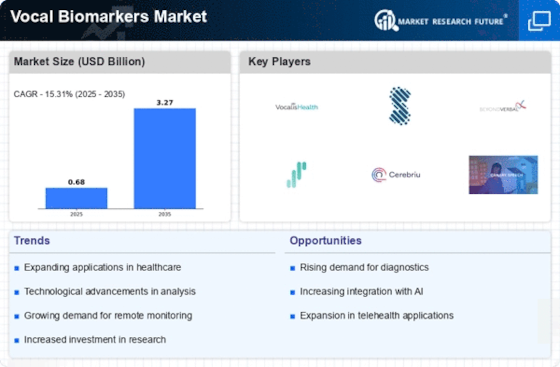
As per Market Research Future analysis, the Vocal Biomarkers Market Size was estimated at 0.6815 USD Billion in 2024. The Vocal Biomarkers industry is projected to grow from USD 0.7859 Billion in 2025 to USD 3.267 Billion by 2035, exhibiting a compound annual growth rate (CAGR) of 15.3% during the forecast period 2025 - 2035

Key Market Trends & Highlights

The Vocal Biomarkers Market is experiencing robust growth driven by technological advancements and a shift towards personalized medicine.

  • North America remains the largest market for vocal biomarkers, driven by advanced healthcare infrastructure and research initiatives. The Asia-Pacific region is emerging as the fastest-growing market, fueled by increasing investments in healthcare technology and rising awareness of mental health. Frequency analysis is the largest segment, while amplitude analysis is witnessing the fastest growth due to its potential in diverse applications. Key market drivers include the growing demand for non-invasive diagnostics and the integration of vocal biomarkers in telehealth solutions.

Market Size & Forecast

2024 Market Size 0.6815 (USD Billion)
2035 Market Size 3.267 (USD Billion)
CAGR (2025 - 2035) 15.31%
Largest Regional Market Share in 2024 North America

Major Players

Vocalis Health (IL), <a href="https://www.sondehealth.com/vocal-biomarkers-for-mental-fitness-scoring-and-tracking">Sonde Health</a> (US), Beyond Verbal (IL), Aural Analytics (US), Cerebriu (US), Vocal Biomarkers (ES), Nervana (US), Synthego (US)

Market Trends

The Vocal Biomarkers Market is currently experiencing a notable evolution, driven by advancements in technology and an increasing understanding of the relationship between voice and health. This market encompasses the development and application of voice analysis tools that can detect various health conditions through vocal patterns. As healthcare systems globally seek innovative solutions for early diagnosis and monitoring, the demand for vocal biomarkers is likely to rise. The integration of artificial intelligence and machine learning into voice analysis is enhancing the accuracy and efficiency of these tools, suggesting a promising future for this sector. Moreover, the growing emphasis on personalized medicine appears to be influencing the Vocal Biomarkers Market significantly. Healthcare providers are increasingly recognizing the potential of vocal biomarkers to offer tailored insights into individual health profiles. This trend may lead to more widespread adoption of voice-based diagnostics in clinical settings, as practitioners seek to leverage non-invasive methods for patient assessment. As research continues to unveil the complexities of vocal signals, the market is poised for further expansion, potentially transforming how health conditions are diagnosed and managed.

Technological Advancements in Voice Analysis

Recent innovations in artificial intelligence and machine learning are enhancing the capabilities of voice analysis tools. These advancements enable more precise detection of health conditions through vocal patterns, thereby increasing the reliability of vocal biomarkers in clinical applications.

Shift Towards Personalized Medicine

The growing focus on personalized healthcare is driving interest in vocal biomarkers. By providing individualized insights into health, these tools are likely to become integral in developing tailored treatment plans, thus improving patient outcomes.

Increased Demand for Non-Invasive Diagnostics

There is a rising preference for non-invasive diagnostic methods within the healthcare sector. Vocal biomarkers offer a unique solution, allowing for health assessments without the need for invasive procedures, which may enhance patient comfort and compliance.

Vocal Biomarkers Market Market Drivers

Shift Towards Personalized Medicine

The Vocal Biomarkers Market is witnessing a notable shift towards personalized medicine, which emphasizes tailored healthcare solutions based on individual patient profiles. Vocal biomarkers offer a unique opportunity to gather real-time data on a patient's health status, allowing for more precise treatment plans. This trend is particularly relevant in chronic disease management, where understanding a patient's vocal changes can lead to timely interventions. The market is likely to expand as healthcare providers increasingly recognize the value of integrating vocal biomarker analysis into personalized treatment strategies. Furthermore, the potential for vocal biomarkers to enhance patient engagement and adherence to treatment regimens is becoming more apparent, thereby driving demand within the industry.

Growing Awareness of Mental Health Issues

The Vocal Biomarkers Market is increasingly influenced by the growing awareness of mental health issues across various populations. As society becomes more attuned to the importance of mental well-being, there is a corresponding demand for innovative diagnostic tools that can aid in the early detection of mental health disorders. Vocal biomarkers have shown potential in identifying stress, anxiety, and depression through vocal changes. This awareness is driving research and development efforts aimed at integrating vocal analysis into mental health assessments. Consequently, the market is expected to expand as mental health professionals seek effective, non-invasive methods to monitor and treat patients, thereby enhancing the overall quality of care.

Technological Advancements in Voice Analysis

The Vocal Biomarkers Market is experiencing a surge due to rapid technological advancements in voice analysis. Innovations in artificial intelligence and machine learning are enhancing the accuracy and efficiency of vocal biomarker detection. These technologies enable the identification of subtle changes in voice patterns that may indicate various health conditions. For instance, the integration of deep learning algorithms has shown promise in diagnosing mental health disorders through vocal analysis. As a result, the market is projected to grow significantly, with estimates suggesting a compound annual growth rate of over 20% in the coming years. This growth is driven by the increasing adoption of voice analysis tools in clinical settings, which are becoming essential for early diagnosis and monitoring of diseases.

Increased Demand for Non-Invasive Diagnostics

The Vocal Biomarkers Market is benefiting from the rising demand for non-invasive diagnostic methods. Patients and healthcare providers alike are seeking alternatives to traditional invasive procedures, which often carry risks and discomfort. Vocal biomarkers present a non-invasive solution that can be easily implemented in various healthcare settings. This trend is particularly relevant in the context of mental health assessments, where vocal analysis can provide insights without the need for invasive tests. The market is projected to grow as more healthcare institutions adopt vocal biomarker technologies, with a focus on improving patient experience and outcomes. The convenience and accessibility of vocal biomarker analysis are likely to further propel its adoption in routine clinical practice.

Integration of Vocal Biomarkers in Telehealth Solutions

The Vocal Biomarkers Market is experiencing growth due to the integration of vocal biomarkers into telehealth solutions. As telehealth becomes more prevalent, the ability to assess patients remotely through vocal analysis is gaining traction. This integration allows healthcare providers to monitor patients' health status without the need for in-person visits, which is particularly beneficial for those with mobility issues or living in remote areas. The market is likely to see increased investment in technologies that facilitate vocal biomarker analysis within telehealth platforms. This trend not only enhances patient access to care but also supports ongoing health monitoring, which is crucial for chronic disease management. The potential for vocal biomarkers to improve telehealth services is expected to drive further innovation and adoption in the industry.

Market Segment Insights

By Type: Frequency (Largest) vs. Amplitude (Fastest-Growing)

<p>In the Vocal Biomarkers Market, the type segment reveals a diverse distribution among various vocal metrics. Frequency dominates the landscape, accounting for a significant portion of market share, driven by its critical role in distinguishing speech patterns and detecting stress or health conditions. Amplitude has also gained traction, showcasing a rising demand due to its importance in understanding vocal intensity and emotional states. Other segment values like Error Rate, Vocal Rise Or Fall Time, Phonation Time, Voice Tremor, Pitch, and Others collectively contribute to the segment's overall dynamics but do not reach the prominence of Frequency and Amplitude. The growth trends within the type segment are fueled by advancements in technology and increasing applications of vocal biomarkers in health monitoring and diagnostics. With the widespread adoption of telehealth and remote patient monitoring systems, there is a surge in the demand for reliable vocal metrics. Amplitude, recognized as the fastest-growing segment, is seeing increased interest from researchers seeking to analyze emotional well-being through voice characteristics. The need for comprehensive vocal analysis across various sectors, including mental health and customer service, is propelling innovation and expansion in this market segment.</p>

<p>Frequency (Dominant) vs. Pitch (Emerging)</p>

<p>Frequency is the dominant segment in the Vocal Biomarkers Market due to its foundational role in vocal analysis, enabling the identification of speaker identity and emotional states. It allows clinicians and researchers to understand various health conditions, making it crucial in diagnostics and monitoring. On the other hand, Pitch is emerging as a significant value, drawing attention for its ability to reveal emotional nuances and variations in vocal expression. As research expands towards recognizing mental health indicators through voice, Pitch's relevance is anticipated to rise. This duality – Frequency's established dominance and Pitch's growing interest – showcases the market's evolution and the ongoing search for more sophisticated vocal analysis techniques.</p>

By Verticals: Psychiatric Disorders (Largest) vs. Neurological Disorders (Fastest-Growing)

<p>In the Vocal Biomarkers Market, the distribution of share among the verticals segment reveals that Psychiatric Disorders currently command the largest market share. This segment encompasses a wide range of conditions, from depression to anxiety disorders, leveraging vocal analysis for diagnosis and monitoring. Neurological Disorders are also significant, but their share is growing at an accelerated rate, fueled by increasing recognition of the utility of vocal biomarkers in early detection and patient management.</p>

<p>Psychiatric Disorders: Dominant vs. Neurological Disorders: Emerging</p>

<p>Psychiatric Disorders represent the dominant force in the vocal biomarkers segment, driven by growing investments in mental health technologies and advancements in artificial intelligence. These solutions allow for more personalized and timely interventions for patients. Conversely, Neurological Disorders, while currently smaller, are emerging as a key focus area due to the increasing prevalence of conditions like Alzheimer's and Parkinson's disease. The drive for early intervention and the integration of voice analysis in routine assessments are propelling the growth of this segment, indicating significant potential for future innovations.</p>

By End-User: Hospitals & Clinics (Largest) vs. Academic & Research (Fastest-Growing)

<p>The Vocal Biomarkers Market exhibits significant variation among its end-user segments, with Hospitals & Clinics holding the largest market share. This dominance is attributed to their increasing adoption of vocal biomarker technologies for patient diagnosis, monitoring, and management. Academic & Research institutions also play a critical role, albeit at a smaller scale, as they drive innovation and exploration in vocal biomarker applications. Other end-users are a diverse group, which includes private practices, rehabilitation centers, and specialized institutions, contributing to the overall market dynamics without dominating the share. In terms of growth trends, Academic & Research institutions are recognized as the fastest-growing segment within the Vocal Biomarkers Market. The surge in research activities, along with the increasing investment in healthcare technology, has ignited interest in vocal biomarker applications. Hospitals & Clinics continue to expand their infrastructure, aligning with technological advancements that bolster diagnostic capabilities. The need for rapid, non-invasive diagnostics is propelling growth in this burgeoning market, making it attractive for both established players and new entrants alike.</p>

<p>Hospitals & Clinics (Dominant) vs. Academic & Research (Emerging)</p>

<p>In the Vocal Biomarkers Market, Hospitals & Clinics stand out as the dominant force, primarily due to their extensive resources and infrastructure for integrating vocal biomarker technologies into routine medical practices. Their established networks and the critical need for accurate patient assessments ensure a steady demand for vocal biomarkers in diagnostics and therapeutics. On the other hand, Academic & Research institutions are characterized as the emerging segment, serving as incubators for innovation. These institutions focus on exploring the potential of vocal biomarkers through studies and trials, which often leads to new applications that can later transition to clinical settings. Their investigative nature fosters a collaborative environment with industry partners, enhancing the overall market landscape through continuous advancements.</p>

Get more detailed insights about Vocal Biomarkers Market Research Report- Global Forecast till 2035

Regional Insights

North America : Innovation and Technology Leader

North America is the largest market for vocal biomarkers, holding approximately 45% of the global share. The region benefits from advanced healthcare infrastructure, significant investments in AI and machine learning, and a growing demand for remote patient monitoring solutions. Regulatory support from agencies like the FDA further catalyzes market growth, encouraging innovation and adoption of vocal biomarker technologies. The United States leads the market, driven by key players such as Vocalis Health, Sonde Health, and Aural Analytics. The competitive landscape is characterized by rapid technological advancements and collaborations between tech firms and healthcare providers. Canada also shows promise, contributing to the regional growth with its supportive healthcare policies and research initiatives.

Europe : Emerging Market with Potential

Europe is witnessing a significant rise in the vocal biomarkers market, holding around 30% of the global share. The region's growth is driven by increasing healthcare expenditures, a focus on personalized medicine, and supportive regulatory frameworks. Countries like Germany and the UK are at the forefront, with initiatives aimed at integrating digital health solutions into traditional healthcare systems, thus enhancing patient outcomes. Germany, the UK, and France are leading the charge in vocal biomarker research and application. The competitive landscape features companies like Beyond Verbal and Vocal Biomarkers Market, which are innovating to meet the growing demand. The European market is characterized by collaborations between tech startups and established healthcare providers, fostering a vibrant ecosystem for vocal biomarker technologies.

Asia-Pacific : Rapid Growth and Innovation

Asia-Pacific is emerging as a significant player in the vocal biomarkers market, accounting for approximately 20% of the global share. The region's growth is fueled by increasing smartphone penetration, rising healthcare awareness, and government initiatives promoting digital health technologies. Countries like China and India are leading this growth, with substantial investments in healthcare innovation and technology adoption. China is at the forefront, supported by a robust tech ecosystem and government backing for health tech startups. India is also making strides, with companies like Aural Analytics and Cerebriu entering the market. The competitive landscape is dynamic, with a mix of local startups and international players vying for market share, driving innovation and accessibility in vocal biomarker solutions.

Middle East and Africa : Emerging Market with Challenges

The Middle East and Africa region is gradually developing its vocal biomarkers market, holding about 5% of the global share. Growth is driven by increasing healthcare investments, a rising prevalence of chronic diseases, and a push towards digital health solutions. However, challenges such as regulatory hurdles and limited infrastructure can impede rapid growth. Countries like South Africa and the UAE are leading the way in adopting these technologies. South Africa is emerging as a key player, with initiatives aimed at integrating vocal biomarker technologies into healthcare systems. The UAE is also investing in health tech, fostering a competitive landscape that includes both local and international companies. The market is characterized by a growing interest in innovative health solutions, although it still faces significant challenges in terms of scalability and regulatory compliance.

Key Players and Competitive Insights

The Vocal Biomarkers Market is currently characterized by a dynamic competitive landscape, driven by advancements in artificial intelligence and machine learning technologies. Key players are increasingly focusing on innovation and strategic partnerships to enhance their product offerings and market reach. For instance, Vocalis Health (IL) has positioned itself as a leader in the development of vocal biomarker solutions for early disease detection, emphasizing its commitment to research and development. Similarly, Sonde Health (US) is leveraging its proprietary algorithms to analyze vocal patterns, aiming to expand its applications in mental health and chronic disease management. These strategies collectively contribute to a competitive environment that is both innovative and rapidly evolving.
In terms of business tactics, companies are increasingly localizing their manufacturing processes and optimizing supply chains to enhance operational efficiency. The Vocal Biomarkers Market appears to be moderately fragmented, with several players vying for market share. The collective influence of these key players is shaping a landscape where collaboration and technological advancement are paramount, allowing for a more integrated approach to health monitoring and diagnostics.
In August 2025, Beyond Verbal (IL) announced a strategic partnership with a leading telehealth provider to integrate its vocal analysis technology into remote patient monitoring systems. This collaboration is expected to enhance the accuracy of health assessments conducted via telehealth platforms, thereby expanding Beyond Verbal's market presence and reinforcing its commitment to innovative healthcare solutions. The strategic importance of this partnership lies in its potential to improve patient outcomes through more precise and timely health interventions.
In September 2025, Aural Analytics (US) launched a new version of its vocal biomarker platform, which includes enhanced features for real-time health monitoring. This upgrade is particularly significant as it positions Aural Analytics to better serve the growing demand for remote health solutions, especially in the context of chronic disease management. The introduction of these advanced features may provide Aural Analytics with a competitive edge, allowing it to attract a broader client base in the healthcare sector.
In October 2025, Cerebriu (US) secured a substantial investment to further develop its AI-driven vocal analysis technology. This funding is likely to accelerate the company's research initiatives and product development, enabling it to enhance its offerings in the mental health space. The strategic importance of this investment cannot be overstated, as it may facilitate Cerebriu's entry into new markets and strengthen its position against competitors.
As of October 2025, the competitive trends in the Vocal Biomarkers Market are increasingly defined by digitalization, sustainability, and the integration of AI technologies. Strategic alliances are playing a crucial role in shaping the current landscape, allowing companies to pool resources and expertise. Looking ahead, it is anticipated that competitive differentiation will evolve from traditional price-based strategies to a focus on innovation, technological advancement, and supply chain reliability, thereby fostering a more resilient and forward-thinking market environment.

Key Companies in the Vocal Biomarkers Market include

Industry Developments

March 2021 Sonde Health teamed up with Xavier University Center for Population Health to analyze the effectiveness of the former's vocal biomarker platform as a screening tool for COVID-19 symptoms.

June 2021 Medable's Cancer Moonshot work collaborated with Aural Analytics, which provides clinical-grade voice collecting and analytical instruments to assess remote data gathering and digital biomarkers in cancer patients. The partnership will observe the health of oncology patients using the Medable platform for decentralized trials utilizing Aural Analytics technology. The National Institutes of Health Beau Biden Cancer Moonshot Program was launched five years ago, a seven-year action named in memory of President Joe Biden's late son. Via the 21st Century Cures Act, the action has funded an additional USD 18 billion in cancer research.

Moonshot money has invested in 240 research projects across more than 70 initiatives, with Medable obtaining funding in 2018.

Future Outlook

Vocal Biomarkers Market Future Outlook

The Vocal Biomarkers Market is projected to grow at a 15.31% CAGR from 2025 to 2035, driven by advancements in AI technology, increased healthcare demand, and rising awareness of mental health.

New opportunities lie in:

  • Development of AI-driven vocal analysis software for early disease detection.
  • Integration of vocal biomarker technology in telehealth platforms.
  • Partnerships with healthcare providers for personalized patient monitoring solutions.

By 2035, the Vocal Biomarkers Market is expected to be a pivotal component of healthcare innovation.

Market Segmentation

Vocal Biomarkers Market Type Outlook

  • Frequency
  • Amplitude
  • Error Rate
  • Vocal Rise Or Fall Time
  • Phonation Time
  • Voice Tremor
  • Pitch
  • Others

Vocal Biomarkers Market End-User Outlook

  • Hospitals & Clinics
  • Academic & Research
  • Others

Vocal Biomarkers Market Verticals Outlook

  • Psychiatric Disorders
  • Neurological Disorders
  • Respiratory Disorders
  • Cardiovascular Disorders
  • Traumatic Brain Injury (TBI)
  • Others

Report Scope

MARKET SIZE 2024 0.6815(USD Billion)
MARKET SIZE 2025 0.7859(USD Billion)
MARKET SIZE 2035 3.267(USD Billion)
COMPOUND ANNUAL GROWTH RATE (CAGR) 15.31% (2025 - 2035)
REPORT COVERAGE Revenue Forecast, Competitive Landscape, Growth Factors, and Trends
BASE YEAR 2024
Market Forecast Period 2025 - 2035
Historical Data 2019 - 2024
Market Forecast Units USD Billion
Key Companies Profiled Vocalis Health (IL), Sonde Health (US), Beyond Verbal (IL), Aural Analytics (US), Cerebriu (US), Vocal Biomarkers (ES), Nervana (US), Synthego (US)
Segments Covered Type, End-User, Verticals, Region – Industry Forecast To 2035
Key Market Opportunities Integration of artificial intelligence in Vocal Biomarkers Market enhances diagnostic accuracy and patient monitoring.
Key Market Dynamics Technological advancements drive the adoption of vocal biomarkers in healthcare, enhancing diagnostics and patient monitoring capabilities.
Countries Covered North America, Europe, APAC, South America, MEA

FAQs

What is the current valuation of the Vocal Biomarkers Market as of 2024?

<p>The Vocal Biomarkers Market was valued at 0.6815 USD Billion in 2024.</p>

What is the projected market size for the Vocal Biomarkers Market in 2035?

<p>The market is projected to reach 3.267 USD Billion by 2035.</p>

What is the expected CAGR for the Vocal Biomarkers Market during the forecast period 2025 - 2035?

<p>The expected CAGR for the Vocal Biomarkers Market during 2025 - 2035 is 15.31%.</p>

Which companies are considered key players in the Vocal Biomarkers Market?

<p>Key players in the market include Vocalis Health, Sonde Health, Beyond Verbal, Aural Analytics, Cerebriu, Vocal Biomarkers, Nervana, and Synthego.</p>

What are the primary segments of the Vocal Biomarkers Market?

<p>The primary segments include Type, Verticals, and End-User.</p>

How does the market segment for psychiatric disorders perform in terms of valuation?

<p>The psychiatric disorders segment is valued between 0.15075 and 0.71025 USD Billion.</p>

What is the valuation range for the hospitals and clinics segment in the Vocal Biomarkers Market?

<p>The hospitals and clinics segment is valued between 0.34 and 1.6 USD Billion.</p>

What specific types of vocal biomarkers are included in the market analysis?

Types of vocal biomarkers include Frequency, Amplitude, Error Rate, Vocal Rise or Fall Time, Phonation Time, Voice Tremor, and Pitch.

What is the valuation range for the neurological disorders segment?

The neurological disorders segment is valued between 0.1363 and 0.6357 USD Billion.

What potential applications do vocal biomarkers have in healthcare?

Vocal biomarkers may be utilized in diagnosing and monitoring psychiatric, neurological, respiratory, and cardiovascular disorders.

  1. SECTION I: EXECUTIVE SUMMARY AND KEY HIGHLIGHTS
    1. | 1.1 EXECUTIVE SUMMARY
    2. | | 1.1.1 Market Overview
    3. | | 1.1.2 Key Findings
    4. | | 1.1.3 Market Segmentation
    5. | | 1.1.4 Competitive Landscape
    6. | | 1.1.5 Challenges and Opportunities
    7. | | 1.1.6 Future Outlook
  2. SECTION II: SCOPING, METHODOLOGY AND MARKET STRUCTURE
    1. | 2.1 MARKET INTRODUCTION
    2. | | 2.1.1 Definition
    3. | | 2.1.2 Scope of the study
    4. | | | 2.1.2.1 Research Objective
    5. | | | 2.1.2.2 Assumption
    6. | | | 2.1.2.3 Limitations
    7. | 2.2 RESEARCH METHODOLOGY
    8. | | 2.2.1 Overview
    9. | | 2.2.2 Data Mining
    10. | | 2.2.3 Secondary Research
    11. | | 2.2.4 Primary Research
    12. | | | 2.2.4.1 Primary Interviews and Information Gathering Process
    13. | | | 2.2.4.2 Breakdown of Primary Respondents
    14. | | 2.2.5 Forecasting Model
    15. | | 2.2.6 Market Size Estimation
    16. | | | 2.2.6.1 Bottom-Up Approach
    17. | | | 2.2.6.2 Top-Down Approach
    18. | | 2.2.7 Data Triangulation
    19. | | 2.2.8 Validation
  3. SECTION III: QUALITATIVE ANALYSIS
    1. | 3.1 MARKET DYNAMICS
    2. | | 3.1.1 Overview
    3. | | 3.1.2 Drivers
    4. | | 3.1.3 Restraints
    5. | | 3.1.4 Opportunities
    6. | 3.2 MARKET FACTOR ANALYSIS
    7. | | 3.2.1 Value chain Analysis
    8. | | 3.2.2 Porter's Five Forces Analysis
    9. | | | 3.2.2.1 Bargaining Power of Suppliers
    10. | | | 3.2.2.2 Bargaining Power of Buyers
    11. | | | 3.2.2.3 Threat of New Entrants
    12. | | | 3.2.2.4 Threat of Substitutes
    13. | | | 3.2.2.5 Intensity of Rivalry
    14. | | 3.2.3 COVID-19 Impact Analysis
    15. | | | 3.2.3.1 Market Impact Analysis
    16. | | | 3.2.3.2 Regional Impact
    17. | | | 3.2.3.3 Opportunity and Threat Analysis
  4. SECTION IV: QUANTITATIVE ANALYSIS
    1. | 4.1 Healthcare, BY Type (USD Billion)
    2. | | 4.1.1 Frequency
    3. | | 4.1.2 Amplitude
    4. | | 4.1.3 Error Rate
    5. | | 4.1.4 Vocal Rise Or Fall Time
    6. | | 4.1.5 Phonation Time
    7. | | 4.1.6 Voice Tremor
    8. | | 4.1.7 Pitch
    9. | | 4.1.8 Others
    10. | 4.2 Healthcare, BY Verticals (USD Billion)
    11. | | 4.2.1 Psychiatric Disorders
    12. | | 4.2.2 Neurological Disorders
    13. | | 4.2.3 Respiratory Disorders
    14. | | 4.2.4 Cardiovascular Disorders
    15. | | 4.2.5 Traumatic Brain Injury (TBI)
    16. | | 4.2.6 Others
    17. | 4.3 Healthcare, BY End-User (USD Billion)
    18. | | 4.3.1 Hospitals & Clinics
    19. | | 4.3.2 Academic & Research
    20. | | 4.3.3 Others
    21. | 4.4 Healthcare, BY Region (USD Billion)
    22. | | 4.4.1 North America
    23. | | | 4.4.1.1 US
    24. | | | 4.4.1.2 Canada
    25. | | 4.4.2 Europe
    26. | | | 4.4.2.1 Germany
    27. | | | 4.4.2.2 UK
    28. | | | 4.4.2.3 France
    29. | | | 4.4.2.4 Russia
    30. | | | 4.4.2.5 Italy
    31. | | | 4.4.2.6 Spain
    32. | | | 4.4.2.7 Rest of Europe
    33. | | 4.4.3 APAC
    34. | | | 4.4.3.1 China
    35. | | | 4.4.3.2 India
    36. | | | 4.4.3.3 Japan
    37. | | | 4.4.3.4 South Korea
    38. | | | 4.4.3.5 Malaysia
    39. | | | 4.4.3.6 Thailand
    40. | | | 4.4.3.7 Indonesia
    41. | | | 4.4.3.8 Rest of APAC
    42. | | 4.4.4 South America
    43. | | | 4.4.4.1 Brazil
    44. | | | 4.4.4.2 Mexico
    45. | | | 4.4.4.3 Argentina
    46. | | | 4.4.4.4 Rest of South America
    47. | | 4.4.5 MEA
    48. | | | 4.4.5.1 GCC Countries
    49. | | | 4.4.5.2 South Africa
    50. | | | 4.4.5.3 Rest of MEA
  5. SECTION V: COMPETITIVE ANALYSIS
    1. | 5.1 Competitive Landscape
    2. | | 5.1.1 Overview
    3. | | 5.1.2 Competitive Analysis
    4. | | 5.1.3 Market share Analysis
    5. | | 5.1.4 Major Growth Strategy in the Healthcare
    6. | | 5.1.5 Competitive Benchmarking
    7. | | 5.1.6 Leading Players in Terms of Number of Developments in the Healthcare
    8. | | 5.1.7 Key developments and growth strategies
    9. | | | 5.1.7.1 New Product Launch/Service Deployment
    10. | | | 5.1.7.2 Merger & Acquisitions
    11. | | | 5.1.7.3 Joint Ventures
    12. | | 5.1.8 Major Players Financial Matrix
    13. | | | 5.1.8.1 Sales and Operating Income
    14. | | | 5.1.8.2 Major Players R&D Expenditure. 2023
    15. | 5.2 Company Profiles
    16. | | 5.2.1 Vocalis Health (IL)
    17. | | | 5.2.1.1 Financial Overview
    18. | | | 5.2.1.2 Products Offered
    19. | | | 5.2.1.3 Key Developments
    20. | | | 5.2.1.4 SWOT Analysis
    21. | | | 5.2.1.5 Key Strategies
    22. | | 5.2.2 Sonde Health (US)
    23. | | | 5.2.2.1 Financial Overview
    24. | | | 5.2.2.2 Products Offered
    25. | | | 5.2.2.3 Key Developments
    26. | | | 5.2.2.4 SWOT Analysis
    27. | | | 5.2.2.5 Key Strategies
    28. | | 5.2.3 Beyond Verbal (IL)
    29. | | | 5.2.3.1 Financial Overview
    30. | | | 5.2.3.2 Products Offered
    31. | | | 5.2.3.3 Key Developments
    32. | | | 5.2.3.4 SWOT Analysis
    33. | | | 5.2.3.5 Key Strategies
    34. | | 5.2.4 Aural Analytics (US)
    35. | | | 5.2.4.1 Financial Overview
    36. | | | 5.2.4.2 Products Offered
    37. | | | 5.2.4.3 Key Developments
    38. | | | 5.2.4.4 SWOT Analysis
    39. | | | 5.2.4.5 Key Strategies
    40. | | 5.2.5 Cerebriu (US)
    41. | | | 5.2.5.1 Financial Overview
    42. | | | 5.2.5.2 Products Offered
    43. | | | 5.2.5.3 Key Developments
    44. | | | 5.2.5.4 SWOT Analysis
    45. | | | 5.2.5.5 Key Strategies
    46. | | 5.2.6 Vocal Biomarkers (ES)
    47. | | | 5.2.6.1 Financial Overview
    48. | | | 5.2.6.2 Products Offered
    49. | | | 5.2.6.3 Key Developments
    50. | | | 5.2.6.4 SWOT Analysis
    51. | | | 5.2.6.5 Key Strategies
    52. | | 5.2.7 Nervana (US)
    53. | | | 5.2.7.1 Financial Overview
    54. | | | 5.2.7.2 Products Offered
    55. | | | 5.2.7.3 Key Developments
    56. | | | 5.2.7.4 SWOT Analysis
    57. | | | 5.2.7.5 Key Strategies
    58. | | 5.2.8 Synthego (US)
    59. | | | 5.2.8.1 Financial Overview
    60. | | | 5.2.8.2 Products Offered
    61. | | | 5.2.8.3 Key Developments
    62. | | | 5.2.8.4 SWOT Analysis
    63. | | | 5.2.8.5 Key Strategies
    64. | 5.3 Appendix
    65. | | 5.3.1 References
    66. | | 5.3.2 Related Reports
  6. LIST OF FIGURES
    1. | 6.1 MARKET SYNOPSIS
    2. | 6.2 NORTH AMERICA MARKET ANALYSIS
    3. | 6.3 US MARKET ANALYSIS BY TYPE
    4. | 6.4 US MARKET ANALYSIS BY VERTICALS
    5. | 6.5 US MARKET ANALYSIS BY END-USER
    6. | 6.6 CANADA MARKET ANALYSIS BY TYPE
    7. | 6.7 CANADA MARKET ANALYSIS BY VERTICALS
    8. | 6.8 CANADA MARKET ANALYSIS BY END-USER
    9. | 6.9 EUROPE MARKET ANALYSIS
    10. | 6.10 GERMANY MARKET ANALYSIS BY TYPE
    11. | 6.11 GERMANY MARKET ANALYSIS BY VERTICALS
    12. | 6.12 GERMANY MARKET ANALYSIS BY END-USER
    13. | 6.13 UK MARKET ANALYSIS BY TYPE
    14. | 6.14 UK MARKET ANALYSIS BY VERTICALS
    15. | 6.15 UK MARKET ANALYSIS BY END-USER
    16. | 6.16 FRANCE MARKET ANALYSIS BY TYPE
    17. | 6.17 FRANCE MARKET ANALYSIS BY VERTICALS
    18. | 6.18 FRANCE MARKET ANALYSIS BY END-USER
    19. | 6.19 RUSSIA MARKET ANALYSIS BY TYPE
    20. | 6.20 RUSSIA MARKET ANALYSIS BY VERTICALS
    21. | 6.21 RUSSIA MARKET ANALYSIS BY END-USER
    22. | 6.22 ITALY MARKET ANALYSIS BY TYPE
    23. | 6.23 ITALY MARKET ANALYSIS BY VERTICALS
    24. | 6.24 ITALY MARKET ANALYSIS BY END-USER
    25. | 6.25 SPAIN MARKET ANALYSIS BY TYPE
    26. | 6.26 SPAIN MARKET ANALYSIS BY VERTICALS
    27. | 6.27 SPAIN MARKET ANALYSIS BY END-USER
    28. | 6.28 REST OF EUROPE MARKET ANALYSIS BY TYPE
    29. | 6.29 REST OF EUROPE MARKET ANALYSIS BY VERTICALS
    30. | 6.30 REST OF EUROPE MARKET ANALYSIS BY END-USER
    31. | 6.31 APAC MARKET ANALYSIS
    32. | 6.32 CHINA MARKET ANALYSIS BY TYPE
    33. | 6.33 CHINA MARKET ANALYSIS BY VERTICALS
    34. | 6.34 CHINA MARKET ANALYSIS BY END-USER
    35. | 6.35 INDIA MARKET ANALYSIS BY TYPE
    36. | 6.36 INDIA MARKET ANALYSIS BY VERTICALS
    37. | 6.37 INDIA MARKET ANALYSIS BY END-USER
    38. | 6.38 JAPAN MARKET ANALYSIS BY TYPE
    39. | 6.39 JAPAN MARKET ANALYSIS BY VERTICALS
    40. | 6.40 JAPAN MARKET ANALYSIS BY END-USER
    41. | 6.41 SOUTH KOREA MARKET ANALYSIS BY TYPE
    42. | 6.42 SOUTH KOREA MARKET ANALYSIS BY VERTICALS
    43. | 6.43 SOUTH KOREA MARKET ANALYSIS BY END-USER
    44. | 6.44 MALAYSIA MARKET ANALYSIS BY TYPE
    45. | 6.45 MALAYSIA MARKET ANALYSIS BY VERTICALS
    46. | 6.46 MALAYSIA MARKET ANALYSIS BY END-USER
    47. | 6.47 THAILAND MARKET ANALYSIS BY TYPE
    48. | 6.48 THAILAND MARKET ANALYSIS BY VERTICALS
    49. | 6.49 THAILAND MARKET ANALYSIS BY END-USER
    50. | 6.50 INDONESIA MARKET ANALYSIS BY TYPE
    51. | 6.51 INDONESIA MARKET ANALYSIS BY VERTICALS
    52. | 6.52 INDONESIA MARKET ANALYSIS BY END-USER
    53. | 6.53 REST OF APAC MARKET ANALYSIS BY TYPE
    54. | 6.54 REST OF APAC MARKET ANALYSIS BY VERTICALS
    55. | 6.55 REST OF APAC MARKET ANALYSIS BY END-USER
    56. | 6.56 SOUTH AMERICA MARKET ANALYSIS
    57. | 6.57 BRAZIL MARKET ANALYSIS BY TYPE
    58. | 6.58 BRAZIL MARKET ANALYSIS BY VERTICALS
    59. | 6.59 BRAZIL MARKET ANALYSIS BY END-USER
    60. | 6.60 MEXICO MARKET ANALYSIS BY TYPE
    61. | 6.61 MEXICO MARKET ANALYSIS BY VERTICALS
    62. | 6.62 MEXICO MARKET ANALYSIS BY END-USER
    63. | 6.63 ARGENTINA MARKET ANALYSIS BY TYPE
    64. | 6.64 ARGENTINA MARKET ANALYSIS BY VERTICALS
    65. | 6.65 ARGENTINA MARKET ANALYSIS BY END-USER
    66. | 6.66 REST OF SOUTH AMERICA MARKET ANALYSIS BY TYPE
    67. | 6.67 REST OF SOUTH AMERICA MARKET ANALYSIS BY VERTICALS
    68. | 6.68 REST OF SOUTH AMERICA MARKET ANALYSIS BY END-USER
    69. | 6.69 MEA MARKET ANALYSIS
    70. | 6.70 GCC COUNTRIES MARKET ANALYSIS BY TYPE
    71. | 6.71 GCC COUNTRIES MARKET ANALYSIS BY VERTICALS
    72. | 6.72 GCC COUNTRIES MARKET ANALYSIS BY END-USER
    73. | 6.73 SOUTH AFRICA MARKET ANALYSIS BY TYPE
    74. | 6.74 SOUTH AFRICA MARKET ANALYSIS BY VERTICALS
    75. | 6.75 SOUTH AFRICA MARKET ANALYSIS BY END-USER
    76. | 6.76 REST OF MEA MARKET ANALYSIS BY TYPE
    77. | 6.77 REST OF MEA MARKET ANALYSIS BY VERTICALS
    78. | 6.78 REST OF MEA MARKET ANALYSIS BY END-USER
    79. | 6.79 KEY BUYING CRITERIA OF HEALTHCARE
    80. | 6.80 RESEARCH PROCESS OF MRFR
    81. | 6.81 DRO ANALYSIS OF HEALTHCARE
    82. | 6.82 DRIVERS IMPACT ANALYSIS: HEALTHCARE
    83. | 6.83 RESTRAINTS IMPACT ANALYSIS: HEALTHCARE
    84. | 6.84 SUPPLY / VALUE CHAIN: HEALTHCARE
    85. | 6.85 HEALTHCARE, BY TYPE, 2024 (% SHARE)
    86. | 6.86 HEALTHCARE, BY TYPE, 2024 TO 2035 (USD Billion)
    87. | 6.87 HEALTHCARE, BY VERTICALS, 2024 (% SHARE)
    88. | 6.88 HEALTHCARE, BY VERTICALS, 2024 TO 2035 (USD Billion)
    89. | 6.89 HEALTHCARE, BY END-USER, 2024 (% SHARE)
    90. | 6.90 HEALTHCARE, BY END-USER, 2024 TO 2035 (USD Billion)
    91. | 6.91 BENCHMARKING OF MAJOR COMPETITORS
  7. LIST OF TABLES
    1. | 7.1 LIST OF ASSUMPTIONS
    2. | | 7.1.1
    3. | 7.2 North America MARKET SIZE ESTIMATES; FORECAST
    4. | | 7.2.1 BY TYPE, 2025-2035 (USD Billion)
    5. | | 7.2.2 BY VERTICALS, 2025-2035 (USD Billion)
    6. | | 7.2.3 BY END-USER, 2025-2035 (USD Billion)
    7. | 7.3 US MARKET SIZE ESTIMATES; FORECAST
    8. | | 7.3.1 BY TYPE, 2025-2035 (USD Billion)
    9. | | 7.3.2 BY VERTICALS, 2025-2035 (USD Billion)
    10. | | 7.3.3 BY END-USER, 2025-2035 (USD Billion)
    11. | 7.4 Canada MARKET SIZE ESTIMATES; FORECAST
    12. | | 7.4.1 BY TYPE, 2025-2035 (USD Billion)
    13. | | 7.4.2 BY VERTICALS, 2025-2035 (USD Billion)
    14. | | 7.4.3 BY END-USER, 2025-2035 (USD Billion)
    15. | 7.5 Europe MARKET SIZE ESTIMATES; FORECAST
    16. | | 7.5.1 BY TYPE, 2025-2035 (USD Billion)
    17. | | 7.5.2 BY VERTICALS, 2025-2035 (USD Billion)
    18. | | 7.5.3 BY END-USER, 2025-2035 (USD Billion)
    19. | 7.6 Germany MARKET SIZE ESTIMATES; FORECAST
    20. | | 7.6.1 BY TYPE, 2025-2035 (USD Billion)
    21. | | 7.6.2 BY VERTICALS, 2025-2035 (USD Billion)
    22. | | 7.6.3 BY END-USER, 2025-2035 (USD Billion)
    23. | 7.7 UK MARKET SIZE ESTIMATES; FORECAST
    24. | | 7.7.1 BY TYPE, 2025-2035 (USD Billion)
    25. | | 7.7.2 BY VERTICALS, 2025-2035 (USD Billion)
    26. | | 7.7.3 BY END-USER, 2025-2035 (USD Billion)
    27. | 7.8 France MARKET SIZE ESTIMATES; FORECAST
    28. | | 7.8.1 BY TYPE, 2025-2035 (USD Billion)
    29. | | 7.8.2 BY VERTICALS, 2025-2035 (USD Billion)
    30. | | 7.8.3 BY END-USER, 2025-2035 (USD Billion)
    31. | 7.9 Russia MARKET SIZE ESTIMATES; FORECAST
    32. | | 7.9.1 BY TYPE, 2025-2035 (USD Billion)
    33. | | 7.9.2 BY VERTICALS, 2025-2035 (USD Billion)
    34. | | 7.9.3 BY END-USER, 2025-2035 (USD Billion)
    35. | 7.10 Italy MARKET SIZE ESTIMATES; FORECAST
    36. | | 7.10.1 BY TYPE, 2025-2035 (USD Billion)
    37. | | 7.10.2 BY VERTICALS, 2025-2035 (USD Billion)
    38. | | 7.10.3 BY END-USER, 2025-2035 (USD Billion)
    39. | 7.11 Spain MARKET SIZE ESTIMATES; FORECAST
    40. | | 7.11.1 BY TYPE, 2025-2035 (USD Billion)
    41. | | 7.11.2 BY VERTICALS, 2025-2035 (USD Billion)
    42. | | 7.11.3 BY END-USER, 2025-2035 (USD Billion)
    43. | 7.12 Rest of Europe MARKET SIZE ESTIMATES; FORECAST
    44. | | 7.12.1 BY TYPE, 2025-2035 (USD Billion)
    45. | | 7.12.2 BY VERTICALS, 2025-2035 (USD Billion)
    46. | | 7.12.3 BY END-USER, 2025-2035 (USD Billion)
    47. | 7.13 APAC MARKET SIZE ESTIMATES; FORECAST
    48. | | 7.13.1 BY TYPE, 2025-2035 (USD Billion)
    49. | | 7.13.2 BY VERTICALS, 2025-2035 (USD Billion)
    50. | | 7.13.3 BY END-USER, 2025-2035 (USD Billion)
    51. | 7.14 China MARKET SIZE ESTIMATES; FORECAST
    52. | | 7.14.1 BY TYPE, 2025-2035 (USD Billion)
    53. | | 7.14.2 BY VERTICALS, 2025-2035 (USD Billion)
    54. | | 7.14.3 BY END-USER, 2025-2035 (USD Billion)
    55. | 7.15 India MARKET SIZE ESTIMATES; FORECAST
    56. | | 7.15.1 BY TYPE, 2025-2035 (USD Billion)
    57. | | 7.15.2 BY VERTICALS, 2025-2035 (USD Billion)
    58. | | 7.15.3 BY END-USER, 2025-2035 (USD Billion)
    59. | 7.16 Japan MARKET SIZE ESTIMATES; FORECAST
    60. | | 7.16.1 BY TYPE, 2025-2035 (USD Billion)
    61. | | 7.16.2 BY VERTICALS, 2025-2035 (USD Billion)
    62. | | 7.16.3 BY END-USER, 2025-2035 (USD Billion)
    63. | 7.17 South Korea MARKET SIZE ESTIMATES; FORECAST
    64. | | 7.17.1 BY TYPE, 2025-2035 (USD Billion)
    65. | | 7.17.2 BY VERTICALS, 2025-2035 (USD Billion)
    66. | | 7.17.3 BY END-USER, 2025-2035 (USD Billion)
    67. | 7.18 Malaysia MARKET SIZE ESTIMATES; FORECAST
    68. | | 7.18.1 BY TYPE, 2025-2035 (USD Billion)
    69. | | 7.18.2 BY VERTICALS, 2025-2035 (USD Billion)
    70. | | 7.18.3 BY END-USER, 2025-2035 (USD Billion)
    71. | 7.19 Thailand MARKET SIZE ESTIMATES; FORECAST
    72. | | 7.19.1 BY TYPE, 2025-2035 (USD Billion)
    73. | | 7.19.2 BY VERTICALS, 2025-2035 (USD Billion)
    74. | | 7.19.3 BY END-USER, 2025-2035 (USD Billion)
    75. | 7.20 Indonesia MARKET SIZE ESTIMATES; FORECAST
    76. | | 7.20.1 BY TYPE, 2025-2035 (USD Billion)
    77. | | 7.20.2 BY VERTICALS, 2025-2035 (USD Billion)
    78. | | 7.20.3 BY END-USER, 2025-2035 (USD Billion)
    79. | 7.21 Rest of APAC MARKET SIZE ESTIMATES; FORECAST
    80. | | 7.21.1 BY TYPE, 2025-2035 (USD Billion)
    81. | | 7.21.2 BY VERTICALS, 2025-2035 (USD Billion)
    82. | | 7.21.3 BY END-USER, 2025-2035 (USD Billion)
    83. | 7.22 South America MARKET SIZE ESTIMATES; FORECAST
    84. | | 7.22.1 BY TYPE, 2025-2035 (USD Billion)
    85. | | 7.22.2 BY VERTICALS, 2025-2035 (USD Billion)
    86. | | 7.22.3 BY END-USER, 2025-2035 (USD Billion)
    87. | 7.23 Brazil MARKET SIZE ESTIMATES; FORECAST
    88. | | 7.23.1 BY TYPE, 2025-2035 (USD Billion)
    89. | | 7.23.2 BY VERTICALS, 2025-2035 (USD Billion)
    90. | | 7.23.3 BY END-USER, 2025-2035 (USD Billion)
    91. | 7.24 Mexico MARKET SIZE ESTIMATES; FORECAST
    92. | | 7.24.1 BY TYPE, 2025-2035 (USD Billion)
    93. | | 7.24.2 BY VERTICALS, 2025-2035 (USD Billion)
    94. | | 7.24.3 BY END-USER, 2025-2035 (USD Billion)
    95. | 7.25 Argentina MARKET SIZE ESTIMATES; FORECAST
    96. | | 7.25.1 BY TYPE, 2025-2035 (USD Billion)
    97. | | 7.25.2 BY VERTICALS, 2025-2035 (USD Billion)
    98. | | 7.25.3 BY END-USER, 2025-2035 (USD Billion)
    99. | 7.26 Rest of South America MARKET SIZE ESTIMATES; FORECAST
    100. | | 7.26.1 BY TYPE, 2025-2035 (USD Billion)
    101. | | 7.26.2 BY VERTICALS, 2025-2035 (USD Billion)
    102. | | 7.26.3 BY END-USER, 2025-2035 (USD Billion)
    103. | 7.27 MEA MARKET SIZE ESTIMATES; FORECAST
    104. | | 7.27.1 BY TYPE, 2025-2035 (USD Billion)
    105. | | 7.27.2 BY VERTICALS, 2025-2035 (USD Billion)
    106. | | 7.27.3 BY END-USER, 2025-2035 (USD Billion)
    107. | 7.28 GCC Countries MARKET SIZE ESTIMATES; FORECAST
    108. | | 7.28.1 BY TYPE, 2025-2035 (USD Billion)
    109. | | 7.28.2 BY VERTICALS, 2025-2035 (USD Billion)
    110. | | 7.28.3 BY END-USER, 2025-2035 (USD Billion)
    111. | 7.29 South Africa MARKET SIZE ESTIMATES; FORECAST
    112. | | 7.29.1 BY TYPE, 2025-2035 (USD Billion)
    113. | | 7.29.2 BY VERTICALS, 2025-2035 (USD Billion)
    114. | | 7.29.3 BY END-USER, 2025-2035 (USD Billion)
    115. | 7.30 Rest of MEA MARKET SIZE ESTIMATES; FORECAST
    116. | | 7.30.1 BY TYPE, 2025-2035 (USD Billion)
    117. | | 7.30.2 BY VERTICALS, 2025-2035 (USD Billion)
    118. | | 7.30.3 BY END-USER, 2025-2035 (USD Billion)
    119. | 7.31 PRODUCT LAUNCH/PRODUCT DEVELOPMENT/APPROVAL
    120. | | 7.31.1
    121. | 7.32 ACQUISITION/PARTNERSHIP
    122. | | 7.32.1

Healthcare Market Segmentation

Healthcare By Type (USD Billion, 2025-2035)

  • Frequency
  • Amplitude
  • Error Rate
  • Vocal Rise Or Fall Time
  • Phonation Time
  • Voice Tremor
  • Pitch
  • Others

Healthcare By Verticals (USD Billion, 2025-2035)

  • Psychiatric Disorders
  • Neurological Disorders
  • Respiratory Disorders
  • Cardiovascular Disorders
  • Traumatic Brain Injury (TBI)
  • Others

Healthcare By End-User (USD Billion, 2025-2035)

  • Hospitals & Clinics
  • Academic & Research
  • Others
Infographic

Free Sample Request

Kindly complete the form below to receive a free sample of this Report

Get Free Sample

Customer Strories

Compare Licence

×
Features License Type
Single User Multiuser License Enterprise User
Price $4,950 $5,950 $7,250
Maximum User Access Limit 1 User Upto 10 Users Unrestricted Access Throughout the Organization
Free Customization
Direct Access to Analyst
Deliverable Format
Platform Access
Discount on Next Purchase 10% 15% 15%
Printable Versions