×
Request Free Sample ×

Kindly complete the form below to receive a free sample of this Report

* Please use a valid business email

Leading companies partner with us for data-driven Insights

clients tt-cursor
Hero Background
English
Chinese
French
Japanese
Korean
German
Spanish

US SATCOM Market Size

ID: MRFR/AD/11038-HCR
128 Pages
Sejal Akre
October 2025

US SATCOM Market Size, Share, Industry Trend & Analysis Research Report Information By Component (Equipment and Services), By Application (Asset Tracking/Monitoring, Airtime, Drones Connectivity, Data Backup & Recovery, Navigation & Monitoring, Tele-medicine, Broadcasting, and Others), and By Vertical (Energy & Utility, Government & Defense, Transport & Cargo, Maritime, Mining And Oil & Gas, Agriculture, Communication Companies, Corporates/Enterprises, Media & Broadcasting, Events, Aviation, Environmental &amp... read more

Share:
Download PDF ×

We do not share your information with anyone. However, we may send you emails based on your report interest from time to time. You may contact us at any time to opt-out.

US SATCOM Market Infographic
Purchase Options

Us Satcom Size

US SATCOM Market Growth Projections and Opportunities

The US SATCOM (Satellite Communication) market is heavily influenced by several key factors that drive its growth and development. One significant factor is the increasing demand for reliable and secure communication solutions across various industries, including telecommunications, government and defense, aviation, maritime, and broadcasting. SATCOM technology offers a robust and resilient means of communication, enabling seamless connectivity and data transmission over vast distances, regardless of geographical barriers or terrestrial infrastructure limitations. As organizations increasingly rely on high-speed, low-latency communication networks to support their operations and services, there is a growing demand for SATCOM solutions that can provide reliable connectivity and support a wide range of applications.

Moreover, technological advancements play a crucial role in shaping the US SATCOM market. The ongoing development of satellite technology, including the deployment of high-throughput satellites (HTS), small satellites (SmallSats), and low Earth orbit (LEO) constellations, enables SATCOM providers to offer enhanced performance, capacity, and coverage for their customers. These technological advancements drive market growth by expanding the capabilities and scalability of SATCOM networks, enabling providers to deliver higher bandwidth, lower latency, and more reliable communication services to their customers across various industries and applications.

Furthermore, increasing government investment in space exploration and national security initiatives drives market growth for US SATCOM solutions. The US government plays a significant role in shaping the SATCOM market through its investment in satellite infrastructure, research and development, and defense programs. Government agencies and military organizations rely on SATCOM technology for secure and resilient communication capabilities to support mission-critical operations, command and control systems, intelligence gathering, and situational awareness. As a result, there is a growing demand for SATCOM solutions that can meet the stringent requirements and security standards of government and defense customers, driving market growth and innovation in the US SATCOM sector.

Additionally, the growing demand for broadband connectivity in remote and underserved areas contributes to market growth for US SATCOM solutions. SATCOM technology offers a cost-effective and scalable solution for delivering high-speed internet access to rural communities, remote regions, and areas lacking terrestrial infrastructure. Satellite broadband services enable residents, businesses, and governments in these areas to access essential services such as telemedicine, distance learning, e-commerce, and government services, driving market demand for SATCOM solutions that can provide reliable and affordable connectivity to underserved populations.

Moreover, the increasing adoption of connected devices, IoT (Internet of Things) applications, and M2M (Machine-to-Machine) communications drives market growth for US SATCOM solutions. As the number of connected devices and IoT applications continues to proliferate across various industries, there is a growing need for robust and reliable communication networks to support data transmission, remote monitoring, and control capabilities. SATCOM technology offers a scalable and secure solution for connecting IoT devices, sensors, and M2M applications, enabling organizations to collect and analyze data in real-time, optimize operations, and improve efficiency, driving market demand for SATCOM solutions that can support the growing IoT ecosystem.

Furthermore, the increasing demand for mobility and connectivity in the aviation and maritime sectors drives market growth for US SATCOM solutions. Airlines, commercial shipping companies, and maritime operators rely on SATCOM technology to provide passengers and crew with high-speed internet access, voice communication, and entertainment services while traveling over land, sea, or air. SATCOM solutions enable seamless connectivity and communication, even in remote and oceanic regions, enhancing the passenger experience, improving operational efficiency, and ensuring safety and security for travelers and crew members. As a result, there is a growing demand for SATCOM solutions that can meet the unique requirements and challenges of the aviation and maritime industries, driving market growth and innovation in the US SATCOM market.
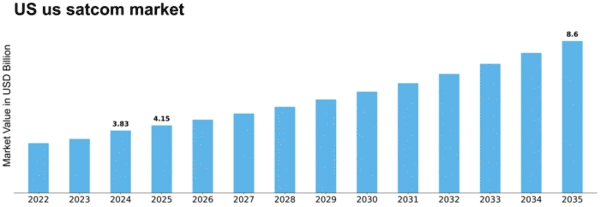

US SATCOM Market Size Graph
Author
Sejal Akre
Senior Research Analyst

She has over 5 years of rich experience, in market research and consulting providing valuable market insights to client. Hands on expertise in management consulting, and extensive knowledge in domain including ICT, Automotive & Transportation and Aerospace & Defense. She is skilled in Go-to market strategy, industry analysis, market sizing, in depth company profiling, competitive intelligence & benchmarking and value chain amongst others.

Leave a Comment

FAQs

What is the current valuation of the US Satellite Communication Market?

<p>As of 2024, the US Satellite Communication Market was valued at 3.83 USD Billion.</p>

What is the projected market valuation for the US Satellite Communication Market in 2035?

<p>The market is projected to reach a valuation of 8.6 USD Billion by 2035.</p>

What is the expected CAGR for the US Satellite Communication Market during the forecast period 2025 - 2035?

<p>The expected CAGR for the market during the forecast period 2025 - 2035 is 7.64%.</p>

Which companies are considered key players in the US Satellite Communication Market?

<p>Key players in the market include SpaceX, Intelsat, SES S.A., Iridium Communications Inc., Hughes Network Systems, Viasat Inc., L3Harris Technologies, Northrop Grumman Corporation, and Maxar Technologies.</p>

How does the market segment by application perform in terms of valuation?

<p>In 2024, the Telecommunication segment was valued at 1.5 USD Billion, while it is projected to grow to 3.2 USD Billion by 2035.</p>

Market Summary

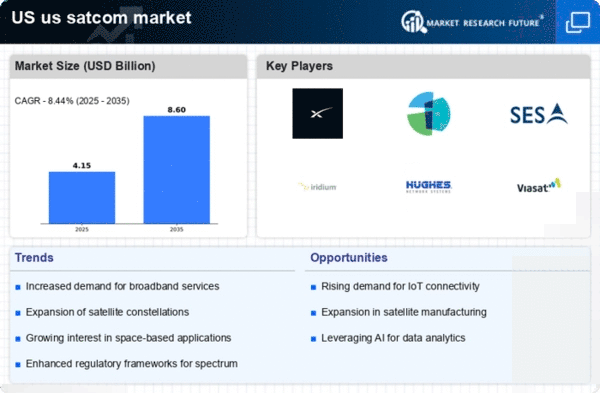
As per analysis, the US Satellite Communication Market is projected to grow from USD 3.83 Billion in 2024 to USD 8.6 Billion by 2035, exhibiting a compound annual growth rate (CAGR) of 7.64% during the forecast period (2025 - 2035).

Key Market Trends & Highlights

The US Satellite Communication Market is poised for substantial growth driven by technological advancements and increasing demand for connectivity.

  • The emergence of Low Earth Orbit satellites is transforming the landscape of satellite communication, enhancing coverage and reducing latency.
  • The telecommunication segment remains the largest, while the broadcasting segment is experiencing the fastest growth due to rising content consumption.
  • Government applications dominate the market, yet commercial applications are rapidly expanding, particularly in IoT and smart city initiatives.
  • Growing demand for high-speed internet and advancements in satellite technology are key drivers propelling market expansion.

Market Size & Forecast

2024 Market Size 3.83 (USD Billion)
2035 Market Size 8.6 (USD Billion)
CAGR (2025 - 2035) 7.64%

Major Players

<p>SpaceX (US), Intelsat (US), SES S.A. (US), Iridium Communications Inc. (US), Hughes Network Systems (US), Viasat Inc. (US), L3Harris Technologies (US), Northrop Grumman Corporation (US), Maxar Technologies (US)</p>

Market Trends

The US Satellite Communication Market is currently experiencing a dynamic evolution, driven by advancements in technology and increasing demand for reliable communication services. The proliferation of satellite-based applications, including broadband internet, television broadcasting, and secure military communications, has led to a robust growth trajectory. As the nation continues to invest in infrastructure, the integration of satellite systems with terrestrial networks appears to enhance connectivity, particularly in rural and underserved areas. Furthermore, the ongoing development of low Earth orbit (LEO) satellite constellations suggests a potential shift in how communication services are delivered, promising lower latency and improved service quality. In addition to technological advancements, regulatory frameworks and government initiatives play a crucial role in shaping the US Satellite Communication Market. The Federal Communications Commission (FCC) has been actively working to streamline licensing processes and promote competition among service providers. This regulatory environment, coupled with increasing collaboration between public and private sectors, indicates a favorable landscape for innovation and investment. As the market continues to evolve, stakeholders must remain vigilant to emerging trends and challenges, ensuring that the US maintains its leadership in satellite communications.

Emergence of Low Earth Orbit Satellites

The rise of low Earth orbit (LEO) satellite constellations is transforming the US Satellite Communication Market. These systems promise enhanced connectivity and reduced latency, making them particularly appealing for broadband services. Companies are increasingly investing in LEO technology to provide high-speed internet access, especially in remote regions, thereby addressing the digital divide.

Regulatory Support for Innovation

Regulatory frameworks established by the Federal Communications Commission (FCC) are fostering innovation within the US Satellite Communication Market. By streamlining licensing processes and encouraging competition, the FCC is creating an environment conducive to the development of new technologies and services. This proactive approach is likely to stimulate growth and attract investment.

Integration with Terrestrial Networks

The integration of satellite communication systems with terrestrial networks is becoming more prevalent in the US. This convergence allows for seamless connectivity and improved service delivery across various platforms. As stakeholders explore hybrid solutions, the potential for enhanced communication capabilities appears promising, particularly in urban and rural settings.

US SATCOM Market Market Drivers

Advancements in Satellite Technology

Technological advancements are playing a pivotal role in shaping the US Satellite Communication Market. Innovations in satellite design, propulsion systems, and miniaturization are enabling the deployment of more efficient and cost-effective satellites. The introduction of LEO satellites has revolutionized communication capabilities, allowing for lower latency and higher data throughput. As of January 2026, the market is projected to grow at a compound annual growth rate (CAGR) of 10% over the next five years, driven by these technological improvements. This evolution not only enhances service offerings but also attracts investments, further solidifying the US Satellite Communication Market's position in the global landscape.

Growing Demand for High-Speed Internet

The US Satellite Communication Market is experiencing a surge in demand for high-speed internet services, particularly in rural and underserved areas. As of January 2026, approximately 30 million Americans lack access to reliable broadband, prompting government initiatives to bridge this digital divide. Satellite communication offers a viable solution, providing connectivity where traditional infrastructure is lacking. Companies like SpaceX and Amazon are actively deploying low Earth orbit (LEO) satellites to enhance internet access. This trend is likely to continue, as the Federal Communications Commission (FCC) supports satellite broadband initiatives, indicating a robust growth trajectory for the US Satellite Communication Market.

Regulatory Framework and Policy Support

The regulatory environment is a crucial driver for the US Satellite Communication Market. The FCC and other governmental bodies are actively promoting policies that facilitate satellite deployment and operation. Recent initiatives aim to streamline licensing processes and encourage competition among satellite service providers. As of January 2026, these regulatory efforts are expected to foster innovation and investment in the satellite sector, potentially leading to a more dynamic market landscape. The US government is also exploring partnerships with private companies to enhance satellite communication capabilities, indicating a supportive framework that could propel the US Satellite Communication Market forward.

Increased Military and Defense Applications

The US Satellite Communication Market is significantly influenced by the growing demand for military and defense applications. The Department of Defense (DoD) continues to invest heavily in satellite communication systems to enhance national security and operational capabilities. As of January 2026, military satellite communication spending is projected to reach $20 billion annually, reflecting the critical role of satellite technology in modern warfare. This trend underscores the importance of secure and reliable communication channels for defense operations, thereby driving growth in the US Satellite Communication Market. The integration of advanced encryption and secure communication protocols further enhances the appeal of satellite solutions for military applications.

Emerging Applications in IoT and Smart Cities

The rise of the Internet of Things (IoT) and smart city initiatives is creating new opportunities within the US Satellite Communication Market. As urban areas increasingly adopt smart technologies, the need for reliable communication networks becomes paramount. Satellite communication provides a robust solution for connecting IoT devices, particularly in remote or hard-to-reach locations. By January 2026, the market for satellite-enabled IoT applications is expected to grow significantly, driven by investments in smart infrastructure and urban planning. This trend not only enhances operational efficiency but also supports sustainability goals, positioning the US Satellite Communication Market as a key player in the future of urban development.

Market Segment Insights

By Application: Telecommunication (Largest) vs. Broadcasting (Fastest-Growing)

<p>In the US Satellite Communication Market, the application segment showcases considerable diversity. Telecommunication holds the largest share as it encompasses essential services such as voice, data, and internet connectivity, leveraging satellite technology for widespread access. Broadcasting follows suit, catering to television and radio transmission services, and has seen remarkable interest and investment. Remote sensing, navigation, and earth observation round out the segment, each playing crucial roles in their respective domains but with smaller market shares compared to telecommunication and broadcasting. Growth trends in this segment are being driven by technological advancements and increased demand for high-bandwidth services. Telecommunication remains strong due to the ongoing expansion of internet access across rural areas. Broadcasting is rapidly evolving, fueled by trends towards streaming services and the need for reliable content delivery. The growing importance of remote sensing for environmental monitoring and navigation for traffic management also contributes to the overall segmentation growth, keeping the market dynamic and competitive.</p>

<p>Telecommunication (Dominant) vs. Broadcasting (Emerging)</p>

<p>The telecommunication segment stands as the dominant force in the US Satellite Communication Market, primarily characterized by its extensive infrastructure and established user base. It is integral to providing critical connectivity services to urban and rural areas alike, often serving as a backbone for internet and telecommunications providers. On the other hand, the broadcasting segment is emerging rapidly, adapting to the digital age with innovations in content delivery, including streaming and interactive services. This transformation is driven by viewer demand for high-quality content and seamless transmission. While telecommunication focuses on maintaining reliability and coverage, broadcasting is investing heavily in technology to enhance viewer experience. Both segments occupy unique market positions, contributing to a well-rounded satellite communication ecosystem.</p>

By End Use: Government (Largest) vs. Commercial (Fastest-Growing)

<p>The US Satellite Communication Market showcases a balanced distribution among several end-use segments, with Government holding the largest market share. Due to its reliance on satellite communications for various operational needs, the Government sector dominates this market landscape. Following closely is the Commercial sector, which, fueled by advancements in technology and increasing demand for reliable communication, illustrates significant growth. Other segments such as Military, Aerospace, and Maritime also contribute, but they represent a smaller portion of the overall market.</p>

<p>Government (Dominant) vs. Commercial (Emerging)</p>

<p>The Government segment stands out as the dominant player within the US Satellite Communication Market. Its extensive use of satellite technology for services such as surveillance, emergency management, and public safety drives its success. On the other hand, the Commercial sector is identified as an emerging segment, rapidly gaining ground due to innovations in satellite technology and expanding applications in various industries, including telecommunications and broadcasting. This dynamic enables the Commercial sector to capture a growing consumer base, making it a critical area to watch for future growth.</p>

By Technology: Geostationary Satellite (Largest) vs. Low Earth Orbit Satellite (Fastest-Growing)

<p>In the US Satellite Communication Market, Geostationary Satellites maintain the largest market share, primarily due to their long-standing infrastructure, reliability, and ability to cover vast areas with a single satellite. These satellites are strategically positioned to provide continuous coverage, making them ideal for broadcasting and telecommunications. Meanwhile, Low Earth Orbit Satellites, though currently smaller in share, are rapidly gaining attention as the fastest-growing segment. Their proximity to Earth allows for lower latency and enhanced data speeds, appealing to modern communication needs.</p>

<p>Technology: Geostationary Satellite (Dominant) vs. Low Earth Orbit Satellite (Emerging)</p>

<p>Geostationary Satellites play a dominant role in the US Satellite Communication Market, leveraging their orbital characteristics to support a wide range of applications, including television broadcasting and internet services. Their established presence offers consistent service, particularly in regions where terrestrial networks may be unreliable. Conversely, Low Earth Orbit Satellites are positioned as an emerging technology, with new companies investing in fleets that promise global connectivity at competitive prices. These satellites utilize advanced technologies to reduce latency and improve bandwidth, positioning them as key players in the future landscape of satellite communications.</p>

Get more detailed insights about US SATCOM Market Research Report – Forecast till 2035

Regional Insights

North America : Leading Innovation and Growth

North America is the largest market for SATCOM, holding approximately 45% of the global share. The region's growth is driven by increasing demand for broadband connectivity, advancements in satellite technology, and supportive regulatory frameworks. The U.S. Federal Communications Commission (FCC) has been instrumental in promoting satellite communications, facilitating innovation and investment in the sector. The competitive landscape is robust, with key players like Intelsat, Hughes Network Systems, and Viasat leading the charge. The U.S. and Canada are the primary contributors, leveraging their technological expertise and infrastructure. The presence of major companies ensures a dynamic market, fostering partnerships and collaborations to enhance service offerings and expand reach.

Europe : Emerging Regulatory Frameworks

Europe is the second-largest market for SATCOM, accounting for around 30% of the global share. The region's growth is fueled by increasing demand for satellite broadband services, particularly in rural areas, and the European Space Agency's initiatives to enhance satellite infrastructure. Regulatory support, such as the European Union's Digital Compass, aims to boost connectivity and innovation in the sector. Leading countries include the UK, France, and Germany, with significant contributions from companies like Eutelsat and SES S.A. The competitive landscape is characterized by a mix of established players and emerging startups, fostering innovation. The presence of key players ensures a diverse range of services, catering to various sectors, including telecommunications and broadcasting.

Asia-Pacific : Rapidly Growing Market Potential

Asia-Pacific is witnessing rapid growth in the SATCOM market, driven by increasing demand for connectivity in remote areas and advancements in satellite technology. The region holds approximately 20% of the global market share, with countries like India and China leading the charge. Government initiatives to enhance digital infrastructure and promote satellite communications are key growth drivers, supported by favorable regulations. The competitive landscape features a mix of local and international players, including key companies like Inmarsat and Iridium Communications. The presence of these players is crucial for addressing the diverse needs of the region, from telecommunications to disaster management. As demand for satellite services continues to rise, the market is expected to expand significantly in the coming years, attracting further investment and innovation.

Middle East and Africa : Untapped Market Opportunities

The Middle East and Africa region is emerging as a significant player in the SATCOM market, holding about 5% of the global share. The growth is driven by increasing demand for broadband services, particularly in underserved areas, and government initiatives to enhance satellite infrastructure. Regulatory bodies are working to create a conducive environment for investment, which is crucial for market expansion. Leading countries include South Africa and the UAE, where investments in satellite technology are on the rise. The competitive landscape is evolving, with both local and international players like Thales Alenia Space making strides in the market. As the region continues to develop its SATCOM capabilities, opportunities for growth and collaboration are expected to increase, attracting more players to the sector.

Key Players and Competitive Insights

The Satellite Communication Market in the US is characterized by a dynamic competitive landscape, driven by technological advancements and increasing demand for high-speed connectivity. Key players such as SpaceX (US), Intelsat (US), and Viasat Inc. (US) are at the forefront, each adopting distinct strategies to enhance their market positioning. SpaceX (US) continues to innovate with its Starlink project, focusing on expanding its satellite constellation to provide global broadband services. Intelsat (US) is leveraging partnerships to enhance its service offerings, while Viasat Inc. (US) is concentrating on integrating advanced technologies to improve user experience and operational efficiency. Collectively, these strategies contribute to a competitive environment that is increasingly focused on innovation and customer-centric solutions.

In terms of business tactics, companies are localizing manufacturing and optimizing supply chains to enhance operational efficiency. The market structure appears moderately fragmented, with several key players exerting influence over various segments. This fragmentation allows for a diverse range of services and solutions, catering to different customer needs and preferences. The collective influence of these companies shapes the market dynamics, fostering an environment where innovation and strategic partnerships are paramount.

In December 2025, SpaceX (US) announced the successful launch of its latest batch of Starlink satellites, aimed at enhancing global internet coverage. This strategic move is significant as it not only expands their service reach but also reinforces their commitment to providing high-speed internet in underserved areas. The implications of this launch could potentially disrupt traditional broadband markets, positioning SpaceX (US) as a leader in satellite-based internet services.

In November 2025, Intelsat (US) entered into a strategic partnership with a major telecommunications provider to enhance its satellite services. This collaboration is likely to bolster Intelsat's market presence and improve service delivery, particularly in the enterprise sector. By aligning with established telecom networks, Intelsat (US) may enhance its competitive edge and expand its customer base.

In October 2025, Viasat Inc. (US) unveiled a new satellite technology designed to increase data throughput and reduce latency for its users. This innovation is crucial in a market where demand for high-speed connectivity is surging. By investing in cutting-edge technology, Viasat Inc. (US) positions itself as a forward-thinking player, likely to attract customers seeking reliable and fast internet solutions.

As of January 2026, current trends in the Satellite Communication Market indicate a strong emphasis on digitalization, sustainability, and the integration of artificial intelligence (AI) into operations. Strategic alliances are increasingly shaping the competitive landscape, allowing companies to pool resources and expertise. Looking ahead, competitive differentiation is expected to evolve, with a shift from price-based competition to a focus on innovation, technology, and supply chain reliability. This transition may redefine how companies engage with customers and deliver value in an ever-evolving market.

Key Companies in the US SATCOM Market include

Industry Developments

Future Outlook

US SATCOM Market Future Outlook

The US Satellite Communication Market is projected to grow at a 7.64% CAGR from 2025 to 2035, driven by advancements in technology, increasing demand for broadband, and expanding satellite constellations.

New opportunities lie in:

  • Development of low Earth orbit satellite networks for global broadband access.
  • Integration of satellite communication with 5G networks for enhanced connectivity.
  • Expansion of satellite-based IoT solutions for smart agriculture and logistics.

By 2035, the market is expected to be robust, driven by innovation and diverse applications.

Market Segmentation

US SATCOM Market End Use Outlook

  • Government
  • Commercial
  • Military
  • Aerospace
  • Maritime

US SATCOM Market Technology Outlook

  • Geostationary Satellite
  • Low Earth Orbit Satellite
  • Medium Earth Orbit Satellite
  • Satellite Communication Network
  • Satellite Payload

US SATCOM Market Application Outlook

  • Telecommunication
  • Broadcasting
  • Remote Sensing
  • Navigation
  • Earth Observation

Report Scope

MARKET SIZE 20243.83(USD Billion)
MARKET SIZE 20254.15(USD Billion)
MARKET SIZE 20358.6(USD Billion)
COMPOUND ANNUAL GROWTH RATE (CAGR)7.64% (2024 - 2035)
REPORT COVERAGERevenue Forecast, Competitive Landscape, Growth Factors, and Trends
BASE YEAR2024
Market Forecast Period2025 - 2035
Historical Data2019 - 2024
Market Forecast UnitsUSD Billion
Key Companies ProfiledSpaceX (US), Intelsat (US), SES S.A. (US), Iridium Communications Inc. (US), Hughes Network Systems (US), Viasat Inc. (US), L3Harris Technologies (US), Northrop Grumman Corporation (US), Maxar Technologies (US)
Segments CoveredApplication, End Use, Technology
Key Market OpportunitiesExpansion of low Earth orbit satellite constellations enhances connectivity and broadband access across the US.
Key Market DynamicsTechnological advancements drive competition and regulatory changes in the US Satellite Communication Market.
Countries CoveredUS

FAQs

What is the current valuation of the US Satellite Communication Market?

<p>As of 2024, the US Satellite Communication Market was valued at 3.83 USD Billion.</p>

What is the projected market valuation for the US Satellite Communication Market in 2035?

<p>The market is projected to reach a valuation of 8.6 USD Billion by 2035.</p>

What is the expected CAGR for the US Satellite Communication Market during the forecast period 2025 - 2035?

<p>The expected CAGR for the market during the forecast period 2025 - 2035 is 7.64%.</p>

Which companies are considered key players in the US Satellite Communication Market?

<p>Key players in the market include SpaceX, Intelsat, SES S.A., Iridium Communications Inc., Hughes Network Systems, Viasat Inc., L3Harris Technologies, Northrop Grumman Corporation, and Maxar Technologies.</p>

How does the market segment by application perform in terms of valuation?

<p>In 2024, the Telecommunication segment was valued at 1.5 USD Billion, while it is projected to grow to 3.2 USD Billion by 2035.</p>

  1. EXECUTIVE
    1. SUMMARY
  2. MARKET INTRODUCTION
    1. Definition
    2. Scope of the
      1. Research Objective
      2. Assumptions
      3. Limitations
    3. Study
  3. RESEARCH METHODOLOGY
    1. Overview
    2. Data Mining
    3. Secondary Research
    4. Primary Research
      1. Primary Interviews and
      2. Breakdown of Primary Respondents
    5. Information Gathering Process
    6. Forecasting Model
    7. Market Size Estimation
      1. Bottom-Up Approach
      2. Top-Down Approach
    8. Data Triangulation
    9. Validation
  4. MARKET DYNAMICS
    1. Overview
    2. Drivers
    3. Restraints
    4. Opportunities
  5. MARKET FACTOR ANALYSIS
    1. Value Chain Analysis
    2. Porter’s Five Forces Analysis
      1. Bargaining Power of Suppliers
      2. Bargaining Power of Buyers
      3. Threat of New Entrants
      4. Intensity of Rivalry
    3. Threat of Substitutes
    4. COVID-19 Impact
      1. Market Impact Analysis
      2. Regional Impact
    5. Analysis
    6. Opportunity and Threat Analysis
  6. US SATCOM MARKET, BY COMPONENT
    1. Overview
    2. Equipment
    3. Services
  7. US SATCOM MARKET, BY APPLICATION
    1. Overview
    2. Asset Tracking/Monitoring
    3. Airtime
    4. Drones Connectivity
    5. Data Backup & Recovery
    6. Navigation &
    7. Monitoring
    8. Tele-medicine
    9. Broadcasting
    10. Others
  8. US SATCOM MARKET, BY VERTICAL
    1. Overview
    2. Energy & Utility
    3. Government & Defense
    4. Transport & Cargo
    5. Maritime
    6. Mining And Oil & Gas
    7. Agriculture
    8. Communication Companies
    9. Corporates/Enterprises
    10. Media & Broadcasting
    11. Events
    12. Aviation
    13. Environmental & Monitoring
    14. Forestry
    15. Consumer
    16. Healthcare
    17. Others
  9. COMPETITIVE LANDSCAPE
    1. Overview
    2. Competitive Analysis
    3. Market Share Analysis
    4. Major Growth Strategy in the US SATCOM Market,
    5. Competitive Benchmarking
    6. Leading Players in Terms of Number of Developments in the US SATCOM Market,
    7. Key developments and Growth Strategies
      1. New Product Launch/Service
      2. Merger & Acquisitions
      3. Joint Ventures
      4. Sales & Operating Income, 2022
      5. Major Players R&D Expenditure. 2022
    8. Deployment
    9. Major Players Financial Matrix
  10. COMPANY PROFILES
    1. Viasat, Inc
    2. Products Offered
    3. Key Strategies
    4. Overview
    5. SWOT Analysis
    6. Overview
    7. Key Developments
    8. Telesat
    9. Products Offered
    10. Key Strategies
    11. Inc
    12. Offered
    13. Strategies
    14. GROUP
    15. Products Offered
    16. Key Strategies
    17. Offered
    18. Key Strategies
  11. Company Overview
  12. Financial Overview
  13. Key Developments
  14. SWOT Analysis
    1. SES S.A
      1. Company Overview
      2. Financial
      3. Products Offered
      4. Key Developments
      5. Key Strategies
    2. Intelsat
      1. Company
      2. Financial Overview
      3. Products Offered
      4. SWOT Analysis
      5. Key Strategies
      6. Company Overview
      7. Financial Overview
      8. Key Developments
      9. SWOT Analysis
    3. EchoStar Corporation
      1. Company Overview
      2. Financial Overview
      3. Products Offered
      4. Key Developments
      5. SWOT Analysis
      6. Key Strategies
    4. L3Harris Technologies,
      1. Company Overview
      2. Financial Overview
      3. Products
      4. Key Developments
      5. SWOT Analysis
      6. Key
    5. Thuraya Telecommunications Company
      1. Company Overview
      2. Financial Overview
      3. Products Offered
      4. Key Developments
      5. SWOT Analysis
      6. Key Strategies
    6. SKY PERFECT JSAT
      1. Company Overview
      2. Financial Overview
      3. Key Developments
      4. SWOT Analysis
    7. GILAT SATELLITE NETWORKS
      1. Company Overview
      2. Financial Overview
      3. Products Offered
      4. Key Developments
      5. SWOT Analysis
      6. Key Strategies
    8. Cobham Limited
      1. Company Overview
      2. Financial Overview
      3. Products
      4. Key Developments
      5. SWOT Analysis
  15. APPENDIX
    1. References
    2. Related Reports
  16. LIST OF TABLES
  17. US SATCOM MARKET, SYNOPSIS,
  18. US SATCOM MARKET, ESTIMATES & FORECAST, 2025-2034 (USD
    1. BILLION)
  19. US SATCOM MARKET, BY COMPONENT, 2025-2034 (USD BILLION)
  20. US SATCOM MARKET, BY APPLICATION, 2025-2034 (USD BILLION)
    1. TABLE 5
  21. US SATCOM MARKET, BY VERTICAL, 2025-2034 (USD BILLION)
  22. LIST OF FIGURES
  23. RESEARCH PROCESS
  24. MARKET STRUCTURE FOR THE US SATCOM MARKET
  25. MARKET DYNAMICS FOR THE US SATCOM MARKET
  26. US SATCOM MARKET,
    1. SHARE (%), BY COMPONENT, 2022
  27. US SATCOM MARKET, SHARE (%), BY APPLICATION,
  28. US SATCOM MARKET, SHARE (%), BY VERTICAL, 2022
    1. FIGURE
  29. US SATCOM MARKET: COMPANY SHARE ANALYSIS, 2022 (%)
  30. VIASAT, INC:
    1. FINANCIAL OVERVIEW SNAPSHOT
  31. VIASAT, INC: SWOT ANALYSIS
    1. FIGURE
  32. SES S.A: FINANCIAL OVERVIEW SNAPSHOT
  33. SES S.A: SWOT ANALYSIS
  34. INTELSAT: FINANCIAL OVERVIEW SNAPSHOT
  35. INTELSAT: SWOT
    1. ANALYSIS
  36. TELESAT: FINANCIAL OVERVIEW SNAPSHOT
  37. TELESAT:
  38. SWOT ANALYSIS
  39. ECHOSTAR CORPORATION.: FINANCIAL OVERVIEW SNAPSHOT
  40. ECHOSTAR CORPORATION.: SWOT ANALYSIS
  41. L3HARRIS TECHNOLOGIES,
    1. INC: FINANCIAL OVERVIEW SNAPSHOT
  42. L3HARRIS TECHNOLOGIES, INC: SWOT
    1. ANALYSIS
  43. THURAYA TELECOMMUNICATIONS COMPANY: FINANCIAL OVERVIEW
    1. SNAPSHOT
  44. THURAYA TELECOMMUNICATIONS COMPANY: SWOT ANALYSIS
    1. FIGURE
  45. SKY PERFECT JSAT GROUP: FINANCIAL OVERVIEW SNAPSHOT
  46. SKY PERFECT
    1. JSAT GROUP: SWOT ANALYSIS
  47. GILAT SATELLITE NETWORKS: FINANCIAL OVERVIEW
    1. SNAPSHOT
  48. GILAT SATELLITE NETWORKS: SWOT ANALYSIS
  49. COBHAM
    1. LIMITED: FINANCIAL OVERVIEW SNAPSHOT
  50. COBHAM LIMITED: SWOT ANALYSIS

US SATCOM Market Segmentation

Market Segmentation Overview

  • Detailed segmentation data will be available in the full report
  • Comprehensive analysis by multiple parameters
  • Regional and country-level breakdowns
  • Market size forecasts by segment
Infographic

Free Sample Request

Kindly complete the form below to receive a free sample of this Report

Get Free Sample

Customer Strories

Compare Licence

×
Features License Type
Single User Multiuser License Enterprise User
Price $4,950 $5,950 $7,250
Maximum User Access Limit 1 User Upto 10 Users Unrestricted Access Throughout the Organization
Free Customization
Direct Access to Analyst
Deliverable Format
Platform Access
Discount on Next Purchase 10% 15% 15%
Printable Versions