×
Request Free Sample ×

Kindly complete the form below to receive a free sample of this Report

* Please use a valid business email

Leading companies partner with us for data-driven Insights

clients tt-cursor
Hero Background

US Printed Signage Market

ID: MRFR/PCM/18738-HCR
111 Pages
Snehal Singh
February 2026

US Printed Signage Market Research Report By Type (Banner and Backdrop, Corporate Graphics, Exhibitions, and Trade Shows, Backlit Displays, Pop Display, Billboards, Other Signage Types), By Print Technology (Screen, Inkjet, Sheetfed, Other Print Technologies), By End-user Vertical (BFSI, Retail, Transportation and Logistics, Healthcare, Other End-user Verticals (Sports and Entertainment, etc

Share:
Download PDF ×

We do not share your information with anyone. However, we may send you emails based on your report interest from time to time. You may contact us at any time to opt-out.

US Printed Signage Market Infographic
Purchase Options

US Printed Signage Market Summary

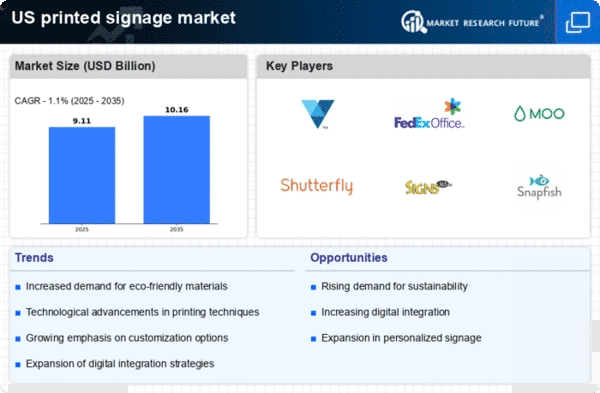
As per Market Research Future analysis, the US printed signage market size was estimated at 9.01 USD Billion in 2024.. The US printed signage market is projected to grow from 9.11 USD Billion in 2025 to 10.16 USD Billion by 2035, exhibiting a compound annual growth rate (CAGR) of 1% during the forecast period 2025 - 2035

Key Market Trends & Highlights

The US printed signage market is experiencing a transformative shift driven by sustainability and technological advancements.

  • Sustainability initiatives are increasingly influencing the design and production of printed signage.
  • Technological advancements are enhancing the quality and efficiency of signage production processes.
  • The retail and hospitality sectors are driving demand for customized signage solutions to improve customer engagement.
  • Growing demand for customization and increased focus on brand visibility are key market drivers shaping the industry.

Market Size & Forecast

2024 Market Size 9.01 (USD Billion)
2035 Market Size 10.16 (USD Billion)
CAGR (2025 - 2035) 1.1%

Major Players

VistaPrint (US), FedEx Office (US), Moo (GB), Shutterfly (US), Signs.com (US), Snapfish (US), Zazzle (US), Overnight Prints (US)

Our Impact
Enabled $4.3B Revenue Impact for Fortune 500 and Leading Multinationals
Partnering with 2000+ Global Organizations Each Year
30K+ Citations by Top-Tier Firms in the Industry

US Printed Signage Market Trends

the printed signage market is currently undergoing significant changes, driven by advancements in technology and changing consumer preferences. Digital printing techniques have gained traction, allowing for greater customization and faster production times. This shift not only enhances the quality of signage but also enables businesses to respond swiftly to market demands. Furthermore, the integration of eco-friendly materials is increasingly common, as companies seek to align with sustainability goals. This trend reflects a broader societal movement towards environmentally responsible practices, which resonates with consumers and businesses alike. In addition, the rise of e-commerce has influenced the printed signage market, as businesses leverage signage to enhance their physical presence and brand visibility. Retailers are increasingly utilizing printed materials to create engaging in-store experiences, thereby attracting customers and driving sales. The ongoing innovation in design and production methods suggests that the printed signage market will continue to adapt and thrive in this evolving landscape, catering to the diverse needs of various industries. As the market progresses, it appears poised for further growth, with opportunities for businesses to explore new avenues for creativity and engagement.

Sustainability Initiatives

the printed signage market is experiencing a significant shift towards sustainable practices. Companies are increasingly adopting eco-friendly materials and processes, reflecting a commitment to environmental responsibility. This trend not only appeals to environmentally conscious consumers but also aligns with regulatory pressures for greener operations.

Technological Advancements

Innovations in printing technology are transforming the printed signage market. Digital printing methods are becoming more prevalent, allowing for quicker turnaround times and enhanced customization options. This evolution enables businesses to produce high-quality signage that meets specific marketing needs.

Enhanced Customer Engagement

Businesses are focusing on using printed signage to create immersive customer experiences. By integrating creative designs and interactive elements, companies aim to capture consumer attention and foster brand loyalty. This trend highlights the importance of effective communication through visual mediums.

US Printed Signage Market Drivers

Growing Demand for Customization

The printed signage market is experiencing a notable increase in demand for customized signage solutions. Businesses are increasingly seeking personalized signs that reflect their brand identity and cater to specific customer needs. This trend is particularly evident in retail and hospitality sectors, where tailored signage can enhance customer experience and drive sales. According to recent data, the customization segment is projected to grow at a CAGR of approximately 5.5% over the next five years. This shift towards personalized signage not only boosts the printed signage market but also encourages innovation in design and production techniques, allowing companies to differentiate themselves in a competitive landscape.

Increased Focus on Brand Visibility

In an increasingly competitive marketplace, businesses are placing a heightened emphasis on brand visibility, which is driving growth in the printed signage market. Effective signage serves as a critical tool for brand recognition and customer engagement. Companies are investing in high-quality printed signs to ensure their branding stands out. Data suggests that businesses that utilize effective signage can increase their visibility by up to 50%. This trend is particularly relevant for small and medium-sized enterprises looking to establish a strong market presence. As brand visibility becomes a priority, the demand for innovative and eye-catching printed signage solutions is expected to rise.

Regulatory Compliance and Safety Standards

Regulatory compliance and safety standards are increasingly influencing the printed signage market. Businesses are required to adhere to various regulations regarding signage, particularly in sectors such as construction, healthcare, and transportation. Compliance with these regulations ensures that signage is not only effective but also safe for public use. As a result, companies in the printed signage market must stay informed about changing regulations and invest in compliant signage solutions. This focus on safety and compliance is expected to drive demand for high-quality printed signage that meets industry standards, thereby shaping the future of the market.

Expansion of Retail and Hospitality Sectors

the expansion of the retail and hospitality sectors in the US is greatly impacting the printed signage market. As new retail outlets and hospitality establishments emerge, the need for effective signage becomes paramount. Signage plays a crucial role in attracting customers and conveying essential information. Recent statistics indicate that the retail sector alone is expected to reach a market value of $5 trillion by 2026, which will likely drive demand for various types of printed signage. This growth presents opportunities for signage companies to develop innovative solutions that cater to the evolving needs of these industries, thereby enhancing their market presence.

Technological Integration in Signage Production

the integration of advanced technologies in the production of printed signage is transforming the industry. Innovations such as digital printing, 3D printing, and augmented reality are enhancing the capabilities of signage manufacturers. These technologies allow for faster production times, improved quality, and greater design flexibility. The printed signage market is likely to benefit from these advancements, as businesses seek to leverage technology to create more engaging and interactive signage. As a result, companies that adopt these technologies may gain a competitive edge, positioning themselves favorably in a rapidly evolving market.


Market Segment Insights

By Type: Billboards (Largest) vs. Pop Display (Fastest-Growing)

In the US printed signage market, the distribution of market share among various segment values reveals that billboards hold the largest share due to their visibility and effectiveness in outdoor advertising. Banner and backdrop signage also occupy a significant position, primarily used for events and promotions. Corporate graphics, exhibitions, and trade shows represent another crucial segment, catering to businesses needing branding and market presence. Backlit displays and pop displays contribute to niche markets with unique advertising needs, while other signage types complete the diverse offerings available in this sector. Growth trends within the US printed signage market indicate a strong demand for pop displays, which are seen as the fastest-growing segment owing to their versatility and impact in retail environments. Billboards continue to be popular, driven by their high exposure rates and effectiveness in capturing consumer attention. Increased investment in events and trade shows is bolstering the corporate graphics segment, while advancements in printing technology enhance the quality and appeal of backlit displays, positioning them well for future gains.

Billboards (Dominant) vs. Pop Display (Emerging)

Billboards remain the dominant force within the segment, offering unparalleled advertising space in high-traffic areas, which appeals to brands aiming for mass visibility. Their traditional design and strategic placement are key factors for their sustained dominance in this market. In contrast, pop displays are emerging as a compelling option for brands seeking flexible and eye-catching solutions for promotional activities. These displays are often designed for easy transport and installation, making them ideal for trade shows and temporary marketing campaigns. As consumer preferences shift towards interactive and immersive experiences, the adaptability and creative potential of pop displays position them as a critical segment in the evolving landscape of printed signage.

By Print Technology: Inkjet (Largest) vs. Screen (Fastest-Growing)

The market share distribution within the print technology segment of the US printed signage market reveals that inkjet printing currently holds the largest share, driven by its versatility and high-quality output. Growing applications across various industries have solidified its position, making it the preferred choice for many signage solutions. In contrast, screen printing is gaining momentum due to its cost-effectiveness for large runs and vibrant color outputs, appealing to a segment of users seeking value without compromising quality. Growth trends in the US printed signage market indicate that screen printing is becoming the fastest-growing method, largely due to an increase in demand for vibrant, durable signage. This growth is further fueled by advancements in technology that have enhanced screen printing capabilities, making it a viable option for low-cost and high-volume projects. Additionally, sustainability initiatives are pushing manufacturers to adopt eco-friendly inks and materials, contributing to the segment's overall appeal.

Inkjet (Dominant) vs. Screen (Emerging)

Inkjet technology in the US printed signage market is currently dominant due to its ability to produce high-quality, full-color prints on diverse substrates. Its adaptability to various sizes and formats allows for a wide array of applications, from banners to billboards. This versatility, coupled with rapid advancements in ink formulation and print head technology, ensures that inkjet remains a top choice among consumers. Meanwhile, screen printing is labeled as an emerging force in the market. It is especially favored for its economical value for large-scale prints, as well as its capacity to achieve vibrant colors that stand out. As businesses increasingly seek cost-effective solutions, screen printing is poised to expand its market presence further.

By End User Vertical: BFSI (Largest) vs. Healthcare (Fastest-Growing)

The US printed signage market is increasingly being shaped by the end user verticals, with BFSI holding the largest share. This sector showcases significant investment in signage to enhance customer experience and streamline operations, reflecting its robust position. Retail follows as a close competitor, utilizing printed signage for branding and promotions. Healthcare is currently the fastest-growing segment, driven by the need for clear communication and wayfinding solutions in medical facilities. Transportation and logistics also contribute to market growth, focusing on safety and information dissemination. As businesses recognize the value of effective communication, the diversification of signage applications continues to expand.

Retail: Dominant vs. Transportation and Logistics: Emerging

The retail sector stands as the dominant player in the US printed signage market, leveraging signage not only for promotional purposes but also for enhancing customer engagement. Vibrant displays and promotional materials are essential in creating an attractive shopping environment. On the other hand, the transportation and logistics sector emerges as a growing segment, primarily focusing on functional signage that ensures safety and efficiency. This includes directional and informational signs crucial for operations. As both sectors evolve, they demonstrate a balance between artistic expression and practical utility, contributing to the overall dynamics of the market.

By Application: Indoor (Largest) vs. Outdoor (Fastest-Growing)

In the US printed signage market, the Indoor application segment holds the largest share due to its extensive use in retail environments, corporate offices, and indoor events. This segment's dominance is attributed to the need for directional signs, promotional materials, and informational displays, which are pivotal for enhancing customer experience and accessibility. Conversely, the Outdoor application segment is recognized as the fastest-growing category, driven by increasing outdoor advertising needs and innovative outdoor display technologies. Growing urbanization and the average consumer's shift to outdoor experiences fuel this segment's expansion, as businesses seek to captivate customers with larger-than-life signage displays that convey impactful messaging in various outdoor settings.

Indoor (Dominant) vs. Outdoor (Emerging)

The Indoor segment in the US printed signage market stands as a dominant force, characterized by its versatility and essential role in engaging customers. Indoor signage includes varied formats, such as posters, banners, and digital displays, tailored to enhance visual communication in controlled environments. This segment is well-established in sectors like retail and hospitality, where effective signage directly influences consumer behavior. In contrast, the Outdoor segment is emerging rapidly, fueled by advancements in printing technology and design. Outdoor signs, often larger and more attention-grabbing, leverage illumination and innovative materials to ensure visibility and impact. As brands increasingly recognize the potential of outdoor advertising, this segment's growth is anticipated to outpace others, driven by evolving consumer engagement strategies.

Get more detailed insights about US Printed Signage Market

Key Players and Competitive Insights

The printed signage market in the US is characterized by a dynamic competitive landscape, driven by technological advancements and evolving consumer preferences. Key players such as VistaPrint (US), FedEx Office (US), and Shutterfly (US) are strategically positioned to leverage innovation and digital transformation. VistaPrint (US) focuses on enhancing its online platform to streamline customer experiences, while FedEx Office (US) emphasizes its extensive network of physical locations to provide personalized services. Shutterfly (US) is increasingly investing in customization options, appealing to both individual and business clients. Collectively, these strategies foster a competitive environment that prioritizes customer-centric solutions and operational efficiency.In terms of business tactics, companies are increasingly localizing manufacturing and optimizing supply chains to enhance responsiveness to market demands. The competitive structure of the printed signage market appears moderately fragmented, with several players vying for market share. This fragmentation allows for diverse offerings, yet the influence of major companies remains significant, as they set trends and standards that smaller firms often follow.

In October VistaPrint (US) announced the launch of a new AI-driven design tool aimed at simplifying the creation of custom signage for small businesses. This strategic move not only enhances user experience but also positions VistaPrint (US) as a leader in integrating technology into the design process. By leveraging AI, the company aims to reduce turnaround times and improve customer satisfaction, which could potentially lead to increased market share.

In September FedEx Office (US) expanded its partnership with local businesses to offer co-branded signage solutions. This initiative is significant as it allows FedEx Office (US) to tap into local markets more effectively while providing businesses with tailored signage options. Such partnerships may enhance brand visibility for both FedEx Office (US) and its partners, fostering community engagement and driving sales.

In August Shutterfly (US) introduced a sustainability initiative focused on using eco-friendly materials for its printed signage products. This move aligns with growing consumer demand for environmentally responsible products and positions Shutterfly (US) favorably among eco-conscious consumers. By prioritizing sustainability, the company not only differentiates itself in a crowded market but also addresses broader societal concerns, potentially attracting a loyal customer base.

As of November current trends in the printed signage market include a strong emphasis on digitalization, sustainability, and the integration of AI technologies. Strategic alliances are increasingly shaping the competitive landscape, enabling companies to enhance their service offerings and operational capabilities. Looking ahead, it appears that competitive differentiation will evolve from traditional price-based competition to a focus on innovation, technological advancements, and supply chain reliability. This shift suggests that companies that prioritize these areas may gain a competitive edge in the rapidly changing market.

Key Companies in the US Printed Signage Market include

Industry Developments

The US Printed Signage Market has recently seen significant developments. Companies such as Staples and FedEx Office are increasing their focus on sustainability initiatives in response to growing consumer demand for eco-friendly products. Cimpress, the parent company of Vistaprint, continues to expand its offerings by integrating digital printing technology, enhancing customization options for businesses.

Notably, AlphaGraphics has been pushing innovation in large format printing solutions, positioning itself as a competitive player in this sector.In terms of market dynamics, the recent growth in e-commerce has substantially impacted the demand for printed signage, with Vistaprint and Signs.com reporting an increase in online orders. Mergers and acquisitions have also influenced the landscape, specifically with Overnight Prints acquiring eSigns in August 2023, which aims to streamline operations and expand service offerings. FastSigns is also notable for its continuous expansion strategy, opening multiple franchises across the country.

The market’s valuation is seeing a notable increase due to these expansions and consolidations, with analysts projecting further growth driven by advancements in technology and heightened demand across various industries, including retail and healthcare.

Future Outlook

US Printed Signage Market Future Outlook

the printed signage market is projected to grow at a compound annual growth rate (CAGR) of 1.1% from 2025 to 2035, driven by technological advancements and increasing demand for customized solutions.

New opportunities lie in:

  • Integration of augmented reality in signage solutions.
  • Expansion of eco-friendly materials for sustainable signage.
  • Development of interactive digital signage for enhanced customer engagement.

By 2035, the market is expected to stabilize with steady growth and diversified offerings.

Market Segmentation

US Printed Signage Market Type Outlook

  • Banner and Backdrop
  • Corporate Graphics, Exhibitions, and Trade Shows
  • Backlit Displays
  • Pop Display
  • Billboards
  • Other Signage Types

US Printed Signage Market Application Outlook

  • Indoor
  • Outdoor

US Printed Signage Market Print Technology Outlook

  • Screen
  • Inkjet
  • Sheetfed
  • Other Print Technologies

US Printed Signage Market End User Vertical Outlook

  • BFSI
  • Retail
  • Transportation and Logistics
  • Healthcare
  • Other End-user Verticals (Sports and Entertainment, etc.)

Report Scope

MARKET SIZE 2024 9.01(USD Billion)
MARKET SIZE 2025 9.11(USD Billion)
MARKET SIZE 2035 10.16(USD Billion)
COMPOUND ANNUAL GROWTH RATE (CAGR) 1.1% (2025 - 2035)
REPORT COVERAGE Revenue Forecast, Competitive Landscape, Growth Factors, and Trends
BASE YEAR 2024
Market Forecast Period 2025 - 2035
Historical Data 2019 - 2024
Market Forecast Units USD Billion
Key Companies Profiled VistaPrint (US), FedEx Office (US), Moo (GB), Shutterfly (US), Signs.com (US), Snapfish (US), Zazzle (US), Overnight Prints (US)
Segments Covered Type, Print Technology, End User Vertical, Application
Key Market Opportunities Integration of sustainable materials and digital technologies enhances growth potential in the printed signage market.
Key Market Dynamics Technological advancements drive innovation in printed signage, enhancing customization and sustainability in production processes.
Countries Covered US
Leave a Comment

FAQs

What is the expected market size of the US Printed Signage Market in 2024?

The US Printed Signage Market is expected to be valued at 8.5 USD Billion in 2024.

What will be the market size of the US Printed Signage Market in 2035?

In 2035, the market is anticipated to reach a valuation of 9.5 USD Billion.

What is the anticipated compound annual growth rate (CAGR) for the US Printed Signage Market from 2025 to 2035?

The market is projected to witness a CAGR of 1.016% during the forecast period of 2025 to 2035.

Which type of printed signage is expected to have the highest valuation in 2024?

The Banner and Backdrop segment is projected to have the highest valuation of 2.0 USD Billion in 2024.

What is the expected market size for Billboards in 2035?

The Billboards segment is anticipated to reach a market size of 2.2 USD Billion in 2035.

Who are the key players in the US Printed Signage Market as of 2025?

Key players in the market include Staples, Cimpress, Signs.com, AlphaGraphics, and FedEx Office among others.

What is the expected market size for Corporate Graphics, Exhibitions, and Trade Shows in 2035?

This segment is expected to grow to a market size of 2.1 USD Billion by 2035.

Which segment within the US Printed Signage Market is forecasted to grow the fastest from 2025 to 2035?

The Pop Display segment is expected to show notable growth during the forecast period.

How does regional demand impact the US Printed Signage Market growth?

Regional demand plays a crucial role in market growth, as different areas may have varying needs and applications for printed signage.

What factors are driving growth in the US Printed Signage Market?

Increased marketing activities and the need for brand visibility are significant drivers of growth in the market.

Download Free Sample

Kindly complete the form below to receive a free sample of this Report

Compare Licence

×
Features License Type
Single User Multiuser License Enterprise User
Price $4,950 $5,950 $7,250
Maximum User Access Limit 1 User Upto 10 Users Unrestricted Access Throughout the Organization
Free Customization
Direct Access to Analyst
Deliverable Format
Platform Access
Discount on Next Purchase 10% 15% 15%
Printable Versions