×
Request Free Sample ×

Kindly complete the form below to receive a free sample of this Report

* Please use a valid business email

Leading companies partner with us for data-driven Insights

clients tt-cursor
Hero Background

US Pre Cast Construction Market

ID: MRFR/PCM/19040-HCR
111 Pages
Snehal Singh
February 2026

US Precast Construction Market Research Report By Element (Utility Vaults, Columns & Beams, Paving Slabs, Floors & Roofs, Pipes, Girders), By Construction Type (Reloadable building, Elemental construction, Permanent construction) and By Sector (Residential, Non-residential sector) - Forecast to 2035

Share:
Download PDF ×

We do not share your information with anyone. However, we may send you emails based on your report interest from time to time. You may contact us at any time to opt-out.

US Pre Cast Construction Market Infographic
Purchase Options

US Pre Cast Construction Market Summary

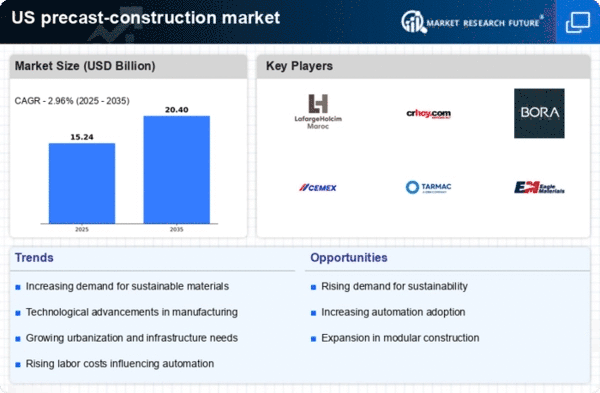
As per Market Research Future analysis, the US precast-construction market size was estimated at 14.8 USD Billion in 2024. The US precast-construction market is projected to grow from 15.24 USD Billion in 2025 to 20.4 USD Billion by 2035, exhibiting a compound annual growth rate (CAGR) of 2.9% during the forecast period 2025 - 2035

Key Market Trends & Highlights

The US pre cast-construction market is experiencing a robust shift towards sustainability and technological integration.

  • Sustainability initiatives are increasingly shaping construction practices, driving demand for eco-friendly materials and methods.
  • Technological advancements, particularly in modular construction, are enhancing efficiency and reducing project timelines.
  • The largest segment in the market is residential construction, while the fastest-growing segment is commercial construction.
  • Rising demand for affordable housing and government infrastructure investments are key drivers propelling market growth.

Market Size & Forecast

2024 Market Size 14.8 (USD Billion)
2035 Market Size 20.4 (USD Billion)
CAGR (2025 - 2035) 2.96%

Major Players

LafargeHolcim (CH), CRH (IE), Boral Limited (AU), Cemex (MX), Tarmac (GB), Eagle Materials (US), Forterra (US), Spancrete (US)

Our Impact
Enabled $4.3B Revenue Impact for Fortune 500 and Leading Multinationals
Partnering with 2000+ Global Organizations Each Year
30K+ Citations by Top-Tier Firms in the Industry

US Pre Cast Construction Market Trends

The pre cast-construction market is currently experiencing a notable transformation, driven by advancements in technology and a growing emphasis on sustainability. The integration of innovative materials and construction techniques appears to enhance efficiency and reduce waste, aligning with the increasing demand for environmentally friendly building practices. Furthermore, the market seems to benefit from a rising interest in modular construction, which allows for faster project completion and improved quality control. As stakeholders prioritize cost-effectiveness and durability, the pre cast-construction market is likely to witness a shift towards more standardized solutions that meet diverse architectural needs. In addition, the regulatory landscape is evolving, with new building codes and standards promoting the use of pre cast elements. This regulatory support may encourage wider adoption among builders and developers, as it simplifies compliance and enhances safety. The market's growth trajectory suggests a robust future, characterized by continuous innovation and adaptation to changing consumer preferences. As the construction industry seeks to address challenges such as labor shortages and rising material costs, the pre cast-construction market is poised to play a crucial role in shaping the future of building practices in the US.

Sustainability Initiatives

The pre cast-construction market is increasingly influenced by sustainability initiatives. Builders are adopting eco-friendly materials and practices to minimize environmental impact. This trend aligns with regulatory pressures and consumer preferences for greener construction methods.

Technological Advancements

Technological advancements are reshaping the pre cast-construction market. Innovations in design software and manufacturing processes enhance precision and efficiency. These developments enable faster project delivery and improved quality, appealing to modern construction demands.

Modular Construction Growth

The growth of modular construction is significantly impacting the pre cast-construction market. This approach allows for off-site fabrication of components, leading to reduced construction time and costs. As demand for quick and efficient building solutions rises, modular methods are gaining traction.

US Pre Cast Construction Market Drivers

Increased Focus on Safety Standards

The pre cast-construction market is witnessing an increased emphasis on safety standards and regulations. As construction sites become more complex, the need for safer building practices has gained prominence. Pre cast-construction methods inherently reduce on-site labor, minimizing the risk of accidents and injuries. In the US, regulatory bodies are implementing stricter safety guidelines, which could potentially favor the adoption of pre cast-construction techniques. This shift towards enhanced safety measures is likely to bolster the market, as companies seek to comply with regulations while ensuring worker safety. The pre cast-construction market is thus positioned to benefit from this trend, as it aligns with the industry's commitment to improving safety outcomes.

Rising Demand for Affordable Housing

The pre cast-construction market is experiencing a notable surge in demand for affordable housing solutions. As urban populations continue to grow, the need for cost-effective construction methods becomes increasingly critical. In the US, housing shortages have led to a significant increase in housing prices, prompting developers to seek innovative solutions. Pre cast-construction offers a faster and more economical approach, reducing labor costs and construction time. According to recent data, the pre cast-construction market is projected to grow at a CAGR of approximately 6.5% over the next five years, driven by this demand for affordable housing. This trend indicates a shift towards more efficient building practices, positioning the pre cast-construction market as a viable alternative for meeting housing needs in urban areas.

Government Infrastructure Investments

Government investments in infrastructure are playing a pivotal role in the growth of the pre cast-construction market. The US government has allocated substantial funding for infrastructure projects, including roads, bridges, and public buildings. This influx of capital is expected to enhance the demand for pre cast-construction methods, which offer durability and speed in project completion. Recent reports indicate that federal infrastructure spending is projected to reach $1 trillion by 2027, creating a favorable environment for the pre cast-construction market. The ability to deliver projects efficiently and within budget constraints makes pre cast-construction an attractive option for government contracts, thereby driving market growth.

Sustainability and Environmental Regulations

Sustainability concerns are increasingly influencing the pre cast-construction market. With growing awareness of environmental issues, regulatory frameworks are evolving to promote sustainable building practices. The US has seen a rise in environmental regulations that encourage the use of eco-friendly materials and construction methods. Pre cast-construction, which often utilizes recycled materials and reduces waste, aligns well with these sustainability goals. As a result, companies in the pre cast-construction market are likely to adopt greener practices to comply with regulations and meet consumer demand for sustainable solutions. This trend not only enhances the market's appeal but also positions it favorably in a competitive landscape.

Technological Integration in Construction Processes

The integration of advanced technologies in construction processes is significantly impacting the pre cast-construction market. Innovations such as Building Information Modeling (BIM) and automation are streamlining design and manufacturing processes, leading to increased efficiency and precision. In the US, the adoption of these technologies is expected to enhance the quality and speed of pre cast-construction projects. As companies leverage technology to optimize their operations, the pre cast-construction market is likely to experience growth driven by improved project outcomes. This technological shift not only reduces costs but also enhances collaboration among stakeholders, making pre cast-construction an attractive option for modern construction needs.

Market Segment Insights

By Type: Precast Concrete Components (Largest) vs. Precast Concrete Panels (Fastest-Growing)

In the US pre cast-construction market, the segment distribution shows that precast concrete components hold a significant share, dominating the overall market landscape. Precast concrete panels, while not as large, are emerging as a rapidly growing segment due to increasing demand for efficient construction practices. Other segments like precast concrete systems and precast concrete blocks are also relevant but lag behind in terms of market size and share. The growth trends indicate that precast concrete panels are benefiting from advancements in technology and changing consumer preferences towards sustainable building practices. Factors such as the rising adoption of off-site construction methodologies and enhanced design capabilities contribute to the accelerated growth in this segment. The overall market is shifting towards more modular and hybrid solutions, fostering a dynamic environment for innovation and competition.

Precast Concrete Components (Dominant) vs. Precast Concrete Systems (Emerging)

Precast concrete components are characterized by their extensive application across various construction projects, serving as the backbone of structural integrity and efficiency. They are traditionally favored for large-scale developments due to their strength and durability. On the other hand, precast concrete systems, though considered emerging, showcase a growing trend towards integrated modular designs that facilitate quicker assembly and reduced onsite labor. This shift is driven by the need for faster project completion times and cost-effectiveness, positioning precast concrete systems as a viable alternative in the evolving construction landscape. Both segments play crucial roles, but precast concrete components remain the dominant force, while precast concrete systems are gradually gaining recognition in specialized applications.

By Construction Type: Residential (Largest) vs. Commercial (Fastest-Growing)

In the US pre cast-construction market, the residential segment holds the largest market share, driven by an increasing demand for affordable housing solutions. The rise in urbanization and population growth has significantly bolstered this segment, making it the dominant player in the overall market. In contrast, the commercial segment, while smaller, is rapidly gaining traction and is recognized as the fastest-growing segment due to the expansion of businesses and the ongoing recovery from the pandemic-related economic downturn. Growth trends indicate a strong push towards sustainability and efficiency across all construction types, particularly within the residential and commercial sectors. The adoption of innovative construction methods and materials enhances speed and reduces costs, which is appealing to developers and investors alike. Infrastructure funding initiatives and urban renewal projects also support growth in these areas, ensuring a positive outlook for both segments in the coming years.

Residential (Dominant) vs. Commercial (Emerging)

The residential segment of the US pre cast-construction market stands out as the dominant force, characterized by a significant volume of housing projects that utilize precast methods for efficiency and durability. This segment caters to a diverse range of housing needs, including single-family homes and multi-unit dwellings, leveraging technology to improve quality and reduce construction timelines. Meanwhile, the commercial segment is emerging, focused on the construction of office spaces, retail establishments, and mixed-use developments. With an increasing number of projects adopting precast technology, this segment is designed to provide faster build times and lower costs while still adhering to high standards of safety and environmental considerations. As both segments evolve, their distinct characteristics highlight their respective roles in shaping the future landscape of construction.

By Application: Building Structures (Largest) vs. Pavements (Fastest-Growing)

The application segment in the US pre cast-construction market is characterized by a diverse array of structures including building structures, bridges, tunnels, and pavements. Among these, building structures hold the largest share, reflecting a robust demand for residential and commercial developments that prioritize speed and efficiency. Pavements, on the other hand, are rapidly gaining traction as infrastructure developments accelerate, particularly in urban areas. This distribution showcases the versatile applications of precast construction methods across different segments of the market. Growth in this segment is driven by increasing urbanization, a rise in infrastructure spending, and the need for quicker construction methods that precast technology provides. Building structures are favored for their robustness and reduced construction time, while pavements are emerging strongly due to advancements in materials that enhance durability and sustainability. As environmental concerns rise, the demand for innovative precast solutions further propels growth across all application areas, fostering competitive advancements in the industry.

Building Structures (Dominant) vs. Pavements (Emerging)

Building structures in the US pre cast-construction market are recognized for their durability and efficiency, making them the dominant application in this segment. With increasing demand for faster construction timelines, precast technology has provided significant advantages, positioning building structures as a preferred choice for both residential and commercial developers. In contrast, pavements represent an emerging value in this market, showcasing rapid growth due to the modernization of urban infrastructure. Technological innovations in precast materials have enhanced the durability of pavements, making them increasingly viable for city planners focused on sustainable and resilient infrastructure solutions. As these two segments evolve, they reflect the dynamic nature of the market where established and emerging applications continue to reshape construction methodologies.

By End-use: Public Sector (Largest) vs. Private Sector (Fastest-Growing)

The market share distribution in the US pre cast-construction market highlights the Public Sector as the dominant player, holding a significant portion of the overall market. This segment benefits from substantial investments in infrastructure and public projects, which continue to drive demand. On the other hand, the Private Sector is emerging quickly, with a growing share as more private developers and construction firms recognize the benefits of pre cast construction methods. Both sectors are crucial, but their dynamics reveal distinct opportunities and challenges in market growth. Growth trends indicate a favorable landscape for both sectors, fueled by various drivers. The Public Sector is supported by government initiatives aimed at enhancing infrastructure resilience, while the Private Sector is experiencing a surge due to urbanization and demand for faster construction solutions. The adoption of innovative technologies and sustainability practices further advances the market, making pre cast construction an appealing choice across both sectors.

Public Sector (Dominant) vs. Private Sector (Emerging)

The Public Sector in the US pre cast-construction market represents a cornerstone of demand, driven primarily by large-scale infrastructure projects and government-funded initiatives. This segment is characterized by long-term contracts and stable funding, which provide assurance for suppliers and contractors involved. In contrast, the Private Sector is witnessing rapid growth, fueled by increased investments in commercial and residential developments. This emerging segment is characterized by its agility, allowing for shorter project timelines and innovative building solutions that meet evolving market needs. Together, these segments illustrate the diverse applications of pre cast construction, ensuring a balanced and dynamic market landscape.

Get more detailed insights about US Pre Cast Construction Market

Key Players and Competitive Insights

The pre cast-construction market is currently characterized by a dynamic competitive landscape, driven by factors such as increasing urbanization, infrastructure development, and a growing emphasis on sustainability. Major players like LafargeHolcim (CH), CRH (IE), and Forterra (US) are strategically positioning themselves through innovation and regional expansion. LafargeHolcim (CH) focuses on enhancing its product offerings with sustainable materials, while CRH (IE) emphasizes mergers and acquisitions to bolster its market presence. Forterra (US) is investing in digital transformation to streamline operations, collectively shaping a competitive environment that prioritizes efficiency and sustainability.Key business tactics within this market include localizing manufacturing and optimizing supply chains to enhance responsiveness to regional demands. The competitive structure appears moderately fragmented, with several key players exerting influence over market dynamics. This fragmentation allows for niche players to thrive, while larger companies leverage their scale to optimize costs and expand their reach.

In October LafargeHolcim (CH) announced a partnership with a leading technology firm to develop AI-driven solutions for precast concrete production. This strategic move is likely to enhance operational efficiency and reduce waste, aligning with the growing trend towards sustainability in construction. The integration of AI technologies may also provide LafargeHolcim (CH) with a competitive edge in terms of product quality and customization.

In September Forterra (US) launched a new line of eco-friendly precast products designed to meet the increasing demand for sustainable building materials. This initiative not only reflects the company's commitment to environmental stewardship but also positions it favorably in a market that is increasingly prioritizing green construction practices. The introduction of these products could potentially attract environmentally conscious clients and projects.

In August CRH (IE) completed the acquisition of a regional precast manufacturer, significantly expanding its footprint in the US market. This acquisition is indicative of CRH's strategy to enhance its market share and diversify its product offerings. By integrating the acquired company's capabilities, CRH (IE) may improve its supply chain efficiency and better serve its customer base.

As of November current trends in the pre cast-construction market include a pronounced shift towards digitalization, sustainability, and the integration of advanced technologies such as AI. Strategic alliances are increasingly shaping the competitive landscape, enabling companies to pool resources and expertise. Looking ahead, competitive differentiation is expected to evolve, with a notable shift from price-based competition to a focus on innovation, technology, and supply chain reliability. This transition underscores the importance of adaptability and forward-thinking strategies in maintaining a competitive edge.

Key Companies in the US Pre Cast Construction Market include

Industry Developments

The US Precast Construction Market is currently experiencing significant developments, particularly with the increasing focus on sustainable construction practices. In September 2023, Coreslab Structures announced the expansion of its operations to meet growing demands in the sustainable building sector, reinforcing its position in the market. Similarly, Forterra unveiled a new range of eco-friendly precast products aimed at reducing the carbon footprint of construction projects. In August 2023, U.S. Concrete reported a 12% growth in revenue, driven by heightened infrastructure investments, translating into increased market valuations for key players.

In terms of mergers and acquisitions, there was notable news when Oldcastle Infrastructure acquired a regional precast manufacturer in July 2023, enhancing its capabilities in the eastern US market. Additionally, Spancrete is reportedly exploring opportunities for strategic partnerships to leverage innovative technologies in precast solutions. The overall market is witnessing an upward trend, with major companies like High Concrete Group and Tindall Corporation adapting to emerging technologies and sustainable practices to remain competitive in this evolving landscape.

This growth trend is supported by federal infrastructure initiatives aimed at revitalizing the construction industry, reflecting the vital role precast construction plays in the US economy.

Future Outlook

US Pre Cast Construction Market Future Outlook

The pre cast-construction market is projected to grow at a 2.96% CAGR from 2025 to 2035, driven by technological advancements, sustainability initiatives, and increasing demand for efficient construction methods.

New opportunities lie in:

  • Development of modular pre cast components for rapid assembly on-site.
  • Integration of smart technology in pre cast elements for enhanced building performance.
  • Expansion into renewable energy infrastructure using pre cast solutions.

By 2035, the pre cast-construction market is expected to achieve robust growth and increased market share.

Market Segmentation

US Pre Cast Construction Market Type Outlook

  • Precast Concrete Components
  • Precast Concrete Systems
  • Precast Concrete Panels
  • Precast Concrete Blocks

US Pre Cast Construction Market End-use Outlook

  • Public Sector
  • Private Sector

US Pre Cast Construction Market Application Outlook

  • Building Structures
  • Bridges
  • Tunnels
  • Pavements

US Pre Cast Construction Market Construction Type Outlook

  • Residential
  • Commercial
  • Industrial
  • Infrastructure

Report Scope

MARKET SIZE 2024 14.8(USD Billion)
MARKET SIZE 2025 15.24(USD Billion)
MARKET SIZE 2035 20.4(USD Billion)
COMPOUND ANNUAL GROWTH RATE (CAGR) 2.96% (2025 - 2035)
REPORT COVERAGE Revenue Forecast, Competitive Landscape, Growth Factors, and Trends
BASE YEAR 2024
Market Forecast Period 2025 - 2035
Historical Data 2019 - 2024
Market Forecast Units USD Billion
Key Companies Profiled LafargeHolcim (CH), CRH (IE), Boral Limited (AU), Cemex (MX), Tarmac (GB), Eagle Materials (US), Forterra (US), Spancrete (US)
Segments Covered Type, Construction Type, Application, End-use
Key Market Opportunities Integration of advanced automation technologies enhances efficiency in the pre cast-construction market.
Key Market Dynamics Technological advancements and regulatory changes drive innovation and efficiency in the pre cast-construction market.
Countries Covered US
Leave a Comment

FAQs

What is the projected market size of the US Precast Construction Market in 2024?

The US Precast Construction Market is expected to be valued at 28.0 USD Billion in 2024.

How much is the US Precast Construction Market expected to grow by 2035?

By 2035, the US Precast Construction Market is projected to reach a value of 53.0 USD Billion.

What is the expected CAGR for the US Precast Construction Market between 2025 and 2035?

The market is expected to grow at a CAGR of 5.972% from 2025 to 2035.

Which segment holds a significant share in the US Precast Construction Market in 2024?

In 2024, the Floors & Roofs segment is valued at 8.0 USD Billion, making it a significant share in the market.

What are the market values for Utility Vaults in the US Precast Construction Market by 2035?

The market value for Utility Vaults is projected to reach 6.0 USD Billion by 2035.

Who are the leading players in the US Precast Construction Market?

Major players include Coreslab Structures, Spancrete, Stresscon Corporation, and Forterra.

What is the projected market size for Pipes in the US Precast Construction Market in 2024?

The market size for Pipes is expected to be 6.0 USD Billion in 2024.

What is the anticipated market growth for Columns & Beams by 2035?

By 2035, the Columns & Beams segment is expected to grow to 12.0 USD Billion.

How does the Paving Slabs segment compare in value between 2024 and 2035?

The value for Paving Slabs is expected to double from 5.0 USD Billion in 2024 to 10.0 USD Billion in 2035.

What opportunities exist in the US Precast Construction Market considering current trends?

There are significant growth opportunities driven by increasing infrastructure investments and sustainable construction practices.

Download Free Sample

Kindly complete the form below to receive a free sample of this Report

Compare Licence

×
Features License Type
Single User Multiuser License Enterprise User
Price $4,950 $5,950 $7,250
Maximum User Access Limit 1 User Upto 10 Users Unrestricted Access Throughout the Organization
Free Customization
Direct Access to Analyst
Deliverable Format
Platform Access
Discount on Next Purchase 10% 15% 15%
Printable Versions