×
Request Free Sample ×

Kindly complete the form below to receive a free sample of this Report

* Please use a valid business email

Leading companies partner with us for data-driven Insights

clients tt-cursor
Hero Background

US Portable Medical Ventilators Market

ID: MRFR/MED/18472-HCR
100 Pages
Garvit Vyas
February 2026

US Portable Medical Ventilators Market Research Report By Mode (combined-mode ventilation, pressure-mode ventilation, volume-mode ventilation, others), By Interface (non-invasive ventilation, invasive ventilation), By Age Group (infant/neonatal ventilators, adult/pediatric ventilators) and By End User (hospitals and clinics, ambulatory care centers, home care settings, others) - Growth & Industry Forecast 2025 To 2035

Share:
Download PDF ×

We do not share your information with anyone. However, we may send you emails based on your report interest from time to time. You may contact us at any time to opt-out.

US Portable Medical Ventilators Market Infographic
Purchase Options

US Portable Medical Ventilators Market Summary

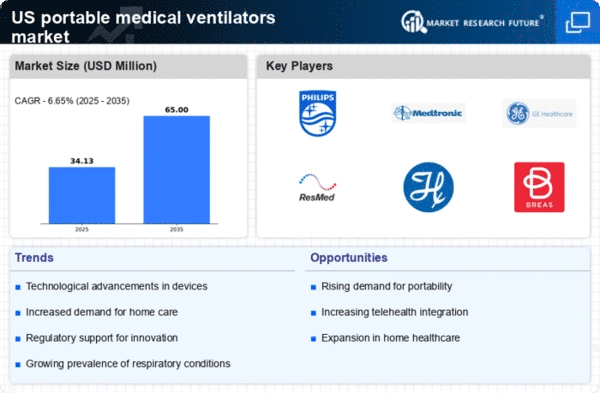
As per Market Research Future analysis, the US Portable Medical Ventilators Market size was estimated at 32.0 USD Million in 2024.. The US portable medical-ventilators market is projected to grow from 34.13 USD Million in 2025 to 65.0 USD Million by 2035, exhibiting a compound annual growth rate (CAGR) of 6.6% during the forecast period 2025 - 2035

Key Market Trends & Highlights

The US portable medical-ventilators market is experiencing robust growth driven by technological advancements and increasing demand for home healthcare solutions.

  • Technological advancements are enhancing the efficiency and functionality of portable medical-ventilators.
  • The home healthcare segment is the fastest-growing, reflecting a shift towards more personalized patient care.
  • Regulatory support is fostering innovation and ensuring safety standards in the portable ventilator market.
  • Rising prevalence of respiratory diseases and an aging population are key drivers propelling market expansion.

Market Size & Forecast

2024 Market Size 32.0 (USD Million)
2035 Market Size 65.0 (USD Million)
CAGR (2025 - 2035) 6.65%

Major Players

Philips (NL), Medtronic (IE), GE Healthcare (GB), ResMed (AU), Hamilton Medical (CH), Breas Medical (SE), Dräger (DE), Smiths Medical (GB), Airon (US)

Our Impact
Enabled $4.3B Revenue Impact for Fortune 500 and Leading Multinationals
Partnering with 2000+ Global Organizations Each Year
30K+ Citations by Top-Tier Firms in the Industry

US Portable Medical Ventilators Market Trends

The US Portable Medical Ventilators Market is currently experiencing notable growth, driven by advancements in technology and increasing demand for home healthcare solutions. Innovations in design and functionality are making these devices more user-friendly and efficient, which appears to enhance their appeal among healthcare providers and patients alike. Furthermore, the rising prevalence of respiratory diseases is likely to contribute to the sustained demand for portable medical ventilators. As healthcare systems evolve, the integration of these devices into various settings, including hospitals and home care, seems to be a growing trend. In addition, regulatory support from government agencies is fostering a favorable environment for manufacturers. This support may include streamlined approval processes for new devices, which could encourage innovation and competition within the market. The emphasis on patient-centered care is also influencing the development of portable medical ventilators, as stakeholders seek to provide more accessible and effective solutions for respiratory support. Overall, the market appears poised for continued expansion, with various factors indicating a positive trajectory in the coming years.

Technological Advancements

Recent innovations in portable medical-ventilators are enhancing their functionality and ease of use. Manufacturers are focusing on developing devices that are lighter, more compact, and equipped with advanced monitoring features. These improvements are likely to make ventilators more accessible for both healthcare professionals and patients.

Increased Demand for Home Healthcare

The trend towards home healthcare is influencing the portable medical-ventilators market significantly. As more patients prefer receiving care at home, the need for reliable and efficient ventilators is growing. This shift may lead to an increase in product offerings tailored for home use.

Regulatory Support and Standards

Government agencies are playing a crucial role in shaping the portable medical-ventilators market through regulatory support. Streamlined approval processes and updated standards are encouraging manufacturers to innovate and bring new products to market, which could enhance competition and improve patient outcomes.

US Portable Medical Ventilators Market Drivers

Shift Towards Home Healthcare Solutions

The trend towards home healthcare solutions is reshaping the portable medical-ventilators market. Patients increasingly prefer receiving care in the comfort of their homes, which has led to a growing demand for portable medical-ventilators that facilitate this transition. Home healthcare not only enhances patient comfort but also reduces the burden on healthcare facilities. According to a report from the National Association for Home Care & Hospice, the home healthcare market is expected to reach $173 billion by 2026, indicating a robust growth trajectory. This shift is likely to drive innovation in portable medical-ventilators, as manufacturers strive to develop devices that are not only effective but also easy to use in a home setting. The market is thus expected to expand as more patients opt for home-based respiratory care.

Technological Innovations in Ventilation

Technological advancements in the design and functionality of portable medical-ventilators are significantly influencing the market. Innovations such as improved battery life, enhanced portability, and user-friendly interfaces are making these devices more accessible and efficient for both healthcare professionals and patients. The integration of smart technology, including connectivity features that allow remote monitoring, is also gaining traction. As a result, the portable medical-ventilators market is experiencing a surge in demand, with manufacturers investing in research and development to create cutting-edge products. The market is expected to grow at a compound annual growth rate (CAGR) of around 8% over the next few years, driven by these technological advancements that enhance the overall user experience and patient care.

Increased Focus on Emergency Preparedness

The heightened focus on emergency preparedness in the US is influencing the portable medical-ventilators market. Natural disasters, pandemics, and other emergencies necessitate the availability of portable medical equipment to ensure that patients receive timely care. As healthcare facilities and emergency response teams recognize the importance of having portable medical-ventilators on hand, the demand for these devices is likely to increase. Government initiatives aimed at improving emergency response capabilities further support this trend. The portable medical-ventilators market is expected to benefit from increased investments in emergency preparedness, as stakeholders prioritize the acquisition of essential medical equipment to enhance patient care during crises.

Rising Prevalence of Respiratory Diseases

The increasing incidence of respiratory diseases in the US is a primary driver for the portable medical-ventilators market. Conditions such as chronic obstructive pulmonary disease (COPD) and asthma are becoming more prevalent, affecting millions of individuals. According to the Centers for Disease Control and Prevention (CDC), approximately 16 million Americans are diagnosed with COPD, and many more remain undiagnosed. This growing patient population necessitates the availability of portable medical-ventilators, as they provide essential support for patients requiring respiratory assistance. The market is projected to expand as healthcare providers seek efficient solutions to manage these chronic conditions, thereby enhancing patient outcomes and reducing hospital readmission rates. Consequently, the demand for portable medical-ventilators is likely to rise, reflecting the urgent need for effective respiratory care solutions in the US healthcare system.

Aging Population and Increased Healthcare Needs

The aging population in the US is a significant driver for the portable medical-ventilators market. As individuals age, they often experience a decline in respiratory function, leading to an increased need for respiratory support. The US Census Bureau projects that by 2030, all baby boomers will be over 65 years old, resulting in a substantial rise in the elderly population. This demographic shift is likely to create a higher demand for portable medical-ventilators, as older adults may prefer home care solutions that allow them to maintain independence while receiving necessary medical support. The market is poised for growth as healthcare systems adapt to meet the needs of this aging population, emphasizing the importance of portable medical-ventilators in providing effective respiratory care.


Market Segment Insights

By Mode: Combined-mode ventilation (Largest) vs. Pressure-mode ventilation (Fastest-Growing)

The market for portable medical-ventilators shows a diverse distribution among the different modes of ventilation. Combined-mode ventilation holds the largest share, reflecting its widespread adoption due to its versatility in patient care. Pressure-mode ventilation, while smaller in share, is rapidly gaining traction as healthcare facilities look for advanced ventilatory support in critical scenarios. As medical technology evolves, these segment values represent critical options for healthcare providers navigating patient treatment requirements. Growth trends indicate a significant shift toward combined-mode ventilation as hospitals and clinics increasingly recognize its adaptability for various patient needs. Meanwhile, pressure-mode ventilation is on the rise as it caters to specific patient populations needing more tailored respiratory support. Factors such as emerging respiratory diseases and an aging population are driving demand, underscoring the importance of these technologies in modern medical care.

Combined-mode ventilation (Dominant) vs. Pressure-mode ventilation (Emerging)

Combined-mode ventilation is characterized by its ability to deliver both pressure and volume controls within a single ventilation strategy, making it the preferred choice for many clinicians. This mode supports a wide range of patient needs, from those requiring basic assistance to those in critical condition. On the other hand, pressure-mode ventilation emerges as a focused approach, designed to optimize patient-specific requirements, particularly for patients with complex respiratory issues. Its rapid growth is attributed to advancements in technology that enhance patient and clinician experience. As each segment continues to evolve, providers are better equipped to make informed decisions about ventilatory support, ensuring that patient care remains at the forefront of the US portable medical-ventilators market.

By Interface: Non-invasive ventilation (Largest) vs. Invasive ventilation (Fastest-Growing)

In the US portable medical-ventilators market, the interface segment is primarily divided into non-invasive and invasive ventilation. Non-invasive ventilation currently holds a larger market share due to the rising preference for non-invasive methods that offer patient comfort and ease of use. This approach is favored in various clinical settings, resulting in its significant adoption among healthcare providers. In contrast, invasive ventilation, though initially smaller in market share, is experiencing robust growth driven by increasing demand in critical care environments requiring higher levels of intervention. The growth trend for the interface segment reflects broader technological advancements and evolving patient care practices. Non-invasive ventilation thrives on developments in devices that allow effective respiratory support without invasive procedures, contributing to lower complication rates and faster recovery times. Meanwhile, invasive ventilation is expanding quickly due to its necessity in acute scenarios, propelled by a growing patient population with severe respiratory conditions that require intensive monitoring and management. Companies are continually innovating in this space, enhancing the efficacy and safety of invasive techniques.

Interface: Non-invasive ventilation (Dominant) vs. Invasive ventilation (Emerging)

Non-invasive ventilation has established itself as the dominant force within the interface segment of the US portable medical-ventilators market. It is characterized by user-friendly designs that facilitate ease of access and are associated with better patient outcomes due to decreased risk of infection and discomfort. The growing awareness and clinical evidence supporting its efficacy contribute to its prevalence. Invasive ventilation, while emerging, has gained traction in critical care settings given its necessity for treating patients with acute respiratory failure or conditions requiring ventilatory support. Its growth is driven by technological improvements and an increasing number of patients needing intensive respiratory therapy, making it a crucial part of the overall ventilation landscape.

By Age Group: Infant/Neonatal (Largest) vs. Adult/Pediatric (Fastest-Growing)

In the US portable medical-ventilators market, the distribution of market share reveals a significant dominance of infant/neonatal ventilators, which cater specifically to the critical needs of premature and low-birth-weight infants. These ventilators account for the largest segment due to the rising incidence of respiratory conditions among neonates and increasing demand for high-quality, specialized respiratory care. In contrast, adult/pediatric ventilators are experiencing rapid growth, driven by an uptick in chronic respiratory diseases and the expanding geriatric population requiring respiratory support. Growth trends in this segment are influenced by technological advancements, increased healthcare expenditure, and a heightened focus on respiratory health, especially in vulnerable populations. The development of smart ventilators, which offer improved patient monitoring and customization, is propelling the adult/pediatric segment forward. Additionally, the ongoing enhancements in healthcare infrastructure and awareness surrounding respiratory illnesses are further supporting the market expansion for both segment values.

Infant/Neonatal (Dominant) vs. Adult/Pediatric (Emerging)

Infant/neonatal ventilators are characterized by their precision, portability, and ability to cater to the unique respiratory requirements of newborns. Their dominant position in the US portable medical-ventilators market is attributed to the critical care provided in neonatal intensive care units (NICUs) and hospitals, addressing severe conditions such as apnea and respiratory distress syndrome. Meanwhile, adult/pediatric ventilators are emerging as a significant segment, offering flexibility to cater to both age groups with advanced features. These ventilators are increasingly prioritized as they adapt to varying patient needs, especially in emergency care and home healthcare settings, further enhancing their growth potential in the market.

By End-User: Hospitals & Clinics (Largest) vs. Home Care Settings (Fastest-Growing)

In the US portable medical-ventilators market, hospitals and clinics represent the largest segment, capturing significant market share due to their extensive use in critical care settings. This segment benefits from a high demand for ventilatory support as the prevalence of respiratory diseases continues to rise. In contrast, home care settings are emerging as a rapidly growing segment, driven by healthcare trends that encourage patient care at home, particularly post-COVID-19. The growth trends in these segments highlight the increasing reliance on portable medical ventilators in home care settings, fueled by advancements in technology that offer efficient, user-friendly devices. As healthcare systems shift towards value-based care, the demand for portable medical ventilators in ambulatory care centers is also rising, helping alleviate pressure on hospitals. Factors like an aging population and increased respiratory illnesses further accelerate the adoption of these devices across all segments.

Hospitals & Clinics: Dominant vs. Home Care Settings: Emerging

Hospitals and clinics serve as the dominant segment within the US portable medical-ventilators market, primarily due to their significant need for advanced respiratory support systems. These facilities utilize a range of ventilators designed for different patient needs, ensuring optimal care for critically ill patients. On the other hand, home care settings represent an emerging segment, characterized by a shift towards more personalized patient care. This segment is benefiting from innovations in portable ventilation technology, which offer compact, easy-to-use devices suitable for patient use outside traditional hospital environments. The rise of telehealth services is also contributing to this growth, as patients increasingly receive respiratory support in the comfort of their homes, which enhances their recovery experience.

Get more detailed insights about US Portable Medical Ventilators Market

Key Players and Competitive Insights

The portable medical-ventilators market is characterized by a dynamic competitive landscape, driven by technological advancements, increasing healthcare demands, and a growing emphasis on patient-centric solutions. Key players such as Philips (NL), Medtronic (IE), and ResMed (AU) are at the forefront, each adopting distinct strategies to enhance their market positioning. Philips (NL) focuses on innovation and digital health integration, aiming to provide comprehensive respiratory solutions. Medtronic (IE) emphasizes strategic partnerships and acquisitions to expand its product portfolio and enhance its technological capabilities. ResMed (AU) is heavily investing in AI-driven technologies to improve patient outcomes and streamline operations. Collectively, these strategies contribute to a competitive environment that is increasingly centered around innovation and technological integration.
In terms of business tactics, companies are localizing manufacturing and optimizing supply chains to enhance efficiency and responsiveness to market demands. The market structure appears moderately fragmented, with several key players exerting influence while also allowing for niche entrants. This fragmentation fosters a competitive atmosphere where innovation and operational excellence are paramount, as companies strive to differentiate themselves in a crowded marketplace.
In October 2025, Philips (NL) announced the launch of a new portable ventilator model designed specifically for home care settings. This strategic move is significant as it aligns with the growing trend of at-home healthcare solutions, catering to a demographic increasingly seeking convenience and comfort. By enhancing its product offerings in this segment, Philips (NL) positions itself to capture a larger share of the market, responding to evolving patient needs.
In September 2025, Medtronic (IE) completed the acquisition of a leading AI healthcare analytics firm, which is expected to bolster its capabilities in predictive analytics for ventilator management. This acquisition is strategically important as it allows Medtronic (IE) to integrate advanced data analytics into its ventilator systems, potentially improving patient monitoring and outcomes. Such a move underscores the company's commitment to leveraging technology to enhance its product offerings and operational efficiency.
In August 2025, ResMed (AU) launched a new cloud-based platform that integrates its ventilators with telehealth services, enabling real-time patient monitoring and support. This initiative reflects a broader trend towards digital health solutions, emphasizing the importance of connectivity in modern healthcare. By enhancing its product ecosystem with telehealth capabilities, ResMed (AU) not only improves patient engagement but also positions itself as a leader in the integration of technology and healthcare.
As of November 2025, current competitive trends in the portable medical-ventilators market include a strong focus on digitalization, sustainability, and AI integration. Strategic alliances are increasingly shaping the landscape, as companies collaborate to enhance their technological capabilities and market reach. Looking ahead, competitive differentiation is likely to evolve from traditional price-based competition towards a focus on innovation, advanced technology, and supply chain reliability. This shift suggests that companies that prioritize these areas will be better positioned to thrive in an increasingly complex and demanding market.

Key Companies in the US Portable Medical Ventilators Market include

Industry Developments

The US Portable Medical Ventilators Market has seen significant developments recently. In March 2023, ResMed announced an expansion of its portfolio with new advanced features for its portable ventilators, enhancing usability for patients with chronic respiratory conditions. Meanwhile, Hamilton Medical has focused on innovative technology integration, emphasizing efficiency and patient safety. Current affairs indicate that sourcing components remains a challenge due to supply chain disruptions, impacting delivery timelines for several manufacturers like Medtronic and Philips.

In terms of mergers and acquisitions, Ventec Life Systems and General Electric signed a collaboration agreement in August 2022 to enhance production capabilities, significantly responding to surging demand during the pandemic. Further, Bunnell Incorporated received investments in July 2023 for expanding its production lines to meet increasing market needs, improving overall capacity. The recent valuation growth of these companies is predominantly driven by rising demand for portable solutions in critical care settings and the need for decentralized healthcare options across the US.

The last couple of years have witnessed regulatory changes enhancing patient access, notably accelerated by the COVID-19 pandemic, which has substantially influenced the landscape of the portable ventilator market.

Future Outlook

US Portable Medical Ventilators Market Future Outlook

The Portable Medical Ventilators Market is projected to grow at a 6.65% CAGR from 2025 to 2035, driven by technological advancements, increasing healthcare demands, and rising awareness of respiratory diseases.

New opportunities lie in:

  • Development of portable ventilators with integrated telehealth capabilities.
  • Expansion into home healthcare markets with user-friendly designs.
  • Partnerships with emergency services for rapid deployment solutions.

By 2035, the market is expected to achieve substantial growth, reflecting evolving healthcare needs.

Market Segmentation

US Portable Medical Ventilators Market Mode Outlook

  • Combined-mode ventilation
  • Pressure-mode ventilation
  • Volume-mode ventilation
  • Others

US Portable Medical Ventilators Market End-User Outlook

  • Hospitals & clinics
  • Ambulatory care centers
  • Home care settings

US Portable Medical Ventilators Market Age Group Outlook

  • Infant/neonatal ventilators
  • Adult/pediatric ventilators

US Portable Medical Ventilators Market Interface Outlook

  • Non-invasive ventilation
  • Invasive ventilation

Report Scope

MARKET SIZE 2024 32.0(USD Million)
MARKET SIZE 2025 34.13(USD Million)
MARKET SIZE 2035 65.0(USD Million)
COMPOUND ANNUAL GROWTH RATE (CAGR) 6.65% (2025 - 2035)
REPORT COVERAGE Revenue Forecast, Competitive Landscape, Growth Factors, and Trends
BASE YEAR 2024
Market Forecast Period 2025 - 2035
Historical Data 2019 - 2024
Market Forecast Units USD Million
Key Companies Profiled Philips (NL), Medtronic (IE), GE Healthcare (GB), ResMed (AU), Hamilton Medical (CH), Breas Medical (SE), Dräger (DE), Smiths Medical (GB), Airon (US)
Segments Covered Mode, Interface, Age Group, End-User
Key Market Opportunities Advancements in battery technology enhance portability and usability in the portable medical-ventilators market.
Key Market Dynamics Technological advancements and regulatory changes drive innovation in the portable medical-ventilators market.
Countries Covered US
Leave a Comment

FAQs

What is the expected market size of the US Portable Medical Ventilators Market in 2024?

The US Portable Medical Ventilators Market is expected to be valued at 28.0 million USD in 2024.

What will the market value be by 2035?

The market is projected to reach 55.0 million USD by the year 2035.

What is the anticipated CAGR for the market from 2025 to 2035?

The expected compound annual growth rate (CAGR) for the market during this period is 6.33%.

Who are the major players in the US Portable Medical Ventilators Market?

Key players include Hamilton Medical, ResMed, Smiths Medical, Medtronic, and Philips among others.

What is the market size for combined-mode ventilation in 2024?

In 2024, the combined-mode ventilation segment is valued at 10.5 million USD.

How much is the pressure-mode ventilation segment expected to be worth by 2035?

The pressure-mode ventilation segment is expected to reach 16.0 million USD by 2035.

What are the projected values for volume-mode ventilation by 2035?

The volume-mode ventilation segment is anticipated to grow to 12.0 million USD in 2035.

What challenges might the US Portable Medical Ventilators Market face in the coming years?

Potential challenges may include increasing competition and regulatory issues affecting market dynamics.

What trends and opportunities are expected to emerge in this market?

Emerging trends may focus on technological advancements and enhanced patient monitoring features in ventilators.

How are current global events impacting the Portable Medical Ventilators Market?

Current global events may influence supply chain dynamics and demand patterns for portable medical ventilators.

Download Free Sample

Kindly complete the form below to receive a free sample of this Report

Compare Licence

×
Features License Type
Single User Multiuser License Enterprise User
Price $4,950 $5,950 $7,250
Maximum User Access Limit 1 User Upto 10 Users Unrestricted Access Throughout the Organization
Free Customization
Direct Access to Analyst
Deliverable Format
Platform Access
Discount on Next Purchase 10% 15% 15%
Printable Versions