×
Request Free Sample ×

Kindly complete the form below to receive a free sample of this Report

* Please use a valid business email

Leading companies partner with us for data-driven Insights

clients tt-cursor
Hero Background

US Polyps Market

ID: MRFR/Pharma/18471-HCR
100 Pages
Garvit Vyas
February 2026

US Polyps Market Research Report By Type (Adenomatous Polyps, Hyperplastic Polyps, Sessile Serrated Polyps, Traditional Serrated Adenomas), By Diagnosis Method (Colonoscopy, Sigmoidoscopy, Endoscopy, Imaging Techniques), By Treatment Method (Polypectomy, Medications, Surveillance, Surgery) and By Patient Demographics (Adults, Senior Citizens, Pediatric) - Growth & Industry Forecast 2025 To 2035

Share:
Download PDF ×

We do not share your information with anyone. However, we may send you emails based on your report interest from time to time. You may contact us at any time to opt-out.

US Polyps Market Infographic
Purchase Options

US Polyps Market Summary

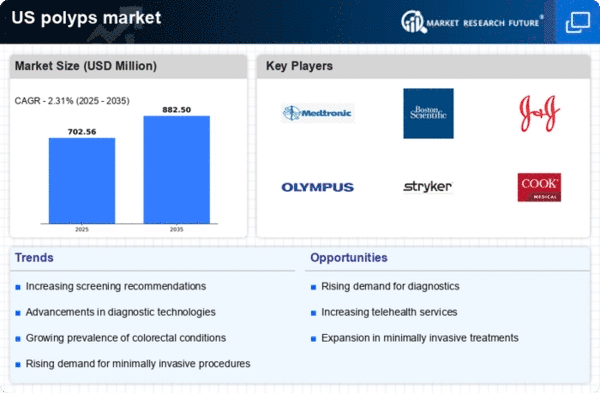
As per Market Research Future analysis, the US polyps market Size was estimated at 686.7 USD Million in 2024. The US polyps market is projected to grow from 702.56 USD Million in 2025 to 882.5 USD Million by 2035, exhibiting a compound annual growth rate (CAGR) of 2.3% during the forecast period 2025 - 2035

Key Market Trends & Highlights

The US polyps market is experiencing a transformative shift driven by technological advancements and increased awareness.

  • Technological advancements in treatment are reshaping the landscape of the US polyps market.
  • The largest segment in this market is the colorectal polyp segment, while the fastest-growing segment is the advanced diagnostic technologies segment.
  • Increased screening and awareness are contributing to a rise in early detection rates, enhancing patient outcomes.
  • Key market drivers include the rising incidence of colorectal cancer and advancements in diagnostic technologies.

Market Size & Forecast

2024 Market Size 686.7 (USD Million)
2035 Market Size 882.5 (USD Million)
CAGR (2025 - 2035) 2.31%

Major Players

Medtronic (US), Boston Scientific (US), Johnson & Johnson (US), Olympus Corporation (JP), Stryker Corporation (US), Cook Medical (US), Conmed Corporation (US), B. Braun Melsungen AG (DE)

Our Impact
Enabled $4.3B Revenue Impact for Fortune 500 and Leading Multinationals
Partnering with 2000+ Global Organizations Each Year
30K+ Citations by Top-Tier Firms in the Industry

US Polyps Market Trends

The polyps market is currently experiencing notable developments driven by advancements in medical technology and increasing awareness regarding gastrointestinal health. The rise in diagnostic procedures, such as colonoscopies, has led to a greater detection rate of polyps, which in turn influences treatment options and market dynamics. Furthermore, the growing emphasis on preventive healthcare is prompting more individuals to seek regular screenings, thereby expanding the patient base for polyp-related treatments. This trend appears to be supported by various health initiatives aimed at reducing colorectal cancer incidence, which is often linked to untreated polyps. In addition, the polyps market is witnessing a shift towards minimally invasive procedures. Innovations in endoscopic techniques and tools are enhancing the efficiency and safety of polyp removal. As healthcare providers increasingly adopt these advanced methods, patient outcomes are likely to improve, fostering greater trust in medical interventions. The interplay between technological advancements and patient preferences is shaping the future landscape of this market, suggesting a potential for sustained growth as awareness and treatment options continue to evolve.

Technological Advancements in Treatment

Recent innovations in medical technology are transforming the landscape of the polyps market. Enhanced endoscopic techniques and tools are facilitating more effective and safer polyp removal procedures. This trend is likely to attract more patients seeking minimally invasive options, thereby expanding the market.

Increased Screening and Awareness

There is a growing emphasis on preventive healthcare, leading to increased screening for polyps. Public health initiatives are raising awareness about the importance of early detection, which may result in a larger patient population seeking treatment. This trend is expected to drive demand within the polyps market.

Shift Towards Personalized Medicine

The polyps market is gradually moving towards personalized treatment approaches. Tailoring interventions based on individual patient profiles and genetic factors could enhance treatment efficacy. This trend indicates a potential evolution in how healthcare providers address polyp management.

US Polyps Market Drivers

Growing Geriatric Population

The aging population in the US is a significant driver of the polyps market. As individuals age, the risk of developing polyps and colorectal cancer increases, making this demographic particularly vulnerable. The US Census Bureau projects that by 2030, approximately 20% of the population will be aged 65 and older. This demographic shift is likely to lead to a higher demand for screening and treatment services related to polyps. Healthcare providers may need to adapt their services to cater to the needs of older adults, including offering more comprehensive screening options. Consequently, the growth of the geriatric population is expected to contribute to the expansion of the polyps market as healthcare systems respond to the increasing demand.

Government Initiatives and Guidelines

Government initiatives aimed at increasing screening rates for colorectal cancer are playing a pivotal role in shaping the polyps market. The US Preventive Services Task Force recommends regular screening for adults starting at age 45, which has led to a surge in screening programs across the nation. These initiatives are designed to raise awareness about the importance of early detection and treatment of polyps, thereby reducing the incidence of colorectal cancer. As more individuals participate in screening programs, the demand for polyp removal procedures is expected to rise, further propelling the polyps market. Additionally, funding and support for public health campaigns are likely to enhance accessibility to screening services.

Rising Incidence of Colorectal Cancer

The increasing incidence of colorectal cancer in the US is a primary driver for the polyps market. According to the American Cancer Society, colorectal cancer is the third most common cancer, with an estimated 104,270 new cases expected in 2021. This rising trend necessitates enhanced screening and treatment options, thereby propelling the demand for polyp detection and removal procedures. As awareness grows regarding the link between polyps and colorectal cancer, healthcare providers are likely to prioritize early detection strategies. This focus on prevention and early intervention is expected to stimulate growth in the polyps market, as more individuals seek screening and treatment options to mitigate their cancer risk.

Advancements in Diagnostic Technologies

Technological innovations in diagnostic tools are significantly influencing the polyps market. Enhanced imaging techniques, such as high-definition endoscopy and chromoendoscopy, allow for more accurate detection of polyps during screening procedures. These advancements not only improve the identification of polyps but also facilitate the assessment of their characteristics, which is crucial for determining the appropriate treatment approach. The integration of artificial intelligence in endoscopic procedures is also emerging, potentially increasing the efficiency and accuracy of polyp detection. As these technologies become more widely adopted, they are likely to drive growth in the polyps market, as healthcare facilities invest in state-of-the-art equipment to enhance patient outcomes.

Increased Focus on Preventive Healthcare

There is a growing emphasis on preventive healthcare in the US, which is influencing the polyps market. As healthcare providers and patients alike recognize the importance of early detection and prevention of diseases, the demand for screening procedures for polyps is likely to increase. Preventive measures, including regular colonoscopies, are being promoted as essential components of healthcare, particularly for individuals at higher risk. This shift towards preventive care is supported by various health organizations advocating for routine screenings. As a result, the polyps market may experience growth as more individuals seek preventive services to identify and address polyps before they develop into more serious health issues.


Market Segment Insights

By Type: Adenomatous Polyps (Largest) vs. Sessile Serrated Polyps (Fastest-Growing)

In the US polyps market, the distribution of market share among different types of polyps reveals that Adenomatous Polyps constitute the largest segment. This type accounts for a significant portion of the overall market due to its prevalence and recognition as a key risk factor for colorectal cancer. In contrast, Hyperplastic Polyps and Traditional Serrated Adenomas follow, but their market share is considerably less, reflecting less common occurrence and recognition in clinical practices. Growth trends in the US polyps market indicate that while Adenomatous Polyps maintain a strong foothold, Sessile Serrated Polyps are emerging rapidly. The increasing awareness of colorectal cancer screening and the role of these polyps in cancer progression have driven their growth. Factors such as advancements in diagnostic techniques and improved screening programs are expected to play pivotal roles in shaping the future of this segment, propelling Sessile Serrated Polyps into higher market prominence.

Adenomatous Polyps (Dominant) vs. Sessile Serrated Polyps (Emerging)

Adenomatous Polyps are recognized as the dominant segment within the US polyps market, known for their potential to progress into colorectal cancer. Their higher prevalence is attributed to various lifestyle and genetic factors, leading to increased surveillance and intervention strategies. Conversely, Sessile Serrated Polyps are gaining attention as an emerging segment, characterized by their unique histological features and association with an alternative pathway to colorectal cancer. The rise in their detection can be linked to enhanced screening methods and a greater understanding of their clinical significance, positioning them as a critical focus for future research and awareness efforts. As medical professionals continue to educate patients about these polyps, the relevance of Sessile Serrated Polyps is expected to expand.

By Diagnosis Method: Colonoscopy (Largest) vs. Sigmoidoscopy (Fastest-Growing)

In the US polyps market, colonoscopy represents the largest share among diagnosis methods, firmly establishing its role as a preferred choice for early detection and prevention of colorectal issues. Following colonoscopy, sigmoidoscopy has gained traction with a growing share, driven by increasing awareness and endorsements from healthcare professionals. The growth trends seen in this segment are significantly influenced by advances in technology and enhanced imaging techniques that improve diagnostic accuracy. Additionally, more health professionals opt for less invasive methods, contributing to the rising adoption of sigmoidoscopy. These trends are expected to continue, driven by increased screening recommendations and a focus on preventative healthcare, further shaping the landscape of diagnostic methods available in this market.

Diagnosis Methods: Colonoscopy (Dominant) vs. Sigmoidoscopy (Emerging)

Colonoscopy is widely recognized as the dominant method in the US polyps market, favored for its comprehensive ability to inspect the entire colon and facilitate biopsy procedures when necessary. Its established safety and efficacy have solidified its position, making it the choice for thorough evaluations. In contrast, sigmoidoscopy is seen as an emerging alternative, particularly appealing due to its less invasive nature and typically shorter procedural time. As medical professionals advocate for more convenient options, sigmoidoscopy is gradually gaining acceptance, especially within targeted screening programs, leveraging its effectiveness in detecting polyps in the lower rectum and sigmoid colon.

By Treatment Method: Polypectomy (Largest) vs. Medications (Fastest-Growing)

In the US polyps market, the treatment methods are segmented primarily into Polypectomy, Medications, Surveillance, and Surgery. Polypectomy holds the largest market share within this segment as it is widely recognized as the standard approach for polyp removal. Medications, while traditionally overshadowed, have been gaining traction due to advancements in pharmacological options that aid in the management and prevention of polyps, contributing to a notable market share as well. The growth trends in this segment reflect a shift towards less invasive treatment options, with Polypectomy remaining dominant due to its effectiveness. Medications are emerging as a fast-growing alternative, driven by increased awareness about polyp prevention and the benefits of pharmacotherapy in polyp management. This trend is complemented by ongoing research leading to novel drug candidates, enhancing the attractiveness of the medication segment for both patients and healthcare providers.

Polypectomy (Dominant) vs. Medications (Emerging)

Polypectomy remains the dominant treatment method within the US polyps market due to its long-standing efficacy and established practice in clinical settings. This method is often preferred for its direct approach to removing polyps, thereby minimizing the risk of progression to colorectal cancer. On the other hand, the medications segment is rapidly emerging as a viable alternative, especially with the introduction of new drugs that offer preventive benefits. These medications can reduce the recurrence of polyps, making treatment more comprehensive. The dual approach of using both surgical intervention and pharmacological management is increasingly being recognized, providing patients with more personalized treatment options and enhancing overall care.

By Patient Demographics: Adults (Largest) vs. Senior Citizens (Fastest-Growing)

In the US polyps market, the distribution of patients among demographic segments shows that adults constitute the largest segment, primarily due to their higher prevalence of colorectal polyps linked to lifestyle choices and aging processes. Senior citizens are emerging as an increasingly significant demographic as the population ages and awareness around screening and prevention measures improves among this age group. This shift is further supported by healthcare initiatives targeting older adults, enhancing their access to screening and treatment options. Growth trends in the patient demographics segment indicate that the senior citizen population is expanding rapidly, which is likely to drive demand for polyp-related interventions. The increase in preventive healthcare measures, alongside technological advancements in screening procedures, is making it easier for older adults to receive timely diagnosis and care. Meanwhile, the adult segment remains stable, focusing on managing lifestyle-related risks and improving overall health outcomes.

Adults: Dominant vs. Senior Citizens: Emerging

The adults segment in the US polyps market is characterized by a broader age range, with individuals typically between 30 and 65 years old. They represent a substantial portion of polyp cases, largely due to lifestyle factors such as diet, exercise, and smoking habits. Preventive screening initiatives have played a crucial role in identifying polyps within this demographic, driving early intervention efforts. On the other hand, senior citizens are becoming an emerging market segment driven by the aging baby boomer population. They are often more susceptible to polyps due to prolonged exposure to risk factors over their lifetimes, which has heightened the focus on tailored treatment strategies and screening services to cater to their unique healthcare needs.

Get more detailed insights about US Polyps Market

Key Players and Competitive Insights

The polyps market exhibits a dynamic competitive landscape characterized by rapid innovation and strategic maneuvering among key players. Major companies such as Medtronic (US), Boston Scientific (US), and Johnson & Johnson (US) are at the forefront, leveraging their extensive research capabilities and established market presence to drive growth. Medtronic (US) focuses on enhancing its product portfolio through technological advancements, while Boston Scientific (US) emphasizes strategic partnerships to expand its reach. Johnson & Johnson (US) appears to be concentrating on integrating digital health solutions into its offerings, thereby aligning with the growing trend towards personalized medicine. Collectively, these strategies foster a competitive environment that is increasingly driven by innovation and technological integration.In terms of business tactics, companies are localizing manufacturing and optimizing supply chains to enhance operational efficiency. The market structure is moderately fragmented, with several players vying for market share. This fragmentation allows for diverse product offerings and fosters competition, as companies strive to differentiate themselves through unique value propositions. The collective influence of these key players shapes market dynamics, as they continuously adapt to evolving consumer needs and regulatory landscapes.

In October Medtronic (US) announced the launch of a new endoscopic device designed specifically for polyp removal, which is expected to enhance procedural efficiency and patient outcomes. This strategic move underscores Medtronic's commitment to innovation and positions the company to capture a larger share of the market by addressing unmet clinical needs. The introduction of this device may also stimulate further advancements in minimally invasive techniques, thereby influencing overall market trends.

In September Boston Scientific (US) entered into a collaboration with a leading telehealth provider to integrate remote monitoring capabilities into its polyp detection systems. This partnership is strategically significant as it aligns with the increasing demand for digital health solutions, enabling healthcare providers to offer more comprehensive care. By enhancing its product offerings with telehealth features, Boston Scientific (US) is likely to improve patient engagement and satisfaction, which could translate into increased market penetration.

In August Johnson & Johnson (US) expanded its surgical robotics division by acquiring a startup specializing in AI-driven imaging technologies for polyp detection. This acquisition is indicative of the company's strategy to incorporate advanced technologies into its surgical solutions, potentially revolutionizing the polyp removal process. The integration of AI could lead to improved diagnostic accuracy and operational efficiencies, thereby enhancing the overall value proposition of Johnson & Johnson's offerings.

As of November current competitive trends in the polyps market are increasingly defined by digitalization, sustainability, and the integration of AI technologies. Strategic alliances are playing a crucial role in shaping the landscape, as companies seek to leverage complementary strengths to enhance their market positions. Looking ahead, competitive differentiation is likely to evolve from traditional price-based competition towards a focus on innovation, technological advancements, and supply chain reliability. This shift may ultimately redefine how companies engage with healthcare providers and patients, emphasizing the importance of delivering superior value through cutting-edge solutions.

Key Companies in the US Polyps Market include

Industry Developments

In recent developments within the US Polyps Market, companies such as Boston Scientific and Medtronic continue to innovate with new technologies aimed at colorectal cancer screening and treatment. In October 2023, Smith and Nephew announced advancements in minimally invasive surgical techniques, driving further interest in the market. Abbott Laboratories has also been expanding its portfolio to include more diagnostic tools for detecting polyps early. Notable mergers include C.R.

Bard’s acquisition of a smaller firm specializing in endoscopic technologies, enhancing its product offerings in September 2023, while Stryker Corporation acquired a medical device company focusing on polyp removal systems in August 2023.

The market is experiencing notable growth with a reported valuation increase among key players. In recent years, Hoya Corporation launched a new imaging device, while Olympus Corporation introduced innovative endoscopic solutions in early 2022, which have significantly impacted market dynamics. The demand for high-definition imaging systems and advanced polyp detection methods continues to rise, underscoring the growing importance of technology in improving patient outcomes in colorectal health. All these factors reflect the ongoing evolution of the US Polyps Market, driven by technological advances and strategic partnerships among major companies.

Future Outlook

US Polyps Market Future Outlook

The Polyps Market is projected to grow at a 2.31% CAGR from 2025 to 2035, driven by advancements in diagnostic technologies and increasing awareness of preventive healthcare.

New opportunities lie in:

  • Development of AI-driven diagnostic tools for early polyp detection.
  • Expansion of telehealth services for remote patient monitoring.
  • Partnerships with healthcare providers for integrated care solutions.

By 2035, the market is expected to achieve robust growth, reflecting evolving healthcare dynamics.

Market Segmentation

US Polyps Market Type Outlook

  • Adenomatous Polyps
  • Hyperplastic Polyps
  • Sessile Serrated Polyps
  • Traditional Serrated Adenomas

US Polyps Market Diagnosis Method Outlook

  • Colonoscopy
  • Sigmoidoscopy
  • Endoscopy
  • Imaging Techniques

US Polyps Market Treatment Method Outlook

  • Polypectomy
  • Medications
  • Surveillance
  • Surgery

US Polyps Market Patient Demographics Outlook

  • Adults
  • Senior Citizens
  • Pediatric

Report Scope

MARKET SIZE 2024 686.7(USD Million)
MARKET SIZE 2025 702.56(USD Million)
MARKET SIZE 2035 882.5(USD Million)
COMPOUND ANNUAL GROWTH RATE (CAGR) 2.31% (2025 - 2035)
REPORT COVERAGE Revenue Forecast, Competitive Landscape, Growth Factors, and Trends
BASE YEAR 2024
Market Forecast Period 2025 - 2035
Historical Data 2019 - 2024
Market Forecast Units USD Million
Key Companies Profiled Medtronic (US), Boston Scientific (US), Johnson & Johnson (US), Olympus Corporation (JP), Stryker Corporation (US), Cook Medical (US), Conmed Corporation (US), B. Braun Melsungen AG (DE)
Segments Covered Type, Diagnosis Method, Treatment Method, Patient Demographics
Key Market Opportunities Advancements in minimally invasive techniques enhance treatment options in the polyps market.
Key Market Dynamics Rising demand for minimally invasive procedures drives innovation and competition in the polyps market.
Countries Covered US
Leave a Comment

FAQs

What is the expected market size of the US Polyps Market in 2024?

The US Polyps Market is expected to be valued at 250.0 USD Million in 2024.

What is the projected market size of the US Polyps Market by 2035?

By 2035, the US Polyps Market is anticipated to reach a value of 850.0 USD Million.

What is the estimated CAGR for the US Polyps Market from 2025 to 2035?

The expected CAGR for the US Polyps Market between 2025 and 2035 is 11.768%.

Which segment within the US Polyps Market is expected to dominate in 2024?

In 2024, the Adenomatous Polyps segment is expected to lead, valued at 90.0 USD Million.

What will be the market value of Hyperplastic Polyps in 2035?

The Hyperplastic Polyps segment is projected to be valued at 245.0 USD Million by 2035.

Who are the key players in the US Polyps Market?

Some major players include Smith and Nephew, C.R. Bard, and Boston Scientific.

What are the expected values of Sessile Serrated Polyps by 2035?

The Sessile Serrated Polyps segment is anticipated to grow to 175.0 USD Million in 2035.

What market growth is expected for Traditional Serrated Adenomas by 2035?

The Traditional Serrated Adenomas segment is projected to reach a value of 115.0 USD Million by 2035.

What impact do emerging trends have on the US Polyps Market?

Emerging trends and technologies are driving significant growth opportunities within the US Polyps Market.

What challenges does the US Polyps Market face currently?

The US Polyps Market faces challenges such as regulatory hurdles and competition among key players.

Download Free Sample

Kindly complete the form below to receive a free sample of this Report

Compare Licence

×
Features License Type
Single User Multiuser License Enterprise User
Price $4,950 $5,950 $7,250
Maximum User Access Limit 1 User Upto 10 Users Unrestricted Access Throughout the Organization
Free Customization
Direct Access to Analyst
Deliverable Format
Platform Access
Discount on Next Purchase 10% 15% 15%
Printable Versions