×
Request Free Sample ×

Kindly complete the form below to receive a free sample of this Report

* Please use a valid business email

Leading companies partner with us for data-driven Insights

clients tt-cursor
Hero Background

US Isoglucose Market

ID: MRFR/FnB/19721-HCR
200 Pages
Snehal Singh
February 2026

US Isoglucose Market Size, Share, Industry Trend & Analysis Research Report: By Type (HFCS-42, HFCS-55), By Distribution Channel (Online, Offline), By Application (Food, Beverages) andBy Food Sub-segment (Bakery, Desserts, Others)- Forecast to 2035

Share:
Download PDF ×

We do not share your information with anyone. However, we may send you emails based on your report interest from time to time. You may contact us at any time to opt-out.

US Isoglucose Market Infographic
Purchase Options

US Isoglucose Market Summary

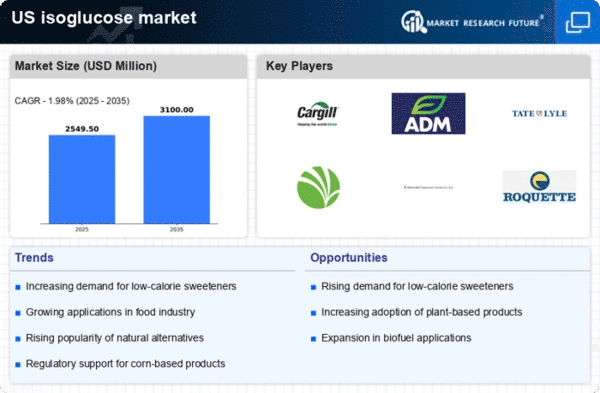
As per Market Research Future analysis, the US Isoglucose Market size was estimated at 2500.0 USD Million in 2024. The Isoglucose market is projected to grow from 2549.5 USD Million in 2025 to 3100.0 USD Million by 2035, exhibiting a compound annual growth rate (CAGR) of 1.9% during the forecast period 2025 - 2035

Key Market Trends & Highlights

The US isoglucose market is experiencing a shift towards natural sweeteners and sustainability.

  • The demand for natural sweeteners is rising, reflecting a broader trend towards healthier consumption choices.
  • Regulatory influences are shaping production practices, particularly in relation to corn-based isoglucose products.
  • Sustainability initiatives are becoming increasingly important, driving innovation in production methods.
  • Key market drivers include increasing health consciousness and rising demand in the beverage industry.

Market Size & Forecast

2024 Market Size 2500.0 (USD Million)
2035 Market Size 3100.0 (USD Million)
CAGR (2025 - 2035) 1.98%

Major Players

Cargill (US), Archer Daniels Midland (US), Tate & Lyle (GB), Ingredion (US), Mitsubishi Corporation (JP), Roquette Freres (FR), Südzucker AG (DE), Bunge Limited (US)

Our Impact
Enabled $4.3B Revenue Impact for Fortune 500 and Leading Multinationals
Partnering with 2000+ Global Organizations Each Year
30K+ Citations by Top-Tier Firms in the Industry

US Isoglucose Market Trends

The US Isoglucose Market is currently experiencing notable shifts driven by various factors. The increasing demand for sweeteners in the food and beverage sector appears to be a primary catalyst for growth. As consumers become more health-conscious, there is a rising preference for low-calorie and natural sweeteners, which isoglucose can provide. Additionally, the versatility of isoglucose in various applications, including baked goods, beverages, and dairy products, suggests a broadening scope of usage. This trend may lead to innovations in product formulations, as manufacturers seek to meet evolving consumer preferences. Moreover, regulatory frameworks and trade policies are influencing the dynamics of the isoglucose market. The U.S. government has implemented measures that could affect the production and distribution of isoglucose, potentially impacting pricing and availability. As sustainability becomes a focal point, producers are likely to explore eco-friendly production methods, which may further shape market trends. Overall, the isoglucose market appears poised for growth, driven by consumer trends and regulatory influences, indicating a vibrant future ahead.

Rising Demand for Natural Sweeteners

There is an increasing consumer inclination towards natural sweeteners, which isoglucose can fulfill. This trend is evident in the food and beverage industry, where manufacturers are reformulating products to cater to health-conscious consumers. As a result, isoglucose is likely to gain traction as a preferred ingredient.

Regulatory Influences on Production

Regulatory frameworks are playing a crucial role in shaping the isoglucose market. Policies regarding production standards and trade can significantly impact the availability and pricing of isoglucose. Producers may need to adapt to these regulations to remain competitive.

Sustainability Initiatives

Sustainability is becoming increasingly important in the isoglucose market. Producers are exploring eco-friendly production methods to meet consumer demand for sustainable products. This shift may lead to innovations that enhance the environmental footprint of isoglucose production.

US Isoglucose Market Drivers

Shifts in Consumer Preferences

Consumer preferences are evolving, with a notable shift towards products that contain isoglucose. This change is influenced by the increasing popularity of processed foods and beverages that utilize isoglucose as a sweetener. The isoglucose market is benefiting from this trend, as manufacturers are reformulating their products to include isoglucose, which offers a cost-effective alternative to sugar. In the US, the market for soft drinks and snacks that incorporate isoglucose is expanding, with sales projected to grow by 4% annually. This shift indicates a broader acceptance of isoglucose in various food applications, suggesting a promising future for the isoglucose market as it aligns with consumer demands for taste and affordability.

Increasing Health Consciousness

The growing awareness of health and wellness among consumers is driving the isoglucose market. As individuals become more health-conscious, they are seeking alternatives to traditional sweeteners that may contribute to health issues such as obesity and diabetes. Isoglucose, being a high-fructose corn syrup, is perceived as a healthier option due to its lower glycemic index. In the US, the demand for low-calorie and low-sugar products has surged, with the market for low-calorie sweeteners projected to reach approximately $1.5 billion by 2026. This trend indicates a shift in consumer preferences, which is likely to benefit the isoglucose market as manufacturers adapt their product lines to meet these evolving demands.

Rising Demand in the Beverage Industry

The beverage industry is experiencing a notable increase in the demand for isoglucose, driven by changing consumer preferences and the need for cost-effective sweetening solutions. As manufacturers seek to reduce production costs while maintaining product quality, isoglucose has emerged as a preferred ingredient in soft drinks and energy beverages. The US beverage market is projected to grow by 5% annually, with isoglucose playing a crucial role in this expansion. This trend suggests that the isoglucose market is well-positioned to capitalize on the growing beverage sector, as companies increasingly incorporate isoglucose to meet consumer demands for flavor and affordability.

Technological Advancements in Production

Innovations in production technology are significantly impacting the isoglucose market. Advances in enzymatic processes and fermentation techniques have enhanced the efficiency of isoglucose production, leading to reduced costs and improved product quality. For instance, the introduction of more effective enzymes has increased the yield of isoglucose from corn, making it a more attractive option for manufacturers. The US market has seen a rise in the adoption of these technologies, with production capacities expanding to meet the growing demand. As a result, the isoglucose market is likely to experience growth driven by these technological improvements, which not only lower production costs but also enhance the sustainability of the manufacturing process.

Regulatory Support for Corn-Based Products

Regulatory frameworks in the US are increasingly supportive of corn-based products, including isoglucose. The government has implemented policies that promote the use of corn as a feedstock for sweeteners, which has bolstered the isoglucose market. These regulations aim to enhance domestic production and reduce reliance on imported sweeteners. Additionally, subsidies for corn farmers have contributed to lower raw material costs, making isoglucose a more competitive option in the sweetener market. As a result, the isoglucose market is likely to benefit from these favorable regulatory conditions, which encourage the growth of corn-based sweeteners in various food and beverage applications.


Market Segment Insights

By Type: HFCS-55 (Largest) vs. HFCS-42 (Fastest-Growing)

In the US isoglucose market, the distribution of market share among the type segment values shows HFCS-55 leading as the largest contributor. This segment's established presence in numerous applications, including beverages and processed foods, significantly bolsters its share. On the other hand, HFCS-42, while holding a smaller share, is gaining traction due to its increasing adoption in various food products, particularly in the baking and confectionery sectors, gradually reshaping the competitive landscape. Growth trends indicate a promising future for both segment values, but HFCS-42 has emerged as the fastest-growing segment, primarily driven by shifts in consumer preferences towards lower caloric sweeteners. This change is coupled with innovative product formulations that utilize HFCS-42 for enhanced flavor profiles. As health-conscious consumers dominate the market, the demand for HFCS-42 is expected to surge, positioning it as a key player in the evolving sweetener industry.

HFCS-55 (Dominant) vs. HFCS-42 (Emerging)

HFCS-55 is characterized by its higher fructose content, making it a preferred choice in the production of soft drinks and other sweet applications. The dominance of this segment is fueled by its ability to deliver sweetness efficiently while maintaining a cost-effective profile for manufacturers. Conversely, HFCS-42, with its slightly lower fructose ratio, is emerging as a versatile alternative in food products where a milder sweetness is desired. Its growing application in healthier and reformulated products reflects changing consumer attitudes towards sugar consumption. As regulatory pressures mount on sugar usage, both HFCS-55 and HFCS-42 are positioned to adapt, with HFCS-42 particularly aligning well with the trend towards healthier ingredient choices.

By Distribution Channel: Online (Largest) vs. Offline (Fastest-Growing)

In the US isoglucose market, the distribution of market share between online and offline channels reveals a significant preference for online purchasing. Consumers increasingly opt for digital platforms to source isoglucose products due to the convenience and accessibility offered by online retailers. This trend highlights the growing role of e-commerce in influencing purchasing behaviors and market dynamics within this segment. Alongside the substantial online presence, offline channels are witnessing rapid expansion as well. The revitalization of brick-and-mortar stores, along with a tailored approach to customer engagement, has made offline distribution a vital area for growth. Factors such as changing consumer preferences, promotional strategies, and product availability are driving establishments to enhance their presence, particularly in local markets.

Distribution Channel: Online (Dominant) vs. Offline (Emerging)

The online distribution channel has established itself as a dominant player in the US isoglucose market. Its appeal lies in its ability to provide consumers with a vast selection of products, competitive pricing, and the convenience of home delivery. This channel thrives on technological advancements and the proliferation of digital payment solutions, allowing for seamless transactions. Conversely, the offline distribution channel, while emerging, is rapidly gaining traction. Retailers are focusing on personalizing customer experiences and creating in-store promotions that resonate with their target audience. This hybrid approach enables businesses to cater to diverse consumer preferences, ensuring that both online and offline channels play pivotal roles in the market's evolution.

By Application: Food (Largest) vs. Beverages (Fastest-Growing)

In the US isoglucose market, the application segment is notably divided between food and beverages. The food segment commands a significant share due to its extensive use in confections, baked goods, and processed foods, attributing to its dominance in the overall market. Conversely, the beverage segment, while smaller, is rapidly expanding as manufacturers seek to enhance flavor profiles and reduce caloric content, thus increasing its appeal among health-conscious consumers. Growth trends in this segment are primarily driven by rising demand for low-calorie and low-sugar products, with consumers increasingly opting for healthier alternatives in both food and beverages. The beverage segment's faster growth rate is attributed to innovative product formulations and the popularity of functional drinks, which leverage isoglucose for improved taste and texture without added sugars. As consumer preferences evolve, both segments are expected to adapt, ensuring sustained growth in this competitive market.

Food (Dominant) vs. Beverages (Emerging)

The food application segment in the US isoglucose market remains dominant due to its widespread usage in various food products, including snacks, desserts, and ready-to-eat meals. Companies in this segment focus on enhancing flavor profiles and improving shelf life, making isoglucose a critical ingredient. On the other hand, the beverage segment is considered emerging, characterized by innovative solutions aimed at meeting the growing consumer demand for healthier options. The use of isoglucose in beverages allows producers to create low-calorie drinks while maintaining sweetness, appealing to a market increasingly aware of health and wellness. This duality highlights the dynamic nature of the applications within the isoglucose landscape.

Get more detailed insights about US Isoglucose Market

Key Players and Competitive Insights

The isoglucose market exhibits a dynamic competitive landscape characterized by a blend of innovation, strategic partnerships, and regional expansion. Key players such as Cargill (US), Archer Daniels Midland (US), and Ingredion (US) are at the forefront, leveraging their extensive supply chains and technological advancements to enhance production efficiency. Cargill (US) has focused on sustainability initiatives, aiming to reduce its carbon footprint while increasing output. Meanwhile, Archer Daniels Midland (US) emphasizes digital transformation, integrating AI into its operations to optimize processes and improve product quality. These strategies collectively foster a competitive environment that prioritizes efficiency and sustainability, driving growth in the sector.In terms of business tactics, companies are increasingly localizing manufacturing to reduce transportation costs and enhance supply chain resilience. The market structure appears moderately fragmented, with several key players holding substantial market shares. This fragmentation allows for competitive pricing strategies while also enabling niche players to thrive. The collective influence of these major companies shapes market dynamics, as they continuously adapt to consumer demands and regulatory changes.

In October Cargill (US) announced a partnership with a leading biotechnology firm to develop advanced fermentation technologies aimed at increasing isoglucose yield. This strategic move is likely to enhance Cargill's competitive edge by improving production efficiency and reducing costs, thereby positioning the company favorably in a market that increasingly values sustainability and innovation.

In September Archer Daniels Midland (US) launched a new line of isoglucose products tailored for the beverage industry, capitalizing on the growing demand for low-calorie sweeteners. This initiative not only diversifies their product portfolio but also aligns with consumer trends favoring healthier options, potentially increasing market share in a competitive segment.

In August Ingredion (US) expanded its manufacturing capabilities in the Midwest, investing $50 million to enhance production capacity for isoglucose. This expansion is indicative of Ingredion's commitment to meeting rising demand and suggests a proactive approach to securing a larger footprint in the market. Such investments are crucial for maintaining competitiveness in an evolving landscape.

As of November current trends in the isoglucose market are heavily influenced by digitalization, sustainability, and the integration of AI technologies. Strategic alliances are becoming increasingly vital, as companies seek to pool resources and expertise to navigate complex market challenges. Looking ahead, competitive differentiation is expected to shift from traditional price-based competition to a focus on innovation, technological advancements, and supply chain reliability. This evolution underscores the necessity for companies to adapt swiftly to changing consumer preferences and regulatory landscapes.

Key Companies in the US Isoglucose Market include

Industry Developments

The US Isoglucose Market has seen significant developments recently. In October 2023, Ingredion announced plans to increase production capacity at its plants, focusing on sustainable practices and efficiency to meet rising demand. Mitsubishi Corporation is also positioning itself to expand its network through potential collaborations with local producers, aimed at enhancing supply chain resilience. Additionally, Lentz Sugar Company and Tate and Lyle are exploring innovations in sweetener formulations to cater to evolving consumer preferences for healthier options. In recent years, the market has witnessed important mergers and acquisitions.

In September 2022, Archer Daniels Midland acquired a smaller competitor to strengthen its portfolio in the sweetener segment. Cargill has also been active in increasing its market share through strategic partnerships to secure supply chains. Between 2021 and 2023, growing interest in low-calorie sweeteners and natural alternatives has significantly impacted market dynamics, with regional sales increasing in response to health trends. The Isoglucose market continues to evolve with these developments, reflecting the changing landscape of consumer demands and regulatory framework in the US.

Future Outlook

US Isoglucose Market Future Outlook

The Isoglucose Market is projected to grow at 1.98% CAGR from 2025 to 2035, driven by rising demand for sweeteners and health-conscious consumer trends.

New opportunities lie in:

  • Expansion into organic isoglucose products to meet health trends.
  • Development of customized isoglucose solutions for food manufacturers.
  • Investment in advanced production technologies to enhance efficiency.

By 2035, the isoglucose market is expected to solidify its position as a key player in the sweetener industry.

Market Segmentation

US Isoglucose Market Type Outlook

  • HFCS-42
  • HFCS-55

US Isoglucose Market Application Outlook

  • Food
  • Beverages

US Isoglucose Market Distribution Channel Outlook

  • Online
  • Offline

Report Scope

MARKET SIZE 2024 2500.0(USD Million)
MARKET SIZE 2025 2549.5(USD Million)
MARKET SIZE 2035 3100.0(USD Million)
COMPOUND ANNUAL GROWTH RATE (CAGR) 1.98% (2025 - 2035)
REPORT COVERAGE Revenue Forecast, Competitive Landscape, Growth Factors, and Trends
BASE YEAR 2024
Market Forecast Period 2025 - 2035
Historical Data 2019 - 2024
Market Forecast Units USD Million
Key Companies Profiled Cargill (US), Archer Daniels Midland (US), Tate & Lyle (GB), Ingredion (US), Mitsubishi Corporation (JP), Roquette Freres (FR), Südzucker AG (DE), Bunge Limited (US)
Segments Covered Type, Distribution Channel, Application
Key Market Opportunities Growing demand for low-calorie sweeteners drives innovation in the isoglucose market.
Key Market Dynamics Rising demand for low-calorie sweeteners drives innovation and competition in the isoglucose market.
Countries Covered US
Leave a Comment

FAQs

What is the expected market size of the US Isoglucose Market in 2024?

The US Isoglucose Market is expected to be valued at 2.75 billion USD in 2024.

What is the projected market size for the US Isoglucose Market by 2035?

By 2035, the US Isoglucose Market is projected to reach a value of 3.5 billion USD.

What is the expected CAGR for the US Isoglucose Market from 2025 to 2035?

The expected CAGR for the US Isoglucose Market from 2025 to 2035 is 2.217%.

Which segment of the US Isoglucose Market has the larger value in 2024?

In 2024, the HFCS-55 segment of the US Isoglucose Market is valued at 1.55 billion USD, which is larger than HFCS-42 valued at 1.2 billion USD.

What is the market value for HFCS-42 expected to reach by 2035?

By 2035, the market value for HFCS-42 is expected to reach 1.55 billion USD.

Who are the key players in the US Isoglucose Market?

Major players in the US Isoglucose Market include Ingredion, Mitsubishi Corporation, Cargill, and DuPont among others.

What is the market value for HFCS-55 projected to be in 2035?

By 2035, the HFCS-55 segment of the US Isoglucose Market is projected to be valued at 1.95 billion USD.

What are some key trends impacting the US Isoglucose Market?

Key trends in the US Isoglucose Market include a growing demand for sweeteners in various applications and advancements in production technologies.

What are the main applications for isoglucose in the market?

Isoglucose is widely used in food and beverage applications, particularly as a sweetener.

How is the US Isoglucose Market expected to respond to emerging challenges?

The market may face challenges such as regulatory changes and competition from alternative sweeteners, which could impact its growth.

Download Free Sample

Kindly complete the form below to receive a free sample of this Report

Compare Licence

×
Features License Type
Single User Multiuser License Enterprise User
Price $4,950 $5,950 $7,250
Maximum User Access Limit 1 User Upto 10 Users Unrestricted Access Throughout the Organization
Free Customization
Direct Access to Analyst
Deliverable Format
Platform Access
Discount on Next Purchase 10% 15% 15%
Printable Versions