×
Request Free Sample ×

Kindly complete the form below to receive a free sample of this Report

* Please use a valid business email

Leading companies partner with us for data-driven Insights

clients tt-cursor
Hero Background

US Interactive Video Wall Market

ID: MRFR/SEM/14749-HCR
200 Pages
Garvit Vyas
February 2026

US Interactive Video Wall Market Size, Share and Research Report By Types (Landscape & Portrait, Custom Layout, 3D Installation), By Display Type (LED, LCD, LPD) and By Frame Size (2x2, 3x3, 4x4) - Industry Forecast Till 2035

Share:
Download PDF ×

We do not share your information with anyone. However, we may send you emails based on your report interest from time to time. You may contact us at any time to opt-out.

US Interactive Video Wall Market Infographic
Purchase Options

US Interactive Video Wall Market Summary

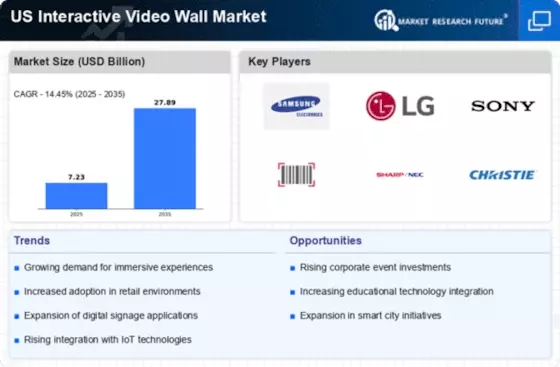
As per analysis, the US Interactive Video Wall Market is projected to grow from USD 6.32 Billion in 2024 to USD 27.89 Billion by 2035, exhibiting a compound annual growth rate (CAGR) of 14.45% during the forecast period (2025 - 2035).

Key Market Trends & Highlights

The US Interactive Video Wall Market is poised for substantial growth driven by technological advancements and increasing applications across various sectors.

  • The integration of AI and machine learning is transforming the capabilities of interactive video walls, enhancing user engagement.
  • The corporate communication segment remains the largest, while retail advertising is emerging as the fastest-growing segment in the market.
  • Expansion in retail spaces is driving demand for interactive video walls, particularly in enhancing customer experiences.
  • Technological advancements in display technology and rising adoption in corporate communication are key drivers propelling market growth.

Market Size & Forecast

2024 Market Size 6.32 (USD Billion)
2035 Market Size 27.89 (USD Billion)
CAGR (2025 - 2035) 14.45%

Major Players

Samsung Electronics (US), LG Electronics (US), Sony Corporation (US), Barco (US), NEC Display Solutions (US), Christie Digital Systems (US), Planar Systems (US), Sharp Electronics (US), Epson America (US)

Our Impact
Enabled $4.3B Revenue Impact for Fortune 500 and Leading Multinationals
Partnering with 2000+ Global Organizations Each Year
30K+ Citations by Top-Tier Firms in the Industry

US Interactive Video Wall Market Trends

The US Interactive Video Wall Market is currently experiencing a dynamic evolution, driven by advancements in technology and increasing demand for immersive visual experiences. Organizations across various sectors, including retail, education, and corporate environments, are increasingly adopting interactive video walls to enhance communication and engagement. These installations not only serve as powerful marketing tools but also facilitate collaboration and information sharing, thereby transforming traditional spaces into interactive environments. As the market matures, the integration of artificial intelligence and machine learning into video wall systems appears to be a growing trend, enabling more personalized and responsive user interactions. Moreover, the rise of remote work and virtual collaboration has further propelled the need for innovative display solutions. Businesses are recognizing the potential of interactive video walls to create engaging virtual meeting spaces, allowing for seamless communication among distributed teams. This shift indicates a broader acceptance of advanced display technologies, which may lead to increased investment in interactive video wall systems. As the US Interactive Video Wall Market continues to expand, stakeholders must remain attuned to emerging technologies and user preferences to maintain a competitive edge in this evolving landscape.

Integration of AI and Machine Learning

The incorporation of artificial intelligence and machine learning into interactive video wall systems is becoming increasingly prevalent. This trend suggests that video walls can offer more tailored experiences, adapting content based on user interactions and preferences. Such advancements may enhance user engagement and improve the overall effectiveness of visual communication.

Growing Demand in Education

Educational institutions are increasingly adopting interactive video walls to facilitate dynamic learning environments. This trend indicates a shift towards more engaging teaching methods, where visual aids can enhance comprehension and retention. The integration of these technologies in classrooms may revolutionize traditional educational practices.

Expansion in Retail Spaces

Retailers are leveraging interactive video walls to create immersive shopping experiences. This trend highlights the potential for video walls to attract customers and enhance brand storytelling. By integrating interactive elements, retailers can engage consumers more effectively, potentially leading to increased foot traffic and sales.

US Interactive Video Wall Market Drivers

Emerging Applications in Healthcare

The US Interactive Video Wall Market is increasingly expanding into the healthcare sector, where interactive video walls are being utilized for patient engagement and information sharing. Hospitals and clinics are adopting these technologies to display health information, educational content, and wayfinding solutions. The integration of video walls in healthcare settings is projected to grow at a rate of 14% annually, driven by the need for improved patient experiences and operational efficiency. As healthcare providers recognize the benefits of interactive displays in enhancing communication and patient satisfaction, the demand for video wall solutions is expected to rise. This trend underscores the potential for the US Interactive Video Wall Market to diversify and cater to various sectors.

Rising Adoption in Corporate Communication

The US Interactive Video Wall Market is witnessing a notable increase in the adoption of video walls for corporate communication. Businesses are increasingly utilizing these systems for presentations, conferences, and internal communications. The ability to display dynamic content in real-time enhances engagement and facilitates better decision-making. Market data indicates that the corporate sector accounts for a substantial share of video wall installations, with projections suggesting a growth rate of approximately 12% annually. This trend is likely to continue as companies recognize the value of effective communication tools in fostering collaboration and innovation. Consequently, the demand for interactive video walls in corporate settings is expected to drive the US Interactive Video Wall Market forward.

Government Initiatives Supporting Smart Cities

The US Interactive Video Wall Market is benefiting from government initiatives aimed at developing smart cities. These initiatives often include the integration of advanced technologies in public spaces, where interactive video walls play a crucial role in information dissemination and community engagement. For instance, cities are deploying video walls in public transport hubs and civic centers to provide real-time information and enhance public services. Government funding and support for smart city projects are expected to drive the demand for interactive video walls, with estimates suggesting a growth potential of 10% in this sector. As municipalities invest in technology to improve urban living, the US Interactive Video Wall Market is likely to see substantial growth.

Increased Focus on Customer Experience in Retail

The US Interactive Video Wall Market is significantly influenced by the growing emphasis on customer experience in retail environments. Retailers are increasingly deploying interactive video walls to create engaging shopping experiences that attract and retain customers. These installations allow for personalized marketing, product demonstrations, and interactive displays that enhance consumer interaction. Recent statistics reveal that retailers investing in such technologies have reported a 20% increase in customer engagement. As the retail landscape evolves, the integration of interactive video walls is likely to become a standard practice, thereby propelling the growth of the US Interactive Video Wall Market. This trend reflects a broader shift towards experiential retail, where customer engagement is paramount.

Technological Advancements in Display Technology

The US Interactive Video Wall Market is experiencing a surge due to rapid advancements in display technology. Innovations such as OLED and LED technologies have enhanced image quality, brightness, and energy efficiency. These improvements are crucial for applications in sectors like advertising, entertainment, and corporate environments. According to recent data, the market for high-resolution displays is projected to grow significantly, with a compound annual growth rate (CAGR) of over 15% through 2026. This growth is driven by the increasing need for immersive visual experiences, which are becoming essential in various industries. As organizations seek to captivate audiences, the demand for advanced video wall solutions is likely to rise, further propelling the US Interactive Video Wall Market.


Market Segment Insights

By Application: Corporate Communication (Largest) vs. Retail Advertising (Fastest-Growing)

In the US Interactive Video Wall Market, the application segment is primarily driven by Corporate Communication, which holds the largest market share. This sector utilizes video walls for various internal communications, enhancing collaboration and engagement among employees. Following closely is Retail Advertising, which is experiencing rapid growth as businesses increasingly leverage interactive displays to enhance customer engagement and influence purchasing decisions. Other sectors, such as Education and Transportation, also contribute significantly but are currently smaller in market size compared to these two primary applications.

Corporate Communication (Dominant) vs. Retail Advertising (Emerging)

Corporate Communication in the US Interactive Video Wall Market stands out as the dominant segment, leveraging sophisticated technology to enhance workplace communication, training, and presentations. Its effectiveness in conveying messages clearly and engagingly makes it a preferred choice for corporations aiming to boost employee collaboration. In contrast, Retail Advertising is an emerging force, rapidly adapting to consumer behavior shifts towards interactive and immersive experiences. Retailers employ video walls to create captivating displays that attract customers, drive sales, and provide tailored advertising based on real-time data analysis. Together, these segments illustrate a dynamic balance between established and growing applications in the video wall market.

By End Use: Commercial (Largest) vs. Government (Fastest-Growing)

In the US Interactive Video Wall Market, the Commercial sector commands the largest share, driven by an increasing demand for advanced visual communication solutions in retail, hospitality, and corporate environments. Businesses are increasingly utilizing video walls for advertising, branding, and interactive customer engagement, which solidifies this segment's prominent position. Meanwhile, the Government segment, although smaller in comparison, is rapidly growing. Government agencies leverage interactive video walls for public information display, surveillance, and crisis management, marking a positive trend in adoption rates.

Commercial (Dominant) vs. Government (Emerging)

The Commercial segment dominates the US Interactive Video Wall Market by focusing on innovative applications that enhance customer experiences. This sector includes retail stores, trade shows, and corporate offices, where visual impact is crucial to attract attention and convey messages effectively. Companies are investing in superior imaging technology and larger displays to meet the demands of experiencing engagement. On the other hand, the Government sector is emerging and expanding its footprint by implementing video walls for various applications like public safety and information dissemination. The increasing emphasis on smart city initiatives and public communications is driving growth in this segment, as governments seek to leverage advanced technologies for efficiency and transparency.

By Technology: LED (Largest) vs. MicroLED (Fastest-Growing)

The US Interactive Video Wall Market demonstrates a diverse technology landscape, with LED technology holding the largest market share. Its widespread adoption across various sectors is driven by its superior brightness, energy efficiency, and vibrant color reproduction. Following LED, LCD technology remains a staple for several applications, offering a balance of performance and cost. Meanwhile, OLED and Projection technologies are carving out niche markets, focusing on high-quality visuals, albeit with a smaller share. MicroLED is gaining traction, poised to challenge existing technologies with its promising features.

Technology: LED (Dominant) vs. MicroLED (Emerging)

LED technology leads the US Interactive Video Wall Market, characterized by its exceptional brightness and low power consumption. It is widely preferred for both indoor and outdoor applications, providing clarity even in well-lit environments. MicroLED, on the other hand, is an emerging technology known for its superior pixel density and flexibility, paving the way for innovative designs. It promises better contrast ratios and color accuracy, which are paramount for high-end displays. As the market evolves, MicroLED is anticipated to grow rapidly, driven by the demand for high-performance displays in various sectors.

By Screen Size: Large (Largest) vs. Extra Large (Fastest-Growing)

In the US Interactive Video Wall Market, the screen size segment is characterized by four main categories: Small, Medium, Large, and Extra Large. Among these, Large screens hold the largest market share, widely preferred for their ability to deliver impactful visuals in various settings, such as corporate environments and event displays. Extra Large screens, while smaller in current market share, are rapidly gaining traction due to the increasing demand for immersive viewing experiences in public spaces and arenas.

Large (Dominant) vs. Extra Large (Emerging)

Large interactive video walls are recognized for their optimal balance between size and functionality, making them a dominant choice in various applications including retail, exhibitions, and corporate presentations. Their capacity to capture attention and deliver detailed content effectively supports brand messaging. Conversely, Extra Large interactive video walls are emerging as a significant trend, driven by advancements in display technology and a rising demand for larger-than-life visual experiences in venues such as stadiums and concert halls. As businesses seek to create engaging environments, the versatility of Extra Large screens positions them as a crucial investment for the future.

By Installation Type: Wall Mounted (Largest) vs. Floor Standing (Fastest-Growing)

In the US Interactive Video Wall Market, the installation type segment shows significant diversity, with 'Wall Mounted' solutions securing the largest market share. These installations are favored for their space-saving designs and versatile deployment in control rooms, lobbies, and retail environments. Meanwhile, 'Floor Standing' displays are emerging quickly, appealing particularly to transient setups and exhibition spaces, marking a notable trend in recent years.

Wall Mounted (Dominant) vs. Floor Standing (Emerging)

The 'Wall Mounted' segment, being the dominant player, offers fixed installations that capitalize on limited space and provide an aesthetically pleasing way to display information. This type enhances the user experience through high-definition visuals in various commercial and public environments. On the other hand, 'Floor Standing' installations are gaining popularity as an emerging trend, offering flexibility and mobility, perfect for dynamic displays in pop-up shops and corporate events. Their versatility allows for easy setup and relocation, catering to businesses that require adaptive solutions.

Get more detailed insights about US Interactive Video Wall Market

Key Players and Competitive Insights

The Interactive Video Wall Market in the US is characterized by a dynamic competitive landscape, driven by technological advancements and increasing demand for immersive visual experiences across various sectors. Key players such as Samsung Electronics (South Korea), LG Electronics (South Korea), and Barco (Belgium) are at the forefront, each adopting distinct strategies to enhance their market positioning. Samsung Electronics (South Korea) focuses on innovation, particularly in the realm of microLED technology, which offers superior image quality and flexibility. Meanwhile, LG Electronics (South Korea) emphasizes partnerships with content creators to deliver tailored solutions, thereby enhancing customer engagement. Barco (Belgium), on the other hand, is concentrating on expanding its presence in the corporate sector, leveraging its expertise in visualization technology to cater to business needs. Collectively, these strategies contribute to a competitive environment that is increasingly centered around technological differentiation and customer-centric solutions.

In terms of business tactics, companies are localizing manufacturing to reduce lead times and optimize supply chains, which is particularly crucial in a market that is moderately fragmented. This approach not only enhances operational efficiency but also allows for greater responsiveness to market demands. The competitive structure is shaped by the collective influence of these key players, who are continuously innovating and adapting to the evolving landscape, thereby fostering a robust ecosystem of competition.

In December 2025, Samsung Electronics (South Korea) announced the launch of its latest line of interactive video walls, featuring advanced AI capabilities for real-time content adaptation. This strategic move is significant as it positions Samsung to capitalize on the growing trend of AI integration in visual technologies, potentially enhancing user experience and engagement. The introduction of AI-driven features may also set a new standard in the market, compelling competitors to innovate further.

In November 2025, LG Electronics (South Korea) entered into a strategic partnership with a leading software developer to create customized content solutions for its interactive video walls. This collaboration is likely to enhance LG's offerings, allowing for more personalized and engaging experiences for end-users. By aligning with a software partner, LG appears to be strengthening its value proposition in a market that increasingly demands tailored solutions.

In October 2025, Barco (Belgium) expanded its operations by acquiring a smaller firm specializing in immersive display technologies. This acquisition is indicative of Barco's commitment to enhancing its product portfolio and expanding its capabilities in the interactive video wall segment. Such strategic actions not only bolster Barco's market position but also reflect a broader trend of consolidation within the industry as companies seek to enhance their technological competencies.

As of January 2026, current trends in the Interactive Video Wall Market are heavily influenced by digitalization, sustainability, and the integration of AI technologies. Strategic alliances are becoming increasingly pivotal, as companies recognize the need to collaborate to stay competitive. The shift from price-based competition to a focus on innovation and technology is evident, with firms prioritizing supply chain reliability and advanced features. Looking ahead, competitive differentiation is likely to evolve further, with an emphasis on creating unique, value-added experiences that resonate with consumers.

Key Companies in the US Interactive Video Wall Market include

Industry Developments

In recent months, the US Interactive Video Wall Market has witnessed significant developments. Companies like Samsung Electronics and LG Electronics have announced advancements in display technologies aimed at enhancing user experience. In October 2023, Samsung showcased its latest lineup of microLED displays, which are expected to redefine interactive wall applications across commercial sectors. Similarly, LG Electronics introduced new OLED solutions that promise improved brightness and color accuracy, allowing for better visibility in various lighting conditions.

Furthermore, in September 2023, Planar Systems unveiled a new line of LED video walls specifically designed for retail environments, positioning itself strongly in this growing segment. The market valuation has seen robust growth attributed to increased demand in sectors such as education, corporate, and entertainment. Regarding mergers and acquisitions, Digital Projection announced its acquisition of a smaller audiovisual technology firm in August 2023, expanding its portfolio in the interactive display space.

Another notable event includes Christie Digital Systems forming a partnership with a leading streaming service in July 2023 to enhance broadcasting capabilities, indicating a trend towards collaborative innovation in the interactive video wall segment.

Future Outlook

US Interactive Video Wall Market Future Outlook

The US Interactive Video Wall Market is projected to grow at a 14.45% CAGR from 2025 to 2035, driven by technological advancements, increasing demand for immersive experiences, and enhanced advertising capabilities.

New opportunities lie in:

  • Integration of AI-driven analytics for real-time audience engagement
  • Development of modular video wall solutions for flexible installations
  • Expansion into virtual reality environments for enhanced user interaction

By 2035, the market is expected to be robust, driven by innovation and diverse applications.

Market Segmentation

US Interactive Video Wall Market End Use Outlook

  • Commercial
  • Government
  • Healthcare
  • Education
  • Transportation

US Interactive Video Wall Market Technology Outlook

  • LED
  • LCD
  • Projection
  • OLED
  • MicroLED

US Interactive Video Wall Market Application Outlook

  • Corporate Communication
  • Retail Advertising
  • Education
  • Entertainment
  • Transportation

US Interactive Video Wall Market Screen Size Outlook

  • Small
  • Medium
  • Large
  • Extra Large

US Interactive Video Wall Market Installation Type Outlook

  • Wall Mounted
  • Floor Standing
  • Portable

Report Scope

MARKET SIZE 20246.32(USD Billion)
MARKET SIZE 20257.33(USD Billion)
MARKET SIZE 203527.89(USD Billion)
COMPOUND ANNUAL GROWTH RATE (CAGR)14.45% (2024 - 2035)
REPORT COVERAGERevenue Forecast, Competitive Landscape, Growth Factors, and Trends
BASE YEAR2024
Market Forecast Period2025 - 2035
Historical Data2019 - 2024
Market Forecast UnitsUSD Billion
Key Companies ProfiledSamsung Electronics (US), LG Electronics (US), Sony Corporation (US), Barco (US), NEC Display Solutions (US), Christie Digital Systems (US), Planar Systems (US), Sharp Electronics (US), Epson America (US)
Segments CoveredApplication, End Use, Technology, Screen Size, Installation Type
Key Market OpportunitiesGrowing demand for immersive experiences in retail and entertainment sectors drives US Interactive Video Wall Market expansion.
Key Market DynamicsRising demand for immersive experiences drives innovation and competition in the US Interactive Video Wall Market.
Countries CoveredUS
Leave a Comment

FAQs

What is the current valuation of the US Interactive Video Wall Market?

The market valuation was 6.32 USD Billion in 2024.

What is the projected market size for the US Interactive Video Wall Market by 2035?

The market is projected to reach 27.89 USD Billion by 2035.

What is the expected CAGR for the US Interactive Video Wall Market during the forecast period?

The expected CAGR for the market from 2025 to 2035 is 14.45%.

Which companies are the key players in the US Interactive Video Wall Market?

Key players include Samsung Electronics, LG Electronics, Sony Corporation, Barco, and NEC Display Solutions.

What are the primary applications of interactive video walls in the US market?

Primary applications include Corporate Communication, Retail Advertising, Education, Entertainment, and Transportation.

How does the market perform in the Corporate Communication segment?

The Corporate Communication segment was valued at 1.9 USD Billion in 2024 and is projected to reach 8.5 USD Billion by 2035.

What is the market valuation for the Retail Advertising segment?

The Retail Advertising segment was valued at 1.5 USD Billion in 2024 and is expected to grow to 6.5 USD Billion by 2035.

What technologies are driving the US Interactive Video Wall Market?

Technologies include LED, LCD, Projection, OLED, and MicroLED, with MicroLED projected to grow from 1.82 USD Billion to 8.39 USD Billion.

What is the expected growth in the Healthcare segment of the market?

The Healthcare segment was valued at 1.0 USD Billion in 2024 and is projected to reach 4.5 USD Billion by 2035.

What are the different installation types for interactive video walls?

Installation types include Wall Mounted, Floor Standing, and Portable, with Wall Mounted expected to grow from 2.52 USD Billion to 11.25 USD Billion.

Download Free Sample

Kindly complete the form below to receive a free sample of this Report

Compare Licence

×
Features License Type
Single User Multiuser License Enterprise User
Price $4,950 $5,950 $7,250
Maximum User Access Limit 1 User Upto 10 Users Unrestricted Access Throughout the Organization
Free Customization
Direct Access to Analyst
Deliverable Format
Platform Access
Discount on Next Purchase 10% 15% 15%
Printable Versions