×
Request Free Sample ×

Kindly complete the form below to receive a free sample of this Report

* Please use a valid business email

Leading companies partner with us for data-driven Insights

clients tt-cursor
Hero Background

US Flavor Enhancer Market

ID: MRFR/FnB/19580-HCR
200 Pages
Snehal Singh
February 2026

US Flavor Enhancer Market Size, Share, Industry Trend & Analysis Research Report: By Application (Food and Beverages, Pharmaceuticals, Cosmetics, Animal Feed), By Type (Natural Flavor Enhancers, Artificial Flavor Enhancers, Organic Flavor Enhancers), By Form (Liquid, Powder, Granular) andBy End Use (Household, Food Service, Industrial)- Forecast to 2035

Share:
Download PDF ×

We do not share your information with anyone. However, we may send you emails based on your report interest from time to time. You may contact us at any time to opt-out.

US Flavor Enhancer Market Infographic
Purchase Options

US Flavor Enhancer Market Summary

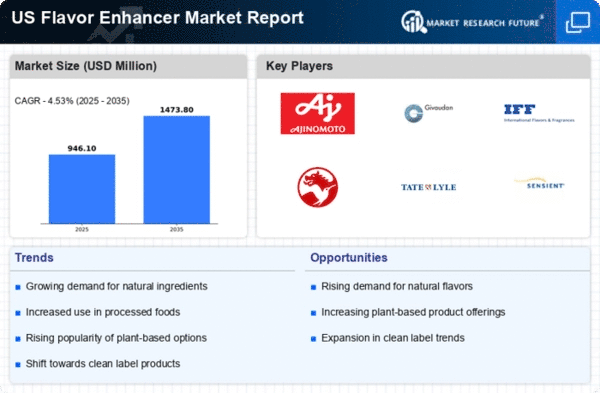
As per Market Research Future analysis, the US flavor enhancer market Size was estimated at 905.1 USD Million in 2024. The US flavor enhancer market is projected to grow from 946.1 USD Million in 2025 to 1473.8 USD Million by 2035, exhibiting a compound annual growth rate (CAGR) of 4.5% during the forecast period 2025 - 2035

Key Market Trends & Highlights

The US flavor enhancer market is experiencing a notable shift towards natural and health-conscious products.

  • The market is witnessing a significant shift towards natural ingredients, driven by consumer preferences for clean label products.
  • Plant-based flavor enhancers are emerging as the fastest-growing segment, reflecting the rising demand for vegan and vegetarian options.
  • Allergen-free products are gaining traction, catering to the increasing awareness of food allergies among consumers.
  • Key market drivers include the growing demand for clean label products and the expansion of the food and beverage sector, which are shaping market dynamics.

Market Size & Forecast

2024 Market Size 905.1 (USD Million)
2035 Market Size 1473.8 (USD Million)
CAGR (2025 - 2035) 4.53%

Major Players

Ajinomoto (JP), Givaudan (CH), International Flavors & Fragrances (US), Symrise (DE), Tate & Lyle (GB), Sensient Technologies (US), Kerry Group (IE), Mane (FR), Firmenich (CH)

Our Impact
Enabled $4.3B Revenue Impact for Fortune 500 and Leading Multinationals
Partnering with 2000+ Global Organizations Each Year
30K+ Citations by Top-Tier Firms in the Industry

US Flavor Enhancer Market Trends

The flavor enhancer market is currently experiencing notable shifts driven by evolving consumer preferences and increasing demand for diverse culinary experiences. As individuals become more adventurous in their eating habits, there is a growing inclination towards products that enhance taste without compromising health. This trend is reflected in the rising popularity of natural and organic flavor enhancers, which are perceived as healthier alternatives to synthetic options. Additionally, the market is witnessing a surge in the use of flavor enhancers in various food categories, including snacks, sauces, and ready-to-eat meals, as manufacturers seek to cater to the evolving tastes of consumers. Moreover, the flavor enhancer market is influenced by the increasing awareness of dietary restrictions and the need for allergen-free options. This has led to the development of specialized products that cater to specific dietary needs, such as gluten-free or vegan flavor enhancers. The emphasis on clean label products is also shaping the market landscape, as consumers demand transparency regarding ingredient sourcing and production methods. Overall, the flavor enhancer market appears poised for growth, driven by innovation and a focus on health-conscious choices.

Shift Towards Natural Ingredients

There is a discernible trend towards the use of natural ingredients in the flavor enhancer market. Consumers are increasingly favoring products that contain no artificial additives, leading manufacturers to reformulate their offerings. This shift aligns with a broader movement towards health and wellness, as individuals seek to avoid synthetic compounds in their diets.

Rise of Plant-Based Flavor Enhancers

The demand for plant-based flavor enhancers is on the rise, reflecting a growing interest in vegetarian and vegan diets. This trend is likely driven by a combination of health considerations and ethical concerns regarding animal welfare. As a result, companies are innovating to create flavor enhancers derived from plant sources, appealing to a wider audience.

Focus on Allergen-Free Products

The flavor enhancer market is increasingly focusing on allergen-free products to accommodate consumers with dietary restrictions. This trend is indicative of a broader awareness of food allergies and intolerances, prompting manufacturers to develop options that are safe for individuals with specific dietary needs. Such products are becoming essential in catering to a diverse consumer base.

US Flavor Enhancer Market Drivers

Increased Focus on Health and Wellness

The flavor enhancer market is significantly influenced by the heightened focus on health and wellness among consumers. As individuals become more aware of the impact of diet on overall health, there is a growing demand for flavor enhancers that offer health benefits without compromising taste. This trend is reflected in the increasing popularity of functional flavor enhancers, which may include ingredients that promote health, such as vitamins, minerals, and probiotics. Market Research Future indicates that the functional food sector is projected to grow by 10% annually, suggesting a robust opportunity for flavor enhancer manufacturers to innovate and create products that align with health-conscious consumer preferences. This focus on wellness is likely to shape product development strategies within the flavor enhancer market.

Growing Demand for Clean Label Products

The flavor enhancer market is experiencing a notable shift towards clean label products, driven by consumer preferences for transparency and natural ingredients. As consumers become increasingly health-conscious, they seek products that are free from artificial additives and preservatives. This trend is reflected in market data, indicating that approximately 70% of consumers in the US are willing to pay a premium for clean label products. Consequently, manufacturers are reformulating their offerings to align with these preferences, leading to a surge in demand for natural flavor enhancers. This shift not only enhances product appeal but also fosters brand loyalty, as consumers gravitate towards companies that prioritize ingredient integrity. The clean label movement is expected to continue influencing the flavor enhancer market, prompting innovation and adaptation among industry players.

Expansion of the Food and Beverage Sector

The flavor enhancer market is significantly impacted by the ongoing expansion of the food and beverage sector in the US. As the industry grows, driven by factors such as increased consumer spending and a diverse range of culinary preferences, the demand for flavor enhancers is likely to rise. Market analysis suggests that the food and beverage sector is projected to reach a valuation of over $1 trillion by 2026, creating ample opportunities for flavor enhancer manufacturers. This growth is further fueled by the rising popularity of convenience foods, which often rely on flavor enhancers to improve taste and appeal. As food manufacturers seek to differentiate their products in a competitive landscape, the flavor enhancer market is poised to benefit from this expansion, leading to increased innovation and product development.

Technological Advancements in Flavor Enhancement

The flavor enhancer market is benefiting from technological advancements that enhance the efficacy and appeal of flavor enhancers. Innovations in extraction and processing techniques allow manufacturers to create more concentrated and potent flavor profiles, which can significantly improve the sensory experience of food products. Additionally, advancements in food science are enabling the development of flavor enhancers that are more stable and versatile, catering to a wider range of applications. Market data suggests that the adoption of new technologies could lead to a 15% increase in the efficiency of flavor enhancement processes. As manufacturers leverage these technologies, they are likely to gain a competitive edge, driving growth and innovation within the flavor enhancer market.

Rising Popularity of Ethnic and International Cuisines

The flavor enhancer market is witnessing a surge in demand due to the rising popularity of ethnic and international cuisines among US consumers. As culinary diversity becomes more mainstream, consumers are increasingly seeking authentic flavors that reflect global culinary traditions. This trend is evident in the growing interest in spices, herbs, and flavor enhancers that cater to diverse palates. Market data indicates that the ethnic food segment is expected to grow at a CAGR of 8% over the next five years, further driving the need for flavor enhancers that can replicate these authentic tastes. Manufacturers are responding by developing innovative flavor profiles that resonate with consumers' adventurous tastes, thereby expanding their product offerings and enhancing market competitiveness.


Market Segment Insights

By Application: Food and Beverages (Largest) vs. Pharmaceuticals (Fastest-Growing)

In the US flavor enhancer market, the Food and Beverages segment is the largest, holding the majority share due to the increasing demand for diverse flavors in processed foods and drinks. This segment significantly influences market dynamics as consumers seek innovative taste experiences. The Pharmaceuticals segment, while smaller, has been rapidly gaining traction as flavor enhancers are integrated into medication formulations to improve patient compliance and acceptance. Growth trends indicate a substantial upward trajectory for both segments. The Food and Beverages sector is projected to continue expanding, driven by trends toward healthier products and artisanal flavors. Meanwhile, the Pharmaceuticals segment is emerging as the fastest-growing area, fueled by advancements in flavor technology and an increasing focus on improving the taste of therapeutic agents, which is vital in enhancing patient experiences.

Food and Beverages: Dominant vs. Pharmaceuticals: Emerging

The Food and Beverages segment remains the dominant force in the US flavor enhancer market, characterized by a vast product range that caters to various consumer preferences. This includes traditional flavorings, natural extracts, and innovative blends that resonate with modern health trends. The focus on clean labels and natural ingredients has led to a significant shift in product offerings, making this segment extremely competitive. On the other hand, Pharmaceuticals are emerging as a vital segment as flavor enhancers play a crucial role in making medicines more palatable. This sector is witnessing rapid innovation with customized flavor solutions tailored for specific medications, meeting the dual need for efficacy and taste. As healthcare continues to evolve, the demand for effective flavor enhancement in pharmaceuticals is expected to surge.

By Type: Natural Flavor Enhancers (Largest) vs. Artificial Flavor Enhancers (Fastest-Growing)

The US flavor enhancer market is characterized by a diverse array of offerings, with Natural Flavor Enhancers claiming a significant portion of the market share due to rising consumer preference for health-conscious options. Artificial Flavor Enhancers, while historically dominant, have seen a decline in popularity as more consumers seek natural alternatives, contributing to a dynamic shift in the market landscape. Growth trends indicate a robust increase in demand for Organic Flavor Enhancers, propelled by the clean-label movement and a growing awareness of the health impacts of artificial additives. The market is also influenced by changing consumer tastes and preferences, with a marked shift towards products that enhance flavor without compromising health, leading to the rapid expansion of emerging segments within the market.

Natural Flavor Enhancers: Dominant vs. Organic Flavor Enhancers: Emerging

Natural Flavor Enhancers remain the dominant force in the US flavor enhancer market, leveraging their appeal among health-conscious consumers. These enhancers are derived from plants, herbs, and spices, and are perceived as healthier options compared to their artificial counterparts. The shift towards Organic Flavor Enhancers represents a growing trend towards sustainability and natural sourcing, aligning with consumer demands for transparency and quality in food products. This segment is experiencing rapid growth due to the increasing demand for organic options, driven by concerns over health and the desire for cleaner ingredient lists. Both segments reflect a broader transformation in consumer preferences, emphasizing a preference for natural ingredients over synthetic alternatives.

By Form: Liquid (Largest) vs. Powder (Fastest-Growing)

The US flavor enhancer market exhibits distinct preferences among different forms, with liquid flavor enhancers leading the market share. Driving factors include the convenience of use and versatility across various culinary applications. In contrast, powdered flavor enhancers have gained significant traction, particularly among health-conscious consumers seeking low-calorie and easily portable options. Growth trends reveal that the powdered segment is experiencing rapid adoption due to innovative product offerings and marketing strategies aimed at millennials and Gen Z. Additionally, the rising interest in cooking at home and the incorporation of flavor enhancers into recipes are boosting the demand for both liquid and powdered forms, showcasing a dynamic shift in consumer preferences.

Liquid (Dominant) vs. Powder (Emerging)

Liquid flavor enhancers dominate the US flavor enhancer market due to their easy incorporation into a wide array of beverages and dishes, appealing particularly to busy consumers seeking flavor without complexity. They are often marketed with flavors that align with consumer lifestyles, such as natural and organic ranges. Conversely, powdered flavor enhancers are emerging rapidly, owing to their affordability and shelf stability, making them attractive to cost-sensitive shoppers. They are particularly favored in settings like gyms or on-the-go meals, where convenience and portion control are priorities. Both segments reflect shifting consumer demands towards flavor customization and healthier eating habits.

By End-use: Household (Largest) vs. Food Service (Fastest-Growing)

The distribution of market share within the US flavor enhancer market indicates that the Household segment holds the largest share, propelled by an increasing number of households seeking to elevate their culinary experiences at home. This segment benefits from a wide array of available products that cater to a variety of preferences, solidifying its dominance in the market. Conversely, the Food Service segment, primarily driven by restaurants and catering services, is rapidly expanding as consumer demand for flavorful dining experiences grows, making it the fastest-growing segment. Growth trends indicate a robust trajectory for the Food Service segment, bolstered by an evolving culinary landscape that emphasizes flavor innovation and variety. Key drivers include the increasing trend of dining out and the rising popularity of gourmet food offerings within restaurants. Moreover, changing consumer preferences for healthier and more authentic flavor options are fueling the demand for flavor enhancers in this sector, further supporting its growth.

Household (Dominant) vs. Food Service (Emerging)

The Household segment of the US flavor enhancer market is characterized by its extensive product offerings that range from classic seasoning blends to innovative flavor infusions, catering to diverse consumer tastes and preferences. It remains a dominant force, supported by a growing trend of home cooking and a desire for culinary experimentation among consumers. In contrast, the Food Service segment, while classified as emerging, shows significant potential for expansion, fueled by the increasing focus on creating unique dining experiences that capture customer interest. This segment is particularly responsive to market trends and consumer feedback, enabling foodservice providers to adapt quickly to emerging flavor trends, making it a dynamic player in the flavor enhancer landscape.

Get more detailed insights about US Flavor Enhancer Market

Key Players and Competitive Insights

The flavor enhancer market exhibits a dynamic competitive landscape characterized by innovation and strategic partnerships. Key players such as Ajinomoto (Japan), International Flavors & Fragrances (US), and Givaudan (Switzerland) are at the forefront, leveraging their extensive R&D capabilities to develop novel flavor solutions. Ajinomoto (Japan) focuses on enhancing its product portfolio through sustainable practices, while International Flavors & Fragrances (US) emphasizes digital transformation to optimize customer engagement. Givaudan (Switzerland) is actively pursuing acquisitions to expand its market reach, indicating a trend towards consolidation in the sector. Collectively, these strategies contribute to a competitive environment that prioritizes innovation and responsiveness to consumer preferences.
In terms of business tactics, companies are increasingly localizing manufacturing to reduce lead times and enhance supply chain efficiency. The market structure appears moderately fragmented, with a mix of large multinational corporations and smaller niche players. This fragmentation allows for diverse offerings, yet the influence of major players remains substantial, as they set trends and standards that smaller companies often follow.
In October 2025, Ajinomoto (Japan) announced a partnership with a leading plant-based food manufacturer to co-develop flavor enhancers tailored for vegan products. This strategic move not only aligns with the growing consumer demand for plant-based alternatives but also reinforces Ajinomoto's commitment to sustainability. By integrating their flavor expertise with the plant-based sector, Ajinomoto positions itself as a key player in a rapidly expanding market segment.
In September 2025, International Flavors & Fragrances (US) launched a new line of natural flavor enhancers derived from sustainable sources. This initiative reflects the company's strategic focus on sustainability and consumer health trends. By prioritizing natural ingredients, IFF aims to capture the attention of health-conscious consumers, thereby enhancing its competitive edge in a market increasingly driven by clean-label demands.
In August 2025, Givaudan (Switzerland) completed the acquisition of a regional flavor company, which is expected to bolster its presence in the North American market. This acquisition is strategically significant as it allows Givaudan to tap into local consumer preferences and expand its product offerings. Such moves indicate a broader trend of consolidation, where larger firms seek to enhance their market share through targeted acquisitions.
As of November 2025, the flavor enhancer market is witnessing trends such as digitalization, sustainability, and the integration of AI technologies. These trends are reshaping competitive dynamics, with companies increasingly forming strategic alliances to enhance their innovation capabilities. The shift from price-based competition to a focus on technological advancement and supply chain reliability is evident. Moving forward, competitive differentiation will likely hinge on the ability to innovate and adapt to evolving consumer preferences, underscoring the importance of agility in a rapidly changing market.

Key Companies in the US Flavor Enhancer Market include

Industry Developments

The US Flavor Enhancer Market is experiencing notable developments as of late 2023. Recent industry news indicates a growing demand for natural flavor enhancers, driven by consumer preferences for clean label products. Companies such as McCormick and Kerry Group are innovating by integrating plant-based ingredients to cater to this trend. Additionally, International Flavors and Fragrances has announced an expansion of its production facilities in response to increased demand, thereby boosting its operational capacity.

On the mergers and acquisitions front, in October 2023, Givaudan acquired a small start-up focused on sustainable flavor solutions, enhancing its portfolio in the health and wellness segment. In the past few years, significant market valuations have been reported, with companies like Symrise and Firmenich also investing heavily in Research and Development for flavor technology advancements. The market has witnessed heightened competition, leading to strategic partnerships and collaborations among major players, including Conagra Brands and Bell Flavors and Fragrances, aimed at developing innovative flavor profiles that align with evolving consumer tastes.

Overall, the US Flavor Enhancer Market remains dynamic, with companies actively adapting to consumer demands and market shifts.


Future Outlook

US Flavor Enhancer Market Future Outlook

The Flavor Enhancer Market is projected to grow at 4.53% CAGR from 2025 to 2035, driven by increasing consumer demand for convenience and flavor innovation.

New opportunities lie in:

  • Development of clean-label flavor enhancers for health-conscious consumers.
  • Expansion into plant-based flavor solutions to cater to vegan markets.
  • Investment in advanced flavor technology for personalized consumer experiences.

By 2035, the flavor enhancer market is expected to achieve robust growth and diversification.

Market Segmentation

US Flavor Enhancer Market Form Outlook

  • Liquid
  • Powder
  • Granular

US Flavor Enhancer Market Type Outlook

  • Natural Flavor Enhancers
  • Artificial Flavor Enhancers
  • Organic Flavor Enhancers

US Flavor Enhancer Market End-use Outlook

  • Household
  • Food Service
  • Industrial

US Flavor Enhancer Market Application Outlook

  • Food and Beverages
  • Pharmaceuticals
  • Cosmetics
  • Animal Feed

Report Scope

MARKET SIZE 2024 905.1(USD Million)
MARKET SIZE 2025 946.1(USD Million)
MARKET SIZE 2035 1473.8(USD Million)
COMPOUND ANNUAL GROWTH RATE (CAGR) 4.53% (2025 - 2035)
REPORT COVERAGE Revenue Forecast, Competitive Landscape, Growth Factors, and Trends
BASE YEAR 2024
Market Forecast Period 2025 - 2035
Historical Data 2019 - 2024
Market Forecast Units USD Million
Key Companies Profiled Ajinomoto (JP), Givaudan (CH), International Flavors & Fragrances (US), Symrise (DE), Tate & Lyle (GB), Sensient Technologies (US), Kerry Group (IE), Mane (FR), Firmenich (CH)
Segments Covered Application, Type, Form, End-use
Key Market Opportunities Growing demand for natural flavor enhancers driven by health-conscious consumer preferences and regulatory support.
Key Market Dynamics Rising consumer demand for natural flavor enhancers drives innovation and competition among manufacturers.
Countries Covered US
Leave a Comment

FAQs

What is the expected market size of the US Flavor Enhancer Market in 2024?

The US Flavor Enhancer Market is expected to be valued at 3.5 billion USD in 2024.

What is the projected market size of the US Flavor Enhancer Market by 2035?

By 2035, the US Flavor Enhancer Market is projected to reach 6.0 billion USD.

What is the expected CAGR for the US Flavor Enhancer Market from 2025 to 2035?

The expected CAGR for the US Flavor Enhancer Market during the period from 2025 to 2035 is 5.022%.

Which application segment holds the largest market share in the US Flavor Enhancer Market?

The Food and Beverages application segment holds the largest market share, valued at 2.1 billion USD in 2024.

What is the expected value of the Pharmaceuticals segment in the US Flavor Enhancer Market by 2035?

The Pharmaceuticals segment is expected to be valued at 1.2 billion USD by 2035.

Who are the major players in the US Flavor Enhancer Market?

Key players include International Flavors and Fragrances, T. Hasegawa, Givaudan, and McCormick among others.

What is the projected value of the Cosmetics segment in the US Flavor Enhancer Market in 2024?

The Cosmetics segment is projected to be valued at 0.4 billion USD in 2024.

How much is the Animal Feed application segment expected to grow by 2035?

The Animal Feed application segment is expected to grow to 0.6 billion USD by 2035.

What challenges are currently faced by the US Flavor Enhancer Market?

The market faces challenges such as fluctuating raw material costs and increasing regulatory pressures.

Which region is expected to dominate the US Flavor Enhancer Market growth?

The US region is anticipated to dominate the growth of the Flavor Enhancer Market through 2035.

Download Free Sample

Kindly complete the form below to receive a free sample of this Report

Compare Licence

×
Features License Type
Single User Multiuser License Enterprise User
Price $4,950 $5,950 $7,250
Maximum User Access Limit 1 User Upto 10 Users Unrestricted Access Throughout the Organization
Free Customization
Direct Access to Analyst
Deliverable Format
Platform Access
Discount on Next Purchase 10% 15% 15%
Printable Versions