×
Request Free Sample ×

Kindly complete the form below to receive a free sample of this Report

* Please use a valid business email

Leading companies partner with us for data-driven Insights

clients tt-cursor
Hero Background

US Biological Stains Market

ID: MRFR/MED/18335-HCR
100 Pages
Garvit Vyas
February 2026

US Biological Stains Market Research Report By Type (Acid Fuchsin, Congo Red, Eosin, Others), By Application (Histology, Bacteriology, Protein Staining, Gram Staining, Others) and By End User (Diagnostic Laboratories, Others) - Growth & Industry Forecast 2025 To 2035

Share:
Download PDF ×

We do not share your information with anyone. However, we may send you emails based on your report interest from time to time. You may contact us at any time to opt-out.

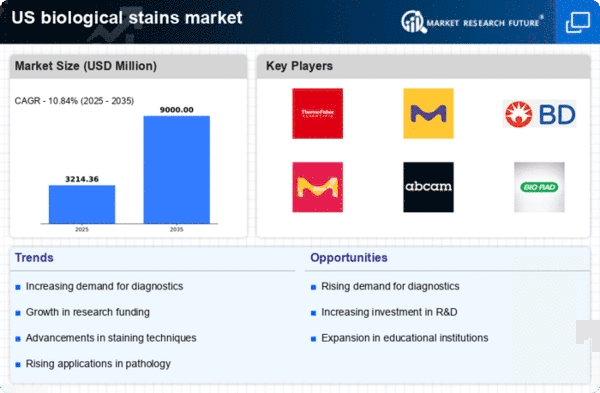
US Biological Stains Market Infographic
Purchase Options

US Biological Stains Market Summary

As per Market Research Future analysis, the US biological stains market size was estimated at 2900.0 USD Million in 2024. The US biological stains market is projected to grow from 3214.36 USD Million in 2025 to 9000.0 USD Million by 2035, exhibiting a compound annual growth rate (CAGR) of 10.8% during the forecast period 2025 - 2035

Key Market Trends & Highlights

The US biological stains market is experiencing robust growth driven by advancements in diagnostic applications and research.

  • The largest segment in the US biological stains market is diagnostic applications, reflecting a rising demand for precise and efficient staining techniques.
  • Technological advancements in staining methods are propelling the market forward, enhancing the quality and efficiency of biological analysis.
  • The fastest-growing segment is histopathology, driven by an increased focus on research and development in the biomedical field.
  • Key market drivers include the growing adoption in clinical laboratories and the surge in educational institutions, which are fostering innovation in staining products.

Market Size & Forecast

2024 Market Size 2900.0 (USD Million)
2035 Market Size 9000.0 (USD Million)
CAGR (2025 - 2035) 10.84%

Major Players

Thermo Fisher Scientific (US), Merck KGaA (DE), BD (US), Sigma-Aldrich (US), Abcam (GB), Bio-Rad Laboratories (US), Fisher Scientific (US), VWR (US)

Our Impact
Enabled $4.3B Revenue Impact for Fortune 500 and Leading Multinationals
Partnering with 2000+ Global Organizations Each Year
30K+ Citations by Top-Tier Firms in the Industry

US Biological Stains Market Trends

The biological stains market is currently experiencing notable growth, driven by advancements in research and development within the life sciences sector. This market encompasses a variety of products used for staining biological specimens, which are essential for microscopic examination and analysis. The increasing demand for diagnostic tools in clinical laboratories and educational institutions is propelling the market forward. Furthermore, the rise in research activities related to cellular biology and histology is likely to enhance the utilization of biological stains, as they play a crucial role in visualizing cellular structures and functions. In addition, the ongoing innovations in staining techniques and the introduction of novel stains are expected to further stimulate market expansion. The integration of automation in laboratories may also contribute to increased efficiency in staining processes, thereby attracting more users. As the biological stains market continues to evolve, it appears poised to meet the growing needs of various sectors, including healthcare, pharmaceuticals, and academia. The focus on quality and reliability in staining products remains paramount, as researchers and clinicians seek to obtain accurate and reproducible results in their work.

Rising Demand for Diagnostic Applications

The biological stains market is witnessing a surge in demand due to the increasing need for diagnostic applications in healthcare settings. As laboratories strive to enhance their diagnostic capabilities, the use of biological stains becomes essential for accurate identification and analysis of cellular components. This trend indicates a shift towards more precise and efficient diagnostic processes, which could lead to improved patient outcomes.

Technological Advancements in Staining Techniques

Innovations in staining techniques are significantly impacting the biological stains market. The development of advanced stains that offer higher specificity and sensitivity is becoming more prevalent. These technological advancements not only improve the quality of results but also expand the range of applications for biological stains, making them more versatile in research and clinical settings.

Increased Focus on Research and Development

There is a growing emphasis on research and development within the biological stains market, driven by the need for enhanced analytical tools. As scientific inquiry progresses, the demand for novel stains that can provide deeper insights into biological processes is likely to rise. This trend suggests that investment in R&D will be crucial for companies aiming to remain competitive and meet the evolving needs of researchers.

US Biological Stains Market Drivers

Rising Interest in Histopathology

The biological stains market is witnessing a rise in interest in histopathology, which is crucial for diagnosing diseases such as cancer. As the prevalence of chronic diseases continues to escalate, the demand for histopathological examinations is likely to grow. Biological stains are integral to this process, as they allow for the detailed examination of tissue samples. The market for biological stains used in histopathology is projected to expand by approximately 5.8% over the next few years. This growth reflects the increasing reliance on biological stains in the medical field, highlighting their significance in the biological stains market.

Surge in Educational Institutions

The biological stains market is benefiting from a surge in the number of educational institutions focusing on biological sciences. As universities and colleges expand their biology and life sciences programs, the demand for biological stains is likely to increase. These institutions require high-quality stains for teaching purposes, research projects, and laboratory experiments. The educational sector's investment in laboratory infrastructure is expected to contribute significantly to the biological stains market, with an estimated increase in demand by 4.2% annually. This trend underscores the essential role that biological stains play in academic research and training, further enhancing their relevance in the biological stains market.

Growing Adoption in Clinical Laboratories

The biological stains market is experiencing a notable increase in adoption within clinical laboratories across the United States. This trend is driven by the rising need for accurate diagnostic tools that facilitate the identification of various diseases. Clinical laboratories are increasingly utilizing biological stains to enhance the visualization of cellular structures, which is crucial for effective diagnosis. The market for biological stains in clinical settings is projected to grow at a CAGR of approximately 6.5% over the next few years. This growth is indicative of the expanding role of biological stains in routine laboratory practices, thereby solidifying their importance in the biological stains market.

Increased Funding for Biomedical Research

The biological stains market is likely to benefit from increased funding for biomedical research initiatives in the United States. Government and private sector investments in research are driving the demand for biological stains, as researchers require these products for various applications, including drug development and disease study. The funding landscape suggests a potential growth of 5% in the biological stains market as research institutions seek to enhance their capabilities. This influx of resources not only supports the development of new staining techniques but also emphasizes the critical role of biological stains in advancing scientific knowledge, thereby impacting the biological stains market.

Technological Innovations in Staining Products

The biological stains market is being propelled by technological innovations that enhance the efficacy and usability of staining products. Recent advancements in staining techniques, such as the development of ready-to-use stains and automated staining systems, are making it easier for laboratories to implement these products. These innovations not only improve the accuracy of staining but also reduce the time required for preparation and application. As a result, the biological stains market is expected to see a growth rate of around 7% in the coming years. This trend indicates a shift towards more efficient laboratory practices, reinforcing the importance of innovation in the biological stains market.


Market Segment Insights

By Type: Eosin (Largest) vs. Methylene Blue (Fastest-Growing)

In the US biological stains market, Eosin leads the segment with the largest market share due to its extensive use in histological applications. Following Eosin, Methylene Blue is gaining recognition as a vital staining agent for various biological and microbiological applications, contributing to its growing market presence. Other notable mentions include Acid Fuchsin and Congo Red, but they hold comparatively smaller shares in the market distribution. The growth trends in this segment are driven by rising demand from the biotechnology and pharmaceutical sectors for advanced diagnostics and research applications. As research activities expand and the need for precise staining methodologies increases, Methylene Blue is emerging rapidly, reflecting a significant growth trajectory. The ongoing innovations in biological staining techniques further bolster the market potential for these stains, particularly in research labs and diagnostic centers.

Eosin (Dominant) vs. Methylene Blue (Emerging)

Eosin, known for its strong staining properties, is predominantly used in histopathology, making it a dominant player in the US biological stains market. It is preferred for its ability to contrast cellular components effectively, aiding in accurate diagnosis. Conversely, Methylene Blue, while being an emerging player, showcases properties such as low toxicity and versatility in various applications including as a vital stain for bacteria and animal tissues. Its rapid adoption is driven by increased research activities and its vital role in microbiology. Both stains serve crucial functions but cater to different aspects of biological staining needs, reflecting the diverse applications within the market.

By Application: Histology (Largest) vs. Bacteriology (Fastest-Growing)

In the US biological stains market, Histology is the largest segment, capturing the most significant market share driven by its widespread use in various diagnostic and research applications. Bacteriology follows closely, benefiting from the increasing prevalence of bacterial infections and the need for rapid diagnostic tools that employ biological stains to identify microorganisms effectively. Growth in these segments is fueled by advancements in staining techniques and increasing R&D activities within the healthcare sector. With the rise of personalized medicine and the ongoing COVID-19 pandemic, the demand for stains that assist in diagnostics and research is on the rise. This trend is particularly evident in the Bacteriology segment, which is rapidly growing due to heightened awareness of bacterial infections and the necessity for prompt testing solutions.

Histology (Dominant) vs. DNA Staining (Emerging)

Histology remains the dominant application in the US biological stains market, prominently used for tissue analysis and diagnosis in clinical settings. The technique allows pathologists to visualize cellular structures and diagnose diseases effectively, reinforcing its pivotal role in precision medicine. Conversely, DNA Staining is an emerging segment, gaining traction due to the growing focus on genetic research and diagnostics. Innovations in staining methods make it possible to visualize genetic material more accurately, which is vital for applications like genomics and molecular biology. While Histology serves as a cornerstone of diagnostic practices, DNA Staining is carving out a critical niche driven by the advancements in biotechnology and genomic studies.

By End-User: Diagnostic Laboratories (Largest) vs. Pharmaceutical and Biotechnology Companies (Fastest-Growing)

In the US biological stains market, Diagnostic Laboratories hold the largest market share, primarily driven by the increasing demand for diagnostic testing and the need for accurate results in medical labs. Academic and Research Institutes also contribute significantly to the market, focusing on educational and experimental applications of biological stains. Pharmaceutical and Biotechnology Companies are emerging as key players, enhancing their presence in the market due to the rise in biopharmaceutical research activities. Growth trends in this segment are influenced by the rapid advancements in life sciences and the rising prevalence of various health conditions that require effective diagnosis. The demand from Academic and Research Institutes is fueled by the need for innovative research techniques. Additionally, the expansion of Pharmaceutical and Biotechnology Companies is accelerating, with these organizations investing in R&D to develop new staining technologies that address evolving market needs.

Diagnostic Laboratories (Dominant) vs. Pharmaceutical and Biotechnology Companies (Emerging)

Diagnostic Laboratories are the dominant players in the US biological stains market, offering a wide range of staining products that cater to various diagnostic applications. These laboratories rely on biological stains to enhance the visualization of cellular structures, thereby facilitating accurate diagnosis and treatment plans. They are well-established with robust infrastructures and regulatory compliance practices. On the other hand, Pharmaceutical and Biotechnology Companies represent an emerging segment that is rapidly gaining traction. These companies are known for integrating cutting-edge technologies in their research and development processes, focusing on novel biological stain formulations that cater to specific therapeutic areas. Their agility in adapting to market trends and their commitment to innovation position them as significant contributors to market growth.

Get more detailed insights about US Biological Stains Market

Key Players and Competitive Insights

The biological stains market exhibits a dynamic competitive landscape characterized by innovation and strategic partnerships. Key players such as Thermo Fisher Scientific (US), Merck KGaA (DE), and Bio-Rad Laboratories (US) are at the forefront, leveraging their extensive portfolios and technological advancements to capture market share. Thermo Fisher Scientific (US) focuses on enhancing its product offerings through continuous innovation, while Merck KGaA (DE) emphasizes strategic acquisitions to broaden its capabilities. Bio-Rad Laboratories (US) is also investing in digital transformation initiatives, which collectively shape a competitive environment that prioritizes technological advancement and customer-centric solutions.In terms of business tactics, companies are increasingly localizing manufacturing and optimizing supply chains to enhance operational efficiency. The market structure appears moderately fragmented, with a mix of established players and emerging companies. This fragmentation allows for diverse strategies, as key players influence market dynamics through their unique approaches to product development and customer engagement.

In October Thermo Fisher Scientific (US) announced the launch of a new line of biological stains designed for high-throughput screening applications. This strategic move is likely to enhance their competitive edge by addressing the growing demand for efficient laboratory solutions. The introduction of these products not only reinforces their commitment to innovation but also positions them favorably against competitors in the rapidly evolving market.

In September Merck KGaA (DE) completed the acquisition of a biotechnology firm specializing in advanced staining techniques. This acquisition is significant as it expands Merck's technological capabilities and product range, allowing them to offer more comprehensive solutions to their customers. Such strategic actions indicate a trend towards consolidation in the market, where companies seek to enhance their competitive positioning through targeted acquisitions.

In August Bio-Rad Laboratories (US) launched a new digital platform aimed at streamlining the ordering process for biological stains. This initiative reflects a broader trend towards digitalization within the industry, as companies recognize the importance of providing seamless customer experiences. By investing in technology, Bio-Rad is likely to improve customer satisfaction and retention, further solidifying its market presence.

As of November current trends in the biological stains market include a strong emphasis on digitalization, sustainability, and the integration of artificial intelligence (AI) in product development. Strategic alliances are increasingly shaping the competitive landscape, enabling companies to pool resources and expertise. Looking ahead, it appears that competitive differentiation will evolve from traditional price-based competition to a focus on innovation, technological advancements, and supply chain reliability. This shift suggests that companies that prioritize these areas will likely emerge as leaders in the market.

Key Companies in the US Biological Stains Market include

Industry Developments

The US Biological Stains Market is currently witnessing significant developments, particularly in the context of increased demand for laboratory diagnostics and research activities fueled by the ongoing advancements in the life sciences sector. Companies such as Thermo Fisher Scientific, BioRad Laboratories, and Abcam are experiencing growth driven by the expansion of their product portfolios and technological innovations. In recent news, Avantor acquired the assets of a firm specializing in critical biopharmaceutical manufacturing technologies in October 2023, which is poised to enhance its capabilities in delivering biological stains.

Furthermore, the merger between Genway Biotech and a leading diagnostics company was finalized in September 2023, indicating strategic consolidations within the industry. The overall market valuation for major players like VWR, Carl Roth, and SigmaAldrich has seen a positive upward trajectory, reflecting the industry's robust growth amid rising investments in Research and Development.

In the past two to three years, the US market has also seen increased collaborations and partnerships aimed at optimizing the supply chain and expanding application landscapes in various medical and academic fields.

Future Outlook

US Biological Stains Market Future Outlook

The Biological Stains Market is projected to grow at a 10.84% CAGR from 2025 to 2035, driven by advancements in diagnostic technologies and increasing research activities.

New opportunities lie in:

  • Development of eco-friendly biological stains for sustainable practices.
  • Expansion into emerging markets with tailored product offerings.
  • Integration of AI in stain analysis for enhanced accuracy and efficiency.

By 2035, the biological stains market is expected to achieve substantial growth and innovation.

Market Segmentation

US Biological Stains Market Type Outlook

  • Acid Fuchsin
  • Congo Red
  • Crystal Violet
  • Eosin
  • Eosin Y
  • Alcoholic Eosin Y
  • Eosin B
  • Eosin-Phloxine
  • Picro-Eosin
  • Methylene Blue
  • Iodine
  • Safranin
  • Others

US Biological Stains Market End-User Outlook

  • Diagnostic Laboratories
  • Academic and Research Institutes
  • Pharmaceutical and Biotechnology Companies
  • Others

US Biological Stains Market Application Outlook

  • Histology
  • Bacteriology
  • Protein Staining
  • Gram Staining
  • DNA Staining
  • Fluorescence Microscopy

Report Scope

MARKET SIZE 2024 2900.0(USD Million)
MARKET SIZE 2025 3214.36(USD Million)
MARKET SIZE 2035 9000.0(USD Million)
COMPOUND ANNUAL GROWTH RATE (CAGR) 10.84% (2025 - 2035)
REPORT COVERAGE Revenue Forecast, Competitive Landscape, Growth Factors, and Trends
BASE YEAR 2024
Market Forecast Period 2025 - 2035
Historical Data 2019 - 2024
Market Forecast Units USD Million
Key Companies Profiled Thermo Fisher Scientific (US), Merck KGaA (DE), BD (US), Sigma-Aldrich (US), Abcam (GB), Bio-Rad Laboratories (US), Fisher Scientific (US), VWR (US)
Segments Covered Type, Application, End-User
Key Market Opportunities Advancements in staining techniques enhance diagnostic accuracy in the biological stains market.

Key Market Dynamics Rising demand for advanced biological stains driven by technological innovations and evolving laboratory practices.
Countries Covered US
Leave a Comment

FAQs

What is the expected market size of the US Biological Stains Market in 2024?

The US Biological Stains Market is expected to be valued at approximately 2.9 billion USD in 2024.

What is the projected market size for the US Biological Stains Market by 2035?

By 2035, the US Biological Stains Market is projected to reach a valuation of about 5.2 billion USD.

What is the expected compound annual growth rate (CAGR) for the US Biological Stains Market from 2025 to 2035?

The market is anticipated to grow at a CAGR of 5.452 percent from 2025 to 2035.

Which segment of the Biological Stains Market is expected to have the highest valuation in 2024?

In 2024, the Eosin segment is expected to have the highest valuation at around 1.0 billion USD.

What is the valuation of the Acid Fuchsin segment in the US Biological Stains Market for 2024?

The Acid Fuchsin segment is valued at approximately 0.8 billion USD in 2024.

Who are the major key players in the US Biological Stains Market?

Key players in the market include Research Products International, Thermo Fisher Scientific, and BioRad Laboratories among others.

What is the projected market value for the Congo Red segment by 2035?

The Congo Red segment is expected to be valued at around 1.3 billion USD by 2035.

What key trend is driving growth in the US Biological Stains Market?

The increasing demand for advanced staining techniques in clinical and research applications is driving market growth.

How is the Others segment in the Biological Stains Market expected to perform by 2035?

The Others segment is projected to grow to approximately 0.5 billion USD by 2035.

What challenges does the US Biological Stains Market face currently?

Challenges include regulatory compliance and the need for continuous innovation in staining products and techniques.

Download Free Sample

Kindly complete the form below to receive a free sample of this Report

Compare Licence

×
Features License Type
Single User Multiuser License Enterprise User
Price $4,950 $5,950 $7,250
Maximum User Access Limit 1 User Upto 10 Users Unrestricted Access Throughout the Organization
Free Customization
Direct Access to Analyst
Deliverable Format
Platform Access
Discount on Next Purchase 10% 15% 15%
Printable Versions