×
Request Free Sample ×

Kindly complete the form below to receive a free sample of this Report

* Please use a valid business email

Leading companies partner with us for data-driven Insights

clients tt-cursor
Hero Background

UK Semi Trailer Market

ID: MRFR/AT/45383-HCR
128 Pages
Sejal Akre
February 2026

UK Semi Trailer Market Research Report By Type (Tankers, Flatbed, Dry van, Lowboy, Refrigerator), By Length (Above 45 feet, Below 45 feet), By Tonnage (25 t to 50 T, 51 T to 100 T, Above 100 T) and By Axles (Below 3 axles, 3 to 4 axles, 4 axles)- Forecast to 2035

Share:
Download PDF ×

We do not share your information with anyone. However, we may send you emails based on your report interest from time to time. You may contact us at any time to opt-out.

UK Semi Trailer Market Infographic
Purchase Options

UK Semi Trailer Market Summary

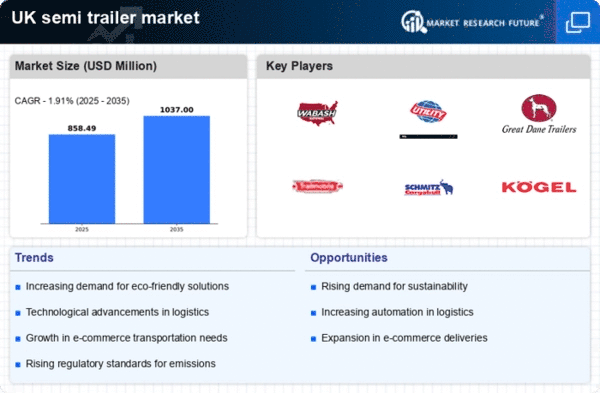
As per Market Research Future analysis, the UK semi trailer market size was estimated at 842.4 USD Million in 2024. The UK semi trailer market is projected to grow from 858.49 USD Million in 2025 to 1037.0 USD Million by 2035, exhibiting a compound annual growth rate (CAGR) of 1.9% during the forecast period 2025 - 2035

Key Market Trends & Highlights

The UK semi trailer market is experiencing a transformative shift towards sustainability and technological integration.

  • Sustainability initiatives are increasingly shaping the design and production of semi trailers, reflecting a broader industry commitment to environmental responsibility.
  • Technological advancements, particularly in fleet management systems, are enhancing operational efficiency and reducing costs for operators.
  • The largest segment in the UK semi trailer market is the flatbed trailers, while the fastest-growing segment is the refrigerated trailers, driven by rising demand in food logistics.
  • Key market drivers include the rising demand for freight transport and the shift towards electric and alternative fuel trailers, which are reshaping industry standards.

Market Size & Forecast

2024 Market Size 842.4 (USD Million)
2035 Market Size 1037.0 (USD Million)
CAGR (2025 - 2035) 1.91%

Major Players

Wabash National Corporation (US), Utility Trailer Manufacturing Company (US), Great Dane Trailers (US), Trailmobile (US), Schmitz Cargobull AG (DE), Kögel Trailer GmbH & Co. KG (DE), Fruehauf Trailer Corporation (US), CIMC Vehicles Group (CN), Bockmann Fahrzeugwerke GmbH (DE)

Our Impact
Enabled $4.3B Revenue Impact for Fortune 500 and Leading Multinationals
Partnering with 2000+ Global Organizations Each Year
30K+ Citations by Top-Tier Firms in the Industry

UK Semi Trailer Market Trends

The semi trailer market is currently experiencing a dynamic phase characterized by evolving consumer preferences and regulatory changes. The demand for semi trailers is influenced by the growing emphasis on sustainability and efficiency in transportation. As businesses seek to optimize logistics and reduce their carbon footprint, there is a noticeable shift towards lightweight materials and aerodynamic designs. This trend not only enhances fuel efficiency but also aligns with broader environmental goals. Furthermore, advancements in technology are reshaping the landscape, with innovations such as telematics and automation becoming increasingly prevalent. These developments suggest a future where semi trailers are not only more efficient but also smarter, integrating seamlessly with modern supply chain systems. In addition, the regulatory environment plays a crucial role in shaping the semi trailer market. Stricter emissions standards and safety regulations are prompting manufacturers to innovate and adapt their offerings. This regulatory pressure may lead to increased investment in research and development, fostering a competitive landscape where companies strive to meet new requirements while maintaining profitability. Overall, the semi trailer market appears poised for growth, driven by technological advancements and a commitment to sustainability, which may redefine the industry in the coming years.

Sustainability Initiatives

The semi trailer market is witnessing a significant shift towards sustainability. Manufacturers are increasingly focusing on producing eco-friendly trailers that utilize lightweight materials and energy-efficient designs. This trend aligns with the growing demand for greener logistics solutions, as companies aim to reduce their environmental impact.

Technological Advancements

Innovations in technology are transforming the semi trailer market. The integration of telematics and automation is enhancing operational efficiency and safety. These advancements allow for real-time tracking and improved maintenance, which can lead to reduced downtime and increased productivity.

Regulatory Compliance

The evolving regulatory landscape is influencing the semi trailer market. Stricter emissions standards and safety regulations are prompting manufacturers to innovate and adapt their products. This compliance focus may drive investment in new technologies and design improvements.

UK Semi Trailer Market Drivers

Rising Demand for Freight Transport

The semi trailer market is experiencing a notable increase in demand for freight transport, driven by the growth of e-commerce and logistics sectors in the UK. As online shopping continues to expand, the need for efficient transportation solutions becomes paramount. In 2025, the UK logistics market is projected to reach approximately £100 billion, indicating a robust growth trajectory. This surge in demand for freight services directly influences the semi trailer market, as companies seek to enhance their transportation capabilities. The increasing volume of goods transported necessitates the use of semi trailers, which offer flexibility and efficiency. Consequently, this driver is likely to shape the semi trailer market, as businesses invest in modern fleets to meet the evolving demands of consumers and supply chains.

Infrastructure Development Initiatives

Infrastructure development initiatives in the UK are significantly impacting the semi trailer market. The government has committed substantial investments to enhance road networks and transport facilities, which are crucial for the efficient movement of goods. In 2025, the UK government allocated £30 billion for infrastructure projects, aimed at improving connectivity and reducing congestion. These enhancements facilitate smoother transportation routes, thereby increasing the operational efficiency of semi trailers. As infrastructure improves, logistics companies are more inclined to invest in semi trailers, recognizing their potential to optimize delivery times and reduce operational costs. This trend suggests a positive outlook for the semi trailer market, as improved infrastructure supports the growth of freight transport.

Growing Focus on Supply Chain Resilience

The growing focus on supply chain resilience is influencing the semi trailer market, as businesses seek to mitigate risks and ensure continuity in operations. Recent disruptions in global supply chains have prompted companies to reassess their logistics strategies, leading to increased investments in robust transportation solutions. In 2025, it is anticipated that 60% of UK logistics firms will prioritize supply chain resilience, driving demand for semi trailers that can adapt to changing conditions. This emphasis on resilience encourages companies to diversify their fleets and invest in semi trailers that offer flexibility and reliability. As a result, the semi trailer market is likely to benefit from this strategic shift, as businesses prioritize investments that enhance their operational capabilities.

Technological Integration in Fleet Management

Technological integration in fleet management is becoming a critical driver for the semi trailer market. The adoption of advanced telematics and fleet management systems allows companies to optimize their operations, improve safety, and reduce costs. In 2025, it is projected that the use of telematics in the UK logistics sector will increase by 40%, as businesses recognize the benefits of data-driven decision-making. This trend enhances the efficiency of semi trailers, enabling real-time tracking and maintenance scheduling. As logistics companies invest in technology, the semi trailer market is likely to see a transformation, with increased demand for trailers equipped with smart technologies that enhance operational efficiency and safety.

Shift Towards Electric and Alternative Fuel Trailers

The semi trailer market is witnessing a shift towards electric and alternative fuel trailers, driven by increasing environmental awareness and regulatory pressures. The UK government has set ambitious targets to reduce carbon emissions, aiming for net-zero by 2050. This regulatory landscape encourages logistics companies to explore sustainable transportation options. In 2025, it is estimated that the market for electric semi trailers could grow by 25%, as companies seek to comply with environmental regulations while reducing fuel costs. This transition not only aligns with sustainability goals but also enhances the competitiveness of businesses in the semi trailer market. As more companies adopt electric and alternative fuel technologies, the market is likely to evolve, presenting new opportunities and challenges.


Market Segment Insights

By Type: Tankers (Largest) vs. Refrigerators (Fastest-Growing)

In the UK semi trailer market, the distribution of market share among different types shows that tankers hold the largest share, benefiting from consistent demand in petroleum and liquid transport industries. Following tankers, flatbed and dry van trailers are also significant players, capturing notable market shares due to their versatility in handling various cargo types. Lowboys and refrigerated trailers, while useful, have smaller portions of the market. Growth trends indicate that refrigerated trailers are the fastest-growing segment in the UK semi trailer market, driven by the surge in demand for perishable goods transportation. The increasing focus on food safety and quality has resulted in a greater need for temperature-controlled logistics. Additionally, advancements in refrigeration technology have made these trailers more efficient and reliable, impacting their uptake positively.

Tankers: Dominant vs. Refrigerators: Emerging

Tankers are the dominant type in the UK semi trailer market, primarily utilized for transporting liquids, chemicals, and petroleum. They are designed for safety and efficiency in handling hazardous materials while complying with stringent regulations. On the other hand, refrigerated trailers are emerging as a critical segment, focusing on the transport of perishable goods, including food and pharmaceuticals. The enhanced features of modern refrigerated trailers, such as better insulation and advanced cooling systems, have significantly enriched their appeal, positioning them as essential for businesses needing temperature-sensitive logistics. As demand grows, both segment types are expected to innovate and adapt to meet market needs.

By Length: Above 45 feet (Largest) vs. Below 45 feet (Fastest-Growing)

In the UK semi trailer market, the above 45 feet segment is the largest, commanding a significant share due to its capability to transport larger loads that are increasingly in demand by various industries. Conversely, the below 45 feet segment, while smaller in terms of market share, is gaining traction, particularly among regional transport companies that prioritize maneuverability and fuel efficiency for shorter hauls. Growth trends indicate that the below 45 feet segment is emerging as the fastest-growing category, driven by increased regulations on urban transport and a shift towards more sustainable logistics practices. This trend is further supported by manufacturers focusing on developing innovative designs that enhance payload while minimizing environmental impact, appealing to businesses looking to optimize their transport operations.

Length: Above 45 feet (Dominant) vs. Below 45 feet (Emerging)

The above 45 feet segment is recognized for its strong dominance in the market, offering substantial payload capacity and versatility, which are crucial for long-haul operations across various sectors including construction and logistics. These trailers are preferred for their ability to carry bulk materials and oversized loads efficiently. On the other hand, below 45 feet trailers are increasingly viewed as the emerging option, especially among smaller transport companies. Their compact size allows for better navigation in congested urban environments and improved fuel efficiency, aligning with current trends towards sustainability. This segment is rapidly capturing interest as companies seek to balance payload efficiency with operational adaptability.

By Tonnage: 51 T to 100 T (Largest) vs. Above 100 T (Fastest-Growing)

In the UK semi trailer market, the tonnage segment is primarily characterized by three main values: 25 t to 50 T, 51 T to 100 T, and Above 100 T. Currently, the 51 T to 100 T category holds the largest market share, driven by increasing demand for heavy freight transportation and logistical efficiency. Meanwhile, the Above 100 T category demonstrates the fastest growth due to rising trends in heavy-duty applications across various industries, including construction and mining. Growth trends in the tonnage segment are influenced by ongoing developments in infrastructure, which amplify the need for larger and more capable trailers. Businesses are increasingly relying on larger units like those above 100 T to maximize payload potential. Furthermore, regulatory changes and advances in trailer technology are facilitating the adoption of heavier trailers, indicating robust future demand within these categories.

25 t to 50 T (Dominant) vs. Above 100 T (Emerging)

The 25 t to 50 T segment is currently dominant within the UK semi trailer market, utilizing various lightweight materials and designs to optimize payload while adhering to regulatory weight limits. This segment is widely used across numerous sectors, providing flexibility and efficiency for freight companies managing medium loads. In contrast, the Above 100 T segment is emerging as a critical player, capitalizing on the need for efficiency in transporting oversized and heavy loads. This rising segment is characterized by advanced engineering and technology, allowing for greater load capacities and improved durability. With the ongoing expansion in heavy industry applications, demand in this category is expected to surge, showcasing its potential in redefining transportation norms.

By Axles: 3 to 4 axles (Largest) vs. 4 axles (Fastest-Growing)

In the UK semi trailer market, the distribution of market share among the axle configurations reveals that the 3 to 4 axles segment holds the largest share, demonstrating its dominance due to its versatility and wide application across various transportation needs. In contrast, the below 3 axles segment, while present, lacks the robust share and appeal, making it less favorable for heavy-duty transport applications. The 4 axles category, although currently smaller in market share, is witnessing rapid growth as logistics companies seek to maximize payload capacity and efficiency. Key growth trends in the axles segment are driven by the increasing demand for more efficient transportation solutions and the rise of e-commerce, necessitating higher payload capacities. The trend towards environmental sustainability is also steering the demand towards multi-axle semi trailers, as they offer better weight distribution, resulting in reduced road wear and improved fuel efficiency. Manufacturers are now focusing on innovation, integrating advanced technology into 4 axle designs that can handle heavier loads and comply with stricter regulations, making this segment highly attractive for future investments.

3 to 4 axles (Dominant) vs. 4 axles (Emerging)

The 3 to 4 axles segment is characterized by its capability to handle a diverse range of cargo types, making it the preferred choice for transportation companies operating in various sectors. This configuration allows for optimized weight distribution, ensuring compliance with legal regulations while maximizing load efficiency. Conversely, the 4 axles segment is emerging as a strong player, particularly appealing to logistics firms focused on expanding their capacity and operational efficiencies. With rising demand for higher payloads and lower environmental impact, the 4 axles segment is becoming increasingly relevant. Companies in this segment are adopting advanced manufacturing technologies to produce lighter yet robust axle systems that enhance fuel efficiency, positioning themselves well for market share growth.

Get more detailed insights about UK Semi Trailer Market

Key Players and Competitive Insights

The semi trailer market is currently characterized by a dynamic competitive landscape, driven by factors such as increasing demand for efficient logistics solutions and the ongoing transition towards sustainable transportation. Key players, including Wabash National Corporation (US), Schmitz Cargobull AG (DE), and CIMC Vehicles Group (CN), are strategically positioning themselves through innovation and regional expansion. Wabash National Corporation (US) focuses on enhancing its product offerings with lightweight materials and advanced aerodynamics, while Schmitz Cargobull AG (DE) emphasizes sustainability through the development of eco-friendly trailers. CIMC Vehicles Group (CN) is expanding its footprint in Europe, indicating a trend towards globalization in the market, which collectively shapes a competitive environment that is increasingly focused on technological advancement and sustainability.
The business tactics employed by these companies reflect a concerted effort to optimize supply chains and localize manufacturing. The market structure appears moderately fragmented, with several players vying for market share. However, the influence of major companies is significant, as they set benchmarks for innovation and operational efficiency. This competitive structure fosters an environment where smaller players must adapt to the evolving demands of the market, particularly in terms of sustainability and technological integration.
In October 2025, Wabash National Corporation (US) announced a partnership with a leading technology firm to develop smart trailer solutions that integrate IoT capabilities. This strategic move is likely to enhance operational efficiency for fleet operators, allowing for real-time monitoring and predictive maintenance, which could significantly reduce downtime and operational costs. Such innovations may position Wabash as a leader in the smart trailer segment, appealing to a market increasingly focused on technology-driven solutions.
In September 2025, Schmitz Cargobull AG (DE) launched a new range of trailers designed specifically for electric vehicles, showcasing its commitment to sustainability. This initiative not only aligns with global trends towards greener logistics but also positions the company as a forward-thinking player in the market. By catering to the growing demand for electric transport solutions, Schmitz Cargobull is likely to capture a niche segment of environmentally conscious customers, thereby enhancing its competitive edge.
In August 2025, CIMC Vehicles Group (CN) expanded its manufacturing capabilities in Europe by opening a new facility in Poland. This strategic expansion is indicative of the company's intent to strengthen its presence in the European market, allowing for more localized production and faster delivery times. Such moves may enhance CIMC's competitiveness by reducing lead times and improving customer service, which are critical factors in the logistics sector.
As of November 2025, the competitive trends in the semi trailer market are increasingly defined by digitalization, sustainability, and the integration of AI technologies. Strategic alliances among key players are shaping the landscape, fostering innovation and collaboration. The shift from price-based competition to a focus on technological advancement and supply chain reliability is evident, suggesting that future differentiation will hinge on the ability to innovate and adapt to changing market demands. Companies that prioritize these aspects are likely to thrive in an evolving market that values efficiency and sustainability.

Key Companies in the UK Semi Trailer Market include

Industry Developments

In recent months, the UK Semi Trailer Market has witnessed notable developments. Companies like CIMC and Schmitz Cargobull are focusing on enhancing their product offerings to better meet evolving transportation demands. The industry is currently benefitting from increased investments in technology, particularly in the areas of sustainability and efficiency, where companies such as Krone and Faymonville are leading the charge with innovative solutions. 

Furthermore, market valuation trends have indicated a growth trajectory driven by heightened demand for freight transport and logistics services. As of August 2023, a significant acquisition was reported, with Fruehauf acquiring a key player in the market, enhancing its operational capabilities. This strategic move is expected to provide a competitive edge in product diversification and service delivery. Other companies like Great Dane Trailers and Tewkesbury Trailers are also noted to be expanding their offerings to capture a larger share of the market. 

Overall, the ongoing shift towards electric and environmentally friendly trailers is becoming a crucial focus in the UK as stakeholders adapt to regulatory pressures and consumer demands. The landscape is dynamic, with established industry players increasingly collaborating to fortify their market presence.

Future Outlook

UK Semi Trailer Market Future Outlook

The semi trailer market is projected to grow at 1.91% CAGR from 2025 to 2035, driven by increasing logistics demand, technological advancements, and sustainability initiatives.

New opportunities lie in:

  • Development of lightweight composite materials for enhanced fuel efficiency.
  • Integration of telematics for real-time fleet management solutions.
  • Expansion into electric semi trailers to meet environmental regulations.

By 2035, the semi trailer market is expected to achieve robust growth, driven by innovation and sustainability.

Market Segmentation

UK Semi Trailer Market Type Outlook

  • tankers
  • flatbed
  • dry van
  • lowboy
  • refrigerator

UK Semi Trailer Market Axles Outlook

  • below 3 axles
  • 3 to 4 axles
  • 4 axles

UK Semi Trailer Market Length Outlook

  • above 45 feet
  • below 45 feet

UK Semi Trailer Market Tonnage Outlook

  • 25 t to 50 T
  • 51 T to 100 T
  • Above 100 T

Report Scope

MARKET SIZE 2024 842.4(USD Million)
MARKET SIZE 2025 858.49(USD Million)
MARKET SIZE 2035 1037.0(USD Million)
COMPOUND ANNUAL GROWTH RATE (CAGR) 1.91% (2025 - 2035)
REPORT COVERAGE Revenue Forecast, Competitive Landscape, Growth Factors, and Trends
BASE YEAR 2024
Market Forecast Period 2025 - 2035
Historical Data 2019 - 2024
Market Forecast Units USD Million
Key Companies Profiled Wabash National Corporation (US), Utility Trailer Manufacturing Company (US), Great Dane Trailers (US), Trailmobile (US), Schmitz Cargobull AG (DE), Kögel Trailer GmbH & Co. KG (DE), Fruehauf Trailer Corporation (US), CIMC Vehicles Group (CN), Bockmann Fahrzeugwerke GmbH (DE)
Segments Covered Type, Length, Tonnage, Axles
Key Market Opportunities Adoption of advanced telematics for enhanced fleet management in the semi trailer market.
Key Market Dynamics Regulatory changes drive innovation in semi trailer design, enhancing fuel efficiency and reducing emissions in the UK.
Countries Covered UK
Leave a Comment

FAQs

What is the expected market size of the UK Semi Trailer Market in 2024?

The UK Semi Trailer Market is expected to be valued at 936.0 million USD in 2024.

How much is the UK Semi Trailer Market projected to grow by 2035?

By 2035, the UK Semi Trailer Market is projected to reach a value of 1308.0 million USD.

What is the CAGR for the UK Semi Trailer Market during the forecast period?

The expected CAGR for the UK Semi Trailer Market from 2025 to 2035 is 3.089%.

Which type of semi trailer is expected to have the highest market value in 2024?

The Dry van segment is anticipated to have the highest market value at 300.0 million USD in 2024.

What is the projected market value of Flatbed semi trailers by 2035?

The Flatbed segment is projected to be valued at 280.0 million USD by 2035.

Who are the key players in the UK Semi Trailer Market?

Major players include CIMC, Fruehauf, Scheidt and Bachmann, and Schmitz Cargobull among others.

What is the expected market value for Tanker semi trailers in 2024?

The Tanker segment is expected to be valued at 180.0 million USD in 2024.

What market size is expected for the Refrigerator segment by 2035?

The Refrigerator segment is expected to reach a value of 198.0 million USD by 2035.

What is the market trend regarding Lowboy semi trailers from 2024 to 2035?

The Lowboy segment is expected to grow from 120.0 million USD in 2024 to 160.0 million USD by 2035.

What opportunities exist for growth in the UK Semi Trailer Market?

Emerging trends in logistics and growing transportation needs present significant growth opportunities.

Download Free Sample

Kindly complete the form below to receive a free sample of this Report

Compare Licence

×
Features License Type
Single User Multiuser License Enterprise User
Price $4,950 $5,950 $7,250
Maximum User Access Limit 1 User Upto 10 Users Unrestricted Access Throughout the Organization
Free Customization
Direct Access to Analyst
Deliverable Format
Platform Access
Discount on Next Purchase 10% 15% 15%
Printable Versions